
Saudi Arabia is nearly ten times the size of Utah, and most of it is desert. Like Southern Utah, the terrain is riven with sandstone canyons and towers, nearly all of them unclimbed. Last January and February, a German trio did a three-week, 4,600-kilometer loop around the desert kingdom, exploring the traditional-climbing potential. So, how did their expedition turn out? It was a mixed bag.…
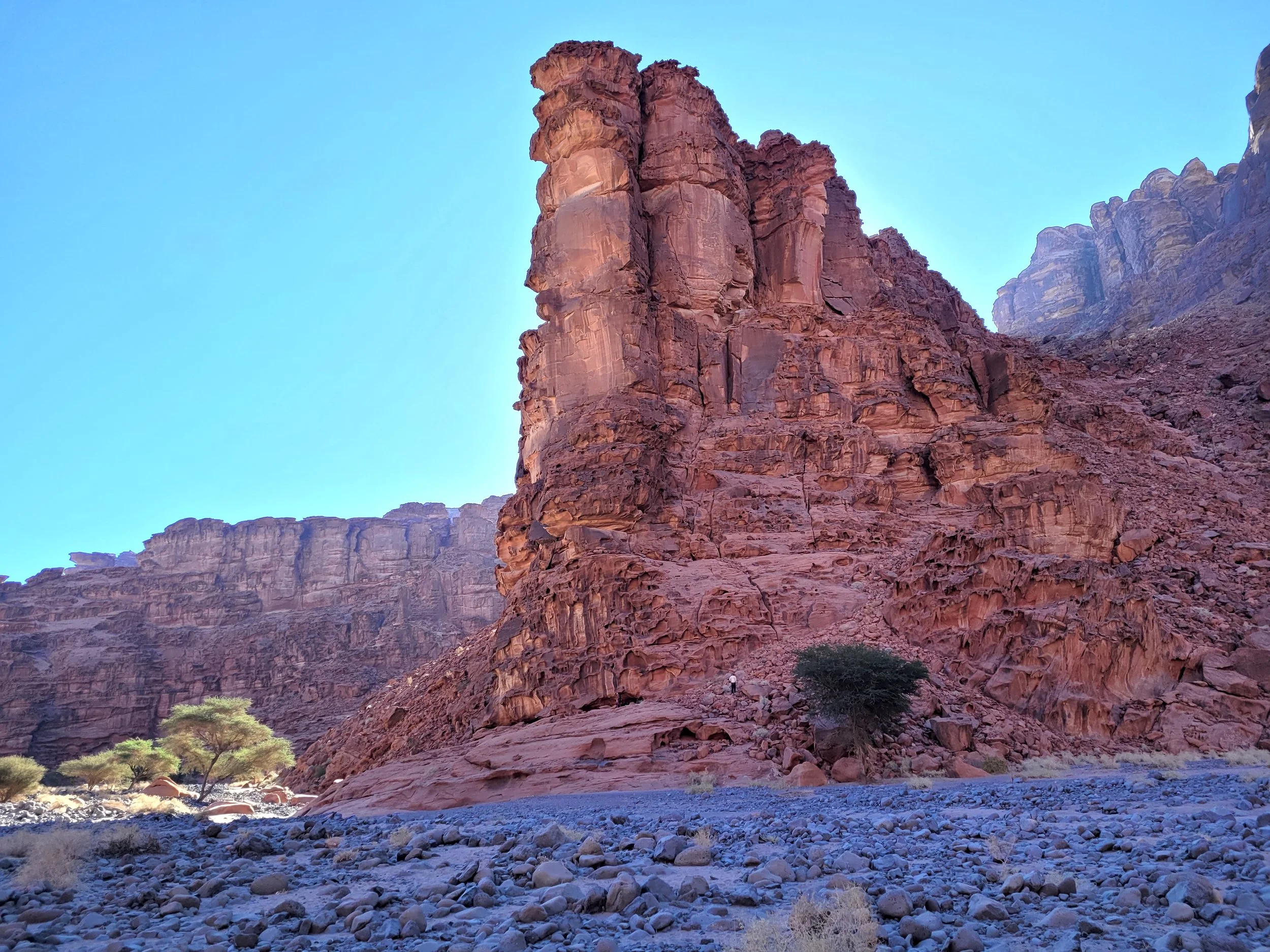
Gemini Tower, north of Wadi Al Disah in western Saudi Arabia. After the first ascent of the four-pitch formation, the German team was informed that climbing is not permitted in this area. Photo: Daniel Hahn Collection
Wadi Al Disah, Bajdah, Wadi Dham: 12 First Ascents
Excited and somewhat stressed, we plunged into the crazy traffic of the seven million–strong metropolis of Riyadh in our rental car. Excited because a journey into the unknown lay ahead: a search for climbs in a country that has only been open to Western tourism since mid-2019. And stressed because only five of our six pieces of luggage had arrived.
With a day to kill, Michael “Michi” Bänsch, Daniel Hahn, and I first shopped for supplies, then drove out of the metropolis toward the Edge of the World, a rocky escarpment northwest of Riyadh. The traffic was terrible; one construction site followed another. The entire country is being dug up; money seems endless. Due to the construction work, neither Edge of the World nor the stunning sandstone tower of Faisal’s Finger were accessible. But at least we spent a nice first night in the desert, giving us some relief and preparing us for the coming weeks.
The next day, January 20, our last piece of luggage arrived. We took a deep breath and set off toward Wadi Al Disah, 1,300 kilometers to the northwest, fairly near the Red Sea. Settlements were very sporadic, and the closer we got to the Hejaz Mountains, the more fascinating the landscape became. When we entered Wadi Al Disah, our jaws dropped: endless sandstone cliffs, magnificent scenery, and potential for generations of adventurers. Atir Tower, the valley’s landmark, glowed in the evening light. After finding a place to sleep and cook dinner, we went swimming—yes, swimming! A stream flows through the wadi, providing gloriously green vegetation and offering us a welcome cool-off every evening.

Seppo and Michi starting up the first pitch on Hinterhaus, a 200-meter formation in Wadi Dham. Photo: Daniel Hahn
The next morning, we headed straight to the Atir, a 350-meter tower and one of the few Saudi formations with documented routes. It was climbed by a chimney route on the east side in 2013, by a party including Donald Poe, a U.S. oil engineer and Saudi Arabia resident. In 2020, a group led by Leo Houlding from the U.K. found a new line on the west face and named it Astro Arabia (5.11). We climbed the original route (UIAA V or about 5.7), hoping to encounter rock roughly akin to the well-known Wadi Rum in Jordan, about 230 kilometers to the north. In fact, the rock turned out to be quite brittle and dirty. But what a summit!
Over the next few days, we searched for more climbable rock, which was harder than expected: There are endless formations, but upon closer inspection, many turned out to be too difficult, too fragile, or both. The fact that we did not have a drill or bolts didn’t make it any easier. But we soon made the first ascent of a beautiful tower (which had obviously been climbed by locals up to its forepeak), right at the valley entrance. We called it Burg (“Castle”) and the route Uralter Weg (“Ancient Path,” 80m, VI/5.10-).
Further into the valley, another peak tempted us, perhaps 100 meters high and with what appeared to be a climbable route. Soon after we started climbing, however, we heard strange noises from below. The SFES (Special Forces Environmental Safety) rangers had spotted us and were ordering us back down. After a lengthy but quite friendly discussion, we were surprised to learn that climbing is prohibited in the entire Wadi Al Disah.
We detoured to a nearby canyon just to the north, Wadi Tarban (or Tourpan), where we climbed Gemini Tower (130m, 4 pitches, V+) and Porcelain Tower (scrambling plus 25m, VI), before being informed by friendly locals that climbing was not allowed there either. So, we left the Wadi Al Disah area earlier than planned and continued to Bajdah, a small town farther north, near the city of Tabuk, where we had been told climbing is officially permitted.
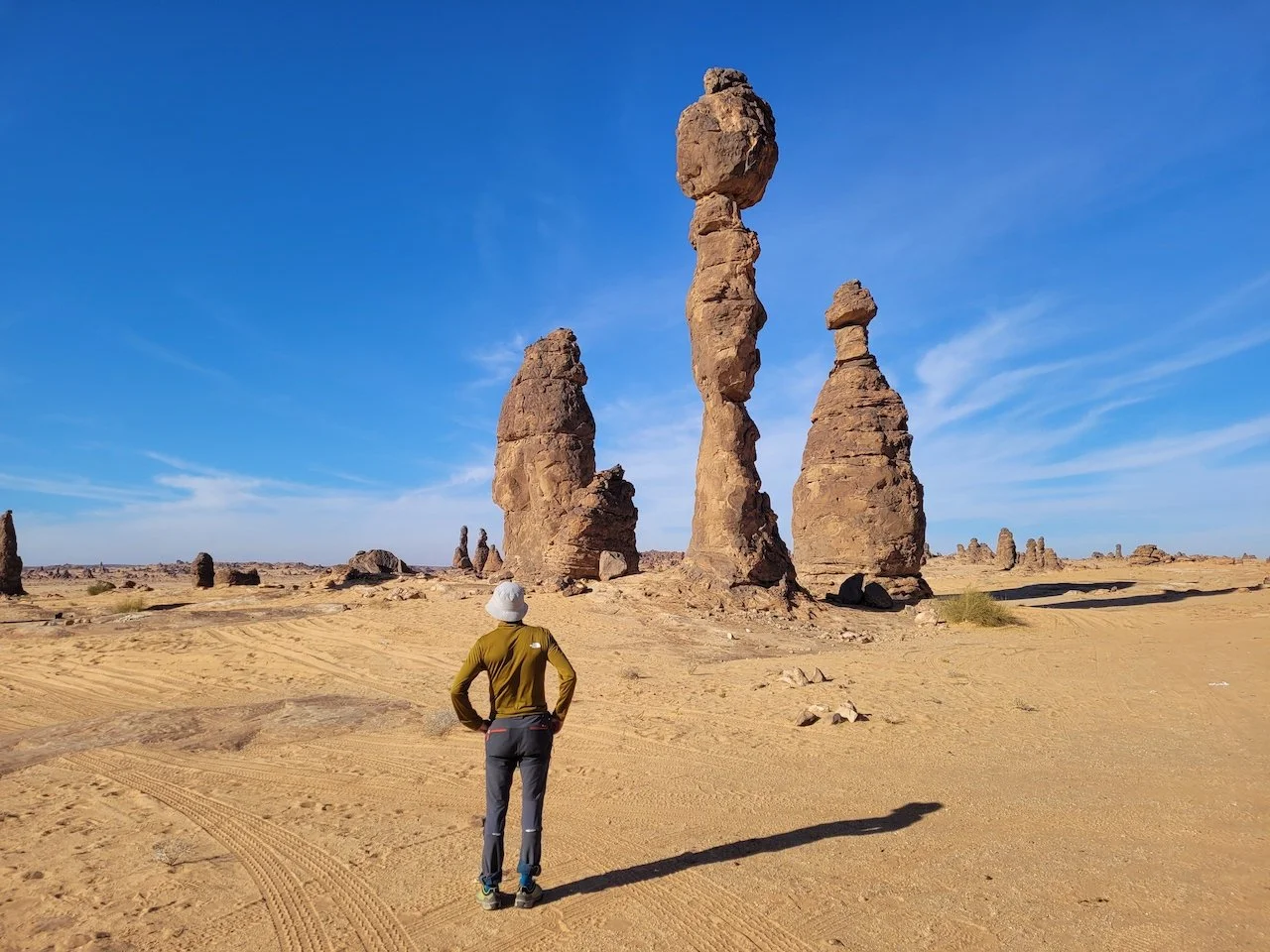
Michi in Al Gharameel Nature Reserve, where the climbers ascended five needles up to 20 meters high. Photo: Daniel Hahn
Here, a completely different landscape awaited us: an open plain from which countless rocks rise, some enormous massifs, some picturesque needles. It may be hard to imagine, but deciding where to start in a sea of rock is truly challenging. But we soon found some nice objectives, including a two-pitch needle that we named Stoneman, climbed by a new route called Triumph des Willens (“Willpower,” ca 100m, VII-/5.10). We also reached all five summits of a formation we named Felsenbrüder (“Brothers of Stone”), about 150 meters high, by the route Geschenk der Wüste (“Gift of the Desert,” VII-). The climbing here was challenging, with brittle overhangs that had to be overcome or bypassed, followed by easy scrambles to the summits.
Next, we visited the nearby Wadi Dham (Damh), where we fanned out, eyes upward, looking for opportunities. We chose a pagoda-like formation we called Hinterhaus. Although generally easy, it also had many small overhangs, and one even required aid: Weg des Willens (VI+ C1). Two more days here brought us the first ascent of another small tower and some beautiful hikes in an impressive landscape—simply a wonderful time.
On all of our climbs, we only used cams, nuts, and slings. No bolts were placed. We live in Dresden, near the famed sandstone towers of Elbsandsteingebirge and Adršpach (Czechia), and we are very experienced sandstone climbers. Yet, even though Saudi Arabia seems to offer endless sandstone climbing, the rock is very unpredictable, even when it looks great—sometimes a hold stays put when weighted, sometimes it pops off. With all the dust and coarse sand, the ropes got stiffer every day—all of our gear suffered as much as our nerves.
After two weeks I headed home, while Michi and Daniel stayed for another week. During this time, they visited Al Gharameel Nature Reserve and found countless sandstone needles. They climbed five towers, up to about 20 meters high and UIAA VI (5.9+/5.10-), without seeing a single trace of previous climbers.
During our travels, we met incredibly friendly people, some of whom offered us water or invited us to share tea or coffee, and shared interesting conversations, sometimes in perfect English, sometimes with gestures and Google Translate. We enjoyed a simple life, sleeping out on the sand. On some mornings, our sleeping bags sparkled with frost. We pushed or dug the car out of the sand twice. In all, we summited 13 formations, probably 12 of them first ascents.
—Stephan “Seppo” Gerber, Germany
Sport Climbing in Saudi Arabia
In addition to the desert towers explored by this team in 2025 and the British group in 2020, a bit of early traditional climbing was reported on granite in the western part of Saudi Arabia, south of Ranyah (AAJ 1989). Of more interest to many climbers will be the sport routes developed in late 2018 at various sandstone, granite, and limestone crags—some of them quite impressive—by Read Macadam (Oman) and various European climbers, who worked with the Saudi Climbing and Hiking Federation. The federation has published PDF guides to these crags, and many of these routes have been posted at Mountain Project.
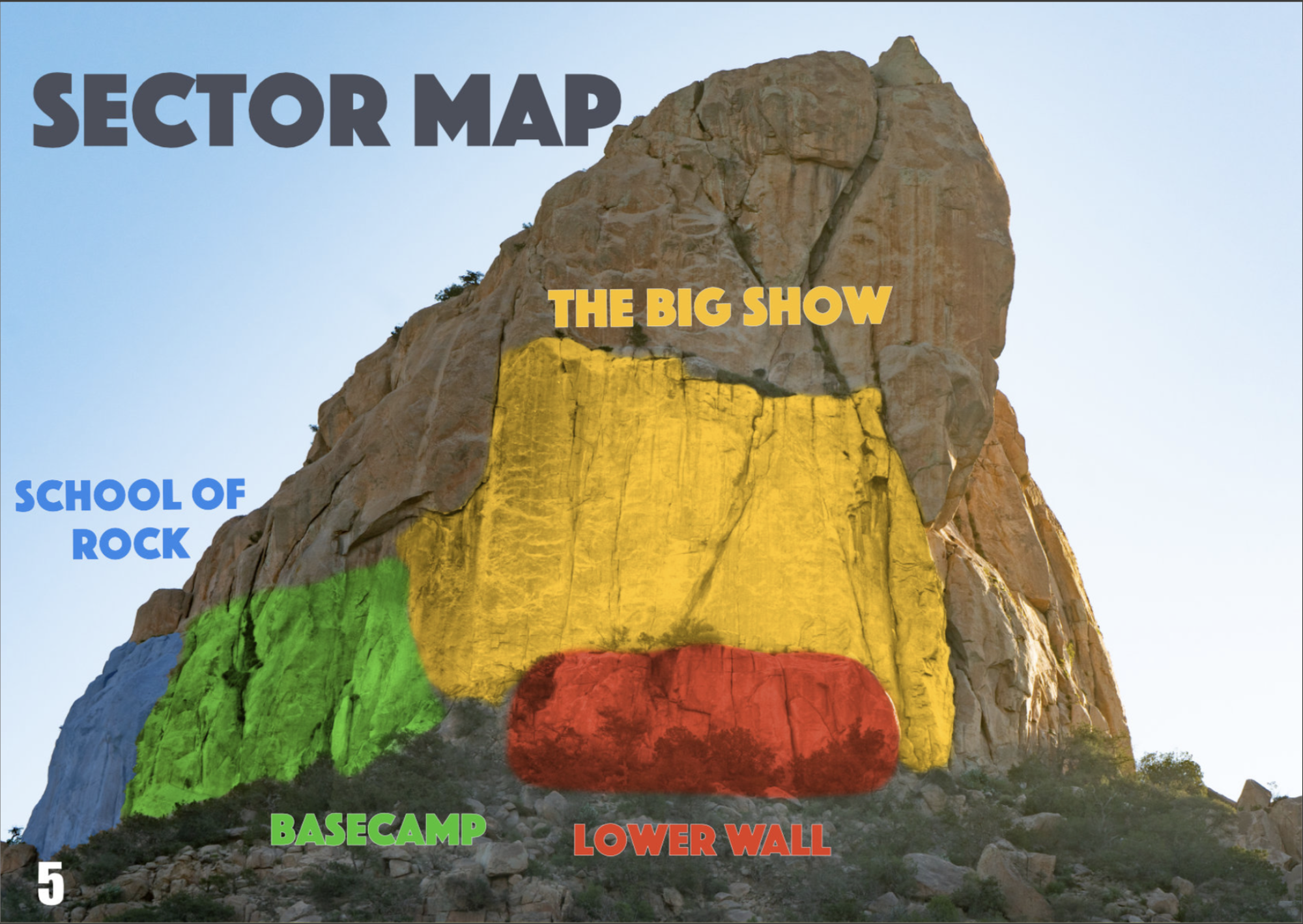
Overview of the impressive Olympic Crag, which has about 40 routes on steep granite, two and a half hours east of Jeddah, Saudi Arabia.
Astro Arabia
In early 2020, shortly after Saudi Arabia opened to tourism, British climbers Waldo Etherington and Leo Houlding visited Wadi Al Disah and climbed two large towers, leading to a film, Great Sheiks, as part of the Brit Rock series. Here’s the opening segment from the film, covering the first ascent of the 100-meter Leaning Tower of Disah—it gives a good sense of the “acquired taste” for exploring variable Saudi sandstone.
The Cutting Edge Podcast: Cerro Torre Solo in Winter
On September 7, Colin Haley reached the summit of Cerro Torre all alone—a climb that tested this Patagonia veteran perhaps more than any before. It was the first winter solo of the stunning granite needle, and the culmination of a nearly 20-year dream. Don’t miss this extraordinary episode of the Cutting Edge.