
First ascents are as much about imagination as they are about strength and skill: They require seeing a possibility where few had imagined one before. River guide and climber Matt Ward had seen a huge, steep wall above Idaho’s Salmon River many times, and he dreamed of making the first ascent. The wall looked climbable, but how to get there? The wild story of how he and Ky Hart solved that problem is published below. Matt’s story appears in AAJ 2025, which is now starting to arrive in AAC members’ mailboxes. But not everyone reads the AAJ cover to cover, and we didn’t want anyone to miss this unique tale of adventure.
IMPASSABLE CANYON, REDSIDE WALL


“Beavers!” Ky Hart yelled over his shoulder.
“No! Bears!” I yelled back.
Actually, it was three bears. Two small black bear cubs were timidly swimming on an eddy line in the Middle Fork of the Salmon River. The large mama bear was waiting for her cubs to follow her across, and she stood up tall when she saw Ky and me about to swim between her and her babies.
“I’m gonna touch one!” Ky yelled out.
My instinct was to do the exact opposite—swim away from them. But the swift current was quickly moving us both directly at the cubs. Fortunately, our appearance shocked them into action. The cubs swam hard for mama, and the current shot us past them.
Looking back on the experience later that day, it occurred to me that the fact that Ky’s first thought was to swim over and touch a wild bear cub while its mother watched was one of many things that made him the perfect partner for this trip. Unhinged, yes. But our plan to hike 22 miles, swim three and a half miles of whitewater, and climb a new route on a backcountry big wall would require more than a little madness.
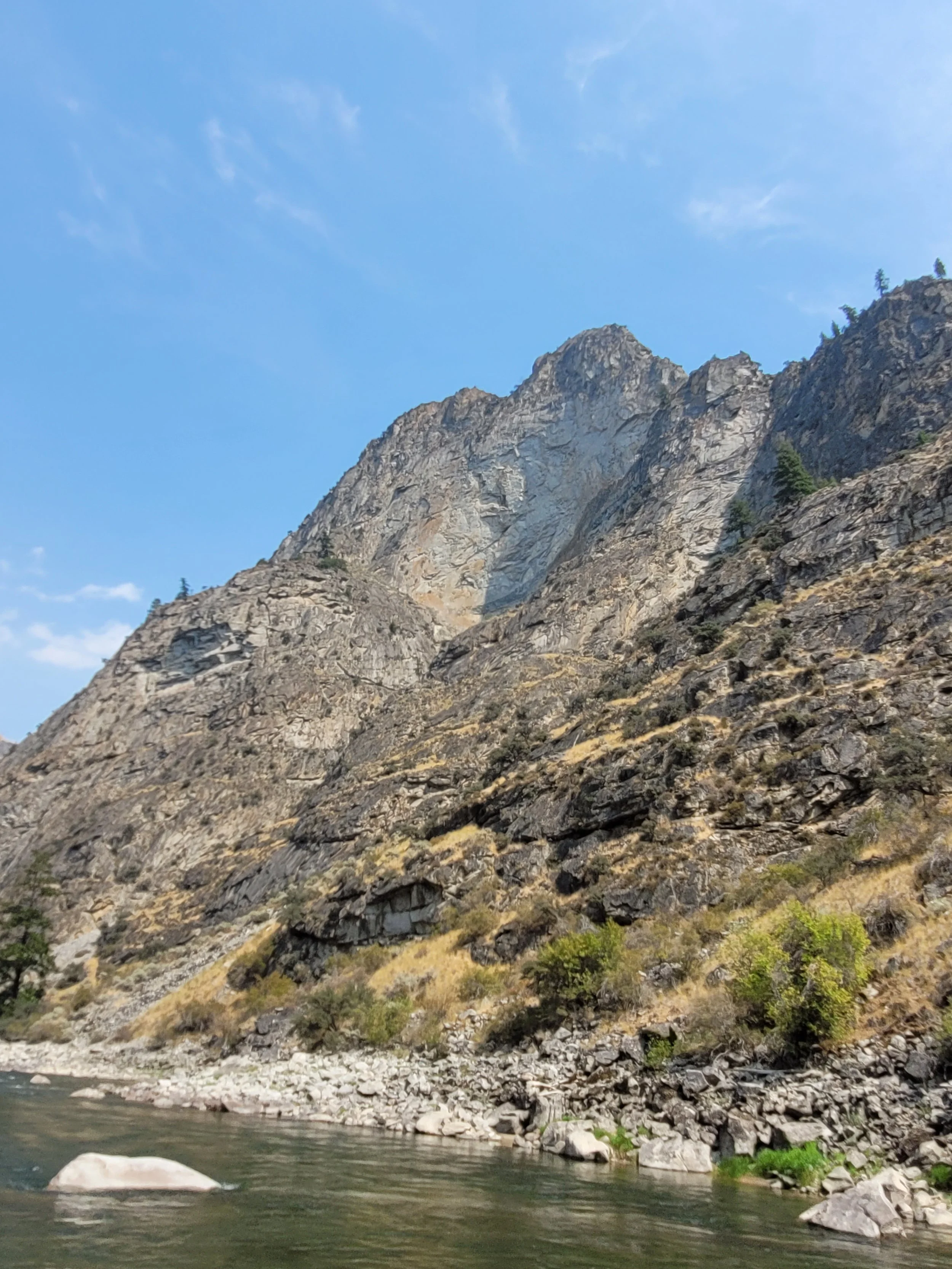
The view of Redside Wall from the Middle Fork of the Salmon River. It would be a challenging first ascent if it were near the road. Eighty-two miles down a heavily regulated wilderness river, Redside would require a novel approach. Matt Ward
Impassable Canyon on the Middle Fork of the Salmon, deep in the heart of Idaho’s massive Frank Church Wilderness, is legendary among river runners and all but unknown to climbers. River permits for the Middle Fork can only be won through a lucky pick in the annual lottery. Once a trip has launched, numerous necessary rules regulate the way that boaters can use the wilderness. One of these prohibits any river trip from camping more than one night in Impassable Canyon.
Over three commercial seasons as a raft guide on the Middle Fork, I had become obsessed with what appeared to be the tallest wall in Impassable Canyon. It’s a landmark for the famous Redside Rapid, and because of this, I’ve always called it the Redside Wall.
The Redside Wall is 82 river miles from the Boundary Creek boat ramp. The nearest trail to the wall crosses the river 3.5 miles upstream, but only after a 22-mile hike down Waterfall Creek. Over years of dreaming about trying to climb Redside, that seemed like the best option—except that those 3.5 downstream miles aren’t walkable at water level; the river often runs against steep, impassable walls. Hitchhiking downstream on river trips would also be illegal, since we wouldn’t be listed on the boat’s permit.
During one of many conversations with river and forest administrators on how to access the area legally, I finally asked the right question. “I don’t need a permit to swim in the river, do I?” The answer was no, I didn’t, delivered with a sideways glance and a chuckle.
At that moment, I hatched a plan. Ky and I would hike the Waterfall Creek Trail into Middle Fork Canyon, descending over 5,500 feet in 22 miles. Then we would swim with our backpacks down 3.5 miles of whitewater, including numerous Class III rapids. Then we would spend three days making the first ascent of a dramatically overhanging wall. Then we would join a friend’s river trip (for which we were listed on the permit) and paddle out.

Ky Hart adds some natural flotation to his waterlogged backpack during the three-mile swim down the Middle Fork of the Salmon River. Matt Ward
On August 29, 2024, we began the hike. After eight hours on the move, we reached the Middle Fork and made camp near the confluence with Big Creek, where a charred hillside across the river was still smoking from a wildfire. We were awoken repeatedly that night by the sound of trees falling and rockfall.
The next morning, we walked until Cutthroat Cove Rapid, where the bank cliffed out. It was time to swim. We eased into the river wearing our PFDs, gasped at the chill of the water, and began the most ridiculous stage of the plan. The bear sighting happened within the first mile. Soon after, our lips were blue, our teeth chattering. Ky found driftwood logs and lashed them to his backpack, which kept him farther out of the water. I opted for walking on sunlit banks when possible; this paid dividends when I found two beers that had been lost by some river trip.
Despite walking past several rapids, we still swam three miles. After the portage around Wall Creek Rapid, we jumped in for the final swim to the wall. Arriving at the beautiful beach beneath it felt a little surreal.
That afternoon, we started up the gully leading to the base of the wall and found the big-wall rack and portaledge I had stashed the week before, while guiding a trip down the river. We began climbing beautiful gray granite, smooth as glass in places. The gully pitches had worried us because they’d looked so polished, but we found enough cracks, bushes, and trees to make good, if dirty, progress.

Matt Ward leads the first difficult aid pitch (A3) on the upper Redside Wall. Ward had cached climbing gear and a portaledge below the wall during a previous river trip. Ky Hart
That evening, we were back on the beach, having fixed our ropes on the first three pitches. With seven river-trip launches a day on the Middle Fork, it was inevitable we would see many boats during our time on the beach. So began the endless answering of questions like, Where’s your boat? And, You didn’t really swim here, right? And, Do you need some beers? I love many things about river people, but especially the ever-present beer supply and the willingness to hand cold ones to suspect characters limping across the beach claiming they’re here to “do a little climbing.”

Hart jumaring after the bivouac on the Redside Wall, with the Middle Fork of the Salmon River about 1,500 feet below and wildfire smoke filling the air. Matt Ward
The next morning we packed the haulbag and committed to the wall. Our progress slowed considerably as the wall reared back and the cracks became seams. Beaks, hooks, and small gear got us to a decent bivy and, just like that, the first A3 pitch was in the bag. Ky went up on the next aid pitch and—long after sunset—kept hooking in the dark. We were, as usual, lost on the wall, but hadn’t found any dead ends yet.
Dawn broke hot. The smoke in the air was dense. We decided to pack a day bag, bring all of the rope we had, and see what happened. Ky swung 20’ away from the wall as he jugged the static line, a reminder of just how steep this thing was.

Looking down from high on the Redside Wall. Matt Ward
We were now in the large open book feature that splits the middle of the face, and the angle eased with every rope length. On the 12th pitch, I left the book and headed straight up with hopes of topping out. A mix of hooking and free climbing brought me onto a ledge covered in huge blocks, with a panoramic view of Impassable Canyon. We could see the Waterfall Creek Trail, most of what we’d swum to get here, Redside Rapid, and much of what lay downstream of us. A short scramble and a 5.8 pitch reminiscent of climbs in the Sawtooth Mountains brought us to the top. Not so much a summit as a high point on a ridge, 1,800 feet above the Middle Fork. We descended to the portaledge by rappelling from natural anchors.
The first lightning strikes happened at twilight but were far enough off to the west not to worry us at first. The Sawtooths and the Salmon River Mountains are both well known for exceptionally violent thunderstorms, and I’ve been pinned down by them more times than I’d like to remember. As the storm came closer, Ky began shooting photos as the lightning illuminated our exposed portaledge. It may have been an illusion, but it seemed we were above the lighting as it shot through the clouds. I pondered whether our 25 beaks could act as a lightning rod. We fell asleep late that night to a soundtrack of thunder, both silently repeating our trip’s mantra: Unkilled once again, so far.
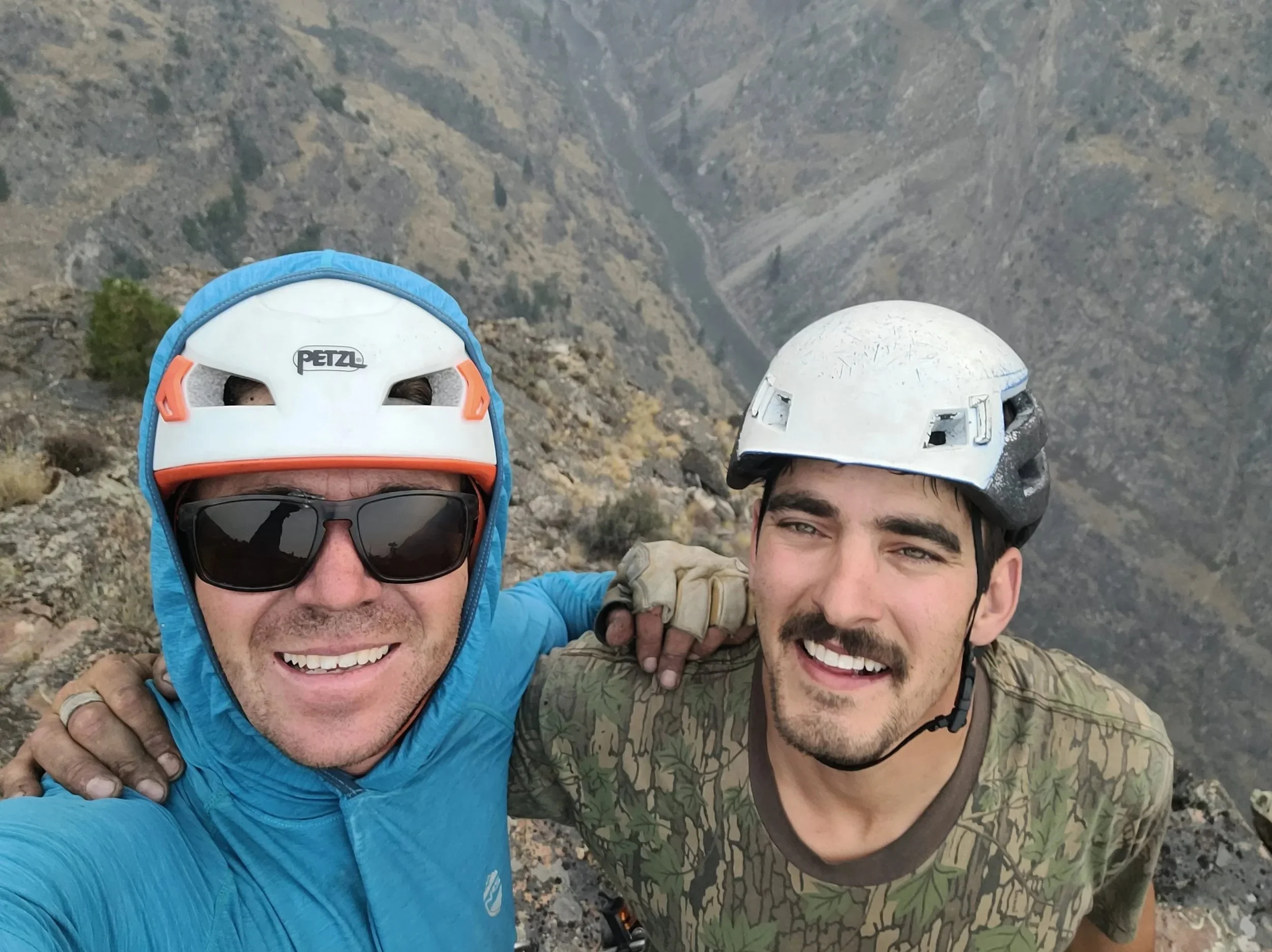
Matt Ward and Ky Hart at the top of the Redside Wall after completing its first ascent via No Rolling Stone (13 pitches, V5.10 A3). Matt Ward
The next day, as we lazed in the shade at the beach, our friends swung by to pick us up, as planned. Our buddy J.P. and the other 13 people on his river trip loaded us up, fed us, and treated us like royalty. We spent another night on the river and the next day drove out to the city of Salmon, ecstatic and shocked that the logistics had all worked out.
Two weeks later in Stanley, Idaho, I married Makayla Hoyt, my best friend and the woman of my dreams, at a beautiful ceremony along the Salmon River. The Redside Wall was my last hurrah as an unmarried man. For the first time in my life, I ain’t No Rolling Stone (13 pitches, V 5.10 A3).
—Matt Ward
The Line is Supported By:
The Line is Powered By:


The Line is the newsletter of the American Alpine Journal (AAJ), powered by Arc’teryx, with additional support from Mountain Project by onX. The Line is emailed to more than 80,000 climbers each month. Sign up below to receive future emails. Find the archive of past editions here. Got a potential story for the AAJ? Email the editors at [email protected].