
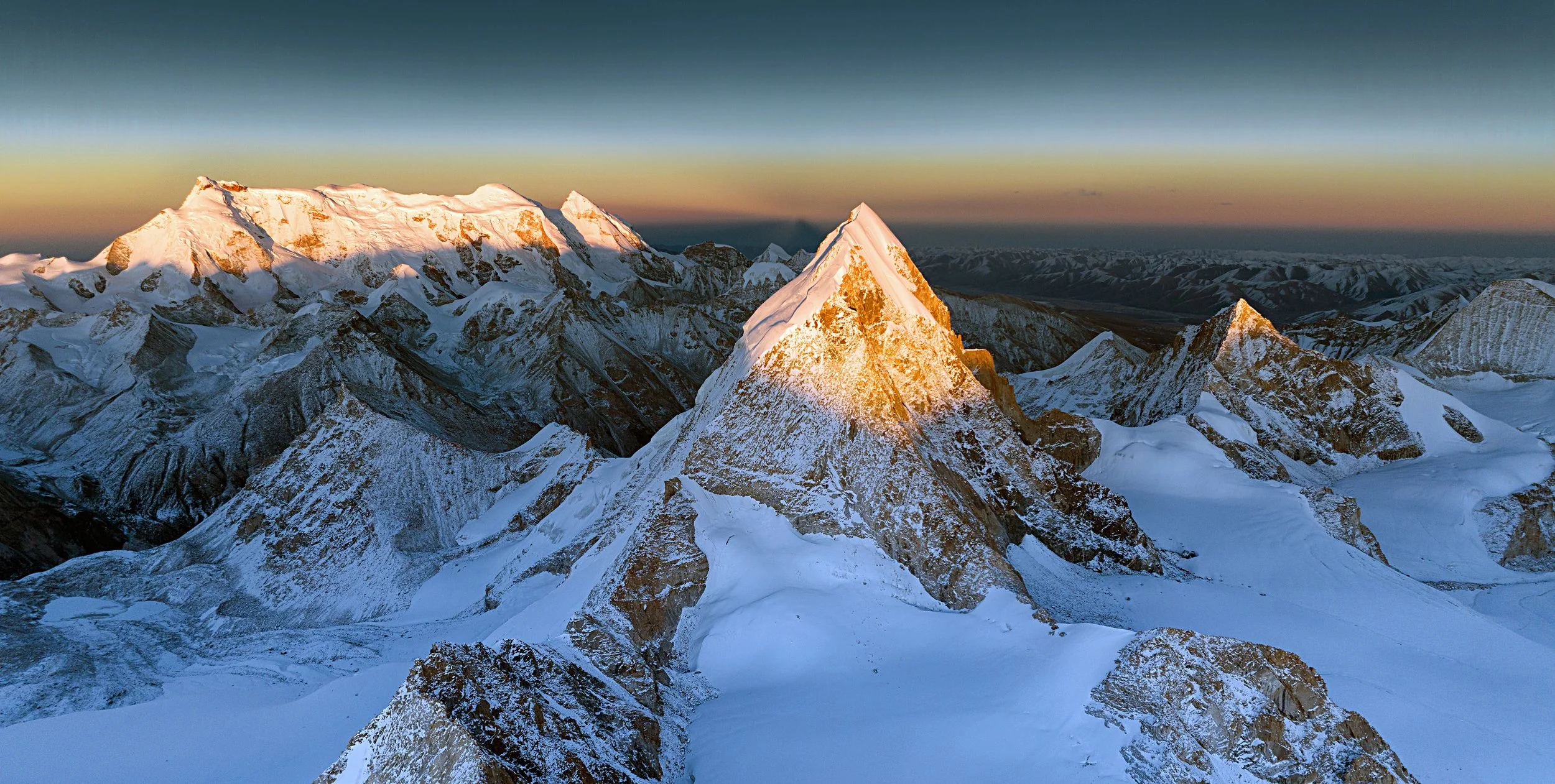
Sir Duk (Golden Dragon, 6,614m) in the Nyanchen Tanglha West mountains. Behind and to the left is the Nyanchen Tanglha Group, with the highest summit, Nyanchen Tanglha I (7,162m), on the left. Three routes have been climbed up the sunlit southwest face and south ridge of Sir Duk, including two summit routes and a line in 2024 that reached the west shoulder. That report is now at the AAJ website. Photo: Fan Rui
The vast Nyanchen Tanglha (a.k.a. Nyainqentanglha) ranges in Tibet span more than 750 kilometers in an arc north of Lhasa—it’s one of the world’s great collections of unclimbed or seldom-climbed high peaks. In the first decade of the 2000s, the Japanese geographer and photographer Tamotsu Nakamura, an AAC honorary member, published a series of articles describing these mountains, including a three-part opus in AAJ 2003 on mountains “East of the Himalaya” (also the title of Nakamura’s landmark 2016 book), with enticing photos from the Nyanchen Tanglha East range.
A bit of a gold rush followed, with various Western climbers snagging the first ascents of attractive summits in Nakamura’s photos. However, there are major logistical difficulties to climbing in this area, including road access and permits. The last AAJ articles about climbs in the Nyanchen Tanglha by Western climbers were published in 2017.
Into the breach has stepped a cohort of Chinese alpinists who have rapidly gained experience and skill in their home mountains in recent years. Now ready to tackle more difficult and remote objectives, they have made many impressive ascents, aided in part by rapid development of road and rail networks in Tibet. Three climbs from late 2024 are highlighted below. These reports could not be completed in time for the 2025 AAJ, but these ascents and many more in Tibet will be described in detail in next year’s book.
Many thanks to Xia Zhongming, who facilitates and writes AAJ reports from China— including these three—and has contributed greatly to the world’s knowledge of modern Chinese alpinism.
MANAMCHO FROM THE SOUTHWEST
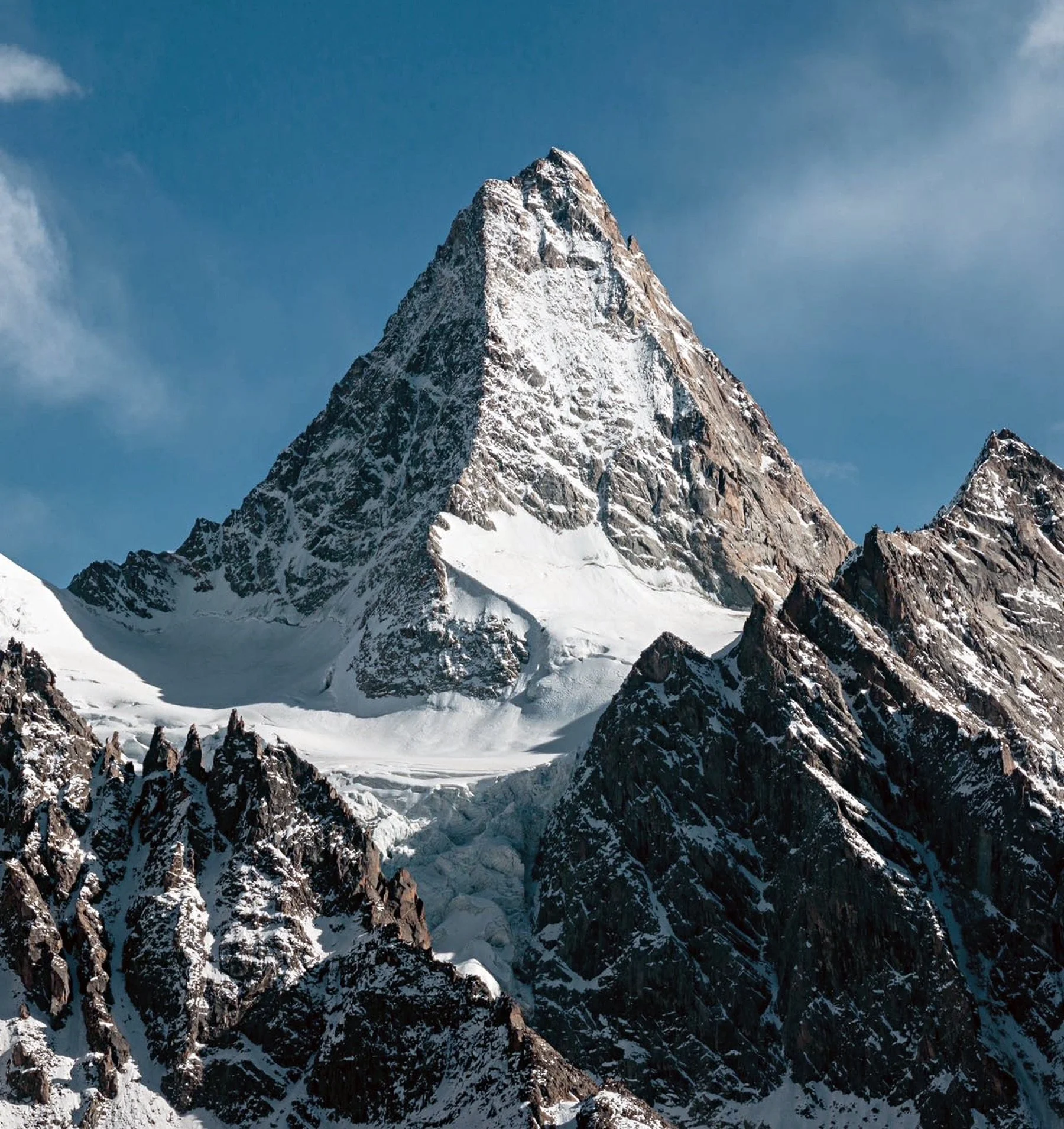
Manamcho (6,264m) from the northwest. The original route (2007) climbed the arête facing the camera. The 2024 route by Chinese alpinists Liu Junfu and Wang Shuai climbed the right side of the sunlit face. Photo: Lai Xingzhu
In 2005, British climbers Mick Fowler and Chris Watts made the first ascent of Kajaqiao in the Nyanchen Tanghlha East mountains. Two years later, Fowler returned with fellow Brit Paul Ramsden to climb Manamcho, a spectacular, Matterhorn-like peak nearby, by the northwest ridge. In September 2024, Chinese alpinists Liu Junfu and Wang Shuai climbed Manamcho’s second route, up the southwest side of the 6,264-meter mountain, in one long day from high camp. To overcome a crux rock slab near the top, Liu tied a rope to one of his ice tools and threw it up the rock. After more than ten tries, the tool stuck and Liu was able to batman up the rope and surmount the slab, opening the way to the summit. See the full report.
CHUCHEPO, FIRST ASCENT
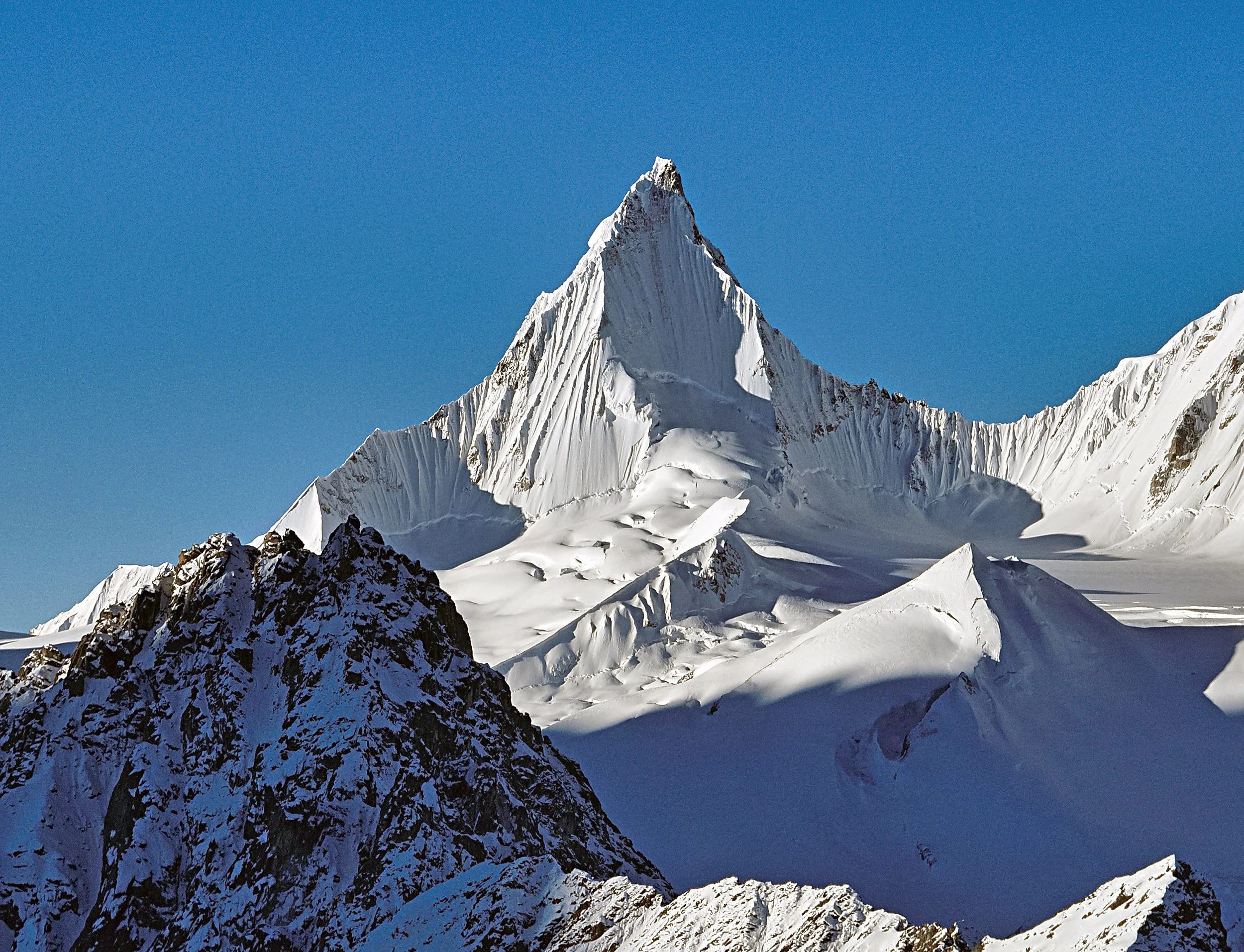
Chuchepo (6,613m), with the 700-meter northeast face in shadow. This face was climbed directly to the summit in September 2024. Photo: Tong Haijun/Wang Yongpeng

Wang Yongpeng on the upper northeast face of Chuchepo during the first ascent. The shapely peak in back is unclimbed Sendho (6,252m). Photo: Tong Haijun
In the southwest section Nyanchen Tanglha East lies Nenang (6,870m), the highest of this range’s unclimbed peaks. Around 10 kilometers from Nenang to the west and east stand two spectacular mountains: Chuchepo (6,613m), west of Nenang, and Jiongmudazhi (6,590m) to the east. Both peaks were noted in AAJ 2007, but no known attempts were made on either peak until August 2024, when Tong Haijun and Wang Yongpeng from China climbed Chuchepo by a direttissima on the northeast face.
On August 16, the two began their approach from the Niwu Valley to the north, establishing advanced base at 5,300 meters after an 11-hour day. From there they scoped a feasible line up the northeast face. The next day, the pair spent seven hours crossing the snow-covered, crevassed glacier before camping at 5,900 meters.
On the 18th, the two left camp at 3 a.m., and after a difficult pitch to cross the bergschrund, they continued up easier terrain to reach 6,230 meters before sunrise.
The major technical difficulties now followed. Wang led a pitch where the ice was too thin to place screws and the rock too compact for cams. Tong then climbed a very run-out pitch on snow-covered compact rock. After this, the snow became deeper and the difficulties eased. Wang made a final belay in deep snow a couple of meters below the summit ridge, and Tong then tunneled through the cornice and continued up left to the highest point. The 700-meter route was graded D+ M4 AI3 75°. See the full report.
JIONGMUDAZHI, FIRST ASCENT

The northwest face of Jiongmudazhi (6,590m) and the line of the first ascent in September 2024. Photo: Tong Haijun/Wang Yongpeng
Less than a month after climbing Chuchepo, Tong Haijun and Wang Yongpeng returned to the area in September 2024 to attempt the first ascent of Jiongmudazhi (6,590m). Again, Tong and Wang approached from the north, via the Biyong Glacier, where they spent a very difficult day bypassing an 800-meter-wide icefall surrounded by steep cliffs. On September 8, another big day brought them to their second camp, at 5,855 meters.
The next morning, they left at 3 a.m. The visibility was poor, and it began to snow heavily. They alternated trail-breaking to the foot of the northwest face, left of the fall-line from the summit. Crossing the bergschrund, Tong led a five-meter vertical ice wall followed by deep snow. Wang led both the second and third pitches, slanting right toward a rocky area. Above this, they then began simul-climbing with intermediate protection; at one point, the two pitched a 20-meter vertical section with no protection.
When dawn broke, an ice block the size of two sofas collapsed from a serac barrier less than 50 meters away. They continued, climbing the right side of another serac barrier, when suddenly the mist cleared and they saw the main summit over to their right. This clearing was fortunate, as otherwise they would have continued up to a false summit. They reached the top at 11 a.m. and were back at their first camp by 5 p.m., having rappelled most of their route. See the full report.
We’ll be adding more of these reports and others from China to the AAJ website in the coming weeks. Follow the AAJ Instagram page for updates.
The Line is Powered by:

The Line is Supported By:


The Line is the newsletter of the American Alpine Journal (AAJ), powered by Arc’teryx, with additional support from Mountain Project by onX. The line is emailed to more than 80,000 climbers each month. Sign up below to receive future emails. Find the archive of past editions here. Got a potential story for the AAJ? Email the editors at [email protected].
To see The Line every month, sign up below!