
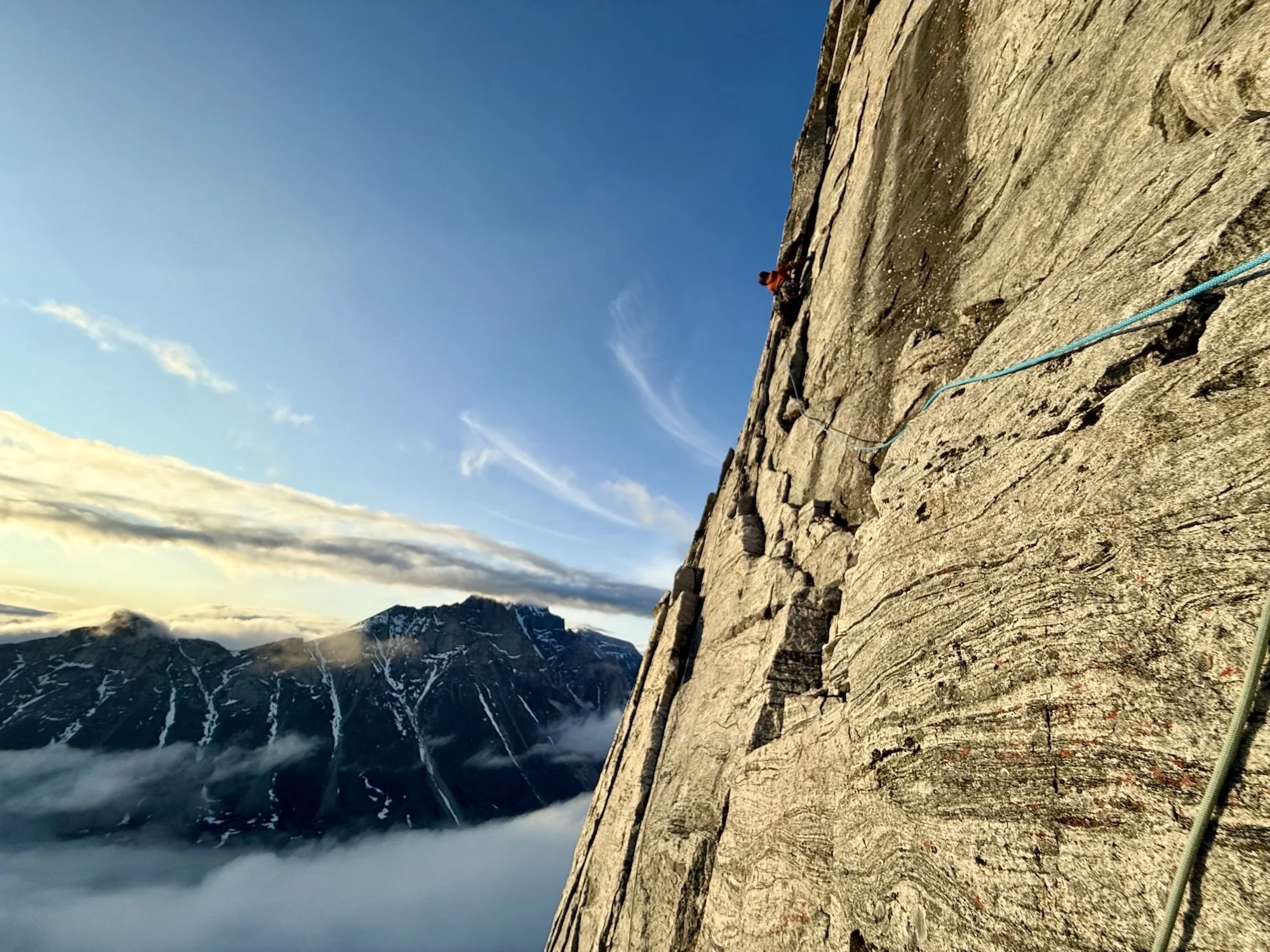
Photo by AAC member Kelly Fields.
By Heather Smallpage
Originally published in Guidebook XVI
I move, therefore I am. I reminded myself of this throughout the journey to and from Arviqtujuq Kangiqtua, formerly known as Eglinton Fjord. Throughout our five-week, multi-sport, primarily human-powered expedition to Baffin Island, in the Canadian Arctic, Kelly Fields, Shira Biner, Natalie Afonina, and I continued to move. We skied over 100 miles across the sea ice in order to get there, and we slogged for another 100 miles over moraine fields, loose talus, sinking meadows, a frozen lake, and a partially frozen river to get out. Movement was our rule, our rhythm. And as a team of three women and a non-binary person, we were motivated to define this movement on our own terms.
Kelly, Shira, Natalie, and I met for the first time in person at the Ottawa Airport en route to the Arctic. Only a few of us had tied in together before this trip. Prior to our real-life introduction, we spent months exchanging messages, photos, screenshots, videos, and group calls on WhatsApp. Now, past the logistical chaos of prep for this expedition, we still had a lot of learning to do about each other. I’m lucky in that I know an abundance of female, non-binary, and queer people who are incredible climbing partners. I prefer to rope up with them because of my ongoing struggles with self-confidence and self-trust that I learned in the shadow of my male climbing partners.
Here was an opportunity to move toward my goals and the style of climbing that most inspires me, alongside a group of people who uplift one another. When we received our first grant—the McNeill-Nott Award from the American Alpine Club—I started to feel that other people believed in us, which gave me more belief in myself. Representation is important, and the organizations that supported us believed that too. It was coming together all too perfectly.
I stared at the vast ice and seascape before me: Circles of white interrupted the piercing blue water that settled up to a foot deep in some places. We were leaving the bay in the small Inuit community of Clyde River.
The gray sky let go of gentle snowflakes that melted on my sunglasses, making my surroundings appear as if I were looking out a window on a rainy day. “So...how thick is this ice?” I asked, my voice wavering. The last time I had put skis on was a number of years ago. On snow, on solid ground.
However, I was soon submerged within and captivated by the ice’s symphony as we glided, heaved, soared over, walked, and trudged—depending on the conditions of the sea ice—over a hundred miles on a seascape that was constantly changing. Moving through that environment was dictated by the wind, temperature, snow, and our bodies’ needs. One moment, we would be trapped in a cloud, the snow absorbing the sound around us and sticking to our ski skins so thick that we had to take them off. Moments later, after turning a corner, the winds had blown the clouds and snow off the surface, and we found ourselves flying over the best ice conditions we had yet experienced. That landscape spoke to me, telling me that it, too, exists in states of movement and change.
I often look to the natural world to find my own sense of belonging. Being a non-binary person often means that I don’t always find a type of belonging that is representative. I struggle in groups of men. In groups of women, I push back on the definitions and create an exclusionary space for myself. Asking for a non-binary category creates the exact thing I don’t want to exist within: a category. One day, I hope I can exist in a way that is outside the confines of man or woman—that I can exist as myself without needing to choose between explaining and educating, or quietly disrespecting myself.
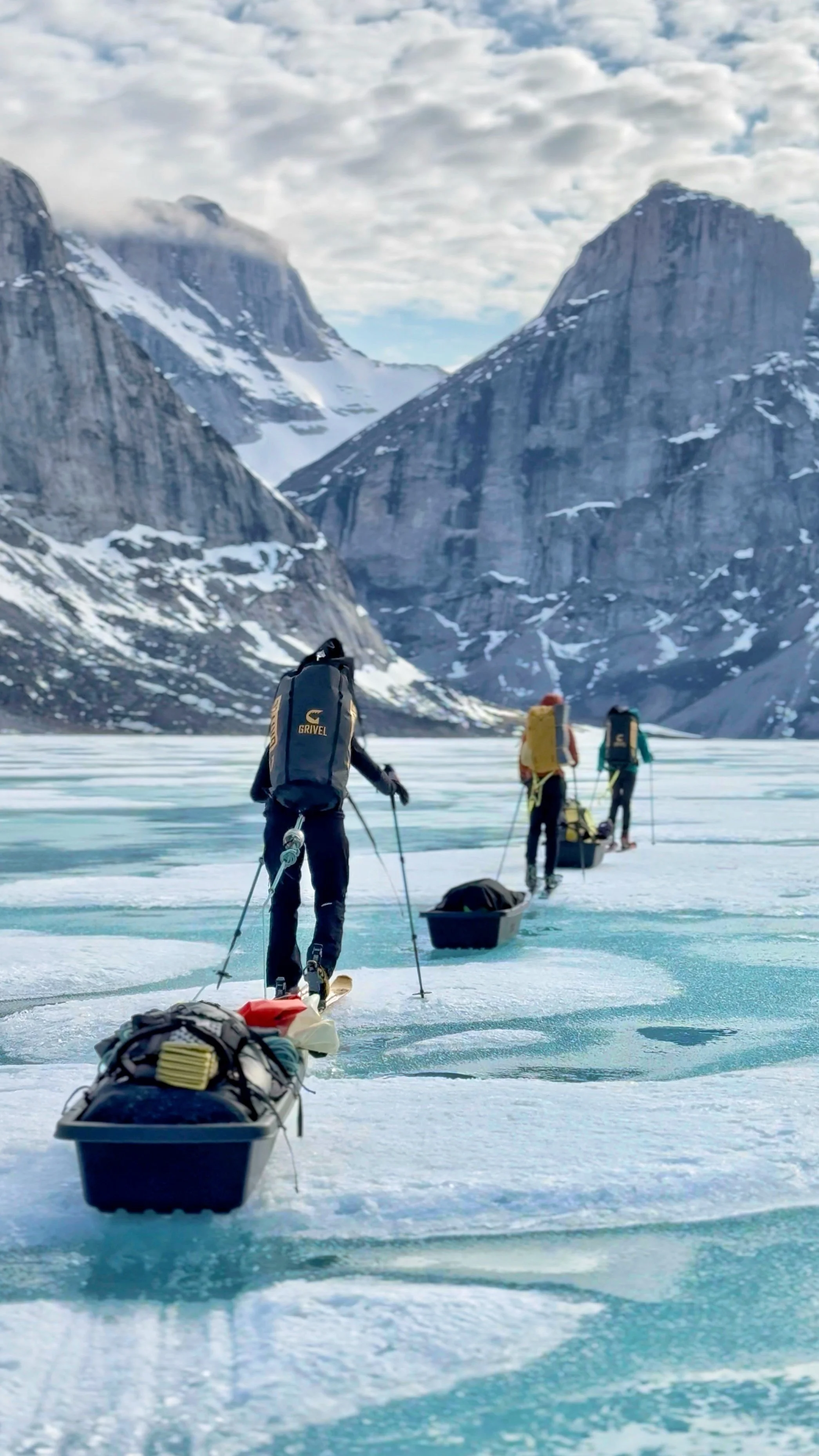
Photo by AAC member Natalie Afonina.
The thing about gender, being non-binary specifically, is that it’s simultaneously the most painful and most beautiful experience one can have. There is a deep gratitude in being the truest form of yourself; there is a wholeness in accepting one’s authenticity. It can also often be painful to a core level. My relationship with gender is like the Arctic wind: always present, sometimes gentle and caressing, other times a chaos that threatens to knock me down.
I felt the spirits skiing into Arviqtujuq Kangiqtua. Finally, among those great walls, exhausted, hungry, sore, and cold, we debated where to set up our base camp and had a hard time getting anywhere productive with it. I remember feeling confused about how I could be in the greatest place I’ve ever stood, a place that made my soul feel so full, yet in conditions that made my humanity feel so absent. Feeling insignificant because of landscapes that humble us is familiar to me, welcomed even. I much prefer the way the land makes me feel small, compared to the way humans have that same ability.
We settled into a base camp at the toe of Eglinton Tower. For a few days, we unpacked our cache of climbing gear and food, and Kelly and I healed our blisters we got from skiing in. I had blisters, and Kelly essentially had holes in her feet. After a few days of rest and skin care, inspired by a period of good weather, we started up the talus to the mountain’s base.
Some hours later, I found myself in a massive offwidth flake high up on the route at midnight, poking my head outside of it, feeling the never-setting sun on my skin. I saw a river of clouds drifting through the canyon below us, swallowing the ground and remaking it into a moving mass of shadows, curves, and drifts that was the most spectacular portrayal of beauty my eyes have had the pleasure of taking in. I started crying in disbelief. Then crying in belief. How often is it that we have the opportunity to pause and take in the moments of beauty that surround us? I had not experienced something that forced me to see my own grandeur and the beauty of it all, or to reckon with the work that I’ve put into arriving here. I found myself in the center of all of that, celebrating this arrival as I felt my humanity swimming through my body as I swam my way up the chimney.
Eglinton Tower has two tiered summits connected by a long stretch of 2nd-to-5th-class terrain. We ascended the main headwall on the lower summit, walked along a series of ledges, and scrambled to the top of a terrace as snow and wind started blowing. From there, we saw the true summit, another 300 meters of rock with portions of snow and ice. It looked unwelcoming and uninspiring with the worsening weather and our lack of food and energy. We celebrated our high point and began our 11-hour descent.
After 49 hours, Kelly, Shira, and I had made our way up and down Eglinton Tower, establishing Lemnos in the Clouds (5.11+ A0). I could say many things about that climb—about our shiver bivy, how Kelly climbed in approach shoes because her heels still had holes in them, how beautiful the rock was to climb, witness, and respect—but the lessons it taught me in taking that pause stay with me most. A pause to let yourself listen to and sing with the birds, to witness the magnificence of your surroundings, and yourself within them; a pause to allow yourself to be in awe.
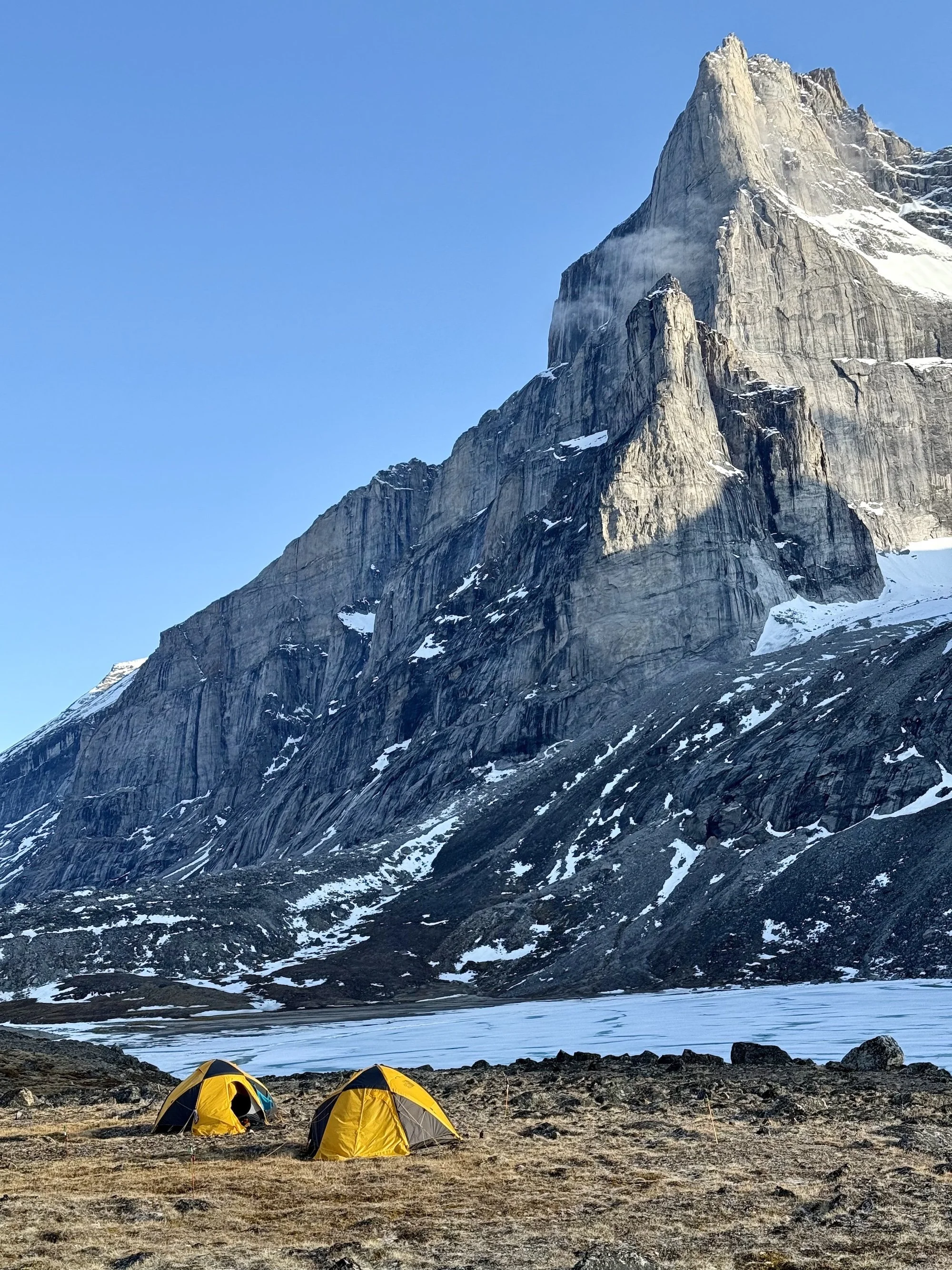
Photo by AAC member Kelly Fields.
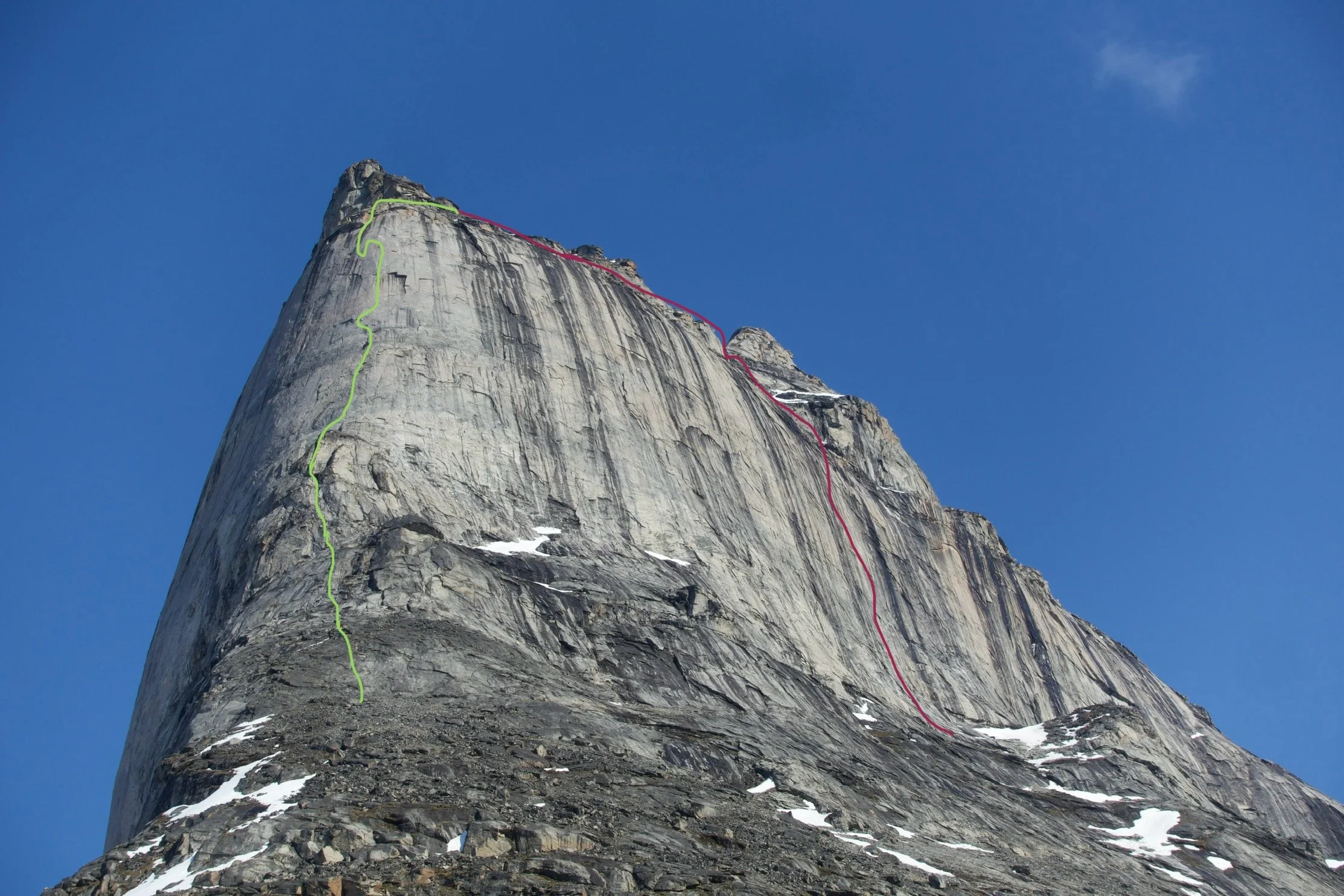
Photo by AAC member Heather Smallpage.
After resting for a few days and monitoring the weather, we decided to start moving from base camp to our next obstacle: Ayr Pass, a six-kilometer pass that connected us to Ayr Lake. It looked cruel and intimidating, and unfortunately was our only option to get back to Clyde River. Now that we had more food, our climbing gear, packrafts, and other essentials resupplied from the cache, we found ourselves with hundreds of pounds of food and equipment. Thus, we became mules.
As we approached Ayr Pass, the fjord fingered off into an outlet and the walls grew around us—the blackest walls I’ve ever seen, where light is swallowed by the water that has dripped and stained the rocks throughout time. We did some repacking and started off on the first of our slogs. First, we crossed a moraine field flowing with a river of silt, where our steps were swallowed by saturated sand and mud. Then came heinous mounds of sand, a frozen lake covered by avalanche debris that we post-holed through, and a large field of loose talus scattered with unstable boulders of all sizes. Finally, we navigated 3rd and sometimes 4th-class terrain with our loads threatening our balance. At last we arrived at our new camp with stiff shoulders and bruised hips, surrounded by tussocks, wildflowers, mosses, streams, boulders, and probably fairies. We walked Ayr Pass five times, three times with heavy, awkward bags.
The conditions of Ayr Lake were a big question mark, and one that would dictate how fast we could move and how easy it would be to continue. Navigating an ice breakup is difficult and incredibly slow-moving work, which we hoped to avoid by getting to the lake before the weather warmed up. Fortunately, it was still solidly frozen apart from the edges, so we packed our pulks again with all our gear and headed north, across the lake toward the Kuugaaluk River.
All this slogging allowed me to take a moment to check in with myself. At this point three weeks in, I wasn’t eating or sleeping much. I felt angry and I couldn’t focus for long. Suddenly, it became abundantly clear: I wasn’t doing too well.
Despite so many moments of connection with myself, moments that could be nothing but experiencing a relationship with this landscape, I was emotionally exhausted from, of all things, disconnection.
I had hoped that going to Baffin Island with women would be a chance to be part of something that could heal some of the jealousy, insecurity, and isolation I feel when I compare myself to people I can understand but don’t identify with. Instead, I found myself drowning. The contradiction was startling: We were in a landscape that elicits a presence that connects to the soul, among certain dynamics that severed any hope of authenticity from each other. The weight of the grief grew heavier as I came to understand that I wasn’t part of a team where there was care for one another or compassionate communication, as I had dreamed.
We were a fractured group because of behaviors that placed experiences and achievements above character.
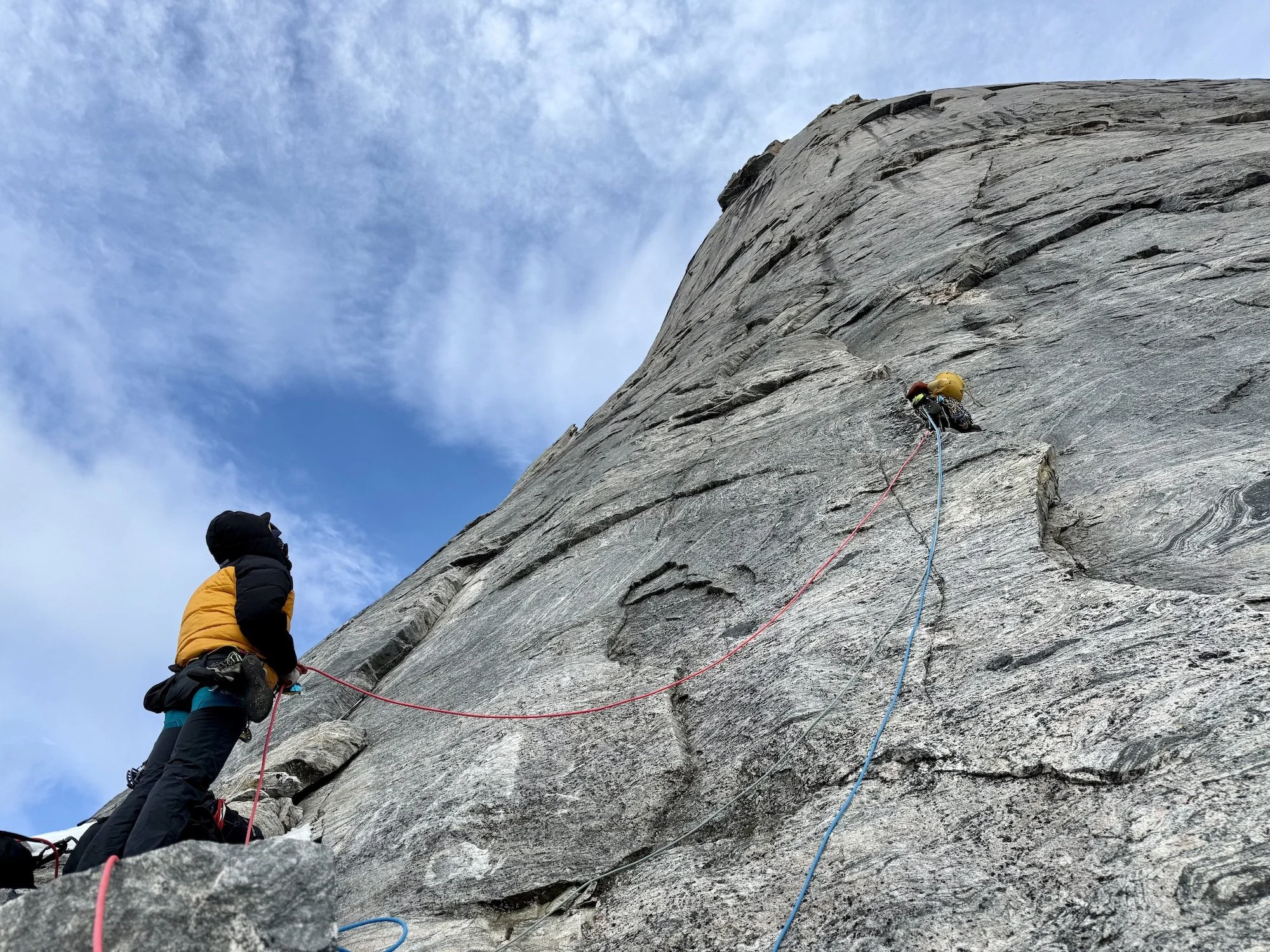
Photo by AAC member Kelly Fields.
Support This Work—AAC Grants
Today, with up to $100,000 in annual grant awards, the Club continues to support these endeavors and is proud to stand behind the individuals and their projects which seek the betterment of the climbing community and climbing landscapes.
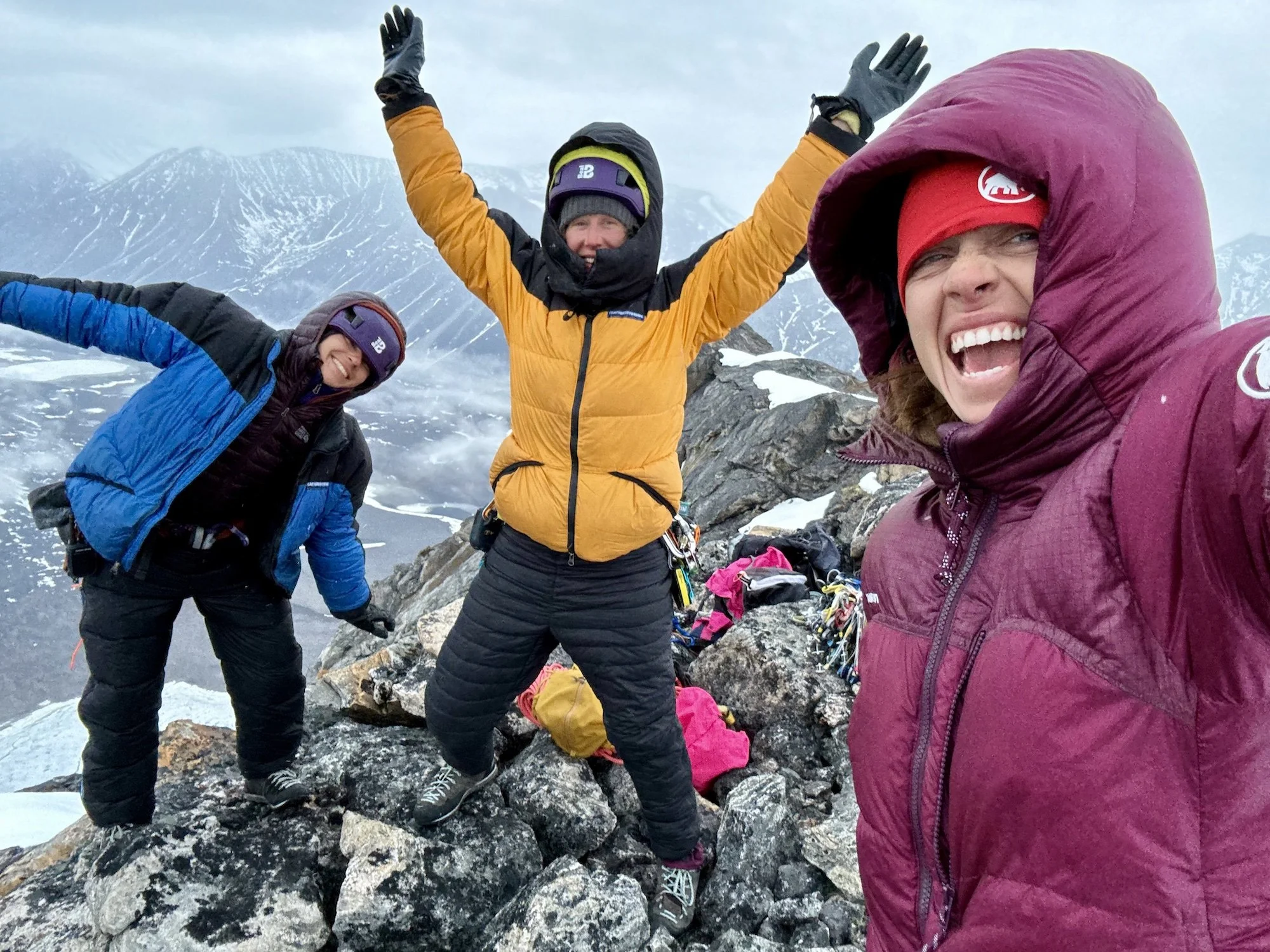
Photo by AAC member Kelly Fields.
Approaching the end of our trip, we spent two days paddling on the Kuugaaluk River— the two most peaceful days of the expedition. On our first day, we were in light rain as we pushed off from our beachfront camp. Our second day on the river immersed us in blue skies and gentle flows.
I spent the few hours we had on the river floating and singing along with the rhythm of the water. It was a time for reflection about all the land we had moved across, by foot, ski, rock, and water; all the far-reaching sights we had seen; and the variety of noises the wind creates. It was a place that connected me to myself, and the changing currents of the water reminded me of the changes in myself—my movement going forward, my flow being the pace of the moment, needing to be nothing more than what I am. The river offered me peace and gentleness when I needed it most. When we got to shore, I thanked the Kuugaaluk as I looked up and felt the sunshine on my skin.
To me, the Arctic feels like a landscape that knows no depth, with wisdom frozen in the glaciers and a sea that is inaccessible to those just passing through. It is a place that impels one to be fully present with your surroundings.
I left Baffin Island with feelings of wonder, gratitude for the lessons from the land, and a deep exhaustion permeating my mind and body. Since coming back and having space to process the duality of the beauty and grief of it all, I’ve felt as if I’ve been laid out for the one who matters most: myself. My resiliency, grit, and authenticity stare back at me. I moved deeper into the person I am.
I move, therefore I am.
