Guidebook XVI

Foremothers: The Story Behind the Four Women Who Helped Found the American Alpine Club

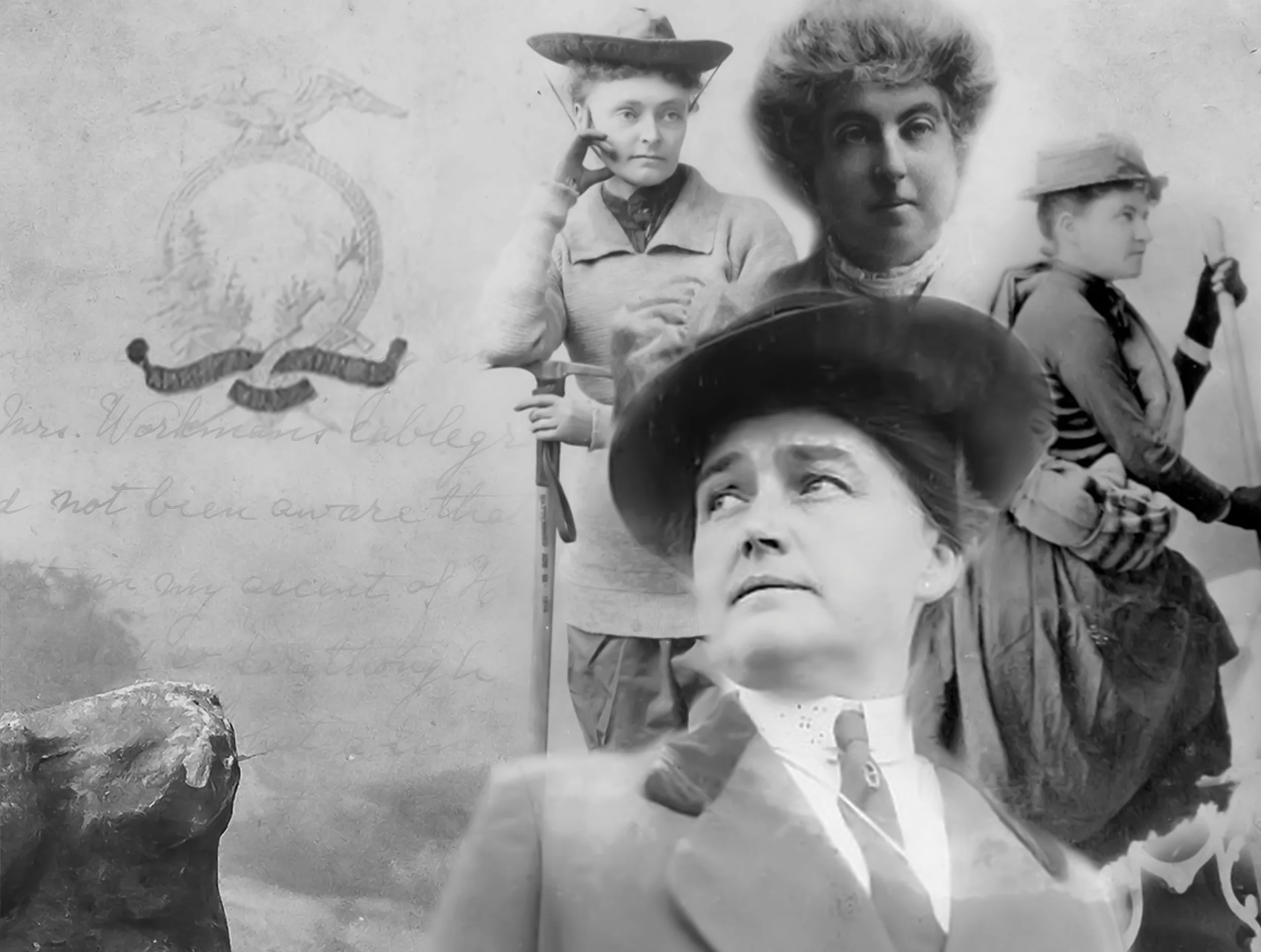
Annie Peck (top left)] Library of Congress; [Fanny Bullock (top middle)] AAC Library Collections; [Fay Fuller (top right)] Wiki Commons; [Josephine Peary (bottom)] Library of Congress; c AAC member Foster Denney

By Sierra McGivney, research supported by the AAC Library

Originally Published in Guidebook XVI

Fuller, Miss Fay
Peary, Mrs. Robert E.
Peck, Miss Annie S.A.M.
Workman, Mrs. Fanny Bullock, F.R.S.G.S.

Their names were written in ink, part of the list of founding members of the American Alpine Club in the AAC bylaws and register book. These four women answered Angelo Heliprins' call to establish an “Alpine Society.” The American Alpine Club was established in 1902, but would not get its name until 1905.

The founding members determined that dues were to be five dollars a year, about $186.90 in today's money. This early version of the Club was interested in projecting a reputation of mountain expertise: members had to apply for membership with a resume of mountain climbing or an explorational expedition they had participated in. Those without a sufficiently impressive resume would not be accepted as members. All the founders had lists of their ascents and exploratory expeditions underneath their names to drive the point home that this was a club of high mountain achievers.

It was no small feat that these women were invited to participate in founding an alpine club at the turn of the 20th century. After all, women weren’t allowed in the British Alpine Club until 1974, forcing women to create their own alpine or climbing clubs.

But Fay Fuller, Josephine Peary, Annie Peck, and Fanny Bullock Workman were forces to be reckoned with, each in their own way. They helped steer the American Alpine Club from its beginnings and pushed boundaries in mountain climbing and Arctic exploration, all well before the 19th Amendment, ratified in 1920, gave women the right to vote. Each year, their new accomplishments were published in the bylaws and register book under their name, and some were even invited to speak during the AAC Annual Gathering about their expeditions.

Ultimately, these four women are foremothers to American climbing and exploration. Their stories are shaped by their historical context, but the meaning of their mountain achievements is timeless.


Miss Edwina Fay Fuller was the first woman to summit Mt. Rainier in 1890. Fuller also climbed other glaciated peaks in the Cascades: Mt. Hood, Mt. Adams, Mt. Pitt (now Mt. McLoughlin, which still had a glacier until the early 20th century), and Sahale Mountain. She was described as self-reliant and dogged.

Fay Fuller’s ascent of Rainier nearly ostracized her from Tacoma society—not because she was mountaineering but because of what she wore and who she traveled with.

Her party of five, all men except for her—scandalous for the time—woke up on August 10, 1890, at half past four and began their arduous journey toward the summit. In a 1950 feature article about Fuller in Tacoma’s newspaper, The News Tribune, she said, “I was very nearly ostracized in Tacoma because of that trip—a lone woman and four men climbing a mountain, and in that immodest costume.”

Her “immodest costume,” an ankle-length bloomer suit covered with a long coatdress, was made of thick blue flannel. She also covered her face in charcoal and cream to prevent a sunburn (unfortunately, it didn’t work). Fuller was determined to reach the summit on this attempt, her second up Mt. Tahoma or Tacoma, now Mt. Rainier.

Fuller and her group climbed the Gibraltar Ledges, a Grade II Alpine Ice 1/2 with moderate snow climbing and significant rockfall hazard. Today, the most popular route on Rainier is Disappointment Cleaver, a mix of snowfields, steep switchbacks, and crevassed glaciers, but no technical climbing. Fuller and her team navigated the difficult and exposed terrain of there route with little prior experience and with gear we wouldn’t dare use today, successfully summiting Rainier.
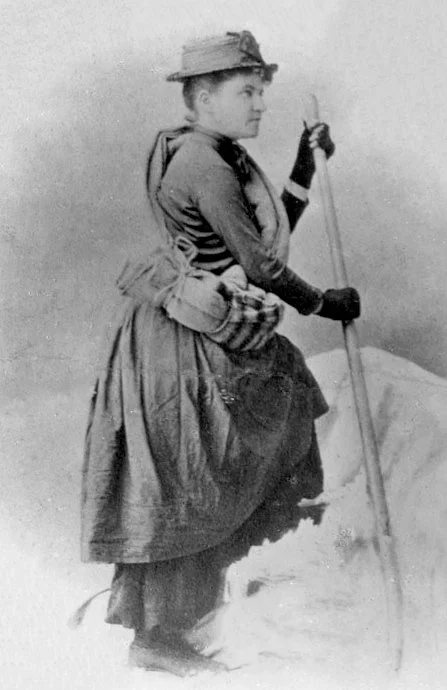
Fay Fuller. Photo by Wiki Commons.

Len Longmire, their guide—though he had never been to the summit—recalled that one of the group members offered Fuller a hand at an especially dangerous place. “No thanks,” she replied, “I want to get up there under my own power or not at all.”

That night, under the stars, the team slept in one of many craters on the stratovolcano, listening to avalanches raging down the mountain. The team continued down safely the next morning, leaving a sardine can containing their names, a tin cup, and a flask filled with brandy as proof of their adventure.

Fuller went on to summit the mountain once more with the Mazamas in 1894.

Her ascent led to her becoming a fierce journalist. She went on to cover the Chicago and St. Louis world’s fairs, and helped found the Mazamas in 1894, the American Alpine Club in 1902, and The Mountaineers in 1906. She became the world’s first harbor mistress in Tacoma and was an actress. Expectations be damned.


Mrs. Josephine Peary attended Spencerian Business College and graduated as the class valedictorian in 1880. Fueled by her own sense of adventure, she accompanied her husband on four of his Arctic expeditions, learning how to hunt, fighting off walruses, and exploring the breathtaking beauty of Greenland. She was considered the “First Lady of the Arctic” and gave birth to her first child, Marie, about 13 degrees, or just under 900 miles, from the North Pole in 1893.

Josephine Peary. Photo by Wikimedia Commons.

“I cannot but admire her courage. She has been where no white woman has ever been, and where many a man hesitates to go,” wrote her husband, Robert Peary—who was embroiled in his own controversy in the early 1900s about whether he “discovered” the North Pole and his treatment of the Greenlandic Inuit—in the preface of Josephine’s book My Arctic Journal.

When the American Alpine Club was formed, sport and trad climbing didn’t exist, and ice climbing was extremely primitive. Exploration was nearly as important as mountaineering in defining the sport.

The American Alpine Club’s foundation was based on exploration and mountain climbing. Indeed, included in the 1902 bylaws was the following mission: “The objects of the Club shall be the scientific exploration and study of the higher mountain elevations and of the regions lying within or about the Arctic and Antarctic Circles; the cultivation of the mountain craft...”

Josephine Peary was not a climber. Her expertise was Arctic exploration, which was wholly unknown to the Western world at the time. In 1891, Peary ventured to northern Greenland with her husband and their crew on the Kite. She spent days under the midnight sun gathering yellow arctic poppies and shooting auks, gulls, and eider ducks.

On September 23, Mrs. Peary joined a small group on a smaller boat, the Mary Peary, to head up Inglefield Gulf. They searched for walruses to obtain the ivory in their tusks and meat for the coming winter. At this time, ivory was in high demand, with the United States taking in 200 tons per year by 1913. The devastating effects of the ivory trade on animal populations have made it illegal since 1989.

Robert Peary had brought a Kodak camera and asked the crew members to row until he said stop. He was so engrossed in getting his picture just right—much like a national park tourist—that he forgot to tell them to stop and ran right on top of an ice cake, nearly tipping the boat over. In the chaos, a walrus was harpooned and it dove underneath the water, dragging the boat off the ice cake and righting it.

But the damage was already done. According to Peary, 250 walruses surrounded the boat and bullets started flying. The walruses were not going down without a fight. Bullets whistled by Josephine’s ears in all directions while she reloaded guns.

“I thought it about an even chance whether I would be shot or drowned,” wrote Peary in My Arctic Journal.

This was just the beginning of their time in the Arctic, and danger was all around them, but she was excited by the uncertainty.


AAC founding member Fanny Bullock Workman standing on Silver Throne plateau, Karakoram. Public Domain Wikimedia Commons c Image recolored by AAC member Foster Denney.

Support the Library

The Henry S. Hall Jr. American Alpine Club Library houses one of the world’s finest collections of mountain-related artifacts, archives, rare books, maps, and media. A climbing bibliophile’s dream, the library contains more than 60,000 books and all the information you could ever want on mountain history, mountain culture, climbing routes, and more.

Donate to the AAC Library to support climbing archives and research!


Today, Annie Peck might be best known for wearing knickerbockers on her 1895 ascent of the Matterhorn. According to Peck’s article “A Woman’s Ascent of the Matterhorn” for McClure's Magazine, wearing knickerbockers with or without a short skirt was the norm when “high climbing.”
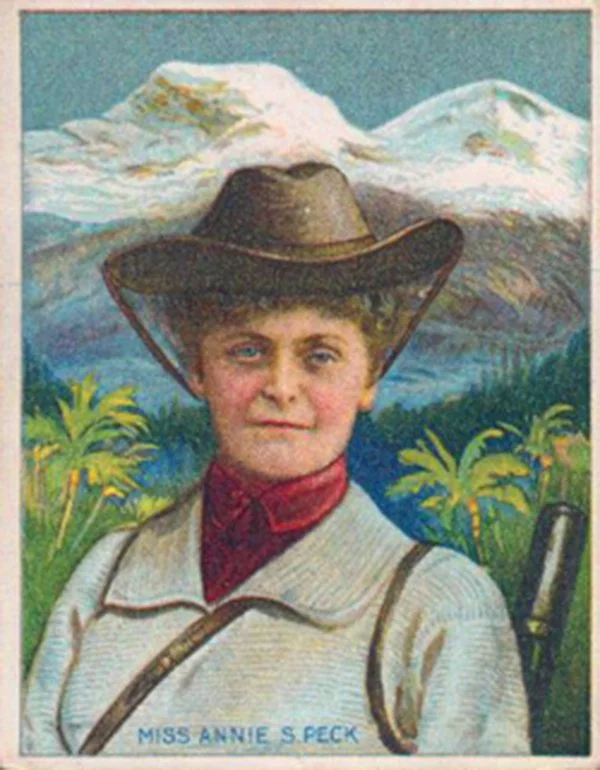
Annie Peck. Photo by Wikimedia Commons.

But not everyone felt this way. Both in and outside the context of mountain climbing, women could face retribution, such as arrest or fines, for wearing pants, but most of the time, they just walked away with damaged reputations or faced social exclusion for their fashion choices. However, some women were arrested for wearing pants and even jailed. Emma Snodgrass, in 1852, was arrested several times for wearing pants in Boston, and Helen Hulick spent five days in jail in 1938 for wearing slacks to a court hearing in Los Angeles.

Peck was a suffragette—whether her pants-wearing was an act of political defiance or a matter of safety, other women had been badly injured or perished while wearing skirts climbing, and she would not be one of them.

“For a woman in difficult mountaineering to waste her strength and endanger her life with a skirt is foolish in the extreme,” wrote Peck in a 1901 article for Outing Magazine titled “Practical Mountain Climbing.”

Peck was a former Latin professor at Smith College who left it all behind to climb mountains and lecture about her adventures. From 1890 to 1910, she climbed a dozen mountains in Europe and Latin America. She would lecture, save up her money, climb mountains, and then repeat the process.

Peck was on the hunt to stand on the apex of America and thought she had found it in Mt. Huascarán in Peru. In 1908, at the age of 58, she successfully summited the mountain on her sixth attempt. She was the first known person to ever stand on top of Mt. Huascarán.

With the help of fellow American Alpine Club member Herschel Parker, a physicist and mountaineer, she determined that the top of the mountain was around 23,520 feet, but she took no measurements from the summit, only the saddle. Peck’s ascent and the associated height she had achieved meant she now held an altitude record, eclipsing Fanny Bullock Workman’s previous record. The claim would start one of the biggest disputes of mountaineering history.
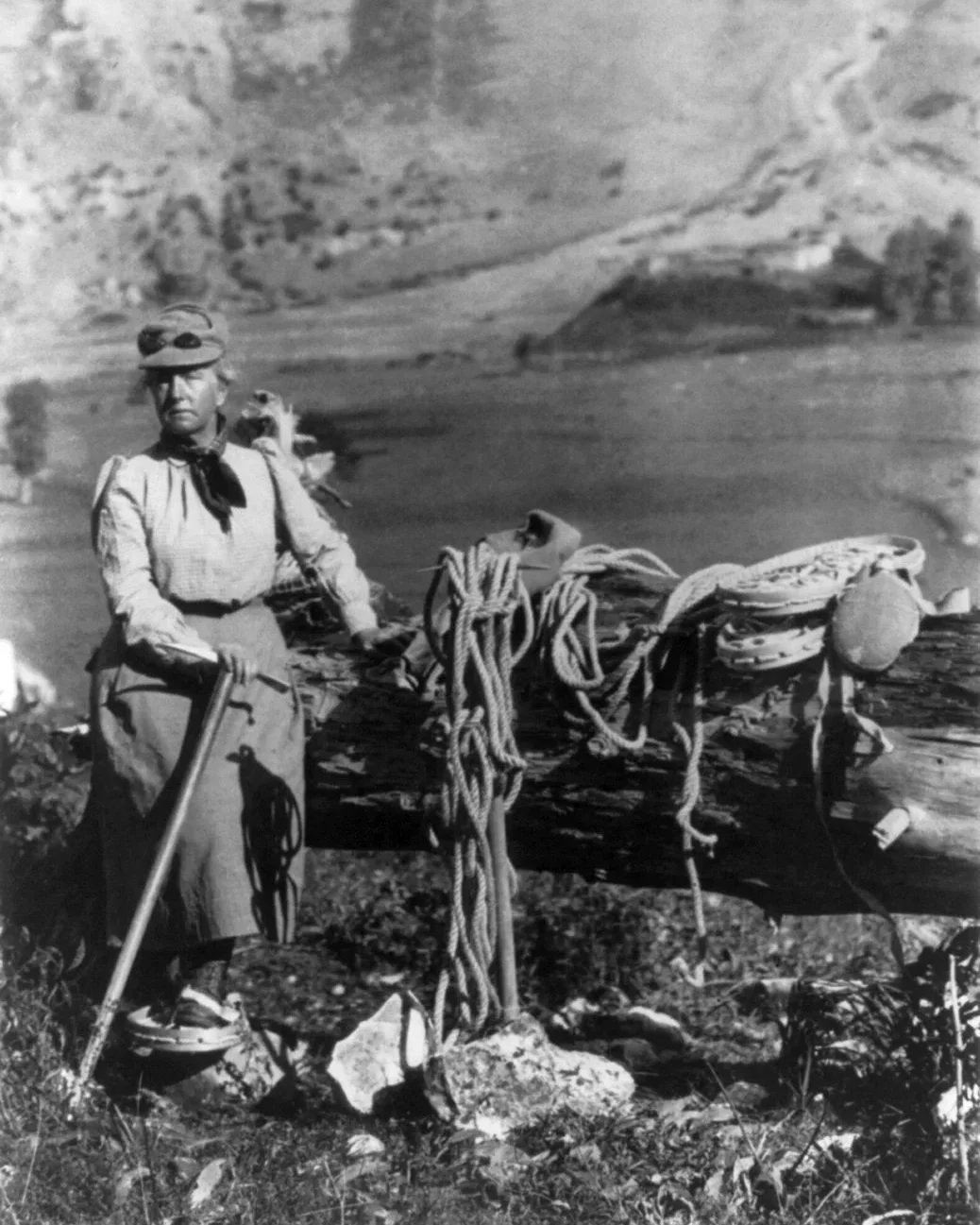

Fanny Bullock. Photo by Wikimedia Commons.

Fanny Bullock Workman was a fierce woman you wouldn’t want to cross. She had an impressive climbing resume, with ascents in the Alps, the Karakoram, and the Punjab Himalaya— she had one of the longer lists of ascents in the AAC’s founders section.

Deeply ambitious, Workman snatched the women’s altitude record from Annie Peck in 1906 when she climbed Pinnacle Peak in the Nun Kun massif in the Himalaya. This spurred Peck to try to take the record back with her climb of Mt. Huascarán, which she claimed to be higher than Pinnacle Peak.

People were engrossed in their feud. The media couldn’t get enough of two powerful women in the same field fighting for the top spot—or rather, the highest spot. Both women gave interviews for articles in newspapers like the Trenton Evening Times, Harrisburg Daily Independent, Detroit Free Press, and Suburbanite Economist, to name a few—defaming one another and trying to frame the story's narrative for their benefit. Whether their feud was malicious or mutually beneficial, people knew their names and accomplishments as mountaineers first, then as women.

In 1909, the American Alpine Club invited Annie Peck to speak about her ascent of Mt. Huascarán. However, the Club grew concerned when newspaper coverage and fans began to question how she ascertained the height of the mountain. Earlier on the same day of her lecture at the AAC’s annual meeting, Charles E. Fay, Vice President of the AAC, proposed an investigation into the height of Huascarán since “exaggerated reports have recently been circulated by the press...regarding the altitude of Mt. Huascarán.”

News outlets exaggerated the peak’s height to up to 26,000 feet. Peck had not brought an aneroid barometer—a sealed metal chamber that expands and contracts depending on the atmospheric pressure around it—with her on the climb to measure the altitude, nor did she take a measurement from the summit, so she couldn’t be sure about the height.

Workman wanted to end speculation and get her title back. In 1909, she spent the equivalent of half a million dollars to send surveyors to Peru to find the true height of Mt. Huascarán. The surveyors returned with triangulated heights for both the north and south peaks. They determined that the north peak was 21,812 feet (modern technology has determined it is actually 21,831 feet) and the South Peak was 22,187 feet (actually 22,205 feet). Either way, Pinnacle Peak was higher than both.

According to a 1911 New York Times article, the Academy of Sciences ruled in Workman’s favor. The year prior, in a letter sent from Henry G. Bryant, then AAC President, to Annie Peck, Bryant said the AAC sided with Workman’s assessment of the peak’s height. Workman had won back the altitude record, retaining her reign over women’s alpinism.

Caught off guard, Peck didn’t hesitate to make a quippy remark in a letter back to Bryant: “I had not been aware that her interest in my ascent of Huascarán extended so far, though I am not surprised. What fine thing it is to have plenty of money!”

But not all was lost for Peck. In 1910, the Hassan Cigarette Company featured a series of trading cards titled “World’s Greatest Explorers.” Out of 25 cards, Peck was the only woman featured. That same year, the Singer Sewing Machine Company gave away a packet of postcards featuring Peck’s travels and climbing accomplishments with every machine they sold. She still published her book about her expedition on Mt. Huascarán, but switched the title from The Apex of America to A Search for the Apex of America. She was a household name, something money can’t buy.

Still, you wouldn’t have wanted to be seated between Peck and Workman at the American Alpine Club Annual Gathering that year.


These four women helped shape the Club as we know it today. Fuller, Workman, Peck, and Peary were strong-willed, educated women in a world governed by rules and regulations of what a woman should be. Each woman stood defiant in her own way. Fuller was independent. Peary welcomed exploration. Peck believed in safety regardless of norms. Workman was dogged in all of her pursuits. They were courageous and ambitious, petty and imperfect. They were history makers. They were part of something bigger than themselves.
Sign Up for AAC Emails

The Lizard Life: A Glimpse at Hueco Climbing Culture in Its Modern Age

Photo by AAC member Michael Lim.

By Hannah Provost

Originally published in Guidebook XVI

Luis Contreras is breathing steadily, forcefully, with intention.

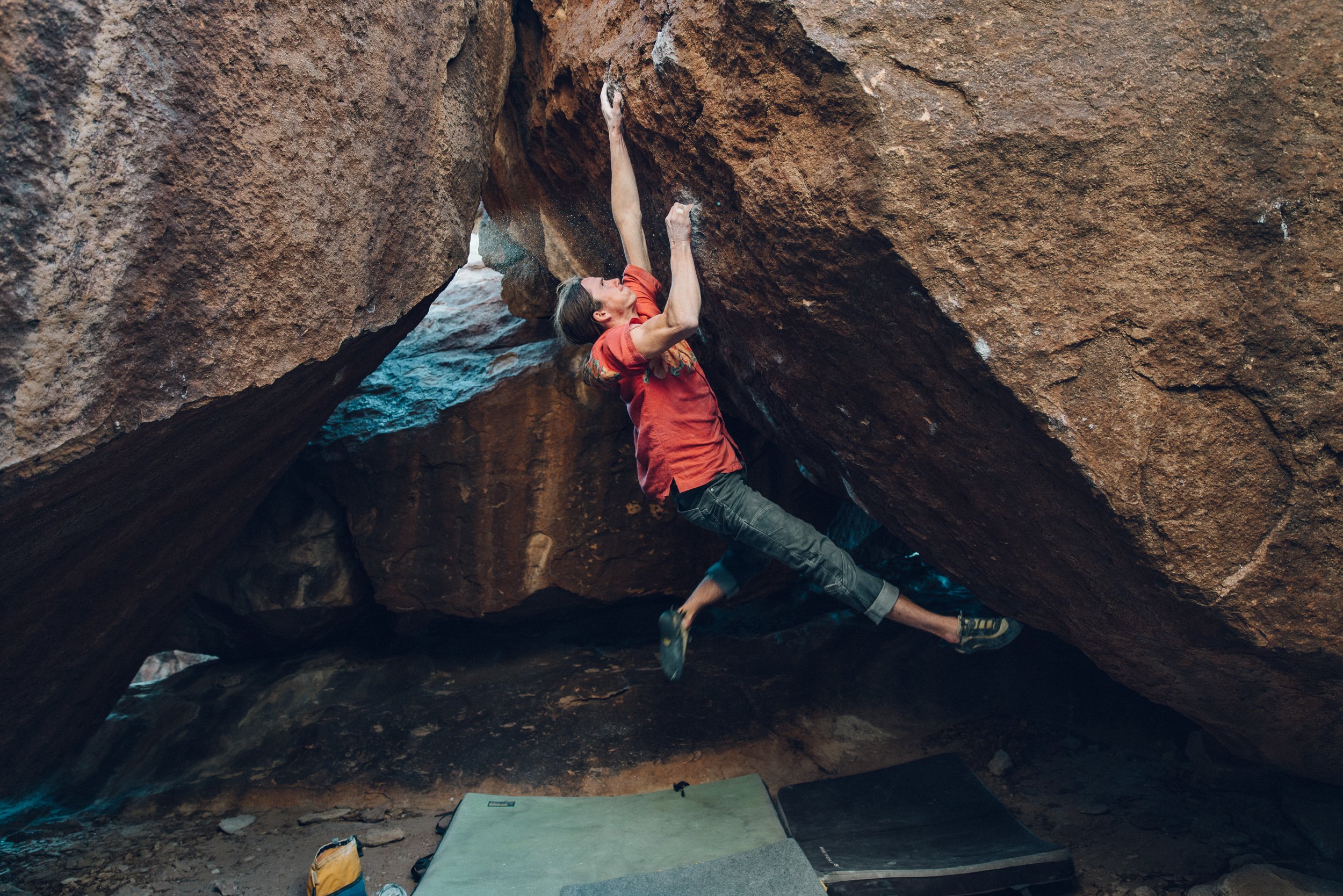
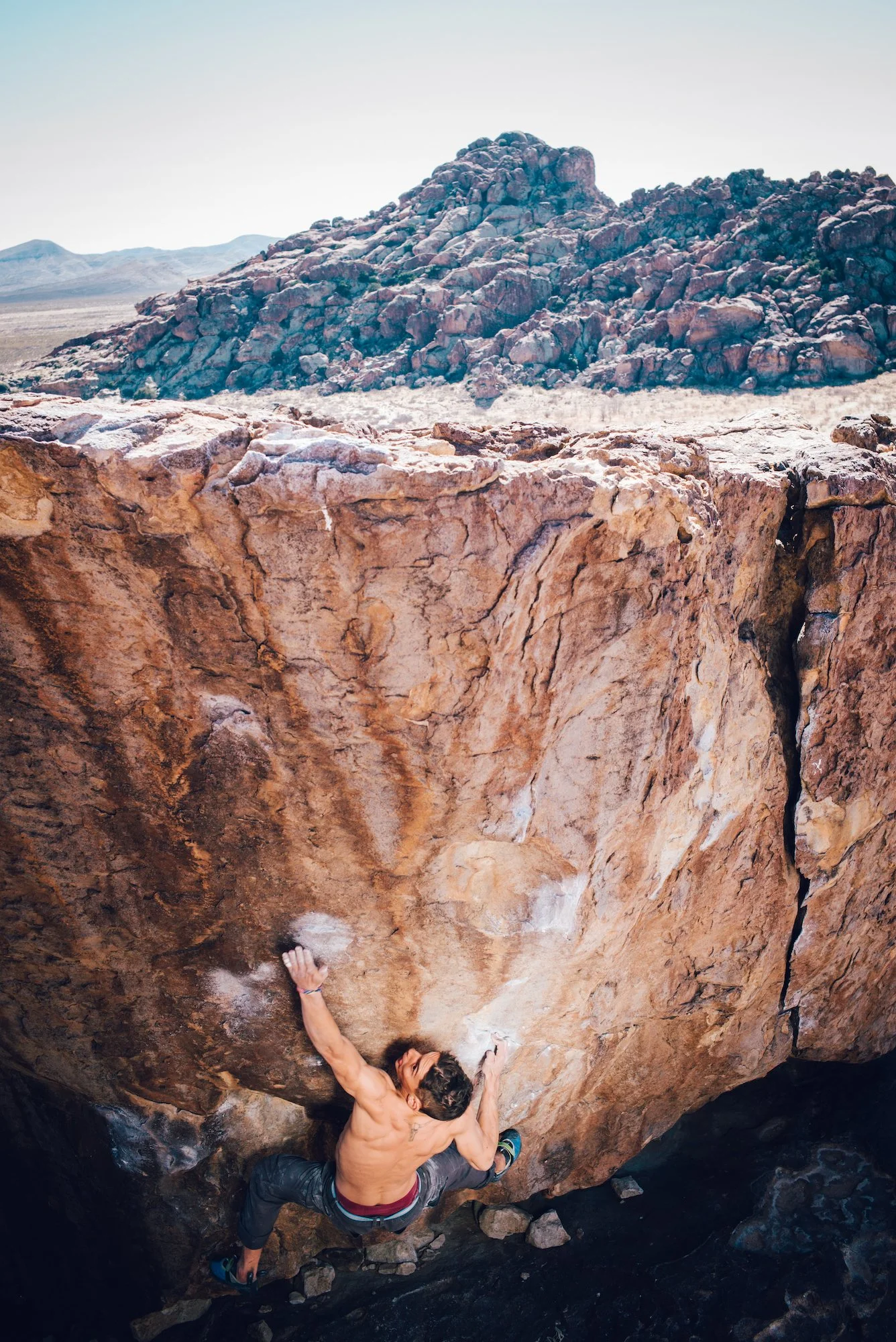
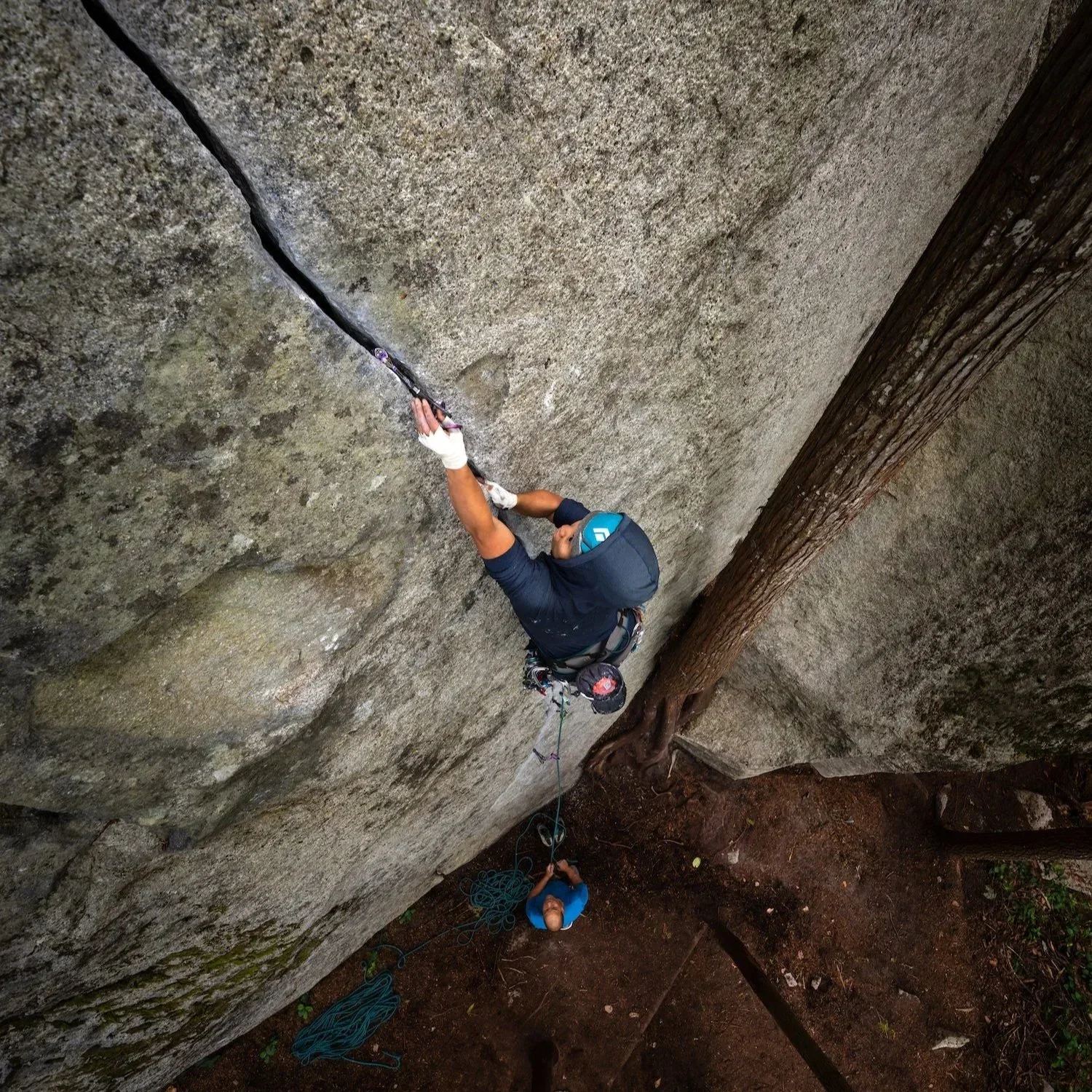
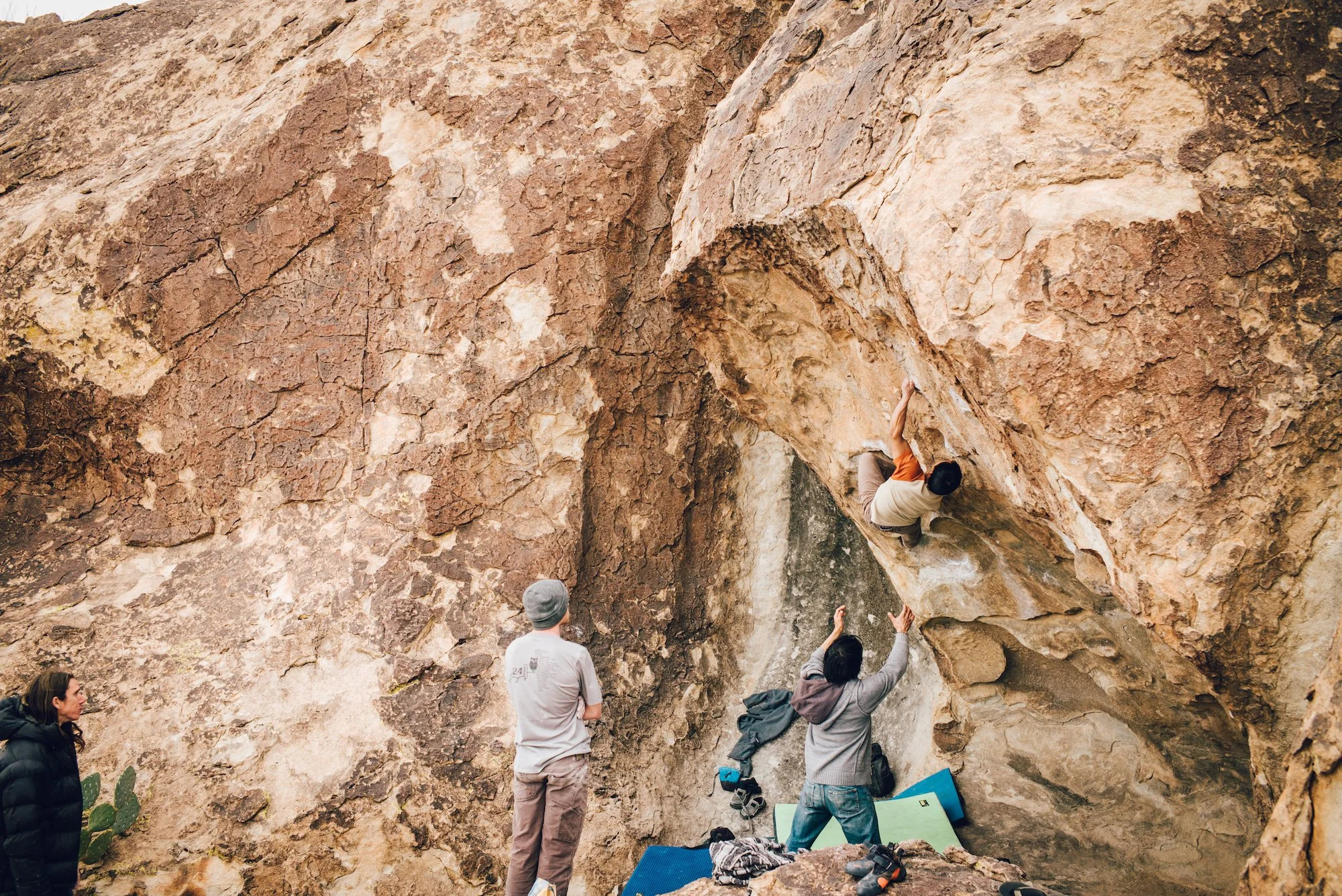
He is 15 feet off the deck, and has 20 more feet of textured edges, sidepulls, and huecos to top out Wyoming Cowgirls, a 35-foot V5 on Hueco Tanks’ North Mountain that has recently been reopened.

A few pads sit lonely in the rocks below. Each of his precise foot placements and composed breaths are indicators of the stakes, and they reflect the time this climber put into top-rope rehearsing such a consequential highball. His movements are linked in chains of powerful bursts punctuated by rests. A certain barely observable shaking reverberates from his core into his limbs, but his breaths and the wind are the song he is dancing to—the shaking and the fear squashed down.

For Contreras, “the best climbs are the ones that even if you’re not a climber you walk by and you say, 'Wow that’s a sick climb...' I [am] drawn to these striking tall faces.” Wyoming Cowgirls had always been one of those climbs.

Contreras tops out quietly, his focus unwavering until he is fully over the rounded slab of this immense boulder, where he sits. No whoops, no cheers. Just a private adrenaline high coursing through his veins.

Instead of celebration, he gazes out to the brush-filled desert beyond.


How do you understand the essence of a place? There are of course the facts and figures, the ecology and topography of the terrain, but there are also the traditions and rituals and history of the people who move across it. Such entanglements are why some might say that “the climbing community” (singular) is a misnomer. Our landscapes too-specifically shape us.

For example, Rifle is the land of lifers. That tight canyon, with its near-instant access to climbing seconds from the car, allows for kids splashing in the stream, craggers at Project Wall rubbernecking as you drive by, and the daily parking shuffle as you move from crag to crag. Ten Sleep is Adult Summer Camp: Given the long journey required to get there and its minimal infrastructure, the place welcomes tech bros and remote workers to set up shop for a month or the whole summer, with scheduled camp activities limited to river time, brewery time, or climbing time. As a final example, the Red River Gorge is never never land, where a dirtbag might never grow up.

Climbing cultures, like any culture, are a mixture of language, beliefs, rituals, norms, legends, and ethics that are largely shared by a community and emerge from the interaction of that community with their landscape. Hueco’s iconic roofs, abundant kneebars, airy highballs, deep bouldering history, importance to Indigenous cultures like the Tigua Indians of Ysleta del Sur, and fragile and rare ecosystem shape its climbers too, on an individual level and at scale.


Bouldering in Hueco is an intimate affair. With guides required to access most of the climbing, and groups capped at ten people, “most people know most people, and if you don’t know them it’s only a matter of time,” says Luis Contreras, who is a Hueco guide of a decade and El Paso born and raised.

Most climbers at Hueco fall into one of four groups: the El Paso “city” climbers, the lifers who own property right outside Hueco Tanks State Park, the seasonal dirtbags who migrate every winter, and the out-of-town visitors who pilgrimage there (often yearly) when they can scrabble together some PTO. Even the visitors become known entities—once you have a guide you trust, why not come back to climb with them again and again? You’ll likely find who you’re looking for at one of three community hubs: the Iron Gnome, the AAC’s Hueco Rock Ranch, or the Mountain Hut.

Photo by AAC member Dawn Kish.

Within such a small community, a run-in with an old head or unique character is considered commonplace. You might chat with Lynn Hill over beers at the Iron Gnome, or spot Jason Kehl out in the distance developing a new line. You’ll likely wave at Sid Roberts as he leaves the park from his early-morning session, or even share a laugh with the colorful John Sherman—the originator of the V-Scale.

But no matter what kind of Hueco climber you are, climbing at Hueco feels deeply entangled—it requires a self-consciousness of landscape, access, and ethics that doesn’t just fall away when you throw down your pads and pull onto rock. But that’s not a downside for locals like Luis Contreras and Joey McDaniel. That’s the richness of it.


Among the javelinas and ringtails, among the scooped huecos and textured patina crimps, it’s common to hear the idea that “climbing in Hueco is a privilege.”

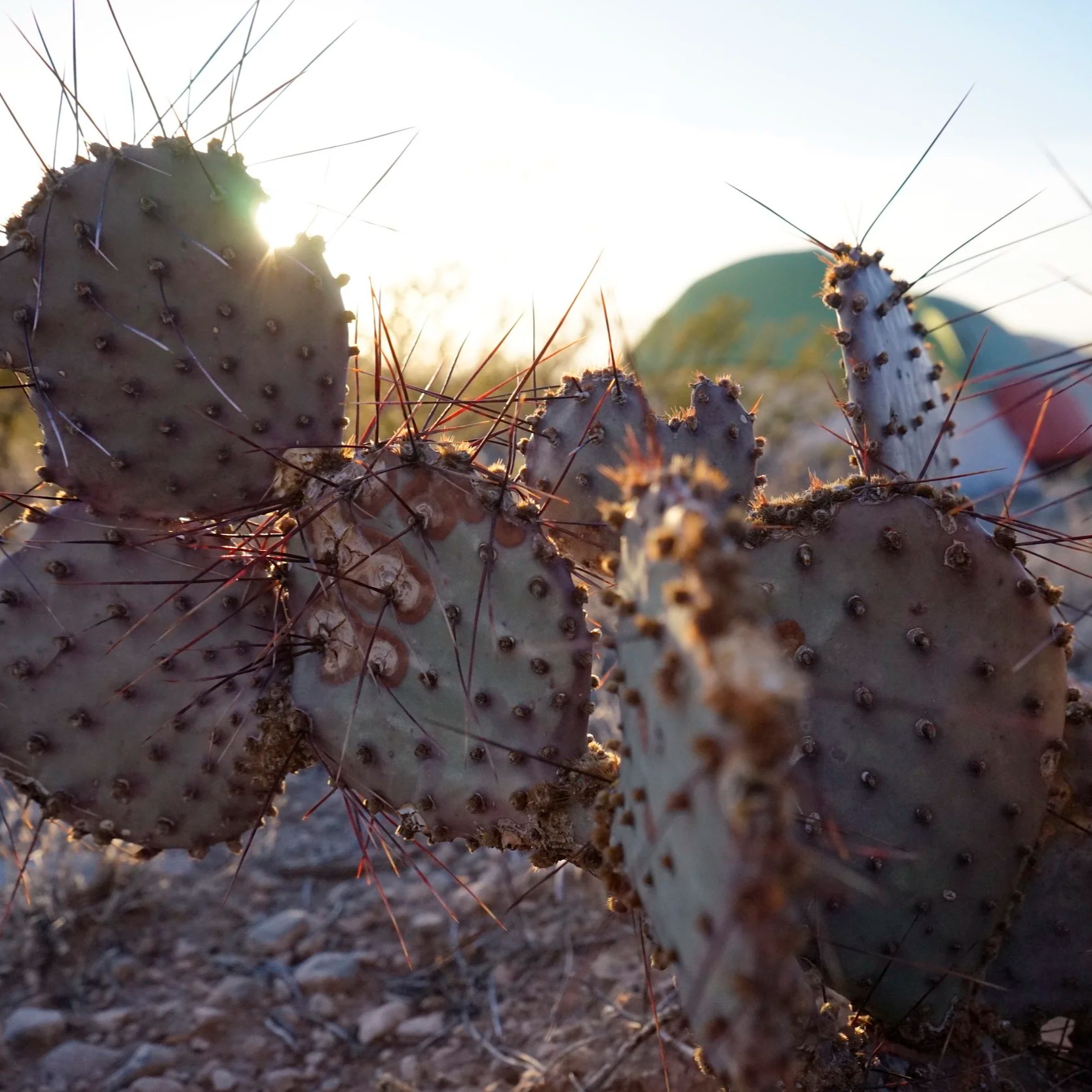
Again and again, locals point to a shared ethic when asked about the culture of Hueco. There is a protectiveness over the ecological uniqueness of the place. The Chihuahuan Desert holds 25 percent of the world’s cacti diversity after all—including prickly friends like the Texas rainbow cactus, scarlet hedgehog cactus, and horse crippler cactus. Hueco guide Joey McDaniel always likes to say, when it comes to Hueco, “the more you look, the more you see.” And indeed, for the ancient water systems in the huecos for which the park gets its name—where the famous fairy shrimp eggs lie in wait, for years at a time, anticipating the water that will enable them to hatch— this is most certainly the case.

Some Hueco climbers express pride in the sandbagged nature of the grading. Others hold tight to the humbling challenge posed by the proliferation of highballs in the area.

Others note the awe of walking past ancient rock art on your way to the proj, or learning from a tribal elder during the park’s Community Fair (also known as the Interpreter Fair) about the way local tribes continue to celebrate Hueco as a sacred space.

For some, there is something special about how knowledge and local ethics are passed down orally—from guide to climber as they laze about in the shade between burns. Whether it’s the story behind the FA of Scarface and The Flame, or how Verm started it all.

Plus, climbing at Hueco doesn’t come easy. It’s serious business that you follow established trails, and climbing is an absolute no-go until at least 24 hours after it rains. Water scarcity in this desert area can be a pain for van-lifers, and group dynamics among tours can be a challenge when climbers don’t agree on an itinerary, or are restricted by the number of groups that can be in one area at a time. Evidently, going with the flow is essential.

Photo by AAC member Michael Lim.


Photo by AAC staff Foster Denney.

Book Your Stay at the Hueco Rock Ranch

The AAC’s lodging facilities are a launch pad for adventure and a hub for community and the Hueco bouldering season is upon us! Experience this place for yourself by booking your stay at the Huceo Rock Ranch today.

AAC members enjoy discounts at lodging facilities across the country. Not a member? Join today.


But these are the rules of the Hueco game.

Some of Hueco’s traditions flirt with a classic climbing motivator: competition.

Photo by AAC member Foster Denney.

Challenges are what you get when locals get bored—or when climbers want to break from the bleariness of project-send-repeat. They range from famous and lauded, like the Big Five in Fontainebleau—a circuit of five classic problems from 7c to 8a (V9 to V11) in the Cuvier Rempart sector, which pro climbers now complete in a day—to locally legendary, like the Dungeon Master challenge at Staunton Rocks, which involves sending all the 5.13s at the crag in a day (still unclaimed).

At Hueco, there’s the Wanker 101.

The Wanker 101 is a list of one-hundred-and-one boulders on North Mountain, ranging up to V2 but most in the V0 range, that essentially functions as a tour-de-North Mountain and an iconic test piece of volume, skin strength, and planning. These days, a number of the original lines are closed due to proximity to rock art or fragile environmental surroundings, so alternative problems have been chosen to ensure the challenge lives on.

Carrie Cooper, reflecting on her experience completing the challenge in an article for Climbing, highlights how unexpectedly challenging the Wanker is, even if by the numbers it looks trivial. But with that volume of climbing, and romping on beautifully sculpted holds, can come a climber’s high: “It felt like falling in love. Problems 96 to 99 were fantastic, every move a joy. We would rest at interesting holds, 15-plus feet up, no pad, almost singing to one another the beauty of the climb.”

During the 2024-2025 winter season, AAC Hueco Rock Ranch camper Jackson Jewett on-sighted the challenge in a very impressive time of 5 hours 38 minutes.

In recent years, a new challenge has emerged that’s a little more bite-sized, though one climber reflects that “so far, all who've completed it have tasted blood.” The car-to-car format of the No One Runs Out of Here Alive Challenge is familiar, but with a bouldering twist. Competitors bust up the infamous chain trail on North Mountain, top out Nobody Gets Out of Here Alive (one of the most iconic and classic V2s at Hueco) and return to the starting position. The fastest time is currently held by Jake Croft at 6 minutes, 24 seconds.

Of course, other traditions have popped up, shaped by Hueco’s unique environment. One that stands out is the newer tradition of Aoudad Feast.

Aoudads are barbary sheep that roam in and out of Hueco Tanks State Park and the surrounding area. These brown mountain-goat-looking creatures are actually invasive, and have posed a growing problem in the park, due to overgrazing, kicking up soil, displacing native animals, and competing for the same resources. For Aoudad Feast, local climber Billy Heart hunts a few aoudad (outside the park boundaries of course) and provides a meal for local climbers—an excuse to gather and bring attention to the ecological impact of the aoudad, which is often incorrectly attributed to climbers. Appropriately for the desert, the party can get a little weird.

While not necessarily making a dent in this environmental issue, the event is symbolic at the least—these local climbers are tuned in to what matters to Hueco climbing, and how access is complexly intertwined with the landscape’s environmental health.


Hueco, importantly, has a critical role in bouldering history and the cutting edge of the sport. It has become known as a proving ground for climbers of all levels. And it certainly has been the site of many a sending rampage. Though no doubt it requires “paying your dues” to learn the movement and style, the rock also largely rewards strength and power—something plenty of pro boulderers have in spades. For example, Nathaniel Coleman showed up to the AAC’s 2024 Hueco Rock Rodeo and flashed Slashface (V13) and sent Li (V13) and Coeur de Leon (V14), among plenty of other double-digit boulders.

Similarly, Michaela Kiersch had her “best bouldering day ever” at the same Rodeo, reclimbing Crown of Aragorn (V13) and standing atop plenty of other double-digit boulders, like Thrilla in Manilla (V12), Rumble in the Jungle (V12), Phantom Limb (V12), Power of Landjager (V11), and Sunshine (V11).

Matt Fultz, a pro climber known for being down-to-earth with an unusually long wingspan, has been at the forefront of recent hard ascents in Hueco in the last year. Last winter he reopened a climb that previously had been done at V12, located on the left side of the famous Martini Cave. A key hold had broken around 2005, and the route was proclaimed impossible. Fultz was able to reopen the problem again as The Hangover, playing into the martini theme of the area. According to Fultz, it was “probably the most morpho problem [he’s] ever done.” He shares: “I thought the original sequence looked so fun, but was disappointed to hear it was broken and impossible. It wasn’t until last year that I realized I could potentially span the move, but only using every inch of my [six-foot-five] wingspan, along with extra strategy on how I would grip the holds and set up for the move. After a few days of dialing in the sequence, I was able to open up the line again.”

Photo by AAC member Keith Allen Peters.

That same season, Fultz also did the second ascent of Desesperación, and has proposed an upgrade to V15 for the climb, since he thought it was at least a grade harder than its twin, Esperanza (V14). Reflecting on his process, Fultz shares that Desesperación “involves some cryptic moves in and out of a kneebar to some very intense shoulder and tension positions, all through a 60-to-70 degree roof. It’s so cool! It was a pleasure to work out the moves from scratch, as all I had for clues on beta were a couple pictures from the first ascensionist, Martin Mobraten. Projecting Desesperación was different from trying The Hangover in that the biggest challenge was solving the puzzle rather than spanning the moves.”

Of course, Jason Kehl has proved ever-prolific in his ongoing development of boulders in the park, but first ascents on the cutting edge of the sport have slowed down. Fultz thinks that will change in the future: “To my knowledge there is currently nothing harder than V15 that has been climbed at Hueco, but I believe that there is so much potential for harder problems! And with how incredibly talented the upcoming generation of boulderers are, I have no doubt V16 and beyond will come to Hueco in the near future. I think generally people can find Hueco difficult for projecting or having extended trips due to the regulations, but what I’ve found is that they're really not as bad as their reputation.”


Photo by AAC member Michael Lim.

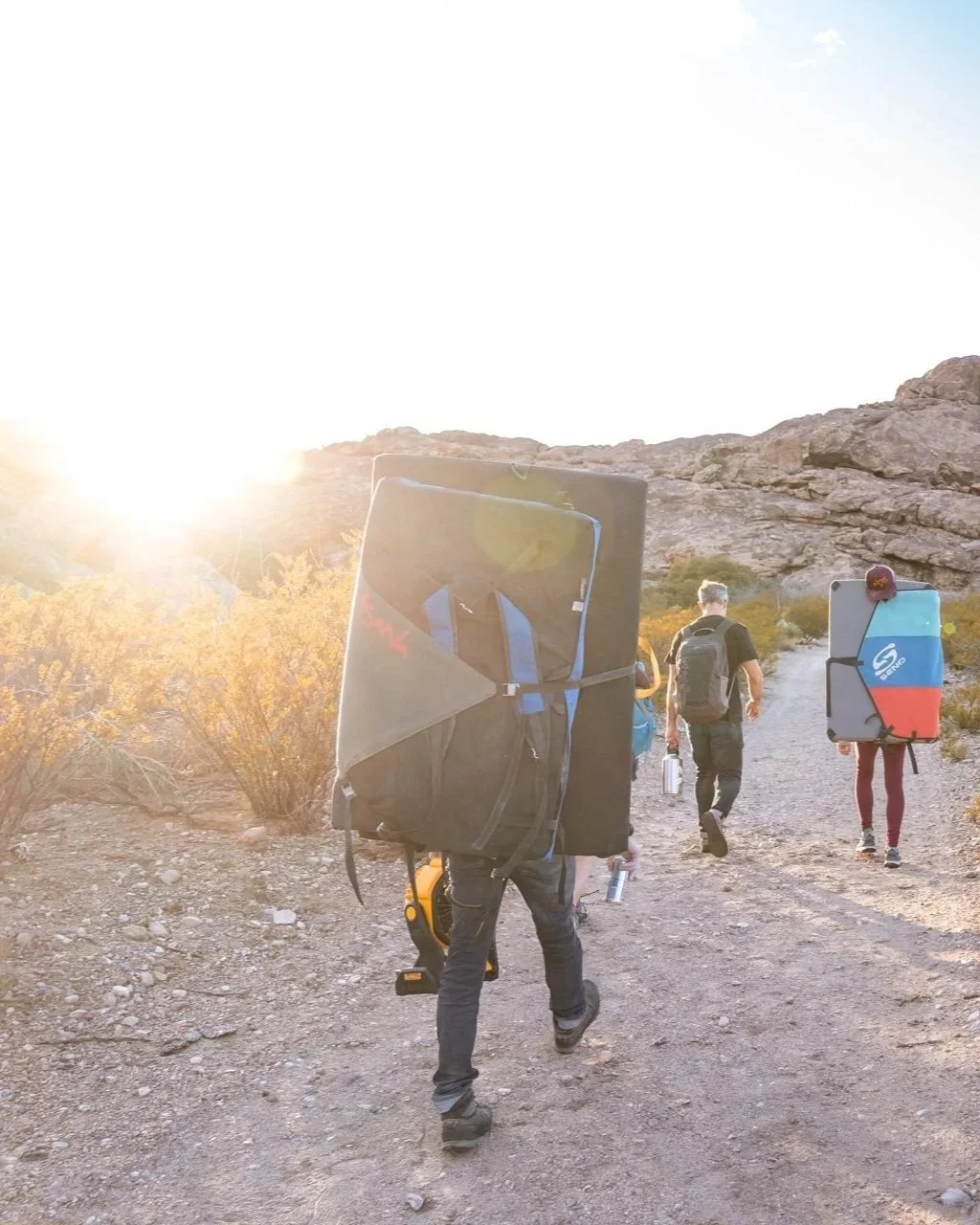
But Hueco’s star status for the pros is just one piece of the puzzle. The close-knit “keep it small” culture at Hueco is why the mijos and mijas will rally around a friend to support a big highball attempt, lugging out pads on a rest day. It’s reinforced by how far Hueco and El Paso are from other major cities, requiring a force of will to get there. And it’s fueled by waiting in the hot desert sun in your car, living the “lizard life” as one climber called it, alongside friends and strangers, waiting in line to be one of the 70 climbers allowed into North Mountain to climb for the day—knowing that climbing access isn’t a guarantee.

Rather than begrudging the regulations and inconvenience, many climbers of Hueco seem to recognize that the lizard life represents something necessary about an incredible world-class climbing area that climbers share with the world. This holistic take on climbing access even pervades the art coming out of the Hueco climbing scene. The Hut Smut Review is a zine that many locals and travelers have contributed to in its first few years. The driving force behind Hut Smut is to get into the complexities of who we are as climbers and how that fits into our other identities. Joe Knapp, one of the creators of the zine, says the idea originated during the dead space and boredom of hot lizard days. What else will emerge from this landscape?

Like every crag, Hueco is a unique experience. Traditions and competitions have emerged around Hueco’s boulders, ecology, and culture. Climbers aren’t afraid to hold each other to the ethics of the area. And at the center of it all are the crimps that taste like glory, that pulled us in in the first place.

Forget stone monkeys—meet us in the dusty Hueco Tanks parking lot so we can be rock lizards.

Psyched to visit Hueco? It’s imperative that you be in the know on all Hueco Tanks State Park regulations and the ins and outs of getting a guide: tpwd.texas.gov/state-parks/ hueco-tanks/activities


Sign Up for AAC Emails

The Fluidity of Grief and Beauty: A Story from the McNeill-Nott Award

Photo by AAC member Kelly Fields.

By Heather Smallpage

Originally published in Guidebook XVI

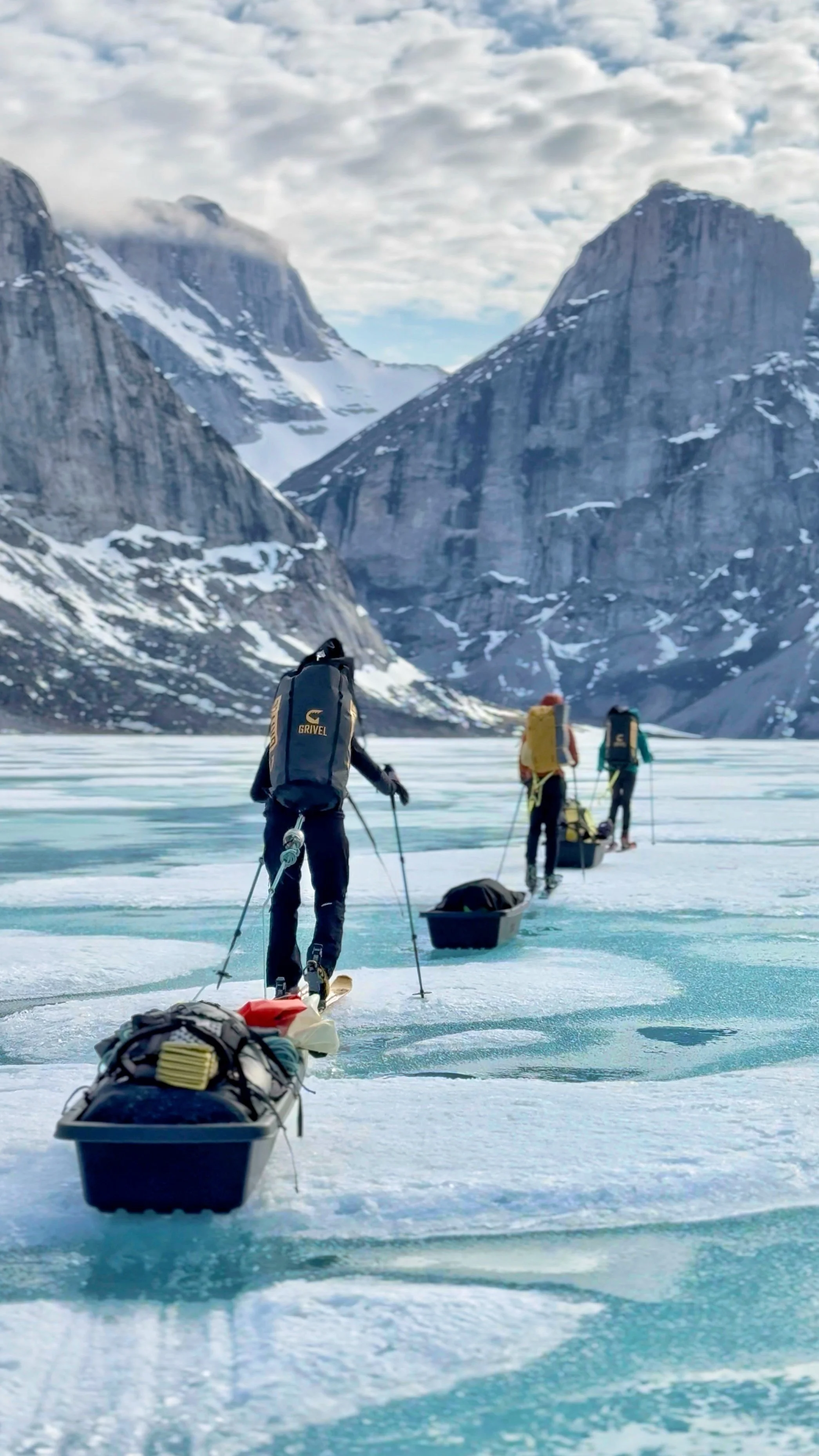
I move, therefore I am. I reminded myself of this throughout the journey to and from Arviqtujuq Kangiqtua, formerly known as Eglinton Fjord. Throughout our five-week, multi-sport, primarily human-powered expedition to Baffin Island, in the Canadian Arctic, Kelly Fields, Shira Biner, Natalie Afonina, and I continued to move. We skied over 100 miles across the sea ice in order to get there, and we slogged for another 100 miles over moraine fields, loose talus, sinking meadows, a frozen lake, and a partially frozen river to get out. Movement was our rule, our rhythm. And as a team of three women and a non-binary person, we were motivated to define this movement on our own terms.

Kelly, Shira, Natalie, and I met for the first time in person at the Ottawa Airport en route to the Arctic. Only a few of us had tied in together before this trip. Prior to our real-life introduction, we spent months exchanging messages, photos, screenshots, videos, and group calls on WhatsApp. Now, past the logistical chaos of prep for this expedition, we still had a lot of learning to do about each other. I’m lucky in that I know an abundance of female, non-binary, and queer people who are incredible climbing partners. I prefer to rope up with them because of my ongoing struggles with self-confidence and self-trust that I learned in the shadow of my male climbing partners.

Here was an opportunity to move toward my goals and the style of climbing that most inspires me, alongside a group of people who uplift one another. When we received our first grant—the McNeill-Nott Award from the American Alpine Club—I started to feel that other people believed in us, which gave me more belief in myself. Representation is important, and the organizations that supported us believed that too. It was coming together all too perfectly.


I stared at the vast ice and seascape before me: Circles of white interrupted the piercing blue water that settled up to a foot deep in some places. We were leaving the bay in the small Inuit community of Clyde River.

The gray sky let go of gentle snowflakes that melted on my sunglasses, making my surroundings appear as if I were looking out a window on a rainy day. “So...how thick is this ice?” I asked, my voice wavering. The last time I had put skis on was a number of years ago. On snow, on solid ground.

However, I was soon submerged within and captivated by the ice’s symphony as we glided, heaved, soared over, walked, and trudged—depending on the conditions of the sea ice—over a hundred miles on a seascape that was constantly changing. Moving through that environment was dictated by the wind, temperature, snow, and our bodies’ needs. One moment, we would be trapped in a cloud, the snow absorbing the sound around us and sticking to our ski skins so thick that we had to take them off. Moments later, after turning a corner, the winds had blown the clouds and snow off the surface, and we found ourselves flying over the best ice conditions we had yet experienced. That landscape spoke to me, telling me that it, too, exists in states of movement and change.

I often look to the natural world to find my own sense of belonging. Being a non-binary person often means that I don’t always find a type of belonging that is representative. I struggle in groups of men. In groups of women, I push back on the definitions and create an exclusionary space for myself. Asking for a non-binary category creates the exact thing I don’t want to exist within: a category. One day, I hope I can exist in a way that is outside the confines of man or woman—that I can exist as myself without needing to choose between explaining and educating, or quietly disrespecting myself.

Photo by AAC member Natalie Afonina.

The thing about gender, being non-binary specifically, is that it’s simultaneously the most painful and most beautiful experience one can have. There is a deep gratitude in being the truest form of yourself; there is a wholeness in accepting one’s authenticity. It can also often be painful to a core level. My relationship with gender is like the Arctic wind: always present, sometimes gentle and caressing, other times a chaos that threatens to knock me down.

I felt the spirits skiing into Arviqtujuq Kangiqtua. Finally, among those great walls, exhausted, hungry, sore, and cold, we debated where to set up our base camp and had a hard time getting anywhere productive with it. I remember feeling confused about how I could be in the greatest place I’ve ever stood, a place that made my soul feel so full, yet in conditions that made my humanity feel so absent. Feeling insignificant because of landscapes that humble us is familiar to me, welcomed even. I much prefer the way the land makes me feel small, compared to the way humans have that same ability.

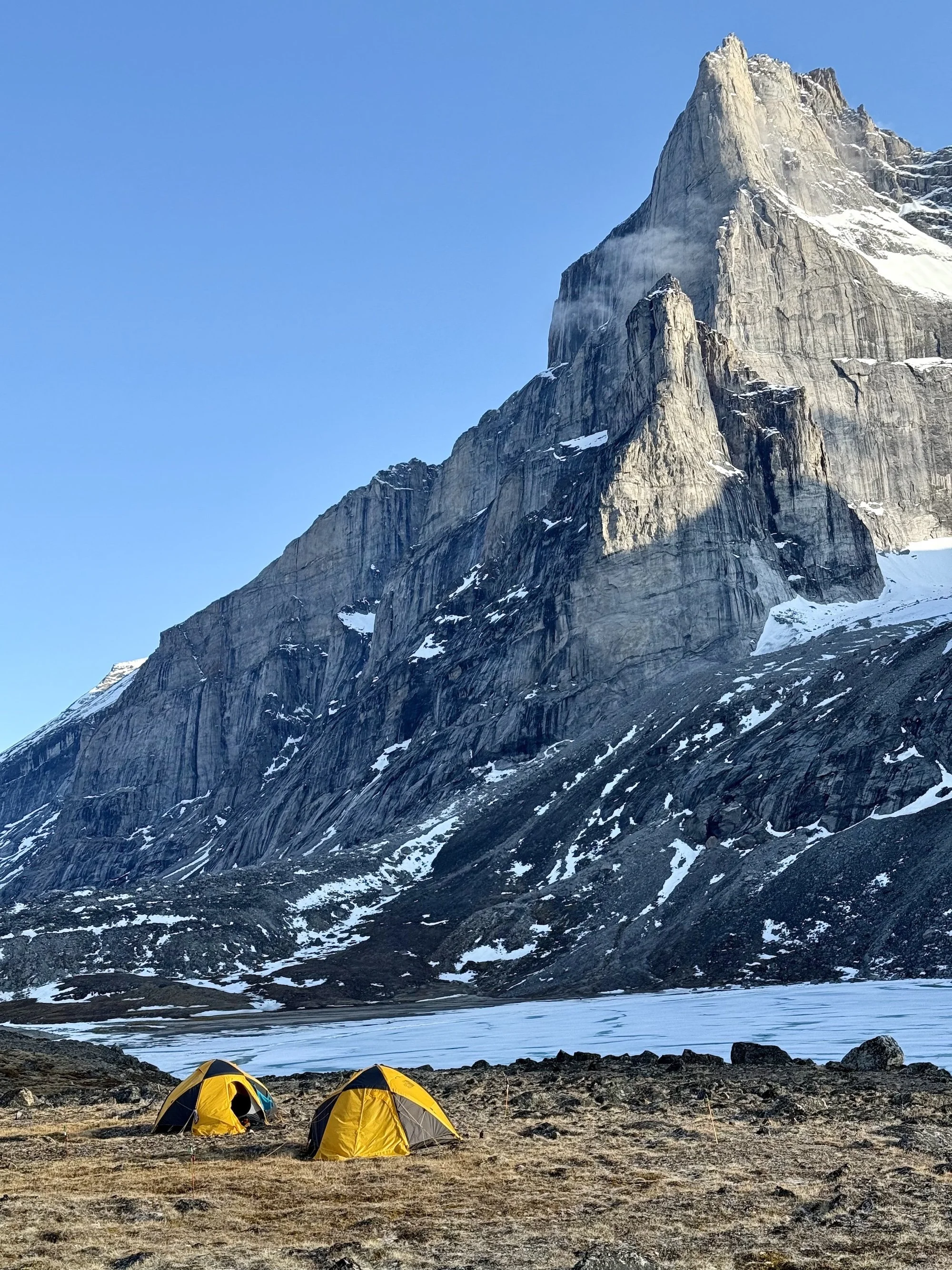
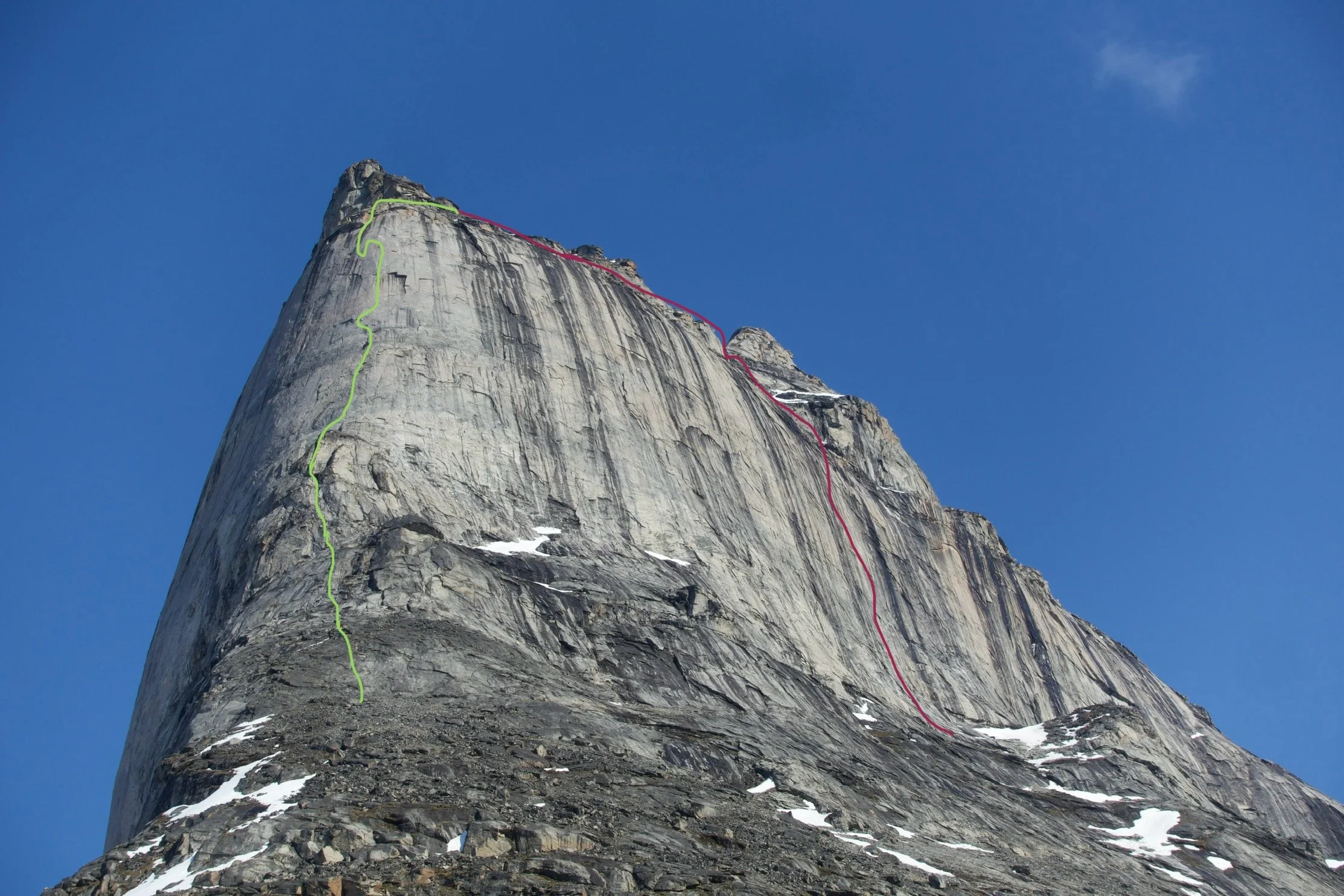
We settled into a base camp at the toe of Eglinton Tower. For a few days, we unpacked our cache of climbing gear and food, and Kelly and I healed our blisters we got from skiing in. I had blisters, and Kelly essentially had holes in her feet. After a few days of rest and skin care, inspired by a period of good weather, we started up the talus to the mountain’s base.

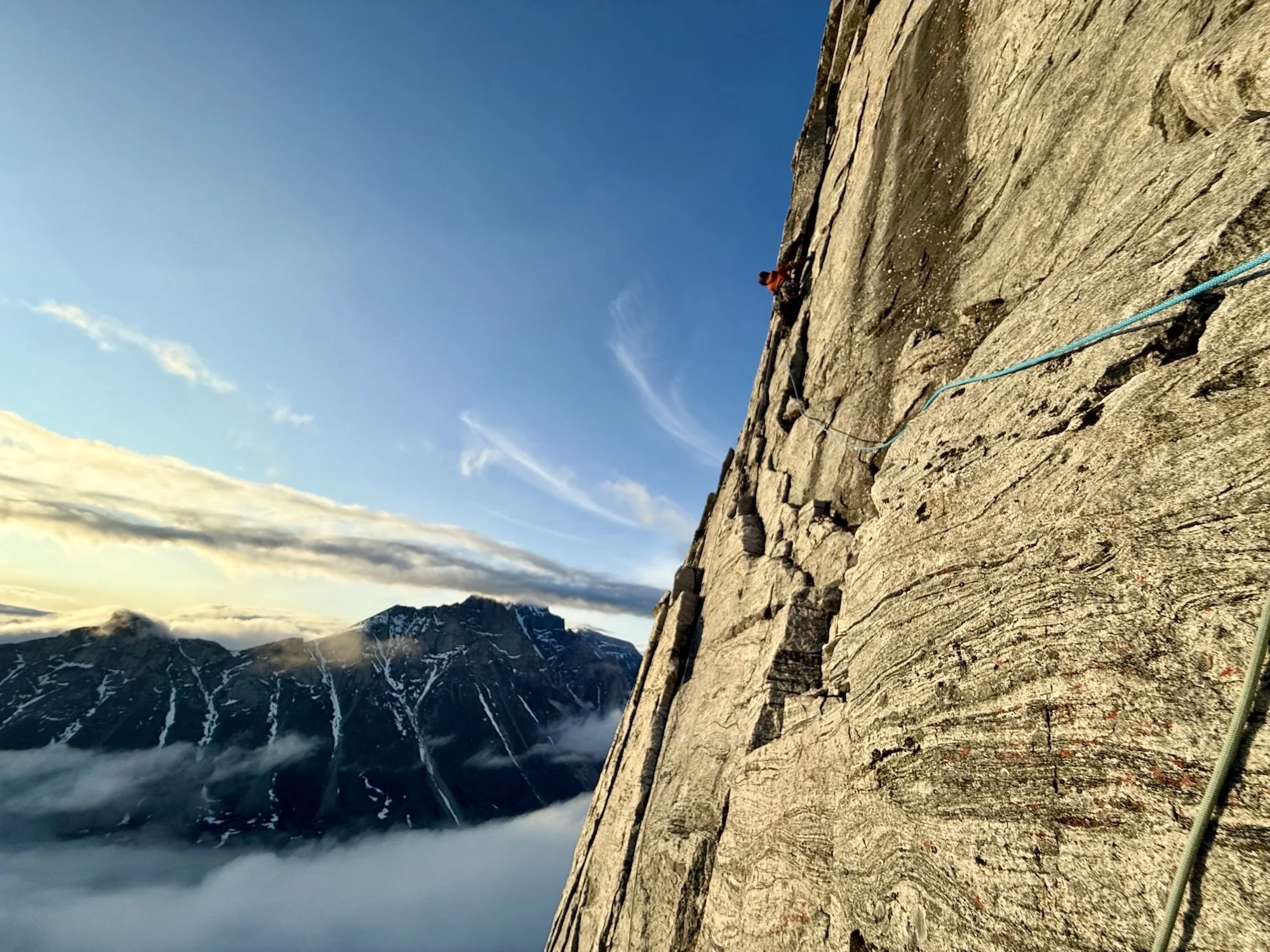
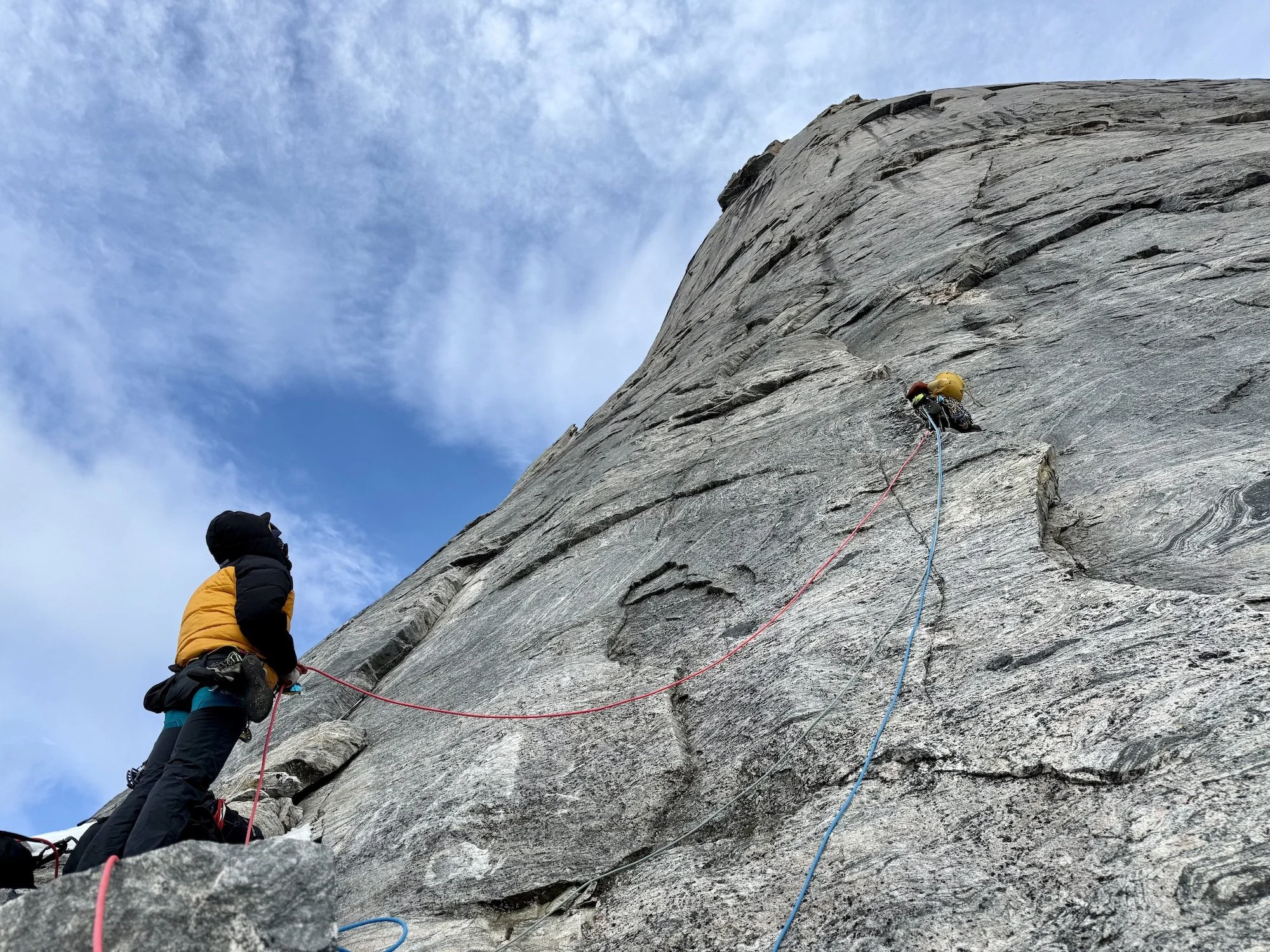
Some hours later, I found myself in a massive offwidth flake high up on the route at midnight, poking my head outside of it, feeling the never-setting sun on my skin. I saw a river of clouds drifting through the canyon below us, swallowing the ground and remaking it into a moving mass of shadows, curves, and drifts that was the most spectacular portrayal of beauty my eyes have had the pleasure of taking in. I started crying in disbelief. Then crying in belief. How often is it that we have the opportunity to pause and take in the moments of beauty that surround us? I had not experienced something that forced me to see my own grandeur and the beauty of it all, or to reckon with the work that I’ve put into arriving here. I found myself in the center of all of that, celebrating this arrival as I felt my humanity swimming through my body as I swam my way up the chimney.

Eglinton Tower has two tiered summits connected by a long stretch of 2nd-to-5th-class terrain. We ascended the main headwall on the lower summit, walked along a series of ledges, and scrambled to the top of a terrace as snow and wind started blowing. From there, we saw the true summit, another 300 meters of rock with portions of snow and ice. It looked unwelcoming and uninspiring with the worsening weather and our lack of food and energy. We celebrated our high point and began our 11-hour descent.

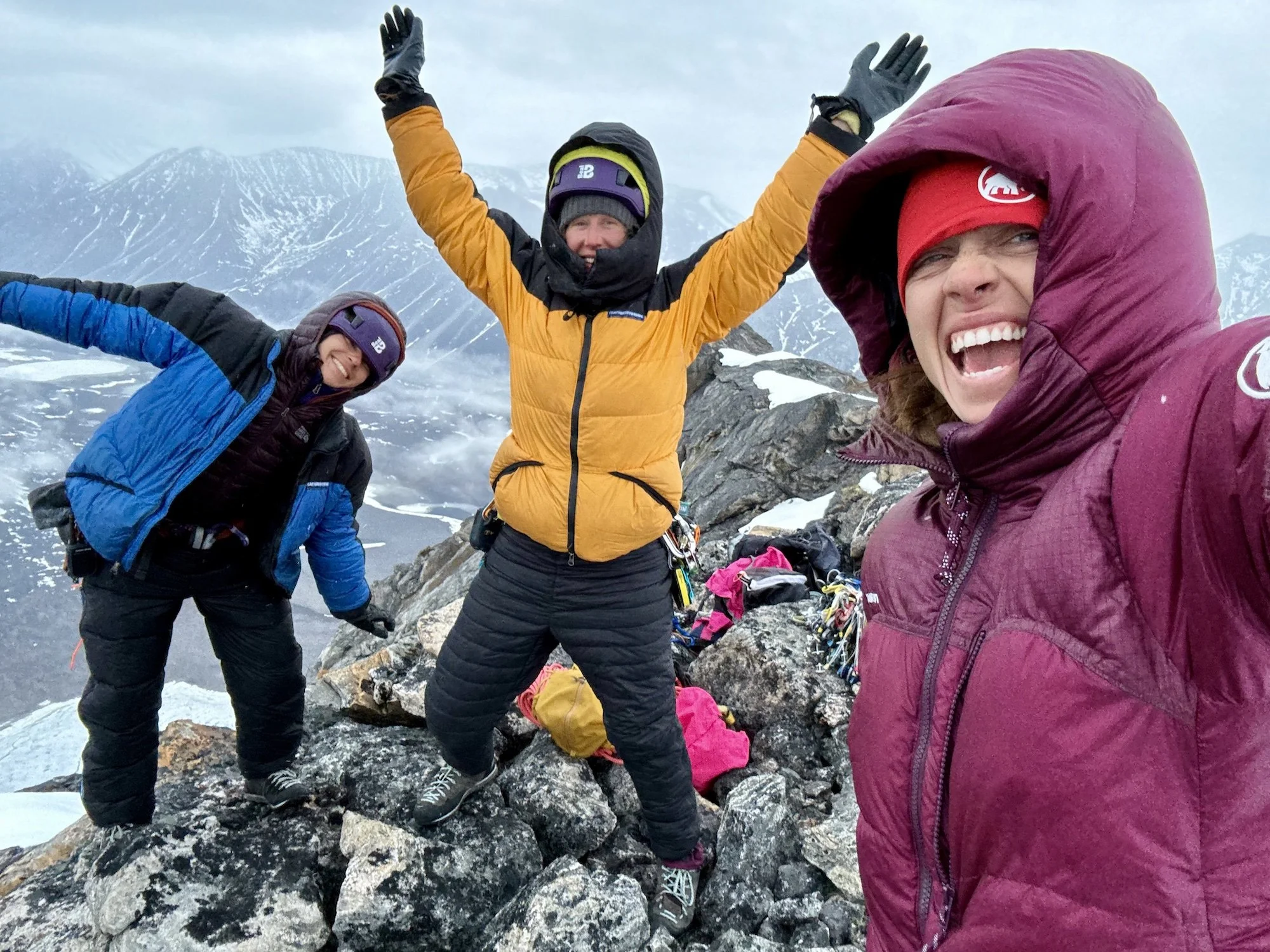
After 49 hours, Kelly, Shira, and I had made our way up and down Eglinton Tower, establishing Lemnos in the Clouds (5.11+ A0). I could say many things about that climb—about our shiver bivy, how Kelly climbed in approach shoes because her heels still had holes in them, how beautiful the rock was to climb, witness, and respect—but the lessons it taught me in taking that pause stay with me most. A pause to let yourself listen to and sing with the birds, to witness the magnificence of your surroundings, and yourself within them; a pause to allow yourself to be in awe.

Photo by AAC member Kelly Fields.


Photo by AAC member Heather Smallpage.

After resting for a few days and monitoring the weather, we decided to start moving from base camp to our next obstacle: Ayr Pass, a six-kilometer pass that connected us to Ayr Lake. It looked cruel and intimidating, and unfortunately was our only option to get back to Clyde River. Now that we had more food, our climbing gear, packrafts, and other essentials resupplied from the cache, we found ourselves with hundreds of pounds of food and equipment. Thus, we became mules.

As we approached Ayr Pass, the fjord fingered off into an outlet and the walls grew around us—the blackest walls I’ve ever seen, where light is swallowed by the water that has dripped and stained the rocks throughout time. We did some repacking and started off on the first of our slogs. First, we crossed a moraine field flowing with a river of silt, where our steps were swallowed by saturated sand and mud. Then came heinous mounds of sand, a frozen lake covered by avalanche debris that we post-holed through, and a large field of loose talus scattered with unstable boulders of all sizes. Finally, we navigated 3rd and sometimes 4th-class terrain with our loads threatening our balance. At last we arrived at our new camp with stiff shoulders and bruised hips, surrounded by tussocks, wildflowers, mosses, streams, boulders, and probably fairies. We walked Ayr Pass five times, three times with heavy, awkward bags.

The conditions of Ayr Lake were a big question mark, and one that would dictate how fast we could move and how easy it would be to continue. Navigating an ice breakup is difficult and incredibly slow-moving work, which we hoped to avoid by getting to the lake before the weather warmed up. Fortunately, it was still solidly frozen apart from the edges, so we packed our pulks again with all our gear and headed north, across the lake toward the Kuugaaluk River.

All this slogging allowed me to take a moment to check in with myself. At this point three weeks in, I wasn’t eating or sleeping much. I felt angry and I couldn’t focus for long. Suddenly, it became abundantly clear: I wasn’t doing too well.

Despite so many moments of connection with myself, moments that could be nothing but experiencing a relationship with this landscape, I was emotionally exhausted from, of all things, disconnection.

I had hoped that going to Baffin Island with women would be a chance to be part of something that could heal some of the jealousy, insecurity, and isolation I feel when I compare myself to people I can understand but don’t identify with. Instead, I found myself drowning. The contradiction was startling: We were in a landscape that elicits a presence that connects to the soul, among certain dynamics that severed any hope of authenticity from each other. The weight of the grief grew heavier as I came to understand that I wasn’t part of a team where there was care for one another or compassionate communication, as I had dreamed.

We were a fractured group because of behaviors that placed experiences and achievements above character.

Photo by AAC member Kelly Fields.


Support This Work—AAC Grants

Today, with up to $100,000 in annual grant awards, the Club continues to support these endeavors and is proud to stand behind the individuals and their projects which seek the betterment of the climbing community and climbing landscapes.


Photo by AAC member Kelly Fields.

Approaching the end of our trip, we spent two days paddling on the Kuugaaluk River— the two most peaceful days of the expedition. On our first day, we were in light rain as we pushed off from our beachfront camp. Our second day on the river immersed us in blue skies and gentle flows.

I spent the few hours we had on the river floating and singing along with the rhythm of the water. It was a time for reflection about all the land we had moved across, by foot, ski, rock, and water; all the far-reaching sights we had seen; and the variety of noises the wind creates. It was a place that connected me to myself, and the changing currents of the water reminded me of the changes in myself—my movement going forward, my flow being the pace of the moment, needing to be nothing more than what I am. The river offered me peace and gentleness when I needed it most. When we got to shore, I thanked the Kuugaaluk as I looked up and felt the sunshine on my skin.

To me, the Arctic feels like a landscape that knows no depth, with wisdom frozen in the glaciers and a sea that is inaccessible to those just passing through. It is a place that impels one to be fully present with your surroundings.

I left Baffin Island with feelings of wonder, gratitude for the lessons from the land, and a deep exhaustion permeating my mind and body. Since coming back and having space to process the duality of the beauty and grief of it all, I’ve felt as if I’ve been laid out for the one who matters most: myself. My resiliency, grit, and authenticity stare back at me. I moved deeper into the person I am.

I move, therefore I am.


Sign Up for AAC Emails