Photo by AAC member Michael Lim.
By Hannah Provost
Originally published in Guidebook XVI
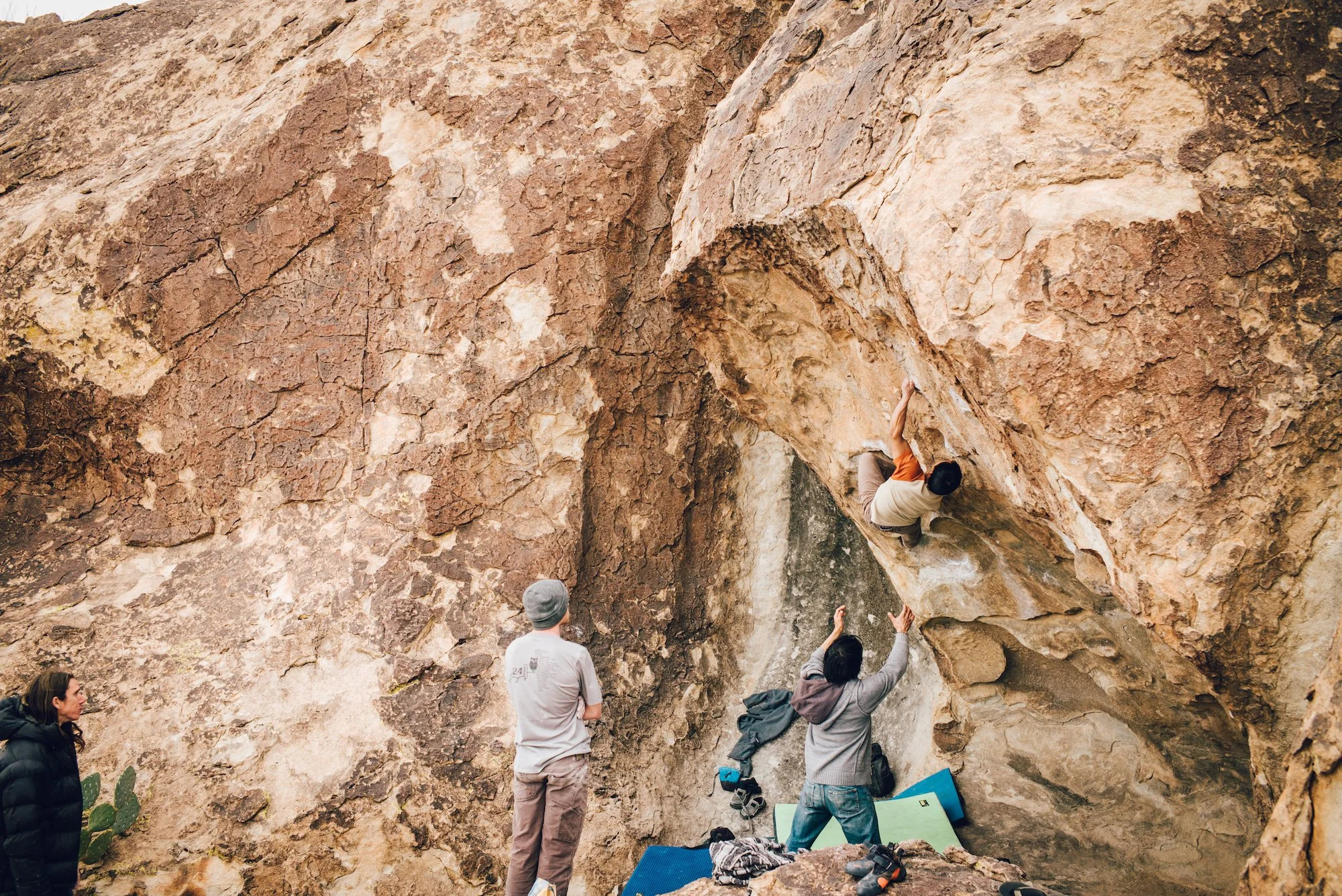
Luis Contreras is breathing steadily, forcefully, with intention.
He is 15 feet off the deck, and has 20 more feet of textured edges, sidepulls, and huecos to top out Wyoming Cowgirls, a 35-foot V5 on Hueco Tanks’ North Mountain that has recently been reopened.
A few pads sit lonely in the rocks below. Each of his precise foot placements and composed breaths are indicators of the stakes, and they reflect the time this climber put into top-rope rehearsing such a consequential highball. His movements are linked in chains of powerful bursts punctuated by rests. A certain barely observable shaking reverberates from his core into his limbs, but his breaths and the wind are the song he is dancing to—the shaking and the fear squashed down.
For Contreras, “the best climbs are the ones that even if you’re not a climber you walk by and you say, 'Wow that’s a sick climb...' I [am] drawn to these striking tall faces.” Wyoming Cowgirls had always been one of those climbs.
Contreras tops out quietly, his focus unwavering until he is fully over the rounded slab of this immense boulder, where he sits. No whoops, no cheers. Just a private adrenaline high coursing through his veins.
Instead of celebration, he gazes out to the brush-filled desert beyond.
How do you understand the essence of a place? There are of course the facts and figures, the ecology and topography of the terrain, but there are also the traditions and rituals and history of the people who move across it. Such entanglements are why some might say that “the climbing community” (singular) is a misnomer. Our landscapes too-specifically shape us.
For example, Rifle is the land of lifers. That tight canyon, with its near-instant access to climbing seconds from the car, allows for kids splashing in the stream, craggers at Project Wall rubbernecking as you drive by, and the daily parking shuffle as you move from crag to crag. Ten Sleep is Adult Summer Camp: Given the long journey required to get there and its minimal infrastructure, the place welcomes tech bros and remote workers to set up shop for a month or the whole summer, with scheduled camp activities limited to river time, brewery time, or climbing time. As a final example, the Red River Gorge is never never land, where a dirtbag might never grow up.
Climbing cultures, like any culture, are a mixture of language, beliefs, rituals, norms, legends, and ethics that are largely shared by a community and emerge from the interaction of that community with their landscape. Hueco’s iconic roofs, abundant kneebars, airy highballs, deep bouldering history, importance to Indigenous cultures like the Tigua Indians of Ysleta del Sur, and fragile and rare ecosystem shape its climbers too, on an individual level and at scale.
Bouldering in Hueco is an intimate affair. With guides required to access most of the climbing, and groups capped at ten people, “most people know most people, and if you don’t know them it’s only a matter of time,” says Luis Contreras, who is a Hueco guide of a decade and El Paso born and raised.
Most climbers at Hueco fall into one of four groups: the El Paso “city” climbers, the lifers who own property right outside Hueco Tanks State Park, the seasonal dirtbags who migrate every winter, and the out-of-town visitors who pilgrimage there (often yearly) when they can scrabble together some PTO. Even the visitors become known entities—once you have a guide you trust, why not come back to climb with them again and again? You’ll likely find who you’re looking for at one of three community hubs: the Iron Gnome, the AAC’s Hueco Rock Ranch, or the Mountain Hut.
Photo by AAC member Dawn Kish.
Within such a small community, a run-in with an old head or unique character is considered commonplace. You might chat with Lynn Hill over beers at the Iron Gnome, or spot Jason Kehl out in the distance developing a new line. You’ll likely wave at Sid Roberts as he leaves the park from his early-morning session, or even share a laugh with the colorful John Sherman—the originator of the V-Scale.
But no matter what kind of Hueco climber you are, climbing at Hueco feels deeply entangled—it requires a self-consciousness of landscape, access, and ethics that doesn’t just fall away when you throw down your pads and pull onto rock. But that’s not a downside for locals like Luis Contreras and Joey McDaniel. That’s the richness of it.
Among the javelinas and ringtails, among the scooped huecos and textured patina crimps, it’s common to hear the idea that “climbing in Hueco is a privilege.”
Again and again, locals point to a shared ethic when asked about the culture of Hueco. There is a protectiveness over the ecological uniqueness of the place. The Chihuahuan Desert holds 25 percent of the world’s cacti diversity after all—including prickly friends like the Texas rainbow cactus, scarlet hedgehog cactus, and horse crippler cactus. Hueco guide Joey McDaniel always likes to say, when it comes to Hueco, “the more you look, the more you see.” And indeed, for the ancient water systems in the huecos for which the park gets its name—where the famous fairy shrimp eggs lie in wait, for years at a time, anticipating the water that will enable them to hatch— this is most certainly the case.
Some Hueco climbers express pride in the sandbagged nature of the grading. Others hold tight to the humbling challenge posed by the proliferation of highballs in the area.
Others note the awe of walking past ancient rock art on your way to the proj, or learning from a tribal elder during the park’s Community Fair (also known as the Interpreter Fair) about the way local tribes continue to celebrate Hueco as a sacred space.
For some, there is something special about how knowledge and local ethics are passed down orally—from guide to climber as they laze about in the shade between burns. Whether it’s the story behind the FA of Scarface and The Flame, or how Verm started it all.
Plus, climbing at Hueco doesn’t come easy. It’s serious business that you follow established trails, and climbing is an absolute no-go until at least 24 hours after it rains. Water scarcity in this desert area can be a pain for van-lifers, and group dynamics among tours can be a challenge when climbers don’t agree on an itinerary, or are restricted by the number of groups that can be in one area at a time. Evidently, going with the flow is essential.
Photo by AAC member Michael Lim.
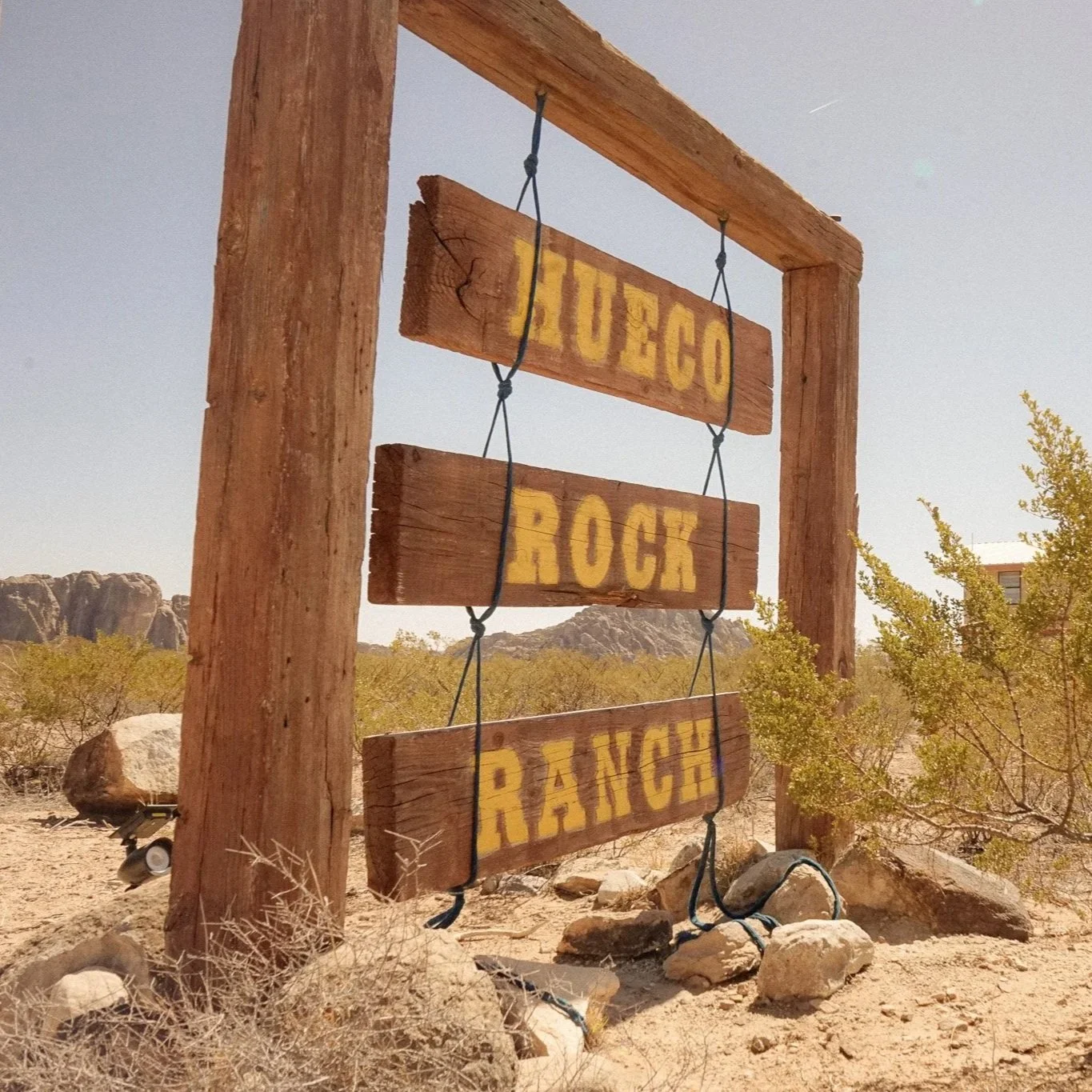
Photo by AAC staff Foster Denney.
Book Your Stay at the Hueco Rock Ranch
The AAC’s lodging facilities are a launch pad for adventure and a hub for community and the Hueco bouldering season is upon us! Experience this place for yourself by booking your stay at the Huceo Rock Ranch today.
AAC members enjoy discounts at lodging facilities across the country. Not a member? Join today.
But these are the rules of the Hueco game.
Some of Hueco’s traditions flirt with a classic climbing motivator: competition.
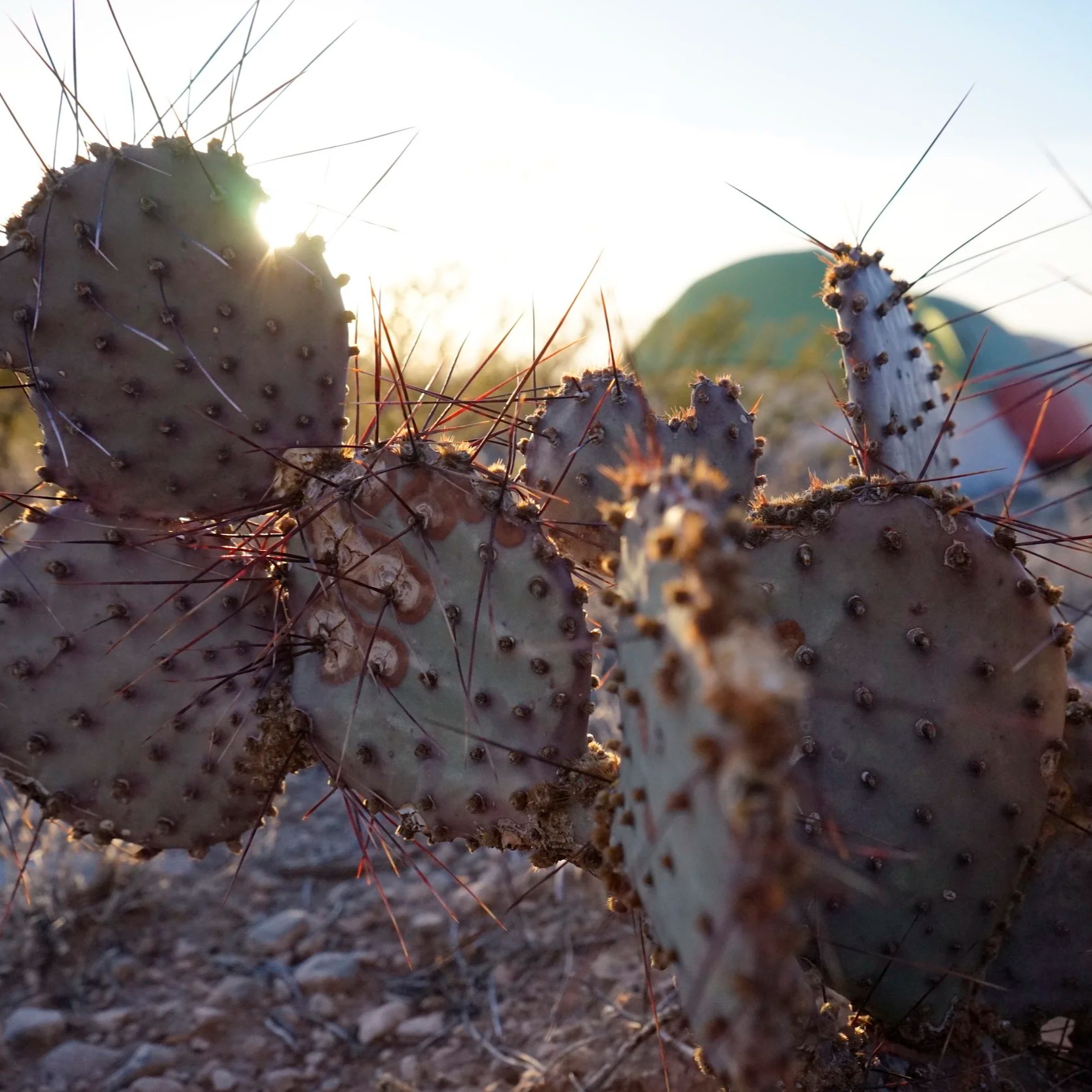
Photo by AAC member Foster Denney.
Challenges are what you get when locals get bored—or when climbers want to break from the bleariness of project-send-repeat. They range from famous and lauded, like the Big Five in Fontainebleau—a circuit of five classic problems from 7c to 8a (V9 to V11) in the Cuvier Rempart sector, which pro climbers now complete in a day—to locally legendary, like the Dungeon Master challenge at Staunton Rocks, which involves sending all the 5.13s at the crag in a day (still unclaimed).
At Hueco, there’s the Wanker 101.
The Wanker 101 is a list of one-hundred-and-one boulders on North Mountain, ranging up to V2 but most in the V0 range, that essentially functions as a tour-de-North Mountain and an iconic test piece of volume, skin strength, and planning. These days, a number of the original lines are closed due to proximity to rock art or fragile environmental surroundings, so alternative problems have been chosen to ensure the challenge lives on.
Carrie Cooper, reflecting on her experience completing the challenge in an article for Climbing, highlights how unexpectedly challenging the Wanker is, even if by the numbers it looks trivial. But with that volume of climbing, and romping on beautifully sculpted holds, can come a climber’s high: “It felt like falling in love. Problems 96 to 99 were fantastic, every move a joy. We would rest at interesting holds, 15-plus feet up, no pad, almost singing to one another the beauty of the climb.”
During the 2024-2025 winter season, AAC Hueco Rock Ranch camper Jackson Jewett on-sighted the challenge in a very impressive time of 5 hours 38 minutes.
In recent years, a new challenge has emerged that’s a little more bite-sized, though one climber reflects that “so far, all who've completed it have tasted blood.” The car-to-car format of the No One Runs Out of Here Alive Challenge is familiar, but with a bouldering twist. Competitors bust up the infamous chain trail on North Mountain, top out Nobody Gets Out of Here Alive (one of the most iconic and classic V2s at Hueco) and return to the starting position. The fastest time is currently held by Jake Croft at 6 minutes, 24 seconds.
Of course, other traditions have popped up, shaped by Hueco’s unique environment. One that stands out is the newer tradition of Aoudad Feast.
Aoudads are barbary sheep that roam in and out of Hueco Tanks State Park and the surrounding area. These brown mountain-goat-looking creatures are actually invasive, and have posed a growing problem in the park, due to overgrazing, kicking up soil, displacing native animals, and competing for the same resources. For Aoudad Feast, local climber Billy Heart hunts a few aoudad (outside the park boundaries of course) and provides a meal for local climbers—an excuse to gather and bring attention to the ecological impact of the aoudad, which is often incorrectly attributed to climbers. Appropriately for the desert, the party can get a little weird.
While not necessarily making a dent in this environmental issue, the event is symbolic at the least—these local climbers are tuned in to what matters to Hueco climbing, and how access is complexly intertwined with the landscape’s environmental health.
Hueco, importantly, has a critical role in bouldering history and the cutting edge of the sport. It has become known as a proving ground for climbers of all levels. And it certainly has been the site of many a sending rampage. Though no doubt it requires “paying your dues” to learn the movement and style, the rock also largely rewards strength and power—something plenty of pro boulderers have in spades. For example, Nathaniel Coleman showed up to the AAC’s 2024 Hueco Rock Rodeo and flashed Slashface (V13) and sent Li (V13) and Coeur de Leon (V14), among plenty of other double-digit boulders.
Similarly, Michaela Kiersch had her “best bouldering day ever” at the same Rodeo, reclimbing Crown of Aragorn (V13) and standing atop plenty of other double-digit boulders, like Thrilla in Manilla (V12), Rumble in the Jungle (V12), Phantom Limb (V12), Power of Landjager (V11), and Sunshine (V11).
Matt Fultz, a pro climber known for being down-to-earth with an unusually long wingspan, has been at the forefront of recent hard ascents in Hueco in the last year. Last winter he reopened a climb that previously had been done at V12, located on the left side of the famous Martini Cave. A key hold had broken around 2005, and the route was proclaimed impossible. Fultz was able to reopen the problem again as The Hangover, playing into the martini theme of the area. According to Fultz, it was “probably the most morpho problem [he’s] ever done.” He shares: “I thought the original sequence looked so fun, but was disappointed to hear it was broken and impossible. It wasn’t until last year that I realized I could potentially span the move, but only using every inch of my [six-foot-five] wingspan, along with extra strategy on how I would grip the holds and set up for the move. After a few days of dialing in the sequence, I was able to open up the line again.”
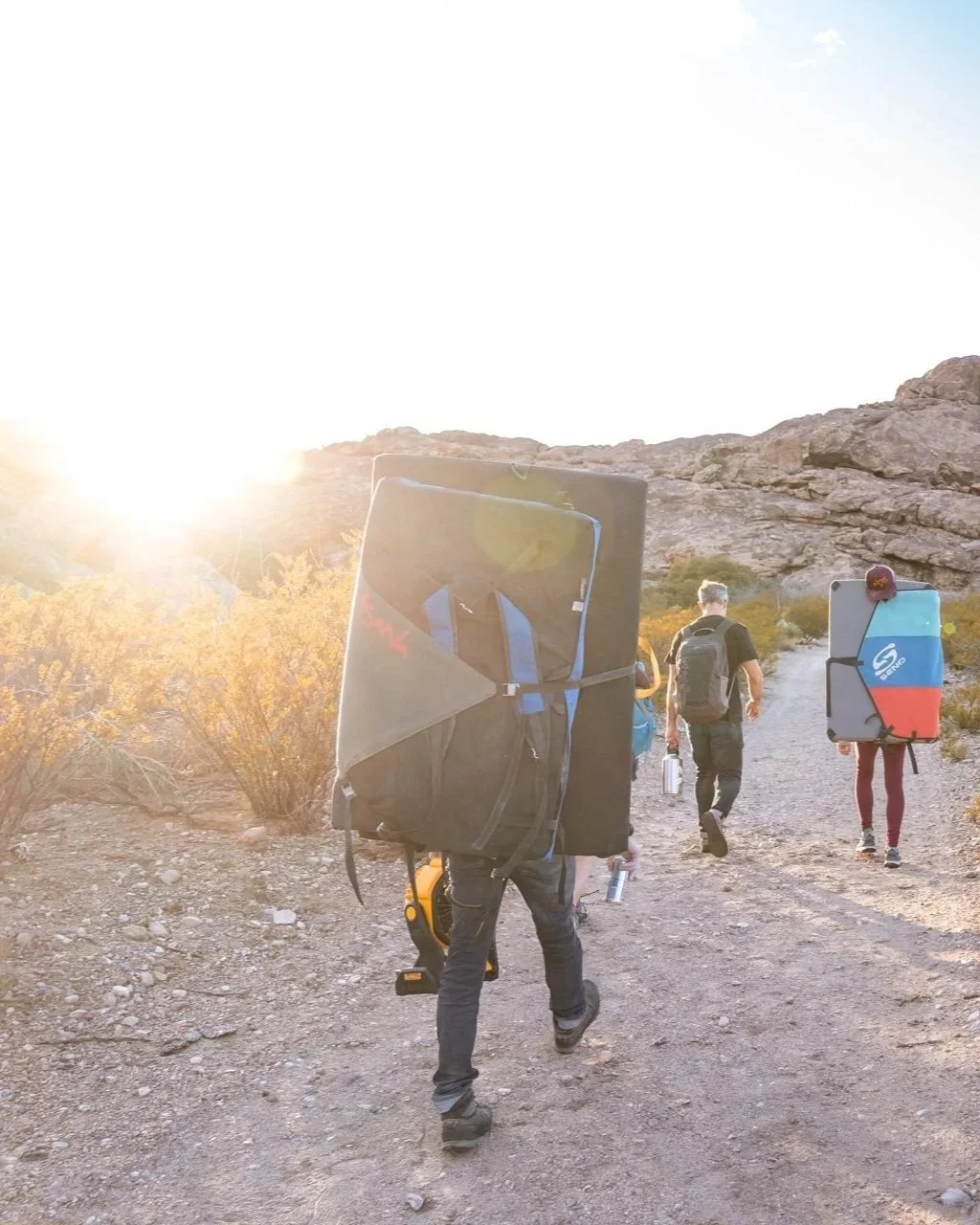
Photo by AAC member Keith Allen Peters.
That same season, Fultz also did the second ascent of Desesperación, and has proposed an upgrade to V15 for the climb, since he thought it was at least a grade harder than its twin, Esperanza (V14). Reflecting on his process, Fultz shares that Desesperación “involves some cryptic moves in and out of a kneebar to some very intense shoulder and tension positions, all through a 60-to-70 degree roof. It’s so cool! It was a pleasure to work out the moves from scratch, as all I had for clues on beta were a couple pictures from the first ascensionist, Martin Mobraten. Projecting Desesperación was different from trying The Hangover in that the biggest challenge was solving the puzzle rather than spanning the moves.”
Of course, Jason Kehl has proved ever-prolific in his ongoing development of boulders in the park, but first ascents on the cutting edge of the sport have slowed down. Fultz thinks that will change in the future: “To my knowledge there is currently nothing harder than V15 that has been climbed at Hueco, but I believe that there is so much potential for harder problems! And with how incredibly talented the upcoming generation of boulderers are, I have no doubt V16 and beyond will come to Hueco in the near future. I think generally people can find Hueco difficult for projecting or having extended trips due to the regulations, but what I’ve found is that they're really not as bad as their reputation.”
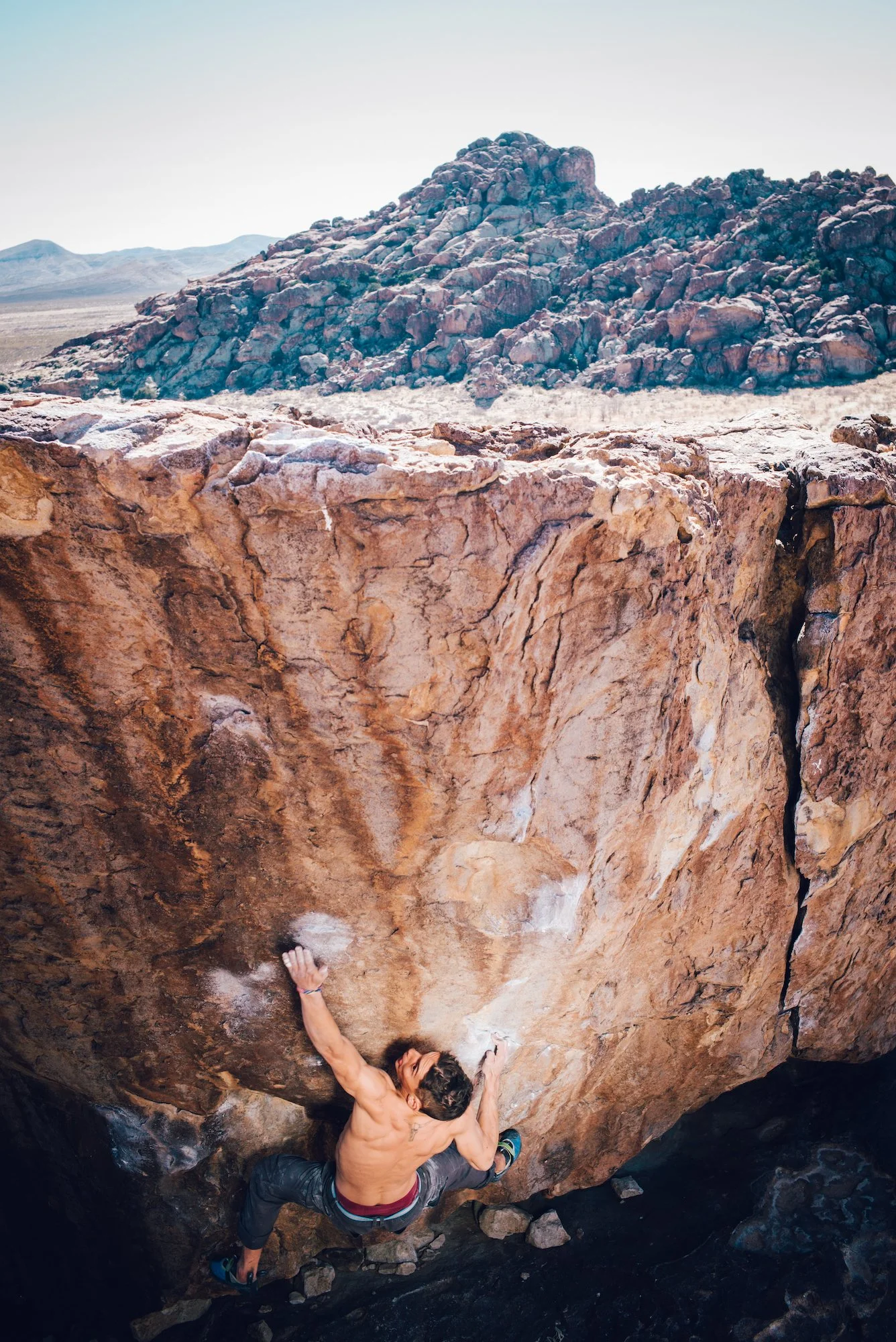
Photo by AAC member Michael Lim.
But Hueco’s star status for the pros is just one piece of the puzzle. The close-knit “keep it small” culture at Hueco is why the mijos and mijas will rally around a friend to support a big highball attempt, lugging out pads on a rest day. It’s reinforced by how far Hueco and El Paso are from other major cities, requiring a force of will to get there. And it’s fueled by waiting in the hot desert sun in your car, living the “lizard life” as one climber called it, alongside friends and strangers, waiting in line to be one of the 70 climbers allowed into North Mountain to climb for the day—knowing that climbing access isn’t a guarantee.
Rather than begrudging the regulations and inconvenience, many climbers of Hueco seem to recognize that the lizard life represents something necessary about an incredible world-class climbing area that climbers share with the world. This holistic take on climbing access even pervades the art coming out of the Hueco climbing scene. The Hut Smut Review is a zine that many locals and travelers have contributed to in its first few years. The driving force behind Hut Smut is to get into the complexities of who we are as climbers and how that fits into our other identities. Joe Knapp, one of the creators of the zine, says the idea originated during the dead space and boredom of hot lizard days. What else will emerge from this landscape?
Like every crag, Hueco is a unique experience. Traditions and competitions have emerged around Hueco’s boulders, ecology, and culture. Climbers aren’t afraid to hold each other to the ethics of the area. And at the center of it all are the crimps that taste like glory, that pulled us in in the first place.
Forget stone monkeys—meet us in the dusty Hueco Tanks parking lot so we can be rock lizards.
Psyched to visit Hueco? It’s imperative that you be in the know on all Hueco Tanks State Park regulations and the ins and outs of getting a guide: tpwd.texas.gov/state-parks/ hueco-tanks/activities