
A World of Appalling Grandeur
The First Ascent of Mt. Logan
By Hannah Provost with support from the AAC Library
Photos from the Allen Carpé Collection in the AAC Library
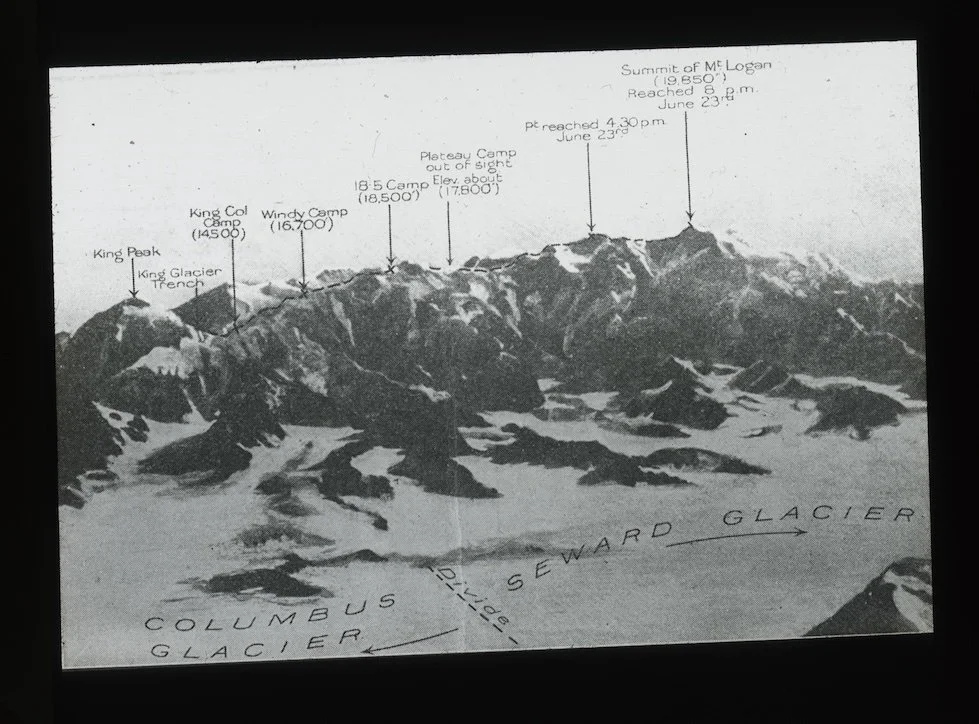
The snowy fortress of Mt. Logan massif had opened its door after weeks of siege. It was June 23, 1925, when Allen Carpé and five others stood atop the highest peak in Canada for the first time, the sheer pinnacle of the summit plunging down sharply to the Seward Glacier below.
To Carpé, in the thin air, it felt like every moment was twice lived.
And in the media storm and flurry of drama that followed, he would be called upon to set the record straight—and relive those moments yet another time.
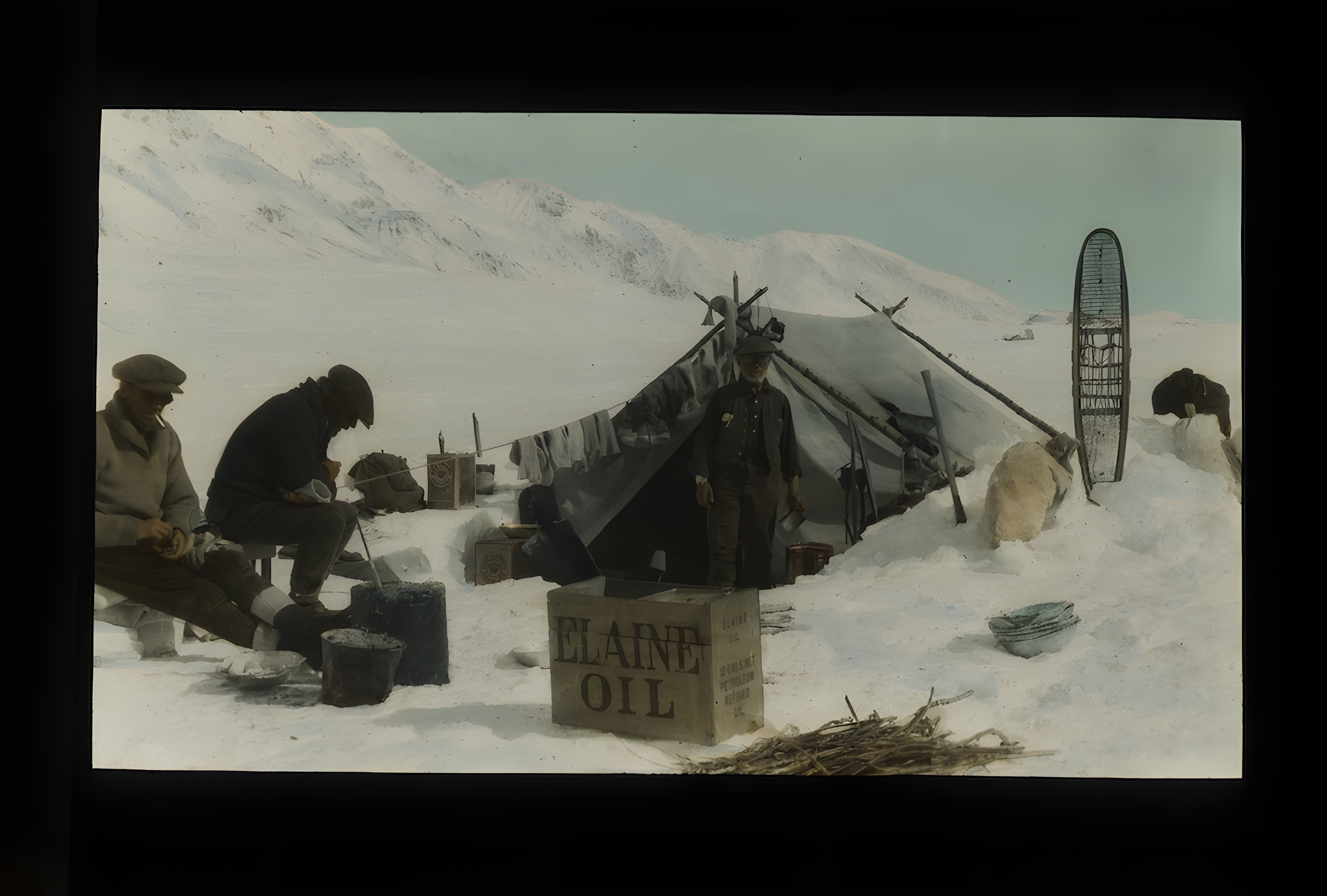
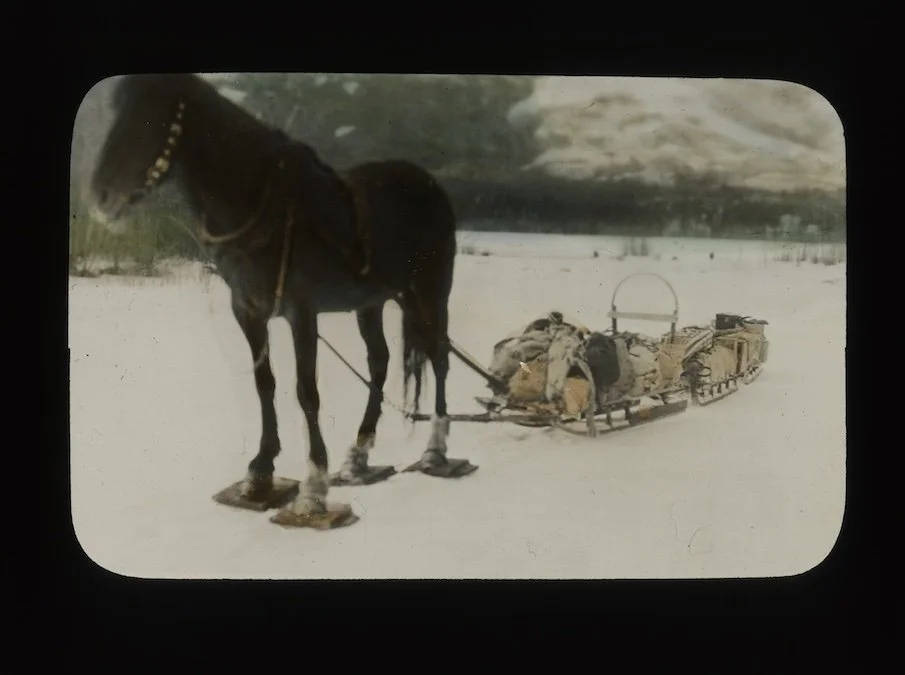
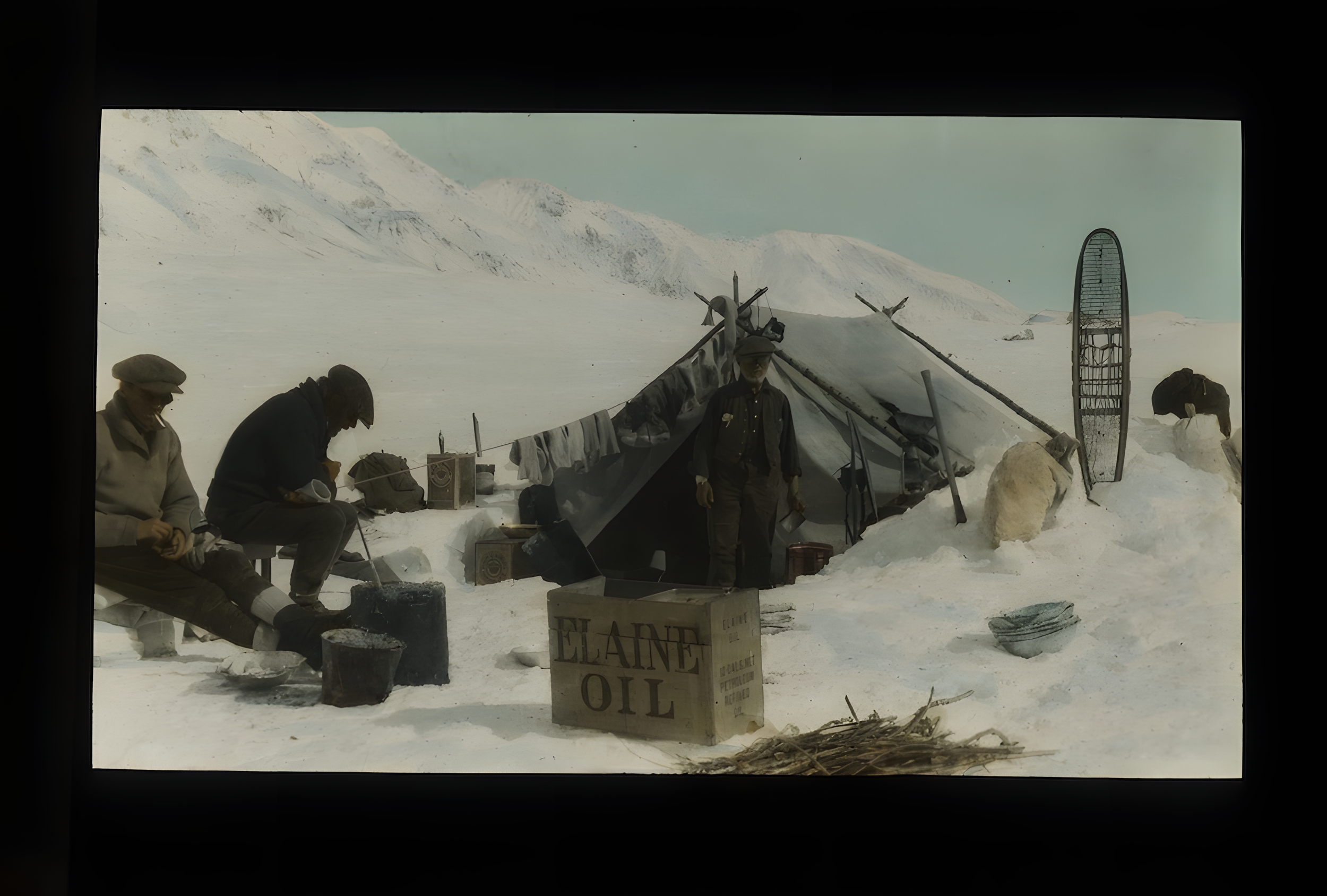
At first glance, the 100-year-old story of the first ascent of Mt. Logan might have a familiar outline—a band of men push up and up to ascend to the great heights, facing great hardship along the way. In the classic telling, we follow the expedition leader Albert MacCarthy as he spends weeks caching supplies in the dead of winter, utilizing sleds pulled by snowshoe-clad horses, and higher up on the mountain, cunning dog teams that fight whenever left alone.
In the classic telling, we follow MacCarthy, American Alpine Club representative Allen Carpé, American Norman Read, Colonel Foster, and the others on the expedition as they ferry their own gear back and forth between each subsequent camp, the measure of days the number of heavy loads these men have carried to the next advanced base camp, or their proximity to frostbite. With teeth on edge, we’d read of 11 journeys through a precarious icefall as they consolidated their camp above 10,000 feet, transporting nearly a ton of equipment and food.
Once high on the massif, we’d delight in the cunning trick, attributed to MacCarthy, of planting 600 bare willow branches in the blowing snow every hundred feet, to prevent against getting lost in the whiteout. Such trail maintenance would ultimately save lives and precious time, but still couldn’t prevent one rope team from losing their way during a storm that chased them down from the summit. Those men spent 42 hours without shelter in the freezing, grainy snowbanks, only realizing their mistake when they found themselves walking in circles, back on the summit plateau, the slopes ominously appearing at unexpected angles.
The theme of that story is loneliness, drudgery, and the sheer force of will needed against the worst conditions that such an icy world could offer.
Reflecting on these themes, Carpé writes in his own telling of the ascent, published in 1933 in the American Alpine Journal: “I think it was during these days that the awful loneliness of these great ranges was first borne in upon me with something of the force of a personal experience. Until we turned the corner into the Ogilvie glacier, we could look back down the valley and sense the presence of the lower hills and of living things. Now as we worked in toward the savage cliffs of Logan we entered a new world of appalling grandeur, and our little band seemed insignificant and very much alone. We had no support behind us, no organization of supply, no linkage at all with the outer world. We were on our own.”
That telling is perhaps best left to those who experienced it. But a 100-year distance can sharpen the focus of our lens on something else—the mundane letters and newspaper stories that came afterward, that can so easily be forgotten as part of the story, and that might tell us a little something different about the legacy our climbing ancestors have left us.
There are, of course, the historical accounts—a hundred pages dedicated to the planning of the ascent, scientific studies accomplished during the expedition, and the story of the climb itself, all included in the Canadian Alpine Journal. Because the AAC was not yet publishing the American Alpine Journal (it would do so for the first time in 1929), the American account of the ascent was published in the Appalachian Mountain Club’s journal. The American public, too, was in awe, with repeated articles appearing in the New York Times, the Boston Transcript, and others.
But a flurry of letters from September 1925, dashed off in angry haste with cross-outs and misspellings, reveal a gap in the telling. The writer, expedition member Norman Read, repeatedly argues to his friend and reader, Allen Carpé, that the representations of the expedition in the media are “positively disgusting in its sensationalism and its falsity.” He asks Carpé to write the story the right way—to tell it in a manner ‘worthy of the fraternity of mountaineering.’ The letters are a source of 100-year-old gossip—they tell of personal disgruntlement and vendetta, but also raise a question that a century later still holds: If there is no cheating in climbing, only lying, then what do you do about a little storytelling flair—a little hyperbole? What are the ethics of telling a mountaineering story right?

Flip over one of The New York Times clippings that features the story of the Logan ascent, and you’ll see pictures of the season’s debutantes printed in sepia—flaunting flapper dresses and long strings of pearls. It was the 1920s: a period of extravagance, economic growth, and patriotism after the horrors of the First World War. Only a decade before, in 1913, did the first people stand atop Denali (Mt. McKinley). In 1924, a highly public attempt on Mt. Everest ended in the disappearance of George Mallory and Andrew Irvine, generating considerable speculation about whether they had made the first ascent before going missing. The American Alpine Club was founded in 1902; the Alpine Club of Canada had started in 1906. Amid this milieu, as they watched the U.K.’s Alpine Club take their shot at Everest, the Canadians and Americans had started to look around for their own slice of history. There was a lot at stake— this ascent needed to make a splash.
From the get-go, the Logan expedition was known to be a massive undertaking in logistics, and MacCarthy took on the labor of caching the supplies needed for a siege-style ascent, so deep in the Canadian interior that it was a slog of over 100 miles from the nearest town to Logan’s surrounding glaciers. As Carpé would write, MacCarthy “was not a man to hold back when there was work to do.” MacCarthy, as leader, dominated the expedition, and this really rubbed Read the wrong way.
Read alludes to “unpleasantness of the trip” and “personal grievances” in his letters. And it seems that such unpleasantness wasn’t all in Read’s head. MacCarthy, in his own account of the trip for the CAJ, closes with an acknowledgment of his behavior, and quite the excuse: “Thus, at midnight on June 28th, we again were down to the level where men think and breathe and work in a rational way and so may be held accountable for their actions. If sometimes while above that level, I was harsh and disagreeable, I ask that my companions please forgive me.”
Many accusations pile up in Read’s letters.
Read had heard whispers that the Canadians hadn’t even wanted the Americans to come along, and in Read’s opinion, Foster and MacCarthy were colluding to take all the attention from everyone else.
In the newspaper stories citing MacCarthy and Foster as sources, aspersions were cast that Read had deserted his companions in an hour of need, that another expedition member was weak and ineffectual, that Carpé was a coward and had wanted to turn back during the final summit push, and that “[MacCarthy] forced [Carpé] on since he felt that the official representative of the American Alpine Club should reach the top.”
And then there was the hyperbole—yes, they had rafted back down the river as the final leg back to town, but they were not “plunging through the swift waters of canyons” by any stretch. Similarly, there was plenty of heroism in the expedition, but the newspapers likewise stretched the danger they faced in the final snowy pitches. Read writes: ”Nobody was in a precarious position and there was no danger of loss of life that I could see. Such accounts as these hardly seem to fit in with the ethics of true mountaineering.”
In each of his letters, Read nudges Carpé to set the record straight. Always, it is some version of the note in his last letter: “Someone ought to really write the true story and blow up their attempt to distort the facts.” It was the 1920s version of double-texting: Read, experiencing intense emotion after reading each newspaper story, wrote Carpé multiple letters before ever receiving a response.
Allen Carpé did set the record straight—in fact it was one of his last acts. Carpé’s accounting of the Logan expedition, included in the 1933 AA J, was published posthumously, after he went missing on Denali in 1932. It is suspected that he fell into a crevasse while attempting to help a fellow expedition member. He had brought a draft of what would become the 1933 AAJ article, intending to work on edits for a magazine, before he vanished on the mountain. It is one of his last known writings.
Seven years after the original ascent, Carpé’s story is reflective of the man himself. In his AAJ obituary, W.S. Ladd describes Carpé as a “quiet, shy man” with a “clear, calculating mind...precise in his methods” and with “little patience with inefficiency.” Indeed, “all his efforts I shall always think of as being governed by one motive—precision.”

Allen Carpé (right) with Howard Palmer.
How did Carpé, given this characterization, receive Norman Read’s undifferentiated vitriol for the leaders of their expedition, and the (supposedly inaccurate) tales told in the media? Carpé’s own letters back to Read have yet to be found, if they even survive at all, and yet penciled-in commentary in the margins points to a potential understanding of his mind.
The marginalia could be Carpé’s reactions to Read’s letters—or maybe Howard Palmer’s, whose papers they were found with, or an unknown other—but regardless the marks are enough to question the full veracity of Read’s grumbling. “Not strictly true” is noted in the margins where Read shares his version of events to prove he didn’t desert his fellows. Yet Carpé does address some of Read’s concerns in his own account—he clearly wasn’t discounting Read outright. Whether we should consider Carpé’s account as universally true, it’s hard to say—but at least he seems a more measured and dispassionate observer of the tale than either Read or MacCarthy and Foster.
Carpé’s telling captures great trials with understated grace. Describing the summit, he writes:
What did we see, how did we feel, what were our thoughts in that precarious half-hour of victory? The first question is the easiest: we saw fog about us, and rare glimpses of a world far below of which we seemed not at all a part, and for a time we saw in the fog gigantic shadow mind...precise in his methods” and with “little patience with inefficiency.” Indeed, “all his efforts I shall always think of as being governed by one motive—precision.”
How did Carpé, given this characterization, receive Norman Read’s undifferentiated vitriol for the leaders of their expedition, and the (supposedly inaccurate) tales told in the media? Carpé’s own letters back to Read have yet to be found, if they even survive at all, and yet penciled-in commentary in the margins points to a potential understanding of his mind.
The marginalia could be Carpé’s reactions to Read’s letters—or maybe Howard Palmer’s, whose papers they were found with, or an unknown other—but regardless the marks are enough to question the full veracity of Read’s grumbling. “Not strictly true” is noted in the margins where Read shares his version of events to prove he didn’t desert his fellows. Yet Carpé does address some of Read’s concerns in his own account—he clearly wasn’t discounting Read outright. Whether we should consider Carpé’s account as universally true, it’s hard to say—but at least he seems a more measured and dispassionate observer of the tale than either Read or MacCarthy and Foster.
Carpé’s telling captures great trials with understated grace. Describing the summit, he writes:
What did we see, how did we feel, what were our thoughts in that precarious half-hour of victory? The first question is the easiest: we saw fog about us, and rare glimpses of a world far below of which we seemed not at all a part, and for a time we saw in the fog gigantic shadow
images of ourselves...As to the rest, I fear we were too spent to make the answer very exciting. Almost automatically we went through the appointed routine: hand-clasps and congratulations, a round of motion pictures, the empty gesture of a record of names and date thrust into the snow. Then we turned and began the descent in the gathering storm.
Whether truly Foster and MacCarthy’s fault, or the heavy hand of overexuberant newspaper editors, the sensationalism of the media recounting of the Logan ascent feels a little familiar to our modern gaze. In Carpé’s hands, the moments of low morale at the false summit, or the small moments of heroism, like when in their haste to descend they were all going the wrong way before Read saw the error and corrected course, feel truer.
In Carpé’s more stoic account, there is danger and bravery, heroism and moments of a greater spiritual connection. The drama is already there, in the act of climbing itself. Even if some of Read’s fighting words come from a place of hurt ego, perhaps his larger point isn’t so off the mark. We don’t need to add anything in for effect—climbing already has a built-in plot. Logan was already a world of appalling grandeur.