Image from the Detterline Collection, Courtesy of the AAC Library
Rewind the Climb with Diana Boyer
Originally Published in Guidebook XIX.
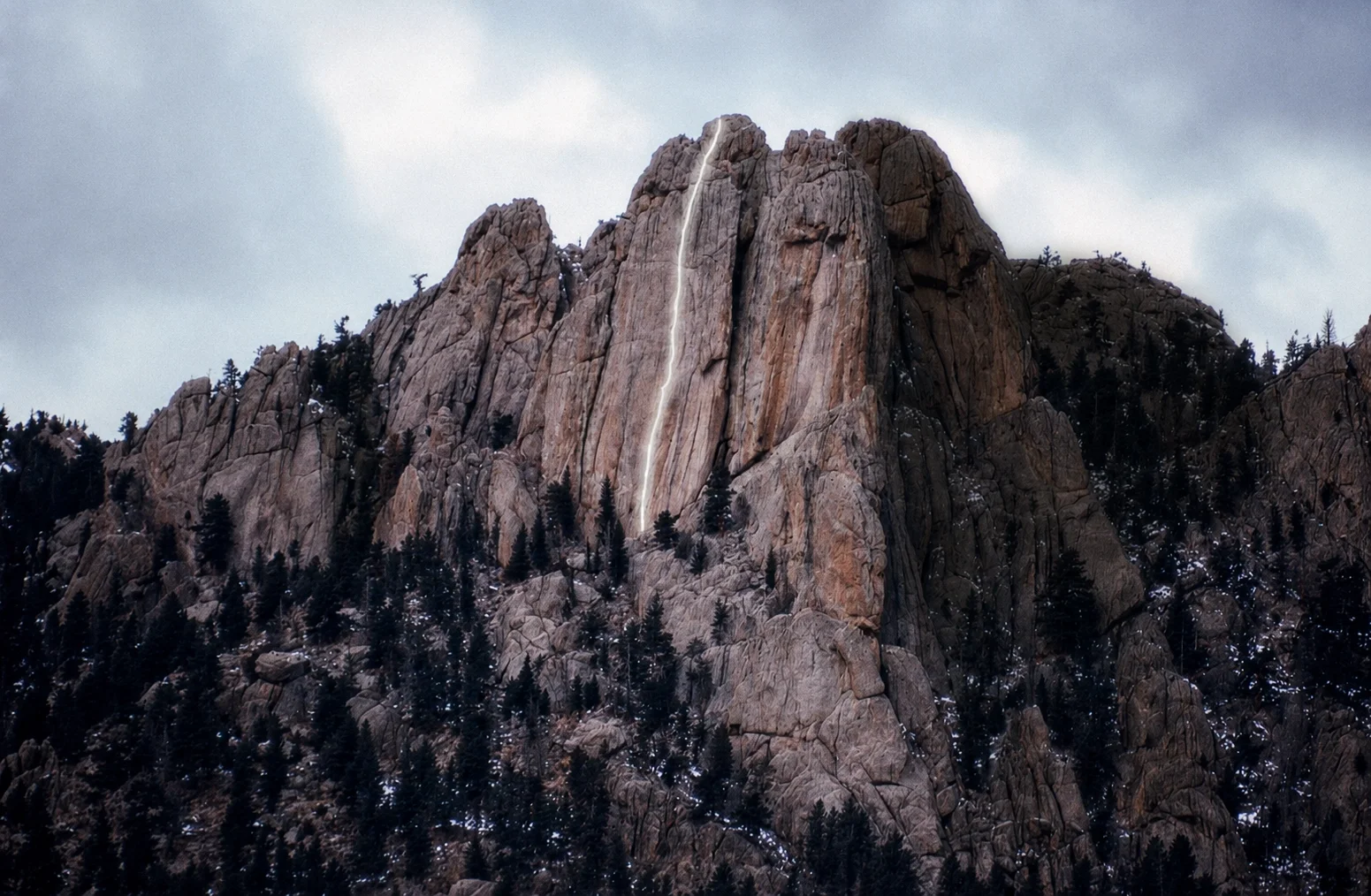
On the jagged skyline north of Estes Park, Colorado, rises a formidable formation, the Twin Owls, its south face split by an obvious crack up a leaning corner. From a distance, the climb looks approachable, curving up toward the summit, but the fact that the crack is visible from so far belies its inviting disposition. In fact, this cavernous, “wider than wide” Lumpy Ridge fissure is infamous, and only the naive go into it blindly. Its smooth walls offer few options for face holds except for the occasional crystals for those who are unwilling or lack the know-how to offwidth. Crystal pinching can only take a person so far until their fingertips are blown and split from the rock’s sandpaper texture. You’d think that the foreboding name, which only perpetuates the mystique and lore surrounding this historical offwidth, might be a bit of a clue.
At 5.10d—a notorious offwidth grade that can mean basically anything—Crack of Fear is a testament to history. Over the years, it’s become known as a cruel sandbag. Its Mountain Project page is littered with stories of comical attempts and harrowing epics. A rather hysterical and self-deprecating account from Steve “Crusher” Bartlett, a legendary desert-tower climber, reads, “I’m too fat to do this! The crux would be easier for skinnier folks, who can keep their hips in the crack as they are easing up towards the beckoning (but still tiny) face holds. This is a masochistic struggle.” George Bell writes, “My only ‘attempt’ at this route was in 1983, when I was visiting the area and a buddy who lived in Boulder suggested we ‘check it out.’ Knowing nothing of the route, I foolishly agreed, figuring my friend probably wanted to lead it anyway. We got to the base, and there was a party ahead of us.… Some guy was following the first pitch, and man it looked horrendous!” After realizing their gear wasn’t big enough, they never left the ground, walking away with their tails between their legs. People aren’t rushing to climb Crack of Fear, a fact further underscored by Lenore Sparks, who writes, “This climb is sweet because you don’t have to wait in line for it.”
Layton Kor and Paul Mayrose made the three-pitch climb’s first ascent in 1963. Kor was one of the most prolific first ascensionists of the 1960s, leaving his mark on American climbing with first ascents of The Naked Edge in Eldorado Canyon State Park, Finger of Fate on the Titan, the Kor-Ingalls Route on Castleton Tower, and countless other climbs. On Crack of Fear, the first 30 feet start off fairly easy with hand jams along a pillar called the Rat’s Tooth, with the occasional stance to rest and assess before the real fight begins. For the next 200 feet, clear to the summit, the crack morphs into a wide, physical beast. On Kor’s ascent, when he reached the crux on pitch two about 100 feet up, he managed to drill a bolt while balancing on a ledge. From there, it’s surmised that he used the bolt as a point of aid, placing one more bolt on that same pitch. These bolts helped him surmount a difficult undercling section that briefly leaves the offwidth before requiring a committing move back into the crack above the roof, allowing him to eventually complete the climb. Sixty-plus years later, Kor’s bolts are still in the rock—historical artifacts, but dubious protection.
While Crack of Fear is only three pitches long, it required—and requires—skills that are also key for big-wall climbing. Back in the late 1950s and early 1960s, climbers were focused primarily on walls, setting their sights on objectives like Half Dome, the Nose, the Dihedral Wall, and the Salathé Wall in Yosemite Valley. With free climbing standards and gear not what they are today, and with a mountaineering-informed ethos centered on getting to the top by whatever means, climbers were rarely hesitant to aid when merited: If a section got too hard or scary, hammering in a pin or drilling a bolt as a quick resting point or point of aid was often the norm. Hence Kor and Mayrose’s two bolts on the route—and only a partial free ascent.
Another big-wall skill at play on Crack of Fear is offwidth climbing. Knowing how to climb wide is a necessary skill in any big-wall aspirant’s tool kit. The widest gear available at the time was large, V-shaped aluminum pitons called “bongs,” first commercially produced by Yvon Chouinard and Tom Frost, and named for the “bong-bong” sound they made when hammered into a crack. They varied in width, with the biggest around four to six inches. Compared to modern offwidth cams, they were quite small, which meant protecting wide climbs was challenging and not always guaranteed. A level of bravery was required—a stepping into the unknown. There was often uncertainty as to whether a climb would even take gear, so the mindset was to keep moving and hope to reach the next belay before running out of energy. With their rudimentary gear, it’s likely Kor understood from the ground he was taking a leap of faith climbing something so wide, hence the name Crack of Fear.

Image from the Detterline Collection, Courtesy of the AAC Library
Shortly after Kor and Mayrose’s first ascent, Royal Robbins attempted to free the route. During that era, Robbins was (and remains) a well-known pioneer of American rock climbing. He helped forge the path for free climbing, making notable ascents such as freeing America’s first 5.9, Open Book at Tahquitz Rock, in 1952, and later, in 1964, the first free ascent of Danse Macabre (5.10) on Devils Tower. When he failed to free Crack of Fear, its reputation only grew. Who would get the first free ascent?
Back in the mid-1960s, Jamie Logan was an eager kid excited to prove herself in the world of climbing. After moving to Boulder to attend the University of Colorado, she soon flunked out, spending all of her time climbing instead. Logan was always in search of partners to belay her on the next challenging climb, but finding consistent ones wasn’t easy at first. It was only when she gained recognition for her prowess on the rock at Castle Rock in Boulder Canyon that she found her inner circle—all of whom, Logan included, would go on to become climbing legends. Castle Rock remains a popular crag for its variety of stellar crack climbs. It was there that she ran into Royal Robbins and Pat Ament top-roping Final Exam, a route rated 5.11a by today’s standards, which they hoped to free climb (and eventually did in 1964). Logan, excited to have found fellow climbers, asked if she could try. Surprised and unsure of her abilities, they hesitantly said yes. She shocked them when she onsighted. From then on, it was clear Logan was part of the next generation of climbers pushing free climbing forward.
Logan was only 19 years old when, in 1966, she was part of the first free ascent of Crack of Fear with Chris Fredericks. That year, Fredericks flew from California, intending to free it, but he needed a partner. Fredericks was a methodical and sometimes slow climber. His lack of speed accommodated his thoughtful technique, helping him accomplish many first ascents, such as the South Face on Yosemite’s Washington Column in 1964 and Snake Dike (5.7) on Half Dome in 1965. Word spread, and he heard Logan was a strong crack climber. Logan loved climbing Grand Giraffe in Eldorado Canyon, another offwidth that requires its own bag of tricks. At the time, it was 5.8; today, it’s 5.10a. Logan was recruited.
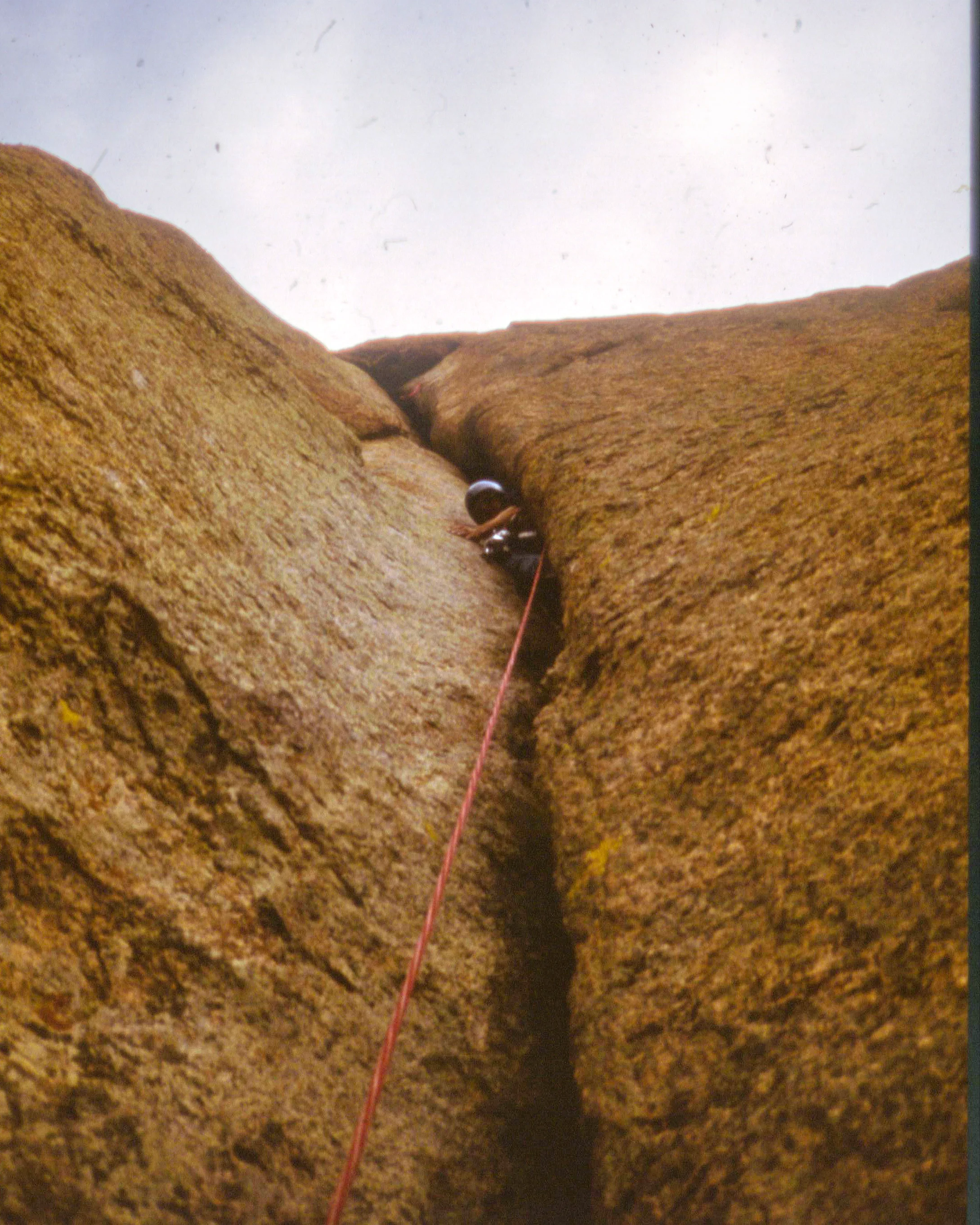
Image from the Detterline Collection, Courtesy of the AAC Library
In the heat of summer, Fredericks, Logan, and a third (tentatively remembered as Ken Kelly) hiked to the base of the Twin Owls. Wearing blue jeans, a T-shirt, a swami belt, and leather Kronhofer climbing shoes, Logan took the first pitch but struggled with the start of the offwidth, ending the lead. After pounding in a four-inch bong (the biggest piece they had with them), Logan attempted to wriggle upward, but was having little luck. “I didn’t know what I was doing,” Logan recalls. “I was just skinny and stoked.” Fredericks lost patience and told Logan to come back down, lowering her off the bong. From there, Fredericks took over leading. He climbed to the first ledge, built an anchor, and belayed Logan and Kelly up.
Exhausted from the sheer physicality of the first small section of offwidth on the first pitch, Kelly vomited at the ledge and had to be lowered to the ground, leaving Logan and Fredericks to continue the quest. The next 70 feet were the true crux. At the start of the second pitch, there is a small foot rail, which allowed Fredericks to establish himself in the offwidth. Once he left the safety of the rail, the crack widened, opening its coarse granite jaws, making it difficult for Fredericks to find any security. By shoving his heels together and using his inside knee to maintain progress, he slowly inched up. After clipping one of Kor’s bolts, he pushed and grunted toward another gear placement. “You so wanted to stand on the bolt,” Logan recounts, but they were committed to a free ascent. Fredericks managed to find an armbar, forming a chicken-wing, and hammered a one-inch angle into a thin crack above him. He then traversed across the face before re-entering the crack, completing the most difficult pitch.
Now came Logan’s turn to second. Skinnier than Fredericks, she could squeeze deeper into the crack. “I’m making progress like a quarter inch at a time [or] a half inch at a time. I get up there, and I remember grabbing this little tiny edge, and I just worked it,” Logan says. When she reached the piton Fredericks had placed, she was too pumped to clean it, so she grabbed the carabiner off the pin and continued upward, knowing she’d owe him a one-inch angle later. She emerged from the crack a bloody, excited mess, her arms shredded from its sharp granite walls.
Fredericks led the final pitch, and together they completed the first free ascent. Logan told him she couldn’t wait to share the news with the climbing community back in Boulder. Fredericks replied, “You know, that’s not really why we’re supposed to do this.”
At the time, Crack of Fear was one of the hardest climbs in the country at 5.10. Rating a climb 5.10 meant it was extremely difficult, but acceptance of the grade took time. Logan recalls how there were many mathematicians and scientists in the climbing world during the 1960s who would gladly argue that 5.10 was not a “real” number, therefore nonsensical as a climbing grade. Climbers like David Rearick, who, with Bob Kamps, made the first ascent of the Diamond on Longs Peak and had a Ph.D. in mathematics, and Frank Sacherer, a legendary free climber in Yosemite who would go on to work as a theoretical physicist at CERN, the European Organization for Nuclear Research, argued against expanding the Yosemite Decimal System beyond 5.9. But as climbing progressed, and 5.9 and 5.9+ were no longer sufficient, 5.10 became the new standard. In the 1970s, Jim Bridwell proposed adding letter grades (a–d) to further differentiate difficulty from 5.10 on up.
Free climbing was in its nascence. On the popular climbs of the era, there was often a plethora of “fixed pins,” thanks to pioneering climbers either using soft angle-iron pins that were hard to remove or, later, overdriving their chromoly steel pitons into cracks and seams. Over time, these routes became littered with fixed gear, unintentionally making them better protected and/or leaving pin scars that could be used as handholds for free ascents. “There was this interim period of lots of pins,” says Logan. With more pins, free climbing became more efficient than aid climbing. At the time, many top climbers had their sights set on Yosemite’s big walls. An essential part of completing such big objectives was speed, and if a climber was strong enough to climb through sections without hanging or using aiders, it saved a lot of time—as did clipping fixed pins as pro. As time passed, climbers like Derek Hersey, a British rock jock who specialized in free soloing, took on Crack of Fear. It’s said he onsight free soloed it, believing it to be just another 5.10, a grade well within his wheelhouse. He was sorely mistaken, however, and spent hours surviving his way up, convinced he might die but ultimately reaching the summit. He showed up to work the next night, half his body bloody, raw, and swollen from crushing himself into the crack.
Today, gear has drastically improved. Modern cams are lighter, easier to place, versatile, and safer than the bong-bongs of yore—they cover a wider range of crack sizes, including offwidths. Yet Crack of Fear retains its aura. Kelly Cordes, Estes Park local legend, climber, and writer, last climbed it 20 years ago. “I’ve only climbed it once, basically got my ass kicked so bad that my friend had to lead the two harder pitches, and I’ve avoided it ever since. It felt so utterly desperate to me that I just gave up on ever trying again,” Cordes says. “The cool thing about it, I think, is how much respect it still garners. I don’t think anyone just strolls up to it and finds it easy; the [5.10d] grade is virtually meaningless and absurd, but somehow, fitting.”
Unlike Cordes, Eddie Taylor became obsessed. The Colorado-based climber, teacher, and track coach estimates trying it 15 times, most of those attempts in the fall of 2024. “The only reason I really wanted to try it was because someone told me it was a really good simulator for the Monster Offwidth,” Taylor says, referencing the 200-foot 5.11d crack that is considered one of the cruxes of El Capitan’s Free Rider (31 pitches, VI 5.13a).
In 2024, as Taylor trained for Free Rider, he headed up to try Crack of Fear with his climbing mentor, Cody Scarpella. When Scarpella, a granite wizard, struggled to figure out the crux, Taylor knew it must be extremely difficult. A year later, Taylor returned and was able to figure out the move that had stumped them both previously. He made it a goal to send the entire climb in one push, never leaving the crack, by linking the pitches together with one long rope. Choosing not to stop at the belay stances turned the climb into an endurance push. The idea was to build stamina for its offwidth cousin on Free Rider.
Though not an offwidth specialist, Taylor is a well-rounded climber, as any big-wall climber must be. “Definitely for a route that’s rated 10d, I put…more work [into it] than…[any other] 5.10 route,” Taylor says. Trying to find a continuous offwidth near the Front Range is like looking for a needle in a haystack—few other than Crack of Fear offer a sustained, continuous fight. It’s as if a little slice of Yosemite got lost and found itself in Estes Park instead.
Taylor and many other climbers agree that the climb is most likely somewhere in the 5.11c range, which many 5.10+ routes from that era likely are as well. Logan herself admits that with today’s modern grades, it would sit somewhere in the 5.11 range. Taylor eventually freed Crack of Fear, top-rope soloing it in a continuous pitch on a fixed line. It became part of his routine: getting out of work, driving up to Lumpy Ridge, and trying to squeeze in four or five laps before the sun set. When Taylor eventually attempted Free Rider, he found the Monster Offwidth to be much easier.
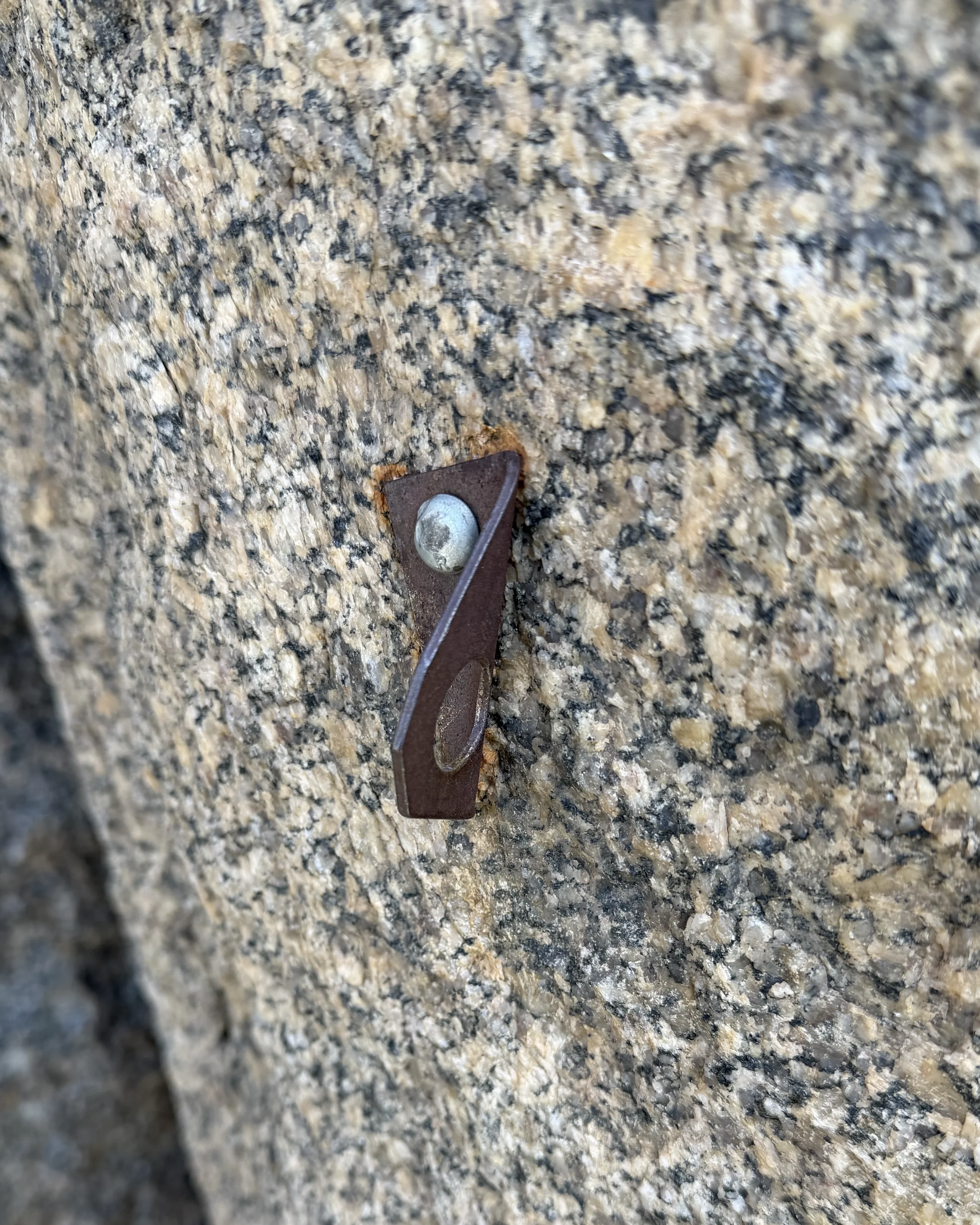
Believed to be the original bolts placed by Layton Kor.
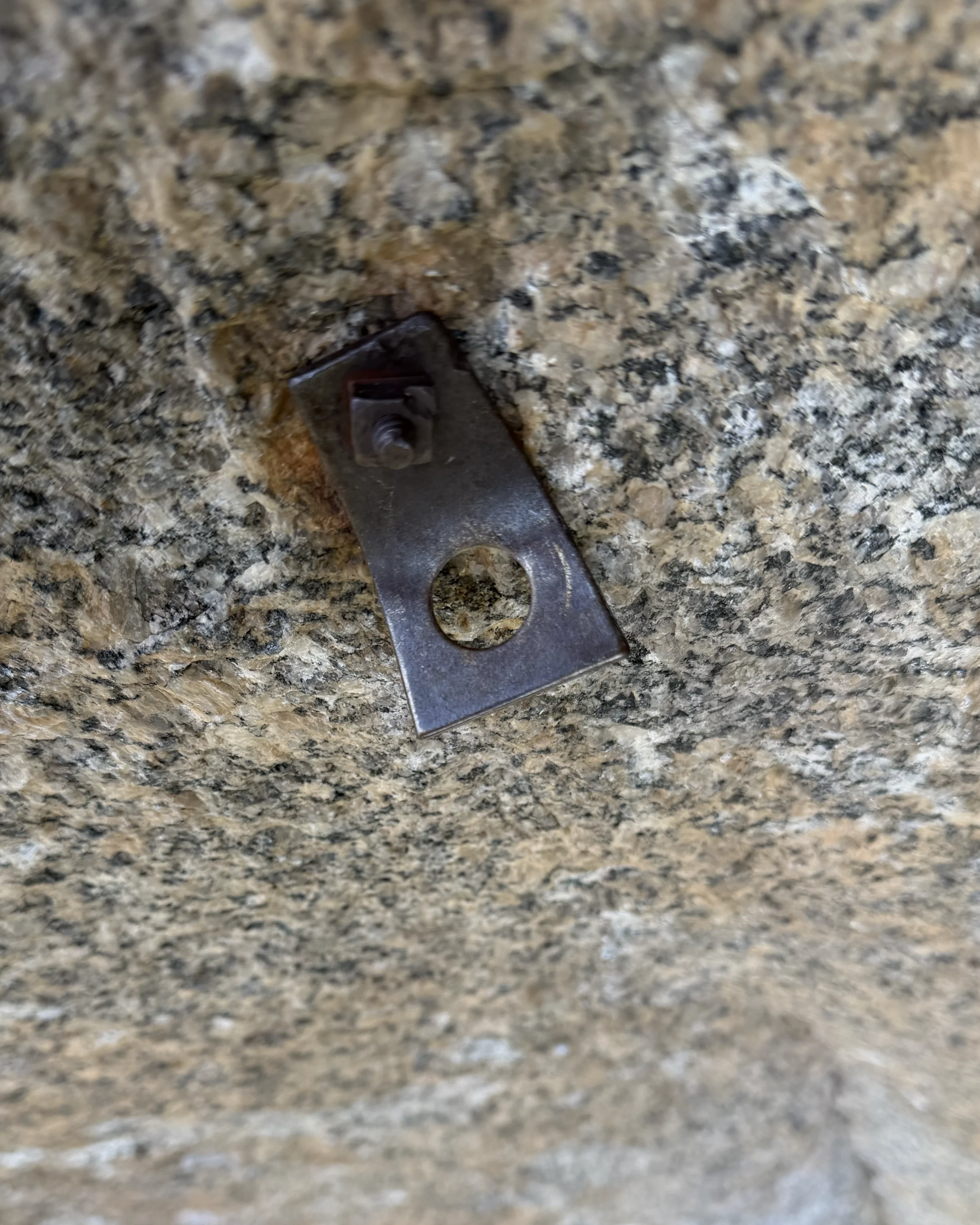
Images: AAC VP of Media Shane Johnson
Similar to Taylor, two young retired British competition climbers, Alex Waterhouse and Billy Ridal, were pointed in the direction of Crack of Fear before they took on the Nose of El Capitan (VI 5.14a). With very little crack-climbing experience but an incredible amount of strength and technique, they freed the Nose in 2023. Logan, who was speaking at a conference with Waterhouse and Ridal, listened to the boys regale the crowd with their adventures and mishaps. At the end of their story, as Logan recalls, Ridal said, “But the hardest thing we did is we went to climb this crack in Estes Park, and people said it would be good training for us and that it was 5.10.”
Going in blind, without looking at the guidebook or reading Mountain Project, Waterhouse and Ridal set off into the wide—and quickly got their butts kicked. Waterhouse, leading on pitch two, accidentally dislodged their No. 6 cam, so that his only protection was the two rusty bolts placed by Layton Kor. Waterhouse was terrified. As the Brits described their harrowing ascent, Logan realized they were talking about Crack of Fear. Logan chuckles and says, “So that was kind of fun. It made me feel like I was a good rock climber.”
Inspired by the story behind the climb? Support the AAC archives, and help the AAC continue to preserve climbing history.