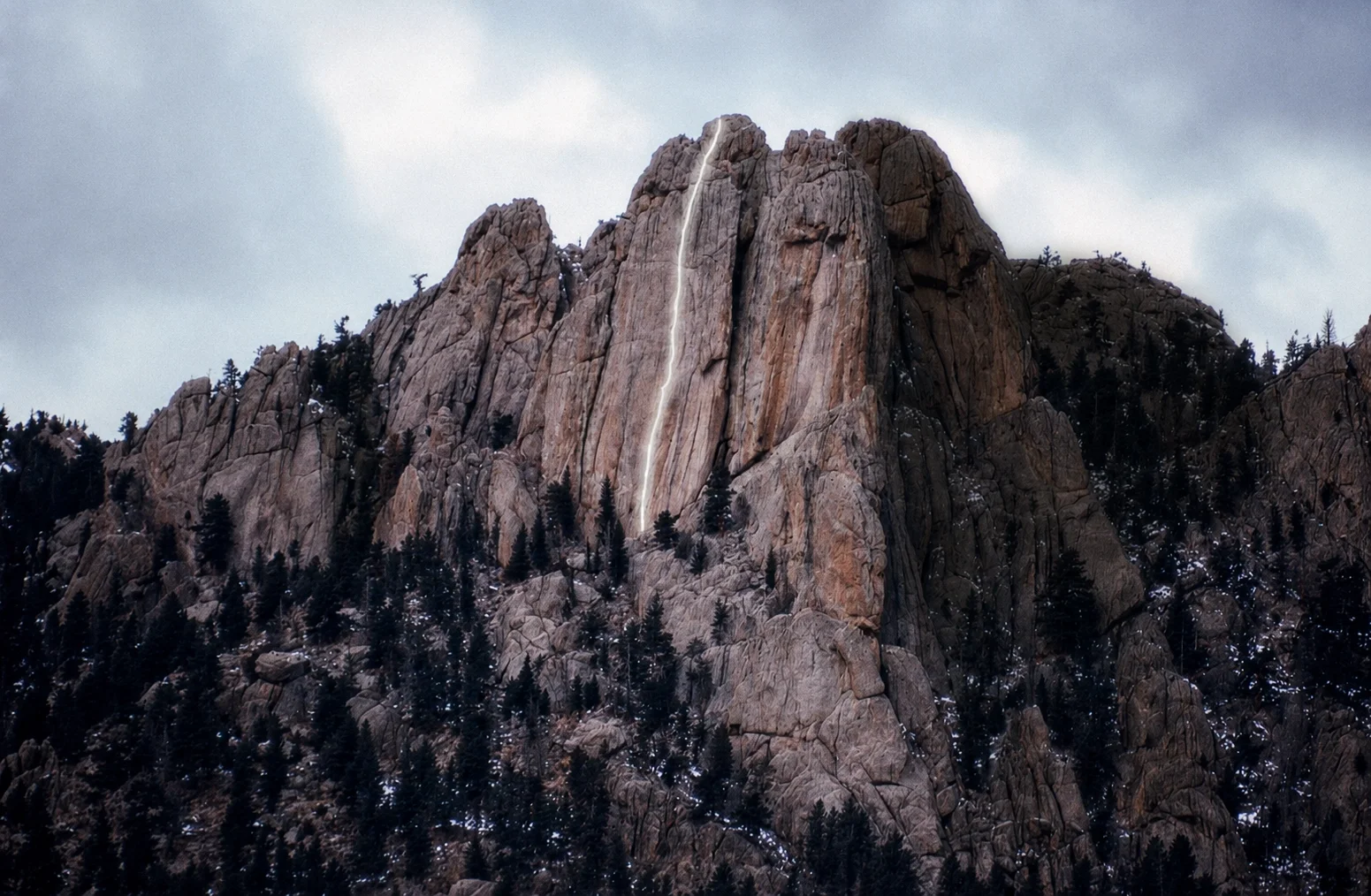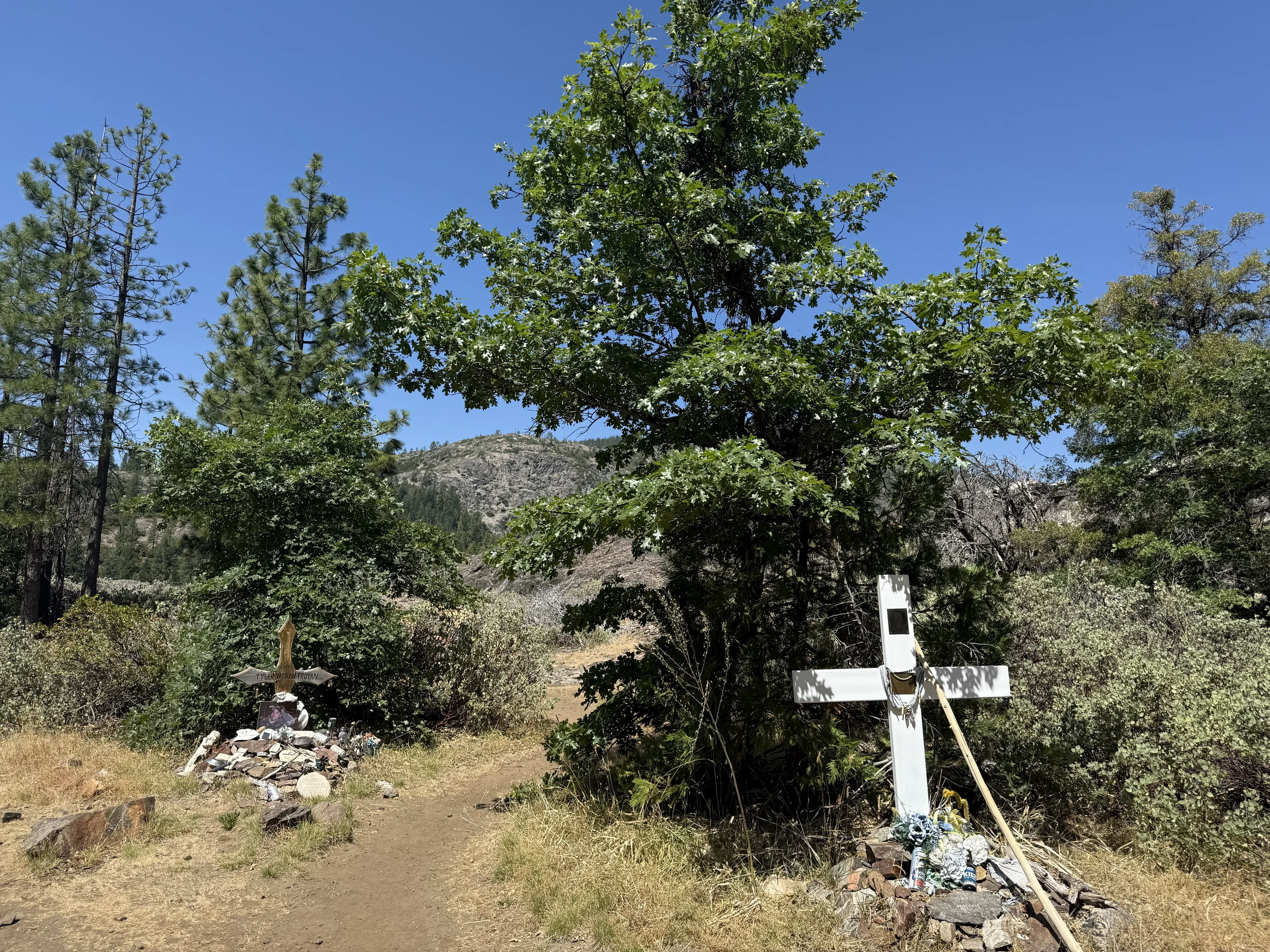
Image by Christian Kiefer
A Member Story by Christian Kiefer
Originally Published in Guidebook XIX.
My father enters the hospital after his third round of chemotherapy. Over the preceding months, he has suffered a sore throat and often been out of breath. The diagnosis is, at first, a crushed tonsil, the result of a previous round of chemo seven years before. Then came the revision: a return of lymphoma, a different variety than the one he had beaten, although this one is, they tell him, easier to treat. A good prognosis, considering; he feels calm and resolved. He beat it once; he knows what to expect; this will be much the same.
The first new round of chemo knocks him off his feet for a few weeks, but he recovers. The second results in a cough and shortness of breath serious enough to be of concern. Now, after the third round, the cough becomes persistent enough that he has trouble catching his breath and can't sleep. I am climbing in Red Rocks when my mom calls to tell me that I need to come home. It takes most of a day to get back to my parents' Northern California home, and when arrive, it is to find my father pale and drawn, exhausted, clearly out of breath, his sentences comprised of three or four words.
***
Over the next 25 days in the hospital, my father's condition improves and then worsens and then improves again and then finally cascades into an increasingly untenable situation. Air is black on a CT scan, and the image of his lungs from the previous year showed healthy black emptiness striated by white threads. The newest images show lungs the color of concrete: tissue without air.
“I just want three good days so I can talk to people,” he says. It does not yet occur to either of us that all the good days he might have had are already behind him.
I stay overnight every night, my sister and my mom take the day shifts. Some days, he wants visitors-anything to assuage the boredom-but the visits also exhaust him. On a day when neither my mom nor sister is available to sit with him, he bursts into tears when I arrive in the early evening. "That was too long," he says. "That was too long."
He goes from the ICU to the telemetry floor and then back to the ICU and back to telemetry and back to ICU again, where he stays. At no point do I really believe that he will not make it home. I assume that he will probably be on oxygen, at least until the chemo is over, and we talk about how I might rearrange his house so that he can get around better in a somewhat debilitated state.
"I think this is it," he says sometimes.
"But you're getting better," I tell him. "You don't see it because it's so slow, but you're better than you were when you first got here."
"I guess," he'd say in return.
"Shut the f*&k up," I'd tell him.
He would laugh. I would laugh. There would be laughter.
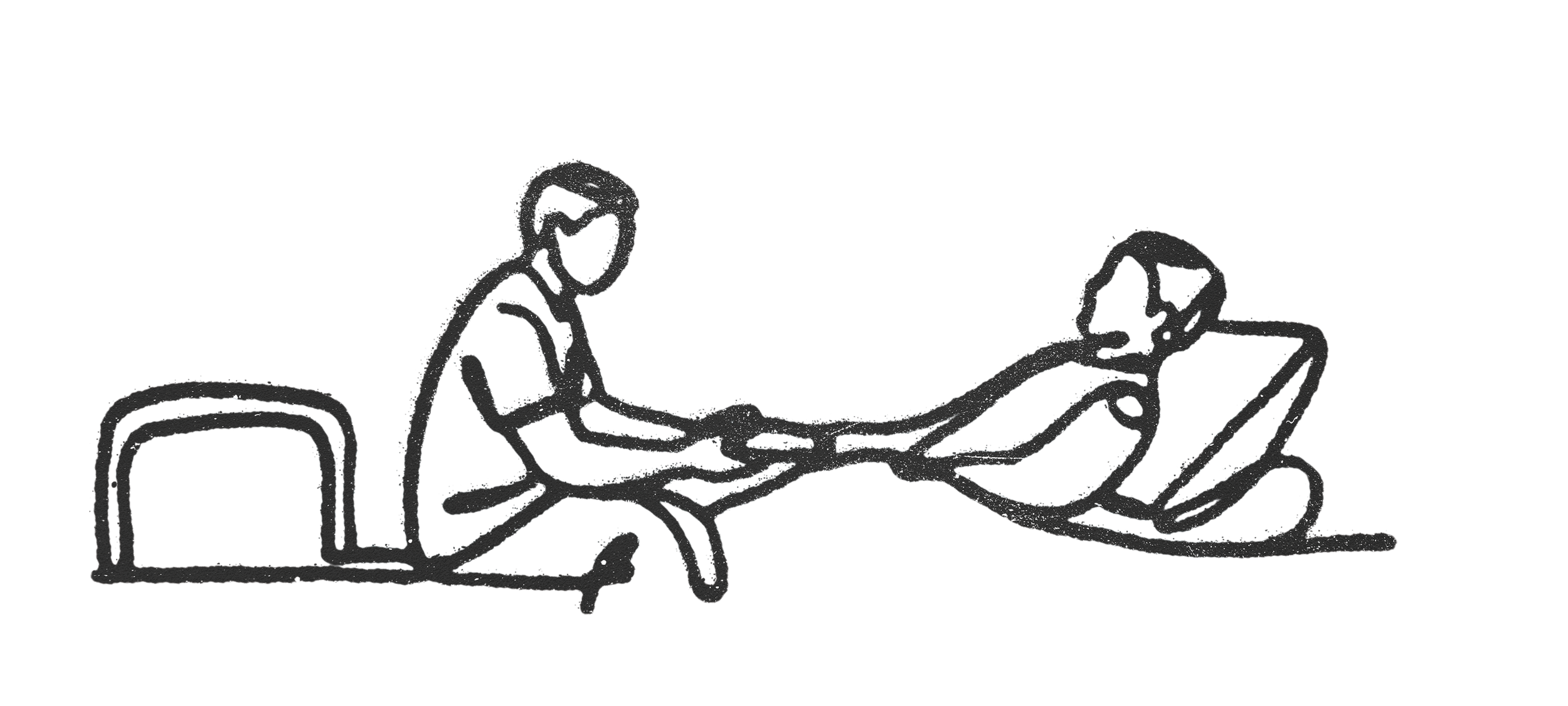
Illustration by Foster Denney
***
I give my dad the best of me, but when I’m not in the hospital, I feel the black wave of depression come washing once more over my heart. I was officially diagnosed with major depressive disorder at the age of 18 or 19, although it probably started well before that. There have been better days, of course, but over the past three or four years, the darkness has felt increasingly overwhelming.
Climbing has been the only thing I’ve found that helps at all, and in the days between hospital visits, I’ve found a mungy, moss-covered, dirty, fractured, undeveloped crag not far from my home. My current climbing obsession is dry-tooling, although I’m not particularly good at it. Using ice tools to climb bare, unfrozen rock is a strange obsession for someone who lives in Northern California, the topography of which offers few venues. Climbing takes all of me, body and mind, so that there is nothing left. I can hardly remember a climb when I’m done with it—it’s like I enter a fugue state, less flow and more annihilation—and dry-tooling puts me in that headspace from the moment my cramponed feet leave the dirt. Perhaps this is a strange reason to climb, but I’ve found nothing else that brings me to absolute zero, without which I often don’t think I’d survive at all.
There’s an arête at the center of the crag, perhaps 20 feet of vertical or near-vertical climbing after which it devolves into typical Sierra granite rambling. It’s probably something like 5.8 in climbing shoes, the holds solid if dirty, but with ice tools and crampons it feels skittery and tenuous. I bolt it between trips to the hospital and do solo top-rope laps for hours.
***
I think about taking my dad out to the new crag when he’s better. I think about him sitting in the shade, belaying or just watching as I scratch my way up and down the route. Sometimes it feels like that day might be possible. Things get better. But then things get worse. During the days, I venture to the crag and put three sets of top anchors in, and then drop a rope and run up and down possible routes with my tools. At night, I show Dad pictures on my phone. At some point—10 or 11p.m.—I pull the chair into a bed and fall asleep listening to the various machines beep and whir. The nurses come and go. He does not sleep well—how could he?—so his nights are mostly tedious, watching the clock and waiting for the day to begin. When the sun comes up, it’s always a relief.
“Why?” I ask him. “Day and night are pretty much the same here.”
“I know,” he says. “It’s weird, but I’m always waiting for the day.”
He is mostly terrified—terrified and bored, a combination that anyone who has spent much time in a hospital will recognize with abject horror. He felt betrayed by his upbringing as a Catholic, and when he split from that faith, it was total. For him, what lies beyond is only a bleak and all-encompassing emptiness.
And yet this: “I keep thinking how much I’ll miss everyone,” he tells me from his hospital bed, the high-flow cannula a constant hiss. “I know that’s stupid. I’m the one who’ll be gone.”
***
By day 25, my father has deteriorated to the point where he can only function if dosed regularly with Schedule II painkillers—morphine and Dilaudid—and a cocktail of benzodiazepines for his ever-increasing anxiety and air-hunger. When I arrive home early that morning, I tell my mom that I hope we can wean him off the benzos, as they make him so exhausted and distracted, and it is impossible to communicate with him.
It is that same day that my sister calls to tell me that Dad wants to be taken off everything. “He’s done,” she says. There isn’t even a sense of loss. Not yet. There is nothing but the physical motion of getting back in the car.
His family, my family, gather across the afternoon. At his request, he is dosed with morphine, and we drop the oxygen slowly. I hold his hand and talk to him for five hours until he is gone. Or I try to. At four hours and 30 minutes, I fall apart, screaming and crying, my snot dripping onto the hospital floor. I can’t help him. I can’t do anything. And there is my dad, his final, agonal breaths rasping, and then, finally, lifeless, pale. And all I can think is: That’s my dad. That’s my dad. A few weeks before, he had been helping me build a storage shed in the forest. Now he is gone. And what I thought then, what I still think, is this: How can there be a world that my dad is not in?
* * *
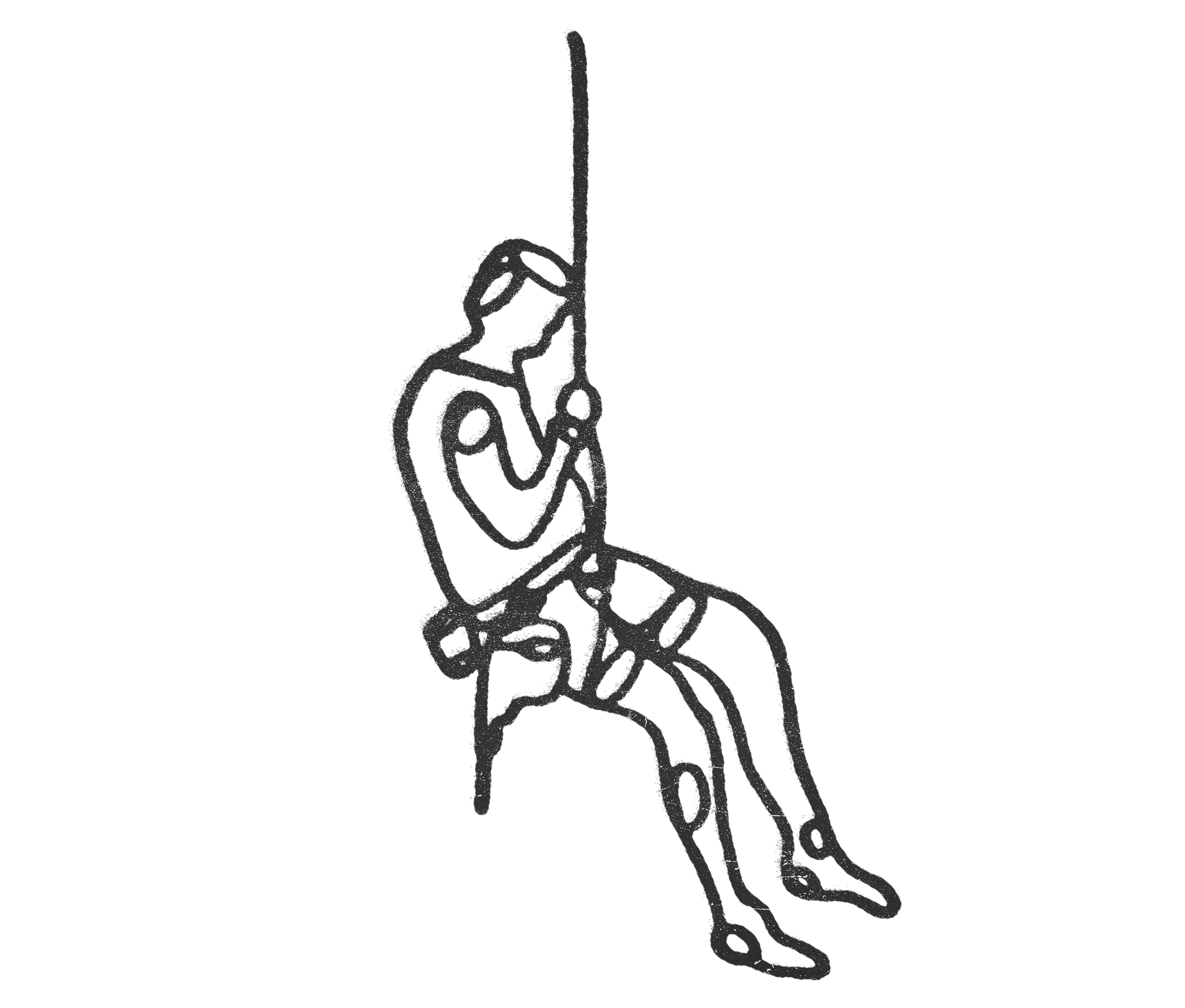
Illustration by Foster Denney
The day after my father’s death, I return to the crag, clip into the anchors, drop onto the rambling, fractured face, and begin bolting again. A few hours of granite dust, tears, sweat. Occasionally, I think of telling my dad about the new route only to be reminded that I’ll never get to tell him anything again.
I call the new route Mr. Subaru, in reference to my dad’s late-in-life used car business. The route runs up the side of a broken arête so that the climber must shuffle up and to the right over and over again, rising and turning across the face on thin edges, one’s body constantly tipping sideways into the fall line, ice tools scratching at bare granite. It is balancey, tenuous, and just difficult enough to demand attention. I cannot say that I feel any joy upon the first ascent, but it at least requires enough of me that I can’t think of anything else.
I have no partner at the crag. Everything I do here is alone. I bolt routes and climb them. I sit in the shade of the cedars. I weep.
* * *
My father returns home as a box of ashes in early July. The box is simple cardboard wrapped in plastic, although there’s a separate small baggie for me to scatter in Yosemite, the place he loved the best in all the world. I have plans to go up El Cap and scatter those ashes from the top after climbing it, but realistically, that will probably never happen.
My mom places the box on a small shelf in the closet of the bedroom, which is now only her own.
What is the point if, in the end, you are just a box of ashes in someone’s closet? Why struggle? Why do any of it at all?
* * *
I bolt three more routes. There is a wasp’s nest in one of the cracks under a prominent roof, although I cannot determine which crack actually holds their paper hexagons. The wasps are uniformly black and move lazily around me as I pull myself up the route, testing holds, looking for good crampon placements from which to clip, thumping possible bolt locations with my fist or the hammer. Then the impact drill. Then the bolt and the hammer. Then I wrench it down.
The rope I have been using was fairly new when I started; once 80m, it has been cut into 50m and 30m, rockfall having created a core shot. Even what remains is fuzzy in places, probably unsafe. I’m not sure that I care, although I have noticed that, when putting up my rope for the day, I’m not excited about falling from the top anchors. So do I want to live? Maybe my body does, the animal in me. Sometimes I holster the drill and just hang there in the harness midway up that fuzzy rope. Sometimes I cry there, up above the ground. Sometimes I just remain where I am for no reason I can determine. Maybe it’s just the act of being in a location difficult enough to get to that I feel a measure of safety. Sometimes I close my eyes. Sometimes I open them.
* * *
The most difficult route gives the entire crag its name: Grief Project. It’s the route with the wasps, beginning with a short slab with scratchy but positive placements, just enough to keep you moving and in balance. The trouble starts at a roof that is, coincidentally, about where the slab smooths out, and the placements disappear. One can lever in the back of the roof—difficult but possible—and then a pick can be slotted leftward into a crack formed by an exfoliating hunk of granite akin to a loaf of French bread. It’s a solid placement, but just at the edge of the lip of the roof, so that one is forced into a left-handed lock-off on that tool. It’s difficult—impossible for me—to get into a Figure 4 or 9 as my body ends up crammed up under the roof and I actually lose more height than I gain.
I think about the route at night when I’m lying in bed, in my parents’—in my mom’s—spare bedroom. Sometimes I feel like I can almost do the move. If I lock off and then reach far right and then shift my feet over to the bottom of the roof …
But instead, I’m stuck at the lip of the roof again. I scratch around, sweat running into my eyes, but find no purchase. The black wasps circle. One eventually stings me on the forehead as I struggle to release my two progress capture devices from the rope. This is the price of the ticket, it seems.
* * *
When one is in the depths, when the black dogs are roaming, you do not remember ever feeling different. You cannot. The overwhelming feeling of doom is your only reality, and it is infinite. Upon waking, it is with the grim understanding that I am now faced with the task of filling another seemingly endless collection of bleak hours before I can return to bed. I’ve told people it is akin to waking up each day with an invisible gun in your mouth.
The psychiatrist writes a Wellbutrin prescription to augment my current Prozac. My mom tells me I seem better. I don’t feel any difference except that now I’m waking up at 7a.m. and can’t get back to sleep, a problem in that it adds to the daylight hours I need to fill. So I do what I do: I pack up my car with my increasingly decrepit rope and the box of bolts and hangers, screws and washers, set everything on the junk-show that is the back of my car, and head back to the project.
A few times a day, teenagers, mostly boys, pass on the trail below me on the way to or from the swimming hole and cliff diving downriver.
“Whoa, bro, are you a climber? That’s so sick.”
“Did you see that movie about that guy who climbed that stuff?”
“Have you climbed El Cap?”
I’m kind, and I even answer their questions, but you can imagine what I’m thinking.
* * *
At some point, I put the Grief Project on the internet. I’m not done with the development yet, but it helps me keep track of things. Each route is named with significance, most related to my dad’s passing, but others in tribute to a friend’s deceased brothers. There are ten climbs now, each slowly being filled in with lead bolts; all ready for top-rope, at least.
I tend to head out to the crag in the late afternoon, avoiding the direct summer heat, bolting for an hour or two, and then heading home. Sometimes I think that the bolting is not really the point; the point is that I have to force myself to get out of the house and do something, and this is what I’ve chosen. It is lonely, but then again, so am I.
Illustration by Foster Denney
Then comes a day when, much to my surprise, I arrive at the crag to find a rope—not my rope—affixed to one of the anchors. I rap in to discover someone I don’t know top-rope soloing Mr. Subaru. When he reaches the ground, he introduces himself. He’s found the crag from my internet post and has driven from Sacramento. Now he’s effusive in his thanks for my commitment to dry-tooling and the work I’ve done in putting in the routes. When he talks about the climb, calling it by the name I have given it, the name that was in honor of my dad, I almost start crying. He rattles off the other climbs he’s already done here: Pop Goes, The Creezle, Take What You Need. They’re all names that hold deep meaning to me, and now they are in the world. “I did a variation of Discrete Mathematics,” he tells me. I ask him if it’s good, and he tells me it’s his favorite of the crag. So I bolted it as a route and put his name up on Mountain Project as the FA. Mathematics Direct (Variation), I call it.
I call my eldest son that night and tell him I met a guy climbing the routes I put up. “That’s f*&king awesome,” he says. “Those routes will be there forever.”
I guess that’s true.
* * *
I don’t know where this all leaves me. In depression, there is no great reckoning. With addiction, one can—at least theoretically—stop using and begin the path to recovery. But there is no recovery from depression, or at least I don’t know of one. I take my meds each morning, although there comes a day when it’s clear that the Wellbutrin is making things worse. I cry during a visit to my regular doctor, then I cry at the dentist’s. There isn’t any clear thought behind it; it’s just a terrible ache in my gut and a mangled moan interrupted by sobbing. I pull over on the freeway; I stop in parking lots. There’s no end to it. My head aches. I have a therapist and a psychiatrist, so I’m doing what I’m supposed to be doing, but I don’t know if any of it will amount to anything.
And yet I return again and again to the Grief Project. It’s been a private place for me, but now it’s public, a community resource. I know of five people who have visited the crag. Perhaps more will come. There’s an active dry-tooling community in Bozeman, the place where I first fully caught the dry-tooling bug, and sometimes I wonder if I could start something similar in Northern California. This has been a place of terrible grief but also a variety of solace, and sometimes I fantasize that we could hold a small dry-tooling festival here under the cedars, on the banks of the river. What a strange thought to have. Does this mean something is working?
I feel empty when the final bolt is tightened down, and I pull up the rope, coil it, and begin the short walk back to the car. It feels like something has ended out here in the shadows of the cedars. Not my grief, but this stage of working through it, of allowing my heart to change shape enough to begin to contain it. Or whatever the heart does. That night, I log into Mountain Project and add one final route, the sixteenth: up the mungy, broken corner that runs up the right side of the crag. I’d been looking at it for a long while, thinking it might need bolts, but I think I’ve put enough bolts in already, and it’s not really a climb that someone would much want to lead: a scramble up broken granite steps with plenty of easy rests, perhaps something a newcomer to dry-tooling might enjoy. I decide to keep it unbolted. Top-rope only. A blocky road disappearing into the ever-darkening sky.
As I type this, my dad’s 1970 El Camino SS gathers dust in the carport under the deck. He restored it from junk, lavishing it with care and attention. Even through the dust it shines, a blue that is almost black.
I call the route El Camino Obscuro. The dark road.
I wish you were here to see it all, Dad. God, how I wish you were here.