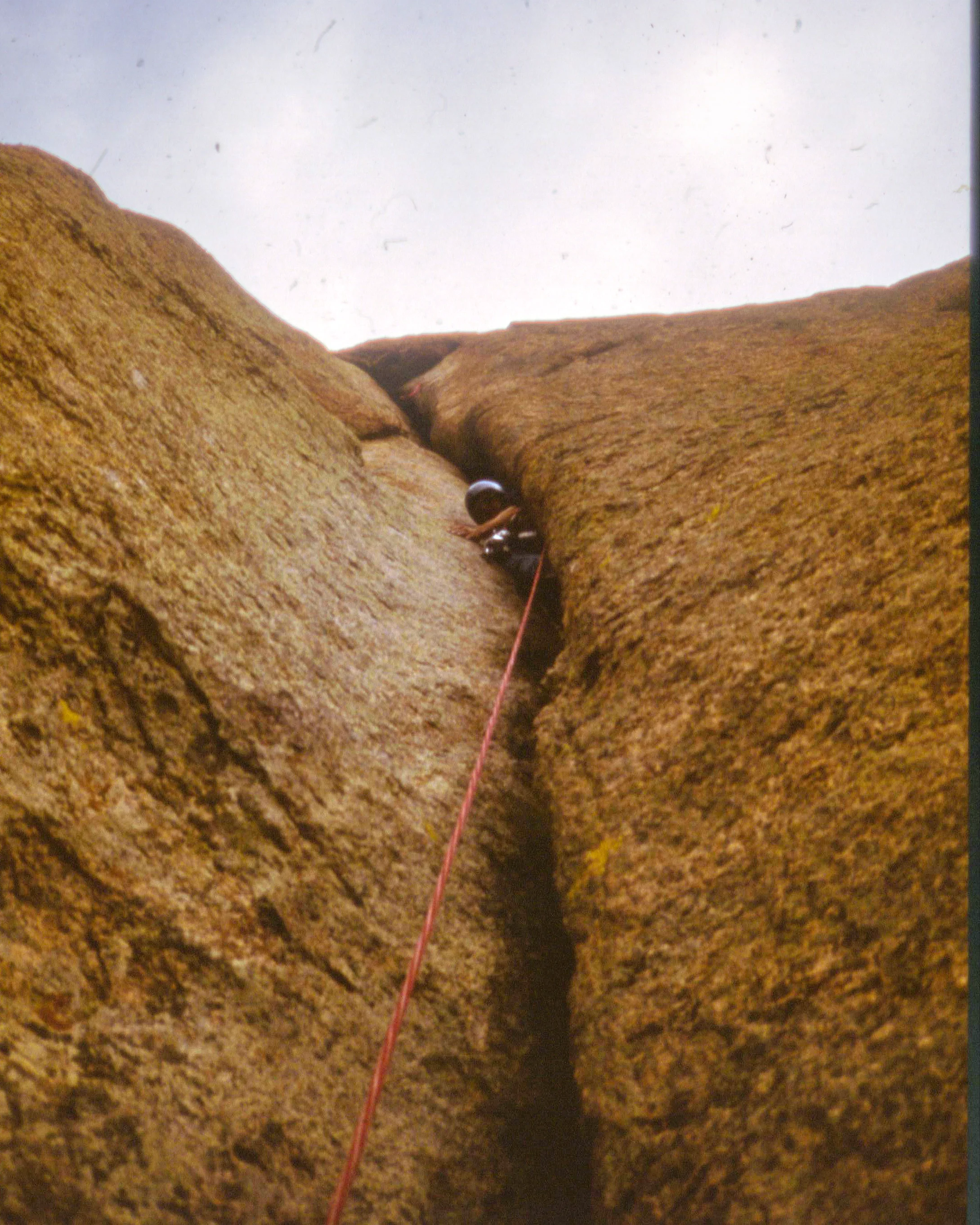
Images Courtesy of the Howard Lukens Collection
Lodging Spotlight by Sierra McGivney
Originally Published in Guidebook XIX.
A boxy light blue Ford van rattled down the road, well equipped with a cassette player and six cassettes—Springsteen, Little Feat, Steely Dan, The Allman Brothers Band, Robert Palmer, Bob Dylan—a beanbag chair (the prime spot), and six East Coasters. Dieter Klose, Angus Thuermer, Mike Kurle, Karen Kurle-Edwards, Howard Lukens, and Barry Rugo were looking for adventure, and they were convinced that Wyoming had it in abundance. They had heard whispers at Seneca Rocks, the Gunks, and Carderock—their usual stomping grounds—that the Tetons were the place to learn what they were made of.
It was 1976, the year of Charlie’s Angels, The Eagles’ Hotel California, Roots: The Saga of an American Family, Jimmy Carter winning the presidential election, and the ongoing Cold War and the 1970s energy crisis. In 1976, climbers were still pounding pitons, but there was a clear shift in this decade toward alpine-style ascents, clean climbing, and speed records. The Tetons promised to be a much bigger playground for the skills these climbers had honed in their backyards. So with swami belts, EB climbing shoes, and Chouinard Hexes and Stoppers stuffed into the back of the van, they headed west.
A different expectation for young people existed at the time. Children and teenagers were able to be free-range in a way that is rare today. Dieter Klose, now best known for his ascents on Devils Thumb, grew up with German parents who were both proud of and worried about his climbing. He first traveled out to the Tetons at age 15 without his parents or supervision, tagging along with an “older climber” in his late teens or early 20s. Begrudgingly, for Klose, they climbed Mt. Moran three times. This trip would be different.
Karen Kurle-Edwards and Mike Kurle were brother and sister. Karen’s mom didn’t get her. Not long before they left for Wyoming, their mother had told Kurle-Edwards, “You have to quit going everywhere, you’re going to have gone everywhere by the time you’re 25.” Kurle-Edwards wasn’t going to let that stop her. Howard Lukens, now Treasurer of the AAC Board of Directors, was Kurle’s friend from high school. Lukens had been invited on the trip at the last minute after another climber had taken a fall and gotten injured.
Angus Thuermer recalls meeting the group at Seneca Rocks through Barry Rugo. Thuermer was the most experienced climber of the bunch; he had climbed with the Yale Mountaineering Club. Founded in 1947, the club focused on training students in rock climbing and mountaineering techniques. Rugo and Klose went to the same high school and were in the same Explorer troop (Senior Boy Scout troop) as Kurle and Kurle-Edwards. The knotted threads of community were tied, and the group was formed. The possibilities of grand climbing adventures were on the horizon.
Thuermer recalls that the climbing itself wasn’t their only compass. The promise of a cheap bed and a community of climbers was pulling them west as well. His stay at the Grand Teton Climbers’ Ranch would end up being “quite influential in me becoming an alpinist and a climber.”
Historic Roots
That rickety van would soon find itself parked in front of the newly minted Grand Teton Climbers’ Ranch (GTCR), which had opened six years prior. After the Jenny Lake climbers’ camp was shut down in 1966, it was hard for climbers to find camping spots, as outdoor recreation and climbing in the United States were on the rise, and the National Park Service had to impose limits on campground use.
The solution was simple: The vacant Double Diamond Ranch, which once offered cabins snuggled at the base of the Tetons to tourists, but was sold to the National Park in 1964, would be leased out to the American Alpine Club starting on January 1, 1970, to provide climbers with cheap, one-dollar-a-day, modest lodging. Lodgers did not need to be affiliated with the Club, but they did need to be a climber.
Nick Clinch, the American Alpine Club President at the time, clearly had a vision: adding bunk beds and imagining the main lodge to be a place of gathering on rainy days to tell “stories of high daring and plan future climbs.” He even dreamed that someone would donate a projector and slides—generating a culture of trip reports and climbing presentations. The Ranch needed some work, but it wasn’t anything the AAC, with the help of volunteers, donors, members, and climbers passing through, couldn’t handle.
Clinch wrote, “Although the American Alpine Club has assumed the obligation…for the operation of the ranch, the ranch does not belong to the Club. It belongs to all climbers, just as it is open to all climbers. It is your ranch and needs your assistance to make it a success.”
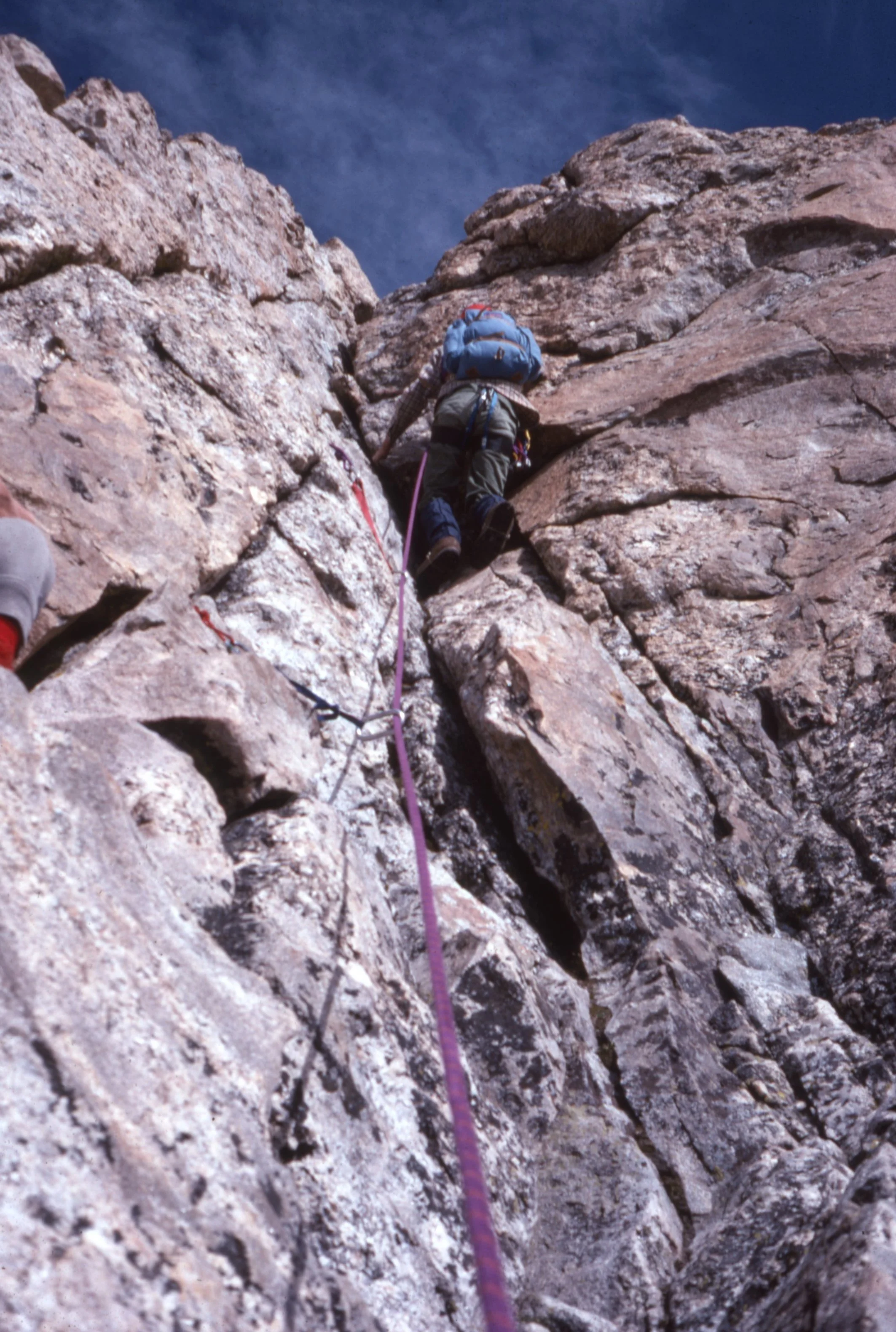
Image Courtesy of the Howard Lukens Collection
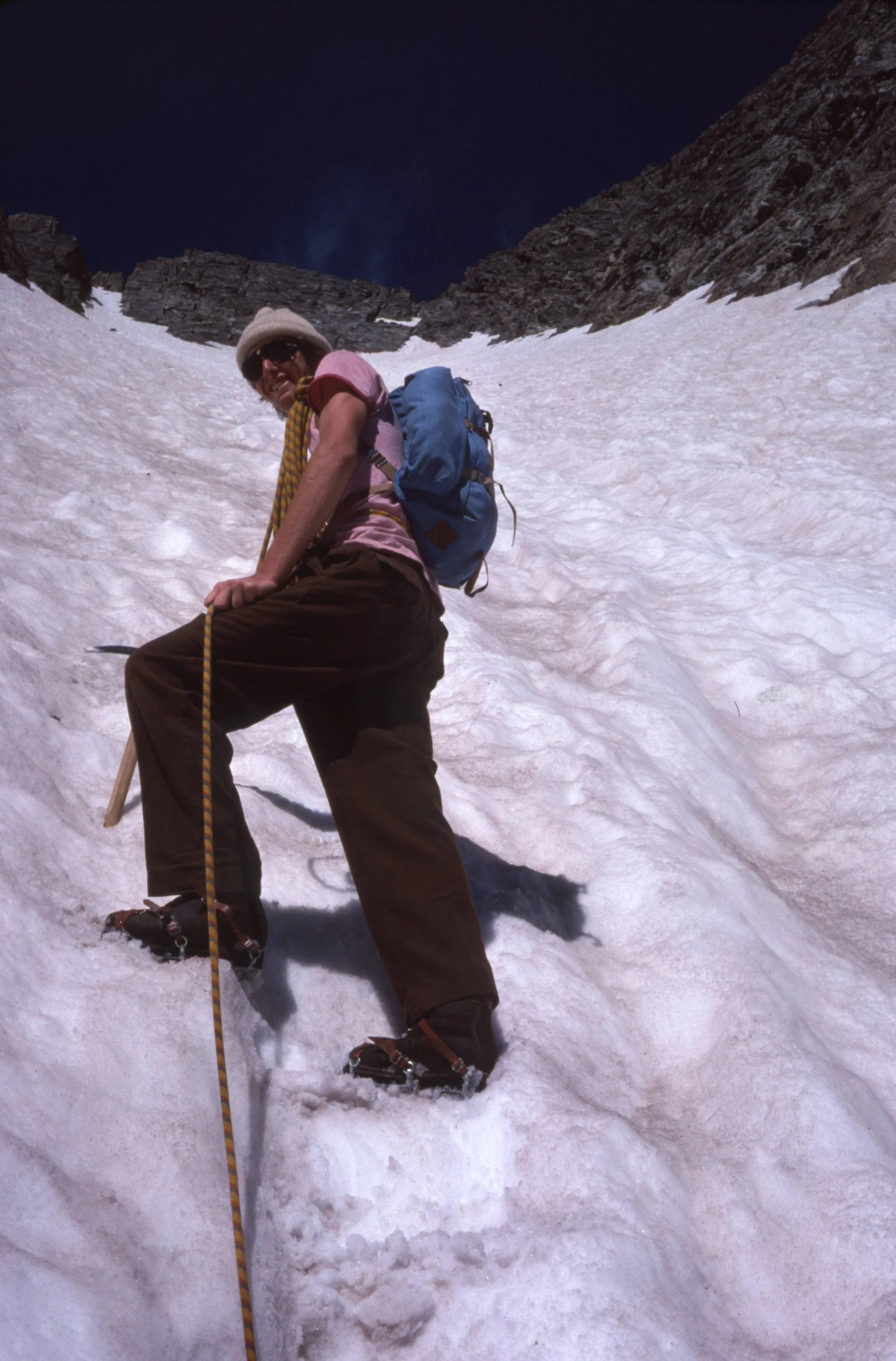
Image Courtesy of the Howard Lukens Collection
Leap of Faith
Enclosure Ice Couloir (800’, 6 pitches, III 5.6 AI3) had it all: trad, ice, and snow—the perfect mix for the ultimate alpine adventure. That summer of 1976, Thuermer and Klose were high up in the couloir when Klose took over the lead, preparing to switch from ice to rock. Klose climbed into a small dihedral and continued traversing to the left, unsure of the route. He stepped on several loose blocks in the inside corner of the open book, feeling the disconcerting wobble with each move as he progressed upward. Without thinking of Thuermer, he trundled the rocks. Once Thuermer followed, he got to the open book—but all of the footholds were gone.
“What do you want me to do here?” Thuermer called out to Klose.
“Jump, Angus!” was Klose’s response.
They did not climb together again, but laugh about it today. This climb was full-on, involving hard ice climbing, loose rock, and unsure footing. But wasn’t that the point? To make mistakes and learn, with a warm bed and camaraderie waiting for you at the Ranch.
Out of the Frying Pan
The Skillet Couloir descends from the summit and pools into the Skillet Glacier, creating a pan-like shape on the side of Mt. Moran, a dramatic mountain above Leigh and Jackson lakes. Skillet Glacier is an ultraclassic ski line in the colder months, but by early summer, the couloir is a steep snow line. When the snow melts out, it turns into the CMC Route, an alpine trad climb.
Lukens and Kurle had reached the top of the Skillet Couloir in stellar conditions, the sun beaming down on the snow, making the day warm and inviting—so warm that Kurle had ditched his shirt, a sunburn starting to form.
“How are we going to get down?” asked Lukens. The full extent of the two young Virginians’ glacier skills had come from Mountaineering: The Freedom of the Hills.
Kurle replied that they would plunge-step, a technique that involves keeping your center of gravity low and leading with your heel as you kick steps through soft snow. Lukens began setting up a boot-axe belay—flying by the seat of his pants and some half-remembered book knowledge—when, two plunge steps later, Kurle plummeted head over heels down the couloir. The warm snow had balled up on his crampons, making it hard for the sharp points to dig into the mush.
Lukens could only watch as the rope unspooled and finally became taut, pulling him down the glacier. The slope zipped by as Lukens frantically tried to stop himself. They were heading straight for the edge of the glacier, an unknown drop-off waiting for them. Miraculously, their unintentional glissade slowed until they stopped 50 yards from the edge.
Mt. Moran is relatively remote, so the pair had to bushwhack for miles, which made their epic even longer. Kurle’s ankle had suffered from the fall, and his sunburn had deepened. To make it worse, he kept tripping and falling into brush-covered streams, cursing up a storm. Lukens calmed him down and motivated him to keep going. They continued like this until they reached the road.
Kurle finally dug his heels in. “I can’t go another inch,” he told his friend. Lukens threw his thumb out, hoping to hitchhike, but the luck they had on the glacier’s edge had seemingly evaporated. All of a sudden, like an angel from afar, Kurle-Edwards pulled up in the van.
If Kurle-Edwards hadn’t driven by, things would have gotten dire. “We’d probably still be out there,” said Lukens.
Once back at the Climbers’ Ranch, starving after not eating in over 24 hours, Lukens, looking like hell, approached a guy cooking at the pavilion, asking if he had any food. The climber directed him to half a can of pea soup. Lukens grabbed it off the stove and guzzled the soup down. To this day, Lukens loves green pea soup.
Lightning Strikes Twice
Klose and Kurle-Edwards had summited Middle Teton. As they were rappelling down, their gear started to click. Kurle-Edwards's hair was sticking out of her helmet, Klose laughing at the strands poking through. Hot, clear summer days in the Tetons can turn dangerous quickly, high up in the alpine. Midday thunderstorms are common and can be deadly to climbers with metal on their harnesses up at 7,000 feet. Stopping at a notch, Klose and Kurle-Edwards turned to each other, at a loss for what to do. Lightning was buzzing in the air.
Kurle-Edwards, afraid of being electrocuted, ditched her ice axe, despite Klose's warning about the ice axe's importance. They decided to put all their gear on one side of the notch and scramble to the other side. Clinging to the rock, they had no choice but to wait out the storm and hoped that they would make it through.
"Lightning was flashing in front of us. It was really terrifying," said Kurle-Edwards.
Over on Symmetry Spire near Jenny Lake, Thuermer, Kurle, Rugo, and Lukens were in a similar situation when the storm came in. Lightning, thunder, and snow squalls descended. Their gear buzzed from the electricity, and snow blew up the rock face.
"It was like [someone] was throwing sticks of dynamite at us," said Kurle.
The group of four had been split into two, climbing different routes on the spire Direct Jensen Ridge (10 pitches, I|I 5.8) and Durrance Ridge (8 pitches, I| 5.6) — but were able to converge on a ledge. Frightened, they waited out the storm. Everyone huddled on the ledge, hoping that the next lightning strike wouldn't fry them. The storm, like all storms, passed, and the lightning strikes slowly became fewer and farther between. The sun peered out, as if ignorant of the chaos that had come minutes before. They tied their ropes together to do a longer rappel, slinging a rock flake. Rugo started rappelling, jumping down the rock face quickly. The other three looked on in horror as the flake shook and trembled, thinking it would surely blow. Frantically, they screamed for Rugo to stop. Rugo continued downward, completely unaware of the precarious anchor his life was dependent on, the edge he was teetering on.
Lukens's thoughts skated ahead if Rugo fell, both the rope and Rugo would be gone into the abyss, leaving the group stranded with no way to call for help and Rugo dead.
But soon enough, Rugo was off rappel. The flake had held. Lukens, Thuermer, and Kurle looked at each other, pale, their faces drained after their glimpse of the grim reaper. The three set up a new anchor promptly and cautiously. Shaken from the incident and the lightning, they began rappelling.
Both groups had known they should be done climbing betore midday, but had spent more time route-finding than they had planned. They trudged back to the safety of GTCR, met with laughter and camaraderie, the group grateful to have made it down unscathed.
The trip was a test of will, uncertainty, and mountain skills. The GTCR provided a refuge after the storm, the epics, the wins, and the failures. It was a place you could meet climbing partners and climbing heroes, or find kindred spirits and a can of soup around a campfire.
"The Climbers' Ranch has always been very important," said Thuermer, "and I think this little group, it's sort of-it's a story that could be told by dozens and dozens of other climbers and teams."
Into the Fire
While they headed east and all went their separate ways after the summer of 1976, Thuermer felt called to return to the Tetons and settled in Jackson in 1978, getting a job as a pressman at the Jackson Hole News.
Lightning wasn't the only powerful force to contend with in the dry air of the Tetons. By the 1980s, fires in the park had become a huge debate in the Tetons. Previously, American land managers had immediately squashed the smallest wildfires. During the '70s, scientists began advocating for letting fires burn in the Mountain West, due to the unnatural buildup of live and dead trees, pine needles, shrubs, and grasses, all of which would contribute to a significant source of fuel that wouldn't be present in natural circumstances, when fires weren't mitigated by humans. As the Park Service has noted, Indigenous peoples have long practiced intentional burning in the Northern Rockies, "clearing undergrowth, creating wildlife habitat, supporting hunting strategies, reducing fire risk, and stimulating the growth of key food sources, such as huckleberries."
As the research piled up, the Park Service decided to let natural fires burn as long as they didn't impact the public.
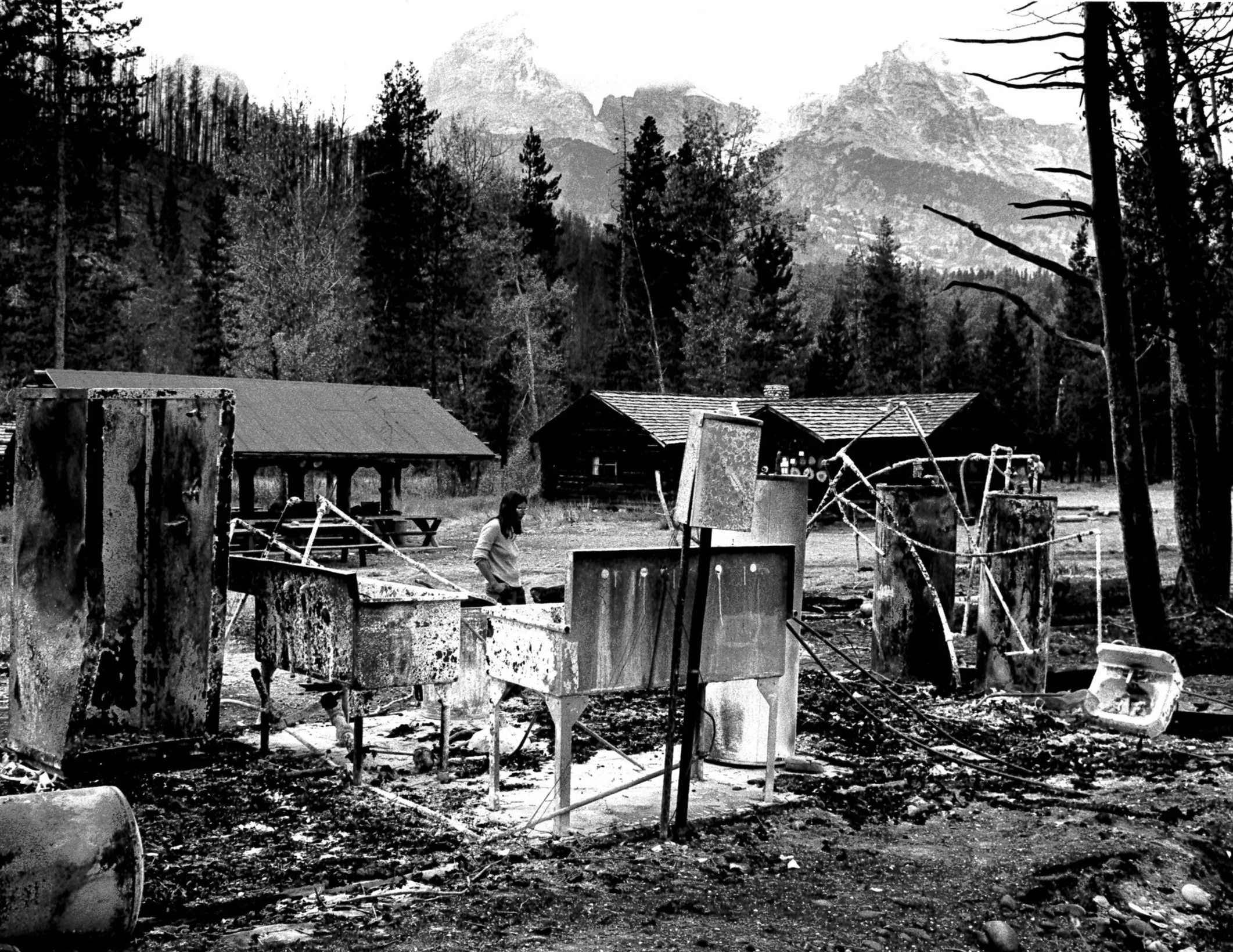
Image by Angus Thuermer
Small to moderately sized fires burned in the '80s with no harm, but in 1985, a fire started near park housing. NPS immediately tried to put it out, but high winds had another idea, escalating the situation.
Thuermer had become a reporter at the Jackson Hole News at this point, he had more than a personal interest in the happenings within Grand Teton National Park. Hearing about the fire, he threw on a yellow Patagonia windbreaker and snuck into the chaos, hoping to blend in with the firefighters. The superintendent and a park ranger were on their way out when they stopped him. His disguise hadn't worked.
In classic journalist fashion, Thuermer said: 'You can't stop me! This is breaking news!' They let him go but told him they weren't responsible for any damage to his truck. By the time he arrived, the fire had spread to the GTCR, burning several buildings.
Thuermer photographed the whole thing. As he was walking around, he saw an ember land on the boardwalk in front of the Climbers' Ranch main lodge. The ember looked like it could keep the fire going, so he called a firefighter over, and they put it out. Thanks to Thuermer, a section of the Climbers' Ranch may have been saved. The burned down buildings were rebuilt with help from members of the Club, like Leigh Ortenburger.
Fifty years later, the GTCR still calls to Lukens; he's returned a handful of times, with a trip coming up this summer. "It's my favorite place in the world," said Lukens. Kurle and Lukens still climb and ski together, always looking for their next adventure. Klose no longer climbs due to a back injury, but he made sure his last climb was a good one: the Grand. "It was wonderful," he reminisced from his van on the Oregon Coast. Thuermer still lives in Jackson Hole and currently works as the natural resources reporter for WyoFile. Kurle-Edwards returned to the Tetons shortly after and now loves walking meditation, through-hiking the Appalachian Trail, the Colorado Trail, the Camino del Norte, and more, taking each step slowly so she doesn't miss a thing. Rugo landed in the Northeast. His climbing career spanned the world soloing Open Cockpit (5.11 +) in the Gunks and putting up a three-pitch 5.10 in Telluride in the '80s; attempting Devils Thumb and Choktoi, summiting Everest and serving as the AAC New England Section Chair in the '90s.
From the Double Diamond Ranch days, to fighting fires, to rebuilding the Ranch, to the Historic Lodge at the GTCR being placed on the National Register of Historic Places in 1998, the GTCR has remained at the foot of the Grand, sustained by the dreams of the climbers who have shaped it again and again with their time, skills, and donations. As Clinch manifested all those years ago, the Grand Teton Climbers' Ranch is not ours; it is yours.