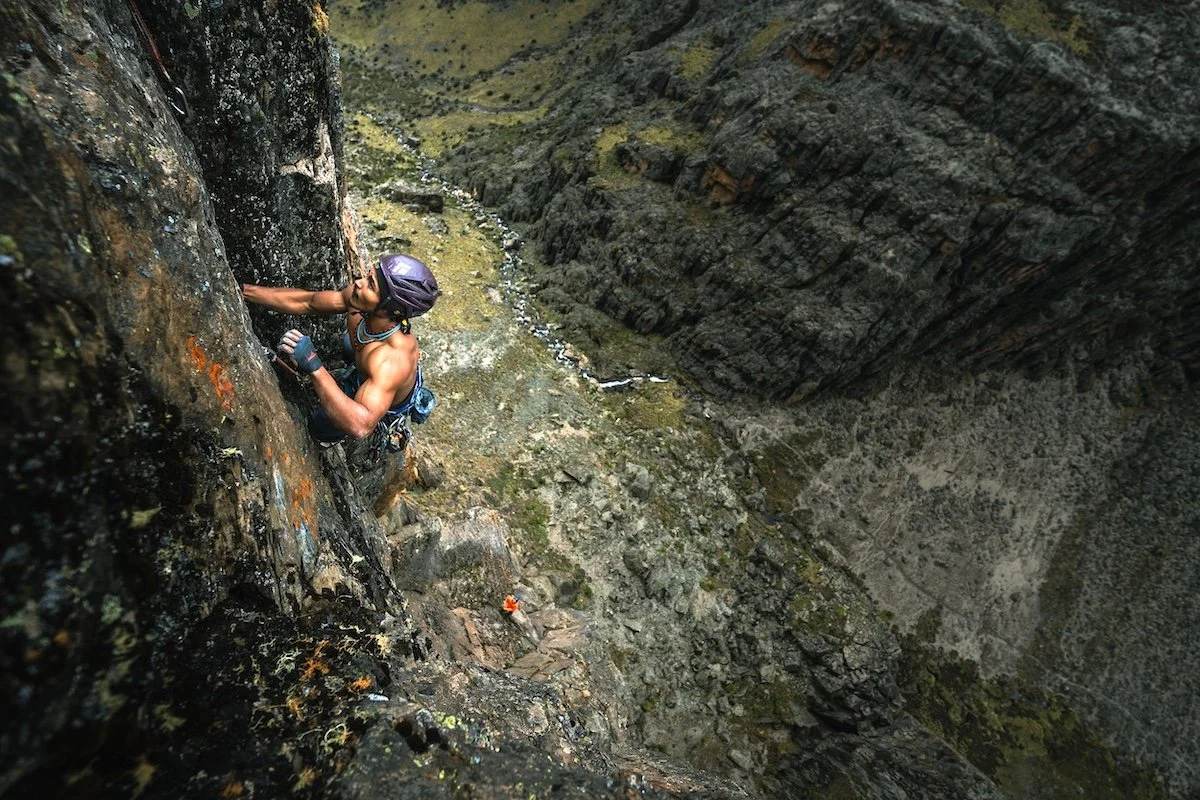
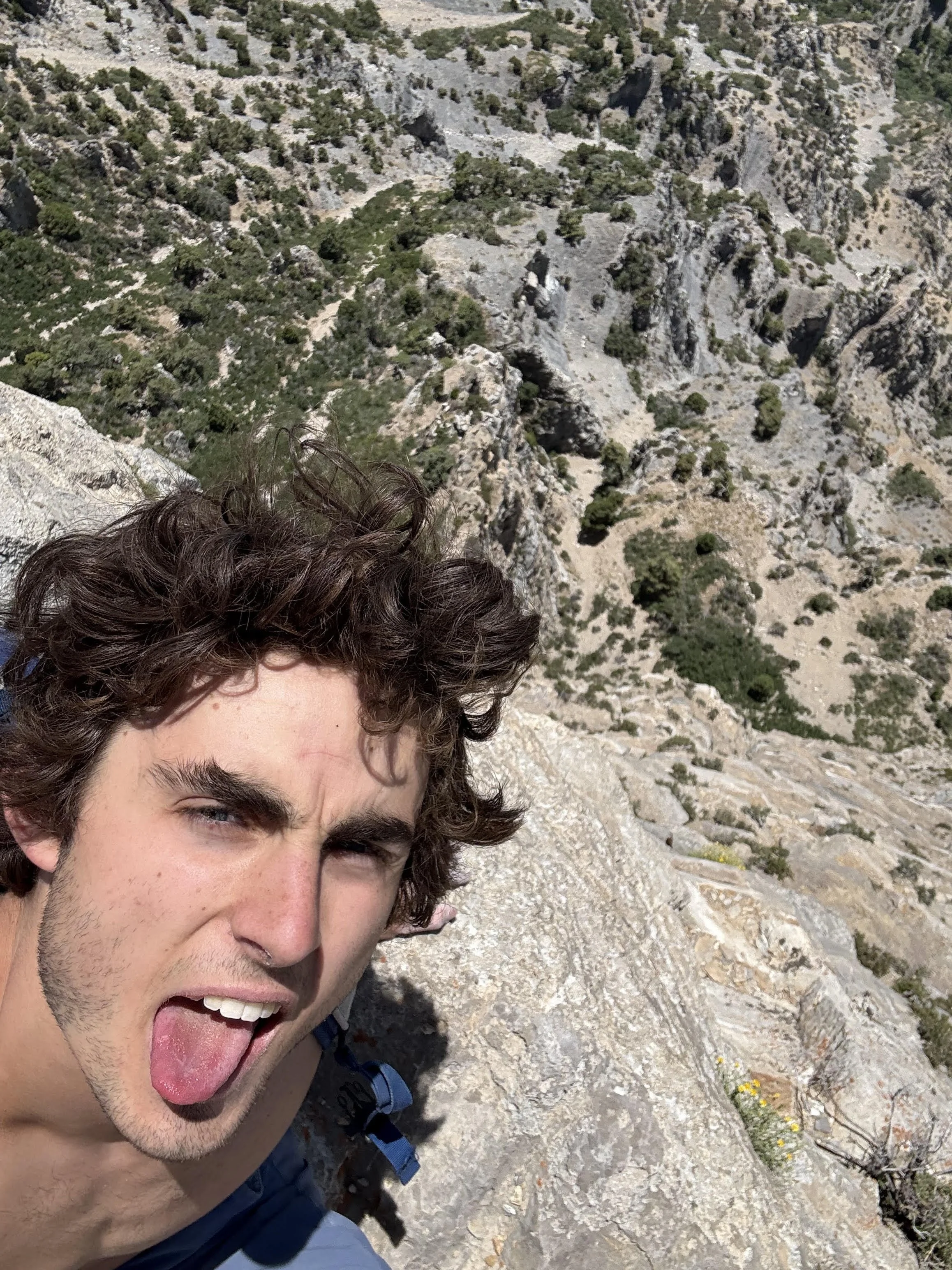
Lincoln Knowles ropeless in a selfie taken high on Squawstruck/Khyv Peak (1,900’, 22 pitches, IV 5.11b) during his ropeless ascent on July 10, 2025. Lincoln Knowles (@lincolnclimbs)
Lincoln Knowles—or at least his online persona—may not be everyone’s cup of tea. The Utah-based climber became famous/infamous a couple years back on YouTube and Instagram for his irreverent antics, including free soloing (lots of it) and even “drunk bouldering,” in which he slammed beers while Kilter Boarding and bouldering at the local gym, eventually earning a ban from the facility. In fact, Knowles was so brash, at least at first, that the AAC did a podcast discussing “ragebaiting,” epitomized by Knowles, with the author and AAJ contributing editor Owen Clarke, who’d written a piece about the trend for Climbing Magazine.
Still, it would be facile and ahistorical to deny the iconoclastic, libertine, and countercultural threads in our sport—think of those over-the-top, risk-seeking Golden Age personalities like Don Whillans, Warren “Batso” Harding, John Bachar, and Jim Bridwell. Maybe their ribald behavior isn’t for you, to either participate in or bear witness to, but it also makes the sport lively and unpredictable.
Knowles’s content these days has morphed to pretty standard free-solo stuff; he’s even teamed up with Cedar Wright and Alex Honnold to climb ropeless together. Of course, free soloing isn’t everyone’s jam, given that a fall can be lethal, but it’s also true that climbers have always done and will always do it—before ropes and gear were reliable, you were basically free soloing anyway.
In 2025, Knowles pulled off an audacious free solo of one of America’s longest sport climbs, unsupported and with minimal preparation. The grade of the 22-pitch Khvy Peak in Rock Canyon, Utah, might “only” be 5.11b—more than a few notches below Honnold’s free solo of Free Rider (IV 5.13a) in 2017—but the route is chossy, it sits in the sun most of the day, and there’s stacks of sustained 5.10 and 5.10+ on slick limestone. Below, Knowles details his journey up the climb—and a surprising encounter he had on the descent.
—Matt Samet, Editor, American Climbing Journal
First Free Solo of Squawstruck/Khyv Peak
It was the first morning of 2025 that I’d walked outside and thought about rock climbing. The February air felt warm. I approached my friend Eli outside the University of Utah’s Marriott Library, but he had an exam the next day. This was how a lot of my big soloing days started: I would call friends, who always seemed to be going to class and didn’t approve of the Lincoln method—skip school and neglect responsibilities in favor of climbing.
But I had also recently started a beautiful habit: I had been free soloing on buildings and short, easy walls since age 15, but now at age 21, it was my new focus. The freedom to just go alone, to look at something and climb it, was enthralling.
I had climbed Squawstruck three years earlier with Eli, taking 13 hours. [Editor’s Note: Squawstruck is the route’s original name, taken from the 7,876-foot mountain’s former appellation of Squaw Peak, which was changed by a 2022 federal order that removed the word “squaw” from hundreds of geographic features. Today, Mountain Project lists the climb as Khyv Peak, though its first ascensionist, Tristan Higbee, still lists it as Squawstruck at his blog.] Today, harness and daisy chain on, I meandered up the 22-pitch, 1,900-foot 5.11b sport route—one of America’s longest—resting on my harness and slings around the crux pitches.
The climb, up the obvious, tallest face at the mouth of Rock Canyon, was put up by Tristan Higbee and Thomas Gappmayer in September 2010, with Christian Burrell helping. Though it wanders, linking buttresses with walking or scrambling traverses, Squawstruck is still steep, sustained, and frequently exposed on variable Wasatch limestone.
As I pulled on my carabiners at the cruxes, I was glad I wasn’t free soloing. Later in 2025—that summer—I was coming off some productive weeks of free soloing in Colorado, including a ropeless ascent of Curvaceous, a slippery 5.11b in Clear Creek Canyon. That July, I thought about Squawstruck again. An excited feeling sprouted in my stomach—I felt primed.
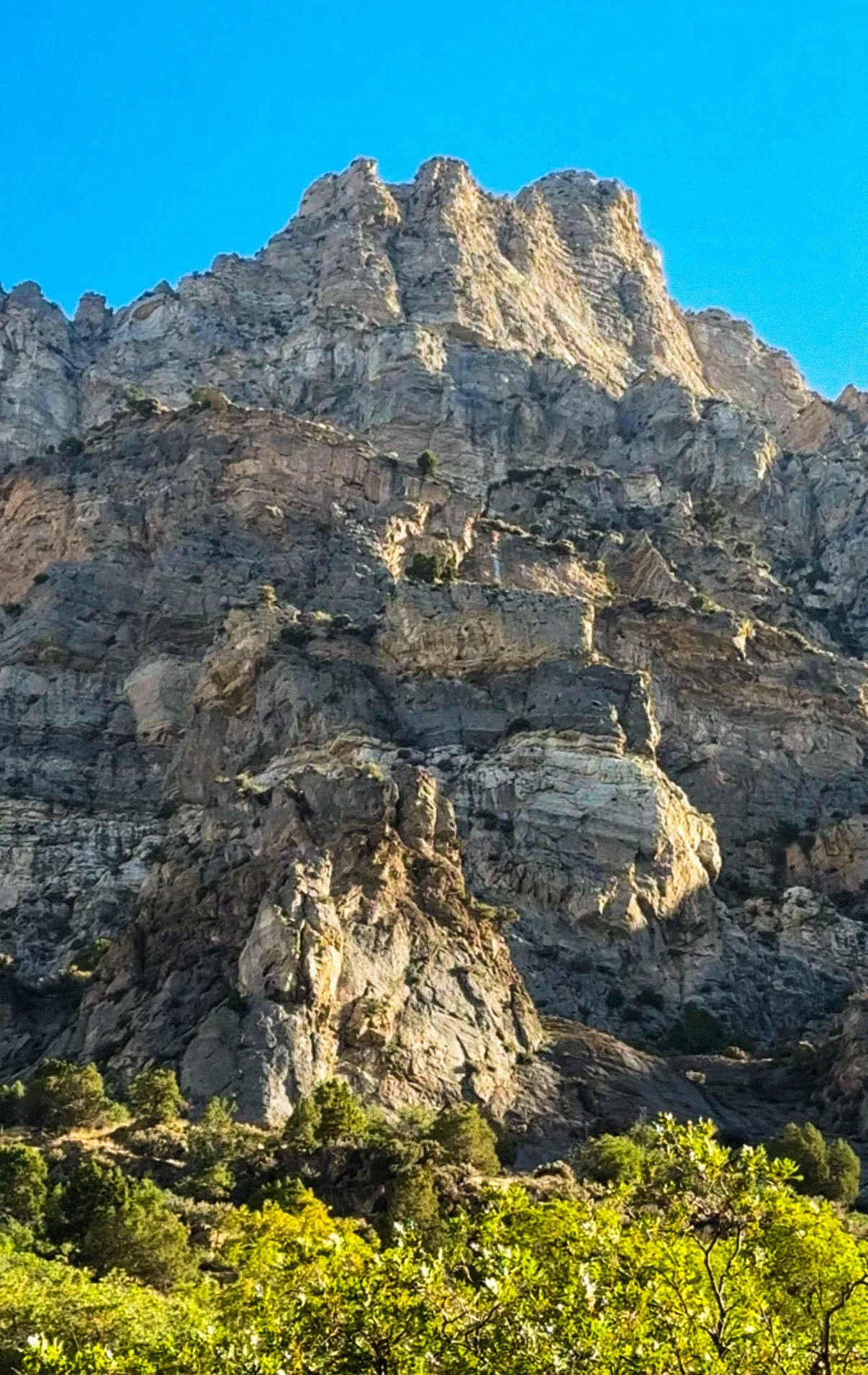
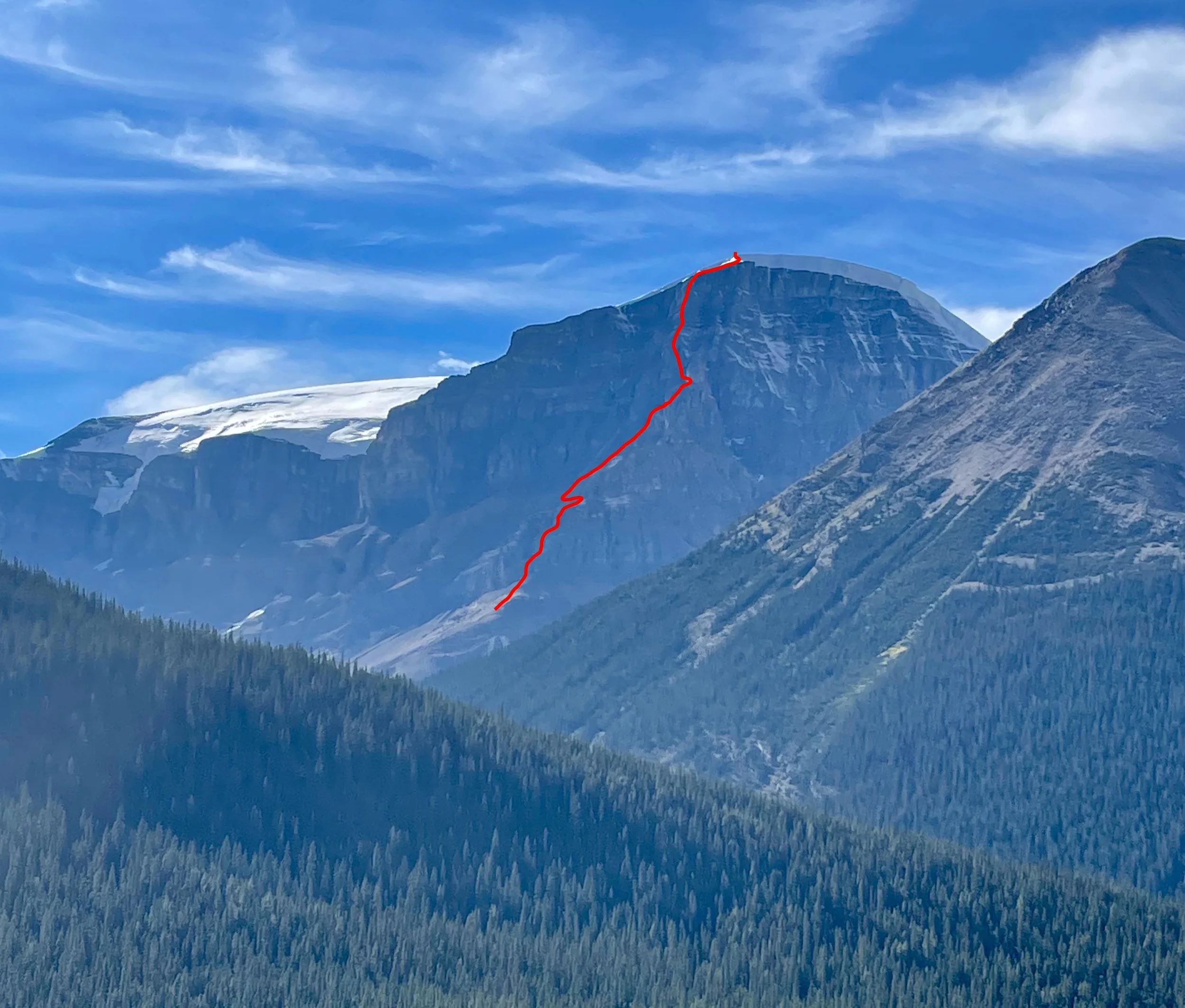
The “limestone layer cake” (per Knowles) of Khyv Peak’s south face, Rock Canyon, Utah. Squawstruck (1,900’, 22 pitches, IV 5.11b) links scrambles across ledges to connect the vertical buttresses. Lincoln Knowles (@lincolnclimbs)
On July 10, 2025, at 8:30 a.m., I started up the scree and talus below Khyv Peak’s south face. I hadn’t been here since February; this time, I had only my shoes and chalk bag. I’d woken up early enough that the crux—the pitch 14 roof—would be shaded. However, the top six or seven pitches, which range from 5.8 to 5.10+ slab, would likely be cooking. The first 11 pitches flew by, with five technical 5.10s in the mix. Music from my phone fueled my pace; Polo G’s “Through Da Storm” looped four times before I changed it up for Kodak Black and Lil Peep.
Until pitch 12, nothing put up much of a fight. But the next five rope lengths averaged 5.10+/5.11-, were hard and thin, and sometimes had chossy rock. I brushed limestone chips and flakes out of pockets and off ledges; some thin spikes and ridges I used as feet crumbled away. I inspected each hold before I weighted it, though it was pumpy having to slow my pace.
“Choss boss,” I murmured.
On pitches 12 and 13, both 5.10+, some roof sections required me to scout and retreat. Then, the crux: a 5.11b roof with a few reachy moves and then a stance before the exposed pitch 15, a sandbagged 5.10b.
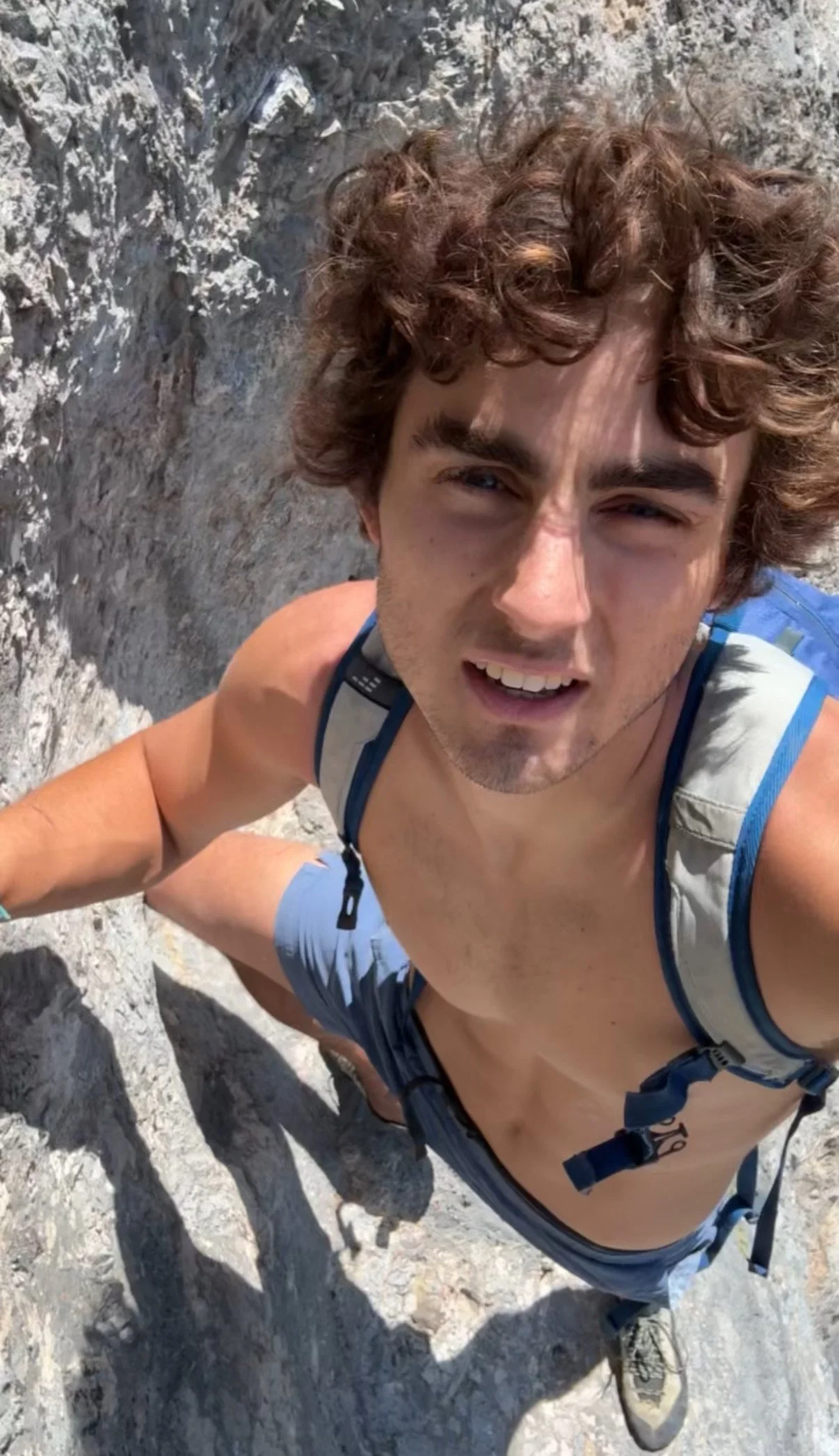
Another selfie high on Squawstruck, enduring sweaty and swollen feet in his rock shoes with the incoming sun. Lincoln Knowles (@lincolnclimbs)
On pitch 14, I carefully stepped through the first 30 feet of large, fragile, layered plates and stood awkwardly below the roof. I took a breath, relaxed, and stemmed my left foot out while pushing with my right hand against the roof for balance. Grasping an undercling with my left hand, I felt out a small, awkwardly angled gaston with my right, but then stepped back down. The left undercling was well chalked, and there was boot rubber on the far-left foot— this had to be the beta. The only beta. I breathed and committed: Right hand push, left foot stem, left hand undercling. Stretch, grab the gaston, bear down, stand up, and then get a jug. I used my momentum to charge the next pitch; slightly pumped, I committed to a step-out over the windy abyss to reach the crimpy crux arête.
Pitch 16, a slick, delicate 5.10+ slab, was baking—and I was sweating. It would be all too easy to get sloppy here. The shallow pockets at the crux gave little confidence. I tried stepping from a ledge out right, placing my foot in a high pocket, but then backed down and reassessed. Next, I came in from the left, feeling out the pockets within reach. It was getting hotter, and I was getting stressed. I looked at the slab again and felt a calmness descend: The left beta was the way. I segued into the pockets, standing on sloping feet and full-crimping the pocket lips.
Now, it was just about endurance. On the final six pitches, I did not let the heat, sun, or hollow blocks deter me. I flew through the 5.9 and 5.10 faces efficiently. At the summit, I sat there happily for a few minutes, feeling the weight of the climb, then stood on the edge and did a dance.
Well down the walk-off, a rafter of wild turkeys ushered me back to my car. I sat on my bumper in the July sun, and then texted Eli: Yo, guess what? Sometimes, having no climbing partners pays off.
—Lincoln Knowles
Ascent Info: First free solo of Squawstruck/Khyv Peak (1,900’, 22 pitches, IV 5.11b), Rock Canyon, Utah; Lincoln Knowles, July 10, 2025.
New Cutting Edge Episode—The Ogre: A Bold Attempt and Narrow Escape
This episode of the Cutting Edge podcast is the only one we've ever done highlighting a team that failed to reach its planned summit. But was it actually a failure? In August 2026, the team of Ethan Berkeland, August Franzen, and Vitaliy Musiyenko turned around just a few pitches below the summit of Ogre I in Pakistan, nearly completing the first alpine-style ascent of the coveted southeast buttress. Their remarkable survival story includes a 40-foot fall at 7,000 meters, an unplanned bivouac at 7,200 meters, and some frostbite. In conversations with Vitaliy, Ethan, and AAJ editor Dougald MacDonald, Cutting Edge host Jim Aikman unpacks the history of the Ogre, this year's bold attempt at the peak's fourth ascent, and how we measure success in the mountains.
The Cutting Edge is sponsored by:
Want More ACJ Content?
Want more thoughtful, deeply researched writing on the cutting edge of North American and international rock climbing in your mailbox? Then join the American Alpine Club at the Partner or higher level, and opt in to receive the inaugural, 224-page 2026 American Climbing Journal! With stories like Adam Ondra flashing Lexicon (E11), Katie Lamb sending The Dark Side (V16), Connor Herson’s crazy pogo on the first proposed 5.15a trad line—ever—plus other features from or about Sasha DiGiulian, Noah Wheeler, Jonathan Siegrist, Sungsu Lee, Hamish McArthur, Mary Eden, Seb Berthe, Chris Deuto, and so many others, the 2026 ACJ offers the world’s best climbing stories about the world’s hardest and most interesting rock climbs.