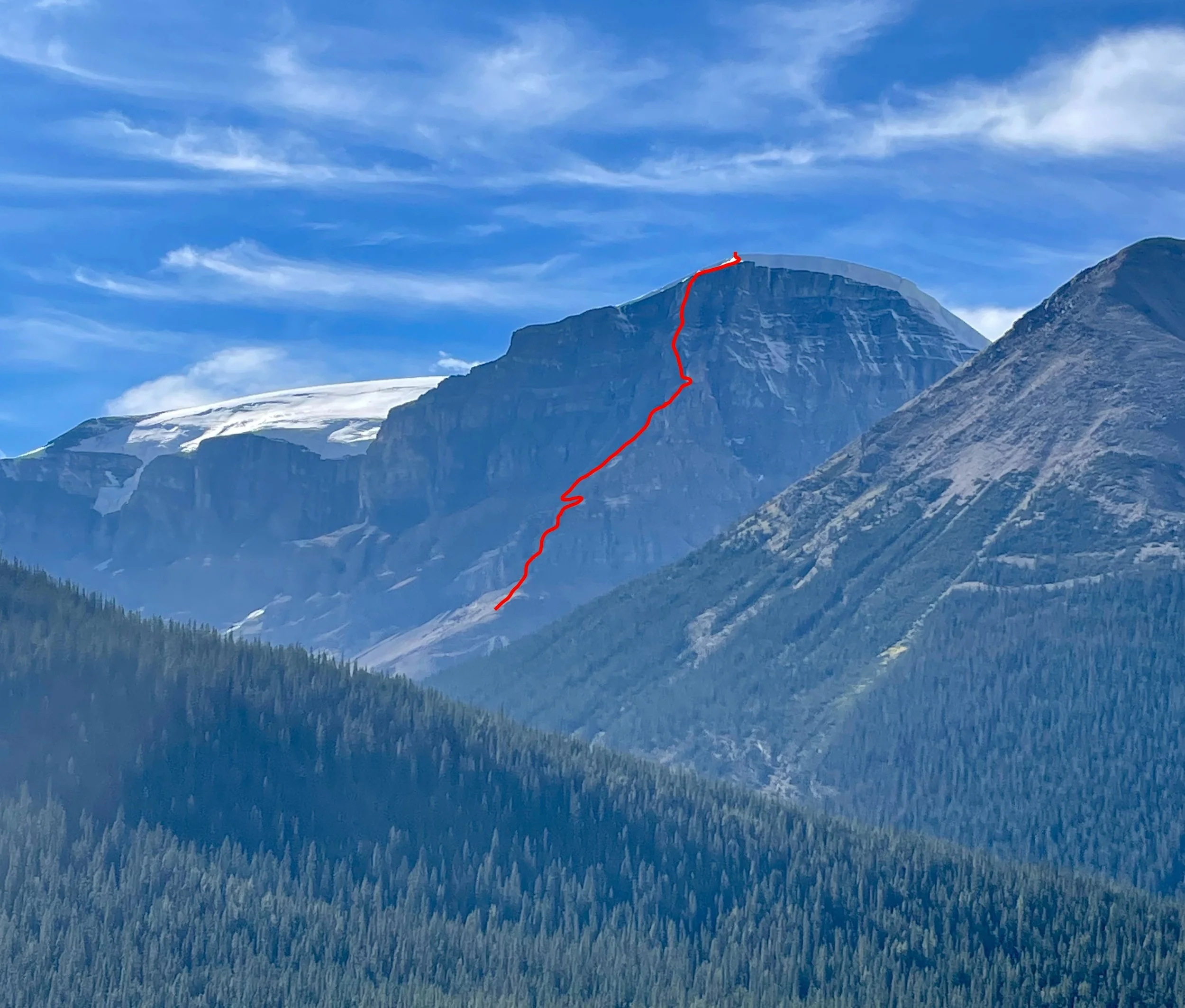
The line of No Fiesta, No Siesta (1,200m, TD- 5.8) on the east ridge of Stutfield Peak East. Photo: Nick Baggaley Collection.
Exploring Canada’s Rockies Chossies
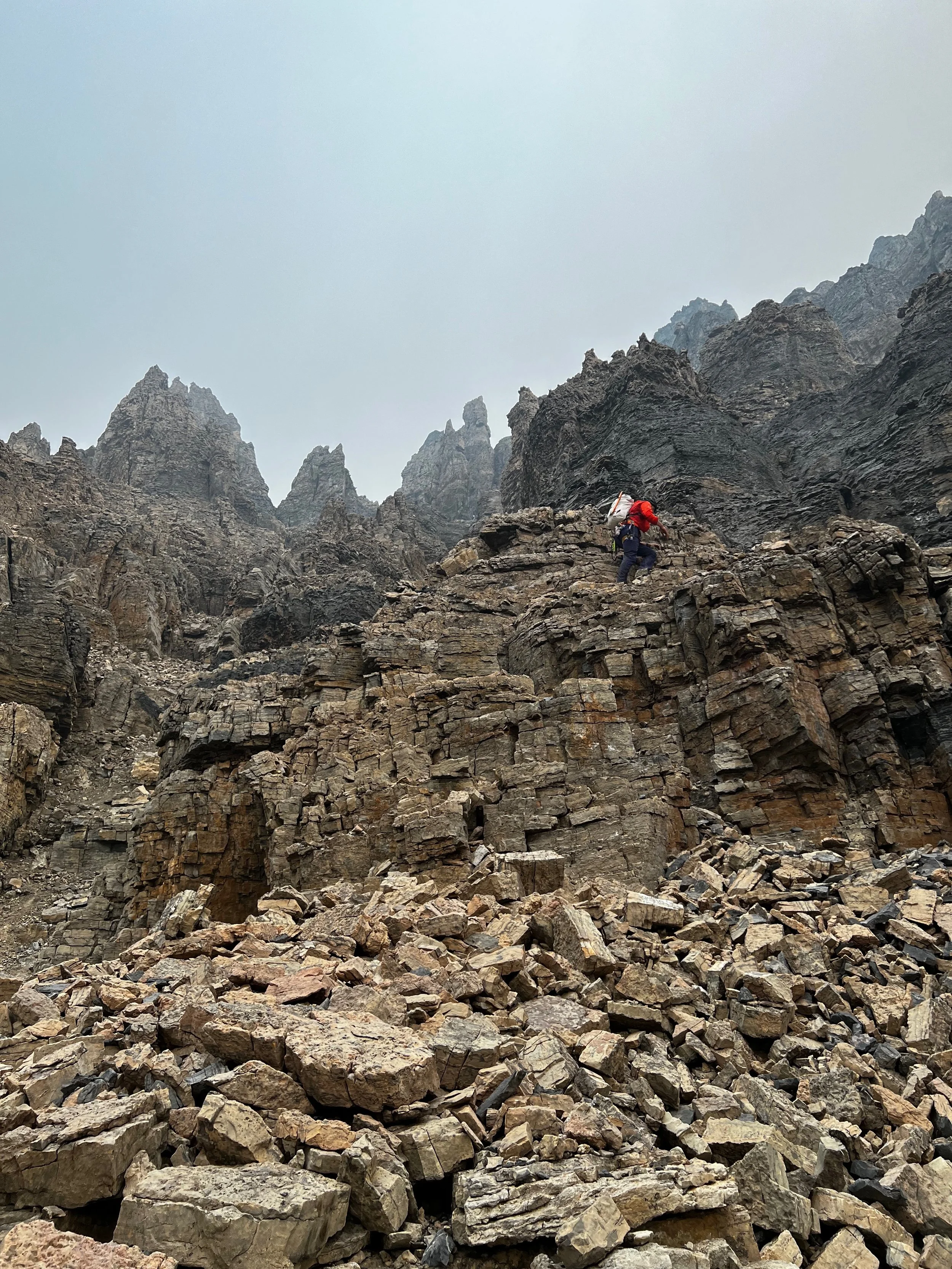
Nick Baggaley scrambling up to the east ridge of Stutfield Peak East during the first ascent of No Fiesta, No Siesta (1,200m, TD- 5.8). Photo by Greg Barrett.
Greg Barrett, a 38-year-old software developer and aspirant alpine guide from Canmore, Alberta, is among the most active climbers currently operating in the Canadian Rockies. Four reports in the upcoming 2026 AAJ cover first ascents on which Barrett was a key player. Barrett and partners keep finding new lines on familiar faces, as well as striking ridges and faces that have never been touched. Almost all of them require a tolerance for—even an appreciation of—the dreaded Canadian Rockies choss. Here, we’re sharing a report that arrived too late for the 2026 edition: Nick Baggaley’s story of the first ascent—with Greg Barrett—of a huge, previously unclimbed, and very chossy ridge on a Rockies 11,000er, where the modest grade of 5.8 only tells part of the story.
Stutfield Peak East, East Ridge, No Fiesta, No Siesta
In the late summer of 2025, after a ton of rain, there were a couple of short weather windows for bigger objectives in the high peaks of the Canadian Rockies. Greg Barrett and I seized the opportunity to get on a route I’d been eyeing for quite some time. The long east ridge of Stutfield Peak East (3,422m/11,227’, a.k.a. Stutfield Northeast) was, as far as I could tell, unclimbed. We didn’t know what to expect but figured that with my alpine guide training over the summer, and with Greg’s recent hot streak of ascents, we’d be able to get the route done in a push.
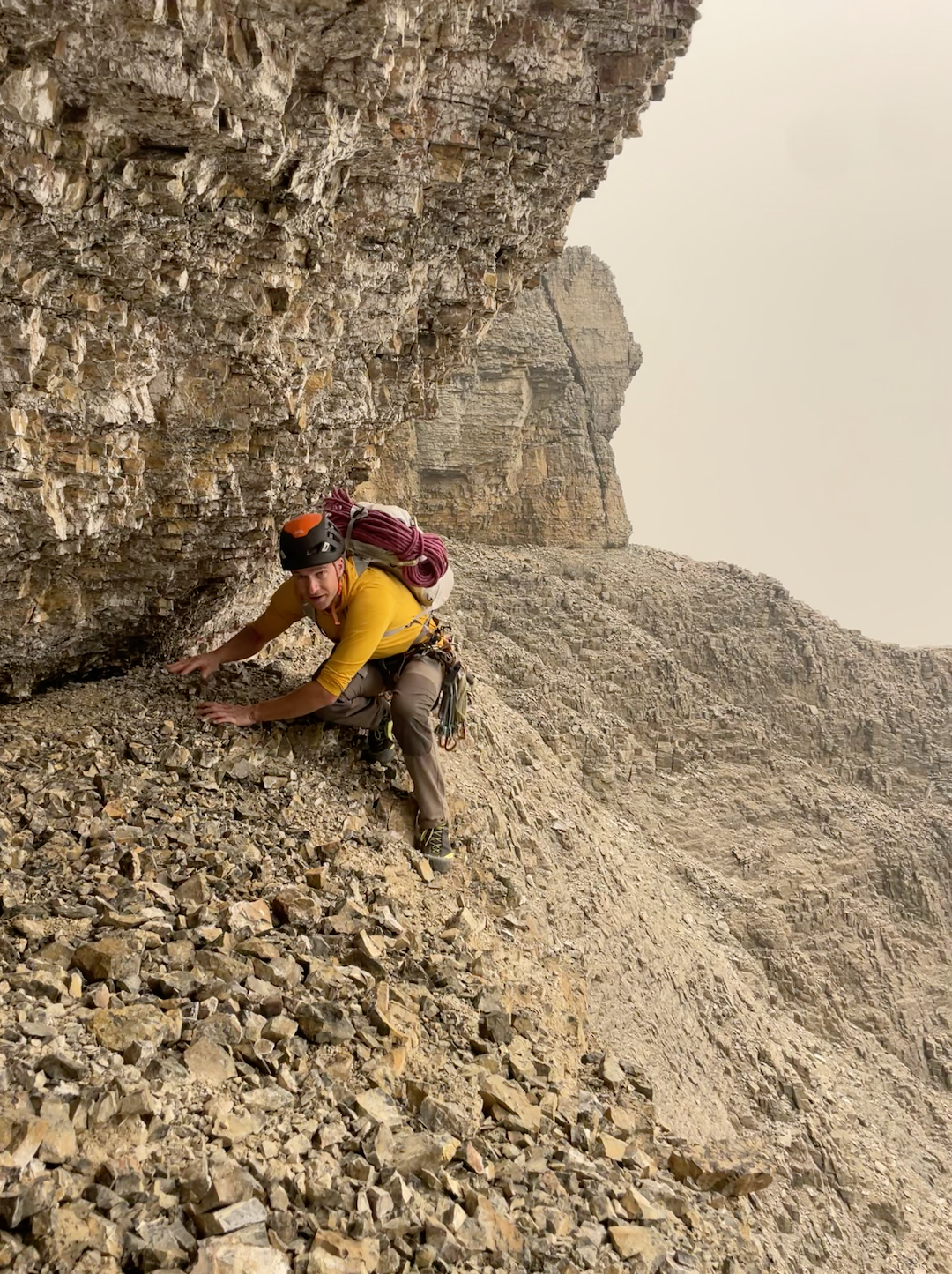
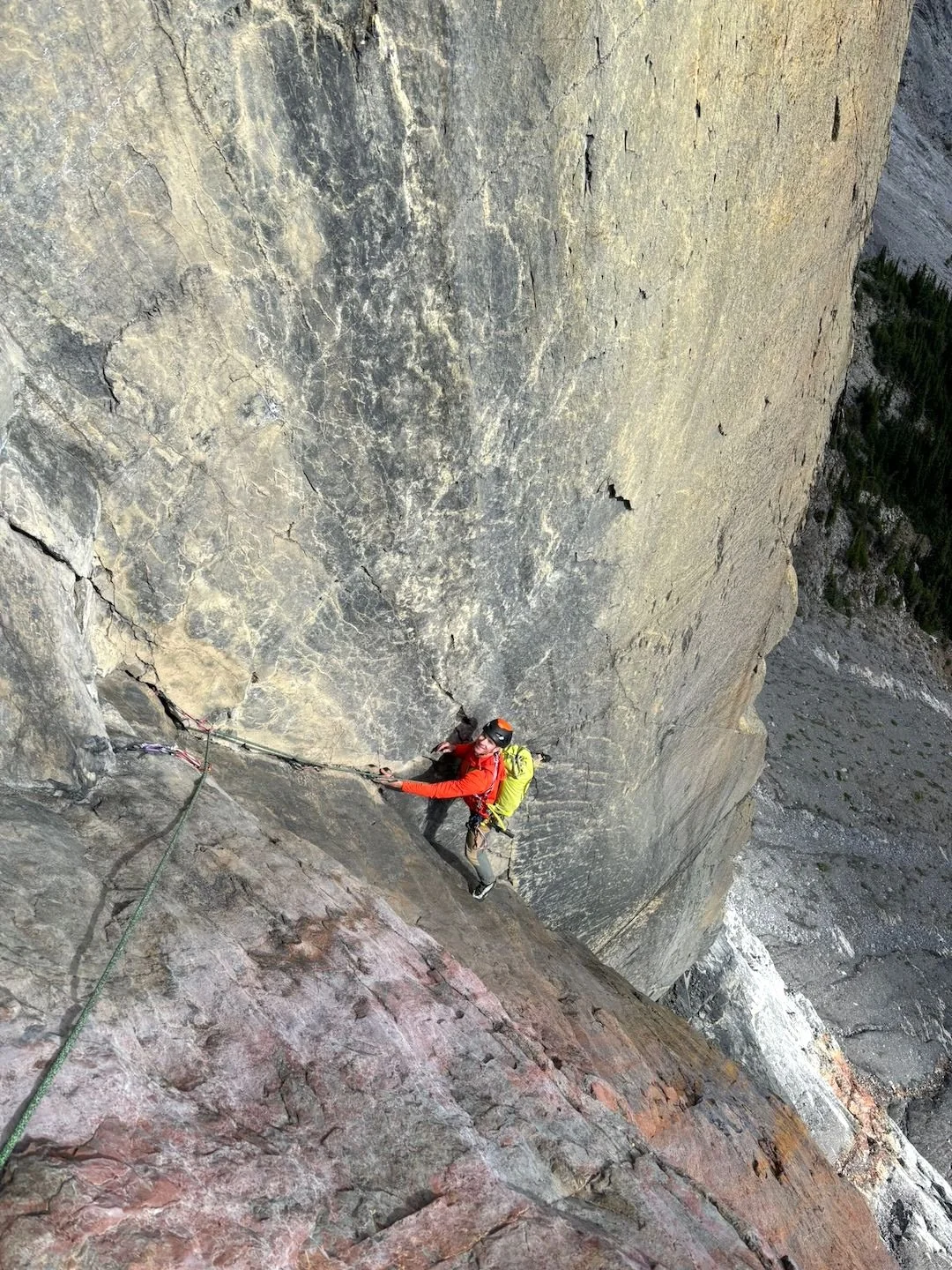
Greg Barrett crawling along a ledge to reach the final tower before the summit of Stutfield Peak East. Photo by Nick Baggaley.
On September 2, we got a late start from Canmore, only to have my Ford Fiesta break down just after passing Banff, with several more hours of driving to go. This delay meant that we only shouldered our packs at the prime alpine-start time of 6:30 p.m.
A three-hour approach up the Stutfield Creek drainage took us to a bivy on the silty bank of an alpine tarn below the ridge. Having forgotten my sleeping pad, I proceeded to snatch a couple of fitful hours of sleep as Greg happily snoozed away beside me. We got a leisurely start at 7 a.m., under an unexpected and unwelcome pall of wildfire smoke.
The ridge started easily enough, with scree and talus hiking turning into fourth- and low-fifth-class rock on the first step. We soloed up several hundred meters before roping up at the base of the second rock step, and then, after about 40 meters of 5.8 climbing, unroped once more.
The imposing towers looming out of the smoke above the next step on the ridge prompted us to search for an easier route, and we traversed several hundred meters south along a scree bench before soloing more fourth-class terrain to regain the ridge crest in the middle of the towers. Challenging route-finding eventually forced us back down on the south side, where we found a chimney that took us around the final tower. From here, we found a ledge across which we crawled to the base of the summit headwall.
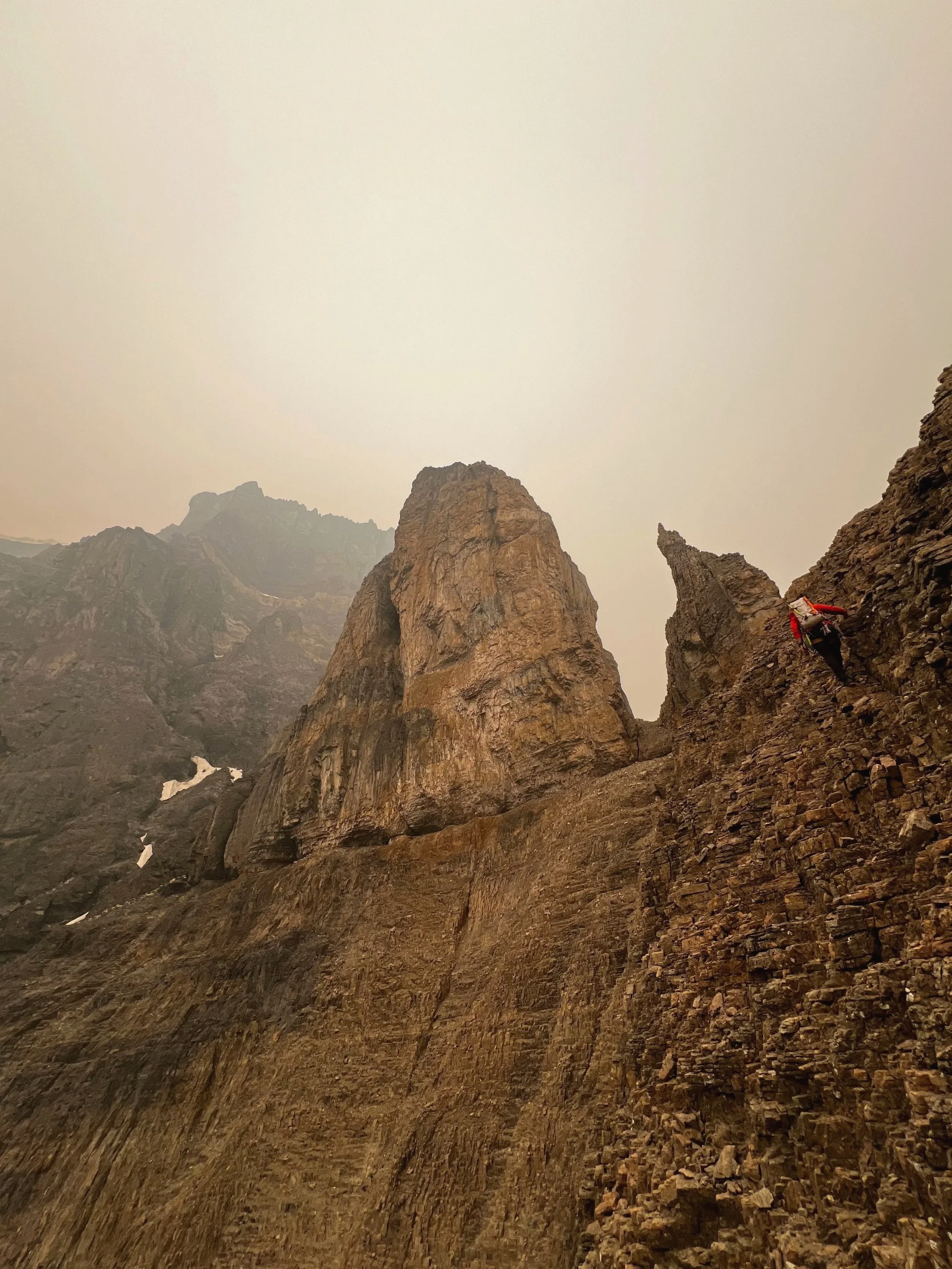
Nick Baggaley scrambling to the base of the final tower on the east ridge of Stutfield Peak East. Photo by Greg Barrett.
More soloing of low- to mid-fifth-class rock, with increasing exposure and steadily terrible rock quality, took us along a rib on the left side of the headwall and up to the last rock band below the summit cornice. Here, we climbed two pitches of loose 5.8 to a rock bench, then climbed through easy snow to bypass the cornice, gain the glacier, and continue to the summit.
We named the route after my late car and my lack of sleeping pad: No Fiesta, No Siesta (1,200m, TD- 5.8). Overall, we would not recommend it to anyone except the most committed choss aficionados, as the poor to terrible rock quality makes protection difficult for most of the ridge. We chose to solo all but three pitches, but would probably recommend that other parties rope up for more.
—Nick Baggaley, Canada
Confessions of a Choss Gobbler
Yet another Greg Barrett new route is Confessions of a Choss Gobbler (440m, 5.11- A0), the first ascent of the northwest headwall of Castle Mountain, climbed with Gavin McNamara in July 2025. We asked Barrett what he loves about routes like this and for his words of wisdom on climbing Rockies choss.
Q. Climbers have been exploring the Rockies for more than 125 years. Why aren’t these mountains climbed out?
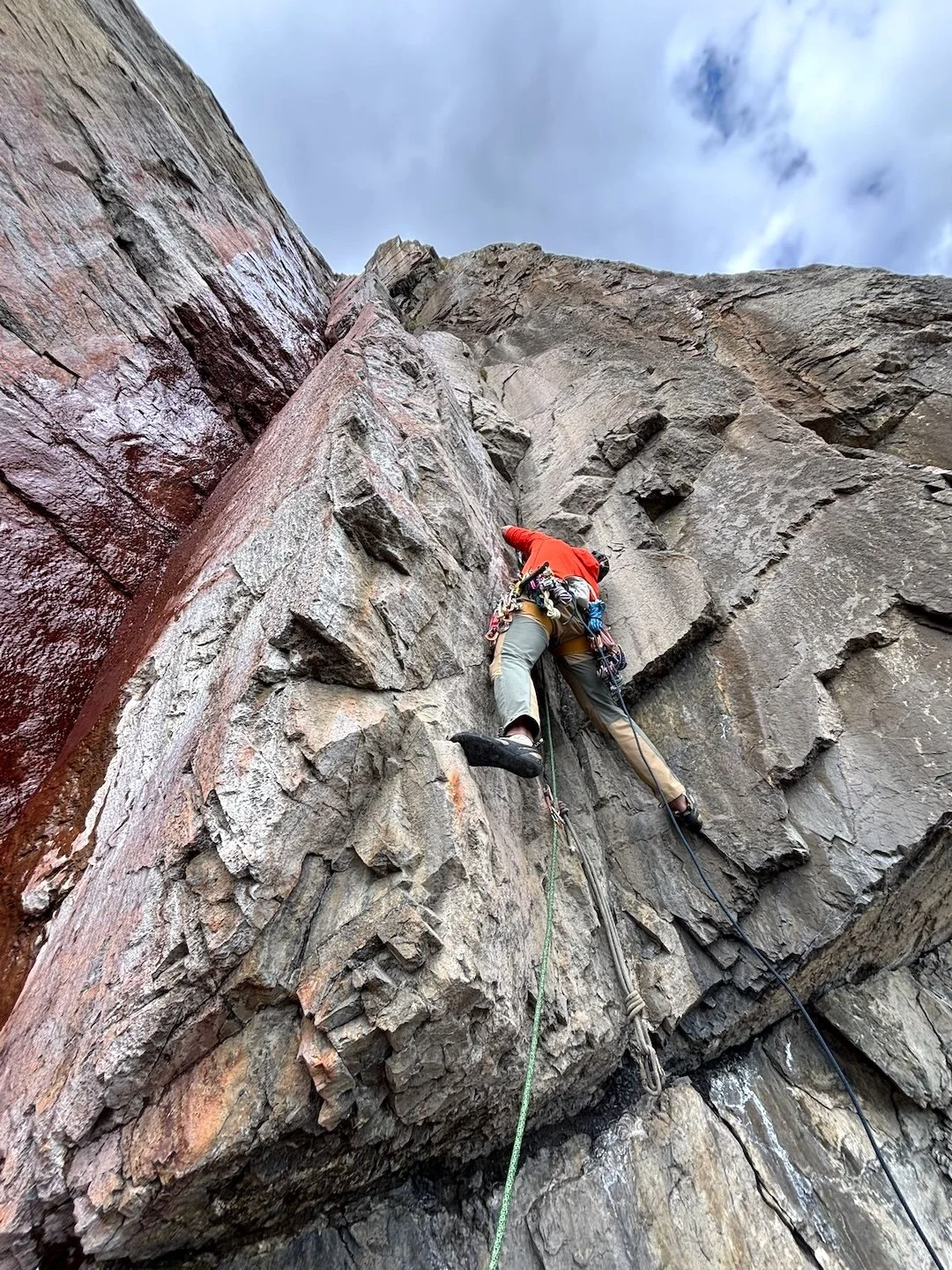
Greg Barrett leading the intimidating pitch-five crux of Iron Tears (465m, TD- 5.11-), above an old fixed anchor from a winter attempt. Photo by Gabs Clark.
Many of the accessible and obvious routes in the Rockies were plucked long ago. But if you stay curious, read between the lines, and look farther afield, many treasures remain. The required commitment and willingness to be scared keep new alpine rock lines available for those who seek them.
Rockies alpine choss is an acquired taste, like bitter black coffee or peaty scotch. Very few people like their first sip, and many people never learn to enjoy it at all. But for the few of us who grow addicted to it, we can’t live without it. I savor the puzzle and the challenge of methodically working through loose, steep, untouched terrain. Long, scary days are taxing in the moment, but they create memories that last a lifetime.
I sometimes yearn for an earlier era when obvious untouched lines abounded. But I don’t know that I would have had the boldness to push those lines with the gear and tactics of those times. Perhaps the present is perfect for me.
Q. What’s your favorite among the new routes you’ve done in the past few years?
Greg Barrett following the beautiful corner on pitch four (5.10+) of Iron Tears, at the Rimwall. Photo by Gabs Clark.
You’re asking me to pick a favorite child. But perhaps I can choose the one I find most recommendable, which is Iron Tears, on the Rimwall, which I climbed last August with Gabs Clark.
One of my favorite parts of that line was the spontaneity and relative commitment. We were planning to repeat an existing route, but during the approach, a striking corner alongside a rusty-red waterfall caught Gabs’s eye, and we decided to explore it instead. With no drill and only a vague plan, we journeyed upward, knowing retreat could be involved and expensive. In the end, we topped out a magical line and were back home before sunset.
Q. What are the secrets to climbing choss (more or less) safely?
First and foremost, stay within your physical ability. With few exceptions, I’m not out on the sharp end pumped out of my mind and facing a bad fall. If I’m not feeling solid on terrain, I’m downclimbing until I can either find a controlled version of the sequence or protect myself well enough that I’m comfortable taking the whip. The ability to maintain composure and control at 5.10 and 5.11 does more for you in the Rockies alpine than being able to power-scream through 5.13.
Mileage is a huge piece of this. On Yamnuska, the big limestone cliff near Canmore, we have a collection of routes from the first published guidebook called “The Kallen 34.” Some are now classics, some are testpieces, and some are obscure, runout choss. I completed the list last summer, and the climber I became by the last pitch of the 34 bears little resemblance to the climber who started that list. This sort of training pays dividends when you get properly “out there.”
It’s also important to fight for protection. Sometimes it’s easier to just keep climbing, but when things are serious, I’ll take the time to sneak in a knifeblade or clear choss out of a slot with my hammer and wiggle in a cam. It’s a numbers game, and you’re going to fall eventually. If you don’t place the gear, it definitely won’t hold.
I do think it’s important to be honest with yourself about the hazards. I’ve met climbers who seem to manage fear by telling themselves they’re infallible. You can get far with this approach, but, ultimately, hope isn’t a strategy. I think it’s healthier and safer to fully acknowledge the hazards you will face, manage them as best you can, and make an honest decision about whether the remaining risks outweigh the rewards.

Cutting Edge Podcast: Le Bombé Bleu
On February 11, Erwan Legrand—son of the legendary French climber François Legrand—took down one of the longest-standing open sport projects in the world: Le Bombé Bleu (5.15b) at Buoux, France. Bolted in 1991 by Marc Le Menestrel, the 100-foot route features a notoriously difficult precision dyno on its blue-streaked bulge, followed by ferocious tugging on tiny pockets. Famously, Le Menestrel had opened the route as long as it was left in its natural state, a vision—35 years ago—of what climbing might someday become. Join host Jim Aikman as he talks with Legrand about his remarkable barefoot redpoint, as well as chats with UK icon Ben Moon—one of the route’s early suitors—and American Climbing Journal Editor Matt Samet.