
It’s February, and yours truly is bouldering in sunny Hueco Tanks, Texas. I was reminded a few weeks ago that all climbing is not without risk, when a close friend fractured his ankle bouldering in the park and had to be extracted by SAR. The situation was compounded when a rescuer fell off the low-fifth-class approach and also required extraction.
This accident, like the one featured below, happened despite the fact that everyone was playing by the book. In the accident below, two apparently textbook cam placements failed when the leader applied body weight to the top cam on a lead of a slippery granite crack. More serious injury was prevented because the climbers in question had built a solid belay anchor on the ledge below, and the leader and the belayer were both wearing helmets. Still, this is a case in point that you can do everything right and still end up in the hospital.
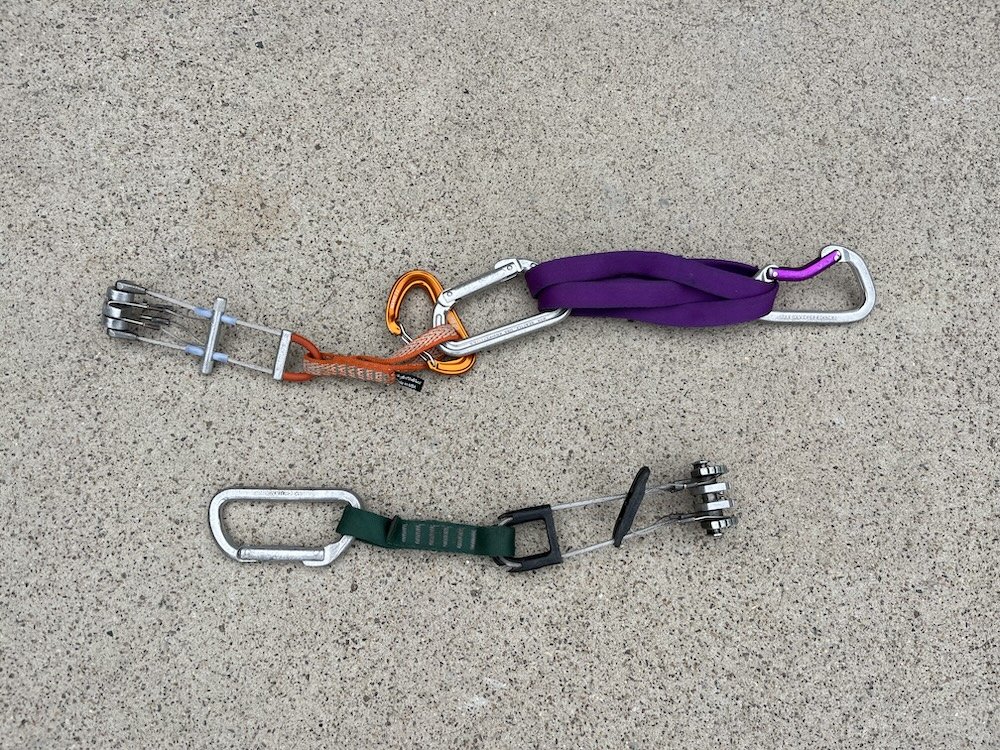
The Metolius TCU is an old version with all cam lobes an equal width. Later, the single middle lobe was widened to provide more opposing surface area. The U-stem Black Diamond Camalot Junior is from the mid-1990s. This version’s cam lobes were fabricated from very hard 7075-T6 aluminum—a material implicated in several incidents in which the cam lobes tracked out of apparently perfect placements. Both models of gear have been improved over the decades and form the backbone of many standard trad climbing racks.
Ground Fall | Multiple Pieces of Protection Pulled
California, San Diego, Mission Gorge
On May 18, 2024, at about 10:40 a.m., my climbing partner and I prepared to climb Gallwas Crack (5.9) at the Main Wall of Mission Gorge in San Diego. Another friend was with us for his first outdoor climbing session. The three of us had already warmed up.
Access involved scrambling eight feet up to a large, flat ledge, then up and over to another ledge at the base of the route. This ledge was big enough to not worry about falling off, but there was a risk of the belayer getting pulled off if the leader fell before placing any gear. We all wore helmets and were very safety focused.
The ledge was 40 feet above the trail. We built a three-piece gear anchor to secure the belayer (me), and our other friend sat untethered on the large ledge below and left. Gallwas Crack looked challenging, with slippery rock, but my climbing partner had led higher-rated climbs at similar areas, so I thought it would be possible, though perhaps at his limit. There appeared to be plentiful gear placements.
He racked up and we did thorough safety checks. He got up a short fourth-class ramp to a secure stance and put in a No. 0.5 Camalot, clipped with an alpine draw. He climbed to where his feet were level with the first cam and placed another, then climbed to where the second cam was at his waist and placed a third cam.
When the third cam was at his waist, he paused to figure out the move, then yelled, “Take! Take! Take!” I pulled in a couple of arm lengths of slack as fast as I could. The rope started becoming taut just before he fell, but it never became completely tight during the fall. I did not get pulled toward the wall as one would expect. The highest (third) piece pulled immediately, and he continued falling. The second piece also pulled as he rotated backward and began falling headfirst. The first piece caught him. I don’t remember being pulled by the rope despite the fact that he fell 30 feet total, past the ledge, and ended hanging upside down, about 30 feet above the trail.
He was not moving. Our other friend yelled, “He’s bleeding out of his right ear.” I can't recall the sequence, but someone yelled to ask if they should call 911. I asked our other friend to attend, since he had emergency medical training. I slowly lowered my partner as he was pulled over to the large ledge. As I was lowering, his body shook for a few seconds. On the flat ledge, he had a pulse and breathing was heavy. I called 911 at 10:56 a.m. and learned that someone else had already called in.
I clipped my climbing partner into the anchor so I could be freed up to help. I held his head, and he’d periodically sit up and moan, then lie back. We tried to keep him down, and he would tell us to stop touching him. A woman with emergency medical training came over and did a good job helping us all stay calm. She confirmed that my climbing partner could respond to his name, by turning his head. A helicopter arrived, lowering a paramedic with a radio and litter, who assessed his condition. The paramedic tried to place a neck brace, but my climbing partner refused it. When we got the brace on, he immediately took it off. Eventually, he was put on a litter and flown to a trauma center. It was less than an hour after he’d started the climb.
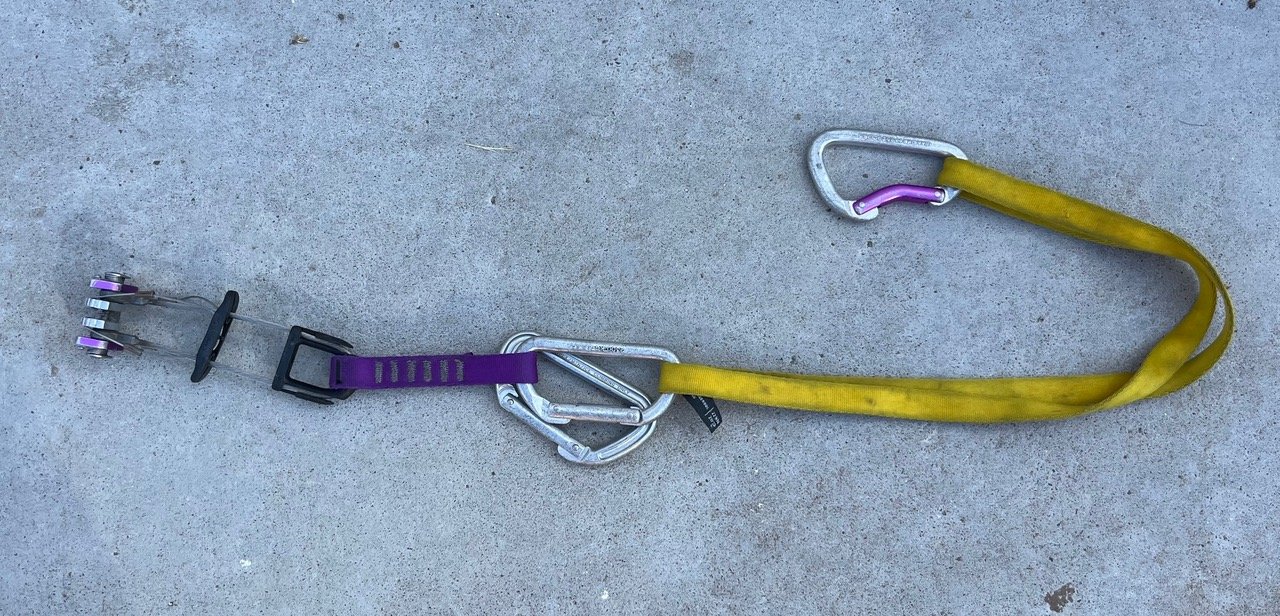
One of the pieces that pulled was a No. 3 (orange) Metolius TCU. The plastic trigger-wire guide on a green (No. 0.75) Camalot was tweaked, so this was probably the other pulled piece. I’m not sure which one pulled first. My climbing partner suffered a severe traumatic brain injury, but he made it through emergency surgery and has mostly recovered.
Video Analysis
Accidents in North American Climbing Editor Pete Takeda and IFMGA/AMGA guide Jason Antin are back at North Table Mountain in Golden, CO to analyze this accident.
They break the accident down into things that could be improved and things that were done really well. Watch the video for a visual analysis.
ANALYSIS
What went right: I was anchored, so I couldn’t get pulled off the ledge when my partner fell. He was wearing a helmet, which probably saved his life. It’s good that we had a third person there, because he was able to respond quickly and help save our friend’s life. We've been able to talk about what happened and support each other. (Source: Anonymous.)
*Editor’s Note: A climber posted on Mountain Project that, in Mission Gorge, “two separate near-fatal accidents” involving cams pulling out occurred in 2024—one on May 18 (Gallwas Crack; described here) and the other on May 19 on the adjacent Nutcracker (5.9+). He also wrote, “Be aware that cams do not hold well on this rock in hot conditions.” Perhaps the Mission Gorge’s slick rock combined with recent rain-generated dirt and silt contributed to the gear pulling. The gear itself may have played a role. Not up for conjecture is that several elements combined to produce an unpredictable accident. The fallen leader was 34 years old and had “many years” of trad experience; the cams did not suffer obvious deformation that would have indicated a high load. As the belayer stated, “They just came right out, with seemingly less than body weight. They didn’t slow the fall at all.”
Support Climbers Recovering From Accidents
The AAC’s Climbing Grief Fund exists to ensure that climbers and their loved ones are met with compassion, care, and community when they are navigating grief, loss, injury, or trauma. It’s one way we look out for one another—long after the ropes are packed away.
When you donate to the Climbing Grief Fund through March 10, your donation is matched—GIVE TODAY!
Donors can recognize someone on our virtual dedication wall by adding a name with—Honoring, In Memory of, or In Gratitude—in the comments field on the donation page.