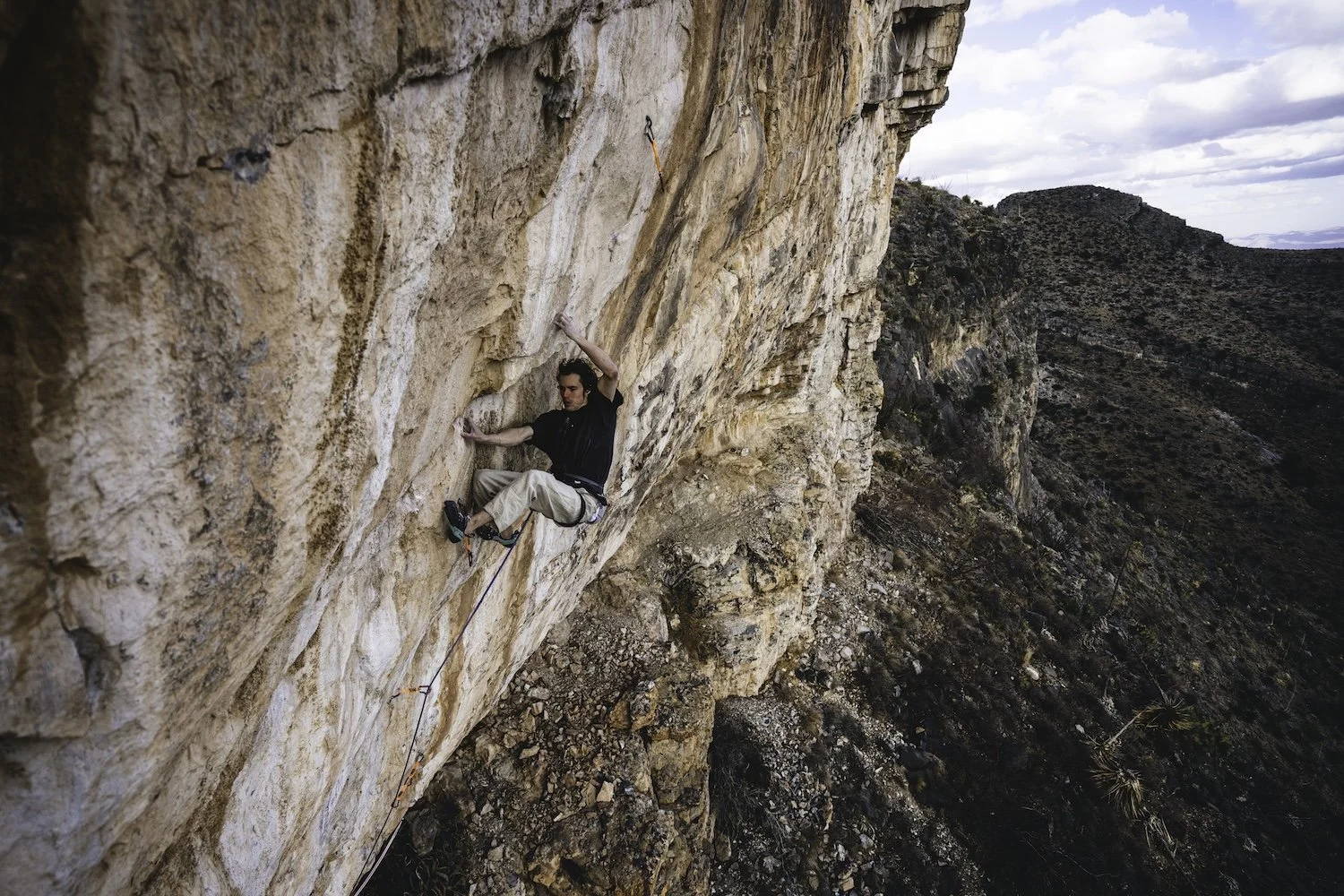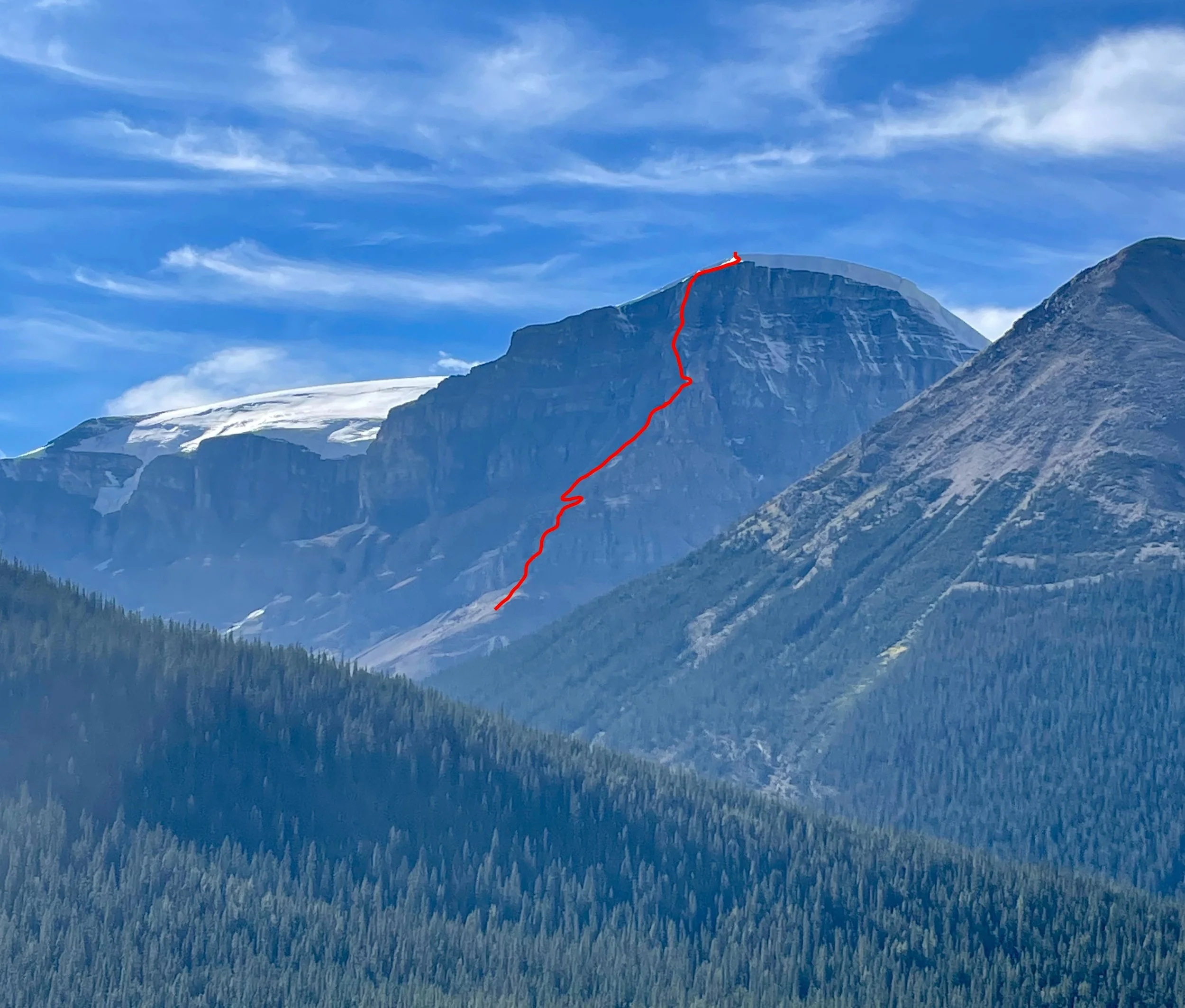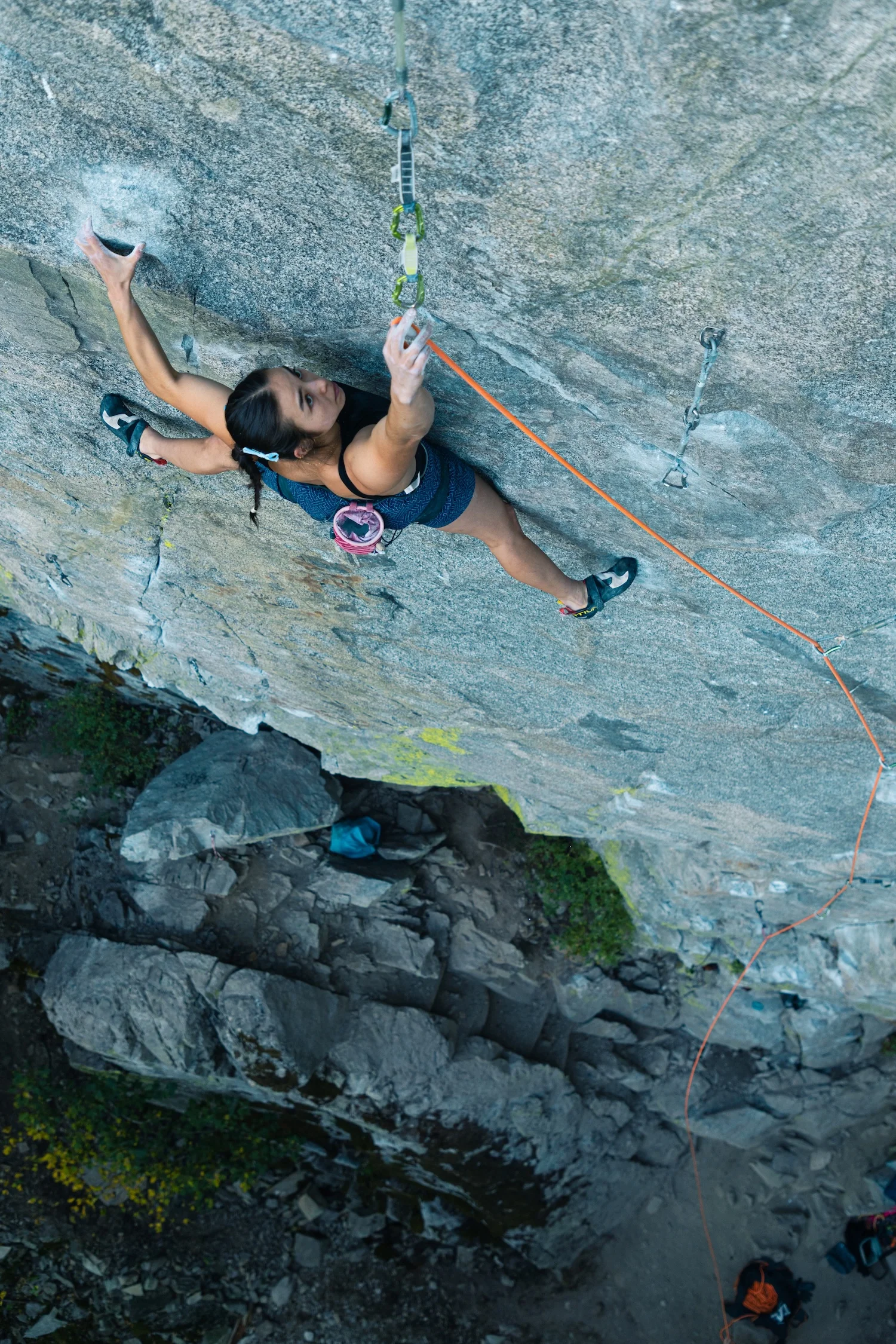
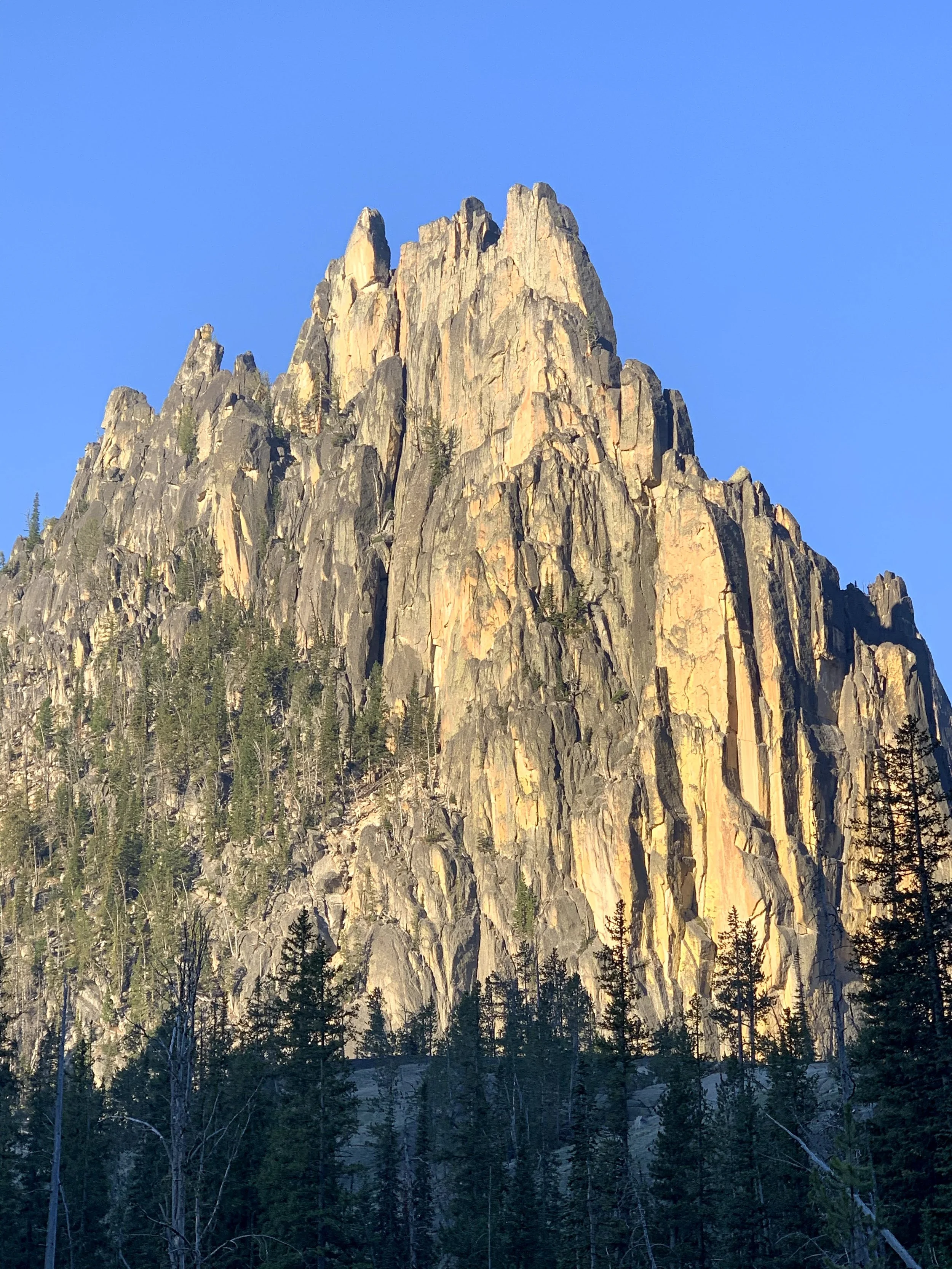
The Bighorn Crags above Ship Island Creek in the Salmon River Mountains are a cluster of towering granite spires that would be crawling with climbers if they were a little closer to the road—or even if they were close to any significant population of climbers. In 1955, climbers—including K2 legend Pete Schoening—briefly explored the area, and a short, alluring description of the cliffs is included in Idaho: A Climbing Guide. But the first reported ascents by modern rock climbers weren’t until 2020, when a team of six made the 13.5-mile trek to the west side of Ship Island Lake and climbed 40 new pitches—with six Grade III and two Grade IV routes—in less than a week. It’s likely few climbers have been there since. Maybe Jim Pace’s story and photos in AAJ 2026 will convince a few more people to brave the steep barrier to entry. The summer is still young, so we’re sharing an abridged version of Jim’s story here.
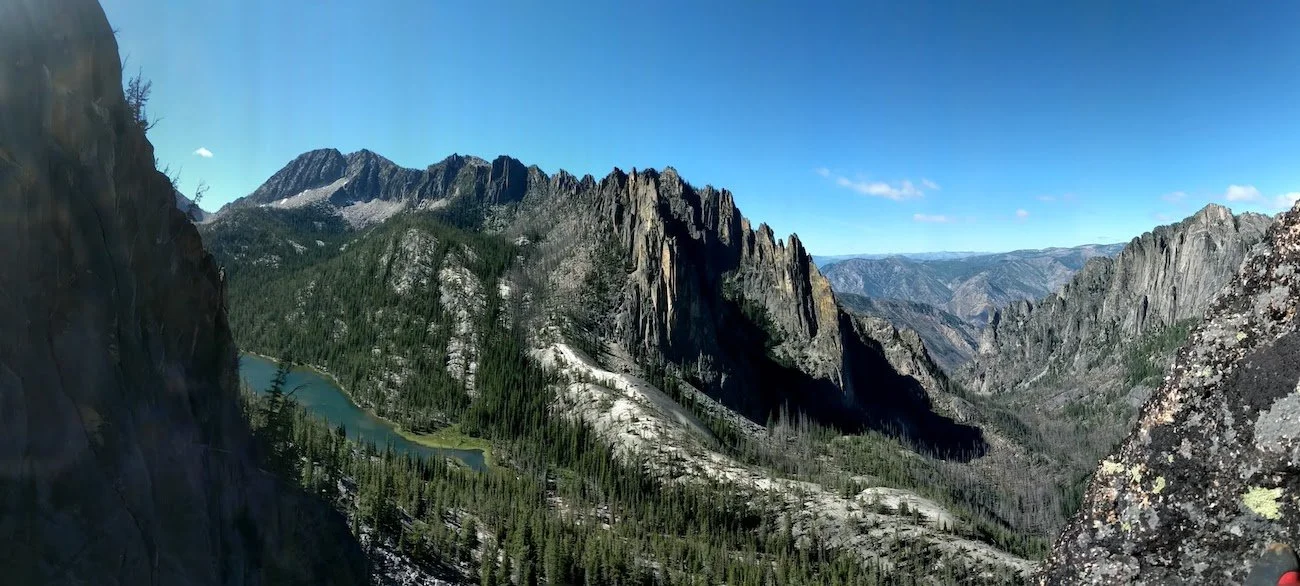
Panoramic view of the crags above both sides of Ship Island Creek, which drains Ship Island Lake at left and flows down to the Middle Fork Salmon River. Photo: Cody Goldberg
The Litner Group: Many First Ascents
For decades, Idaho climbers have imagined what it would be like to climb in the area of the Bighorn Crags surrounding Ship Island Creek, which flows steeply out of Ship Island Lake and down to the Middle Fork Salmon River. The climbs, tantalizingly hard to reach, would ascend long and steep arêtes, faces, and cracks toward summits that didn’t have names, had never been touched by climbers (unless the Sheepeater/Shoshone peoples liked steep rock climbing), and might be made of solid Idaho Batholith granite (but more likely Idaho choss).
In his excellent Idaho: A Climbing Guide, Tom Lopez writes enticingly of the area: “Of interest to rock climbers is a tangled collection of spires, faces, and cliffs at the west end of Ship Island Lake called the Litner Group. Because it is more than 10 miles from the nearest trailhead, little climbing activity has taken place in the Litner Group but, rest assured, the area has high potential for serious rock climbers.” Tom mentions a Litner Peak, but which one is that? No one is sure. The only recorded climbing our group could unearth was detailed in a 1955 expedition report by Lincoln Hales in the Seattle Mountaineers’ annual journal. Hales and Pete Schoening made the first ascent of the “main peak”—presumably the Litner Peak that Tom mentions.
Intrigued, Max Bechdel, Ian Cavanaugh, Cody Goldberg, Brady Johnston, Carolyn Pace, and I made the long trek into the Litner Group in late August 2020, with pack string support, to see what we would find.
From the trailhead—itself three hours from the small town of Challis—we hiked 12 miles and crossed two passes through the Frank Church–River of No Return Wilderness to reach Ship Island Lake. We then bushwhacked another 1.5 miles to the west end of the lake and made camp.
On our first climbing day, we aimed for the obvious face on a twin-spired formation we named the Rabbit Ears, right above camp. Brady and I made the first ascent of Pace Setter (850’, 7 pitches, III 5.9), while 30 meters to our left, Max and Ian opened the Jeff Halligan Memorial Route (850’, 7 pitches, III 5.10), in honor of our horse-packing guide. Both were exceptionally high quality and promised more good things to come.
That same day, Cody and Carolyn established Launch Over It (700’, 5 pitches, III 5.10+), on a formation we called the BFR (Big Fancy? Rocket) after Elon Musk’s Mars ambitions. The BFR lies halfway up the magnificent Mission to Mars massif, just northwest of the Rabbit Ears. The top two pitches of their climb have it all: great cracks, yawning exposure, breathtaking views.
A rainy day allowed us to explore down the canyon. Jaw-dropping views to the Biggie Smalls Wall (dead vertical, 300 meters) made all of us realize just how extensive the climbing here could be. But looks are deceiving: The splitter hand jam in the spotting scope, we learned, often turned out to be a splitter offwidth, the offwidth turned out to be a chimney, and so on. Scaling took practice.
Lighthouse Tower on Wolf’s Fang Ridge: The five-pitch Idahome (5.11a) ascends near the center of the formation. Photo by Jim Pace.
After a cold night that brought snow above camp, Brady, Ian, and Max traversed the lake-outlet slabs to explore a complex tower at the northwest end of the already-named Wolf’s Fang Ridge and completed the first climb to the top: Idahome (925’, 5 pitches, IV 5.11a).
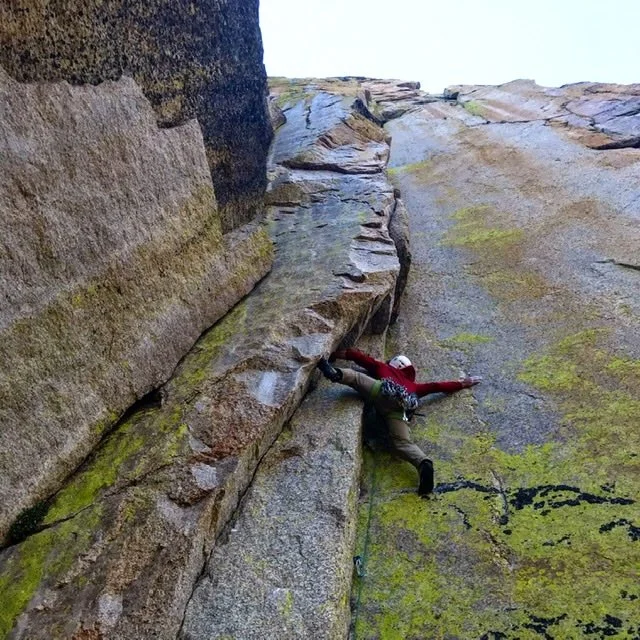
Brady Johnson stemming on Siren’s Song, a 5.12 variation to the three-pitch Mermaid’s Tale (5.11b), on the Bookshelf. Photo: Ian Cavanaugh | Idahoclimbingguide.com.
Meanwhile, Cody and Carolyn established Geoffrey Chosser (650’, 5 pitches, IV 5.10+) on the Bookshelf, a soaring formation with half a dozen or so summits. Over the next two days, the group put up three more climbs on this face. The first two—Mermaid’s Tail (3 pitches, III 5.11b) and a direct variation called Siren’s Song (III 5.12)—were highlights of the trip.
In all, with just four climbing days, our group climbed six Grade III and two Grade IV routes—with a couple of other shorter routes—on mostly great granite. Most of those pitches were 50 to 65 meters and ranged from 5.6 to 5.12. We summited on just three routes, but all the other lines could be continued to their respective summits to create Grade IV or Grade V climbs. —Jim Pace
Pace’s full story will be in AAJ 2026, coming this fall, and an extended version will be published at the AAJ website, along with photos and topos of many climbs. In the meantime, climbers can see his earlier article, on which this story was based, at Idahoclimbingguide.com.
Have You Climbed At Ship Island Creek? Submit a story to the AAJ.
Many Idaho climbers are taciturn and even secretive about their routes, and it’s certainly possible that more climbs have been completed in the Litner Group but never published. If you’ve explored climbs in this area and you’re interested in sharing info, the AAJ would love to help. Contact us at [email protected].

New Cutting Edge Podcast: 24 Hours on the Central Tower of Paine
The east face of the Central Tower in Chile's Torres del Paine is one of the great walls of the world. Recently, Belgian Siebe Vanhee and American Tommy Caldwell completed the third free ascent of the South African Route in remarkable style. On their third attempt, the two climbers raced up the 1,200-meter 5.12 route in exactly 24 hours—in an area where most big-wall ascents take weeks. Host Jim Aikman interviewed both climbers, as well as American Ben Ditto, who was on the first free ascent of the South African Route back in 2009. It's an episode about risk, the ups and downs of multiple efforts on a serious objective, and a partnership that perfectly balances the strengths of two amazing climbers.