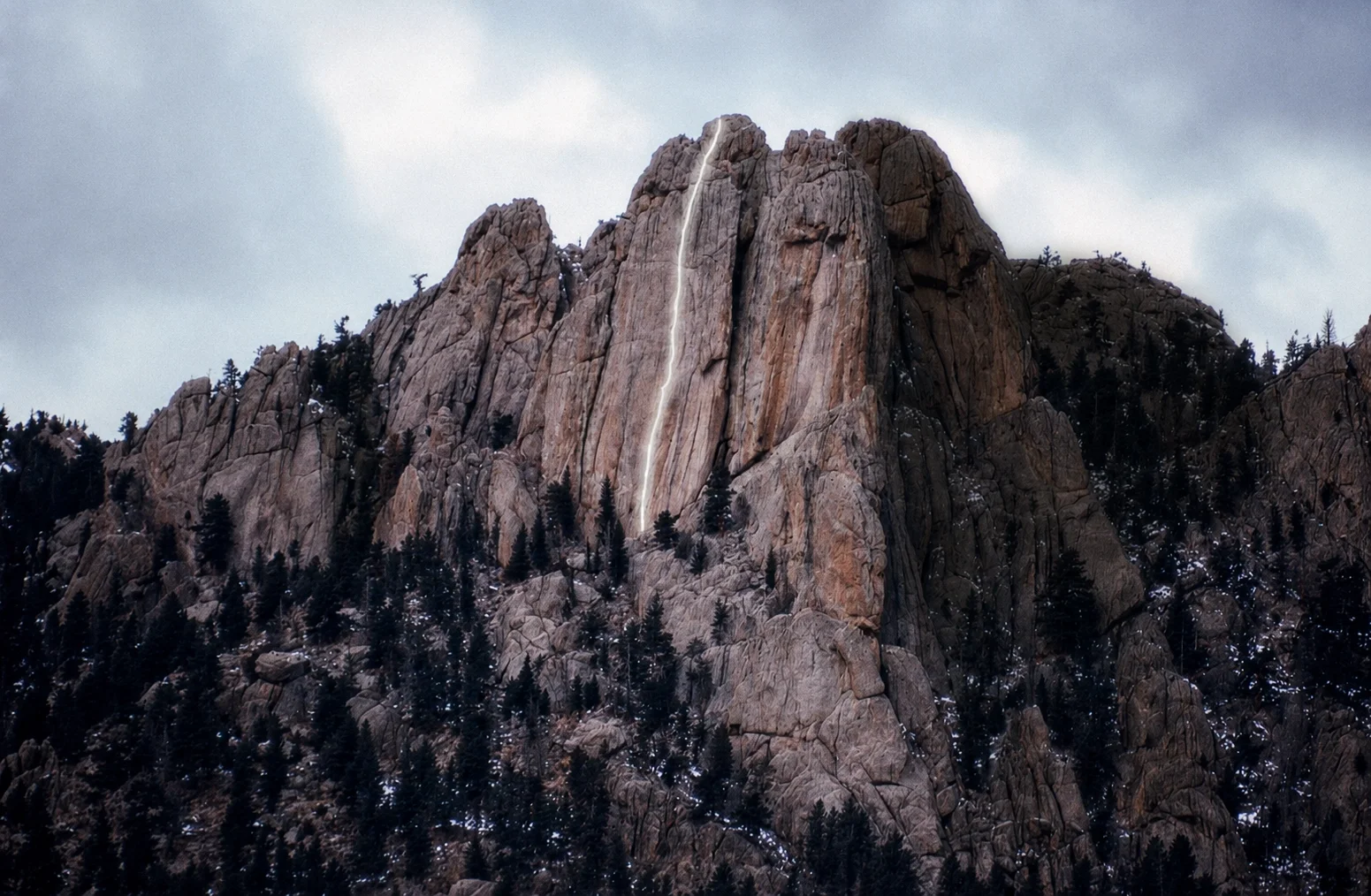
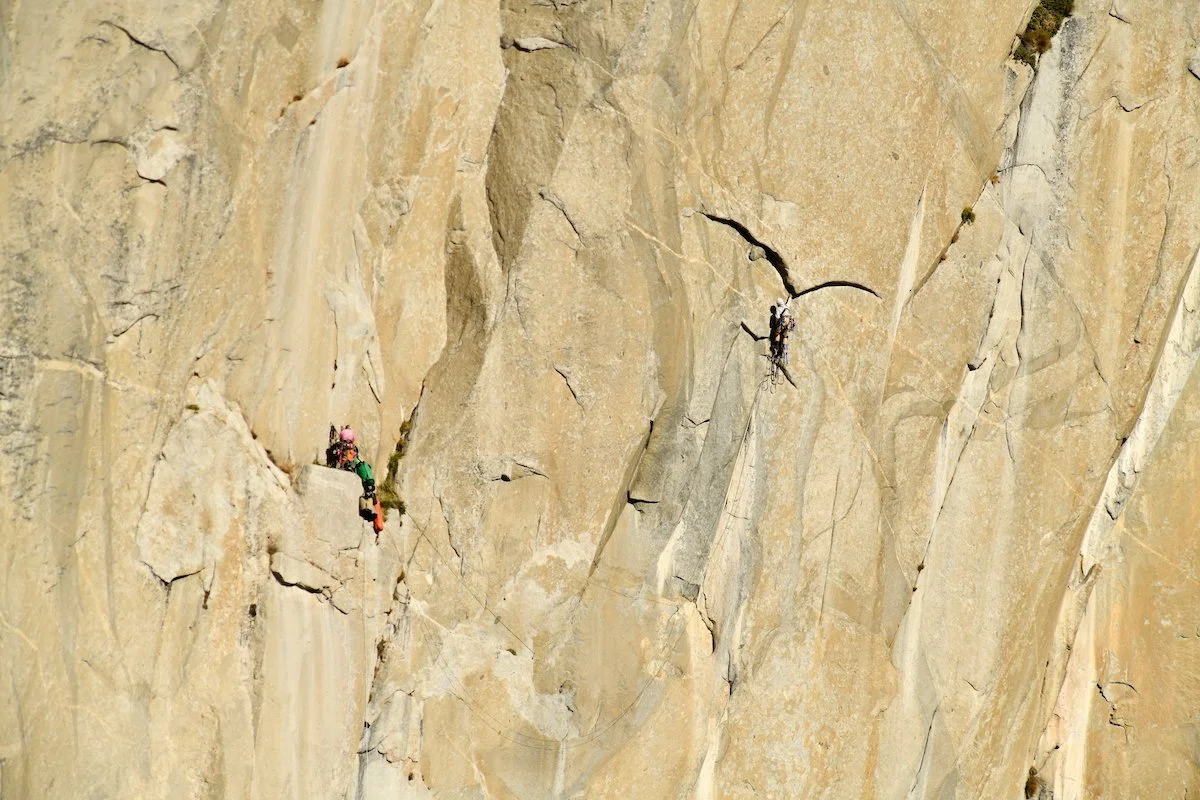
Mark Hudon belaying Ben VanderStouw on The Seagull, pitch six of Mescalito, El Capitan. Photo by Tom Evans.
A Story From The Live Your Dream Grant by Ben VanderStouw
Originally Published in Guidebook XVIII.
I was shivering in the darkness as I led up pitch two that day in Zion. My friend Will and I were climbing our first big aid route, Touchstone Wall. I moved upward in flared pockets and old piton scars—slowly. We had both underestimated the chill cast by the December shade. By pitch four, we were in the sunlight—not because we climbed into it but because dawn caught up to us.
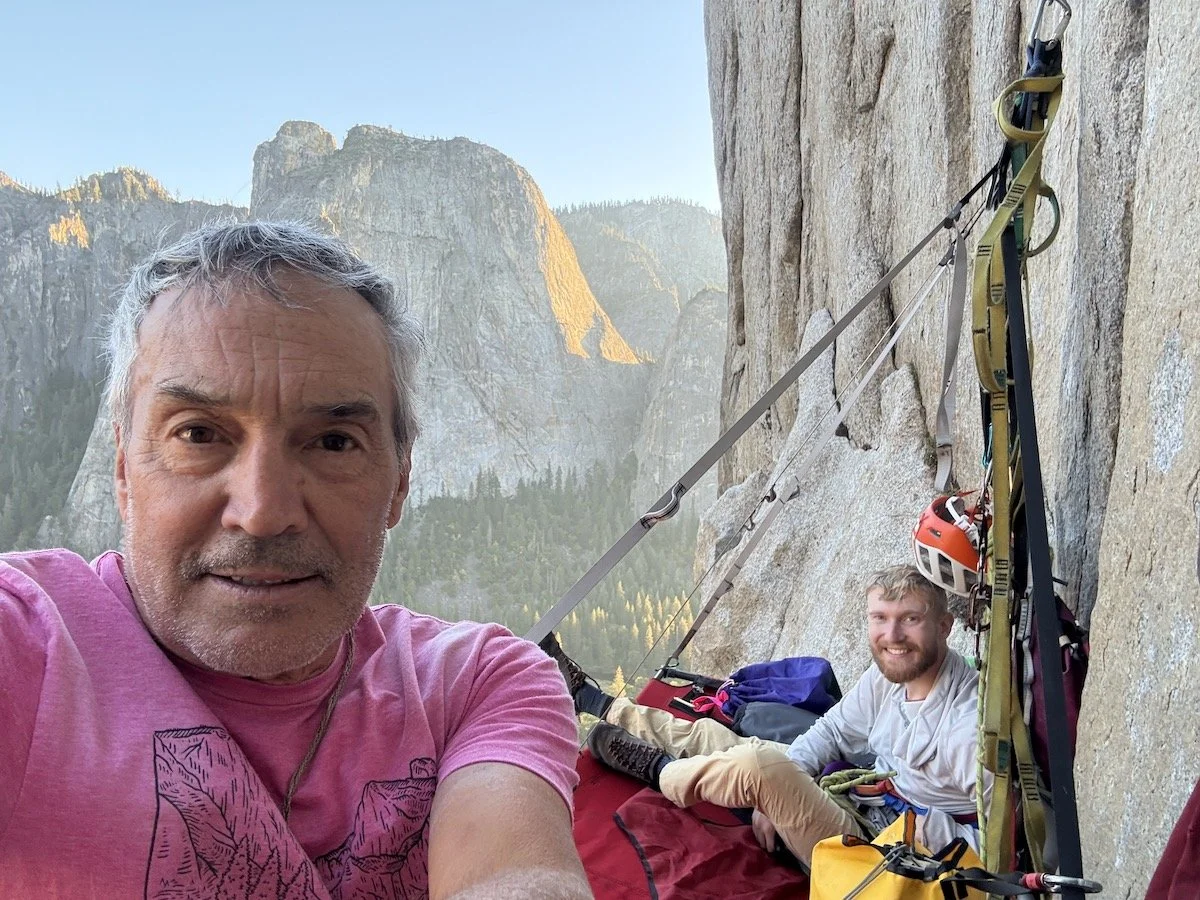
Mark and Ben on the first bivy of Mescalito. Photo by AAC member Mark Hudon.
The day before, I was on a phone call with Mark Hudon, who coached me through the systems we would be using that day. Mark had become my long-distance mentor during the pandemic, calling and emailing when I had big-wall questions. Will and I made it up and down in a day thanks to his advice, but I had a lot more to learn.
In the fall of 2021, I attempted Lurking Fear on El Capitan, where I bailed after popping off a series of hook moves. I blamed my busted knuckles when it was really my nerves. The following year, in the fall of 2022, I drove all the way from Maine to Yosemite to try the Nose. We bailed because of a forecasted storm that never came. I was crushed, and the drive back underscored the immense distance between me and my goal.
Up until that point, I wanted the feather in my cap of having climbed El Capitan. I wasn’t ready for what it demanded, nor was I seeking the experience itself. I continued to learn from Mark, but thought I might never get up the mountain.
Two years later, I called Mark and told him I felt ready. I no longer wanted to check a box; I wanted the experience of climbing a multi-day route with all its frustrations, discomfort, and pain. Though I still lived a long way from Yosemite Valley, and many places traditionally used to prepare for its polished walls, I knew if I had the right partner and opportunity, I could do it.
Mark suggested we climb Mescalito, a 26-pitch aid route that was longer and more challenging than any I had attempted before. It would require multiple nights sleeping in a portaledge and push my aid climbing abilities. It would force me to confront the discomfort that had sent me down twice before.
“You’re going to be a gumby at the bottom and an expert by the time we get to the top,” Mark told me.
At 69, Mark has been climbing El Cap for 51 years. He consistently climbs at least one challenging El Capitan route a year. With Max Jones, Mark had previously climbed the fifth ascent of Mescalito in the fall of 1977, using pitons and chocks.
“I have three El Cap routes left in me,” he told me. “I would love to do one of them with you.”
I kept training, practicing systems, and checking off the gear list, but Mark and I both felt like we were getting an ulcer over the climb. Even with the AAC funding secured, we didn’t know if the October 2025 government shut-down would close the park. I had no choice but to prepare the best I could, hoping our trip wouldn’t be canceled. Less than a week before my flight, we got the good news we needed. After a full day of cross-country travel, I made it to El Cap Meadow.
Two whole days were dedicated to moving our equipment to the base of the wall. We managed to climb up three pitches and hauled our gear to this high point. This allowed us to start higher on our summit push, with the luxury of sleeping on the ground as we prepared. Twenty-three pitches lay ahead of us still. I was already exhausted from hiking seven days of water and equipment up to the base.
To combat the fatigue, Mark suggested that we treat the first day on the wall as a “rest day,” climbing only two pitches instead of four. Leaving the ground for the final time, we jugged our fixed lines, started climbing, and set up camp at the top of pitch five.
I did not expect the unease I felt that first night. I have been up on big features in the dark before, but this was my first night on a proper portaledge. Relaxing and resting had always been something I would do after getting off the wall. A sea of white granite was illuminated by the bright, silvery full moon. I covered my head with my sleeping bag, out of the moon-light, and tried to sleep.
After a leisurely breakfast and coffee, we prepared for the next day’s pitches. The forecast showed great weather. I nursed my cramping legs with electrolyte mix and as many calories as I could choke down. It wasn’t much, but I started racking up.
Mark pushed me hard, insisting that I get the haulbags up to the anchor before he cleaned the gear from the pitch. I never beat him, but it forced me to move quickly and get the systems set up in time. The haulbags had to come off the anchor cleanly so they could move upward without tangling the system. Worse yet, we had brought so much water that I could barely move the bags. I needed to use a 2:1 pulley system to squat over and over again to slowly drag our provisions upward.
“I’m climbing this route with you, I’m not taking you up it,” Mark had told me before we had even started planning the route.
This was important to me, too. I wanted to haul and lead my fair share. Being able to climb and learn with Mark was an incredible opportunity, but it couldn’t be an excuse to slack off.
The first nine pitches of the route angled up and to the right, meaning a retreat after this point would be difficult. We could not rappel straight down, and with such heavy bags, we were committed to the top. As we sat on our portaledge on the top of pitch nine on the second night, we saw cold temperatures and precipitation materialize in the forecast.
The storm was expected to last several days. We now needed a strict quota of four pitches per day to make it up before it hit. We could last a few nights of bad weather, but the extended forecast showed dangerous temperatures and could force us to stay on the wall for too long.
We woke up at 5:30 each morning, forced down breakfast, skipped coffee, and started upward yet again. I knew I was not as efficient as my partner, and there was no time to waste. We ended at twilight, set up the portaledge, and tried to rest.
The biggest variable in getting down safely was the speed with which I could integrate Mark’s lessons into my climbing. Each day, I had to lead at least one difficult pitch, with insecure fixed gear, long sections of standing on hooks, mixed aid and free climbing, and tenuous pitches like the famous Seagull and Molar traverses.
On day four, darkness came before we were able to stop climbing. The sun had set, and I still had a section of 5.7 climbing ahead of me before we could sleep on the Bismarck Ledge. I climbed by headlamp, without climbing shoes or chalk, up the thin seams and blocky ledges. Fear and cold gripped me as I went upward, unable to see where the pitch ended. As I pulled over the edge, I was confronted with a sight that filled me with both frustration and amusement. Plastic containers holding at least ten gallons of water lined the ledge. We had struggled hard against the weight of the water in our own bags for days. Now we had enough to fill a kiddie pool.
The Bismarck looked like a sanctuary on the topo. It was the one real ledge on the route, a place where a storm could be endured rather than survived. It was narrower and more slanted than I’d imagined. Before we started, many said it was their favorite ledge on El Cap. In the cold and dark, I saw it differently. I wrestled the bags up the rocky buttress until they rested beside the treasure trove of water bottles.
I iced my aching hands on the cool rock. The summit stopped being the goal. It was only a step toward getting down in one piece.
Day five on the wall was taxing. Mark fell trying to free climb the offwidth section of pitch 19, The Bismarck. It was a beautiful crack in an orange corner that gradually widened until it could fit a ten-inch piece, which we did not have. There were no features to use aside from the crack itself, so he called down instructions for me to fashion a contraption made of tape, the portaledge fly spreader bar, and our big blue offset nut.
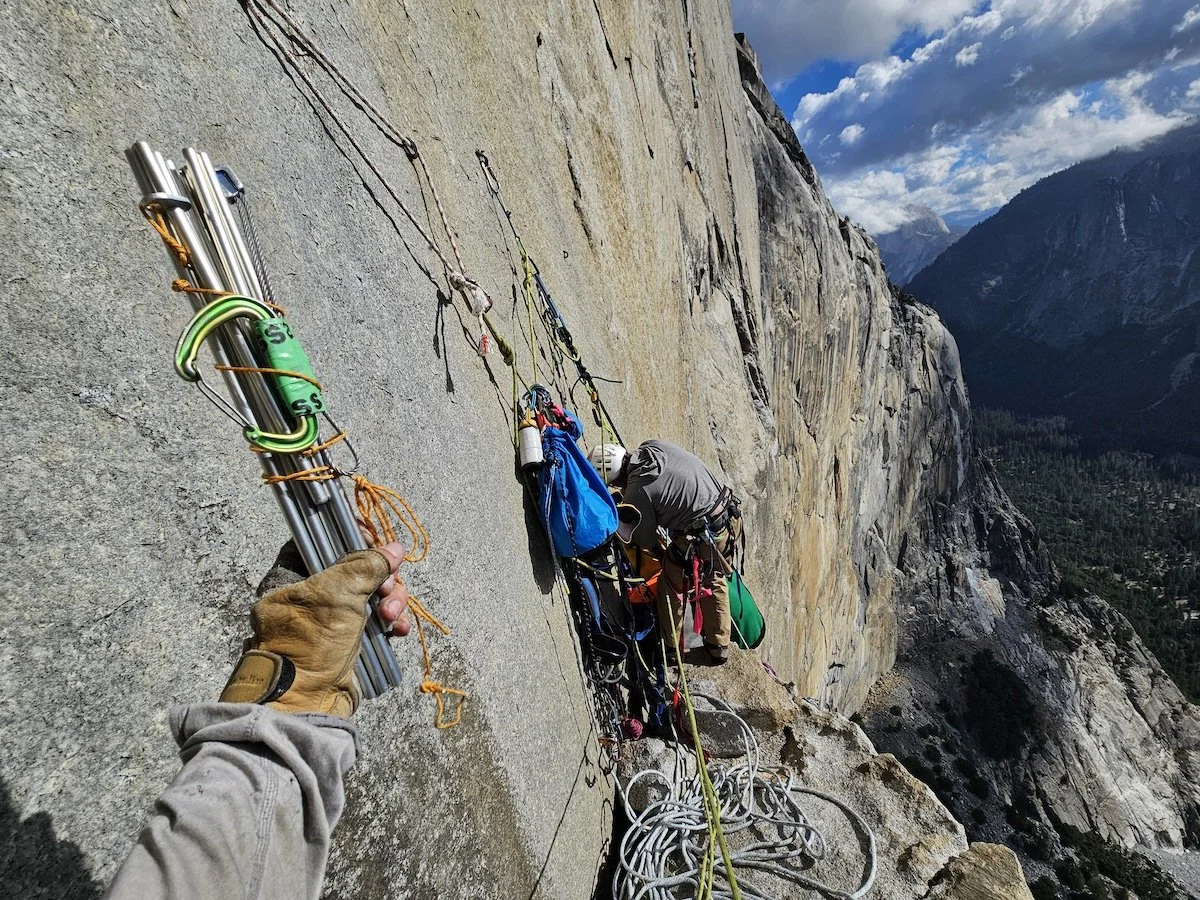
The “ten-foot-long blue offset” Mark used to get to the top of The Bismarck. Photo by AAC member Ben VanderStouw.
After fashioning the device, I sent it up, and Mark used it to place a nut in a seam 20 feet above his head. Mark jugged hand over hand to the nut placement and used it to reach the top. I was relieved when he built his anchor, but when I arrived at the belay, my stomach churned. It had looked decent from below, but any outward pull could have ripped it instantly.
My next pitch was hardly an improvement. It took me hours to find a way through the aptly named Circuitous Pitch. Looking at the topo made it more confusing—there were three different roundabout ways to get to the next anchor, either with big swings and lower-outs, or a 30-foot unprotected ledge traverse. I took the pendulum into another crack system and aided off a horribly tipped-out cam, wishing badly that I hadn’t used so much gear earlier in the pitch.
“Get as high as you can on each piece!” Mark shouted.
On Mark’s next pitch, he had to aid off a huge chunk of rock that shifted under his weight. It threatened to cut the rope and would certainly kill someone who went up this route and pulled on it without looking. After using it to move upward, Mark sent the microwave-sized block down the face. The sound of the impact was delayed a few seconds after we saw it hit the talus below.
According to the itinerary we fretted over, we needed to climb four pitches that day. We had only climbed three. My next pitch looked hollow and delicate, and we were both fried. The sun slid along the wall until it was no longer visible. We both knew this meant we had 20 minutes until darkness.
It was the most reasonable choice to set up the portaledge there and climb an additional pitch the next day. Our last night on the wall felt strangely jovial. We knew we would finish tomorrow, but we needed to climb our biggest day on the wall to do so.
Three separate nights, I saw a shooting star streak across the sky, and each time I wished for the same thing—getting back to the valley floor safely.
Starting off on day six, I moved past hollow flakes that sounded like bongos when tapped. Get on the piece, bounce-test it, highstep, place your next piece. Get on the piece, highstep... I got into the groove and let out a sigh of relief once I was through the notoriously rotten rock of the Gray Bands.
I called down to Mark: “If I can figure out how to wall climb, what can’t I do?”
He seemed pleased, as if I had finally figured out something he had been trying to show me for years.
The rest of the day involved long pitches. We were done being up there. It took a horrendously long time to lead the pitches I needed to link, but we climbed through some of the most beautiful, golden granite on the mountain. We knew even if it took till dark, we were going to beat the storm.
After a very long last day, we managed to creep over the edge of the mountain. On the very last haul, the bags were stuck, and we had little leverage moving them on the slab. Mark and I both had to put an ascender on the rope and pull with all our might to get the bags to move a few inches. We rappelled down to fix them twice. Finally, after hours of hauling, we had the bags at the top of the cliff.
“We haven’t climbed El Cap yet,” Mark told me sternly. “We’re tired, and are still in a dangerous position. We can’t get complacent.”
He was right—we were on top of the cliff, but we and our bags were on a ledge with a slab between us and the very top. I hip-belayed Mark up and across the slab to set a handline on a tree above. We clipped into this handline and dragged our heavy loads upward by headlamp.
“NOW we have climbed El Cap,” Mark told me, exasperated.
I looked at his face in the light of my headlamp and noticed a change in him. We had each lost ten pounds on the route, and our faces looked hollow. We hugged on the summit, and I found myself feeling so grateful for all of Mark’s lessons. We found some flat ground in the darkness, set up our bivvies, and drifted off to sleep looking at the Milky Way.
The morning brought rain and snow, soaking our sleeping bags before the East Ledges descent, a series of slick slabs and fixed lines. Three porters hiked up before sunrise to help us bring our bags down before the big storm hit. It felt surreal to move so fast after inching along the wall all week.
For days afterward, I awoke thinking I was still in a portaledge. The relief of solid ground came slowly each time. Our hands were too battered to make fists. The days blurred as we tried to recall the last week.
Later, Mark told me, “I could have skipped climbing Mescalito. I don’t need another El Cap tick. The true reward is the positive impact it will have on your life.”
Before leaving the Valley, we stopped in the meadow. Another party bound for Mescalito was arranging their gear and food on a large tarp. They asked about our rack, and I shared what worked for us. We wished them well.
I traced our line up the wall one last time, watching the upper pitches disappear into the clouds.