Guidebook XVIII

More Than Mescalito

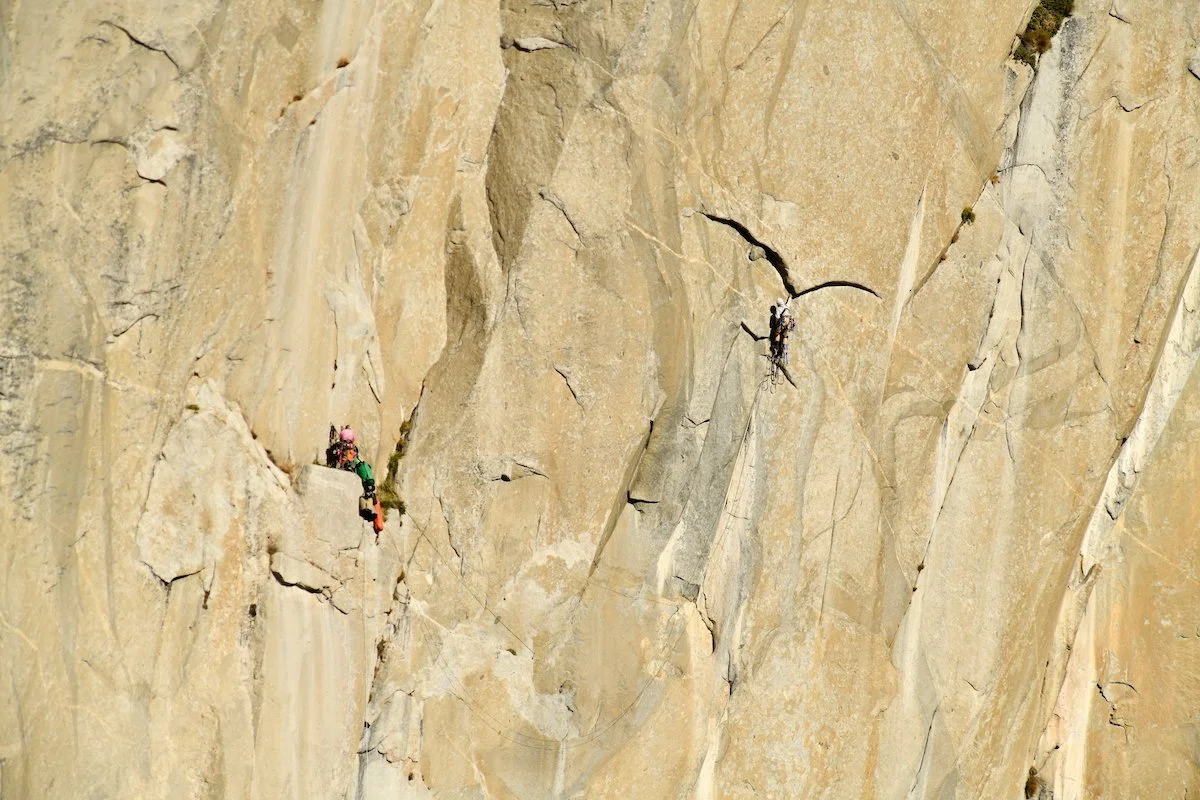
Mark Hudon belaying Ben VanderStouw on The Seagull, pitch six of Mescalito, El Capitan. Photo by Tom Evans.

A Story From The Live Your Dream Grant by Ben VanderStouw

Originally Published in Guidebook XVIII.

I was shivering in the darkness as I led up pitch two that day in Zion. My friend Will and I were climbing our first big aid route, Touchstone Wall. I moved upward in flared pockets and old piton scars—slowly. We had both underestimated the chill cast by the December shade. By pitch four, we were in the sunlight—not because we climbed into it but because dawn caught up to us.
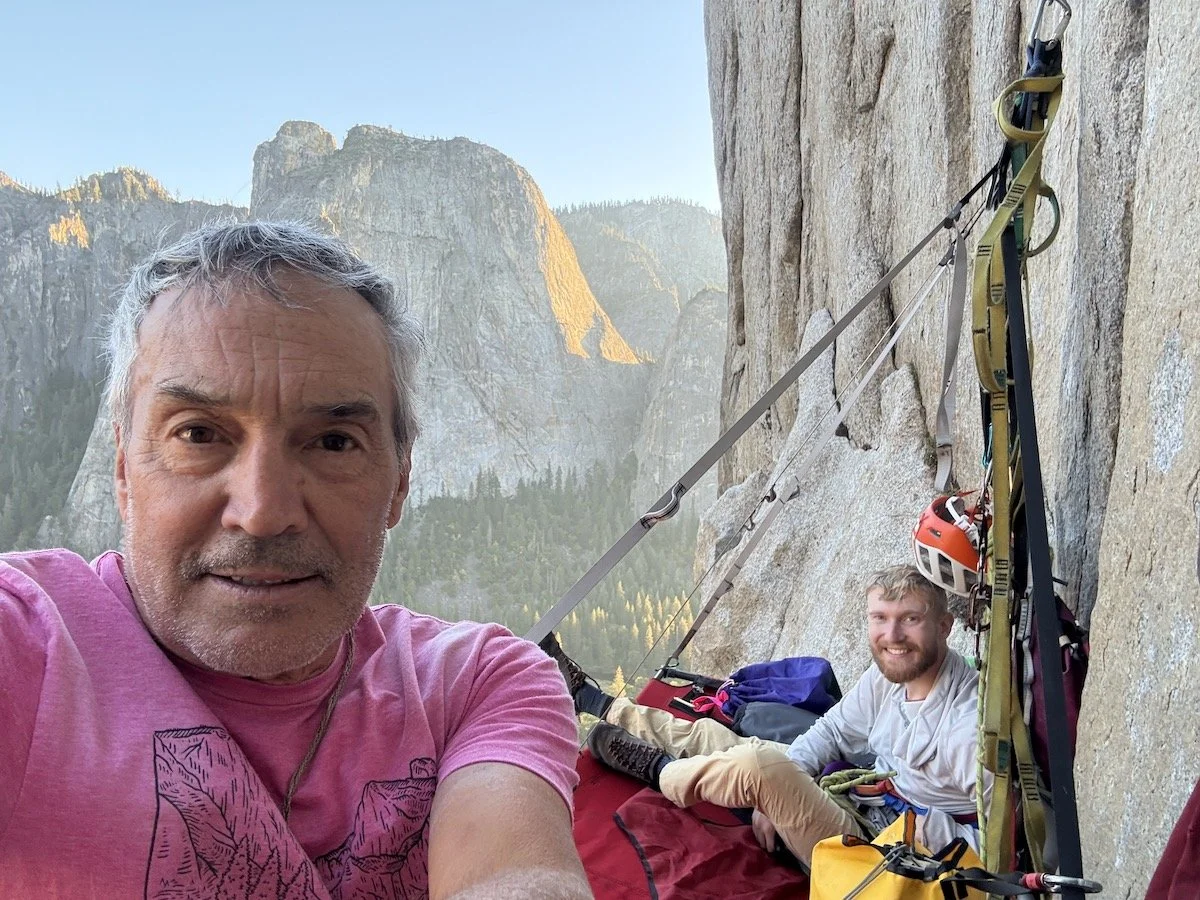
Mark and Ben on the first bivy of Mescalito. Photo by AAC member Mark Hudon.

The day before, I was on a phone call with Mark Hudon, who coached me through the systems we would be using that day. Mark had become my long-distance mentor during the pandemic, calling and emailing when I had big-wall questions. Will and I made it up and down in a day thanks to his advice, but I had a lot more to learn.

In the fall of 2021, I attempted Lurking Fear on El Capitan, where I bailed after popping off a series of hook moves. I blamed my busted knuckles when it was really my nerves. The following year, in the fall of 2022, I drove all the way from Maine to Yosemite to try the Nose. We bailed because of a forecasted storm that never came. I was crushed, and the drive back underscored the immense distance between me and my goal.

Up until that point, I wanted the feather in my cap of having climbed El Capitan. I wasn’t ready for what it demanded, nor was I seeking the experience itself. I continued to learn from Mark, but thought I might never get up the mountain.

Two years later, I called Mark and told him I felt ready. I no longer wanted to check a box; I wanted the experience of climbing a multi-day route with all its frustrations, discomfort, and pain. Though I still lived a long way from Yosemite Valley, and many places traditionally used to prepare for its polished walls, I knew if I had the right partner and opportunity, I could do it.

Mark suggested we climb Mescalito, a 26-pitch aid route that was longer and more challenging than any I had attempted before. It would require multiple nights sleeping in a portaledge and push my aid climbing abilities. It would force me to confront the discomfort that had sent me down twice before.

“You’re going to be a gumby at the bottom and an expert by the time we get to the top,” Mark told me.

At 69, Mark has been climbing El Cap for 51 years. He consistently climbs at least one challenging El Capitan route a year. With Max Jones, Mark had previously climbed the fifth ascent of Mescalito in the fall of 1977, using pitons and chocks.

“I have three El Cap routes left in me,” he told me. “I would love to do one of them with you.”

I kept training, practicing systems, and checking off the gear list, but Mark and I both felt like we were getting an ulcer over the climb. Even with the AAC funding secured, we didn’t know if the October 2025 government shut-down would close the park. I had no choice but to prepare the best I could, hoping our trip wouldn’t be canceled. Less than a week before my flight, we got the good news we needed. After a full day of cross-country travel, I made it to El Cap Meadow.

Two whole days were dedicated to moving our equipment to the base of the wall. We managed to climb up three pitches and hauled our gear to this high point. This allowed us to start higher on our summit push, with the luxury of sleeping on the ground as we prepared. Twenty-three pitches lay ahead of us still. I was already exhausted from hiking seven days of water and equipment up to the base.

To combat the fatigue, Mark suggested that we treat the first day on the wall as a “rest day,” climbing only two pitches instead of four. Leaving the ground for the final time, we jugged our fixed lines, started climbing, and set up camp at the top of pitch five.

I did not expect the unease I felt that first night. I have been up on big features in the dark before, but this was my first night on a proper portaledge. Relaxing and resting had always been something I would do after getting off the wall. A sea of white granite was illuminated by the bright, silvery full moon. I covered my head with my sleeping bag, out of the moon-light, and tried to sleep.

After a leisurely breakfast and coffee, we prepared for the next day’s pitches. The forecast showed great weather. I nursed my cramping legs with electrolyte mix and as many calories as I could choke down. It wasn’t much, but I started racking up.

Mark pushed me hard, insisting that I get the haulbags up to the anchor before he cleaned the gear from the pitch. I never beat him, but it forced me to move quickly and get the systems set up in time. The haulbags had to come off the anchor cleanly so they could move upward without tangling the system. Worse yet, we had brought so much water that I could barely move the bags. I needed to use a 2:1 pulley system to squat over and over again to slowly drag our provisions upward.

“I’m climbing this route with you, I’m not taking you up it,” Mark had told me before we had even started planning the route.

This was important to me, too. I wanted to haul and lead my fair share. Being able to climb and learn with Mark was an incredible opportunity, but it couldn’t be an excuse to slack off.

The first nine pitches of the route angled up and to the right, meaning a retreat after this point would be difficult. We could not rappel straight down, and with such heavy bags, we were committed to the top. As we sat on our portaledge on the top of pitch nine on the second night, we saw cold temperatures and precipitation materialize in the forecast.

The storm was expected to last several days. We now needed a strict quota of four pitches per day to make it up before it hit. We could last a few nights of bad weather, but the extended forecast showed dangerous temperatures and could force us to stay on the wall for too long.

We woke up at 5:30 each morning, forced down breakfast, skipped coffee, and started upward yet again. I knew I was not as efficient as my partner, and there was no time to waste. We ended at twilight, set up the portaledge, and tried to rest.

The biggest variable in getting down safely was the speed with which I could integrate Mark’s lessons into my climbing. Each day, I had to lead at least one difficult pitch, with insecure fixed gear, long sections of standing on hooks, mixed aid and free climbing, and tenuous pitches like the famous Seagull and Molar traverses.

On day four, darkness came before we were able to stop climbing. The sun had set, and I still had a section of 5.7 climbing ahead of me before we could sleep on the Bismarck Ledge. I climbed by headlamp, without climbing shoes or chalk, up the thin seams and blocky ledges. Fear and cold gripped me as I went upward, unable to see where the pitch ended. As I pulled over the edge, I was confronted with a sight that filled me with both frustration and amusement. Plastic containers holding at least ten gallons of water lined the ledge. We had struggled hard against the weight of the water in our own bags for days. Now we had enough to fill a kiddie pool.

The Bismarck looked like a sanctuary on the topo. It was the one real ledge on the route, a place where a storm could be endured rather than survived. It was narrower and more slanted than I’d imagined. Before we started, many said it was their favorite ledge on El Cap. In the cold and dark, I saw it differently. I wrestled the bags up the rocky buttress until they rested beside the treasure trove of water bottles.

I iced my aching hands on the cool rock. The summit stopped being the goal. It was only a step toward getting down in one piece.

Day five on the wall was taxing. Mark fell trying to free climb the offwidth section of pitch 19, The Bismarck. It was a beautiful crack in an orange corner that gradually widened until it could fit a ten-inch piece, which we did not have. There were no features to use aside from the crack itself, so he called down instructions for me to fashion a contraption made of tape, the portaledge fly spreader bar, and our big blue offset nut.
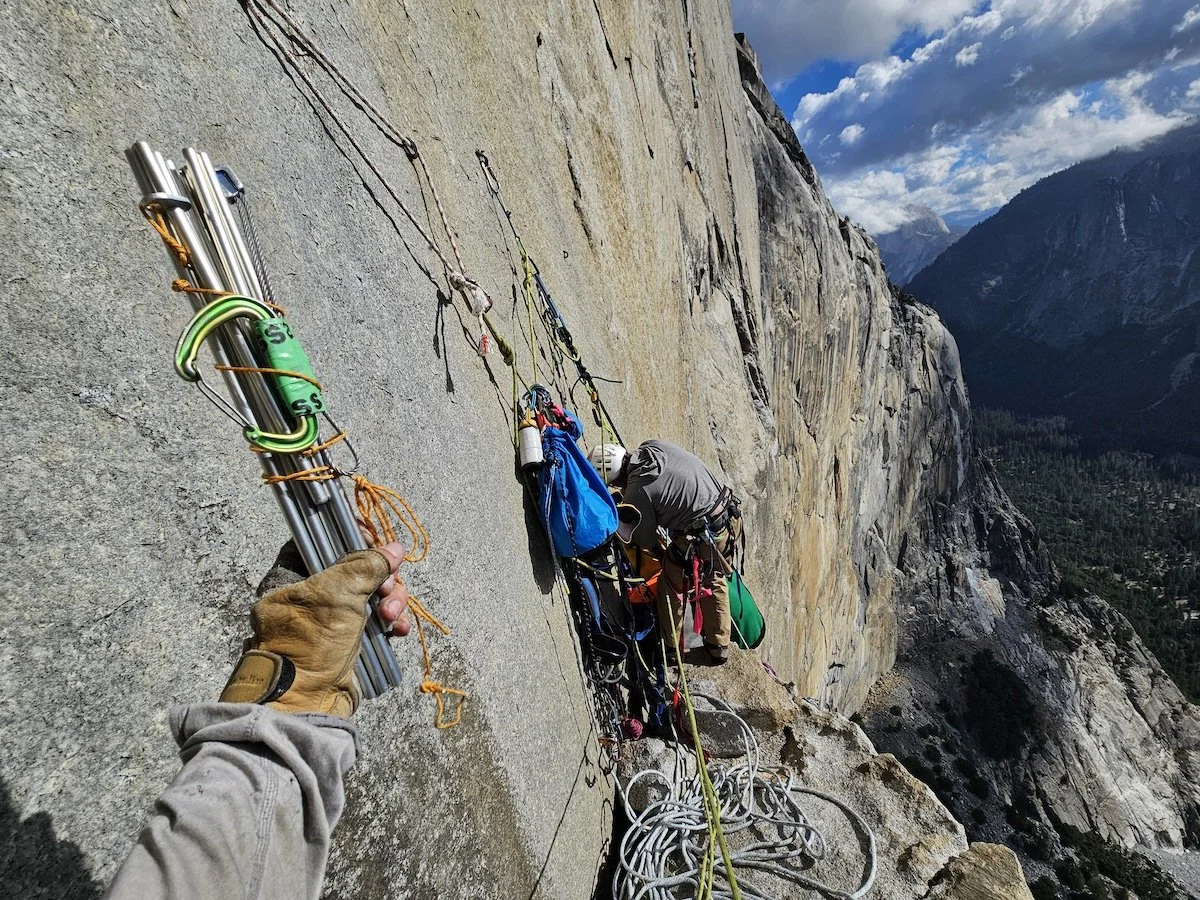
The “ten-foot-long blue offset” Mark used to get to the top of The Bismarck. Photo by AAC member Ben VanderStouw.

After fashioning the device, I sent it up, and Mark used it to place a nut in a seam 20 feet above his head. Mark jugged hand over hand to the nut placement and used it to reach the top. I was relieved when he built his anchor, but when I arrived at the belay, my stomach churned. It had looked decent from below, but any outward pull could have ripped it instantly.

My next pitch was hardly an improvement. It took me hours to find a way through the aptly named Circuitous Pitch. Looking at the topo made it more confusing—there were three different roundabout ways to get to the next anchor, either with big swings and lower-outs, or a 30-foot unprotected ledge traverse. I took the pendulum into another crack system and aided off a horribly tipped-out cam, wishing badly that I hadn’t used so much gear earlier in the pitch.

“Get as high as you can on each piece!” Mark shouted.

On Mark’s next pitch, he had to aid off a huge chunk of rock that shifted under his weight. It threatened to cut the rope and would certainly kill someone who went up this route and pulled on it without looking. After using it to move upward, Mark sent the microwave-sized block down the face. The sound of the impact was delayed a few seconds after we saw it hit the talus below.

According to the itinerary we fretted over, we needed to climb four pitches that day. We had only climbed three. My next pitch looked hollow and delicate, and we were both fried. The sun slid along the wall until it was no longer visible. We both knew this meant we had 20 minutes until darkness.

It was the most reasonable choice to set up the portaledge there and climb an additional pitch the next day. Our last night on the wall felt strangely jovial. We knew we would finish tomorrow, but we needed to climb our biggest day on the wall to do so.

Three separate nights, I saw a shooting star streak across the sky, and each time I wished for the same thing—getting back to the valley floor safely.

Starting off on day six, I moved past hollow flakes that sounded like bongos when tapped. Get on the piece, bounce-test it, highstep, place your next piece. Get on the piece, highstep... I got into the groove and let out a sigh of relief once I was through the notoriously rotten rock of the Gray Bands.

I called down to Mark: “If I can figure out how to wall climb, what can’t I do?”

He seemed pleased, as if I had finally figured out something he had been trying to show me for years.

The rest of the day involved long pitches. We were done being up there. It took a horrendously long time to lead the pitches I needed to link, but we climbed through some of the most beautiful, golden granite on the mountain. We knew even if it took till dark, we were going to beat the storm.

After a very long last day, we managed to creep over the edge of the mountain. On the very last haul, the bags were stuck, and we had little leverage moving them on the slab. Mark and I both had to put an ascender on the rope and pull with all our might to get the bags to move a few inches. We rappelled down to fix them twice. Finally, after hours of hauling, we had the bags at the top of the cliff.

“We haven’t climbed El Cap yet,” Mark told me sternly. “We’re tired, and are still in a dangerous position. We can’t get complacent.”

He was right—we were on top of the cliff, but we and our bags were on a ledge with a slab between us and the very top. I hip-belayed Mark up and across the slab to set a handline on a tree above. We clipped into this handline and dragged our heavy loads upward by headlamp.

“NOW we have climbed El Cap,” Mark told me, exasperated.

I looked at his face in the light of my headlamp and noticed a change in him. We had each lost ten pounds on the route, and our faces looked hollow. We hugged on the summit, and I found myself feeling so grateful for all of Mark’s lessons. We found some flat ground in the darkness, set up our bivvies, and drifted off to sleep looking at the Milky Way.

The morning brought rain and snow, soaking our sleeping bags before the East Ledges descent, a series of slick slabs and fixed lines. Three porters hiked up before sunrise to help us bring our bags down before the big storm hit. It felt surreal to move so fast after inching along the wall all week.

For days afterward, I awoke thinking I was still in a portaledge. The relief of solid ground came slowly each time. Our hands were too battered to make fists. The days blurred as we tried to recall the last week.

Later, Mark told me, “I could have skipped climbing Mescalito. I don’t need another El Cap tick. The true reward is the positive impact it will have on your life.”

Before leaving the Valley, we stopped in the meadow. Another party bound for Mescalito was arranging their gear and food on a large tarp. They asked about our rack, and I shared what worked for us. We wished them well.

I traced our line up the wall one last time, watching the upper pitches disappear into the clouds.

Sign Up for AAC Emails

Imprints Left on Summits

All images and scans were created with help from the AAC Library. Image by AAC member Foster Denney.

Library Spotlight written by Sierra McGivney

Originally published in Guidebook XVIII.

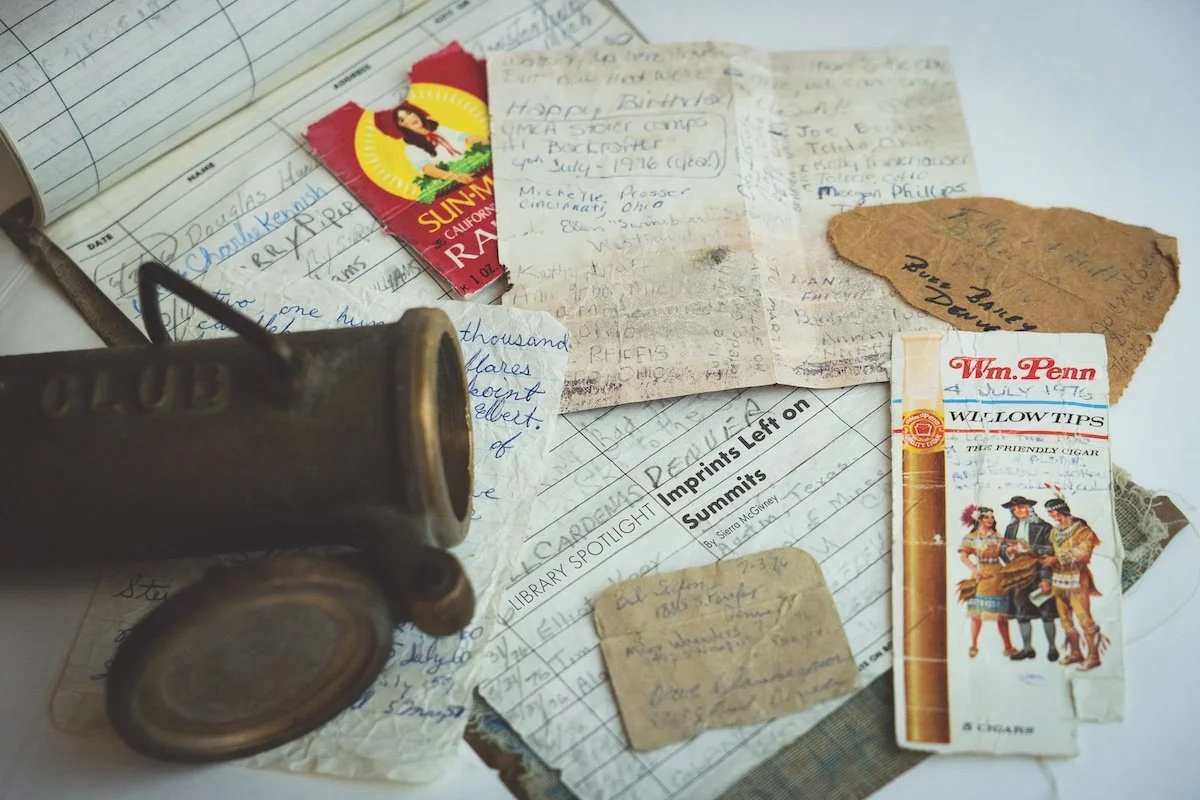
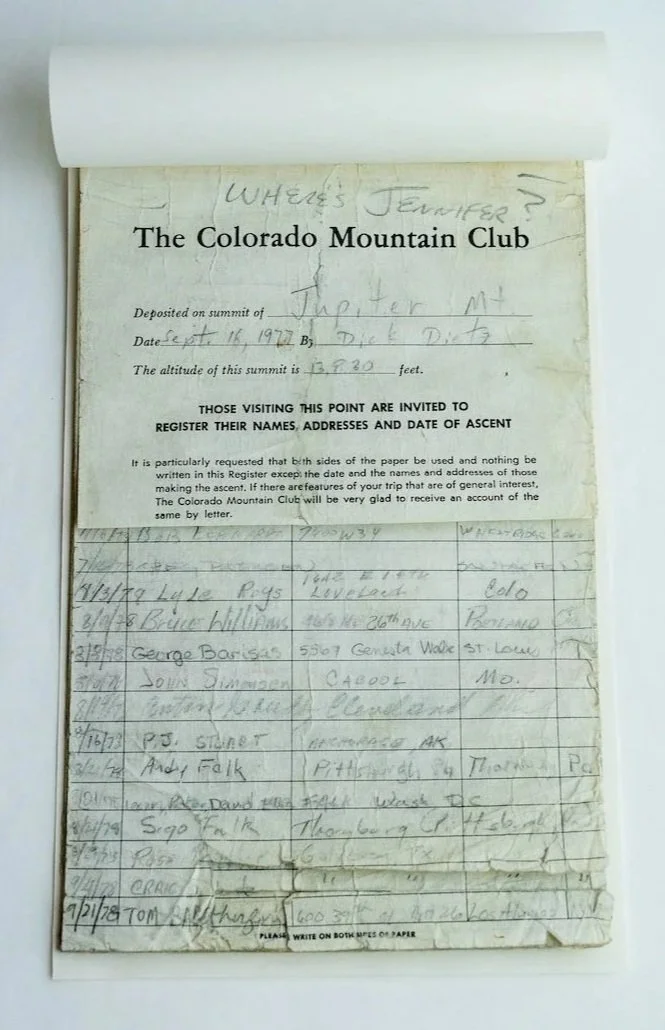
The need to leave our mark on the world is very human. It’s no surprise that when climbing mountains became popular, people started leaving fingerprints here and there in the form of summit registers. After 100 years of the practice, with untold pages of names, addresses, jokes, environmental activism, and weather and wildlife updates, summit registers have become a vibrant record of how humans interact with the mountains.

One historical register from Johnny Bull Mountain (12,026’) in the San Juans of Colorado is a small notebook. Flipping through, you’ll find two self-described “disgruntled employees” warning of the United States Forest Service plan to build a road and drill in the area. You’ll also see a kid named Will grow up, first signing his name at age three in 1988, and then again at ages six and seven. When the paper summit registers were full or nonexistent, hikers would take to writing on anything they had around. According to a Trail and Timberline article from 1989, people have used student IDs, driver’s licenses, a birth certificate, and a Monopoly “Get Out of Jail Free” card. In the James Peak (13,272’) summit register, you can find a Massachusetts car registration and a tuition receipt from Colorado State University, both from 1959.

It is believed that Mt. Powell (13,586’) had the first summit register in Colorado. This 13er is the highest peak in the Gore Range, known for steep terrain with class 2 climbing. On September 26, 1868, John Wesley Powell and Ned E. Farrell summited the mountain and placed a note inside a tin can at the summit. In 1913, during the third ascent of Mt. Powell, Percy Hagerman found the can with two previous ascents recorded, one from the Powell party. His party recorded their ascent on a chocolate bar wrapper and placed it in the tin can. In August 1935, a Colorado Mountain Club (CMC) outing group climbed Mt. Powell, recovered the tin summit register, and gave it to History Colorado, where it currently resides.

The CMC began placing summit registers on Colorado peaks during the 1910s and 1920s. These registers were later used to track usage and determine which mountains needed designated trails, especially after the formation of the Colorado Fourteeners Initiative in 1994. They would archive the registers and then allow people to conduct research or locate their signatures.

Today, the American Alpine Club Library collects, archives, and houses the CMC summit registers, the majority from Colorado—13ers and 14ers, of course, but also from mountains below 13,000’ that are rarely climbed. In addition, the AAC collects a handful of registers from mountains in Wyoming, and has the old Shiprock or “Tsé Bit’a’í” (Rock with Wings) register, from before climbing was banned there—the rock formation is sacred to the Navajo Nation. Once the AAC receives the registers from the CMC or others, they flatten them and sort them into the correct folder for the mountain. If you climbed a peak in Colorado and signed a summit register before 2015, there is a good chance the AAC Library has it.

Photo by AAC member Foster Denney.

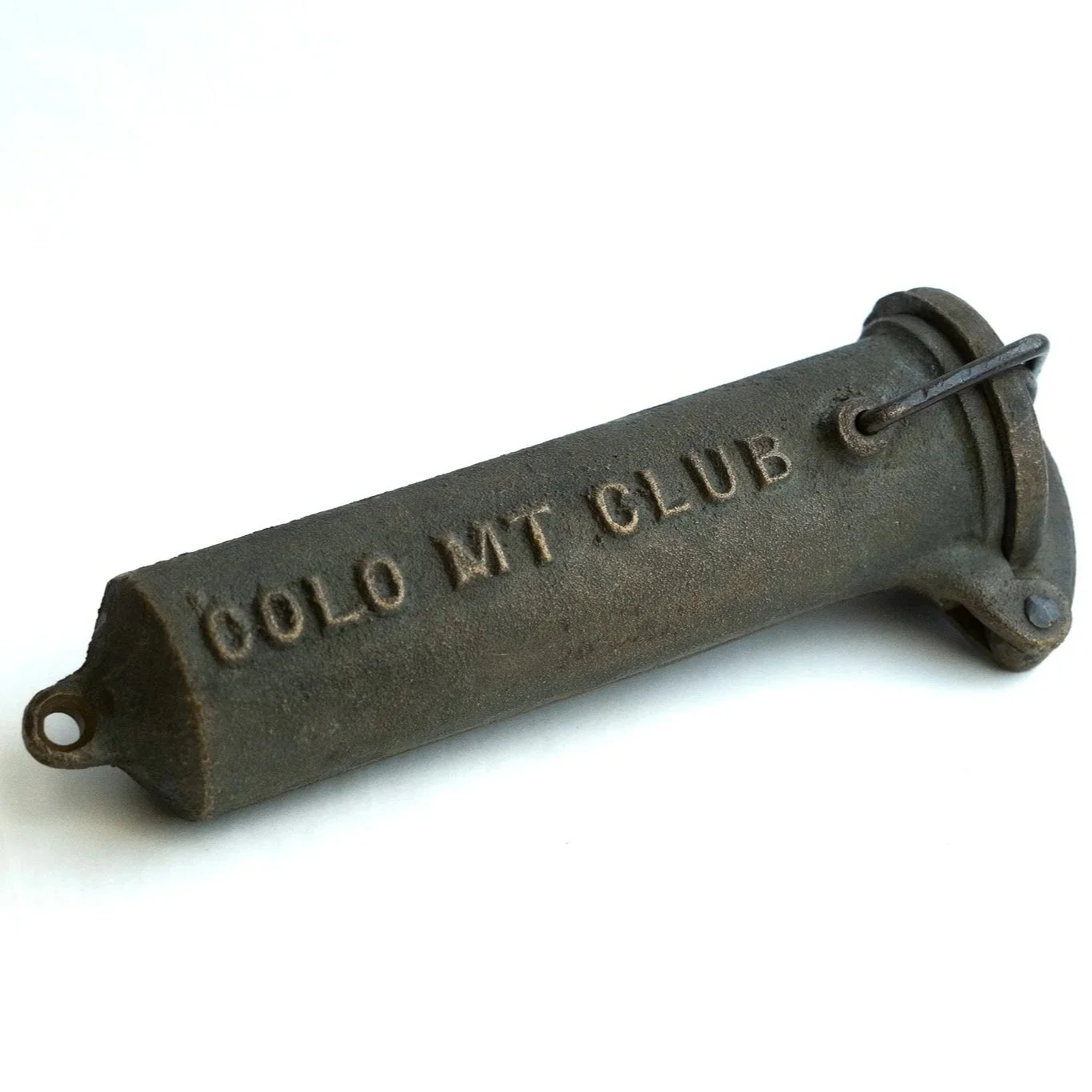
Originally the summit register canisters were made of brass. Today, most register canisters are PVC pipes, but a few are glass jars, food cans or tins, or plastic bags. Spencer Swanger, the first person to climb all 100 of the highest peaks in Colorado, used a pneumatic bank tube. If the canister is closed correctly and undamaged, the register holds up well. Unfortunately, water damage and mold are common, making some registers hard to read.

Most summit registers have not been replaced since the 2010s. With stricter Leave No Trace protocols, it fell out of favor to keep registers on the tops of mountains, but legend has it that on lesser-climbed peaks in Colorado, there are still summit registers. You’ll have to climb them to find out.

Sometimes the summit registers go missing or turn up in unexpected places. The elements sometimes take the registers, and occasionally, curious hikers trying to make a little money do, too. A brass summit register was put up for sale in Grand Junction for $400 in 2020. Katie Sauter, the American Alpine Club Library Director, was notified by a volunteer that it was on eBay. She reached out to the seller, asking if he would donate it to the Library since it was technically CMC property and was needed for archival purposes. The brass summit registers were worth $20 to $25 in the 1920s, and, with inflation, they are worth about $400 in today’s money. Whether the seller knew that or not, he was aiming to get his money’s worth from the register. The seller donated the brass tube containing the register to the Library, and it turned out to be from Culebra Peak, which now has restricted access, making the summit register even more sought-after.

Photo by AAC staff Foster Denney.

That isn’t the strangest retrieval of a summit register Sauter has seen. Jim Detterline, also known as “Mr. Longs Peak,” logged 428 ascents of Longs Peak (14,259’) and was often the person who retrieved the summit registers. Detterline was a Rocky Mountain National Park (RMNP) climbing ranger who started out his National Park Service career at Dinosaur National Monument in 1982. In 1984, he transferred to RMNP and was very determined to climb Longs Peak. By 1985, at 29, he had five failed attempts under his belt. Weather, specifically lightning, had been a problem for Detterline.

In the foreword for Longs Peak: The Story of Colorado’s Favorite Fourteener by Dougald MacDonald (also the editor of the AAJ), Detterline describes his first attempt of the Diamond in July 1979: “As the clouds darkened and increased in mass, I started to feel like one very small microorganism clinging to one very large piece of the universe. Eventually the clouds split open, and 30 million-volt bolts of lightning poured down on us with the cold rain. We retreated.... Standing soaking wet, tired, and cold at the base of Longs Peak, however, I realized I had fallen in love with the rocky mistress.”

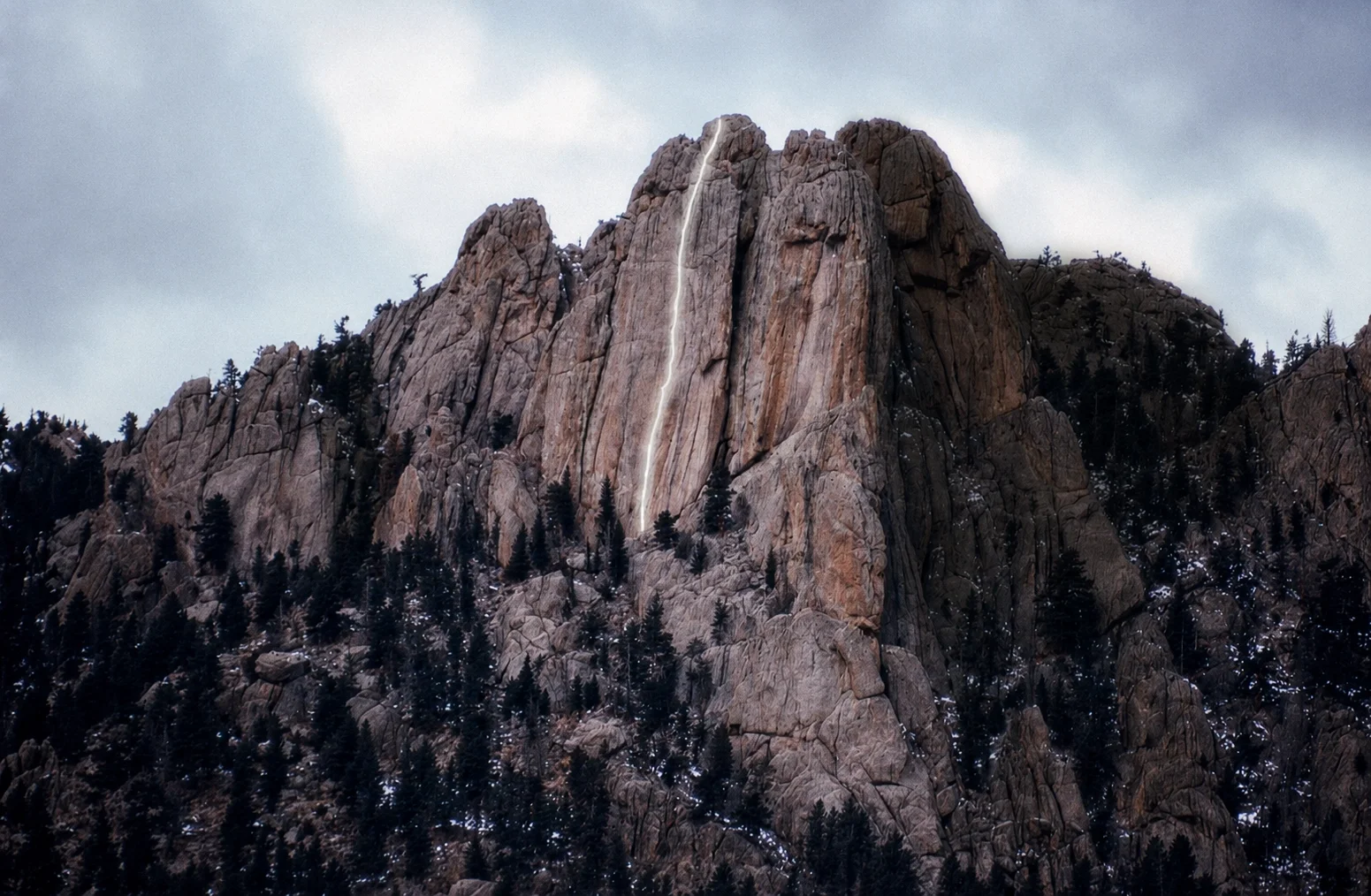
Longs Peak circa 2003. Photo from the Detterline Collection courtesy of the AAC Library.

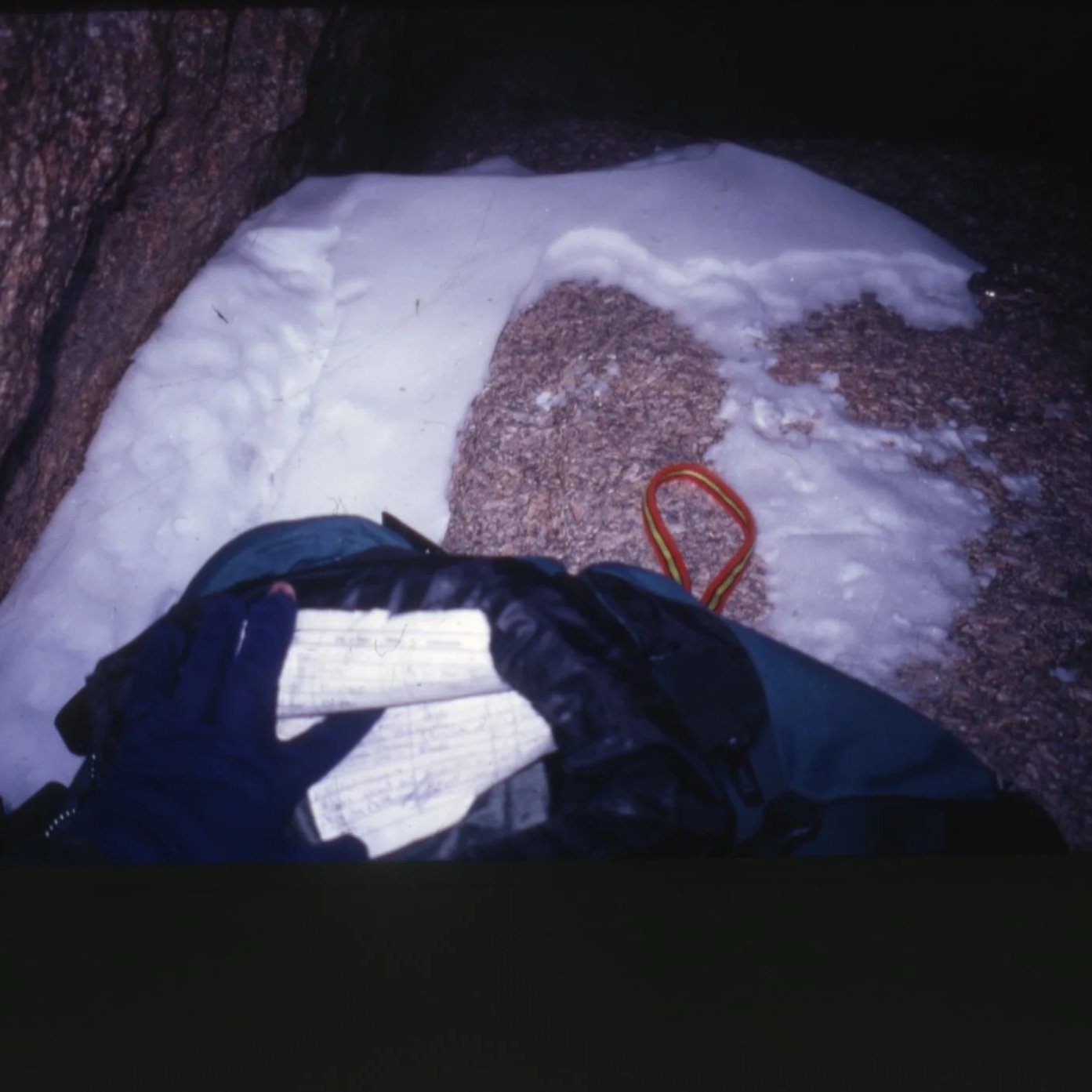
POV of Jim Detterline atop Longs Peak with a summit register. Photo from the Detterline Collection courtesy of the AAC Library.

Each name logged in a summit register is a hint at a personal adventure. Ultimately, Detterline was right to be cautious of the lightning around Longs Peak. In 1985, he and Duane Kitzis set out to climb the Casual Route (5.10a) on the Diamond. Detterline was leading pitch six, 40 feet up, and was still unable to find his first piece of protection. Suddenly, thunder rang out, and a sheet of rain showered down. A basketball-sized ball of St. Elmo’s fire at the top of the crack system began sizzling toward him. According to his unpublished memoir, “The ball came quickly to my position, hovered in front of my face, and exploded with a loud ‘boom’ and a flash of bright light.”

Detterline held strong; however, he had been totally blinded by the lightning strike. Kitzis helped guide Detterline down to the ledge, talking him through each foot and hand move as he downclimbed. They waited about an hour until Detterline’s sight returned; by then it was late, and the rock was wet. With no choice but to bivy, they began climbing at first light the next morning. This was just the beginning of Detterline’s time on Longs Peak, and just one story folded into the pages of the summit registers archived in the AAC Library.

Sauter remembers one Saturday morning at the American Alpine Club Library in the dead of winter. When the door flung open and snow swirled in, Detterline appeared, clad in a snowsuit. He handed her the Longs Peak summit register and walked back out, taking the snow with him. At least, that’s what Sauter says it felt like. The AAC Library is located in the building’s basement, with the door usually propped open, but when Sauter looks back on that day, it feels like Detterline had stepped off Longs Peak’s blustery summit and into the Library.

Longs Peak isn’t the only mountain with intense weather. Mt. Bierstadt (14,066’) is one of the more forgiving 14ers and one of the most popular, given its location near Denver. The weather, especially the snow, is still just as intense. In a summit register entry from February 15, 1976, a hiker describes the weather as “snowing, windy, vis[iblility] 500 feet.” The next entry with an illegible date has the opposite problem: “Too F@%*ing bad there wasn’t snow to ski to the summit.”

The weather turns fast in the mountains, and the summer months don’t always bring warm weather. An August 10, 1976, entry for Bierstadt reads, “...despite the snow. F@%* Colorado weather!” Another entry from August 18, 1976: “Holy sh*t it’s cold.”

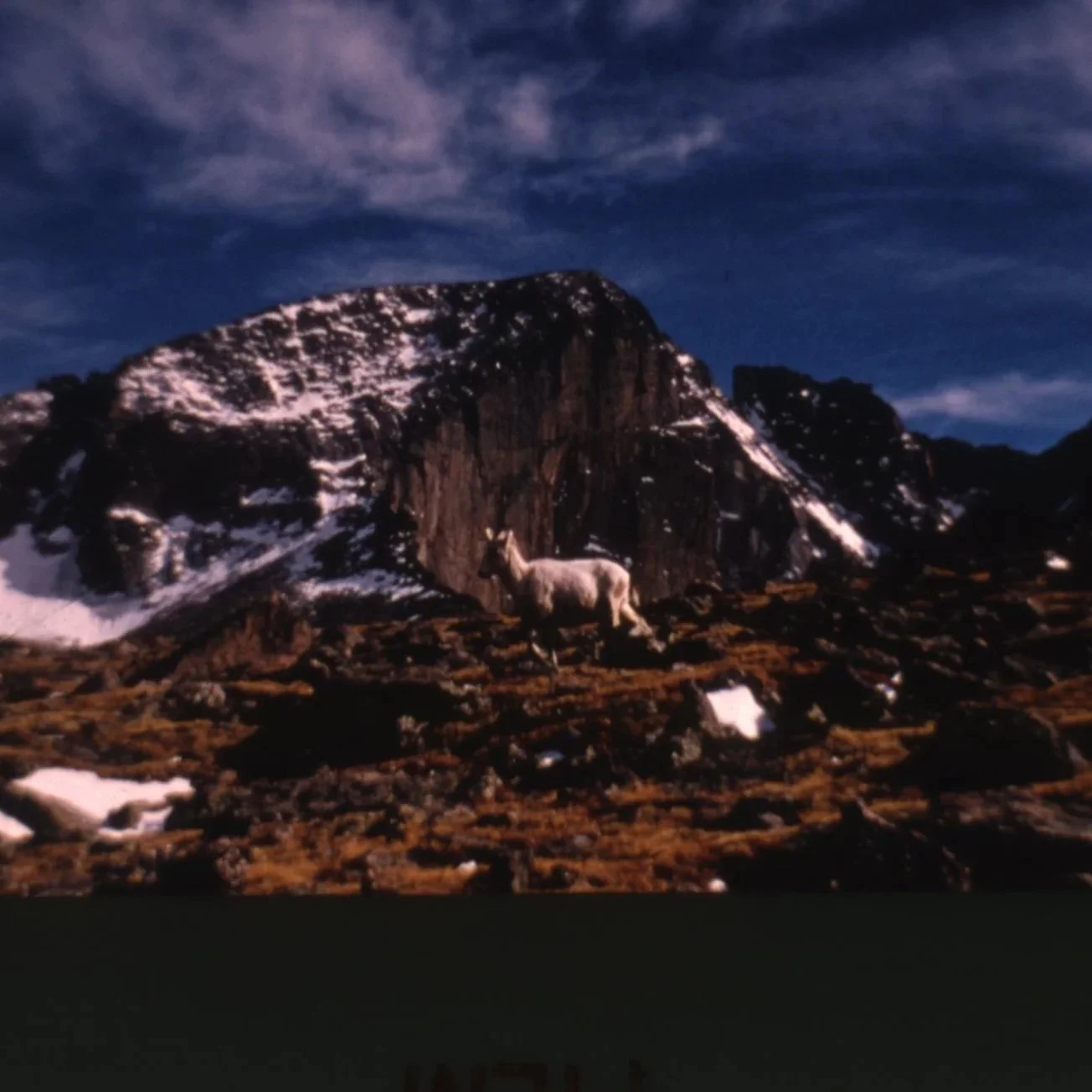
Mt. Blue Sky (14,268’), formerly Mt. Evans, is another 14er near Denver that is popular. The summit registers of Mt. Blue Sky don’t have many entries about the weather; instead, they focus on mountain goats. This doesn’t come as a surprise; the mountain is known for these troublesome, salt-licking creatures. Notes from the register from 2011 show considerable goat activity, with entries like: “Hi goats,” “Baby goats,” “Gorgeous Goats!” and “Goats = Awesome Views = wow.” Unfortunately, the abundant presence of mountain goats reflected in these historical summit registers is now precarious—in a 2025 population estimate by Colorado Parks and Wildlife, the goat population on Mt. Blue Sky was around 70, a far cry from the 2024 estimate of 125. An unknown disease has struck the goats, causing large fluctuations in population. It is suspected that human waste is the source. Hopefully the health of the mountain goat population can be addressed, or else these summit register logs will be strictly history, rather than a vibrant reference to a shared experience across time.

Digging through summit registers and archives in the American Alpine Club Library can transport you into the past, onto windblown summits, or next to shaggy-furred mountain goats. In the AAC Archives, history steps out of the books and into the room with you. The names scribbled onto worn paper on mountaintops miles away hold untold stories waiting to be discovered.


Sign Up for AAC Emails

An Interview with American Climbing Journal Editor

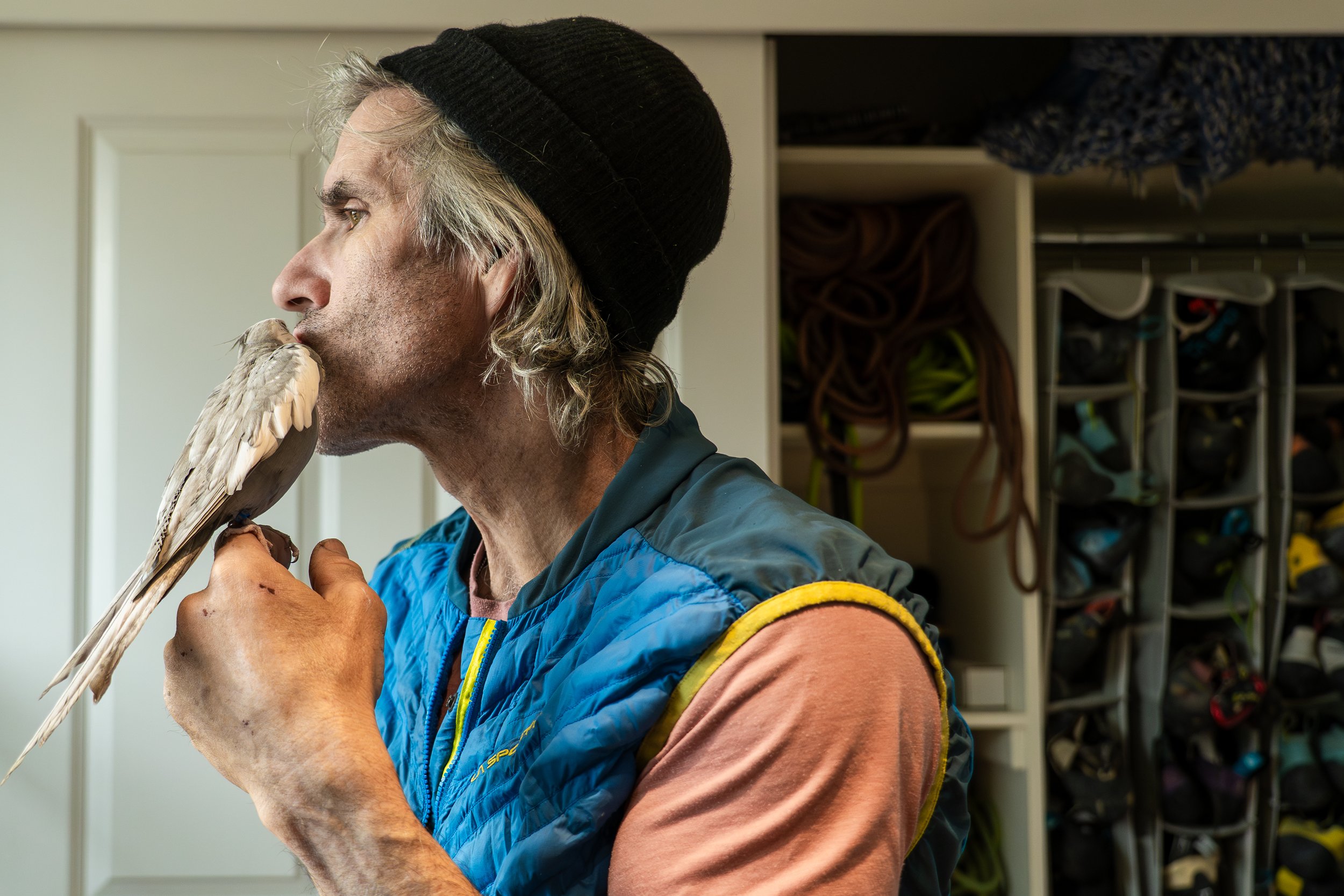
American Climbing Journal editor Matt Samet showing love to his cockatiel, Gandalf. Photo by AAC staff Foster Denney

By Hannah Provost

Originally published in Guidebook XVIII.

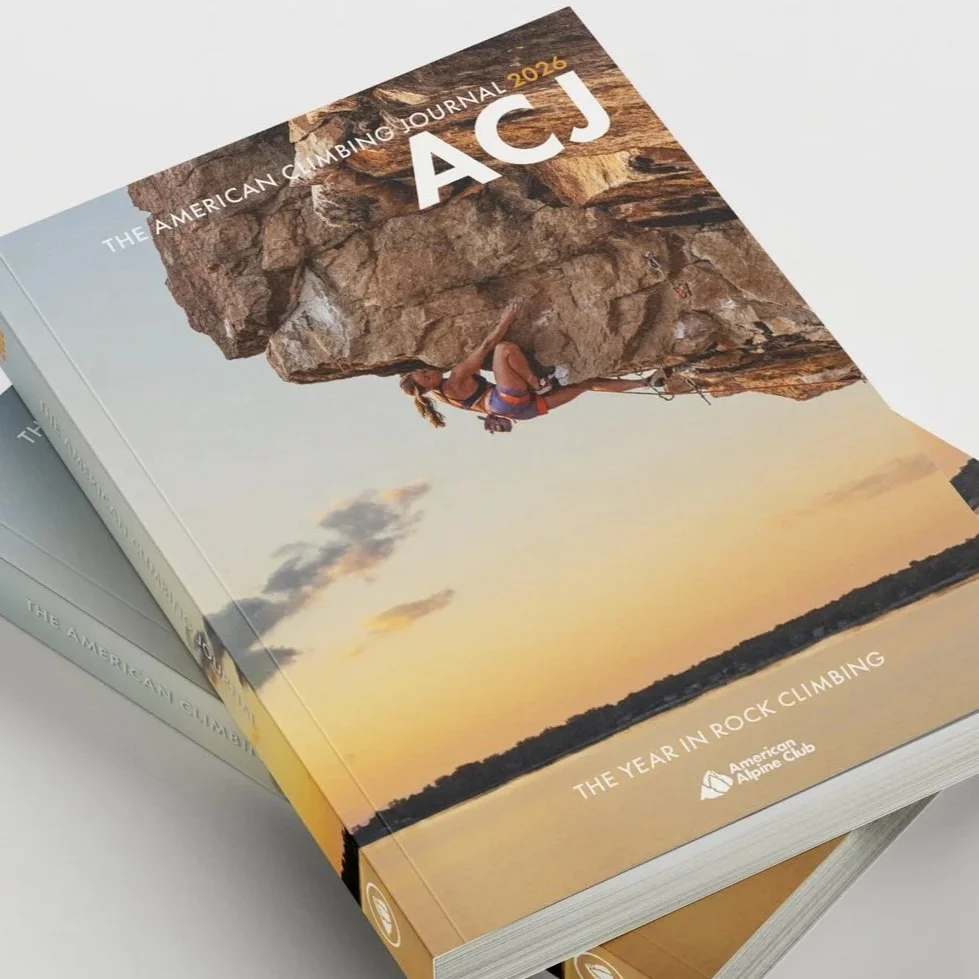
The American Climbing Journal (ACJ) is a new publication of the AAC. Building on the 97-year history of The American Alpine Journal, the ACJ will be the journal of record for the most significant rock climbs each year, covering sport climbing, single-pitch trad, bouldering, and shorter multipitch climbs in sport style, as well as performance-oriented achievements such as outdoor speed climbing and link-ups. AAC members can expect to receive the very first edition of the ACJ in the fall of 2026.

Editor’s Note: The following discussion includes a lot of sidebars, as Matt Samet managed his cockatiel, Gandalf, who was flying around Samet’s home office and making a ruckus as we chatted. Sidebars to Gandalf are noted in parentheses.

Matt Samet: [Referencing the cockatiel on his hand] He’s been flinging fruit pellets at me all day. He’s such a f#@ker. Gandalf?

Hannah Provost: Is that just a plea for attention?

MS: Well, he likes to sort through and get the seeds he wants, but some of it’s just, yeah, being a bird—being a brat. Look at that: Are you a brat? Yes, you are.

HP: Haha. Well, let’s get started. Why is there a need for something like The American Climbing Journal [ACJ]—why should it exist if we have the internet? I.e., what’s the argument for your relevance, Matt?

MS: I think it’s important to have a journal of record for rock climbing, just as it’s been important to have a journal of record for alpinism, like we’ve had with The American Alpine Journal [AAJ] for 97 years now. Rock climbing in the last 40 years has become just as relevant as alpinism, I think. For years, the magazines functioned in that capacity with news departments, features, articles about areas, and profiles on climbs. The magazines were the keepers of that record. Before the internet, they were the only way you could find out what had been done.

(Hi, Gandalf. You are a pretty birdie. You’re a very pretty birdie. He’s ridiculous, isn’t he?)

So, with Drifter’s Escape, the 5.15a traditional climb that Connor Herson freed in Squamish, Connor did something that’s very trendy these days, where he waited to post about it online—some kind of punk-rock marketing, I suppose. But how deep can any Instagram post ever go?

My goal with the ACJ would be to get Connor to write a first-person story and to help fill in the details, which he and a Squamish local and climbing historian, Nat Bailey, did an incredible job of. That way, it’s preserved forever in journal form. And then we have a searchable archive like we have with [the] AAJ, and you can be like, Hey, when was Drifter’s Escape done? and get detailed answers about the facts, but also a first-person description of the experience. It’s also important to have these facts, not because names, grades, and dates matter so much, but because there is a continuum and a living history that’s still evolving, and in very unique and unpredictable ways.

It’s important to have as much documentation as you can for old, geeky history nerds like me, but also for people new to the sport.

(Gandalf, are you a pretty birdie or are you just a pain in the ass? You are a pretty birdie.)

HP: Definitely pretty birdie. Haha. Okay, well, how is the ACJ structured, and in what ways is it similar to or different from the AAJ?

MS: We have our primary features, which aren’t necessarily just the most important things that happened in 2025—they’re also the ones that lend themselves to the best storytelling.

So, for example, there’ll be [Adam] Ondra’s flash of Lexicon, the world’s first flash of an E11—basically a 5.14 death route. Seb Berthe doing the fourth ascent of the Dawn Wall— he took a boat over here twice to get it done, because he’s committed to green travel. Sasha DiGiulian and her first female ascent of the Platinum Wall, a 39-pitch 5.13d on El Cap.

Hamish McArthur, with his astonishing V17 repeats. Connor Herson, as I mentioned, doing Drifter’s Escape, perhaps the first-ever 5.15a trad pitch. Katie Lamb talking about being the first woman to do a V16 “twice,” and what that meant.

Then we get into the gallery section, with photos of [climbs] that are stunning and/or difficult across the world and country, with longer captions that offer deeper storytelling from the people who did the climbs. We’ll also have images of new areas (and newly protected old areas) that have opened (or reopened) up because of successful pushes by local climbing organizations and the Access Fund—places like The Venue at the Red, Farley Ledges in Massachusetts, and Howard Knob in North Carolina.

And then we have a section that’s new in the sense that you wouldn’t necessarily see it in the AAJ: Crag Profiles, which are basically what they sound like. This edition, we have the Ships Prow in Rocky Mountain National Park, and then Cheat Canyon, West Virginia, which is this crazy bouldering, soloing, highballing, off-the-radar gritstone area.

Then we have our American Rock section, which features regional reports on climbs significant to their area. And then World Rock, which is the international version. One idea with some of these American Rock and World Rock reports is that we also want to clue people into areas they might not have heard about—kind of like the Climbs & Expeditions section in the AAJ.

(Stop eating a $10 bill, you f#@ker.)

HP: One of my favorite things about working with Dougald [MacDonald, editor of the AAJ] and Pete [Takeda, editor of Accidents in North American Climbing] is that they’re both big personalities. You are also a big personality, and of course, so is your bird Gandalf...

MS: He’s a bigger personality than me—look at this. Now he wants scritches, or he’s going to bite me.

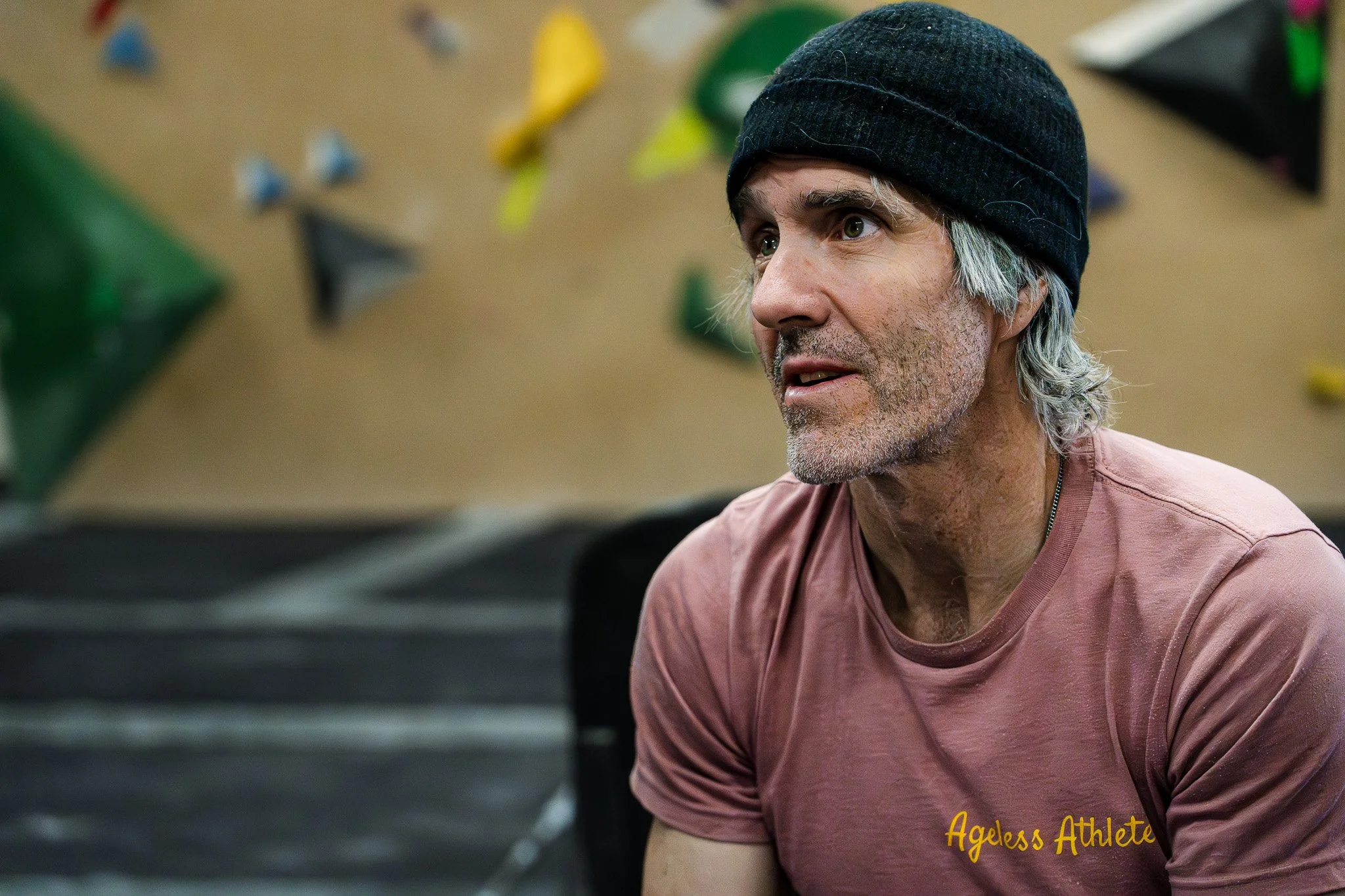
Matt Samet examining a boulder at his local gym. Photo by AAC staff Foster Denney.

HP: So what’s your background in editing, and what parts of your professional and climbing background are you bringing to the ACJ?

MS: I’ve been climbing since age 15. I’m 54 now, so we’re coming up on four decades of climbing. Primarily rock climbing, a little bit of alpine rock here and there. I’ve always been into performance rock climbing; at one point, like, in my teenage years and into my 20s, I was a sponsored climber.

In 2002, I started working at Climbing Magazine after getting my BA in journalism and then a master’s in English/creative writing. I’ve been involved nonstop in editing or writing about climbing since then. So, 24 years of editorial experience, working as a desk editor at Climbing, at Rock & Ice, at Alpinist. I have twice been the editor-in-chief at Climbing, though it wasn’t quite as, umm, glorious as it sounds, because at times I had no staff other than myself. Like 100-hour weeks—I wouldn’t care to do that again.

And I’ve been involved with the AAJ as a freelancer since 2022. I’ve edited a lot of outdoor books and memoirs, too—through Mountaineers Books, Di Angelo Publications, Patagonia, things like that.

HP: Do you ever get bored with climbing stories?

MS: I don’t. I did get bored of climbing stories when I was at the magazines, and the frequency was 10 to 12 issues a year, and my workload was insane. Now, with the longer timeline to put a journal together, I get to spend more time with the stories.

For me, the coolest part is helping climbers/ writers find their voice and their story. When someone’s done a cool climb, but they haven’t quite figured out how to translate that to the page so that other people can experience it with them, it’s a really cool thing to be that conduit or bridge.

When you get into the details of climbing, it becomes this really fascinating thing, because it’s an experiential sport. Being at your limit is a universal experience, right? No matter what the grade or the climb is, we all have to dig deep in the same way in order to succeed at our physical or mental limit. When you’re able to take a climb that’s also at the very cutting edge and translate that climber’s experience into something rooted in details, and that feels universal, it makes for really cool storytelling.

Have you seen the video of Adam Ondra doing Lexicon? It’s insane. He talks [in his article for the ACJ] about the two minutes before he got on the wall, being scared. Here’s the world’s best climber admitting he was scared. That’s such a beautiful thing, because we all get scared. It’s this profound and very real and very human moment we can translate into our own experience. As a dedicated and passionate climber myself, I can see myself and my love of the sport in all these stories.

HP: In the course of sharing your answers to the previous questions, you gave us some sneak peeks of some stories. But can you tell us in detail about a story that really surprised you?

MS: There’s this Korean boulderer, Sungsu Lee, who’s extremely strong. In May 2025, he repeated Burden of Dreams, the world’s first V17, in Finland. But on the successful ascent from the ground, he pulled on, cocked, and maybe bounced off the pads, but maybe not. It’s hard to tell, because he had a baggy T-shirt on. Then he got to the top, and everyone’s like, “Yay!” And he has his celebratory beer.

But you could see something in his eyes where he’s like, Eh, I don’t know if I did it or not. So he went back and repeated it. We have an interview with him that a friend of his, Brian Kim, helped translate, getting into the mindset of why Sungsu went back to do it again. The second time, he did it with his shirt off, which I thought was funny.

To me, this all showed the sense of absurdity but also the seriousness with which we interpret climbing. I mean, someone who’s not a climber, if you tried to explain to them why this guy’s T-shirt and maybe butt bouncing off these foam landing mats below this tiny rock mattered, they’d be like, “Wait, what?”

But to a climber, to the diehards who are our Club members and readers, it’s everything.

Style is everything.

HP: You’ve been an obsessed climber for decades. Is there a climb that still haunts you?

MS: Okay, there’s one I haven’t done that I bolted that I’ve been trying now for three years. It’s up in Skunk Canyon in the Flatirons here above Boulder, Colorado, where I live. It’s 21 bolts long, and my friend Brandon and I bolted it in the fall of 2022. I did the first half of it that season. And I didn’t expect the second half to be that much harder, so I thought, I’ll come back next season and finish it off.

I’ve probably been up there 100 days since then, just trying to do the second half by itself.

Last fall, I almost did it—the second pitch. It’s essentially like V10 into a difficult clip, straight into a V9, on a 35° overhanging panel on small, awkward holds. I had my hand on the jug at the end of the hardest part. And all I needed to do was bring my feet up and bring my other hand in. And I just couldn’t—my elbows were in the sky.

I was very excited to train for it this winter, but then my right pinky finger got infected, as did the tendon. I haven’t been able to train, but I hope to be able to train in the summer and go back in the fall. I mean, at age 54, I don’t know if I can, but I know that it’s now or never. I’d like to do this route because I think it would mark the culmination of everything I’ve worked toward in four decades of climbing. And also to show that as you age, you can still push yourself.

The first half is called The Alpha. The second half is called The Omega. Together, they are The Alpha and The Omega.

HP: What’s an example of a unique challenge that you had to deal with when compiling the ACJ?

MS: The biggest challenge was coming in, and there was no ACJ, no template. We’ve had to develop it from scratch, which initially was very intimidating. We didn’t even quite know what this was—and we needed to get it done by spring 2026. But obviously, you, me, Dougald, and Shane [Johnson, the Vice President of Media at the AAC] put our heads together on it. I’m very grateful for all the help that you guys have given me. And I think the ACJ is going to keep evolving, too. I’m excited to see how people respond once the Journal is out in the world.


Sign Up for AAC Emails