American Climbing Journal

An Interview with American Climbing Journal Editor

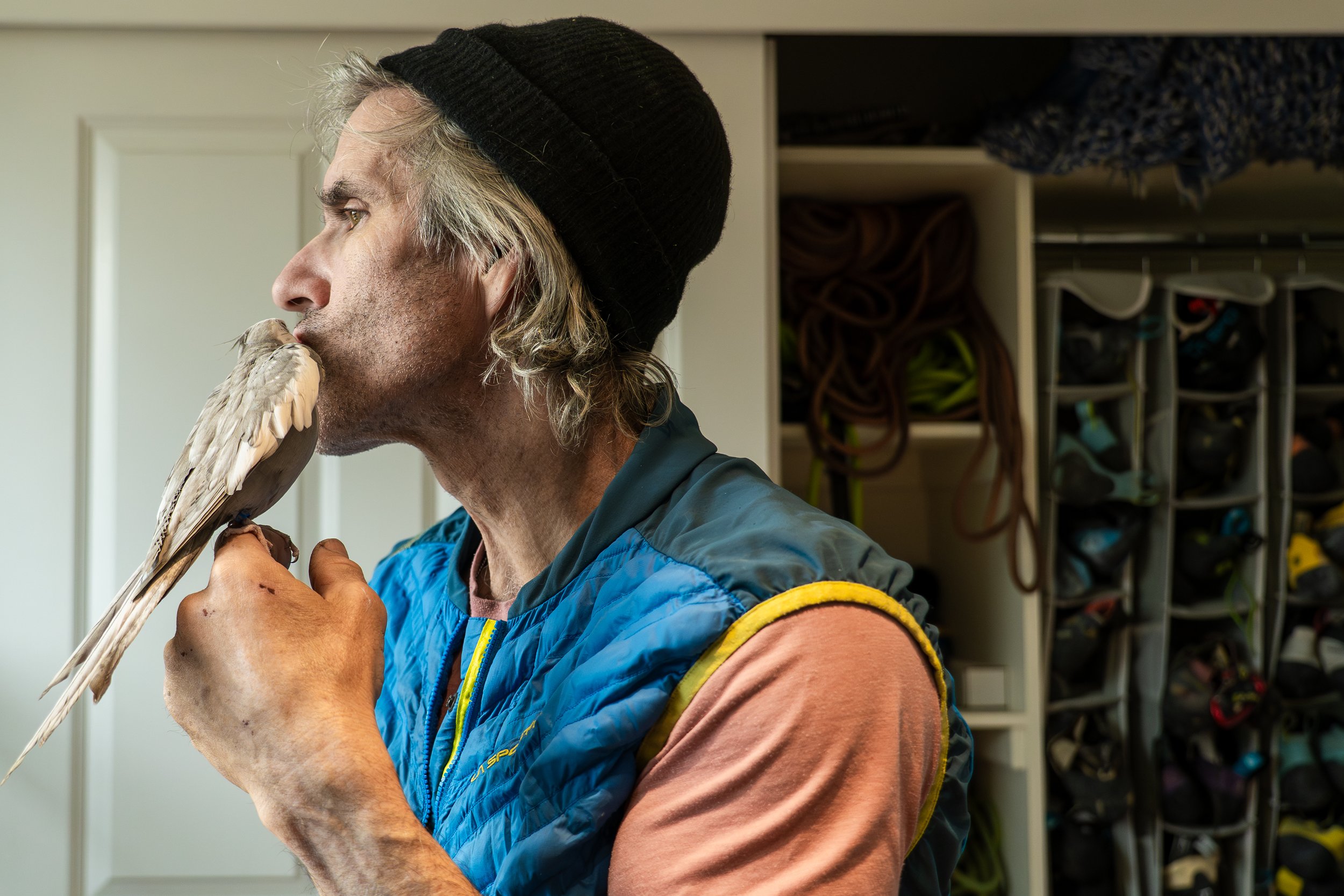
American Climbing Journal editor Matt Samet showing love to his cockatiel, Gandalf. Photo by AAC staff Foster Denney

By Hannah Provost

Originally published in Guidebook XVIII.
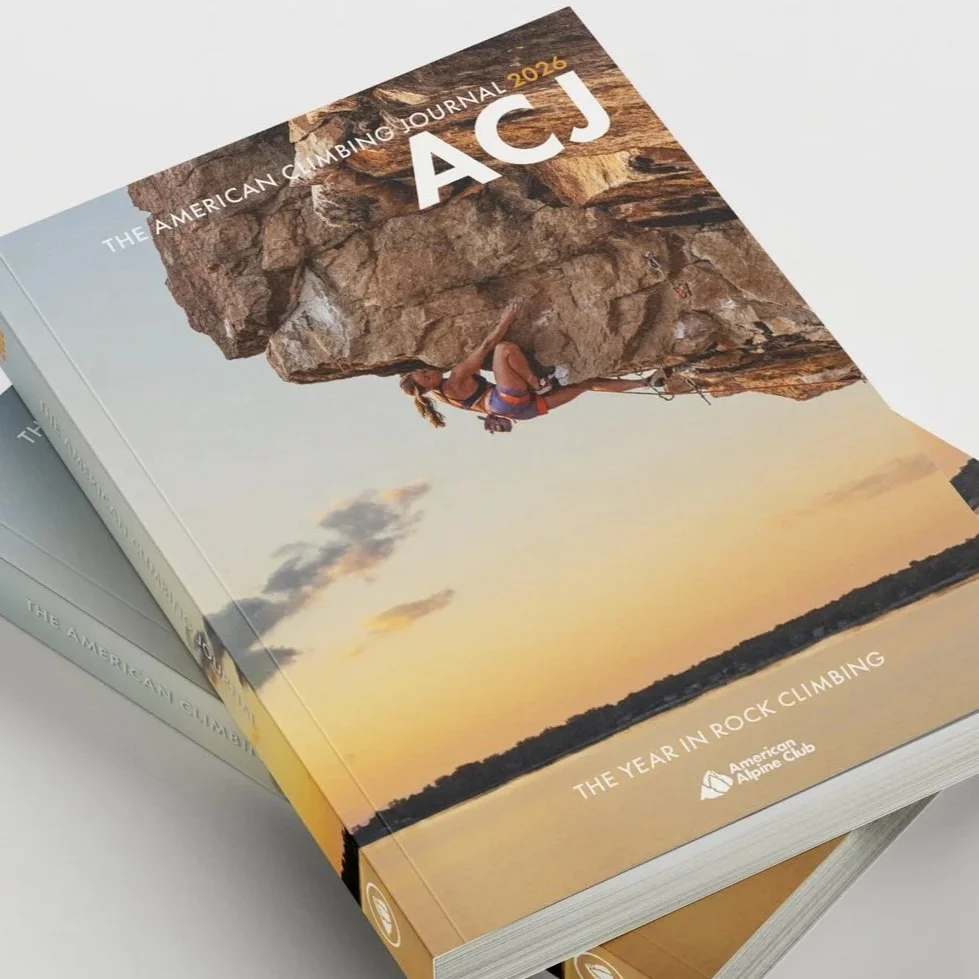
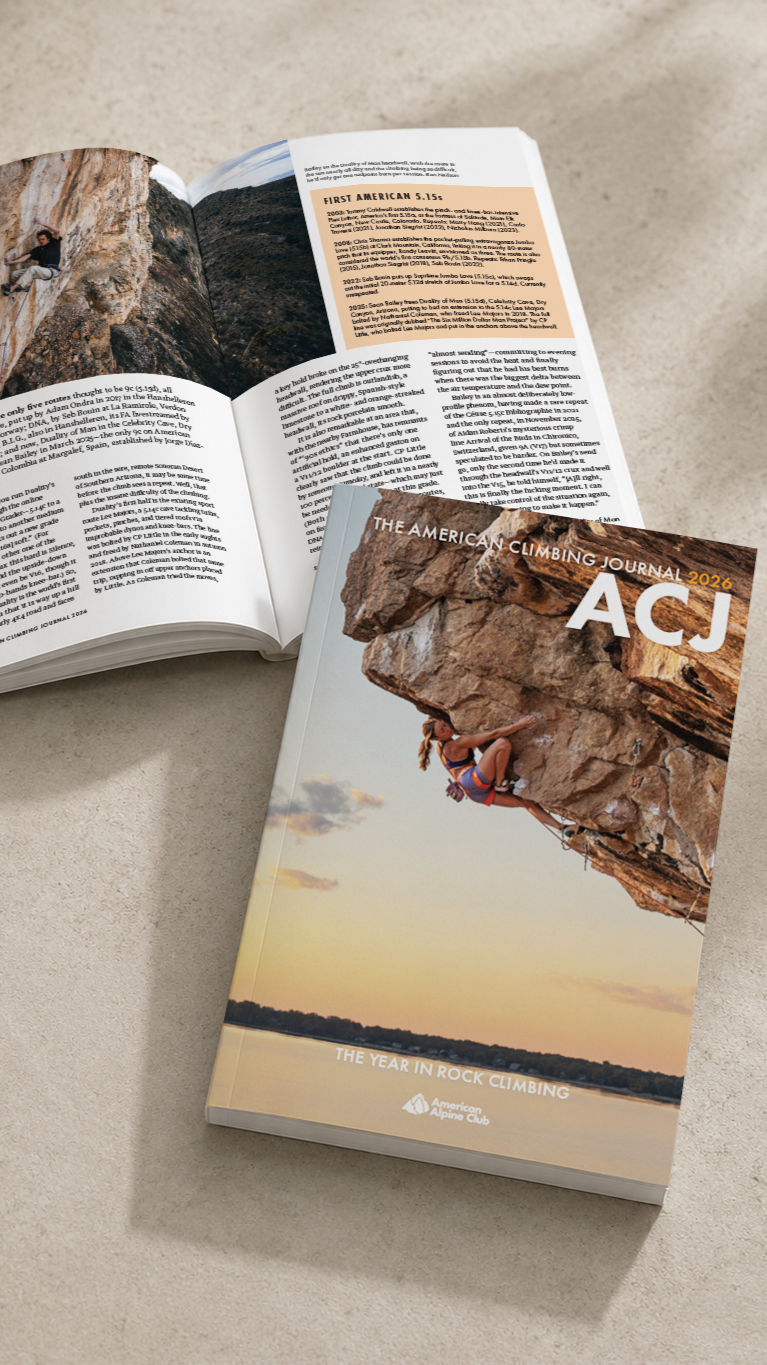
The American Climbing Journal (ACJ) is a new publication of the AAC. Building on the 97-year history of The American Alpine Journal, the ACJ will be the journal of record for the most significant rock climbs each year, covering sport climbing, single-pitch trad, bouldering, and shorter multipitch climbs in sport style, as well as performance-oriented achievements such as outdoor speed climbing and link-ups. AAC members can expect to receive the very first edition of the ACJ in the fall of 2026.

Editor’s Note: The following discussion includes a lot of sidebars, as Matt Samet managed his cockatiel, Gandalf, who was flying around Samet’s home office and making a ruckus as we chatted. Sidebars to Gandalf are noted in parentheses.

Matt Samet: [Referencing the cockatiel on his hand] He’s been flinging fruit pellets at me all day. He’s such a f#@ker. Gandalf?

Hannah Provost: Is that just a plea for attention?

MS: Well, he likes to sort through and get the seeds he wants, but some of it’s just, yeah, being a bird—being a brat. Look at that: Are you a brat? Yes, you are.

HP: Haha. Well, let’s get started. Why is there a need for something like The American Climbing Journal [ACJ]—why should it exist if we have the internet? I.e., what’s the argument for your relevance, Matt?

MS: I think it’s important to have a journal of record for rock climbing, just as it’s been important to have a journal of record for alpinism, like we’ve had with The American Alpine Journal [AAJ] for 97 years now. Rock climbing in the last 40 years has become just as relevant as alpinism, I think. For years, the magazines functioned in that capacity with news departments, features, articles about areas, and profiles on climbs. The magazines were the keepers of that record. Before the internet, they were the only way you could find out what had been done.

(Hi, Gandalf. You are a pretty birdie. You’re a very pretty birdie. He’s ridiculous, isn’t he?)

So, with Drifter’s Escape, the 5.15a traditional climb that Connor Herson freed in Squamish, Connor did something that’s very trendy these days, where he waited to post about it online—some kind of punk-rock marketing, I suppose. But how deep can any Instagram post ever go?

My goal with the ACJ would be to get Connor to write a first-person story and to help fill in the details, which he and a Squamish local and climbing historian, Nat Bailey, did an incredible job of. That way, it’s preserved forever in journal form. And then we have a searchable archive like we have with [the] AAJ, and you can be like, Hey, when was Drifter’s Escape done? and get detailed answers about the facts, but also a first-person description of the experience. It’s also important to have these facts, not because names, grades, and dates matter so much, but because there is a continuum and a living history that’s still evolving, and in very unique and unpredictable ways.

It’s important to have as much documentation as you can for old, geeky history nerds like me, but also for people new to the sport.

(Gandalf, are you a pretty birdie or are you just a pain in the ass? You are a pretty birdie.)

HP: Definitely pretty birdie. Haha. Okay, well, how is the ACJ structured, and in what ways is it similar to or different from the AAJ?

MS: We have our primary features, which aren’t necessarily just the most important things that happened in 2025—they’re also the ones that lend themselves to the best storytelling.

So, for example, there’ll be [Adam] Ondra’s flash of Lexicon, the world’s first flash of an E11—basically a 5.14 death route. Seb Berthe doing the fourth ascent of the Dawn Wall— he took a boat over here twice to get it done, because he’s committed to green travel. Sasha DiGiulian and her first female ascent of the Platinum Wall, a 39-pitch 5.13d on El Cap.

Hamish McArthur, with his astonishing V17 repeats. Connor Herson, as I mentioned, doing Drifter’s Escape, perhaps the first-ever 5.15a trad pitch. Katie Lamb talking about being the first woman to do a V16 “twice,” and what that meant.

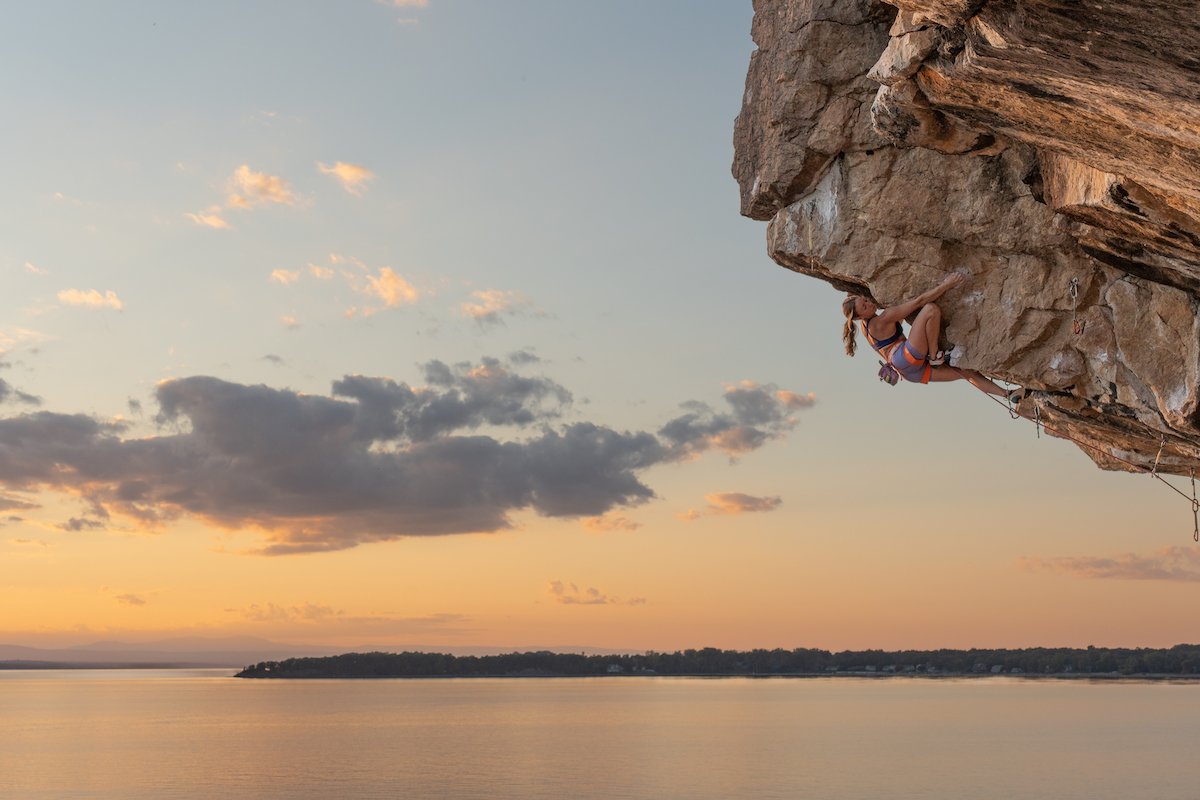
Then we get into the gallery section, with photos of [climbs] that are stunning and/or difficult across the world and country, with longer captions that offer deeper storytelling from the people who did the climbs. We’ll also have images of new areas (and newly protected old areas) that have opened (or reopened) up because of successful pushes by local climbing organizations and the Access Fund—places like The Venue at the Red, Farley Ledges in Massachusetts, and Howard Knob in North Carolina.

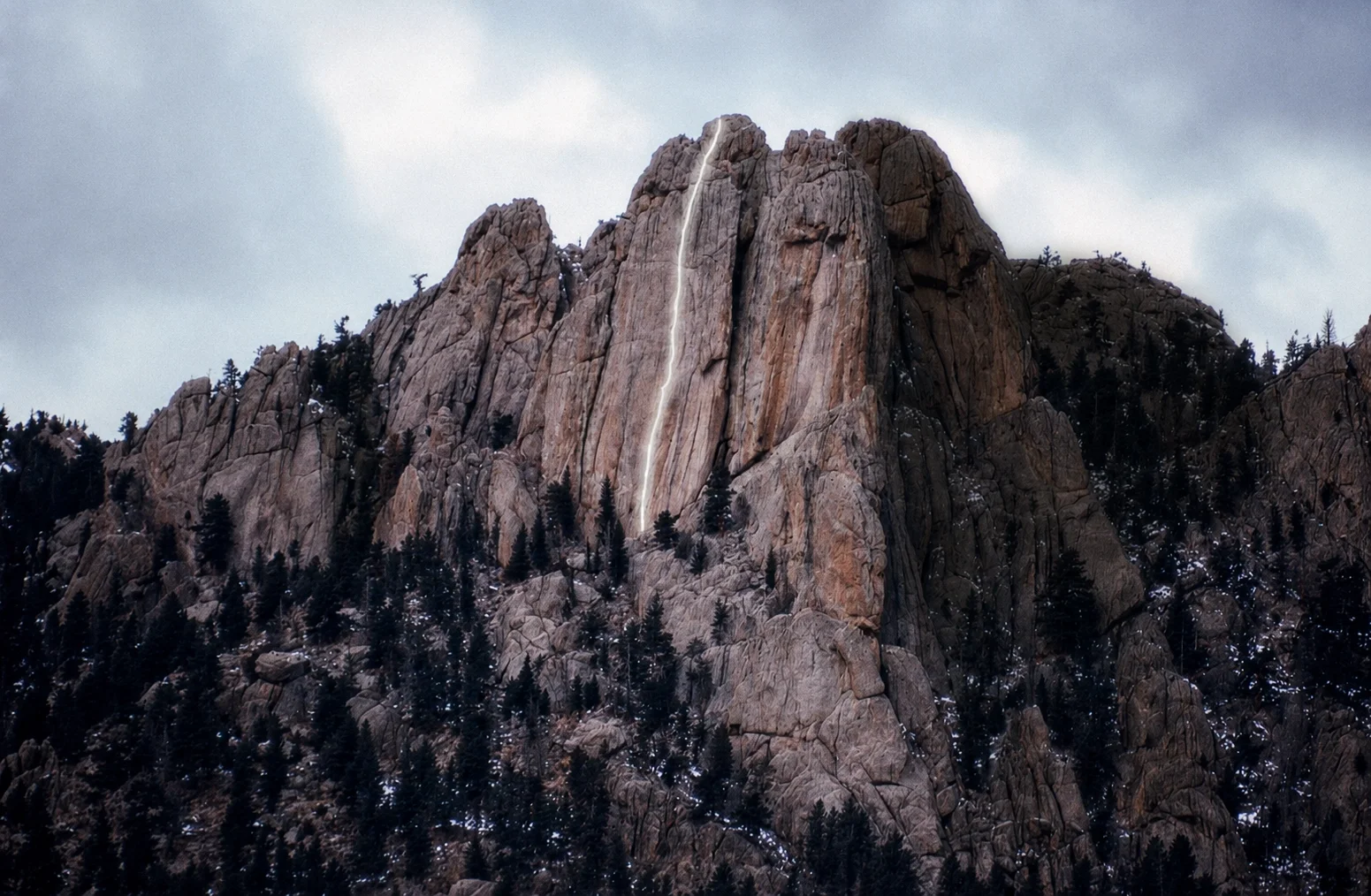
And then we have a section that’s new in the sense that you wouldn’t necessarily see it in the AAJ: Crag Profiles, which are basically what they sound like. This edition, we have the Ships Prow in Rocky Mountain National Park, and then Cheat Canyon, West Virginia, which is this crazy bouldering, soloing, highballing, off-the-radar gritstone area.

Then we have our American Rock section, which features regional reports on climbs significant to their area. And then World Rock, which is the international version. One idea with some of these American Rock and World Rock reports is that we also want to clue people into areas they might not have heard about—kind of like the Climbs & Expeditions section in the AAJ.

(Stop eating a $10 bill, you f#@ker.)

HP: One of my favorite things about working with Dougald [MacDonald, editor of the AAJ] and Pete [Takeda, editor of Accidents in North American Climbing] is that they’re both big personalities. You are also a big personality, and of course, so is your bird Gandalf...

MS: He’s a bigger personality than me—look at this. Now he wants scritches, or he’s going to bite me.
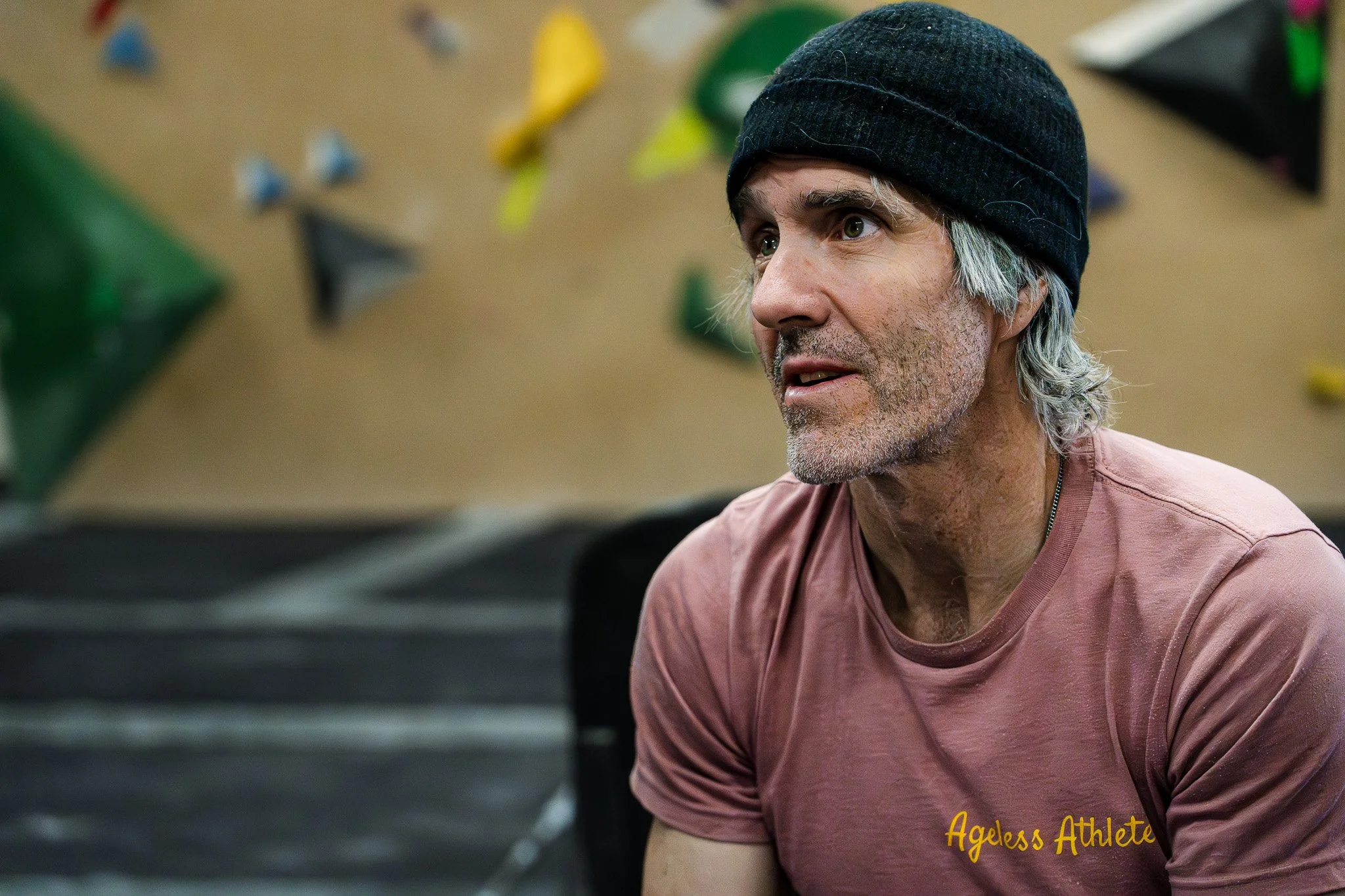
Matt Samet examining a boulder at his local gym. Photo by AAC staff Foster Denney.

HP: So what’s your background in editing, and what parts of your professional and climbing background are you bringing to the ACJ?

MS: I’ve been climbing since age 15. I’m 54 now, so we’re coming up on four decades of climbing. Primarily rock climbing, a little bit of alpine rock here and there. I’ve always been into performance rock climbing; at one point, like, in my teenage years and into my 20s, I was a sponsored climber.

In 2002, I started working at Climbing Magazine after getting my BA in journalism and then a master’s in English/creative writing. I’ve been involved nonstop in editing or writing about climbing since then. So, 24 years of editorial experience, working as a desk editor at Climbing, at Rock & Ice, at Alpinist. I have twice been the editor-in-chief at Climbing, though it wasn’t quite as, umm, glorious as it sounds, because at times I had no staff other than myself. Like 100-hour weeks—I wouldn’t care to do that again.

And I’ve been involved with the AAJ as a freelancer since 2022. I’ve edited a lot of outdoor books and memoirs, too—through Mountaineers Books, Di Angelo Publications, Patagonia, things like that.

HP: Do you ever get bored with climbing stories?

MS: I don’t. I did get bored of climbing stories when I was at the magazines, and the frequency was 10 to 12 issues a year, and my workload was insane. Now, with the longer timeline to put a journal together, I get to spend more time with the stories.

For me, the coolest part is helping climbers/ writers find their voice and their story. When someone’s done a cool climb, but they haven’t quite figured out how to translate that to the page so that other people can experience it with them, it’s a really cool thing to be that conduit or bridge.

When you get into the details of climbing, it becomes this really fascinating thing, because it’s an experiential sport. Being at your limit is a universal experience, right? No matter what the grade or the climb is, we all have to dig deep in the same way in order to succeed at our physical or mental limit. When you’re able to take a climb that’s also at the very cutting edge and translate that climber’s experience into something rooted in details, and that feels universal, it makes for really cool storytelling.

Have you seen the video of Adam Ondra doing Lexicon? It’s insane. He talks [in his article for the ACJ] about the two minutes before he got on the wall, being scared. Here’s the world’s best climber admitting he was scared. That’s such a beautiful thing, because we all get scared. It’s this profound and very real and very human moment we can translate into our own experience. As a dedicated and passionate climber myself, I can see myself and my love of the sport in all these stories.

HP: In the course of sharing your answers to the previous questions, you gave us some sneak peeks of some stories. But can you tell us in detail about a story that really surprised you?

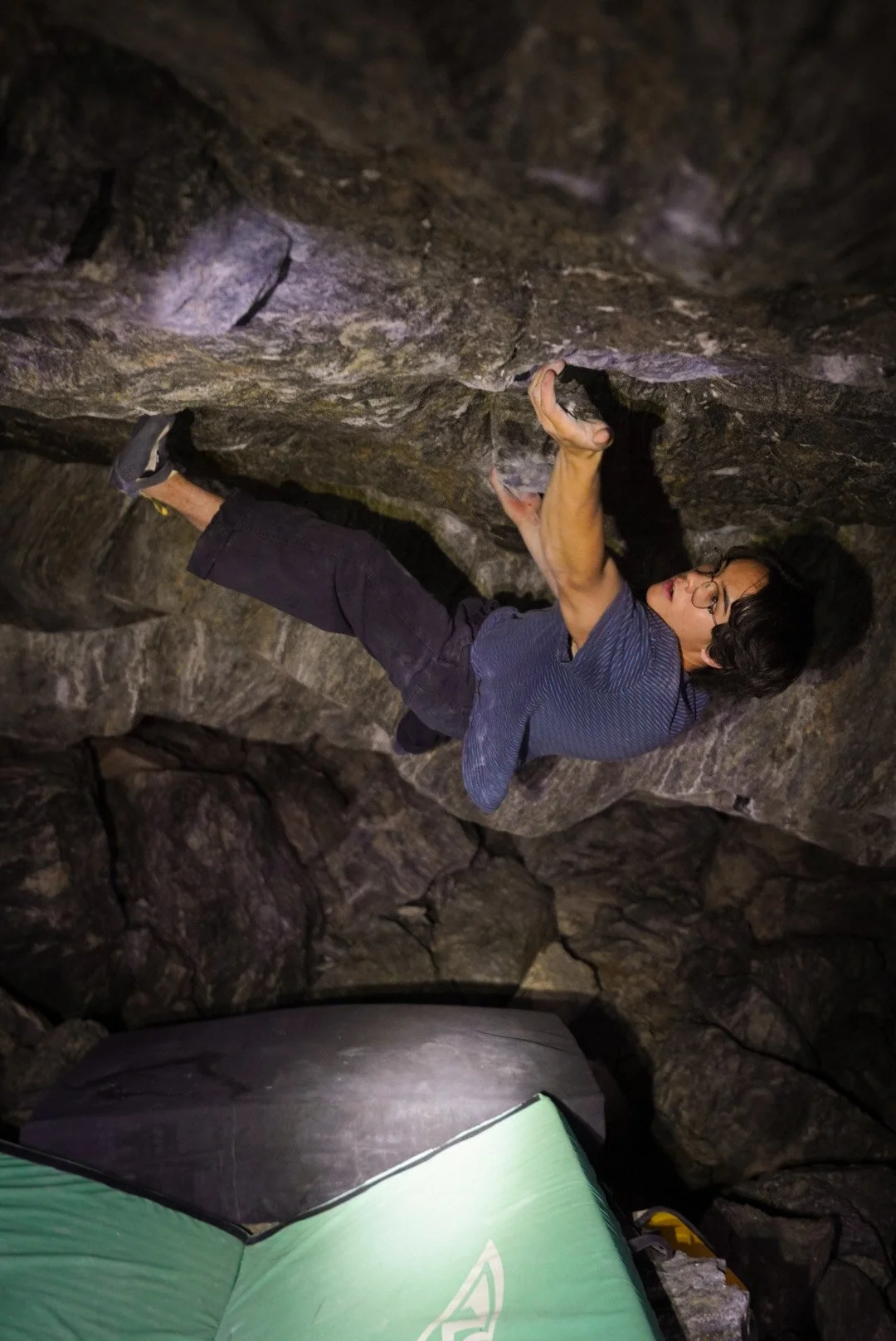
MS: There’s this Korean boulderer, Sungsu Lee, who’s extremely strong. In May 2025, he repeated Burden of Dreams, the world’s first V17, in Finland. But on the successful ascent from the ground, he pulled on, cocked, and maybe bounced off the pads, but maybe not. It’s hard to tell, because he had a baggy T-shirt on. Then he got to the top, and everyone’s like, “Yay!” And he has his celebratory beer.

But you could see something in his eyes where he’s like, Eh, I don’t know if I did it or not. So he went back and repeated it. We have an interview with him that a friend of his, Brian Kim, helped translate, getting into the mindset of why Sungsu went back to do it again. The second time, he did it with his shirt off, which I thought was funny.

To me, this all showed the sense of absurdity but also the seriousness with which we interpret climbing. I mean, someone who’s not a climber, if you tried to explain to them why this guy’s T-shirt and maybe butt bouncing off these foam landing mats below this tiny rock mattered, they’d be like, “Wait, what?”

But to a climber, to the diehards who are our Club members and readers, it’s everything.

Style is everything.

HP: You’ve been an obsessed climber for decades. Is there a climb that still haunts you?

MS: Okay, there’s one I haven’t done that I bolted that I’ve been trying now for three years. It’s up in Skunk Canyon in the Flatirons here above Boulder, Colorado, where I live. It’s 21 bolts long, and my friend Brandon and I bolted it in the fall of 2022. I did the first half of it that season. And I didn’t expect the second half to be that much harder, so I thought, I’ll come back next season and finish it off.

I’ve probably been up there 100 days since then, just trying to do the second half by itself.

Last fall, I almost did it—the second pitch. It’s essentially like V10 into a difficult clip, straight into a V9, on a 35° overhanging panel on small, awkward holds. I had my hand on the jug at the end of the hardest part. And all I needed to do was bring my feet up and bring my other hand in. And I just couldn’t—my elbows were in the sky.

I was very excited to train for it this winter, but then my right pinky finger got infected, as did the tendon. I haven’t been able to train, but I hope to be able to train in the summer and go back in the fall. I mean, at age 54, I don’t know if I can, but I know that it’s now or never. I’d like to do this route because I think it would mark the culmination of everything I’ve worked toward in four decades of climbing. And also to show that as you age, you can still push yourself.

The first half is called The Alpha. The second half is called The Omega. Together, they are The Alpha and The Omega.

HP: What’s an example of a unique challenge that you had to deal with when compiling the ACJ?

MS: The biggest challenge was coming in, and there was no ACJ, no template. We’ve had to develop it from scratch, which initially was very intimidating. We didn’t even quite know what this was—and we needed to get it done by spring 2026. But obviously, you, me, Dougald, and Shane [Johnson, the Vice President of Media at the AAC] put our heads together on it. I’m very grateful for all the help that you guys have given me. And I think the ACJ is going to keep evolving, too. I’m excited to see how people respond once the Journal is out in the world.

Sign Up for AAC Emails

The Line—Old School Adventure in the Alaska Range

Serious adventures in the Alaska Range aren’t just about high-end alpinism. In May 2025, AAC member Roo Streba and frequent ski partner Shawn Jordan pulled off a nine-day traverse of the range involving skiing, trekking, and packrafting—and likely the first ski descent of a 7,000-foot line. There wasn’t room in the upcoming 2026 American Alpine Journal for more than a brief mention of this adventure, so we’re sharing the full story here. 

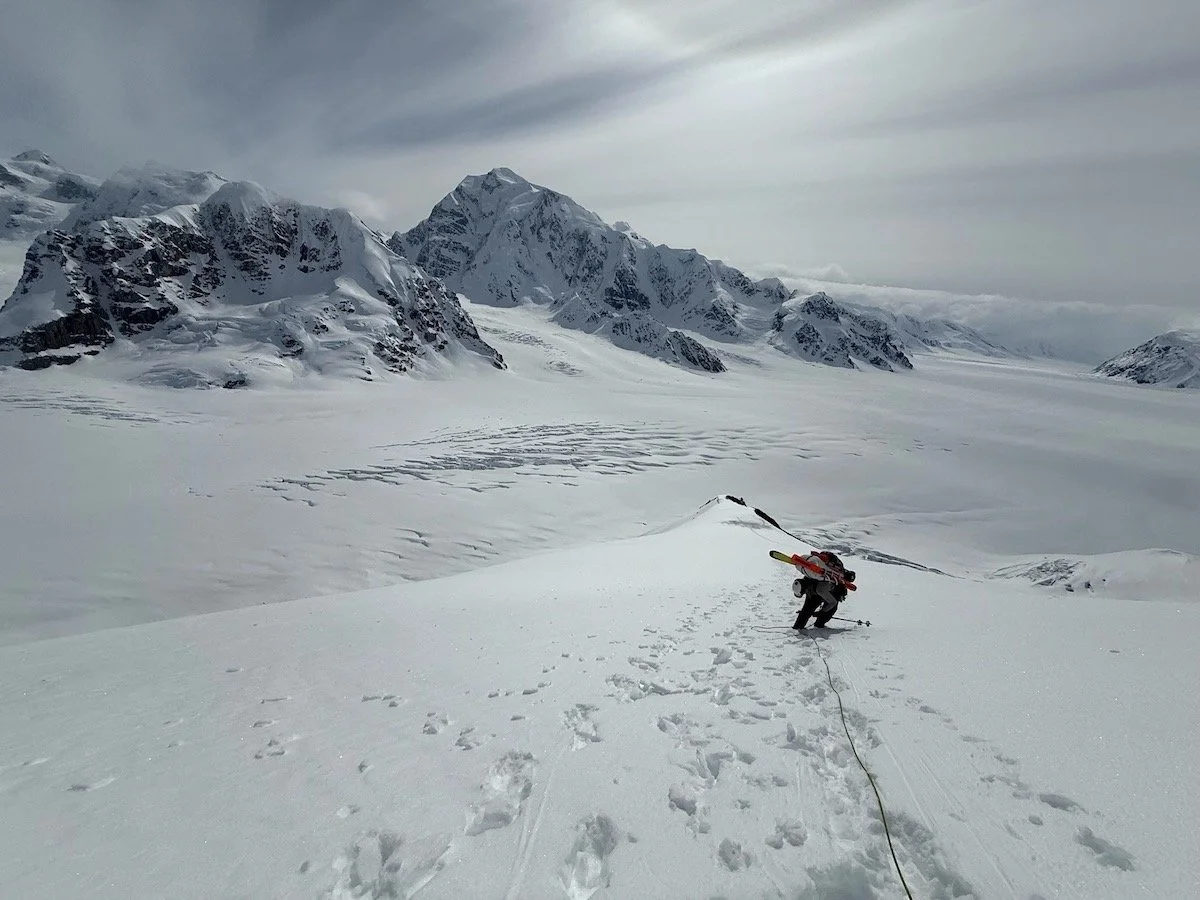
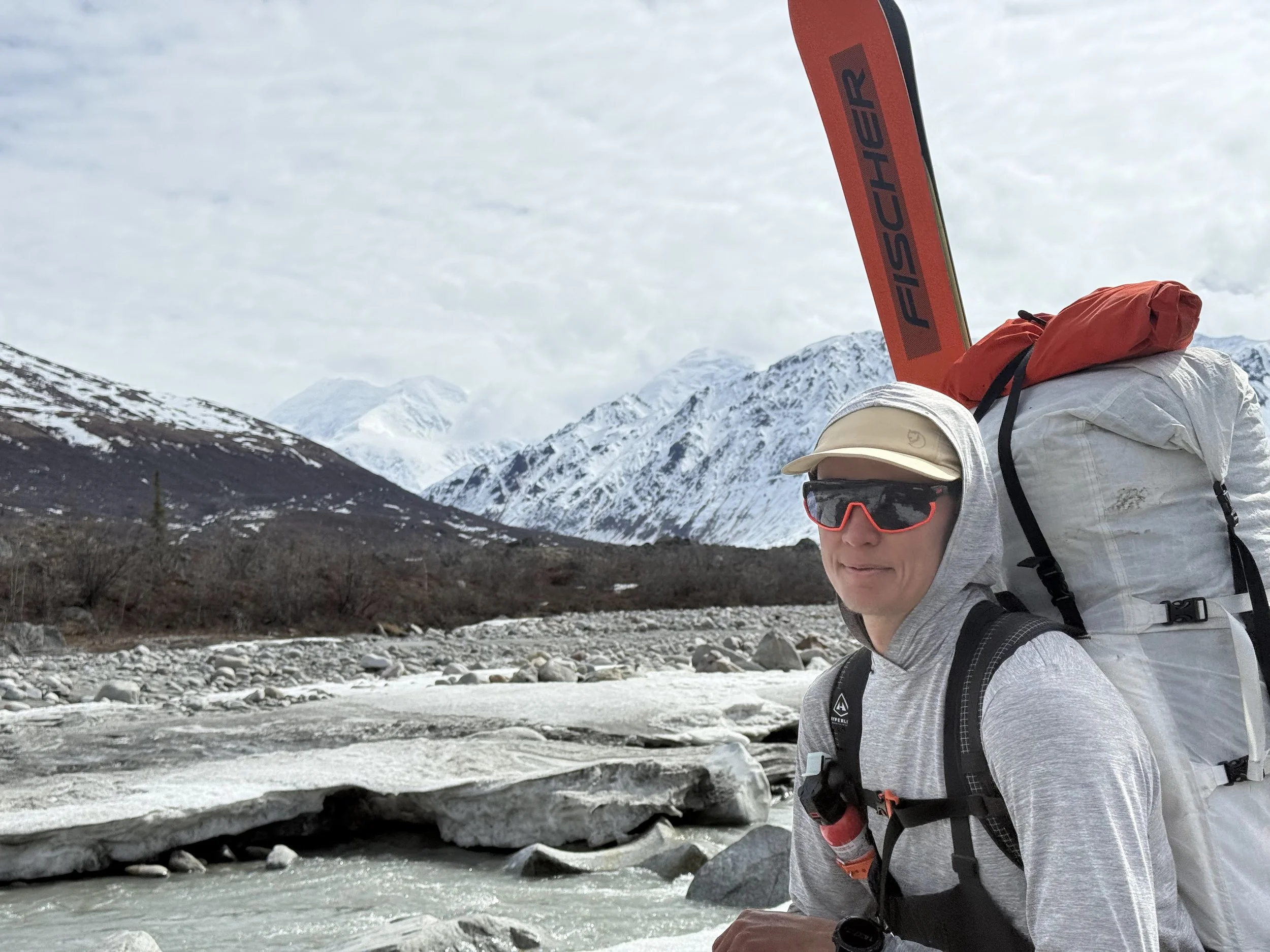
Slogging up Mt. Crosson at the start of the nine-day traverse. Begguya (Mt. Hunter) is prominent in the back, above Kahiltna Base Camp. Photo: Roo Streba Collection

Journey Through the Denali Wilderness

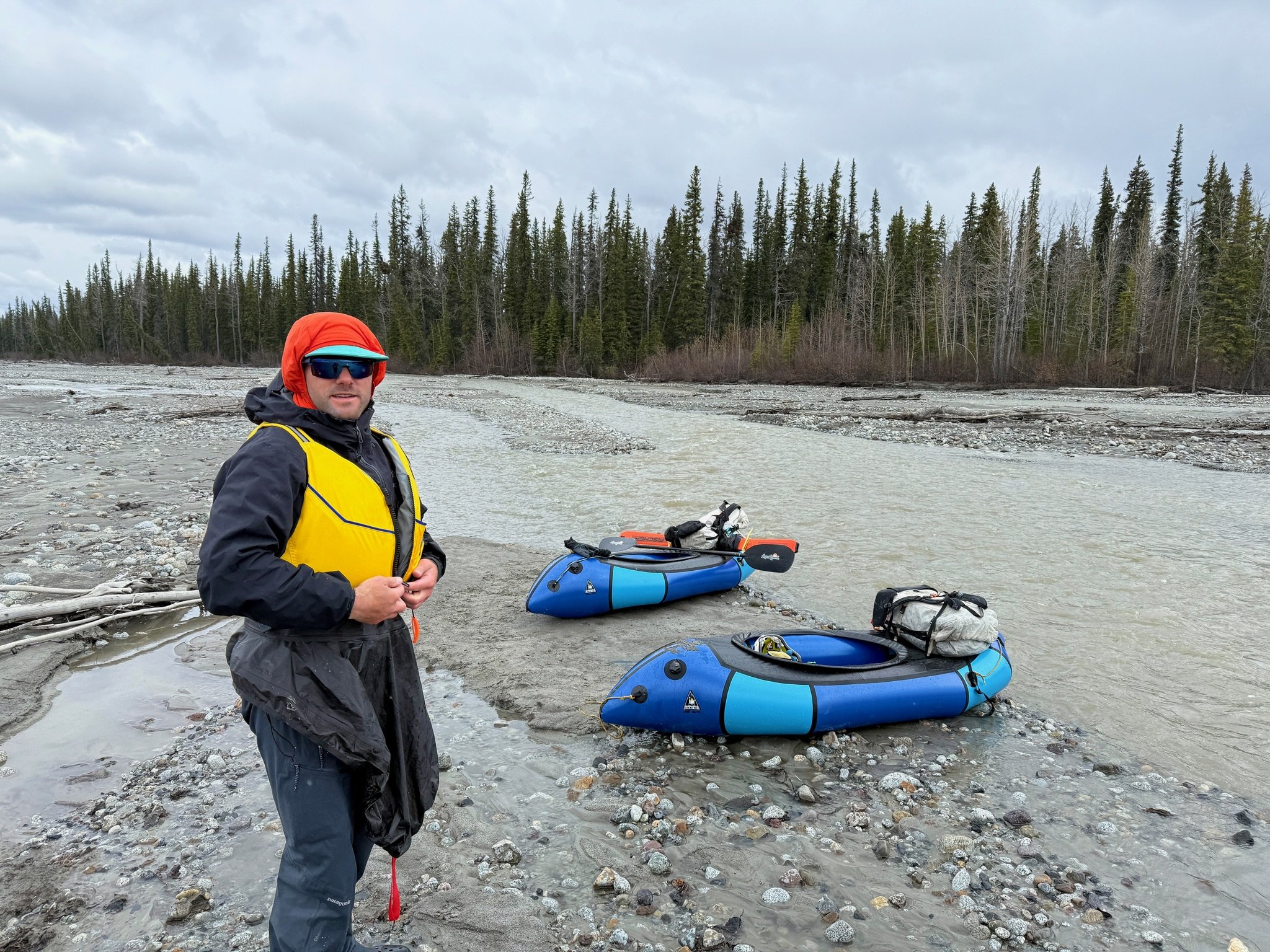
Shawn Jordan and I are Tahoe-based skiers who have adventured together throughout the Sierra. The climbing and expedition history of the Alaska Range have interested both of us for much of our lives. During a visit to the north side of the range in 2023, we conceptualized a trip that would marry aspects of old-school expedition-style mountaineering with modern, lightweight gear and skiing techniques, and that we could pull off in the limited time our lives and work allowed. We flew up to Anchorage in May 2025.

After an anxious few days of trip delays in Talkeetna, Shawn and I landed at Kahiltna Base Camp on May 13 and immediately set off across the glacier to start our ascent of the southeast ridge of Mt. Crosson, the 12,800-foot peak’s normal route. The snow conditions were reasonable, but with our heavy packs the going was a slog.

On the second night, we camped below the summit of Crosson in a cold windstorm and discussed our plan. Multiple forecasts seemed to agree—for once—and they showed a poor trend in the weather. With satellite imagery showing our chosen river of egress in the midst of a later-than-normal break-up, we concluded we would not have the time to complete Plan A: traversing to the Sultana Ridge and up Mt. Foraker, with a descent by skiing the north face and packrafting to Lake Minchumina via the Foraker River.

So, we switched to Plan B: climb over the three peaks of the Crosson group, ski down to the northwest to reach the Foraker Glacier, then ski and packraft to the bush village of Lake Minchumina. The full journey would be just under 100 miles.

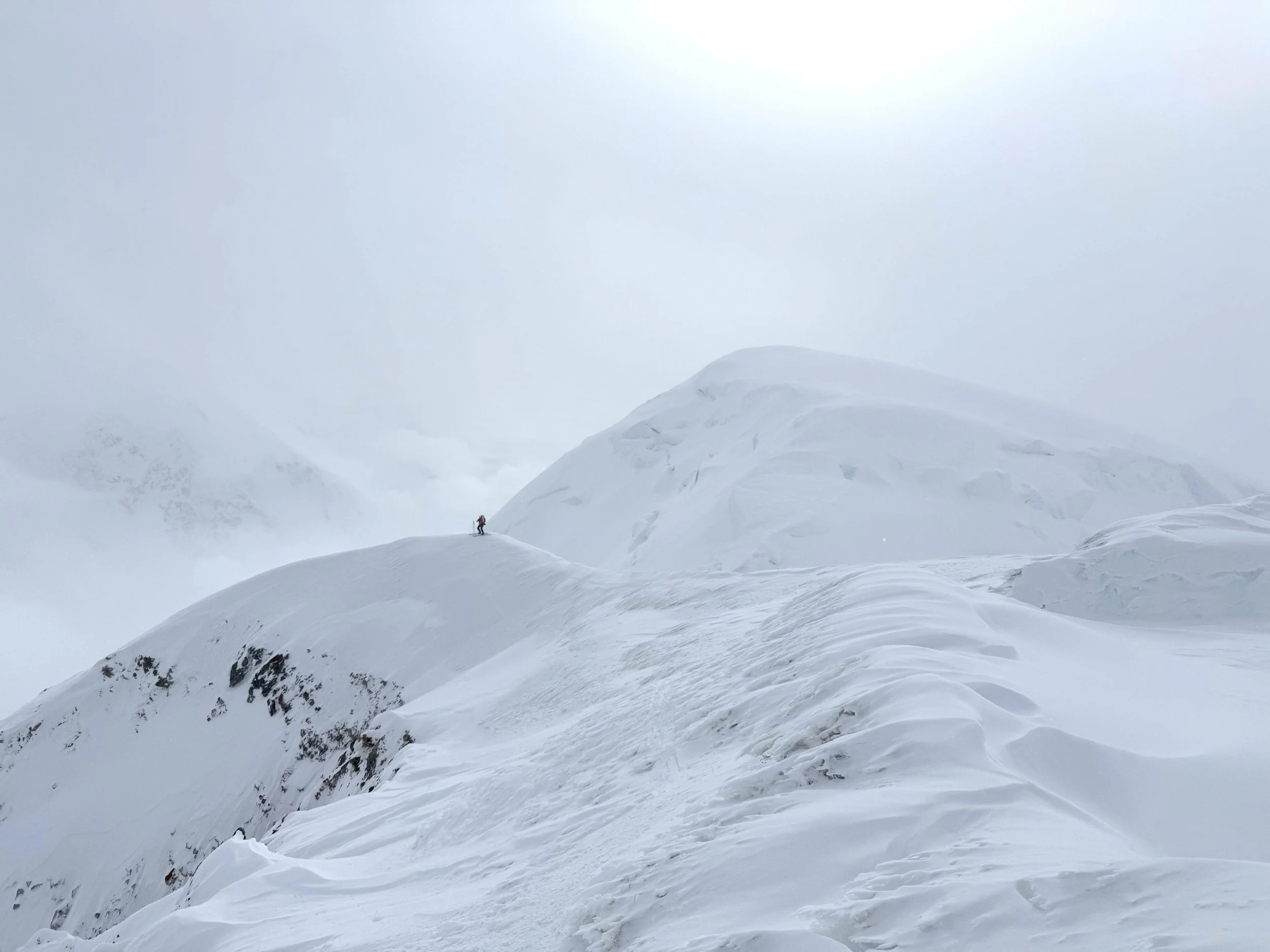
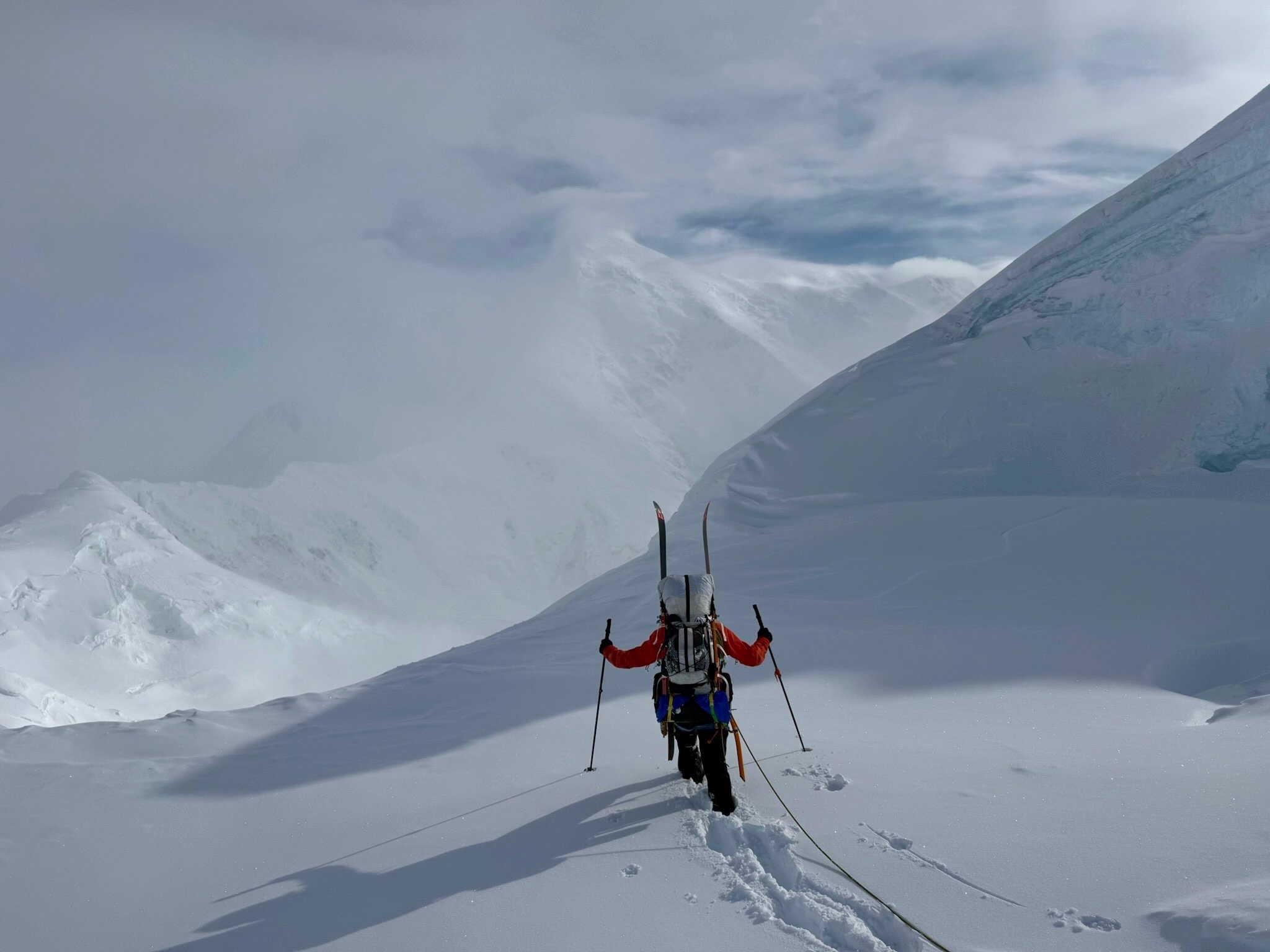
Pausing on the Crosson ridgeline after an icy section of the ski traverse. Photo: Roo Streba Collection

The next day, we woke to excellent weather, summited Crosson, and continued west over Peak 12,472’ (the peak that marks the start of Foraker’s Sultana Ridge) and Point 11,910’. Although summiting a peak is generally very exciting, three summits did not triple our excitement, and by the third we were very much ready for our final transition.

The skiing on the descent varied as much as skiing can. Windswept ice gave way to awkward turns in an upside-down snowpack. The steepness changed dramatically, and at one pinch point in the ridge we rappelled over some suspicious snow.

Despite less-than-glamorous skiing, the views couldn’t have been better: Foraker’s great north face to our left, the back side of Kahiltna Dome to our right, and the north side of the Alaska Range giving way to endless tundra before us. Clouds moved in and out, but somehow we managed to keep good visibility. In the gloaming, we navigated the final seracs on the ridge and made it to a pass between the Foraker and Straightaway glaciers, where we spent our third night. Park rangers later told us this was the first ski descent of the northwest ridge of the Crosson group.

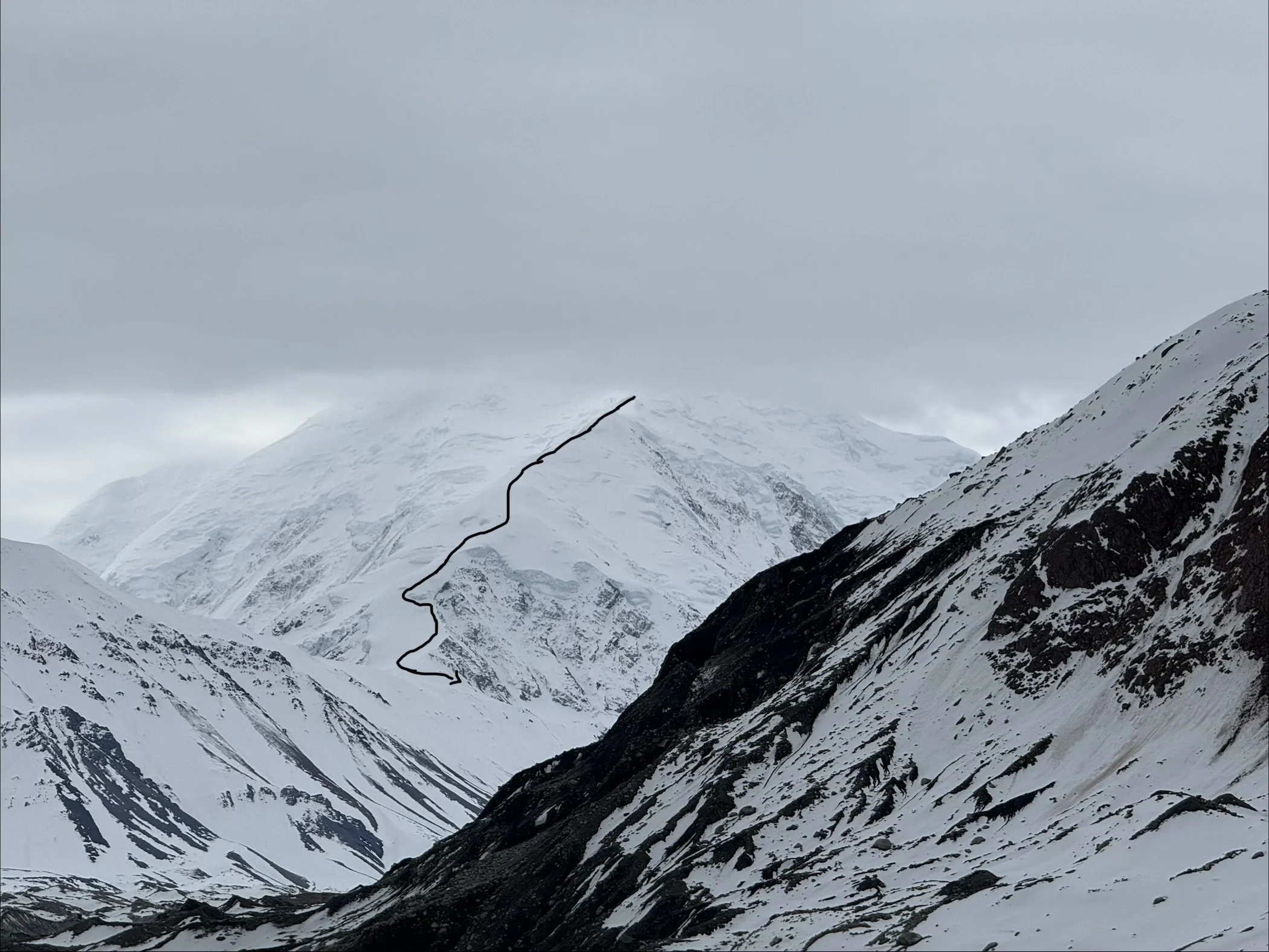
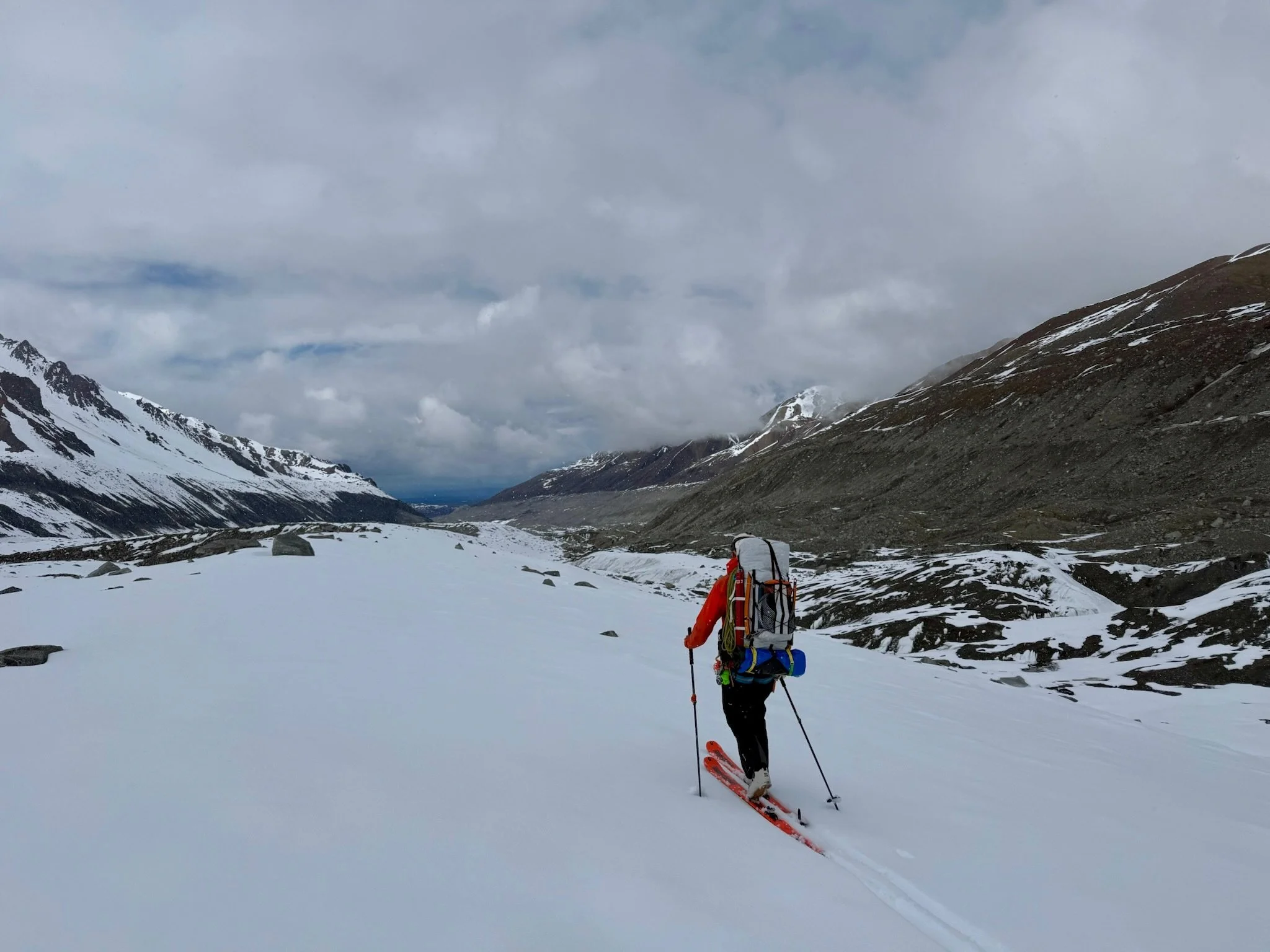
Day four was a dream: We skied the remaining 2,000 feet down to the main Foraker Glacier on a spring snowpack capped with a few inches of powder, easily the best skiing of the trip. (The full descent from Point 11,910’ had been nearly 7,000 vertical feet.) For the rest of that day, we skinned and then walked to exit the Foraker Glacier, appreciating the incredible mountains surrounding us. We passed massive skiable lines on unnamed peaks that would be legendary and coveted in the Lower 48. Signs of life—an occasional bear print, a small plant, and, finally, birds—slowly started to appear as we navigated the moraine. 

The line of the ski descent off the northwest side of the Mt. Crosson group, seen from the Foraker Glacier. Photo: Roo Streba Collection

The next few days provided endless opportunities for character building. The pleasant and efficient travel of the glacier and high tundra gave way to thicker and thicker vegetation, until we found ourselves in all-out brawls with alder thickets. The alders won many of these battles, pulling skis off our packs, testing (and breaking) our patience, and severely hampering our progress, yet we persevered, and on the third afternoon of the descent, we finally found a comfortable location to launch our packrafts.

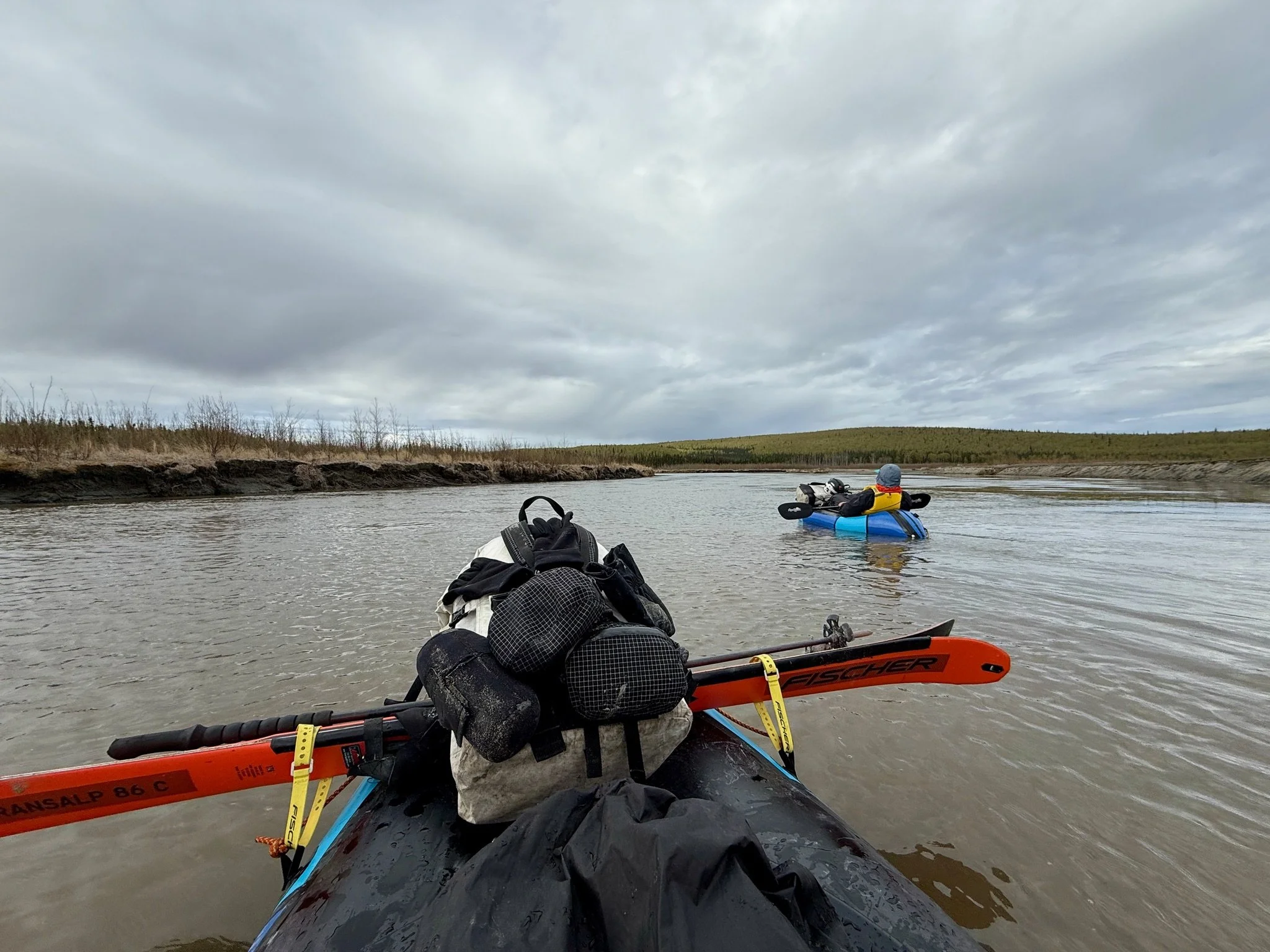
We are skiers a thousand times more than we are packrafters, and, acknowledging this weakness, we had discussed in depth our safety measures, communications, and strategy. We pushed into the fast-moving and turbid glacial river, readying ourselves for epic rafting. Ten yards down the river, my boat scraped bottom and halted. I freed myself, only to notice Shawn stuck ten yards below me. Confused, we continued down, repeatedly getting stuck and unstuck. Finally, with exasperation, we climbed out of rafts and discovered that we were able to walk across the entire river without going more than knee deep.

The following two days were wet. We found ourselves in a cycle of rafting until we hit bottom, walking our boats down the river until it was deep enough to raft again, and repeating. Despite the toil, we made good time and deeply enjoyed our surroundings. Caribou walked past our camp, birds flocked in droves, and planes rarely flew overhead.

Shawn enjoying some easy skiing off the Foraker Glacier near the end of day four of the traverse. Photo: Roo Streba

We finally reached the confluence of the Foraker River with the White River. In normal years, this confluence is of little consequence, as the White River becomes a trickle by summer. This year, due to the late thaw, the river was running at several times the flow of the Foraker, and the next several miles went by in a flash. By dinnertime, we were beyond satisfied with our progress and entirely exhausted. That night, we found enough dry sticks to make a fire and, for the first time in days, went to sleep dry.

The river flowed hard for several more miles, but as the gradient decreased, it sprawled and slowed. Prior to the trip, we had been advised that the Foraker River no longer terminates in Lake Minchumina, and only a branch still reached it. Soon we noticed the river was rising—not the water in the river, but the riverbed itself, which was now notably higher than the surrounding land. In certain sections, parts of the massive river had broken through and were spilling into the muskeg swamp. (We later learned that glacial rivers carry so much silt that, as the river’s gradient and power decrease, the silt builds up until the river eventually breaches its banks.) As we finally neared the branch allegedly heading for Lake Minchumina, the river simply terminated in mud flats. 

Shawn by the upper Foraker River, with Mt. Crosson and its neighbors in the distance. Photo: Roo Streba

We paddled to a sandbar, pulled out our backpacks, and started walking along the dried-up riverbed. In the late-twilight glow, we reminisced on the trip so far—how lucky and grateful we were to see such a wild and remote part of Alaska, to follow the high alpine into the muskeg swamps, to maintain our health and have relatively few hiccups along the way. At one point, a juvenile grizzly false-charged us, and upon realizing we weren’t giving ground, awkwardly sauntered into the brush. At another point that same evening, we both simultaneously fell into quicksand. That night, as we finally went to sleep, we could hear sled dogs howling in the distance.

In the morning, we transitioned for the last time to our packrafts and set off down an inlet of Lake Minchumina (elevation 630 feet). After nine days alone, we were giddy at the prospect of meeting other people. After a few turns, we were greeted by a beautiful house surrounded by well-maintained grass, horses, and a dog team. We had arrived at the home of the Collins twins, Julie and Miki, two women who had spent their entire lives in the bush. They made a living by trapping and had recently started writing books and articles chronicling their adventures. They gave us a tour around their homestead and treated us to a fantastic home-cooked meal.

Roo relaxing on a mellow section of the Foraker River. Photo: Shawn Jordan

The Collins twins live across the lake from the town and airstrip. When we casually mentioned our plans to hitch a ride with the postal plane the following morning, the twins both laughed. The late ice-off meant crossing the lake might be a several-day endeavor, depending on which way the winds blew the remaining lake ice. Alarmed at the prospect of missing our plane, we cut lunch short and hurried off.

We prepared ourselves for a final massive push through the night, but at some point the winds shifted and, somewhat biblically, opened a passage between the ice floes. We thanked our lucky stars and cruised across glassy water to a delicious meal of moose stew and pumpkin pie in Lake Minchumina. We met most of the 12 year-round residents and were told we were the third group to raft the river and the first to come from the mountains. We were also told that many members of the previous groups had decided to make Lake Minchumina their home, and we certainly understood why.

The following day, we hitched a ride on the postal plane from Lake Minchumina to Fairbanks, retracing part of our nine-day, 98-mile traverse. With a bird’s-eye view, we could watch the river meander back toward those incredible mountains. The north side of the Alaska Range is wild, rugged, and alluring. It requires a lot of effort to get there, and even more to get out. For those who persist, an excess of adventure and infinite splendor are guaranteed.

—Roo Streba


Get the First Edition of the American Climbing Journal

Part of the AAC's mission is to provide climbers with resources that enhance climbing knowledge and inspiration. Our world-renowned American Alpine Journal and The Line newsletter are critical pieces of delivering on that mission. For 97 years, we’ve documented the cutting edge of alpine climbing in the AAJ, and it’s been high time the AAC has done the same for bouldering and sport climbing. The ACJ also covers single-pitch trad climbing, performance big-wall ascents, profiles on new areas, and major local ascents from across the world.
If you’re an AAC Partner level or above, you’ll receive the ACJ with your normal publications preferences. Not a member?

Join the Club by July 1 to ensure you get this year’s copy!


The AAC Podcast—Introducing the American Climbing Journal, with Editor Matt Samet

Matt Samet is a climbing lifer, and as a writer and editor in the climbing industry for 25+ years, he’s left his mark on climbing media. The AAC hired him to create our newest publication, the American Climbing Journal, a journal of record for the most significant rock climbs each year.

In the latest episode of the AAC Podcast, we sit down with Matt to chat about the behind-the-scenes secrets of creating this new book, why it matters to have a “yearbook” of climbing when we have the internet, and other nerding out about hard rock climbing. Listen to the episode to learn more about the ACJ! 


Cutting Edge Podcast—Two New Episodes!

Since the last edition of The Line, two new episodes of the Cutting Edge podcast have launched, covering stories from the high peaks of the Himalaya to the boulders of Yosemite Valley. First, French super-alpinist Benjamin Védrines sat still for a minute to share the story of one of last fall’s alpine highlights: the first ascent of the north face of 7,468-meter Jannu East in Nepal. Then, in the first Cutting Edge podcast for the new American Climbing Journal, Cutting Edge host Jim Aikman interviewed Katie Lamb about becoming the first woman to boulder V16.


Buried Treasure

Symon Welfringer during acclimatization for the south face of Sani Pakkush in Pakistan. The view is over the Toltar Glacier and up the Baltar Glacier, looking into the heart of the Batura Muztagh and beyond. Photo by Pierrick Fine

11 Minute Read

A Personal Guide to the 2021 AAJ

By Dougald MacDonald, Editor

Even though COVID-19 forced an abridgment of the American Alpine Journal—about 150 pages shorter than normal—it’s still very unlikely anyone has read the 2021 edition cover to cover, except for the editor in chief. That’s me. Each year, while editing the AAJ, I see gems in these pages that many readers may miss. So, here’s my annual insider’s guide to some memorable pieces from the 2021 edition, plus bonus photos that appear exclusively online. (To see the Buried Treasure guide to the 2020 AAJ, click here.) I hope these notes inspire you to take a second look at that AAJ sitting on your bedside table or in the reading basket in your bathroom. You never know what you might find!

This online feature is made possible by Hilleberg the Tentmaker, lead sponsor of the AAJ’s Cutting Edge Podcast. 

North Howser Tower, Canada

Enticing double cracks on Voodoo Chile, a new route in the Bugaboos. Photo by Alik Berg

If you judge by Instagram likes, the most popular AAJ story of 2021 was Uisdean Hawthorn’s report about a new route up North Howser Tower in the Bugaboos. Yet I’m betting most people didn’t even notice the short report in the AAJ, mainly because this cool photo of an alluring double-cracks pitch—which attracted all the Instagram attention—appeared only online. With 11 pitches and a short 5.11+ crux, Voodoo Chile is a relatively accessible route up North Howser’s daunting west face—at least compared with the huge routes farther left. Every AAJ is packed with enticing objectives, but nothing is more enticing than a route one might actually try someday!

Photo by Bradford McArthur

Call of the Sirens, Canada

The AAJ is filled with great writing, but unless you’re interested in a particular climb or region, you might never read many stand-out pieces. Lots of readers likely missed Jacob Cook’s saga about his three-year quest to climb a multi-pitch slab testpiece in Squamish, British Columbia, originally bolted by the late Marc-André Leclerc. In my opinion, no writer has done a better job of capturing the frustrating and occasionally magical intricacies of high-end slab climbing. Plus, the story has a cool surprise ending. If you didn’t see it, turn to page 103 of this year’s AAJ or read the full story here.

Sani Pakkush, Pakistan

Symon Welfringer during acclimatization for the south face of Sani Pakkush in Pakistan. The view is over the Toltar Glacier and up the Baltar Glacier, looking into the heart of the Batura Muztagh and beyond. Photo by Pierrick Fine

It’s difficult to publish panoramic photos effectively in the AAJ, especially when there’s a climber or other key element right in the middle of the photo, as is the case with the gorgeous image above. To make the most of a panorama in our 6-by-9-inch format, you’d have to run it across a full spread in the book, and in this case the climber would have disappeared into the “gutter” between the pages.

I always encourage readers to visit the online versions of stories like Symon Welfringer’s article about the south face of Sani Pakkush, because most of our stories have extra photos at the website. Pro tip: Drag photos of interesting peaks and walls to the desktop of your computer to blow them up for close examination.

 Pik Communism, Tajikistan

Iron-hard ice on the bitterly cold north face of Pik Communism in January 2020.

While editing the AAJ, I often think of the classic essay “Games Climbers Play,” by Lito Tejada-Flores, originally published in the 1967 Ascent. In a concept that seems obvious today but was novel at the time, Lito proposed that climbing was no longer one sport but instead “a collection of differing (though) related activities, each with its own adepts, distinctive terrain, problems and satisfactions, and perhaps most important, its own rules.” The games he outlined included bouldering, crag climbing, big walls, super-alpine, and more. Since then, the “games climbers play” have continued to expand in number and complexity, often providing new ways for climbers to enjoy mountains relatively close to home. 

All of which is a roundabout way to call attention to a report from Tajikistan in AAJ 2021, describing a new route up 7,495-meter Pik Communism, climbed by a Kyrgyz and Russian team in January 2020. The story also reveals a new “game” pursued by certain climbers in the former Soviet Union: the Winter Snow Leopard. Traditionally, Snow Leopards are mountaineers who have climbed the five great high-altitude mountains of the former USSR. Until 2020, this feat had never been completed in winter, though Kazakh climber Valery Khrishchaty climbed four of the five during the late 1980s and early ’90s. With his ascent of Pik Communism in January 2020, Sergey Seliverstov completed the quintet, followed shortly thereafter by Alexey Usatykh and Mikail Danichkin during the same expedition.

Mt. Logan, Canada

A long way from anywhere during the 2019 ski around Mt. Logan. Photo by Thomas Delfino

We used the COVID-19 travel hiatus to catch up on some expeditions in the AAJ that we had missed earlier. Among these reports, my personal favorite is one that I’d been chasing for a couple of years: an extraordinary French expedition to Mt. Logan in Canada in the spring of 2019. Thomas Delfino, Grégory Douillard, Alexandre Marchesseau, and Hélias Millerioux started from the village of Yakutat, Alaska, and over the next 48 days, team members walked, skied, and rafted more than 650 kilometers in a great arc around Mt. Logan. Along the way, three of the climbers summited Canada’s highest peak and made the most complete ski (and snowboard and monoski) descent of the enormous and technical east ridge. It was a tour de force, and as often happens in the AAJ, we had nowhere near enough pages to highlight their incredible story, but at the AAJ website you’ll find a map, lots of good photos, and a wonderful film of the expedition.

Oso Scary, Wyoming

The roped-solo first free ascent of the north face of Sundance Pinnacle in the Wind River Range was impressive. But it’s the subsequent bear story (and the brilliant route name) that’s most memorable in Kevin Heinrich's short report in AAJ 2021. His topo is pretty classy, too. Find Kevin’s Oso Scary story at publications.americanalpineclub.org.

Joe Brown, 1930 – 2020

Photo by John Cleare

In AAJ 2021 we published In Memoriam tributes to three great mountaineers from the United Kingdom: Joe Brown, Hamish MacInnes, and Doug Scott. The Joe Brown tribute was written by Ed Douglas, the leading mountaineering journalist in Great Britain in recent years. As with many of Ed’s articles, it is filled with insights and personal remembrances made possible by a long career of writing about (and climbing with) legends of the sport. I encourage you to read it at page 210 of this year’s book or at our website, or check out the longer version from which our piece was adapted, originally published at the British Mountaineering Council website. Ed serves as editor of The Alpine Journal, the annual publication of the Alpine Club in the U.K., which has been published since 1863—that’s more than 65 years older than the American Alpine Journal. Each year, Ed helps out the AAJ in many ways—it’s an honor to collaborate with him. 

Gros Morne National Park, Canada

Casey Shaw and Joe Terravechhia in Gros Morne National Park, Newfoundland.

Since the 1990s, successive editors of the AAJ have been hoping to publish a comprehensive article on the gigantic ice climbs of western Newfoundland. Joe Terravecchia and Casey Shaw, the leading protagonists of ice climbing in Gros Morne National Park, weren’t exactly opposed to publishing their climbs, but they did seem to stall for quite a long time—just long enough to climb all the plums. More recently, they’ve both been too busy with work and other pursuits to invest much time in writing an article. It took a third party—Alden Pellett from Vermont, himself one of the leading activists in Newfoundland ice climbing—to herd the cats and make this story happen.

I was especially happy to cajole Casey Shaw and Bernie Mailhot into writing personal accounts of some of their Newfoundland climbs. Both are delightful stories—Casey’s a loving account of the 1999 first ascent of  Captains Courageous, the tallest ice climb in eastern North America, and Bernie’s a very funny tale about a 2004 trip that epitomized the area’s difficult and rapidly changing conditions. Both pieces focused on the Newfoundlanders the two men befriended—a rich reminder that climbing expeditions are almost always as much about the people you meet as the routes you climb. 


This year in review and the AAJ’s Cutting Edge podcast are both presented by Hilleberg the Tentmaker. 2021 was Hilleberg’s 50th year in business; it started as a forestry products company in Sweden and morphed into the tent maker we know today. Visit Hilleberg’s website to order “The Tent Handbook,” their uniquely informative catalog.

Buried Treasure

An all-time base camp in the Khane Valley of Pakistan. Photo courtesy of Konstantin Markevich

A personal guide to less-visible highlights of the 2020 AAJ 

By Dougald MacDonald, Editor

The American Alpine Journal is a 368-page book, and there’s probably only one person who reads it cover to cover: me. As editor in chief, I see and read everything multiple times, and each year a few parts of the book are particularly memorable—because of the quality of the writing or photography, because of the thrill of opening a folder of photos from little-known mountains, or because of the detective work that may go into a single sentence. But even if you did read every page, you wouldn’t see it all, because we can’t fit everything into the book—some of the coolest elements of the AAJ reside exclusively online.

Here, I offer an insider’s look at eight gems buried within the pages of the 2020 edition or hosted only at the AAJ website. In this guide, I’ve purposely skipped over the featured articles in the book. So, this is not a “best of” or an editor’s choice. Consider it a treasure map.

This special feature is made possible by Hilleberg the Tentmaker, lead sponsor of the AAJ’s Cutting Edge Podcast. 

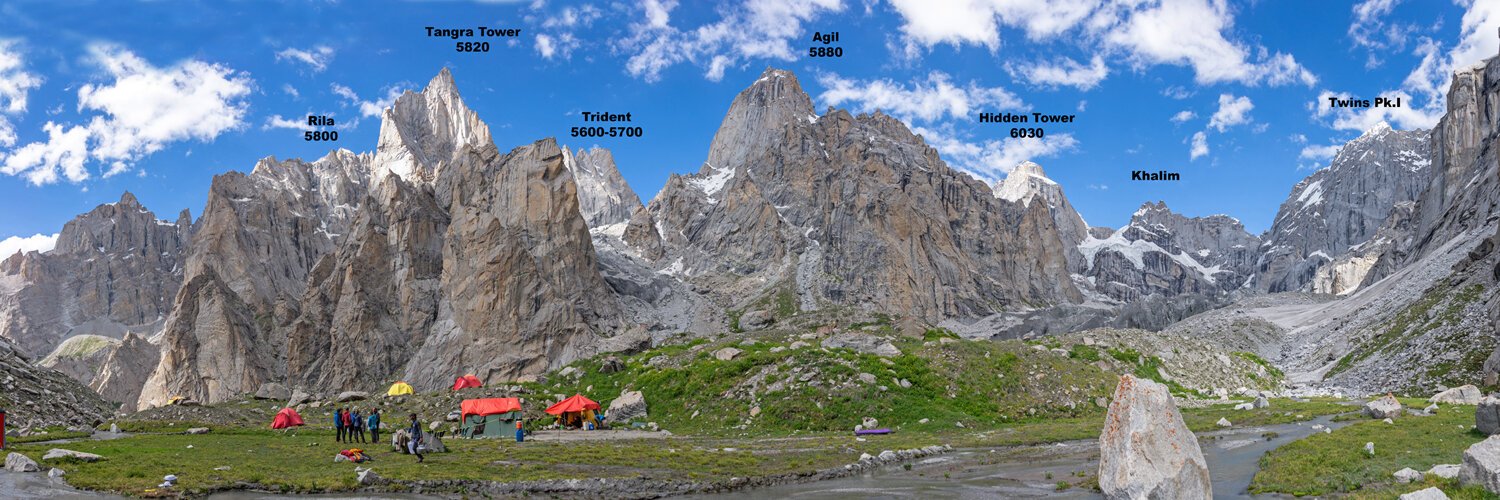
TANGRA TOWER, PAKISTAN

The Krasnoyarsk Route on the southeast face of Tangra Tower (5,820 meters). Photo by Konstantin Markevich

The AAJ’s 6-by-9-inch format does not handle panorama photos well, and the stunning photo at the very top of this page had to be cropped tightly for the book. At full width, it must be one of the most enticing photos for alpine rock climbers that we’ve ever published. The 2019 Russian expedition to the Khane Valley in the Karakoram climbed three peaks, including glorious Tangra Tower and the south summit of The Thumb (mislabeled as Trident in the photo above).

By the way, the first expedition to publish extensive photos of the Tagas Group, as this area is known, was a Bulgarian team in 2010. Their report and more photos were in AAJ 2011.

MT. BREITENBACH, IDAHO

One of the simple pleasures of my job is learning about unfamiliar mountains and ranges—even those within a few hundred miles of my home in Colorado. Marc Hanselman’s report about a new route up the north face of Mt. Breitenbach in Idaho’s Lost River Range, was one of these. I’d never even heard of Breitenbach, but for climbers who can nail the timing for good alpine conditions (this ascent was right after the summer solstice), the north face is an impressive target. Marc’s new route, climbed with Paddy McIlvoy, was possibly only the second line up this rugged face. All other known parties have climbed the original route, the Grand Chockstone Couloir, first done back in 1983. Talk about hidden gems!

Paddy McIlvoy on Cowboy Poetry (2,800’, IV 5.7 R AI2 50˚ snow) on the north face of Mt. Breitenbach (12,140’) in Idaho. Photo by Marc Hanselman

THE EIGER OF THE INYO, CALIFORNIA

Natalie Brechtel wondering what she got herself into as she completes the fifth pitch of the Northeast Buttress (1,300’, IV 5.9 R/X) of Pleasant Point. Photo by Richard Shore

AAJ colleagues know that I have an inordinate fondness for offbeat adventures (girdle traverses, kayak-and-climb extravaganzas, remote and arduous exploration, etc.). Climbing super-hard routes is impressive, but I also like to make space in the AAJ for creative climbing—even when the routes are highly unlikely to become classics. In AAJ 2020, a good example was Richard Shore’s exploration of “The Eiger of the Inyo,” the east face of Pleasant Point in the Inyo Mountains. Shore and Natalie Brechtel completed the first full route up the 1,000-foot wall of shattered limestone and dolomite. “[We] climbed what we deemed to be the ‘safest’ route on the far right side of the peak,” Shore wrote in his AAJ report. “Safe is a relative term on this cliff—torrents of climber-induced rockfall are inevitable, and the dolomite is so sharp that a fall by leader or follower seems likely to cut the rope. Steeper technical sections were interspersed with narrow alpine ridges, and most pitches took an hour or more to lead, due to navigational and protection difficulties in the choss. Soft-iron World War II Army surplus pitons proved to be most valuable—bolts were often worthless in the shattered mess, and hard steel pins would explode the rock into bits.” I can’t get enough of this stuff, and neither, apparently, can Richard Shore. He returned later the same year with Myles Moser for a harder, more direct line up the Inyo Mordwand.

JEBEL KHAZALI, JORDAN

Christian Ravier is a French guide who frequently works and climbs in Jordan (he also wrote the climbing guide to the Taghia Gorge in Morocco), and his report in AAJ 2020 brought us up to speed on some recent routes up the sandstone walls of Jebel Khazali in Wadi Rum. But it was his beautiful hand-crafted topos, complete with watercolor paintings (like this one of local guide and camp host Atayek Hamad), that really caught my eye. Christian’s unique topos weren’t suitable for our print edition, but three of these beautiful references can be seen with his report at the AAJ website. The rock looks pretty amazing, too!

LA GLORIA, MEXICO

We opened the Mexico section of AAJ 2020 with a scenic shot of La Gloria, a stunning mountaintop pyramid of limestone in the mountains west of El Salto in Nuevo León. As beautiful as Zach Clanton’s photo was, however, it didn’t convey the full allure of the climb: a 13-pitch 5.12 up the pillar splitting the south face. It’s an interesting lesson in the power of a route line drawn onto a photo—in this case, a photo that’s only available online. However you look at it, this is a fantastic piece of rock, which seems destined for popularity. Zach’s report at the AAJ website tells the full story of Rezando, the route he developed with Dave Henkel: “To me, the southern pillar of this peak was the Mexican Beckey-Chouinard, a line of perfect blue-orange limestone just begging to be the range’s first alpine sport climb.”

The south pillar of La Gloria (9,688 feet), showing the 1,500-foot route Rezando (13 pitches, 5.12). Photo by Zach Clanton

SIULÁ GRANDE, PERU

Luis Crispin leading out on the upper shoulder of the southeast ridge of rarely climbed Siulá Grande in Peru. Photo by Nate Heald

Nate Heald, a guide based in Cusco, Peru, has been a frequent contributor in recent years, climbing numerous new routes, mostly in the country’s southern ranges. In AAJ 2020, he reported on an ascent that was personally meaningful, in part because of the presence of his frequent partner Luis Crispin, who roped up with the teenage Thomas Schilter to become the first Peruvians to climb Siulá Grande in the Cordillera Huayhuash—and by a new route: Peruana Supreme (1,000m, TD AI4). In recent years, the AAJ has reported many new routes and first ascents of peaks by “local” climbers, throughout Latin America as well as in Pakistan, India, Nepal, and other mountainous countries. Many of these climbers work as guides but increasingly pursue their own ambitions in their local mountains.

Heald wrote in the Siulá Grande report: “I met Luis in 2011 on my way back to Cusco after a climb; he lives in a village at 4,300m below Ausangate and began assisting his uncle with tourist treks when he was 12 years old. He worked with me as I established my guiding agency, and since then we have done many climbs together. From my observations, Luis did not start climbing for any other reason than curiosity and camaraderie. He loves the natural world and has vast knowledge of it, and, at first, I think he just wanted to know what it would be like up there in the snow and ice. Luis and Thomas roped up together on Siulá Grande so no one could suggest they hadn’t made a purely Peruvian ascent of the peak.”

RAGGED RANGE, NORTHWEST TERRITORIES, CANADA

Amy Pagacz on top of a small peak in the Ragged Range after climbing Twisting Couloir (350m, AD). The high peak behind Pagacz is one of several mountains labeled Mt. Sidney Dobson on maps. This one is likely unclimbed. Photo by Wojtek Pagacz

Occasionally, AAJ editors get sucked down the rabbit hole of climbing archives. In AAJ 2020, we printed a short report about an interesting expedition to the Ragged Range in northwest Canada’s Logan Mountains—very few climbers have visited these mountains, which lie south of the popular Cirque of the Unclimbables, at the headwaters of the Fool’s River. The 2019 team climbed a few summits but couldn’t find a good approach to one of their biggest targets, which is labeled “Mt. Sidney Dobson” on many maps of the area. During the editing process, we realized that this Sidney Dobson had in fact been climbed way back in 1952 by an extraordinary expedition of Yale University students. The Yalies spent two and a half months in the area, built a log raft to cross a lake and access the mountains, and subsisted in part on game they shot and smoked, en route to summiting nine peaks, mostly first ascents. A great account of their trip is in the 1953 Canadian Alpine Journal.

Digging deeper, we realized that at least four different peaks in this cluster of mountains, all around 2,600m in elevation, have been called Sidney Dobson by various maps and publications. I spent hours attempting to determine which of the “Sidney Dobson” peaks might be the highest and whether it had been climbed, but the surveys are inadequate and the 2019 team couldn’t tell which was highest from their vantage points. Amy Pagacz’s expedition report and my attempt to unravel the Sidney Dobson mystery are both at the AAJ website. Unfortunately, the 2019 team found mostly poor rock on these impressive mountains and walls. But the first ascent of at least one Mt. Sidney Dobson may still be waiting.

MT. RORAIMA, GUYANA

Edward James lowers out on the Great Northern Prow of Mt. Roraima, watched by Troy Henry. The two men are from a nearby Akawaio community and had never worn a harness before the expedition. Photo by Matt “Pikey” Pycroft

Leo Houlding is a polished storyteller as well as a great climber, and his three-page story in AAJ 2020 about a new route on the northern prow of Mt. Roraima in Guyana is an excellent read. One of the highlights of this expedition was the role of Troy Edwards and Edward James, who live in the Akawaio village of Phillipai, the nearest settlement to the mountain. After guiding the British team to Roraima, the two accepted the Brits’ invitation to carry on up the wall, despite the fact that neither had ever climbed, jumared, or even worn a harness. In the end, they became the first people of Guyana to summit their country’s most famous mountain.

Sadly, we had to cut a full page and a photo from Leo’s story at the last minute, and three pages in the book didn’t come close to being enough for this tale. In fact, no article is as good as hearing Leo tell a story in person, so I highly recommend Chris Kalman’s interview with Leo for episode 27 of the AAJ’s Cutting Edge podcast. It’s great stuff.


The Cutting Edge and this AAJ year in review are both presented by Hilleberg the Tentmaker. Visit their website to learn more about their famous tents and order “The Tent Handbook,” Hilleberg’s uniquely informative catalog.

K2 1953: The Third American Karakoram Expedition

by Eric Rueth

Camp V (22,000 ft.) with Mashrabrum [sic] in the background. Photo, Third American Karakoram Expedition.

For the third and final installment of our pre-2018 Annual Benefit Dinner Americans on K2 wrap-up, we’ll take a look at the Third American Karakoram Expedition in 1953. It doesn’t seem possible to start this blog post better than the way Robert Bates started his article about the expedition in the 1954 American Alpine Club Journal,

 “On 2 August 1953 all eight members of the climbing party of the Third American Karakoram Expedition, in excellent physical condition, were camped at 25,500 feet on K2 with ten days’ food. The summit of the second highest mountain in the world (28,250 ft.) rose less than 3000 feet above us. It was our hope to establish two men at Camp IX, at 27,000 feet or slightly higher, on August 3rd; and on the following day, if all went well, to thrust at the summit.”

The men high up on K2 were Dr. Charles Houston, Robert Bates, George Bell, Robert Craig, Arthur Gilkey, Dee Molenaar, Peter Schoening and Capt. H. R. A. Streather.  After the 1938 First American Karakoram Expedition, Houston and Bates had been dreaming of returning to K2. Delayed by World War II and political conflicts between India and Pakistan they were finally able to return to K2 15 years later for a second attempt at the summit.

The optimism of reaching the summit by those eight men on August 2nd was met with a multi-day storm. At Camp VIII (25,500 ft.), the party was battered by heavy winds. One tent was completely ripped apart, forcing its occupants to seek refuge and residence in nearby tents. Even worse, the wind made keeping stoves alight impossible. Without being able to keep the stoves consistently lit, the party could not melt enough snow to stay hydrated.

After five days of being tent bound and becoming increasingly dehydrated, the storm began to lull. Now that it was possible to hear each other over the wind discussion of pushing higher up the mountain arose. But again optimism was met with disaster. When Gilkey emerged from his tent on April 7th, he immediately passed out.

Gilkey passed out from the pain that a charley horse had caused him. That charley horse turned out to be thrombophlebitis. Gilkey had blood clots in his leg. Getting Gilkey off of the mountain was now the main objective but hope still remained for an attempt on the summit. The party immediately broke camp to begin the descent, only to be turned back by the likelihood of an avalanche along the route. The storm raged on and the party bunkered down. On August 11th, the party’s hand was forced, Gilkey now had a clot in his other leg and more seriously in his lungs.

Capt. Streather at Camp III. Photo, Third American Karakoram Expedition

With the storm still raging, there was no other option than to descend. Any thoughts of a summit attempt were abandoned. Getting Gilkey down was now the only objective. Gilkey, who was unable to walk, was wrapped in his sleeping bag and the remnants of the destroyed tent; he would have to be lowered down the mountain.

The going was slow and required every ounce of strength and focus from the party. The route used to climb up the mountain did not work for descending now that Gilkey had to be lowered. Schoening and Molenaar led the descent by finding a suitable route. The rest of the party would belay Gilkey and each other.

On the steepest pitch of lowering, the storm obscured the line of sight and made vocal communication with others below futile. First Schoening and Molenaar disappeared into the storm. Then Craig escorted Gilkey while he was being lowered until he too disappeared. Streather descended to a point where he could see Craig’s arm signals and relay commands to the rest of the party belaying. Already physically exhausted by the task of lowering Gilkey and being battered by the storm, those belaying were in for a test. Streather turned to the group and shouted, “Hold tight! They’re being carried down in an avalanche!” The group, the ropes, and the anchors held fast. Craig, who was not tied into any ropes, grabbed the ropes lowering Gilkey and held on for the duration.

Following the avalanche, the party was absolutely exhausted. The party was close to the small ledge that served as Camp VII. Craig traversed to the Camp VII to gather himself after surviving the avalanche and to attempt to enlarge the ledge so the entire party could recuperate from the physically and mentally demanding day.

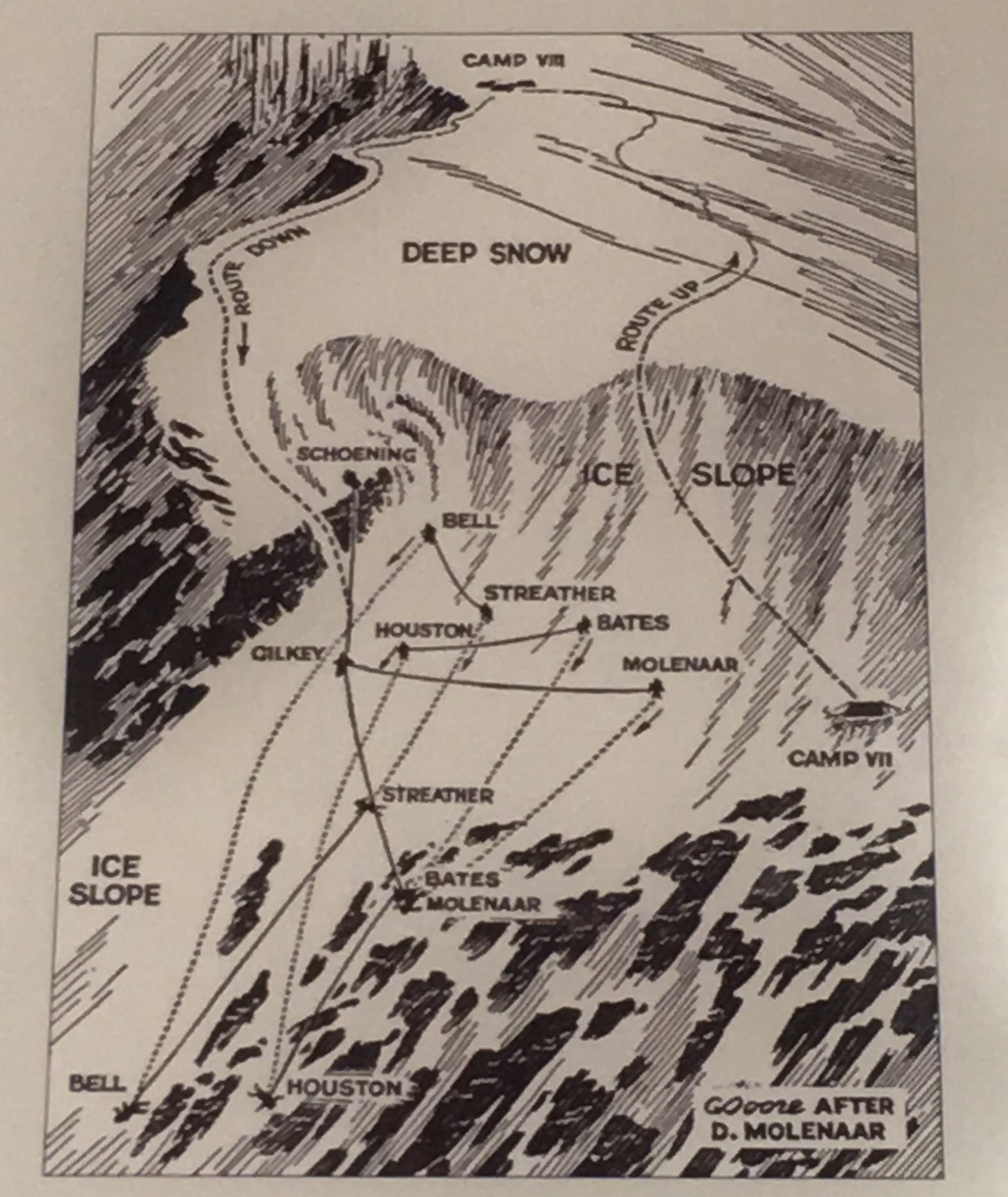
With Craig at Camp VII, the rest of party continued the extremely slow process of working their way towards the ledge. Bell was working his way over a difficult stretch of an ice gully when another catastrophic event occurred, Bell lost his purchase and started falling down the mountain. The hard ice prevented a self-arrest by Bell and Streather, who was tied into the other end of Bell's rope. The location of the pair when they fell set off a chain reaction that would send the entire expedition, except for Craig alone at Camp VII, down the mountain to the Godwin-Austin Glacier two miles below.

Only the entire expedition didn’t disappear over the edge of the mountain and fall two miles through the void. As members one by one were caught up in ropes and pulled from their feet, they tumbled and somersaulted downwards picking up momentum along the way until all of a sudden the rope grew taught. Schoening arrested the fall of his six companions in a moment that will forever be known as, “the belay.”

The entanglement that caused the catastrophic fall down the mountain also worked to save the expedition. Various injuries and lost gear resulted but the expedition suffered no loss of members.

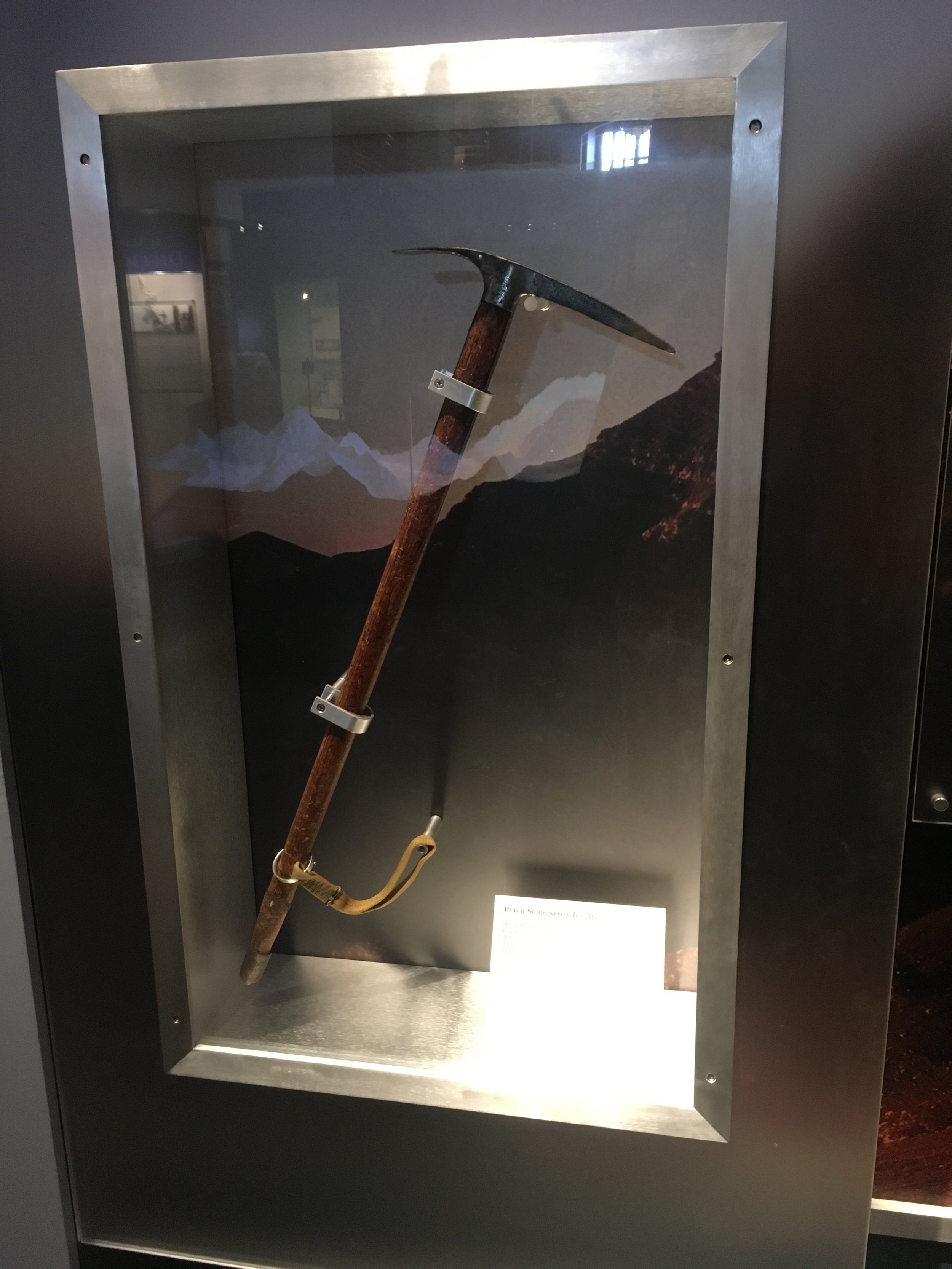
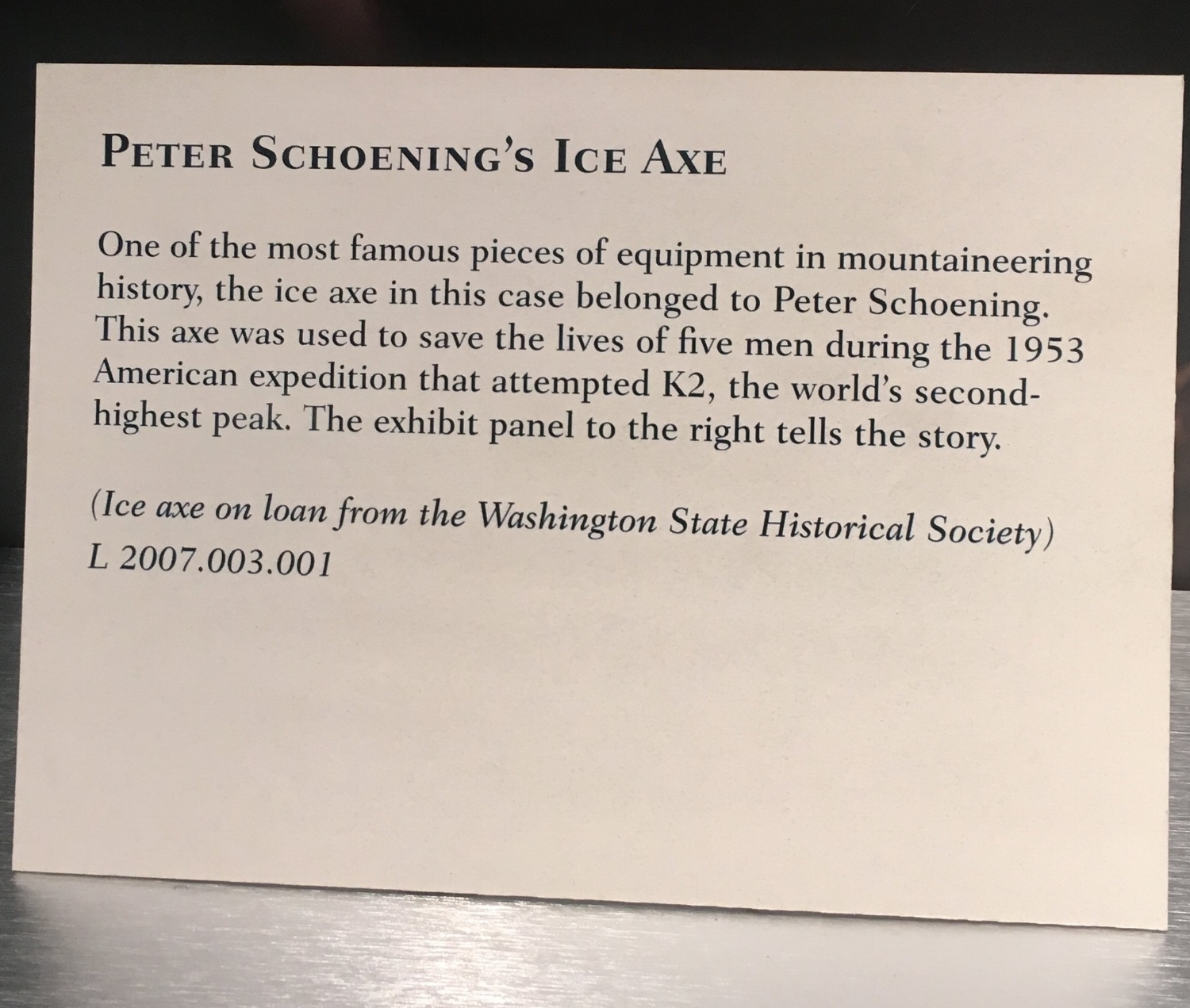
This diagram by Clarence Doore follows an illustration by Dee Molenaar. It is one display at the American Mountaineering Museum.

Eventually making it to Camp VII the ledge still needed to be bigger before tents could be set up and the party could put the horrific day behind them. Gilkey was secured with two ice axes beneath a rock rib while the space was expanded. When camp construction was completed Streather, Craig and Bates went to retrieve him. Only, upon their arrival at the rock rib they found a bare slope. Gilkey and his anchors were gone, swept away by an avalanche.

The night that followed the horrific day would offer little rest. The party had been pushed to the limit physically, mentally, and emotionally and were now cramped together in two tents on a precarious ledge. The storm still raged on and Houston, who had suffered a concussion, would wake up in a state of confusion consequently waking up everyone else.

The next day the storm continued and so did the party. It took four days for the battered party to descend from Camp VII to Camp II. At Camp II, the party was met by porters who provided food and comfort after their heroic and tragic descent.

As they departed the mountain, the expedition built a large cairn memorial for Gilkey near the confluence of the Savoia and Godwin-Austen Glaciers. The memorial still stands to this day and has grown to be more than a memorial only to Art Gilkey; the Gilkey Memorial is now used to remember all who have perished on the Savage Mountain.

With the conclusion of the 1953, there had been three attempts made by Americans on K2. The first had been successful as a reconnaissance but failed to reach the summit. The following two ended without the summit being reached and tragic loss of life. Americans had paid a high price for their efforts on the mountain and it wouldn’t be until 1978 that the mountain would finally yield to Americans.

Read about the Second American Karakoram Expedition here.

Read about the First American Karakoram Expedition here.

*These blog posts were an attempt to sum up the American attempts on K2 prior to the successful expedition in 1978. Unfortunately they leave out a lot of the nitty gritty details and personalities of those involved. If your interests have been piqued you can read the full expedition reports in the American Alpine Club Journal at publications.americanalpineclub.org or if you're an AAC member you can checkout some of the many books about K2 in the AAC Library at booksearch.americanalpineclub.org.

By Eric Rueth

AAC Launches Cutting Edge Podcast

CE_Square.jpg

We're excited to announce the launch of The Cutting Edge: Voices from the American Alpine Journal. The new monthly podcast features in-depth, tightly focused interviews with climbers who've just returned from ground-breaking ascents all over the world. 

The first episode features Will Stanhope, interviewed by AAJ Associate Editor Chris Kalman, giving us the lowdown on an incredible linkup in the Bugaboos with Leo Houlding. 

The Cutting Edge is available now at iTunes, Soundcloud, Google Play, Stitcher, and other sites. Special thanks to Wyoming climber and musician Jason Tyler Burton for the original sound effects and tunes he created for this show.

Enjoy and if you like what you hear, please share!