AAC Podcast

All About Bolts: From Federal Policy, to a Day of Local Rebolting with Ryan Kuehn

This episode is all about bolts. From the nitty gritty of yanking a bad bolt out of the rock at your local sport crag, to the big-picture policies that govern the practice of bolting, rebolting and other fixed anchors on America’s federal public lands.

For the main part of this episode, we talk about the under-appreciated art of bolt replacement with Ryan Kuehn, one of the leads for the Anchor Replacement Program at the Boulder Climbing Community (BCC), an integral local climbing org for the Front Range of Colorado.

We also start the episode with insights from the AAC’s Director of Government Affairs, Byron Harvison, who shares an update on the proposed implementation guidance of the EXPLORE ACT and PARC Act—the historic laws that preserved fixed anchors as appropriate in Wilderness Areas. Bryon explains how the proposed implementation policy, just released and open to public comment, will impact how climbers and LCO’s will place and maintain bolts and other fixed anchors on federal public lands moving forward.

Dive in to get the full picture: from federal policy to a day of local rebolting.

[Correction: We would like to offer clarification on the statement at 15:29 which states that a MRA will be utilized by the BLM for routes which fail the casual use standard.  To be clear, the MRA is to be used when the BLM proposes to prohibit climbing in an area.  The proposed guidance states that a yet-to-be-determined process will be utilized to evaluate those routes that exceed the draft casual use standard.]
Sasha DiGiulian: Slinging Cacti, 8b Big Walls, and Recognizing Your Spot in Climbing History

Sasha DiGiulian has done major ascents on big walls from Madagascar to Brazil to El Cap. She has told the story of these ascents in the American Alpine Journal—and now in the all new American Climbing Journal. With this unique perspective as a contributor to these journals of record, we asked her to weigh in on her history with the AAJ and ACJ, and why documenting climbing’s evolution matters.


We touch on her recent ascent of Platinum Wall, a long 5.13d/8b El Cap climb, (full story on the Cutting Edge Podcast), dive into the overgrown, run-out, cactus-filled pitches of Bravo Les Filles (8b) in Madagascar, discuss what "significant" means in climbing these days, and the art of recognizing your place in climbing history.


Inspired by Sasha’s bold, run-out questing on Bravo Les Filles?


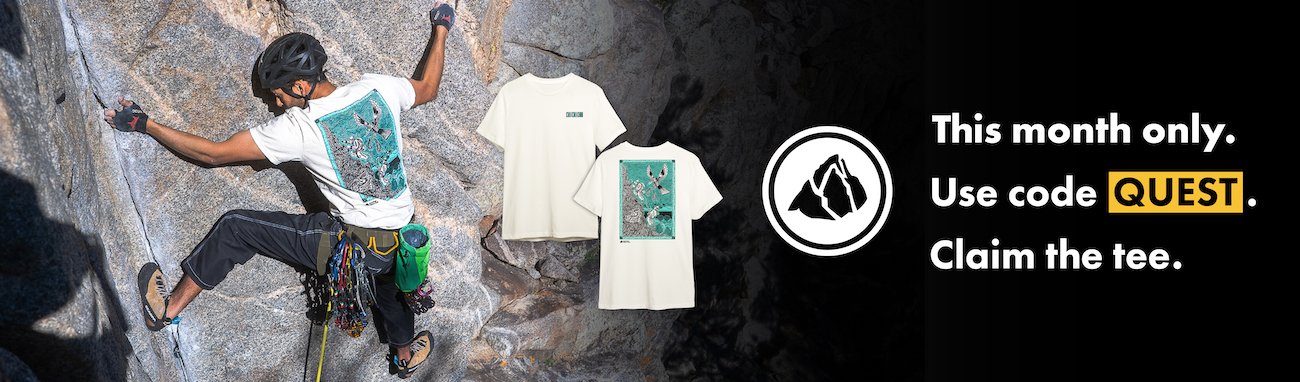
Join the Club or renew at any membership level in June, or donate $30 or more, and you can get our limited edition June tee—just use promo code QUEST. One day left!


Belaytionship Therapy: Tools for Better Climbing Relationships

What can you do if you and your romantic partner constantly bicker at the crag? How do you speak up if your climbing partner has a totally different risk tolerance than you, and you keep getting in way over your head on climbs because of that mismatch? What if one of your climbing partners dropped you, and you can’t quite trust them again? How do you move forward if you’ve witnessed an accident, and nobody seems to be understanding how the trauma continues to live in your mind and body?

We sit down with Dr. Jennifer Dragonette, a Licensed Psychologist, trauma specialist,  and Certified Single Pitch Instructor who is a clinical provider for the AAC’s Climbing Grief Fund Directory, to explore these questions through case studies of belaytionships you might find familiar. 

Dr. Dragonette leverages her expertise in couples therapy and DBT to illustrate where communication and therapeutic tools can help build stronger climbing partnerships and solve friction. If you’ve ever found yourself in need of a little belaytionship therapy, this episode is the place to start! 


Climber Behavior and Attitudes: A Look at the Data

What percent of climbers THINK they always observe safety practices….vs. actually do? What are the unique risks for indoor climbers? Are climbers even interested in training, and is the training equipment climbers use reflective of what the climbing media loves to yap about? Has who climbers are—the demographic make-up of climbing—changed much in the last 7 years? Do indoor climbers even want to climb outside? What are the most popular disciplines of the sport, indoors and outdoors?


Some answers will surprise you…


AAC partnered with the Climbing Wall Association to help get their 2026 survey out to as many climbers as possible to collect data about climbers who use climbing gyms—their behaviors and interests. In this episode, we sat down with Garnet Moore, Executive Director of the Climbing Wall Association, and chatted about the survey, the report that came out of it, and some of the biggest takeaways from the data. Each nugget we discuss poses the question: what assumptions do we all make about the climbing community, that we should reconsider?


Undercover Crushers: Brother-Sister Duo Vasya and Nadya Vorotnikov

In this episode of Undercover Crushers, we talk to AAC members Vasya Vorotnikov and Nadya Vorotnikova about how exactly they crush so hard. While Vas isn’t totally undercover, he isn’t as well-known as he deserves. He’s a quiet phenom, having sent Jaws II in 2007 after the original climb Jaws, going at 14b, broke. The new version, Jaws II, was the second 5.15a in the United States. Nadya is likewise crushing, sending 5.14a a couple times in the last few years, and diving into route development in the South Platte of Colorado—one new climb that she contributed to, with her friend, Tal Wanish, is even featured in this year’s ACJ! In this discussion, the siblings describe learning to climb in Russia when they were little, immigrating to the United States and starting to compete in junior level competitions in the early 2000s, and what has shaped them into the climbers they are now.


We dive into sandbagging, breaththroughs, climbing as coping, coaching yourself, and being the kind of climbing partner that won’t bail—even when you end up climbing in a snow storm. Nadya shares about turning to trad climbing to push her mental limits, after being burnt out from competitions, and what motivates her to give back to the climbing community. Plus, Vasya describes his volume goal from last year, when he set the goal to climb 365 NEW routes 5.12s and harder, 100 new 5.13s and harder, and 10 new 5.14s and harder, all on outdoor rock. Turns out, he far surpassed his goal…


Introducing: The American Climbing Journal, with Editor Matt Samet

You’ve probably heard of Matt Samet—he’s a climbing lifer, and as a writer and editor in the climbing industry for 25+ years, he’s left his mark on climbing media. Recently, the AAC hired him to help create the all-new American Climbing Journal, a journal of record documenting the most significant climbs in rock climbing each year—with stories written almost entirely from the first person POV of the climbers themselves. For 97 years, we’ve documented the cutting-edge of alpine climbing in the AAJ, and it’s been high-time the AAC has done the same for bouldering, sport-climbing, single-pitch trad climbing, and performance big-wall ascents. The ACJ also includes profiles on new areas and major local ascents from all across the US and the world.


In this episode, we sit down with Matt Samet to chat about some of the behind the scenes secrets of creating the book, why it matters to have a collected “yearbook” of climbing when we have the internet, the fickle nature of recording climbing history as it happens, a sneak peek into the big ascents in the book, as well as a fairly long sidebar about AI. Dive in to nerd out about hard rock climbing.


Get your hands on the ACJ!

AAC members at the Partner, Leader, or Advocate level are eligible to get a copy of the ACJ as a member benefit! Keep your eyes peeled for AAC emails, so you can ensure you’re opted-in!

Not a member? Join or renew before July 1 to ensure you get this year’s copy!

Supporter level member? Upgrade by July 1 to get your copy.


The ACJ is Powered By:

The ACJ is Supported By:

Mentorship for the Next Level, with Sam Hennessey and Anne Gilbert Chase

What does it take to level up? The right mentor.


That’s why the AAC has started our Mentorship Program, beginning with the year-long Alpine Track. To kick things off, we had the cutting-edge alpinists coaching this year’s inaugural program, Sam Hennessey and Anne Gilbert Chase, on the podcast to dive into what the Alpine Track is, who it’s for, and why experienced climbers could benefit from such in-depth mentorship and technical field programs. This rigorous program makes the secrets of elite climbing accessible to climbers ready to push themselves. In this episode, Sam and Anne Gilbert dive into stories about their own epic adventures, what drives them to be a mentor, and what they wish they knew about the alpine environment when they were less experienced, as well as the details of the program and how you can apply.

Are you ready to level up? Discover the world of AAC Mentorship when you listen in.
***
You can apply to be a part of this small cohort of mentees from now until May 15, 2026. Learn more about the program schedule, requirements, and FAQs here.


The AAC Mentorship Program is presented by Arc'teryx.


Austin Mallet's Secrets to Building Momentum

The AAC has launched a new grant, called the Momentum Grant, to fund intermediate to advanced alpine adventures, with a focus on ice, mixed, rock, and ski-alpinist objectives. The Momentum grant is in partnership with the family of Austin Mallet, in honor of Austin. Austin was a Texas native who developed a deep passion for big mountain objectives, but whose time was cut short by a tragic avalanche in 2024.

 Austin approached climbing with incredible discipline and sought to grow his skillset and develop his mountain craft at every opportunity. The Momentum Grant will preserve Austin’s spirit by supporting the projects of passionate climbers seeking to elevate their skills in big mountain environments. 

To get applicants inspired by Austin’s story, and to share about the kinds of projects the grant funds, we had some of Austin’s closest friends on the podcast, to share stories of his adventures and mountain philosophy. In this episode, we hear memories from his partner, Emily McKay, and two of his close climbing friends, Chris Labosky and Aiden Whitelaw. We explore Austin’s never-ending psych for adventure, his dialed planning methods, his generosity, his deep belief in his climbing partners, and much more. Dive in to get inspired by Austin’s legacy, and dream up your application for the Momentum Grant. Applications close April 30, 2026. 

Photos provided by Emily McKay and Chris Labosky.


Ask Me Anything, Prescription Edition: Stacked Rappels and Old Cams

In this episode, we sit down with THE dynamic duo Pete Takeda and Jason Antin. Pete and Jason recap and expand upon the climbing accidents featured in the January and February Prescription, the AAC’s monthly dose of accident analysis from our annual book, Accidents in North American Climbing. Then, they answer audience questions that stemmed from their original analysis. We explore questions like what are the pros and cons of stacked rappels—and sidebar into some misunderstandings about simulrapping. We also explore what happens when old stiff cams are put in wet and grimy cracks, and the alternative uses for old gear. If you’ve left a comment on our Prescription videos, or written into the accidents email inbox, we may just have answered your questions! Dive in to hear about these topics and more.

Pete Takeda is the editor of Accidents in North American Climbing. Jason Antin is an IFMGA/AMGA guide. Together, they are the experts behind the AAC’s most popular media—our monthly Prescription email and video. Get it straight to your inbox when you sign up for AAC emails below!


Denali Rescue, 1979: The Untold Full Story

In this episode, we have climbing legends Jamie Logan, Jack Tackle, and Ken Currens on the podcast to retell the story of an accident and rescue on Denali from 1979. Jack Tackle and Ken Currens were climbing partners with a number of big mountains and first ascents under their belt, and in 1979, it was their first trip to the Alaska Range.

They had decided to attempt the unclimbed southeast face of Denali (also known as Mount McKinely). This face would later become known as the Isis Face. In the middle of the climb, Ken, on lead, took a 250 ft fall when snow gave way beneath him. Once the rope came taught, he was hanging in mid air over a cliff, his femur badly broken. The rescue that followed is a story for the ages.

We dive into the mechanics of the accident, what Jack Tackle had to do to get help, and how Jamie Logan and Mugs Stump—two of the most impressive alpinists of the time—were critical in helping save Ken. She and Mugs are especially known for the first ascent of the Emperor Face the year before, and though Mugs has passed, Jamie was able to fill us in on their experience of the rescue.

In this episode, these climbing legends put together, in real time, the pieces of this story (that they all remember a tad bit differently)—47 years later.


A Team Sport: The Psychology of Caregiving After A Climbing Accident

Part of the Climbing Grief Fund’s (CGF) mission is to expand the conversation around grief, loss, and trauma in the climbing community, and interrogate narratives that can be unhelpful to healing. In this episode, we unpack some of the unique challenges faced by caregivers after a loved one gets into a climbing accident, and explore why it can be helpful for caregivers to get mental health support too, not just those directly impacted by an accident.

In section one, we have the CGF Therapeutic Manager, Trevor Davis, on the podcast, to talk about the scope of the Climbing Grief Fund, as well as its ongoing expansion and impact. Trevor chats with Jay Louie, a therapist in the CGF Directory and a CGF committee member, about these topics, and together they frame the conversation about why CGF resources are for caregivers too.

In section two, we dive deeper with Jay, as they share some case studies to illustrate the very human experiences of caregiving after climbing accidents. They share these case studies from their professional experience as a therapist and AMGA Guide, described anonymously, with permission from their clients.

In section three, we sat down with Andrew Kirchner, an incredible supporter of the Climbing Grief Fund and a survivor of a climbing accident himself. Andrew describes his accident, and how it made him realize that the accident didn’t just happen to him, it had a dramatic impact on his loved ones as well. Andrew also elaborates on what motivated him to make the Edwards-Ginsburg fund, and thereby support the CGF’s work so generously.


(Not So) Undercover Crusher Evan Hau: On Showing Up and Trying Hard

Evan Hau is a pro climber, but most Americans still don’t know his name. He’s the first Canadian to climb 5.15a, and swears his success comes from consistently honing his strengths (and mostly ignoring his weaknesses). In this episode, we chat about how he balances pushing his limits, with his tutoring business, and the process of climbing his first 15a, Sacrifice. We cover the magic of the Bow Valley—the epic limestone crags near Canmore, Alberta—as well as what happens when Adam Ondra comes to town to try to flash your proj. We discuss trying hard on long trips, and his send of Death of Villains last year, his second 15a. Plus, we chat about aging as a climber, with his 40th birthday just around the corner.


Tales from Red Rock's Risk Mistress: Joanne Urioste

Joanne Urioste is a powerhouse in Red Rocks climbing history, and we had her on the podcast to share stories from her recently published memoir, “Collages of Rock & Desire.” Her book is a detailed catalogue of the climbing legacy she shares with her husband George Urioste, including the creation of iconic multi pitch climbs like Epinephrine, Levitation 29, A Dream of Wild Turkeys, and many others. The book is also a detailed account of gear innovations and changing climbing ethics through the ‘70s and 80’s—from swami belts and belay plates, to early adoption of nuts and frontpointing on ice, and adding a run-out bolt here and there to connect discontinuous cracks and make many climbs possible on Red Rocks soaring faces. In the interview, we dive into all of this, plus Joanne and George’s wild love story, managing fear on lead, and climbing as a metaphor for life.

You can find a copy of Joanne Urioste's book on Amazon.


Local Hero Dave Hume, on Bringing 5.14 to the Red in the 90s

In the 90s, Dave Hume was one of the Red River Gorge's original kid crushers. After climbing became a family hobby, Dave Hume got obsessed—and left his own mark on the sport.

Dave Hume is now based in Colorado, but loves going back to the Red as often as possible!

In this episode, we talk about what it was like being one of the original Lode Bros, bringing 5.14 to the Red with his ascent of Thanatopsis in 1996, and the one time he beat Chris Sharma in a competition.

He shares the story of how his dad and brother bolted the infamous Breakfast Burrito, one of the Red’s most classic 5.10s, and the sense of discovery of finding new crags like Drive By and Bob Marley.

Plus, we cover the early evolution of the Red from trad to sport climbing, reminisce about Miguel’s before they sold pizza, and how Dave repeated Just Do It, the U.S.’s first 14c, in an insulting few tries. Dive in to hear some fun stories from this Red River Gorge local hero.


If you believe conversations like this matter, a donation to the AAC helps us continue sharing stories, insights, and education for the entire climbing community!

Stay Frosty: The Rescue Matrix, with Pete Takeda and Jason Antin

You’re in the thick of it. An accident just happened while you were out climbing, and now you have to decide: do I self-rescue, or do I call for outside help?

In this episode of the podcast, we dive into that moment of decision, and provide a series of questions that you can use as a matrix to help you decide what to do next. Our guests, Accidents Editor Pete Takeda, and IFMGA/AMGA Guide and Search and Rescue volunteer, Jason Antin, weigh in.

Pete reflects on accident reports from ANAC where individuals have self-rescued, called SAR, or had to do a little of both. We break down a few of these case studies to explore what circumstances caused the accident victims to make the decisions they did to initiate rescue.

Then, Jason shares what happens behind the scenes when you call Search and Rescue for help, and how self-rescue techniques can supplement a SAR team’s mission and help SAR get to an injured party faster. Dive in to help prepare yourself, in case you ever find yourself in the thick of it.


If you believe conversations like this matter, a donation to the AAC helps us continue sharing stories, insights, and education for the entire climbing community. Donate today!


Understanding the Climbing Rage Bait Trend, with Owen Clarke

In this episode of the podcast, we have adventure writer Owen Clarke on the pod to talk about rage bait, and how it’s showing up in climbing media and culture. Owen Clarke is a prolific writer, who regularly contributes to Summit Journal and Climbing.com, as well as many other media outlets. Recently, he covered rage bait for an article on Climbing.com, where he dove into a case study of the free soloist Lincoln Knowles. Rage bait is content that is intentionally created to elicit strong reactions from people—it’s trolling with intention, in order to drive clicks, comments, and other forms of engagement. Dive in to this episode to hear from this expert about why rage creates engagement, how shock-factor in traditional action sports media lends itself to evolving into rage bait, the unique elements of climbing rage bait, and why its specific to short-from media.


22 Seasons at Denali Base Camp, with Lisa Roderick

On this episode of the podcast, we chat with Lisa Roderick about her book: A Place Among Giants: 22 Seasons at Denali Basecamp. As basecamp manager at Denali (also known as Mt McKinley), Lisa was everywhere and doing everything—going out of her way to help climbers even when it wasn’t in her job description. Her job ended up panning out to include: coordinating planes dropping off and picking up climbers and tourists; reporting weather over the radio to nearby pilots maneuvering the Alaska Range; reporting weather to climbers up on Denali without service; and occasionally supporting Denali National Park Rangers in search and rescue efforts. Really only accessible by small planes, the Kahiltna Glacier is its own unique, isolated world—full of inspiration, history-making climbs, risk, worry, fascinating climbing personalities, days sunning on the glacier, and moody weather. Dive into the episode to learn more about Lisa’s decades of experience in one of the most volatile and vibrant climbing hubs on the planet.


Flashback to the Era of AAC Member Applications

In this episode of the podcast, we sit down with AAC Librarian Natalie Siciliano to chat about a fascinating part of the American Alpine Club’s history: the days when you used to have to apply to be a member of the Club. The application membership system lasted for over 90 years—which means we have extensive records in our archives that feature the climbing resumes and recommendation letters from thousands of climbing's most fascinating characters. In this episode, we dive into the how and why of this application system, why it got dismantled, and what membership at the Club looks like now. Plus, we take a look at some highlights from the applications of legends like Lynn Hill, Yvon Chouinard, Ichiro Yoshizawa, and more.


Softening to Grief, with Therapist Ash Langholz

For this episode of the AAC podcast, we’re having a conversation with therapist Ashlee Langholz about grief, traumatic grief, and how the Climbing Grief Fund (CGF) can support climbers and other mountain athletes who are experiencing loss. While we’ve had a few CGF grant recipients on the podcast in recent years to reflect on their personal journeys with grief, this episode is more about demystifying grief therapy and what Ash has learned throughout the years of professionally supporting people in their grief journey. Plus, our host delves into some of her own personal experiences with the topic.

Do you need mental health services as you grapple with loss and injury related to the mountains and mountain sports? Apply to the Climbing Grief Fund today at americanalpineclub.org/grieffund.


Periodizing Mental Training with Neal Palles

The AAC’s Climbing Grief Fund has a directory of therapists who are specialists in the unique risks, challenges, joys, and euphoria of outdoor recreation, and are informed practitioners who support climbers experiencing grief and trauma. And though the directory is an invaluable resource when people need support in the face of the most intense kinds of grief and tragedy, these counselors also have expertise in other areas, including sports performance psychology. Because it's all connected–just as grief and trauma impacts our relationship to climbing, so too, does working on resilience, self-compassion, and other mental health skills help us excel at our goals in climbing. In this episode, we have therapist and sports psychologist Neal Palles on to chat about how to practice and stack various mental training techniques and concepts on top of each other to build towards peak performance. We periodize our physical training, and according to Palles, we can apply that same concept to mental skills as well. Dive in!