A Profile of AAC Member Geoff Hill
By Hannah Provost
Originally published in Guidebook XVII.
It wasn’t the first time, nor would it be the last, that Geoff Hill had chopped up frozen human waste—overflowing from a 200-liter barrel. He was a graduate student at the University of British Columbia (UBC), studying the effects of climate change in the Canadian Arctic. The university had arranged a deal with the Inuit whose land he was standing on. The students could conduct research there, but they could not leave any trace, including human waste—hence the chopping.
All around him, the Arctic gleamed in shades of dense ice, the ocean a penetrating blue. Below the tundra, in a hole, out of sight, was where the research team kept the thing no one ever talks about: a frozen bucket of human waste, a.k.a. a “sh*t barrel,” as Hill often calls it. Tucked away. Put elsewhere.
And that’s the trouble. In a wilderness like the Arctic, there is no elsewhere.
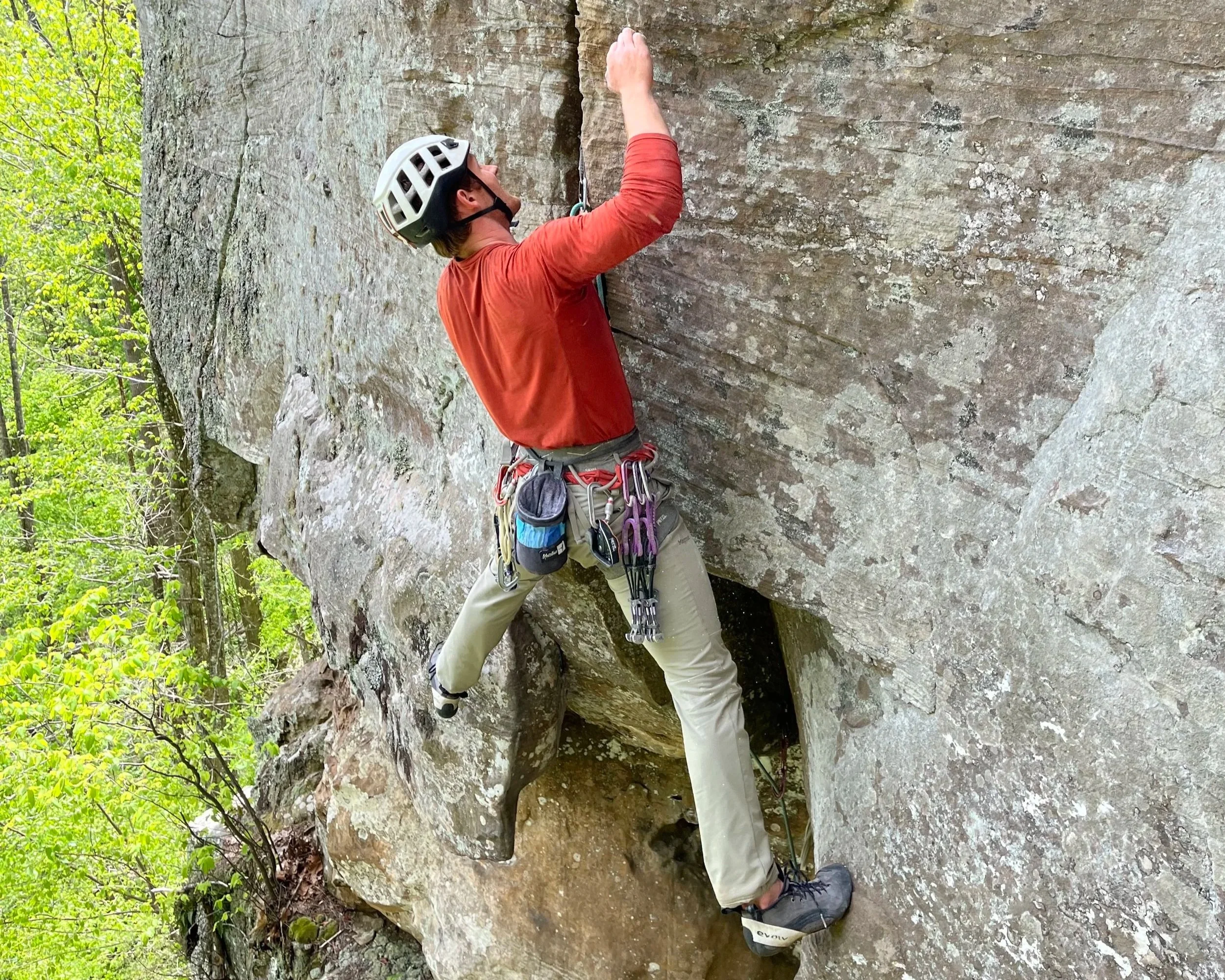
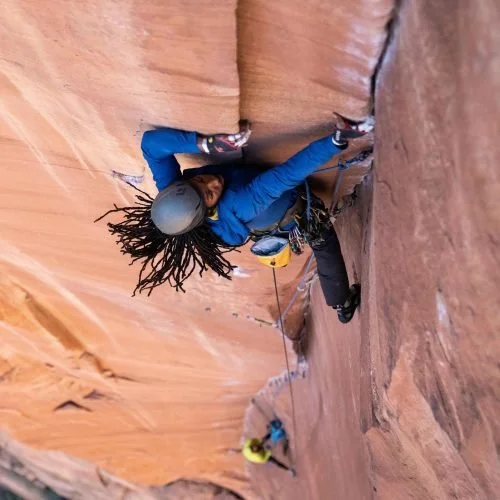
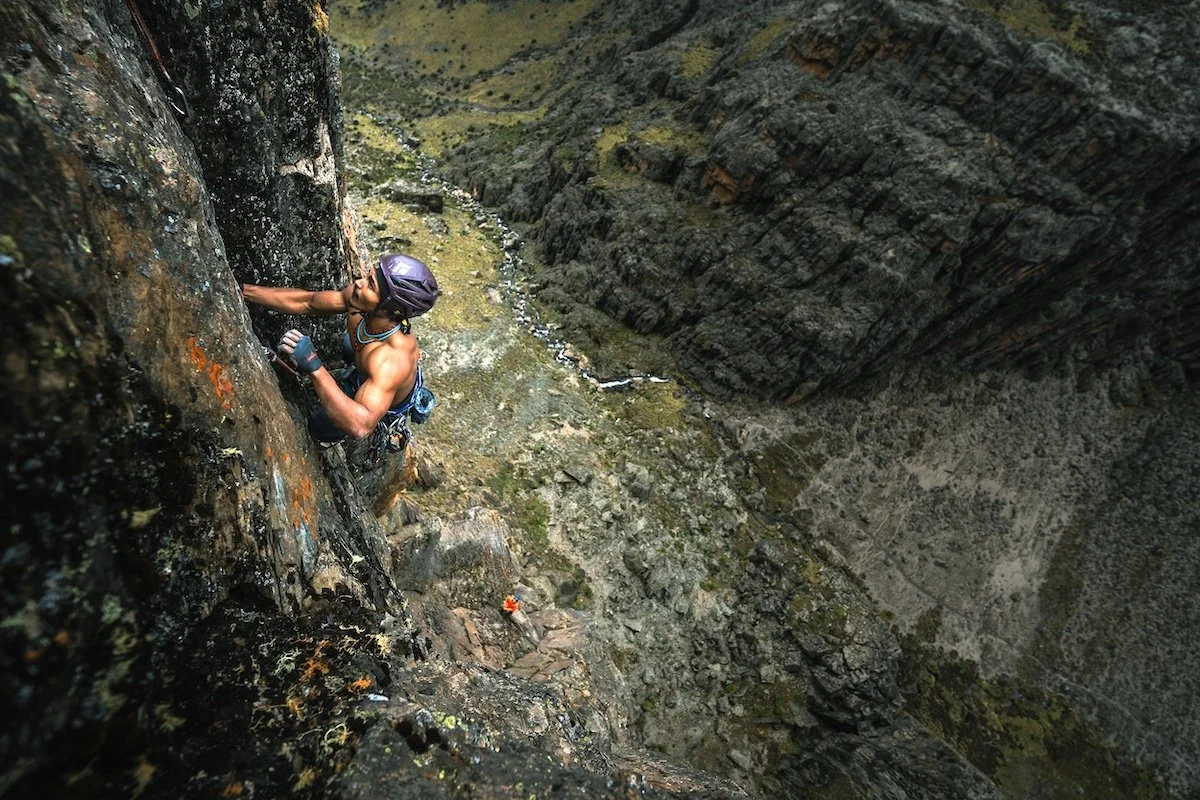
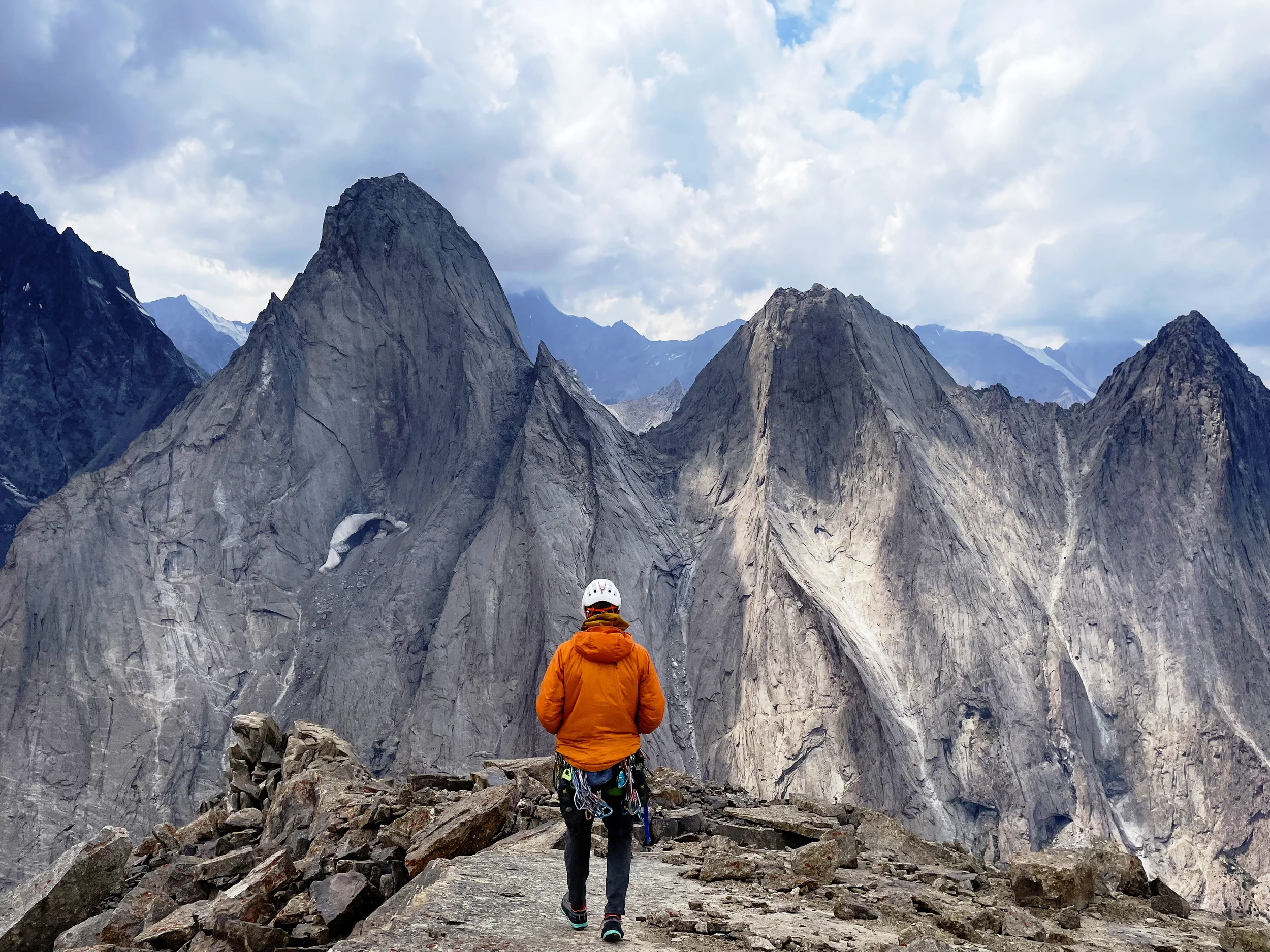
As a climber who fell in love with alpine rock, Hill has spent much time on the road driving toward his next climbing destination. He learned quickly that what he loved most was swimming through a 5.10 hand crack high on a steep, sunny wall. That lifelong thirst for high-country granite would bring him to many wild places, including Mt. Barrill in the Ruth Gorge, El Cap, the Bugaboos, and Mont Blanc’s aiguilles. An epic during an alpine climb in the Canadian Rockies in 2004 spurred him to start reading Accidents in North American Climbing, and he would continue engaging with the AAC throughout his climbing career—for the rescue benefit, community, and research grants that would, in turn, help catalyze his calling.
His passion for these alpine landscapes was boundless, but Hill’s educational path in environmental science was bringing him up against the reality of outdoor recreation’s environmental impact. He wanted to do something about it.
Hill began with driving, launching the Biodiesel Project at UBC, which added sodium hydroxide and methanol to a vat of recycled cooking oil to create an alternative to diesel. “It was fun and dangerous in the beginning,” he recalls. “The pH is crazy. Like, if it splashed in your eye, for sure it would have dissolved a hole in your eyeball.” But it worked. He would fuel up his 1993 Volkswagen Jetta with this biofuel and hit the road to Canmore, Squamish, and even Yosemite. He would later teach some Yosemite rangers how to run their own trucks on biofuel from their waste kitchen grease.
Called by the mountains, Hill toyed with becoming an ACMG Guide (the AMGA equivalent in Canada), but when he failed his exam, he realized his heart wasn’t in it and that he’d rather serve the mountain environment itself—not clients.
Funded by Canada’s Natural Sciences and Engineering Research Council (and an AAC Research Grant), Hill started ringing up the rangers and national park personnel he’d worked with during his previous studies and guide training. He wanted to study the alpine environment in a way that would produce practical results: What did they need help with?

Geoff Hill installs a urine-diverting conveyor-belt toilet system at Rocky Mountain National Park.
Again and again, the National Park Service spoke to the problem of human waste management. Tara Vessella, who runs the backcountry program in Rocky Mountain National Park, spoke of the ongoing struggle to find new land for pit toilets. As Hill recalls her saying, “I cannot find a spot in the forest to put a new pit toilet because every time I dig a hole in the ground, I find old sh*t.” The pit-toilet model, so ubiquitous in the United States, wasn’t sustainable for backcountry landscapes with such intense visitation numbers. So Hill, recalling his frozen-waste-chopping days, embarked on a PhD that would make everyone else’s “business” into his business.
Humans expel feces and urine daily—what we term “waste” when it’s not well integrated into the ecosystem, especially our poop. Yet when we look at the terms more commonly used for animal poop—dung, scat, droppings, guano—the “waste” subtext is absent, revealing a bias toward thinking that human excrement is dysfunctionally related to the natural environment. But Geoff Hill believes it doesn’t have to be that way.
The science is pretty straightforward: Human urine (and all mammal urine, for that matter) is excellent plant fertilizer. Meanwhile, human poop is food for invertebrates and microorganisms—in fact, in the process of eating mammal poop, microorganisms produce rich organic matter that makes for fertile soil.
We’ve evolved to be part of our ecosystem. As Hill puts it, “[We’re] no different than a buffalo running around, dropping a dump on the prairie.” But the problem comes at scale, and when these streams mix.
As Hill relates, “[Waste] became a problem when we moved into castles from nomad culture. It’s concentrated there; it’ll breed bacteria. People got really sick. Black plague. So, got to get it out of the castle. We [then] try putting it in buckets and sloshing it out onto the street.... More black plague. So, get it in the river. But there’s no sense in having a bucket of poo and a bucket of pee if you’re just going to put it in the river, so put it in one bucket intentionally—that’s the toilet.”
Continues Hill, “And from a human health perspective, it is one of the great inventions of all human time. Add to it flushing water and a waste water-treatment plant, so you’re not polluting the river, and you have this whole paradigm of human waste going together in a single-hole toilet and getting flushed downstream to be managed elsewhere.” This paradigm, so dominant in the Western world, doesn’t transfer well to the alpine, however, where there really is no “elsewhere” and where the single-hole toilet is in fact part of the problem.
With no plumbing and waste-removal being exceedingly expensive in such remote locations, the pit toilet—burying it and forgetting about it—has become the common solution. But when human urine and excrement are stored together, like in a pit toilet, urea—the main chemical constituent in urine—will rapidly oxidize into ammonia. And ammonia is toxic: It smells bad, and the invertebrates and worms that would normally happily eat mammal waste, catalyzing its decomposition, say no thanks.
In 2000, the EPA banned the creation of new large-capacity cesspools (which include many pit-toilet designs), “because untreated sanitary waste from cesspools can enter ground water and contaminate drinking water sources.” Between the ammonia toxicity, Vessella’s testimony about running out of land for new pit toilets, and the EPA ban, it was clear that what Hill was hearing from the rangers was rooted in very tangible problems.
At first, Hill was tempted to believe that composting toilets could be the solution. But as he researched and tested the output of various models installed in national parks, he repeatedly found grim results. Because these toilets required the introduction of dry goods like wood shavings for their “composting” process, they added volume. Moreover, they weren’t actually creating compost—with the amount of excrement added daily, the process for turning the results into safe fertilizer was too slow, plus most parks had to remove the waste anyway, instead of reintroducing it back into the ecosystem, because the composted waste didn’t meet federal safety standards for fertilizer.
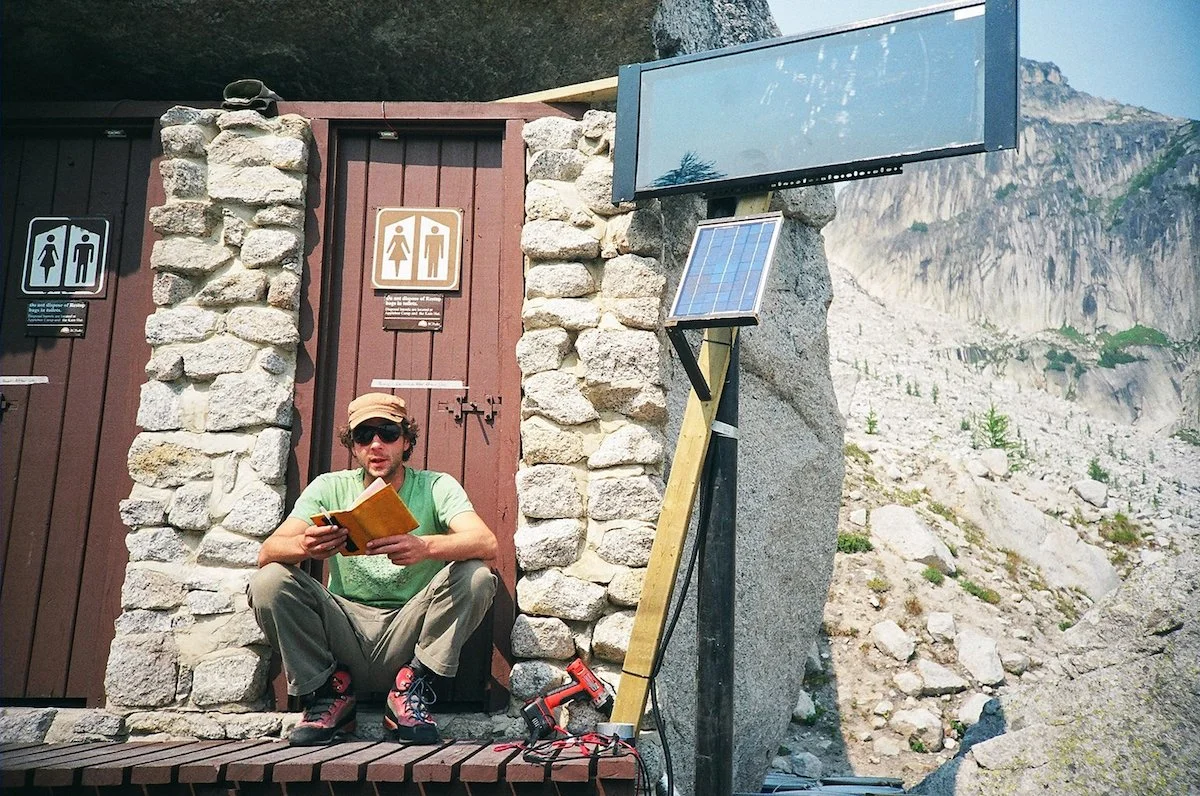
Hill eventually found himself in France, looking at a conveyor-belt toilet. This model took the science seriously and did one major thing differently: The conveyor belt diverted the urine so that the combination of waste products wouldn’t create ammonia, leaving the worms and nematodes to gobble up the solids. And the design was feasible without running water—after a user does their business, urine is directed to the ground via grooves in the conveyer belt, while the inclined conveyer belt carries away the solid waste thanks to a few steps on a mechanical foot pedal. Once it’s in the storage container for solids, worms happily munch away. The example toilets Hill saw in Europe barely needed attention from their technicians, even after years of use, simply because the system was functioning properly, resulting in a significantly lower volume of end product.
He quickly licensed the use of these robust, reliable, stainless steel, urine-diverting conveyor-belt toilet seats from Emmanuel Morin, the industrial designer who designed and sold them through his company Ecodomeo, and started using them in toilets across the Americas. Hill’s business, Toilet Tech, was born.
Through Toilet Tech, Hill has outfitted over 400 remote sites, from Alaska’s Wrangell–St. Elias National Park and Preserve and Glacier Bay to Los Glaciares and Torres del Paine in Argentina and Chile, respectively. You can also find Hill’s creations at Smith Rock and Angels Landing in Zion, where desert environments also make human waste management extra tricky. In fact, Hill’s toilet technology might be the most efficient and cost-effective solution for any public-use toilet that isn’t incorporated into existing municipal sewage structures.
However, the US Forest Service, BLM, and National Park Service move slowly, and often don’t have the funds for a new system, regardless of how badly they need it or how well it works. But despite these constraints, many enterprising NPS staff have partnered with Hill to implement this new vision of waste management in the backcountry—at Mt. Rainier, Rocky Mountain, Zion, and other national parks.
Ultimately, Hill isn’t making a crapload of money on this endeavor—it’s a side quest at best. Yet Hill’s passion for eco-forward innovation and deep knowledge of composting continue to motivate his work at Toilet Tech and his salaried position as head of science at Earth Funeral, a company that specializes in an environmentally friendly alternative to burial and cremation that uses a 30-day process to transform a body into nutrient-rich soil. Hill’s love for alpine granite remains undimmed as well, and has inspired a new dream that involves figuring out how to clean up water bodies in the alpine—he envisions a world in which climbers can hike up to alpine ascents with a teacup, no filter needed.
Though most of us climbers can’t do much more than incorporate good WAG bag etiquette into our climbing ethics, it’s inspiring to know that some climbers are using their expertise to move the needle on the infrastructure that supports our outdoor recreation. Perhaps someday soon those outdated pit and composting toilets at your local area will be replaced by one with conveyor belts, all thanks to Geoff Hill.
Beyond all this, Hill’s story also helps us shift a common paradigm: What would it mean to interrogate the things that we, as a community, let disappear into the elsewhere—that we bury and don’t address? Whether it’s our excrement, the way we interact with and support (or don’t support) each other, or our relationship with fear and risk tolerance, sometimes it’s worth taking a page out of Hill’s book and uncovering the stuff put elsewhere.
Sign Up for AAC Emails