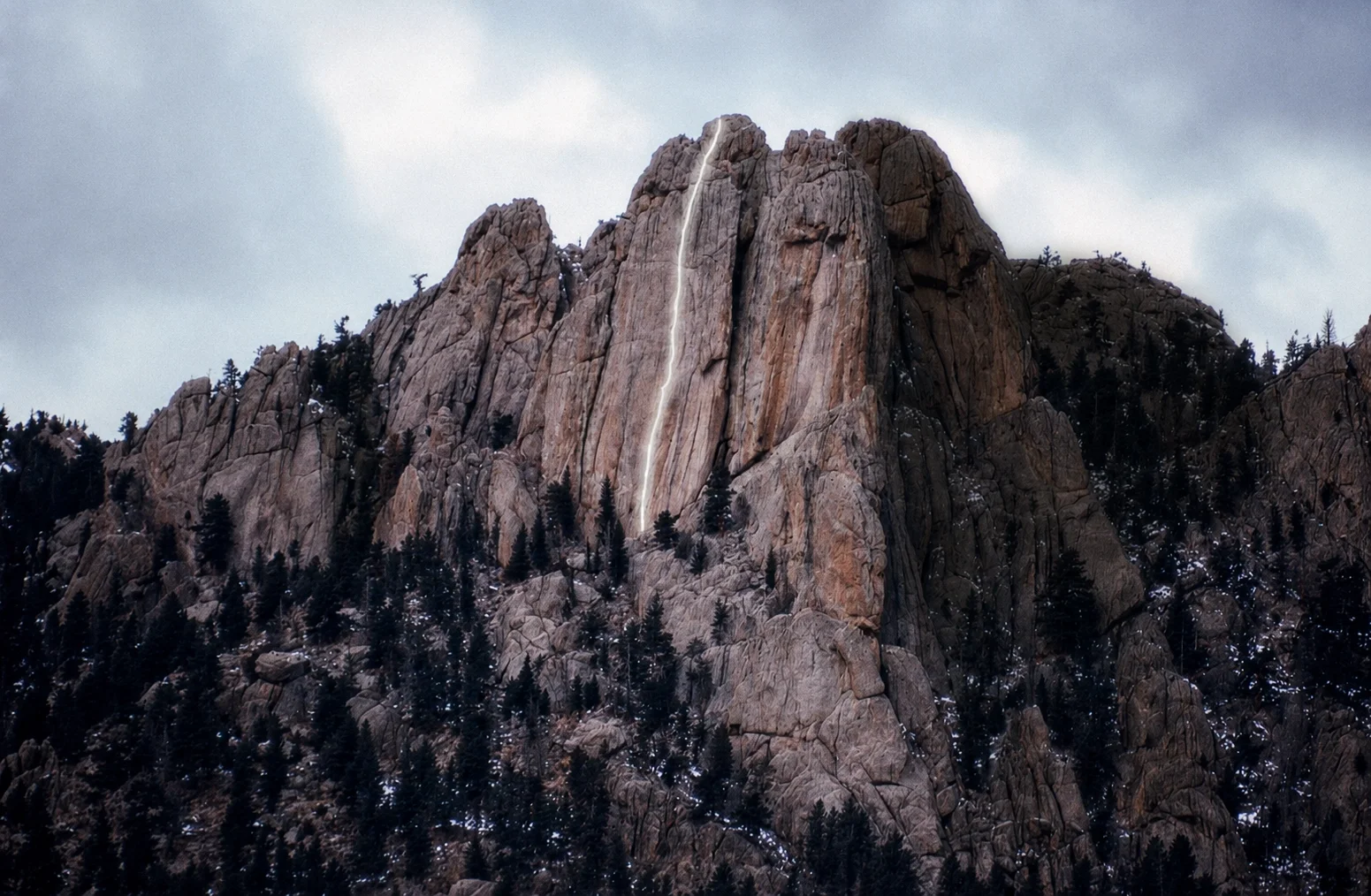
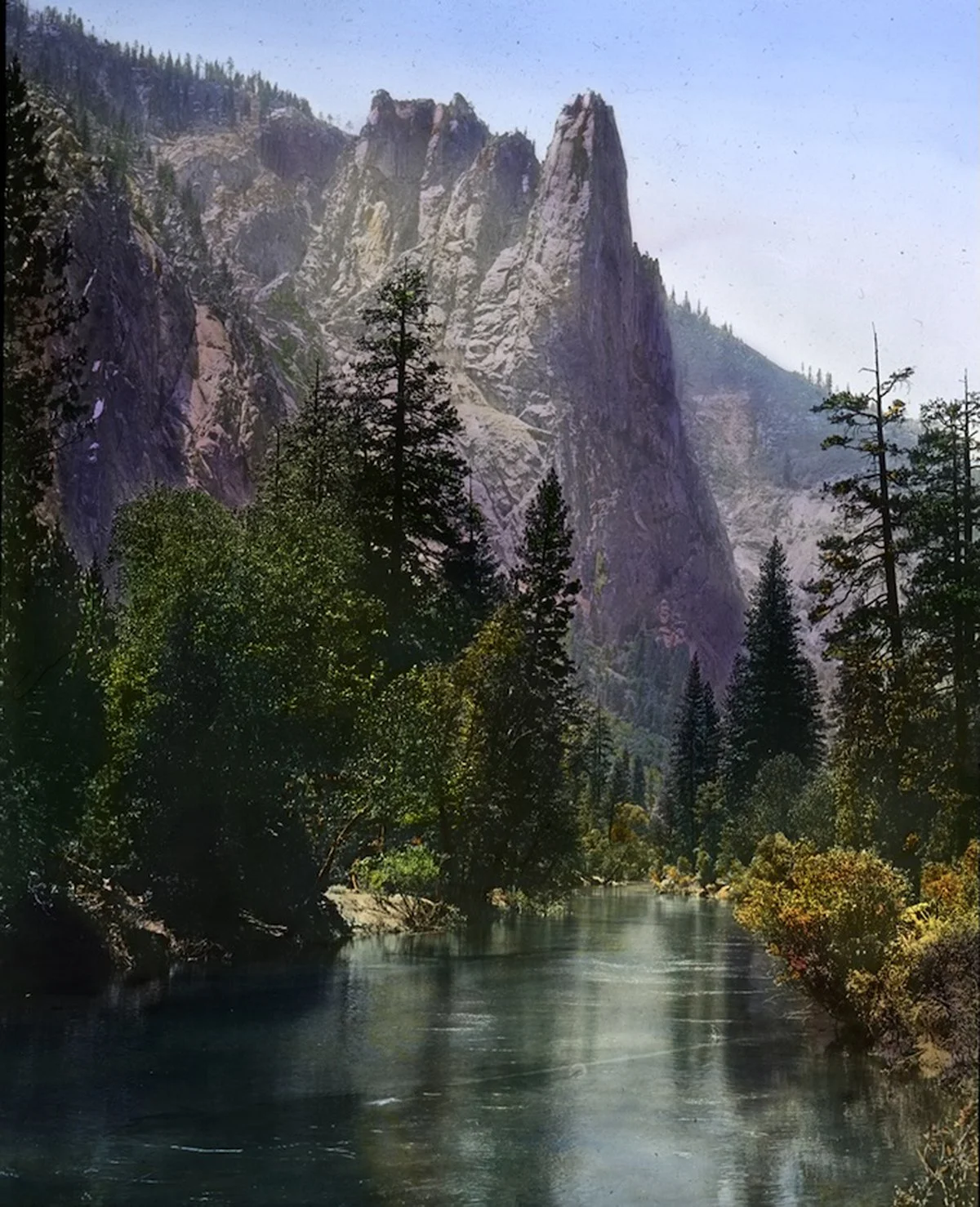
Sentinel Rock circa 1916. Photo provided by Mountain Views Collection.
By Sierra McGivney, with research and imagery support by the AAC Library.
Originally Published in Guidebook XVII.
A lone blacksmith gazed out his window one morning in 1945. He felt awful. After 13 years of working away in his San Mateo, California, forge, located on Highway 101, his health had begun to decline. He watched as a cow and its calf grazed peacefully in a field.
“John, look at those healthy animals. They eat grass, not meat. You eat meat, and you are always feeling sick,” said the voice of an angel.
The angel and the blacksmith conversed a while more. Suddenly, it all clicked for the blacksmith: Vegetarianism was the answer to his problems. Little did John Salathé, the blacksmith, know that his sickness and this moment would propel him toward the tall granite walls of Yosemite, solidifying his spot in climbing history.
Salathé was an immigrant from Switzerland who headed westward, landing first in Montreal, where he met and married Ida Schenk. He then immigrated to the U.S., settling near the Bay Area. There, he opened up Peninsula Wrought Iron Works, his blacksmith shop. He was described as lean and ruddy, and spoke with a thick Swiss accent.
Once Salathé began to fall ill, doctors recommended that he spend time in the Sierra Nevada, where he learned about the Sierra Club. In the fall of 1945, Salathé joined the Sierra Club on a climbing outing at Hunters’ Hill near Vallejo, California. Robin Hansen led a complex and exposed pitch of climbing. He called down to Salathé to “climb freely.” Hansen tugged on the rope but felt no movement or weight. After two or three minutes, Salathé appeared from around the corner unroped because he thought that to climb freely was to free solo. This was the beginning of many instances in which Salathé scared his climbing partner by being extremely bold.
“Height had no meaning to John, and to him fear was a stranger,” wrote Hansen in his tribute to Salathé in the 1994 AAJ.
Salathé started to feel physically better, between his newfound vegetarianism and passion for climbing. Naturally, Salathé was drawn to Yosemite. At 46, he quickly picked up the basics of climbing but was not the most agile; therefore, he leaned into the technical aspects of climbing that were then evolving in the Valley.
Piton technology, when Salathé started climbing, was subpar, so he decided to forge his own. Most pitons at the time were malleable steel pitons, bought at the army surplus store or imported from Europe. They worked great in parallel-sided cracks, but most cracks are irregular along the edges and in the back—the pitons pounded into these fissures tended to get stuck, and if they were removed, they were often too damaged to be reused. Salathé’s high-strength carbon steel pins were far tougher than the European pitons of the day. On each, he added a P inside a diamond, the logo of his blacksmith shop. He could make them big, small, wide, narrow, or long, for the type of cracks he encountered on various climbs.
In 1946, Salathé convinced his friend John Thune to climb the Lost Arrow Tip with him.“I have found a rock in Yosemite that has never been climbed. It is an easy one,” he told Thune. The Lost Arrow Tip is a 250-foot formation, now classified as Grade III, 5.7 C2— not an easy climb, then or now.
Thune, less experienced than Salathé, was the belayer. As Thune stood in the Arrow Notch, belaying, he watched as Salathé’s first piton, of his own making, popped out, and Salathé went for a ride into the void.
“Slowly, John worked his way back to the notch and said with a smile, ‘Well, we start over again.’ He had little fear of high places. I did the shaking for him,” Thune later said.
They got about 30 to 50 feet from the summit, but darkness was approaching, so they retreated. Competition was stiff in the Valley. Unfortunately, another group—the foursome of Robin Hansen, Anton (Ax) Nelson, Fritz Lippmann, and Jack Arnold—just days later got to the summit first by lassoing the Arrow Tip from across the rim. Salathé later told Steve Roper in all seriousness that this competing team had enjoyed “the help of the devil.”
Later that year, Salathé and Ax Nelson climbed the Southwest Face of Half Dome (800’, 7 pitches, Grade IV) in Yosemite. They bivouacked and placed 150 pitons as they ascended, both a first for Yosemite. According to Roper’s Camp 4: Recollections of a Yosemite Rockclimber, for the next year, this stood as the hardest rock climb in the United States, until Salathé and Nelson climbed the Lost Arrow Chimney (1,100’, 10 pitches, IV 5.10a) in 1947. It was the most challenging climb at the time and the first successful big-wall ascent in the United States, done in a single push that took the two men five days and five nights. The sun was rising on the golden age of climbing in Yosemite.
On January 20, 1950, Salathé filed for American Alpine Club membership, backed by Oscar A. Cook and seconded by Richard C. Houston. Allen Steck, a newcomer rising in the Valley after returning home from World War II, had his AAC membership proposal published in the January 10, 1950, list, which Houston also seconded. Both of their climbing résumés were long, but there was something just beyond the horizon waiting for them. It would become one of the greatest climbs in North America: the Steck-Salathé (15 pitches, V 5.10-) on Sentinel Rock.
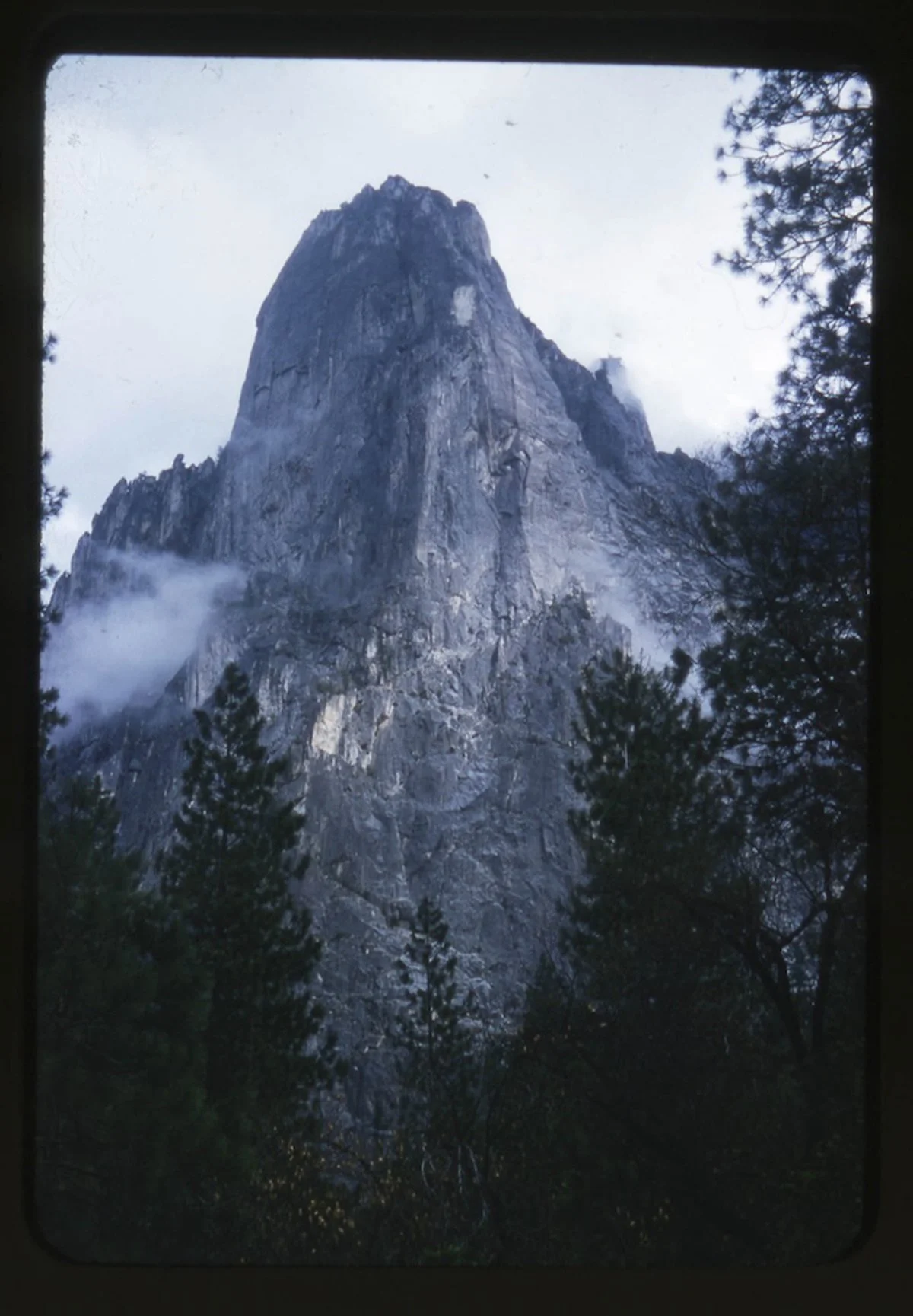
Sentinel Rock circa the 1950s, photo by Nicholas B. Clinch Collection.
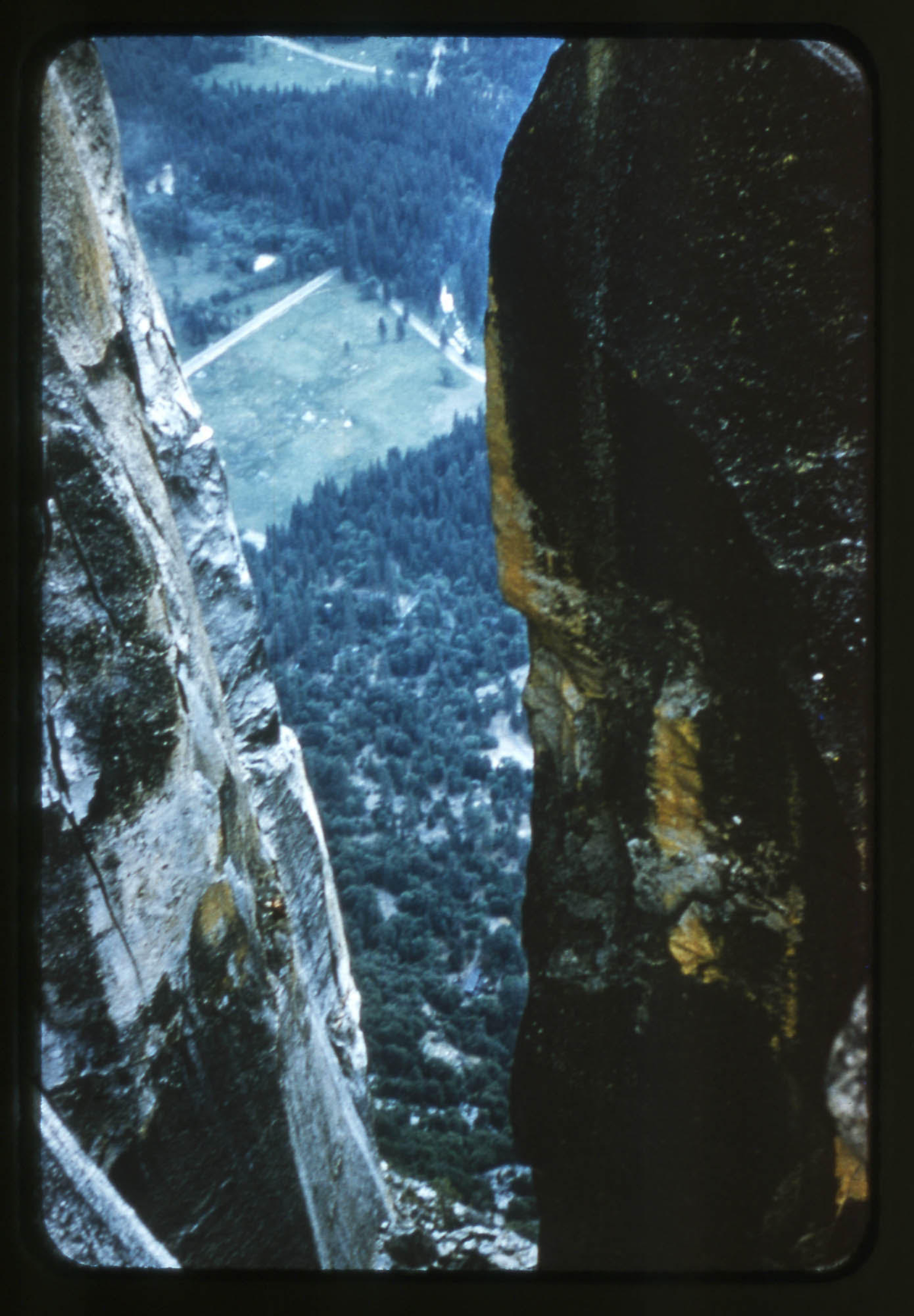
Sentinel Rock circa the 1950s, photo by Nicholas B. Clinch Collection.
In 1950, Allen Steck had become obsessed with climbing Sentinel Rock, and he wasn’t alone in his ambitions. The Valley was a competitive environment. Steck, Phil Bettler, Bill Long, and Jim Wilson made a serious attempt in October 1949, but only managed to reach 400 feet past the previous attempt. More attempts were made in 1950, and with the Fourth of July weekend approaching, Steck was getting antsy; someone would unlock the climb soon. He lay awake at night thinking about the north wall above the buttress.
At the time, Steck was a 24-year-old living in Berkeley, California. He was young and ambitious, just beginning to make a name for himself in Yosemite, and a “carnivore,” as Salathé would say. In contrast, Salathé was 51, had dentures, and was known for his doggedness and patience in climbing. All of Steck’s friends were out of town that weekend, so he asked Salathé to join him.
The angels had earlier told Salathé to look around the Valley, and he would see three superior climbs: Half Dome, the Arrow, and the north face of the Sentinel. The first two were completed, but there was one last climb to go.
Perhaps Salathé and Steck were always moving toward this climb, fated to complete it together—the innovator and the young gun.
When Nelson heard of their plans, he remarked to Salathé, “If you expect to make the top, Al will have to be every bit as stubborn as you!”
On the morning of June 30, the two quested off—Salathé with a handful of dates and Steck with dried fruit, canned tuna, and some nuts. Between the two of them, they had two gallons of water in tin cans, believing it would be enough for their time on the wall.
By midafternoon on the second day, they had reached Steck’s previous high point.
“Even though we were swinging leads, it was clear that Salathé, an aid specialist that he was, should be the one to tackle the steep, almost blank section known as the ‘Headwall,’” wrote Steck in his memoir, A Mountaineer’s Life.
The terrain was complex and unknown, Salathé’s progress slow. They retreated to their bivy at the top of the Flying Buttress. At first light on July 2, Salathé went to work, struggling on the steep headwall for seven hours. They began to feel hot and thirsty. Temperatures reached 105°F on the valley floor—the climbers were like two eggs in a frying pan. Even worse, their water—which should have been enough for a few days under cooler conditions—wasn’t going to last much longer given the dehydrating effects of the heat.
At last, they reached the Great Chimney. They looked up at a steep, flared slot ending in a narrow section. Steck began to wonder how they might escape the wall. Disappointment and thirst were setting in.
The next day, July 3, Steck noticed a cave at the far end of the chimney. He roped up and wriggled up it, popping out a hundred feet above. Salathé ditched an empty water can and his dates, his parched mouth making them unappealing, and prusiked up to Steck. For years to come, climbers would see a rusted tin can as they entered the chimney.
Now, they were at another impasse: A slot about the width of a human head rose above them.
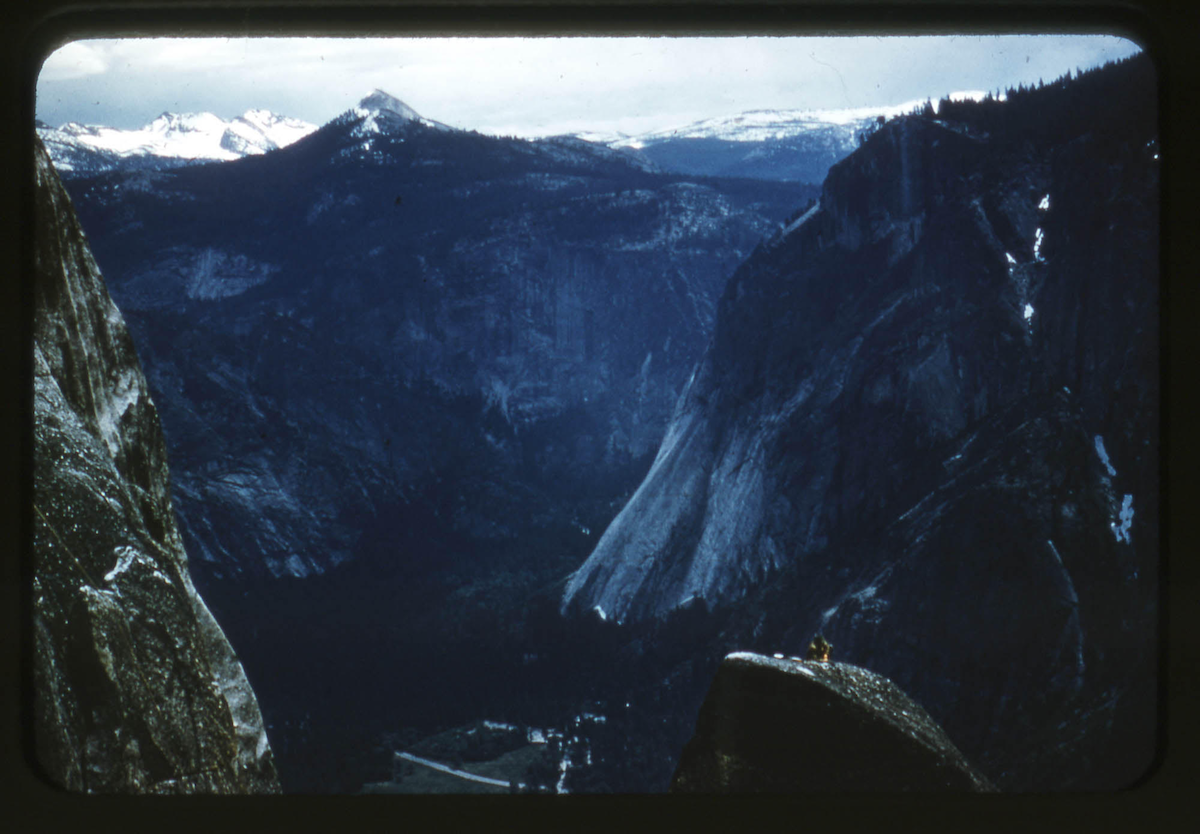
Sentinel Rock circa the 1950s, photo by the Nicholas B. Clinch collection.
Salathé searched for a crack, discovering a rare and thin line leading around the outside of the slot. Salathé placed pitons, climbing the outer face of the chimney until he reached an ample ledge. Salathé had solved the crux of the Narrows, which would become the most notorious feature on the route. Salathé’s route up the Narrows has no known repeats: On the second ascent, in 1954, Royal Robbins discovered an oval-shaped hole in the ceiling above the belay spot, shinnying through this and the chimney above until he found himself in the sunlight again. This has become the standard route.
Steck, before following Salathé, saw water dripping down in a crack. He desperately reached for it, but it was only enough to moisten his lips.
They continued upward in the unrelenting heat, letting their tempers boil over. Whatever their motivations were—anger, water, or the love of climbing—they ended the night two pitches from the summit, albeit sleeping in a painful, seated position hanging from their anchors.
On the morning of July 4, Salathé used their last half cup of water to moisten his false teeth so he could put them back on. By noon, the two stood at the summit.
They “yelled and jumped and almost kissed each other to think we’d made it,” said Salathé in an interview with the San Francisco Chronicle in 1950.
Steck, meanwhile, had become crazed with thirst. He threw his food off the summit and rushed down a gully leading to Sentinel Creek, which they could see from the summit, leaving Salathé. Water was all he could think about. Steck got cliffed out 30 feet above the creek and had to climb back up the gully. He “tripped over bushes, fell over unseen ledges, and finally collapsed fully clothed into a pool at the foot of a small waterfall,” as Steck later wrote in his Sierra Club Bulletin article about the ascent, “Ordeal by Piton.”Salathé, ever patient, had taken his time and traversed over to the water. The men immediately got to slaking their thirst.
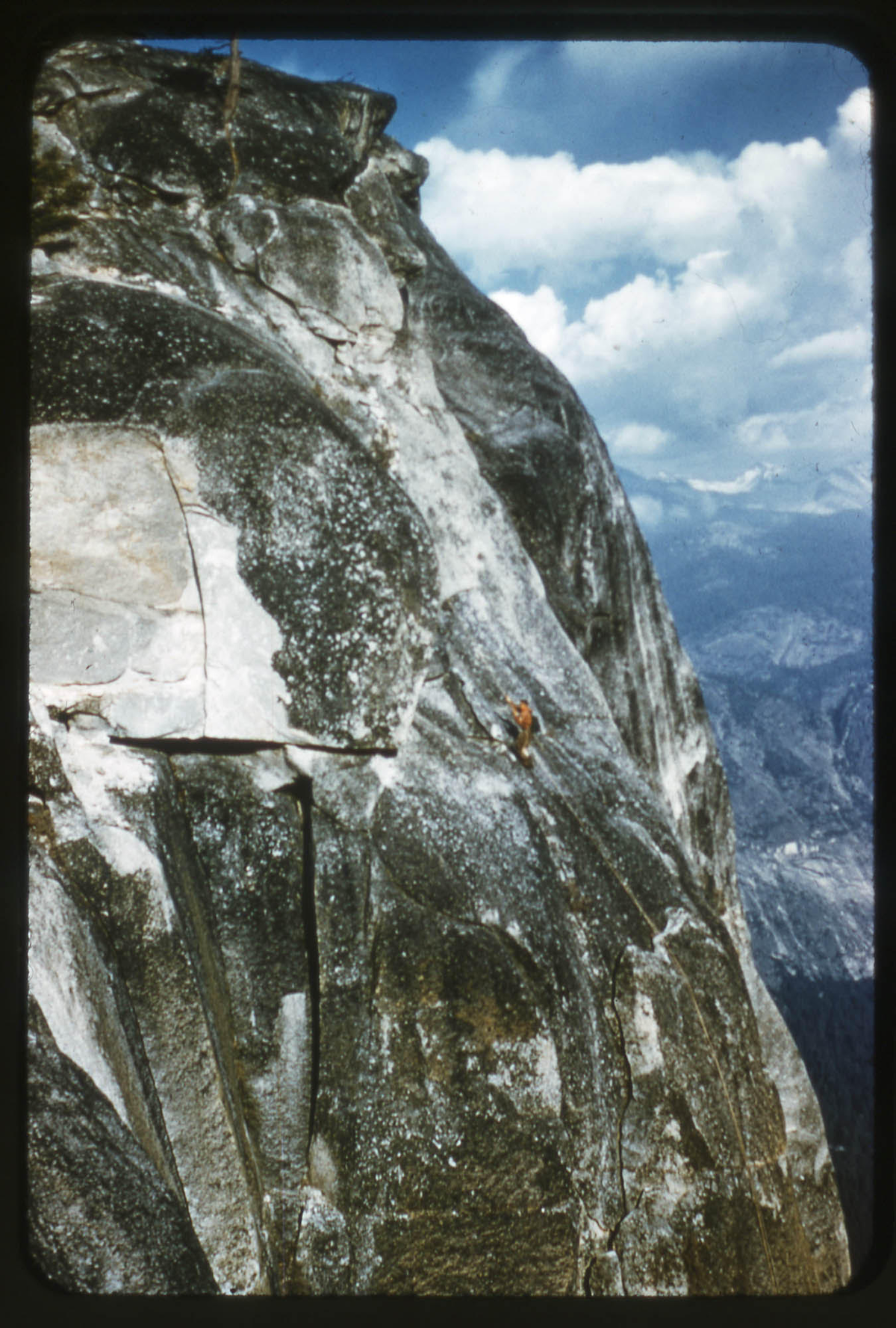
Sentinel Rock circa the 1950s, photo by Nicholas B. Clinch Collection.
Finally, after facing a complex descent over steep, water-worn granite slabs down toward the Valley, they piled into Salathé’s Model T Ford for the drive back to Berkeley, stopping at a produce stand on the way. Salathé bought various fruits, and they ate them eagerly.
“And I can say, in retrospect, that it was well worth the effort. The reason, the incentive, the motive for all this? It is an intangible, provocative concept that I shall leave to the reader to explain. Some think they know why; others despair of ever knowing. I’m not too sure myself,” concluded Steck in “Ordeal by Pitons.”
It was clear Steck was a bit fed up with the climb, but like all climbers, as time goes on, the sufferfest memories fade, and going back up doesn’t sound so bad. Steck went on to climb the Steck-Salathé five more times, the fifth time on the 50th anniversary, when Steck was 75 years old.
Unfortunately, Salathé’s mental health deteriorated soon after this ascent. His wife, Ida, took unknown legal action against him in 1952, and shortly after, he believed she was trying to poison him with cobra venom. He soon returned to Switzerland and joined a religious cult led by a medium who claimed to have the “spirit Joseph” speak through her.
In 1963, Salathé returned to the United States, were he wandered the deserts and mountains of California, living off the land and a pension from the Swiss government.
The Steck-Salathé route on Sentinel Rock was a monumental climb in Yosemite history, a five-day big wall that opened up the idea that other walls could be and would be climbed, if only climbers were willing to bivy for multiple nights in a row. Soon after, several other big features were climbed in the valley, including the Regular Northwest Face of Half Dome in 1957 and The Nose of El Capitan (47 days on the wall) in 1958. Salathé and Steck’s route opened up a new playing field for climbers, leading to some of the greatest routes in North American climbing history.