
Four federal agencies have released draft guidance implementing the EXPLORE Act, influencing how climbing is managed on public lands for years to come. Climbers have an opportunity to help shape the outcome through the public comment process.
A Message from AAC Leadership + AAC Updates
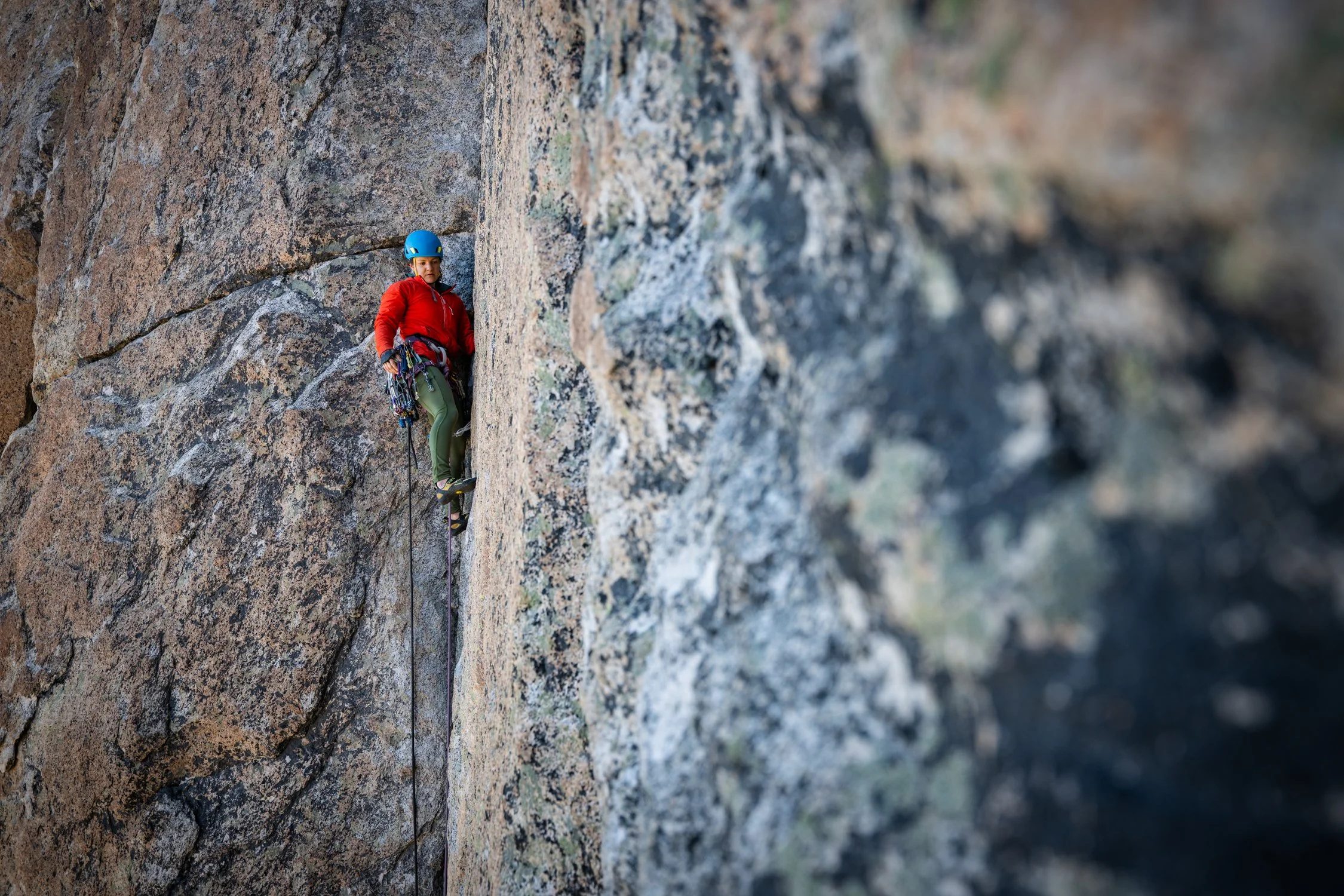
Originally Published in Guidebook XVII
As we step into 2026, I want to begin with gratitude. The support you provide the American Alpine Club through your membership and donations enables us to deliver meaningful work to climbers across the country. Your commitment strengthens the AAC and ensures that we can continue to serve our members.
Climbing is built on connection: the bond between partners, the shared experience at the crag or on an expedition, and the knowledge passed from one generation to the next. This year, we are deepening our focus on uniting climbers and celebrating the culture that gives meaning to our time on rock, ice, and alpine terrain. We are building programming that strengthens members’ connections and creates more opportunities to gather, learn, and celebrate climbing. We look forward to sharing more in the coming months as we build toward 2027 and our 125th anniversary.
Across the country, our lodging facilities remain places where friendships are formed, knowledge is shared, and adventures begin. We continue to deliver critical publications and media, including The American Alpine Journal, Accidents in North American Climbing, monthly Prescription videos, the American Alpine Club Podcast and The Cutting Edge. Our core member benefits, including rescue and medical benefits, discounts, and access to our world-class library, reflect our commitment to supporting climbers wherever their journeys take them.
The AAC plays a unique role in sustaining and strengthening climbing. We maintain the record of climbing so it continues to inform and inspire climbers today. We create moments of connection where people see themselves reflected. And we remain committed to being a sustainable and adaptable organization prepared to meet the evolving needs of our members.
Inside these pages, you will see the AAC’s charge reflected: a commitment to learning, the power of member contributions, and the meaningful journeys climbers undertake around the world. In this edition of The Guidebook, you will find:
“Safer Than Socks in Your Hat: A History of Climbing Helmets and an Updated UIAA Standard”—a practical look at how helmet design and standards have developed, and what climbers should understand about today’s protection.
“The Huayhuash Is Still Open: A Rare Ascent of Jirishanca Chico”—reflections from a challenging expedition funded by the AAC’s Mountaineering Fellowship Fund Grant, offering lessons in risk, humility, and renewed inspiration.
“Elsewhere: The Problem of Human Waste Management in the Wilderness”—a celebration of the work of one AAC member in advancing human waste management systems in alpine environments and what it means for sustainable access.
“An Interview with ANAC Editor Pete Takeda”—sharing key insights from the incidents featured in this year’s Accidents in North American Climbing, to help climbers make better decisions in complex terrain.
“Rewind the Climb: The Steck-Salathé on Yosemite’s Sentinel Rock”—a return to an era-defining ascent in Yosemite and the unique vision of John Salathé.
Each of these contributions reflects a core part of our mission: supporting climbers, learning from experience, honoring our history, and strengthening the connections that define this community.
Thank you for being part of this effort. I am grateful for your continued support and look forward to the work ahead.

Ben Gabriel
AAC Executive Director
AAC Updates
Operations and Governance
The Board, with continued leadership from our President, Nina Williams, welcomed new directors Maryanna Saenko and Sean Chiasson. In addition, the Board elected a new Executive Committee:
Vice President: Keith Thomajan
Secretary: Mo Beck
Treasurer: Howard Lukens
We want to extend our sincere appreciation to outgoing board members Rob DeConto and Pavan Surapaneni for their years of dedication, guidance, and support.
At the Banff Mountain Film and Book Festival, we were honored to be a part of the Best Film: Climbing award, which was given to Old Man Lightning, a film sponsored by the AAC.
We are pleased to welcome new staff to the American Alpine Club, including VP of Philanthropy Melanie Hood and Administrative Assistant Alyssa Grizenk
Member Services
Congratulations to the following climbing teams for receiving Piolets d’Or in 2025. We are honored to have been a small part of these ascents, through conferring the Cutting Edge Grant to the first team listed below, and reporting each of these ascents in the AAJ.
August Franzen, Dane Steadman, and Cody Winckler, for the first ascent of Yashkuk Sar.
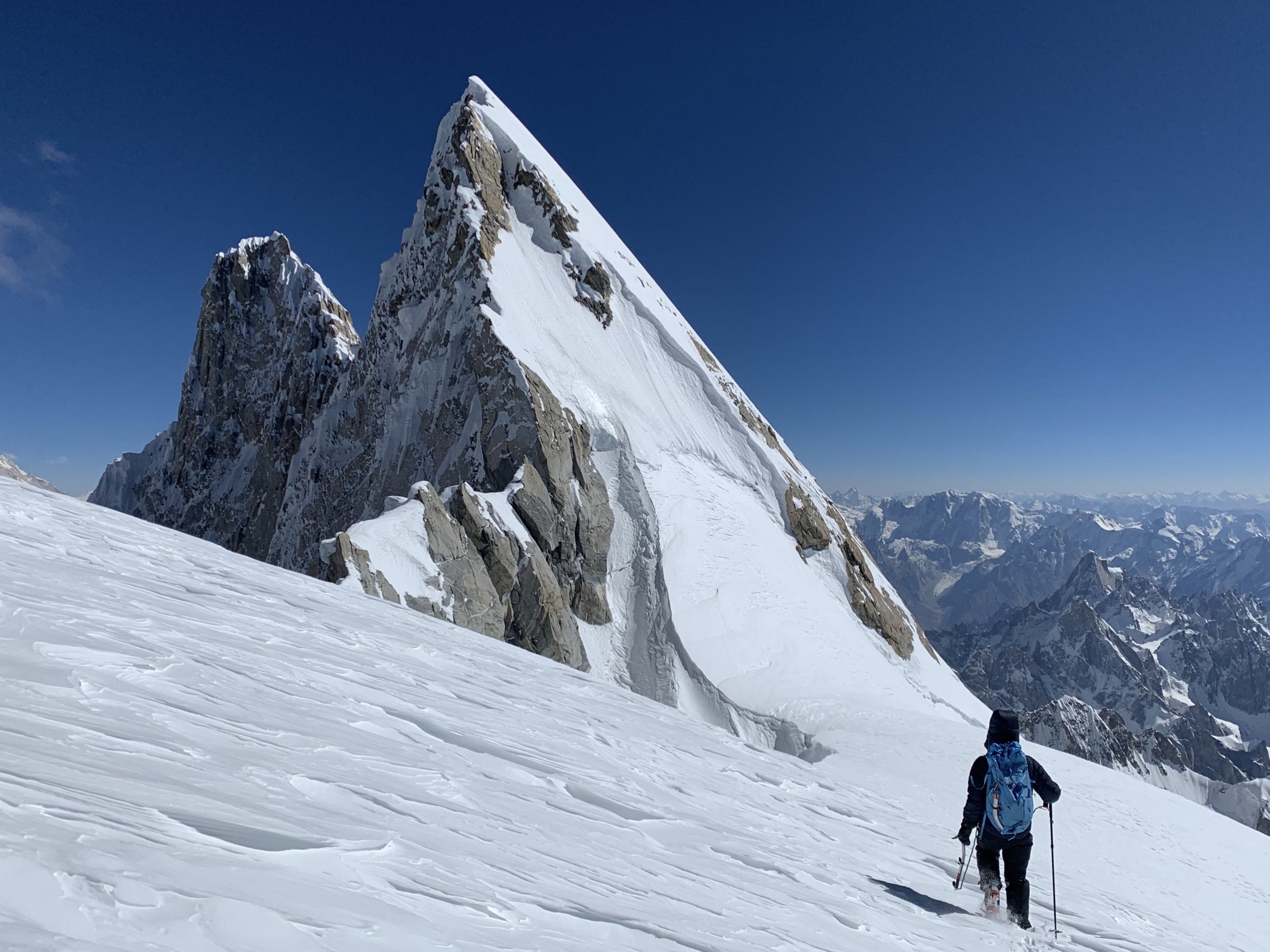
Aleš Česen and Tom Livingstone, for the first ascent of the west ridge of Gasherbrum III.
Spencer Gray, Ryan Griffiths, and Matt Zia, for the first ascent of the southwest arête of Kaqur Kangri.
The AAC 2026 Spring Grants Cycle will be increasing funding for the Research Grant to $9,000.
Programs
The AAC met with other national federation members in Kosovo for the UIAA’s annual General Assembly (GA). At the GA, AAC representative Ron Funderburke was named President of the Training Commission.
Due to a lapse in appropriations, the federal government shut down and halted nonessential operations. The shutdown abated efforts to engage government agencies on implementation issues associated with the EXPLORE Act, and it also impacted federal agencies, such as the National Park Service, in the execution of their duties.
The Climbing Grief Fund received expanded funding and will be able to fund additional awards this year.
Read more stories from The Guidebook:

Sign Up for AAC Emails
Thank You For Making Our Work Possible
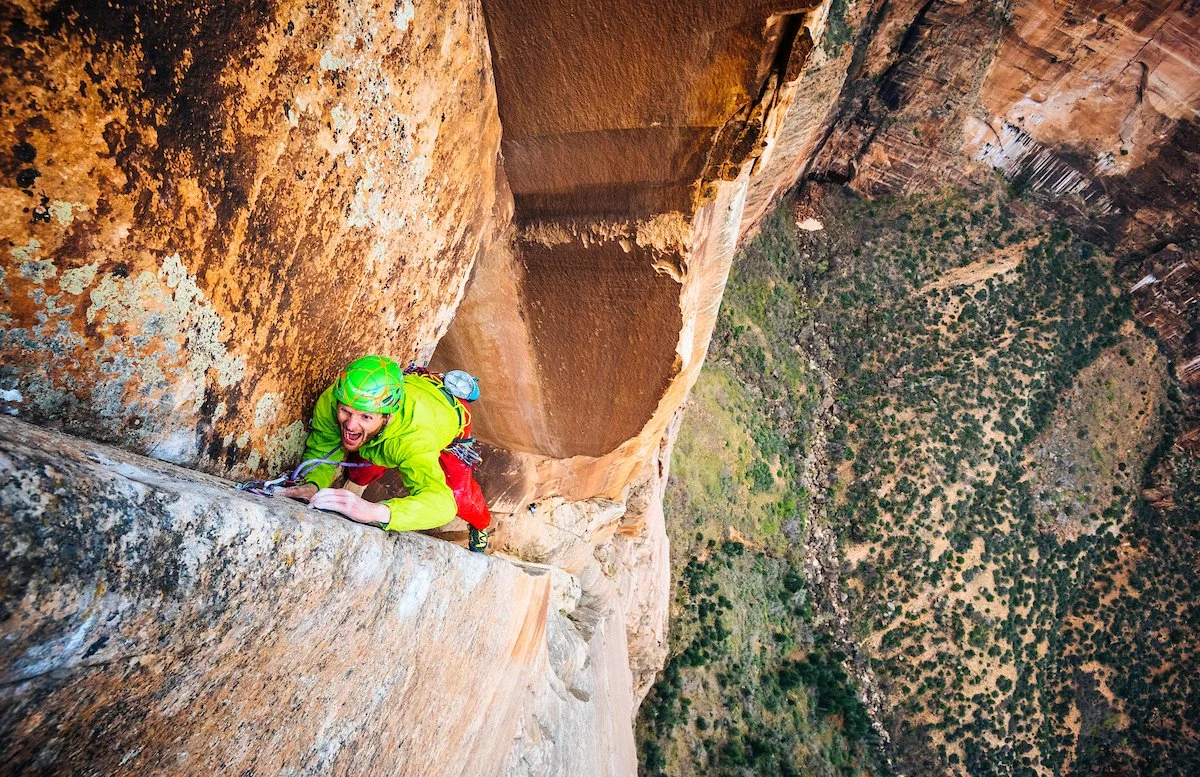
Photo by AAC member Jeremiah Watt.
You did it! Thanks to the generosity of our community, the American Alpine Club is starting 2026 on a strong note.
Together, we’re protecting climbing’s future — one gift, one climb, one community at a time.
Looking Back: 2025
The American Alpine Club made a real, measurable impact on the climbing community.
Dispersed $87,000 in climbing and expedition grants, including securing double the funding for our Climbing Grief Fund
Welcomed over 19,900 climbers from around the world to our lodging facilities—all while investing in major upgrades across each location
Advocated for and supported the passage of the EXPLORE Act to prioritize climbing access and outdoor recreation opportunities on America’s public lands
Preserved the culture and knowledge of climbing through our Library and Archives, including supporting over 112 research projects
Reached over 6 million climbers who viewed our new Prescription Videos, and delivered copies of our world-renowned publications, Accidents in North American Climbing and the American Alpine Journal to our members—offering 90 in-depth accident reports and analysis, and 249 inspiring stories from the cutting edge of our sport
Every one of these wins reflects your belief in the power of this community and your commitment to the AAC. Your generosity is what makes the AAC not just an organization—but a movement built by climbers, for climbers.
Looking Forward: 2026
In 2026, the American Alpine Club plans to continue providing these unique benefits to the climbing community, as well as deepening the quality of our resources for climbers. This includes:
Providing our rescue benefit and $5,000 in medical expense coverage to our Partner, Leader, Advocate, and GRF level members.
Continuing to deliver world-renowned publications and media, including the American Alpine Journal, Accidents in North American Climbing, Prescription videos, and the AAC and Cutting Edge podcasts.
Building programming that strengthens members’ connections and creates more opportunities to gather, learn, and celebrate climbing.
Delivering double the amount of Climbing Grief Fund Grants to climbers who need therapeutic support in processing trauma and grief.
Increasing funding for the Research Grant to $9,000 during the AAC 2026 spring grants cycle.
Cultivating community hubs at our six lodging facilities situated near world-class climbing and outdoor recreation destinations.
Expanding our Great Ranges Fellowship events and communications.
Thank you so much for your contribution to the AAC. Your gift enables us to continue delivering critical resources to climbers and fuels the evolution of this shared passion.
We’re excited to continue delivering these invaluable resources and look forward to the next chapter.
Thank you for tying in with us.
Featured

Guidebook XVI—AAC Updates
AAC's 2025 Impact Report
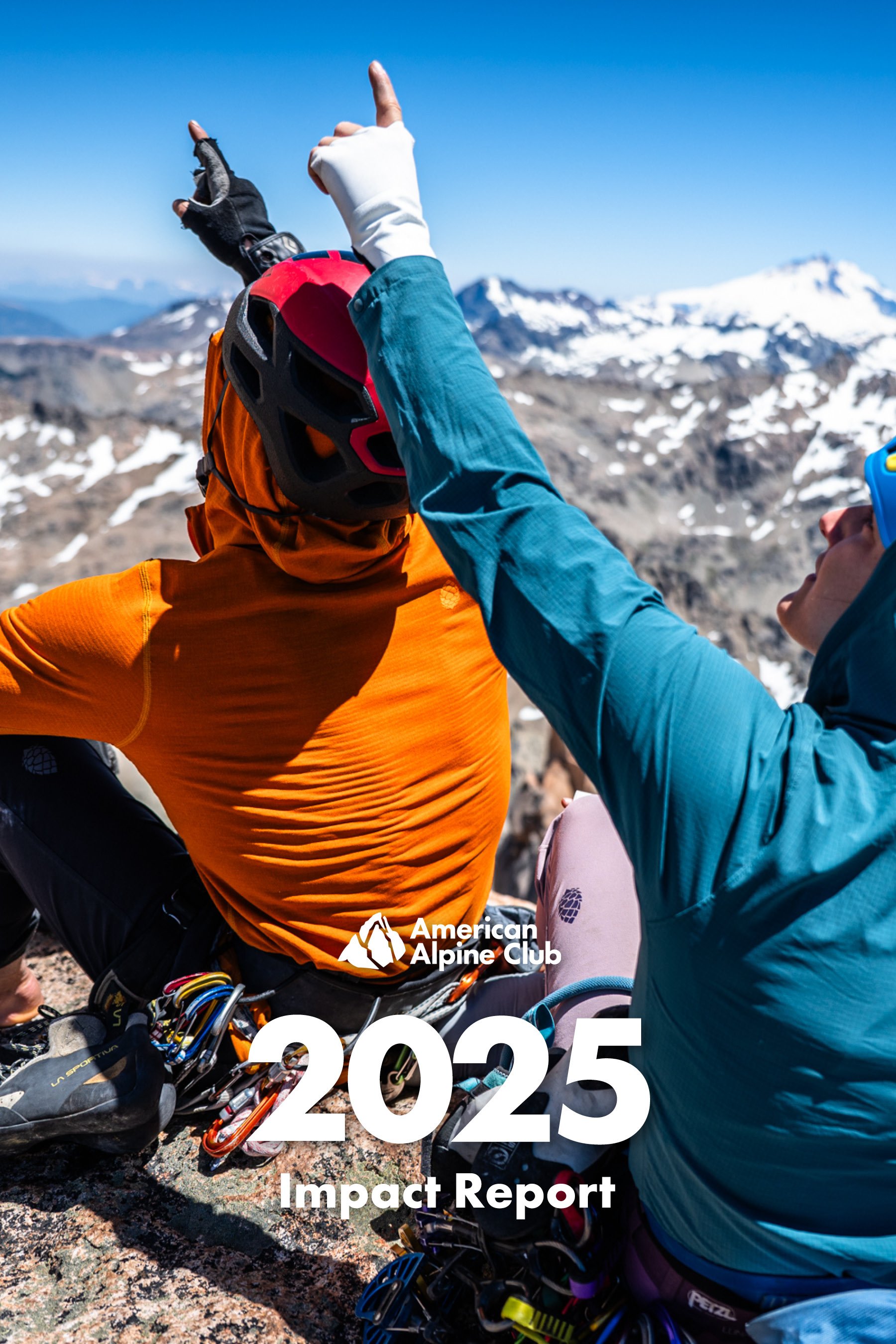
At the AAC, we believe in the power of climbing to change lives. We are driven by the potential to support our members deeply, to use the AAC’s expertise and legacy to deliver resources that climbers can lean on, and that’s why we are so proud of this Impact Report. Each grant recipient we inspired, each lodging guest we launched into adventure, each climber who has learned how to climb a little more safely through our publications—this is what drives our work.
How does it all break down?
Here’s how we’ve met the needs of the AAC community this year.
Support the Club
Donate today and support the AAC’s work. Just like putting in the work on your climbing project, or that long hike to an obscure alpine adventure, we all know that it takes dedication to progress in climbing. It is the dedication of donors and supporters like you that helps the AAC progress in our work—so thank you!
Sign Up for AAC Emails
Guidebook XV—AAC Updates
A Message from AAC Leadership
Dear AAC Community,
It’s easy to think that, as climbers, all of our success stories are individual. After all, when it comes down to executing that final crux on your project, it’s you alone that reaches the top. But one of the things I love about the AAC, and the stories in this edition of The Guidebook, is how individual success is supported by community. The summit is not a vacuum; when we reach the top, our accomplishments are because of ourselves and also those whom we’ve leaned on and learned from.
In these pages, you’ll see that support unfold. In our Member Spotlight, “The Quiet Stories the Land Can Tell,” Rob Mahedy, normally a solo adventurer, learns through a battle with cancer what it means to accept support from his community in order to pursue the summit of Mt. Hayes in Alaska. In our Rewind the Climb story, “A World of Appalling Grandeur,” we celebrate the 100th anniversary of the first ascent of Mt. Logan—a joint expedition between the Alpine Club of Canada and the American Alpine Club that made a huge splash in the newspaper headlines of 1925, in a world that was just imagining that humanity could stand atop Everest. In a splendid deep-dive into corrosion in bolts, called “A Little Rust is All it Takes,” Stephen Gladieux illuminates the importance and impact of the UIAA Safety Commission, for which he is a representative for the AAC. Through SafeComm, the AAC is able to join forces with representatives from nations across the world and work together to formalize standards for climbing equipment and safety practices.
Our final story, “Balance,” is a feature about Brooke Raboutou, who will receive the Robert Hicks Bates Award this year for exceptional accomplishments by a young climber. It’s in her story that I see this interweaving of community so clearly. Brooke’s accomplishments do stand by themselves—silver medalist in the 2024 Olympics for bouldering & lead, an ascent of Box Therapy (V15) in addition to multiple V14’s, and now the first woman to climb 5.15c with her recent send of Excalibur. I have seen Brooke grow from a bright, curious team kid into the warm, determined athlete she is now. The seed of Brooke’s success grew and flourished under the sunshine of overwhelming support from her family, coaches, fellow athletes, and friends, who push and encourage her. She has developed her incredible strength and talent in part because of her environment. As a result, Brooke’s spirit is so vivid that she inspires her community— myself included—to cultivate that same spirit in themselves.
An interesting note: Brooke was nominated for the Bates Award before she sent Excalibur (5.15c) and became the first woman to climb the grade. Excalibur, then, is simply another example of her momentum. There are still frontiers for women to face and break in climbing, but as a community, we are no longer asking whether a woman can climb a given grade. We are just asking—when?
I bouldered with Brooke recently in Bishop, and we made a day of touring the classics. No need to prove anything; we weren’t chasing the most difficult climbs. Instead, we focused on climbing for sheer beauty and joy. What I see in these stories of perseverance and adversity, of pouring one’s life into climbing safety and education, and in Brooke’s story, is that beautiful impulse of climbing for the soul. I see that same impulse bring so many AAC members together.
I hope you enjoy these stories of your fellow members and that they inspire you to shine brightly, connect with others, and pursue your climbing aspirations this summer.

Nina Williams
AAC Board President
AAC Updates
Advocacy
The U.S. House of Representatives removed the public lands sell-off bill from the reconciliation package. The Senate subsequently proposed legislation that considered public lands sales in11western states, which was ultimately removed from the package following strong public opposition. The AAC continues to work with our partners, such as Outdoor Alliance, to coordinate responses to these efforts to introduce legislation that impacts our public lands.
The AAC Advocacy department will travel to Washington, D.C., in October to engage with lawmakers on a variety of issues and support Outdoor Alliance’s Grasstops Collective.
The AAC’s Advocacy Director was recently appointed to the UIAA’s Mountain Protection Commission. The commission, founded in 1969, is one of the foremost authorities regarding the question of sustainability in mountain regions.
Member Services
As of June, expenses up to $15,000 in mortal remains transport are now included in the rescue benefit at the Partner, Leader, Advocate, and Great Ranges Fellowship membership levels. Learn more at americanalpineclub.org/rescue.
The 2025 American Alpine Journal and Accidents in North American Climbing books were sent to the printer in June. If you’ve opted in to print copies, you can expect to receive your books in late summer.
Operations and Governance
The AAC Board of Directors met in Boulder, Colorado from June 6 to 8 for a Board retreat and meeting. The Board discussed strategic priorities for the upcoming fiscal year and future plans for the AAC, and enjoyed some Front Range climbing and dining!
Sign Up for AAC Emails
A Tribute to Virginia Boucher

Sal Marino, Janet Robertson, Dave Robertson, and Virginia Boucher in the Minarets, 1956. Courtesy of the American Alpine Club Library
Virginia Boucher
May 26, 1929 – March 9, 2025
It is with great appreciation that the American Alpine Club honors and celebrates the life of Virginia (Ginnie) Boucher—an unsung hero in the Club’s history.

Virginia Boucher climbing at the Garden of the Gods, 1948. Courtesy of the American Alpine Club Library
Virginia Boucher was the chair for the AAC Library Committee for a decade, and a driving force in introducing best practices to the AAC Library from the 1990s onward—including online access to the AAC’s library catalog, expansion of library staff, and implementing interlibrary loans in this highly niche space of mountaineering libraries and literature. Boucher was also instrumental in the physical move of the AAC Library from the AAC’s original Clubhouse in New York to its current location among the mountains of Golden, Colorado.
Boucher received the 2005 Angelo Heilprin Citation from the AAC for exemplary service to the Club, thanks to her transformational leadership at the AAC Library. Not only did her leadership bring the full force of library science to bear on this now world-renowned library and archive, but she also helped steward the acquisition of many pieces of the John M. Boyle Himalayan Collection and the Nicholas B. Clinch Collection, two keystone collections in the AAC’s current holdings.
In the notes announcing her award of the Heilprin Citation, the Award Committee shares some tidbits that suggest that Boucher wasn’t just the bookish type—she also had a flair for adventure. The committee notes that she and her husband, Stanley Boucher–a lifetime member of the AAC—were known for their unplanned night descents, and had a hilarious story about fighting off porcupines in the San Juans. She climbed the Grand Teton, Rainier, and many of Colorado’s mountains, and in her early years started off her climbing at the Garden of the Gods in Colorado Springs.

Sal Marino, Virginia Boucher, and Janet Robertson in the Minarets, 1956. Courtesy of the American Alpine Club Library
Boucher’s extensive impact as a volunteer for the AAC’s Library Committee was fueled by her love for the mountains and her calling as a librarian. But by the time she was serving on the committee, she had left climbing behind her. In her autobiography, she writes of this part of herself: “I know a number of those who have ‘summited’ Mount Everest…those who are addicted to boulders, and a few such as myself who climb [only] in our memories.”
But even so, climbing was a part of her history and identity, and after shepherding the AAC Library into the world-class institution it is today, she recalls how her volunteer involvement with the AAC Library brought her full-circle in her career: “I have drawn upon my special library experience…to give the best advice I can to this emerging and unique library… And finally, I have returned to my beginnings; I shelve books once again.”
An Update on the AAC's Craggin' Classic Series and Hueco Rock Rodeo

PC: Hunter Johnson, @shinyshinysilver
The American Alpine Club will no longer host the Craggin’ Classic Series or the Hueco Rock Rodeo. We’re thrilled with the impact these events have had over the years and the ways they connected the climbing community. At the same time, we’re inspired by our new Strategic Plan and are confident that we are equipped to deliver even greater impact for climbers with this plan guiding the AAC’s activities for the next three years.

PC: Hunter Johnson
The AAC ran the Craggin’ Classic Series for 13 years, and we're proud of the positive impact those events had on climbers and communities over that time. Nina Williams, AAC Board President, first connected with the Club through the Craggin’ series, and she is not alone. It is certainly true the Craggin’s were a party with a heart, and they truly epitomized bringing the community together over a passion for climbing. Across the 13 years of this series, we estimate that we've served over 30,000 attendees and nearly 8,000 clinic participants. Those same participants have given back to the local crags that host these events with well over 10,000 stewardship hours.
Additionally, the AAC hosted the Hueco Rock Rodeo event for over a decade, and we're proud to have played a role in responsibly introducing thousands of climbers from around the globe to this amazing landscape and world-class bouldering destination. The Rodeo focused on encouraging climbers to challenge themselves through friendly competition while fostering a strong sense of community. It was also an important vehicle to introduce many climbers to the ethics of respecting a fragile landscape and the Indigenous communities that share this land. We’re excited to continue to be a conduit for responsible climbing in Hueco through our iconic lodging facility, the Hueco Rock Ranch.
We look forward to continuing to serve our members, engage local communities, and celebrate climbing through both new and existing initiatives. Please visit this page to learn more about the recently adopted AAC Strategic Plan.
AAC and Yosemite National Park Sign General Agreement and Formalize Partnership
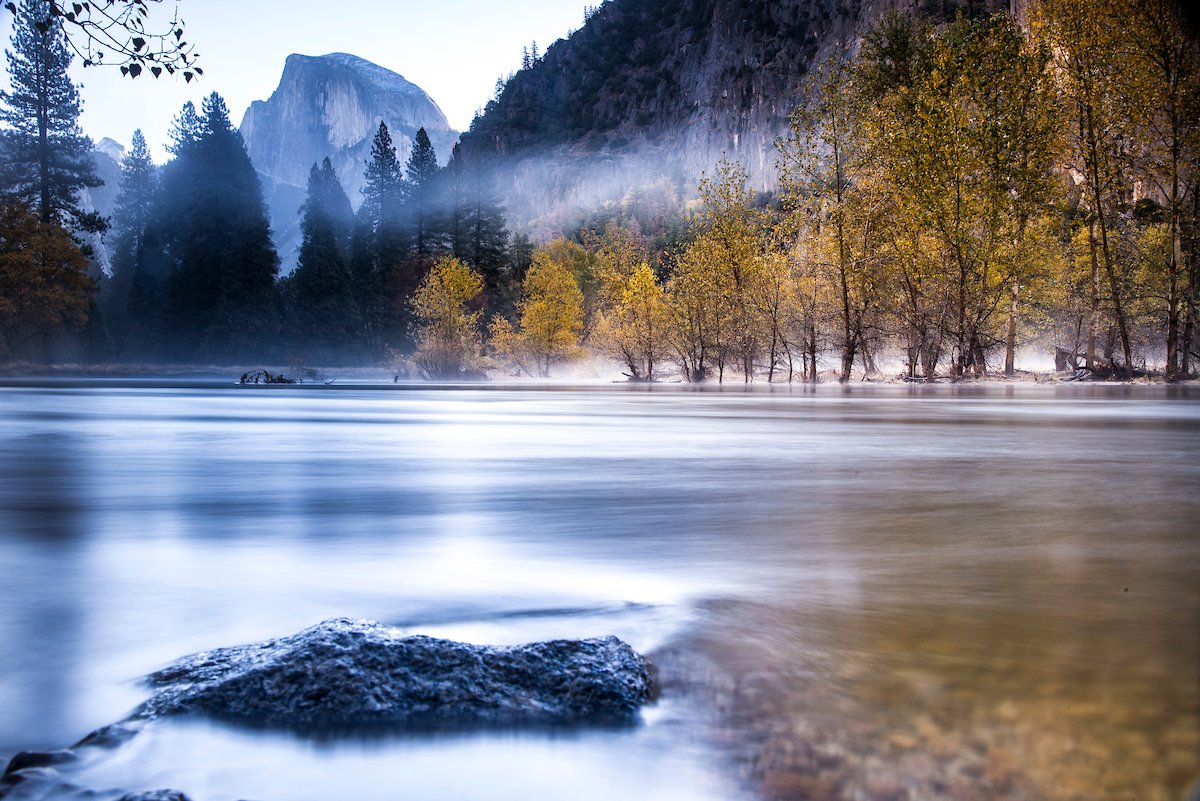
Photo by AAC member Dawn Kish
By Byron Harvison, AAC Director of Policy and Gov’t Affairs
On August 2, 2023, the American Alpine Club entered into a General Agreement with the Yosemite National Park Service with the goal of supporting and promoting climbing in Yosemite Valley. This new formalized partnership is built upon a strong foundation of working together for decades—including on projects like the Yosemite Big Wall Permitting Program, Climber Coffee, sponsoring Yosemite Facelift, and the United in Yosemite festival. This opportunity will allow the AAC to assist the climbing management program at YNPS with public outreach, offer subject matter expertise on climbing stewardship matters, and identify other projects and services which could benefit the Park and climbing community—building on the long established and well-loved climbing iniatives that will continue to exist in the Park.
The AAC has a long history of supporting climbing within the Park and working with Park staff to educate climbers on issues related to climbing in the Park, identifying areas of historic significance, such as Camp 4, and promoting volunteerism. This General Agreement represents the AAC taking on a more formal role. At a time when visitorship of Yosemite National Park, and most National Parks, is at an all time high and park budgets are not being increased to meet the demand, relationships such as this can help bridge the gap.
Key among the intended responsibilities of the Club is the continued refinement and encouragement of responsible climbing practices and stewardship of the climbing areas and infrastructure supporting climbing activities within the Park. This could include working with the Park on impact mitigation projects, maintenance, and construction of climbing related structures or trails, and coordinating and informing volunteers to assist with those projects when appropriate. The Club will assist in the distribution of safety information, closures, and informing the community regarding Park-specific regulations. This work will also include educating climbers on the ins-and-outs of the recently instituted Big Wall Permitting Program, which is a free self-registered permit that is required of all climbers overnighting on big wall climbs. Park staff will look for the AAC’s input on climbing-ethics related issues such as how to address gear-dumping, fixed lines, and storage on top of climbs for top-down attempts on the walls as opposed to embracing the ground-up ethos.
The AAC worked closely with the YNPS staff on the Agreement to outline the areas the Club can have the most impact on the climbing community and the Park, and coordinate work with other organizations such as Yosemite Conservancy and the Yosemite Climbing Association. We greatly appreciate the attention the climbing management program at YNPS has given this matter, and the enthusiastic support from Yosemite National Park. We are thoroughly excited about the opportunities this historic agreement makes possible!
Learn More from our Interview with Head Yosemite Climbing Ranger Jesse McGahey
For Media Enquiries
American Alpine Club Contact, Vice President of Marketing and Communications
Shane Johnson, [email protected] or 303-384-0110
Yosemite National Park Media Contact
Scott Gediman, [email protected] or (209)742-3519
Appeal Aims to Protect California’s Pine Mountain, Reyes Peak from Controversial Logging Project
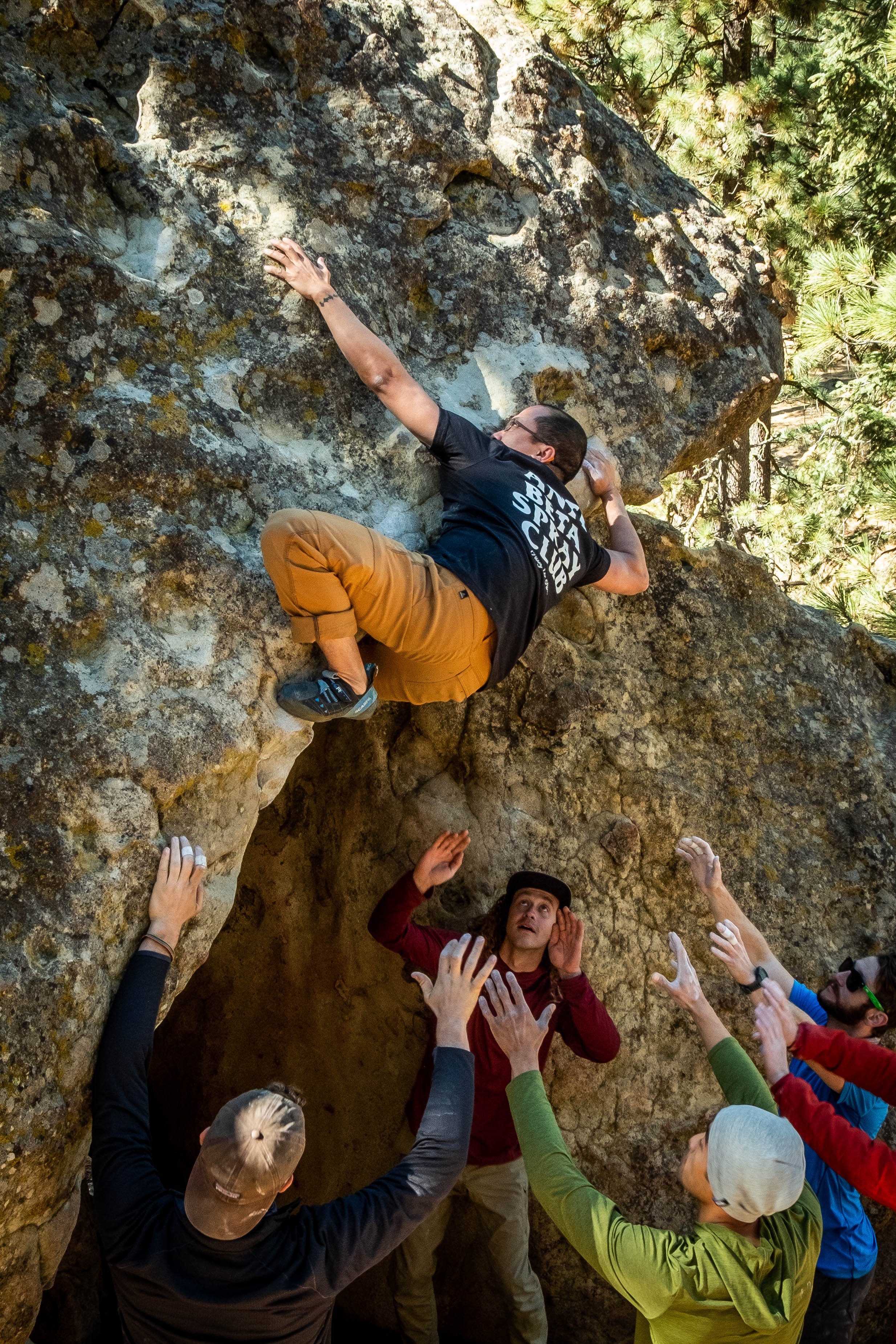
Reposted from the press release of Los Padres ForestWatch
Conservation groups filed an appeal on September 19th in the 9th U.S. Circuit Court of Appeals to cancel a controversial logging and vegetation clearing project atop Pine Mountain and Reyes Peak in Southern California’s Los Padres National Forest.
The appeal seeks to protect a remote ridgeline important to Indigenous groups, climbers, hikers, and other outdoor enthusiasts concerned about the future of this popular forest. In 2022, a coalition of conservation organizations filed lawsuits against the Forest Service on the grounds that the logging and chaparral clearing project would violate environmental laws, harm vulnerable wildlife, and do irreparable damage to the ecology of the forest.
“This logging project would devastate some of the most diverse and unique habitats in the Los Padres National Forest,” said Hans Cole, vice president of Environmental Activism at Patagonia. “Pine Mountain is 90 minutes from our headquarters in Ventura and the area is important to our employees and customers because of its outdoor recreation opportunities including rock climbing, hiking and camping. We will continue advocating for more conservation of Los Padres National Forest.”
The appeal seeks to overturn a U.S. Forest Service decision to cut mature trees and grind native chaparral across 755 acres on Pine Mountain. The project area — equivalent in size to 575 American football fields — is on ancestral lands of the Chumash, who call the mountain ‘Opnow. It is historically and culturally important to Indigenous people, popular with locals and tourists for a range of recreational activities, and home to old-growth conifer forests and unique ecosystems.
“Commercial logging and other activities allowed under the Reyes Peak Project would do irreparable harm to vulnerable wildlife and pristine areas of the forest,” said Maggie Hall, Deputy Chief Counsel at the Environmental Defense Center. “This appeal is critical to protect this beautiful natural place and prevent logging companies from exploiting a sacred cultural site.”
“Today’s appeal seeks to hold the Forest Service accountable for exploiting loopholes, disregarding public input, and threatening irreparable damage to one of our region’s last remaining mature and old growth forests,” said ForestWatch executive director Jeff Kuyper. “We are asking the Ninth Circuit to set aside this dangerous approach that places our forests, our climate, and our communities at risk.”
The U.S. Forest Service approved the logging and clearing in 2021 amid widespread criticism, with more than 16,000 people opposing the project. Indigenous groups, ecologists, archaeologists, retired U.S. Fish and Wildlife and Forest Service scientists, local business owners, dozens of conservation organizations, elected officials, and others requested major changes to the project and an environmental review before moving forward. Most commenters were concerned about using heavy equipment to cut large, healthy trees, possibly using a commercial timber sale. Forest Service officials dismissed these concerns and did not make any changes to the project.
“Most of the current science finds that removing trees from forests creates a hotter, drier, and windier microclimate that actually increases overall severity in wildfires,” said Dr. Chad Hanson, forest ecologist with the John Muir Project of Earth Island Institute.
“The climbing areas and landscape at Pine Mountain deserve to be protected and preserved in order to allow future generations to discover and enjoy the many recreational opportunities the area offers,” said Byron Harvison, Director of Policy and Government Affairs at The American Alpine Club. “Pine Mountain's storied history in local climbing lore, as well as its unique topography and biology, deserve a closer analysis before the terrain is changed forever.”
Last year the groups sued the Forest Service in U.S. District Court, saying the project would violate environmental laws, harm vulnerable wildlife, and damage intact roadless areas in the forest. The groups alleged violations of the Healthy Forests Restoration Act, National Environmental Policy Act, Roadless Area Conservation Rule and National Forest Management Act. In July a federal judge ruled against the groups and allowed the project to proceed.
“Pine Mountain represents a uniquely special environment for its high elevation ancient conifers, its views to our offshore islands, and its variety of recreation opportunities,” said Keep Sespe Wild conservation director Alasdair Coyne. “Logging these old growth conifers will do nothing to protect homes from forest fires, as there are no buildings for miles around.”
“Pine Mountain includes some of Southern California’s last remaining roadless areas, including beautiful old-growth forests that provide crucial wildlife habitat,” said Justin Augustine, a senior attorney at the Center for Biological Diversity. “These forests deserve to be protected, not logged. We’re relying on the appeals court to stop this reckless project.”
Groups filing the appeal are Los Padres ForestWatch, Keep Sespe Wild Committee, Earth Island Institute, and American Alpine Club, represented by the Environmental Defense Center; and the Center for Biological Diversity, California Chaparral Institute, and Patagonia Works, represented by the Center for Biological Diversity.
Transforming the Conditions for the Send
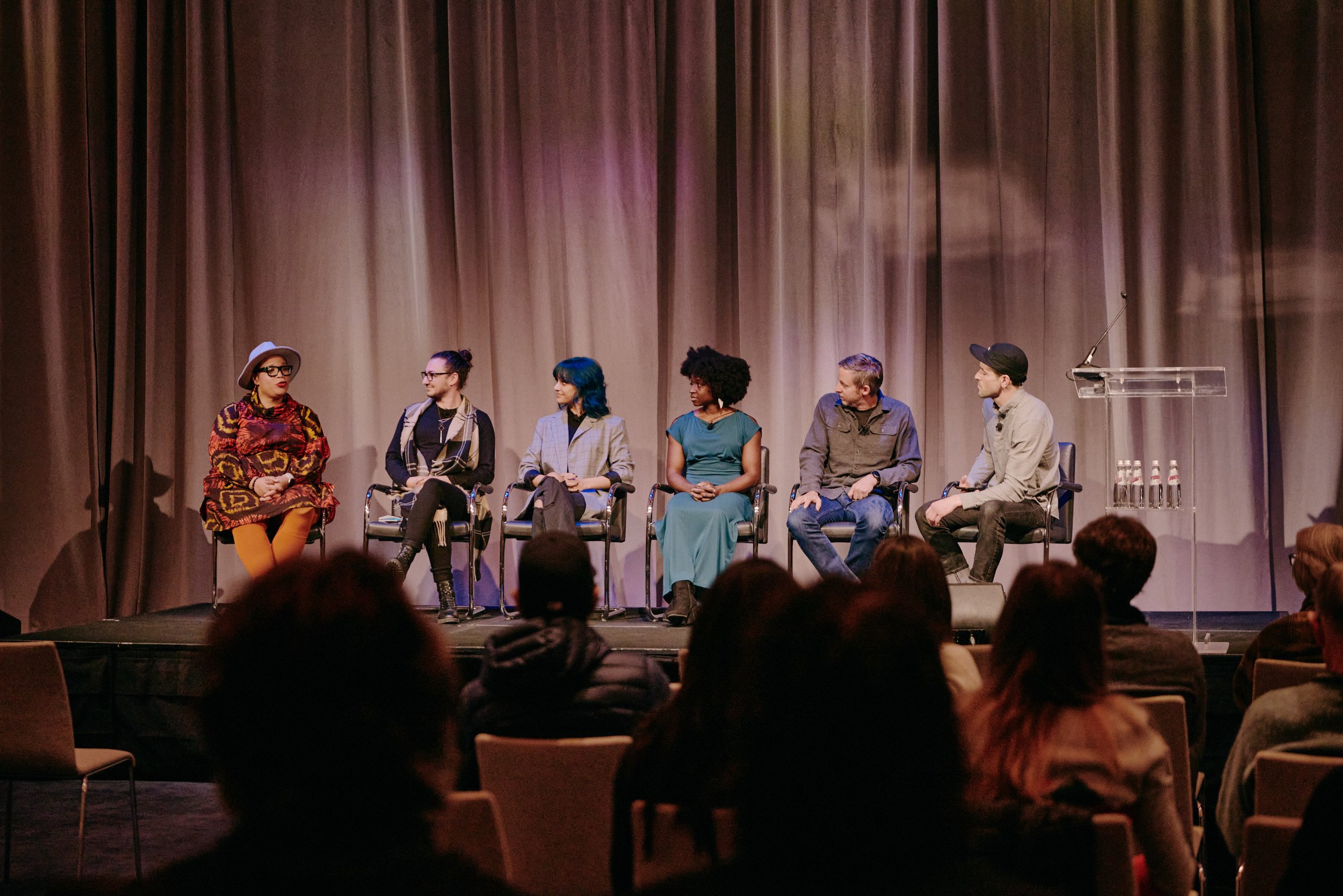
Saturday Session panelists Kareemah Batts, Roshni Brahmbhatt, Lyndon Cudlitz, Ady Wright, and Tommy Caldwell.
The 2023 Annual Benefit Gala
Together we laughed, cried, and celebrated this incredible community.
At this year's AAC Gala, the energy for advocacy was unprecedented. You could feel it in the room, the energy to transform the conditions for the send. At the AAC, we know there are a mess of things impacting the send, not just the weather! Bigger picture—climate change, equitable climbing access and inclusive community, the conservation of public lands, ever evolving climbing management plans, and education for climbers—are all impacting our climbing. At the AAC, we're fighting to transform those conditions in order to protect the heart of climbing—the people and places who make climbing so special. At this year's Gala, the climbing community turned out in force to support and celebrate this transformation.
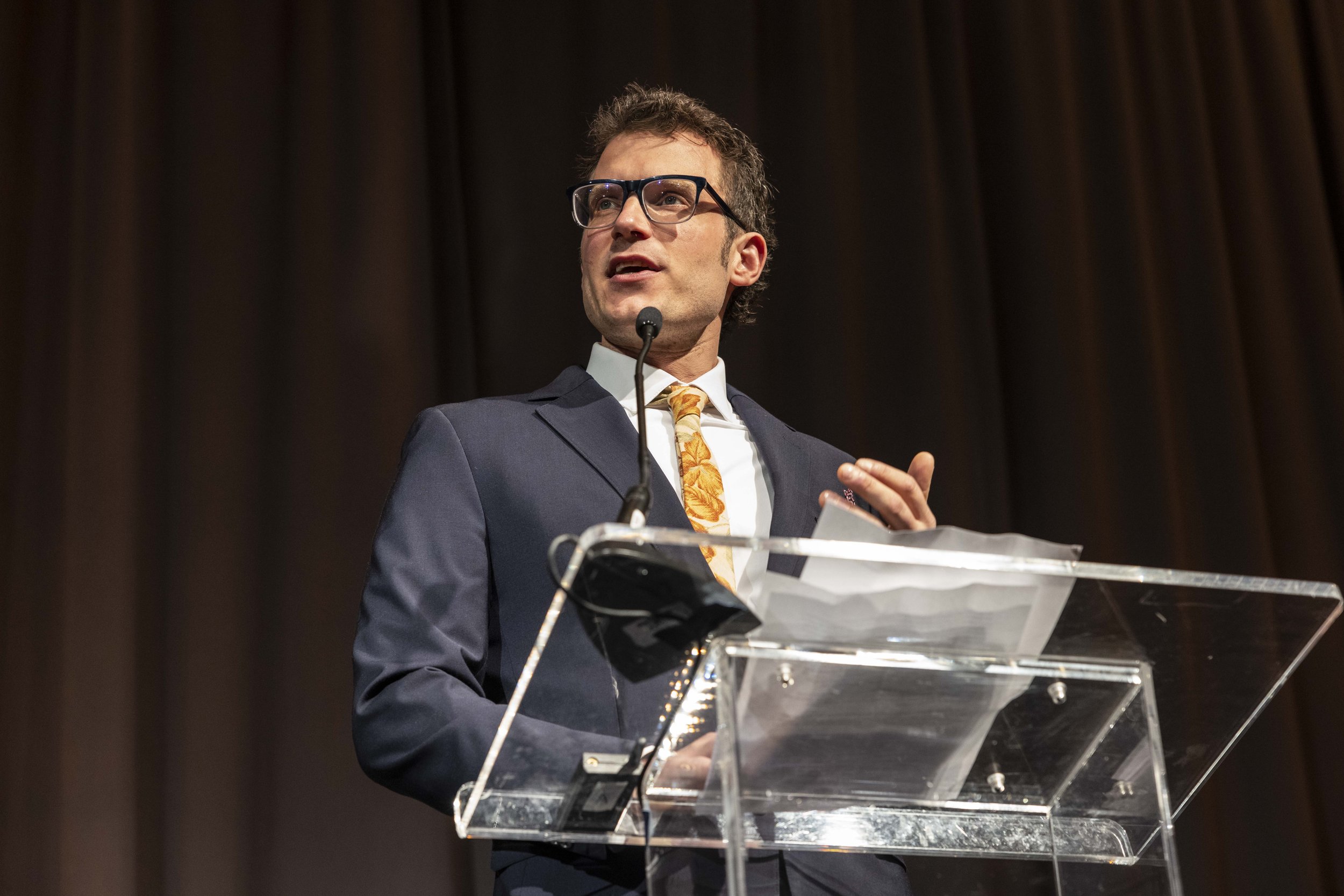

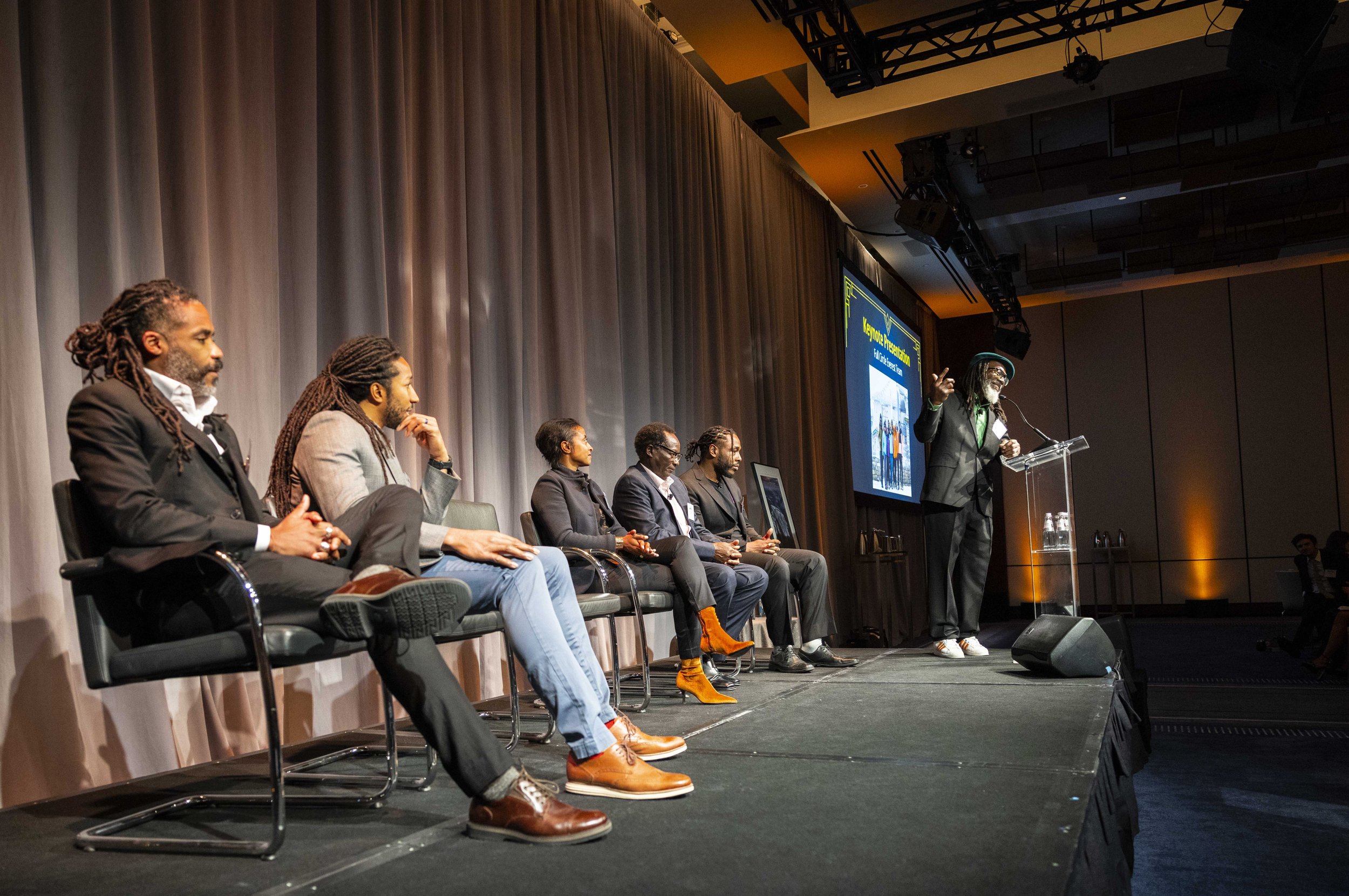
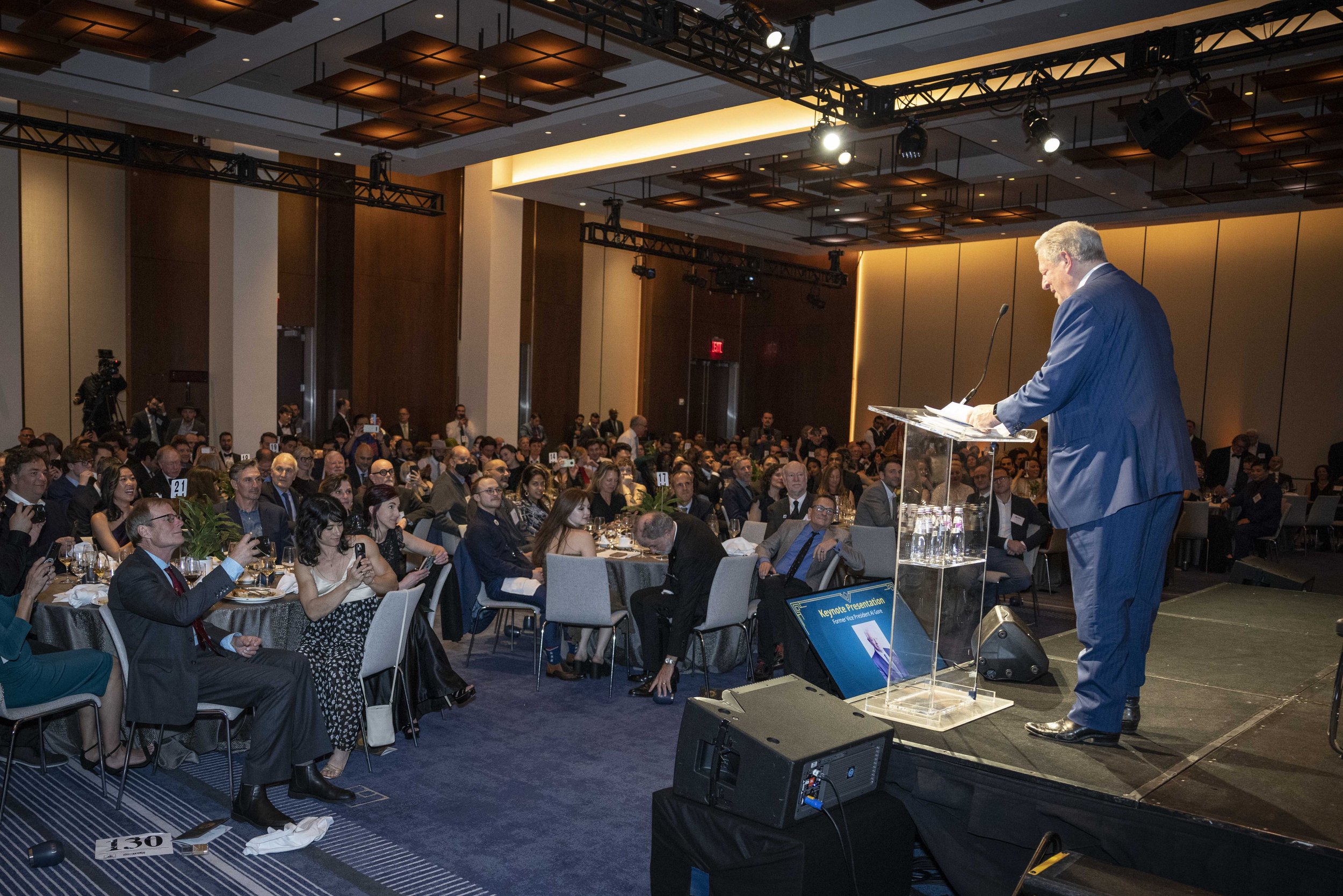
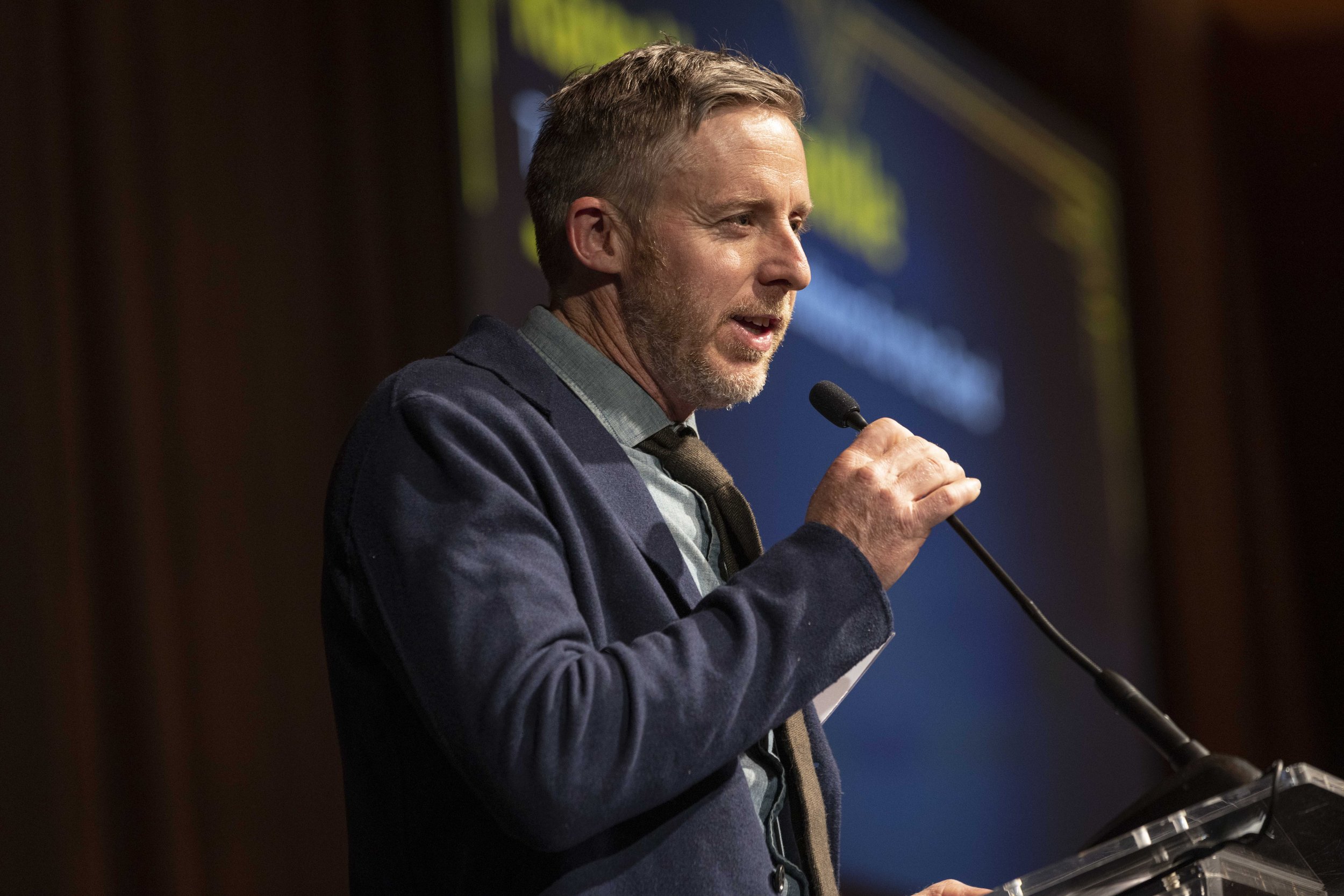
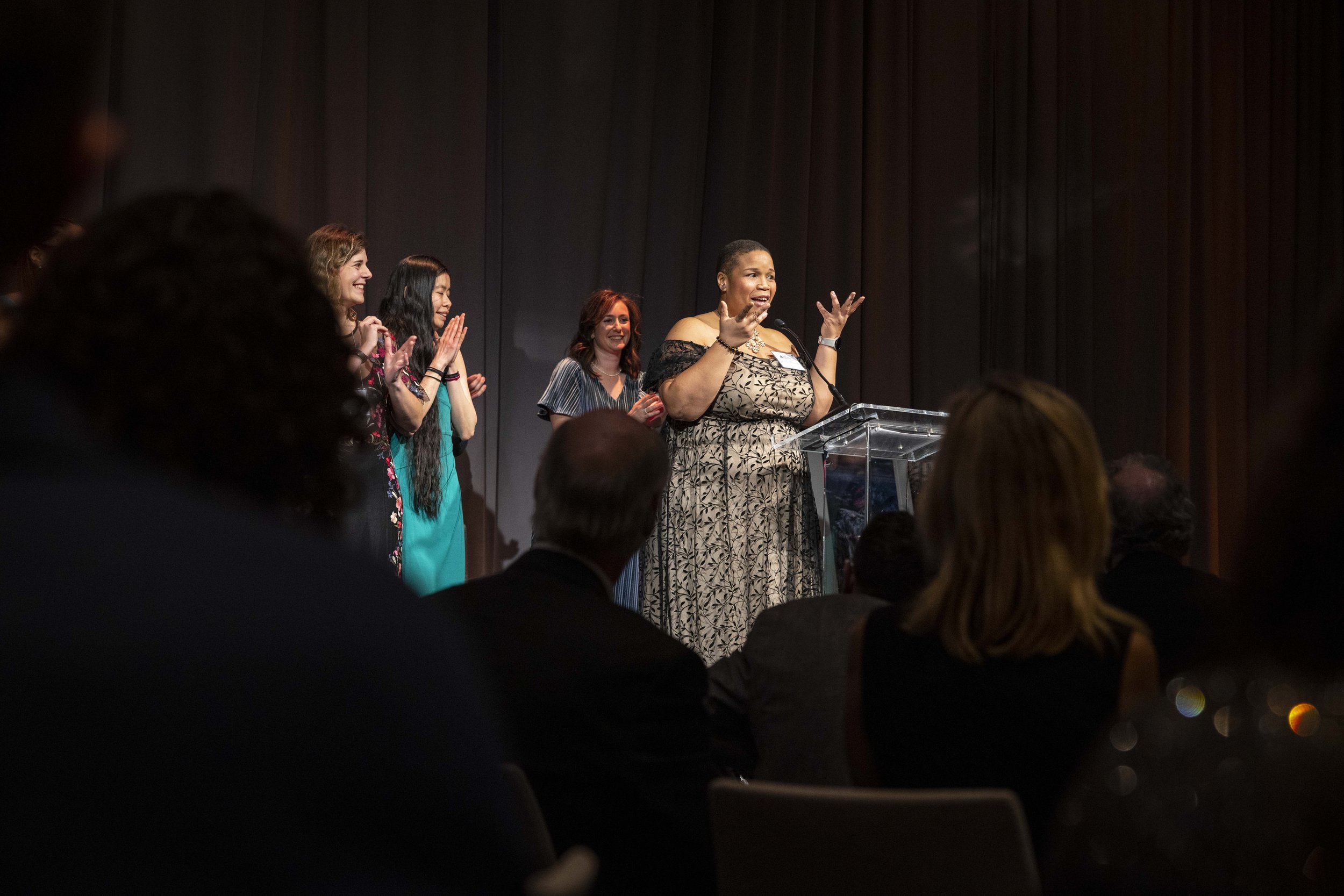
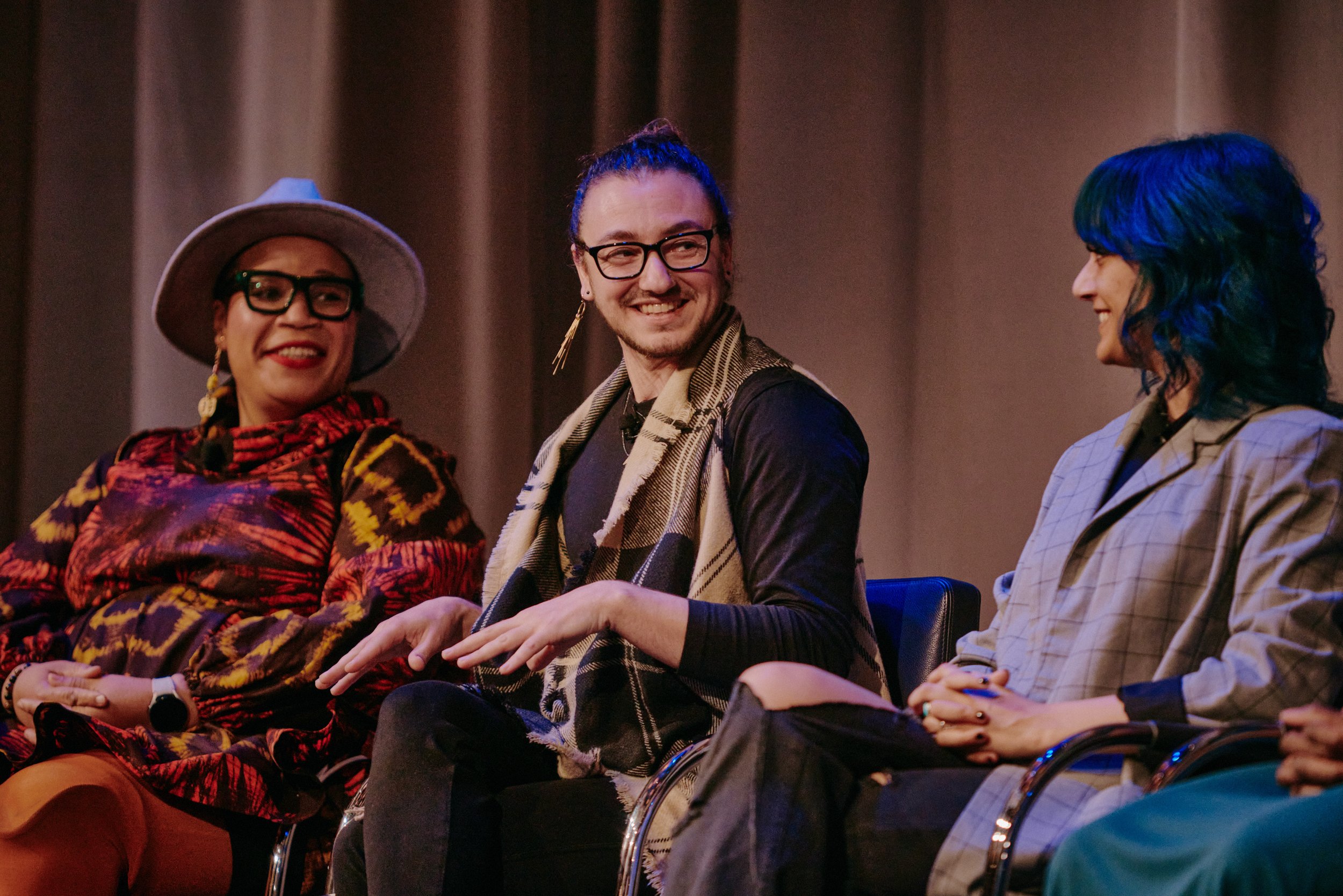
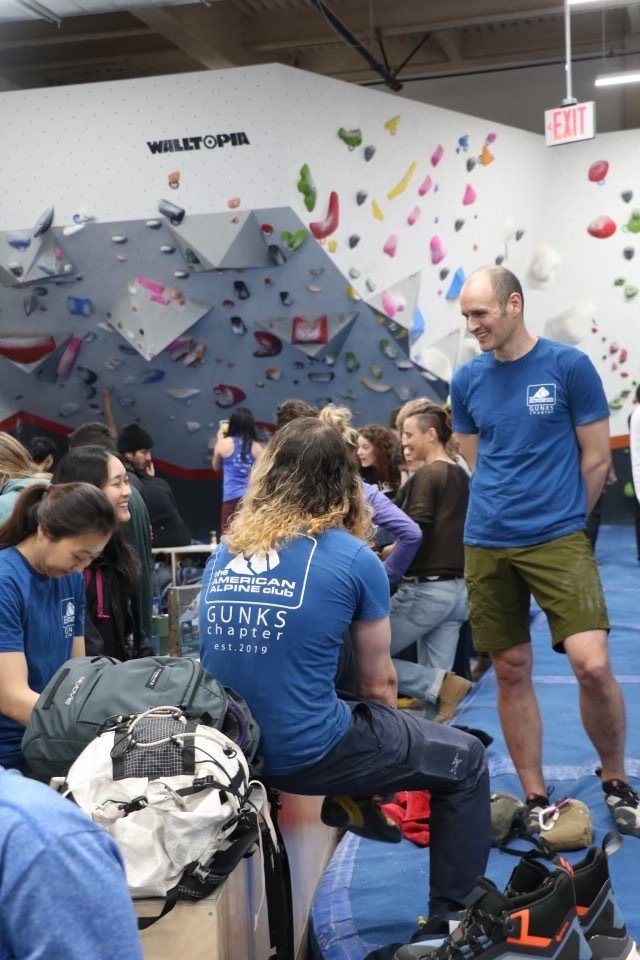
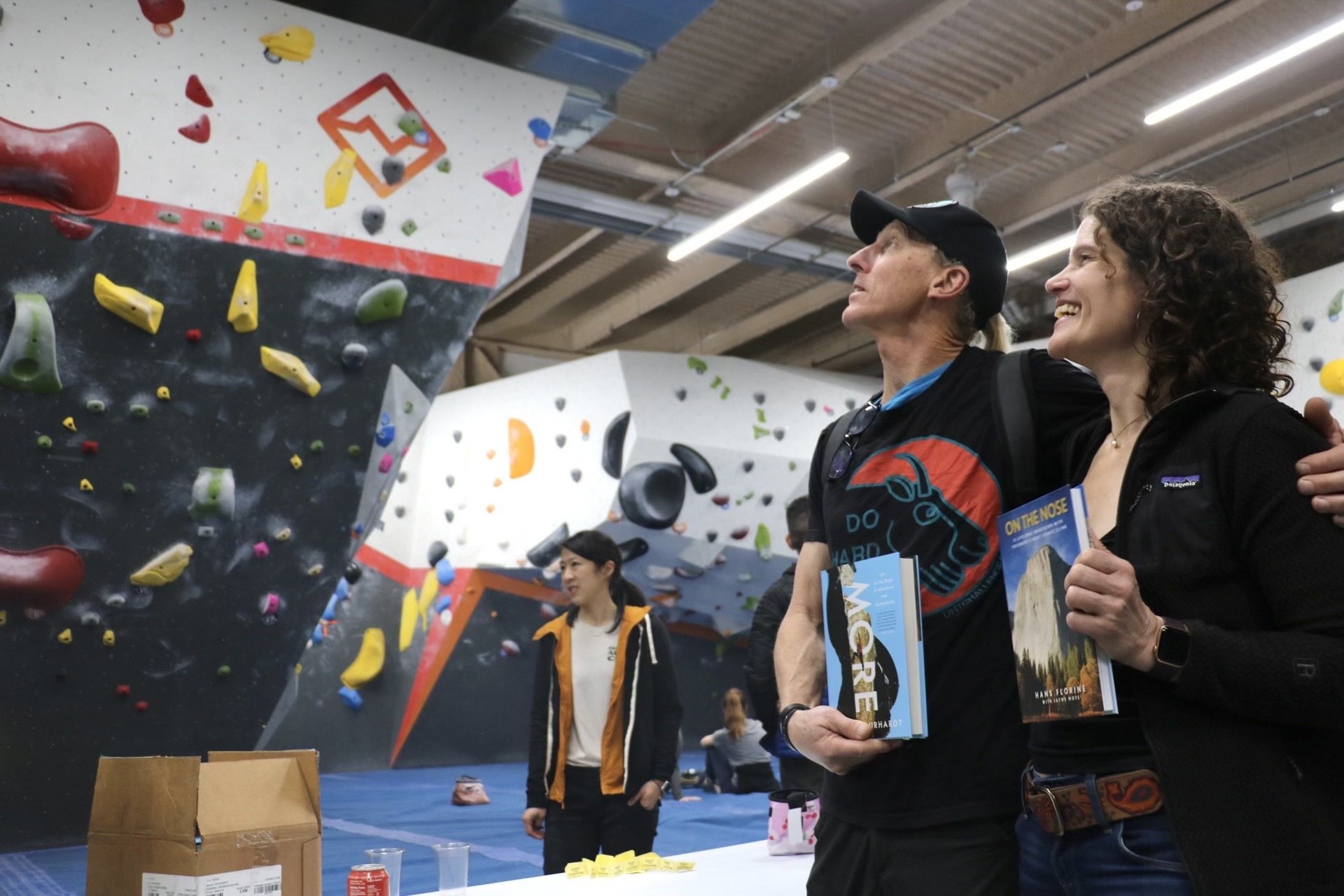
Climbers near and far came together to celebrate the boldness that is crucial for our climbing endeavors and advocacy. We were joined by Former Vice President Al Gore, the Full Circle Everest Team, and a room full of AAC members, industry leaders, and climbing stars.
Dive deep into an unforgettable night in climbing, below!

We've Signed the Indigenous Field Guide, Here's Why

PC: Dawn Kish. Recreating at Oak Flat, land sacred to the San Carlos Apache Tribe.
When we were first asked to sign the Indigenous Field Guide pledge, we as an organization were challenged by how broad many of the tenets were, and how they were inconsistent with many of the current practices of climbers today. While some of the tenets of the pledge ring familiar with Leave No Trace Ethics, such as respecting rock art and staying on trails, other elements of the pledge—such as refraining from rock stacking, or seeking permission to share geographic locations from local Tribes—initially led us to a place of defensiveness. However, we also recognized this reaction should be seen as an impetus to really examine what the pact meant, and why we were reacting in this way.
The AAC has decided to sign onto the pledge, and we’re happy to share why.
Coming from a perspective of Western thought, we are accustomed to taking pacts such as these literally, assigning truth to every word, and were thus afraid we would be signing it performatively. We feared that we would not be able to fully comply with the pact, and instead would continue the pattern of broken promises experienced by Indigenous Tribes since the days of early settlers.
However, through multiple and overlapping conversations with the writers of the Indigenous Field Guide, we came to understand the spirit of the pledge and the value of committing to it despite our hesitations. Fear of failing would only prevent us from growing.
For example, we learned through various discussions with the writers of the pledge that the deepest importance of the imperative to seek permission before sharing coordinates is about protecting undefended Indigenous archeological and cultural sites that are as yet unrecognized or do not have conservation protections. This imperative is a manifestation of the last and most comprehensive directive from the Indigenous Field Guide writers: “I promise that exploration and first ascents are never more important than cultural resources.”
The AAC has a long-standing practice of publishing GPS coordinates of new routes in order to fulfill our mission of supporting and informing climbers. In fact, the sharing of GPS coordinates seemed a step in the direction of inclusion, so that no one developer or elite climber would “hoard” or gate-keep knowledge of a particular climbing area and make climbing that much less accessible for many people. Yet we had not considered how in certain cases, such sharing of coordinates can threaten areas of cultural significance to Indigenous peoples, with increased traffic threatening the spirituality of the sacred place, increasing erosion, and increasing potential defacement.
In addition, we learned that the request to not stack rocks is not a ban on cairns, but rather a way to highlight that the land should be as untouched as possible, and remain exactly as it is, unless steps are necessary (such as marking a trail in wilderness areas) in order to accomplish that goal of minimal impact. Specifically, balancing rocks and creating rock gardens in rivers and streams can destroy fish habitats in the immediate vicinity and downstream.
We as an organization have signed the Indigenous Field Guide Pledge and have started examining how we can transform our internal practices to align with what we have learned. By committing to the pledge, we are committing to staying in the conversation as we move forward collectively. What does that look like for us, the AAC?
We continue to encourage climbers to be conscientious of their impacts on land and people.
Moving forward, the American Alpine Club strongly encourages grant applicants to consider the locations of their pursuits, and when possible to seek out consent from local Tribes before climbing and before publicly sharing coordinates. For many of the grants, having the endorsement of local Tribes will be a condition for the grant to be awarded.
In cases where publication of coordinates might draw large numbers of new visitors to an area, the editors will urge contributors to our publications to consult with local Tribal leaders about the sensitivity of the area and any potential impacts.
We encourage our members and community to learn more here and to sign the pledge for themselves, if they likewise see value in holding themselves accountable to learning and recreating with this context of Indigenous knowledge.
The AAC Podcast Wants Your Craziest Climbing Stories!

Photo by AAC member Joe Virtanen
Have you ever taken a 100-foot fall into a cactus, and walked away with basically no injuries? Taken a whip on a can of pinto beans, just to see what would happen? Or had to deal with a bullet wound while out climbing, like Aubrey Runyon discusses in our recent podcast episode “CONNECT: Climbing 10,000 Pitches in Eldo”? Maybe it’s the biggest whip you almost had to take, or an encounter with an alpine ghost…whatever it is, we want to hear the stories of your craziest day while climbing.
We’re not necessarily asking for your worst crag stories ever, or stories of accidents in the backcountry, though that might be wrapped up in all the crazy. But tell us the most absurd, completely out-there stories that you can think of, and we might feature your story on our podcast!
One of our episodes in January will feature the stories of AAC community members like you. Make sure to submit your stories before January 1st 2023 to get the chance to be featured.
Join Us! We're Hiring
We're Hiring for our Policy and Climb United departments, and we couldn't be more excited.

People—climbers—are our lifeblood.
And climbers have an intimate relationship with the land we recreate on. You can't disentangle the climber from the climbing.
With that understanding in mind, we're linking and expanding our DEI work and policy work so that these initiatives work in tandem. Moving forward, Climb United and our Policy team will be working hand in hand to accomplish the AAC's advocacy and equity objectives.
Learn more about the team, how to apply, and our vision:

The American Alpine Club Announces 2022 Cutting Edge Grant Recipients
PC: Priti Wright, K6 Central
March 2022
The American Alpine Club and Black Diamond Equipment are pleased to announce the 2022 Cutting Edge Grant recipients. The Cutting Edge Grant continues the Club's 100-year tradition and seeks to fund individuals planning expeditions to remote areas featuring unexplored mountain ranges, unclimbed peaks, difficult new routes, first free ascents, or similar world-class pursuits. Four recipients have been awarded a total of $37,000 for this cycle, with objectives featuring a low-impact style and leave-no-trace mentality being looked upon with favor. Black Diamond Equipment is a proud sponsor of the Cutting Edge Grant and a key partner in supporting cutting-edge alpinism.

PC: JThompson
Chantel Astorga will receive a grant for $10,000 to attempt a new route on Lunag Ri (6,895m) in Nepal. Chantel, alongside Anne Gilbert Chase & Jason Thompson will hope to establish a new line on Lunag Ri in alpine style. Chantel recently grabbed the first female solo ascent of the Cassin Ridge in under 15 hours on Denali in 2021. Anne, Jason, and Chantel established a new route on the unclimbed SW Face, Mount Nilkantha (6,500m), India in 2017.
Jerome Sullivan will receive a grant for $10,000 to attempt the first ascent of Pumari Chhish East (6,850m) in the Pakistani Karakoram. Pumari Chhish East is one of the major unclimbed technical summits of Karakoram. Located on the Hispar glacier, it presents three characteristic granite pillars and a 2,000m face. Jerome will attempt the climb alongside Martin Elias, Victor Saucede, and Jeremy Stagnetto. Recently the team climbed K13 west by the new route Harvest Moon. Jerome & Jeremy did the first ascent of the southeast ridge of Cerro Murallon (Patagonia) and the first ascent of Pyramid Peak in the Revelation Range (Alaska).


Alan Rousseau will receive $10,000 to attempt an alpine style ascent of the North Face of Jannu (7,710m) in Nepal. Given its aspect, elevation, and sheer scale (3,200 vertical meters), Jannu is considered one of the most complex alpine objectives in the world. The upper north face headwall has yet to see an alpine style ascent. Jackson Marvell will join Alan on this attempt. Jackson & Alan climbed a new route on the east face of Mount Dickey Ruth Gorge Grinder (1,600m, M7, AI6+) and repeated Trailer Park on London Tower (3,000' WI6, M6), both located in the Ruth Gorge of the Alaska Range.
Priti Wright will receive $7,000 to attempt a new route on K7 in the Pakistani Karakoram. Priti & Jeffrey Wright will attempt the unclimbed peak K7 Central (6,858m) by establishing an entirely new technical route in alpine style. During Priti and Jeff's first Karakoram expedition, they were successful in establishing the first ascent of K6 Central (7,155m) in 2020.

FA of K6 Central, Priti and Jeff Wright. PC: Jeff Wright.
The American Alpine Club has inspired and supported cutting-edge climbing achievements for over 100 years. From funding the first ascent of Mt. Logan in 1925 and the exploration of the Karakoram in 1938 to the 2006 first ascent of Nanga Parbat's Rupal Face, and the countless expeditions in between, the AAC has stood to encourage climbers to push their physical and mental limits, supported their pursuits, and celebrated their accomplishments.
The Cutting Edge Grant continues this tradition, aiming to fund advanced climbing athletes in pursuit of world-class climbing and mountaineering objectives.
The Cutting Edge Grant is sponsored by Black Diamond Equipment, whose equipment has helped climbers and alpinists to reach their summits for decades. Black Diamond Equipment is an integral partner in supporting climbers of all abilities and disciplines, with a long history of supporting climbers and their dreams through grants like the Cutting Edge Grant.
Applications for the Cutting Edge Grant are accepted each year from October 1 through November 30.
Contact:
Shane Johnson, Chief Marketing Officer: [email protected]
Eddie Espinosa, Community Programs Director: [email protected]
About American Alpine Club
The American Alpine Club is a 501(c)(3) charitable organization whose vision is a united community of competent climbers and healthy climbing landscapes. Together with our members, the AAC advocates for American climbers domestically and around the world; provides grants and volunteer opportunities to protect and conserve the places we climb; hosts local and national climbing festivals and events; publishes two of the world's most sought-after climbing annuals, the American Alpine Journal and Accidents in North American Climbing; cares for the world's leading climbing library and country's leading mountaineering museum; manages the Hueco Rock Ranch, New River Gorge Campground, Samuel F. Pryor Shawangunk Gateway Campground, and Grand Teton Climbers' Ranch as part of a larger lodging network for climbers; and annually gives $100,000+ toward climbing, conservation, and research grants that fund adventurers who travel the world. Learn about additional programs and become a member
at americanalpineclub.org.
Introducing the 2022 American Alpine Club Awardees

Each year, the American Alpine Club (AAC) has the honor of presenting its prestigious Annual Climbing Awards to outstanding climbers, conservationists, and volunteers. This year’s awards include Sean Bailey, Natalia Grossman, Rick Reese, Pat Ament, John Kascenska, John Heilprin, David Nyman, and Joe Terravecchia.
The awards will be presented at the AAC Annual Bennefit Gala on March 26, 2022 in Denver, CO.
Honorary Membership
Arlene Blum & Steve Roper will be awarded honorary memberships this year. "Both are “household” names in the climbing community and have distinguished themselves over many years in the mountains through their pioneering leadership of difficult ascents and in areas of the arts and science in mountain related endeavors.
The Robert Hicks Bates Award
Sean Bailey & Natalia Grossman will receive the Robert Hicks Bates Award which honors young climbers who show "outstanding promise for future accomplishment." The selection committee wanted to focus on competition climbing. Sean won two lead world cups and a boulder world cup in 2021, while Natalia won the boulder world championships and won two boulder world cups.
The David R. Brower Award
Rick Reese will be awarded The David Brower Conservation Award. Rick co-founded the Greater Yellowstone Coalition, now the leading conservation group fighting for the protection of this over 4.5million acre iconic ecosystem comprising nearly a dozen mountain ranges. Rick was clearly one of the most important western conservationists of our generation not to mention a bold, tenacious and accomplished pioneer climber and former climbing ranger.
The H. Adams Carter Literary Award
The AAC Literary Committee will award Pat Ament he H. Adams Carter Literary Award. Pat would have 30 books published, approaching 200 magazine articles, and 25 pieces selected for various international anthologies of best climbing writings – more than any other person. His writings include many poems in literary magazines. President emeritus of the AAC, Jim McCarthy, has called Pat "the poet laureate of American climbing writing."
Angelo Heilprin Citation
John Kascenska & John Heilprin will be awarded the 2022 Heilprin Citation for their "exemplary service to the Club." John Kascenska joined the American Alpine Club in 1996 and for many years has volunteered with several Club activities. John Heilprin served on the board of directors from 2012 to 2018.
David A. Sowles Memorial Award
David Nyman will be awarded the David A Sowles Memorial Award for the eight-day ordeal to rescue/evacuate Jim Sweeney from the base of the Elevator Shaft on Mt. Johnson in 1989. The award is conferred from time to time on mountaineers who have distinguished themselves, with unselfish devotion at personal risk or sacrifice of a major objective, in going to the assistance of fellow climbers imperiled in the mountains.
Please join us at the Annual Benefit Gala on March 26, 2022 in Denver, CO to hear from the awardees
Introducing the American Alpine Club Podcast: Episode 01

Designed by Jeff Deikis
2 min read
The American Alpine Club Podcast: Our Vision
That’s right. You can now take a deep dive into your favorite American Alpine Club content via your headphones, car stereo, and more. The drive to work—or your favorite hang board routine—just got way more interesting. Episodes will typically fall into four categories: Climb; Protect; Educate; Connect.
Climb episodes will be just that—about climbs big and small, and the things they make us realize, in conversation with AAC community members.
Protect episodes will dive into the nuances of policy and advocacy issues that matter most to climbers.
Educate episodes will span the logistics of safety and accidents, as well as the history of climbing and how it can inform our present.
Connect episodes will cover the social side of our climbing community, including important conversations about equity and inclusion that have emerged from our work with the Climb United initiative.
Check back here, the AAC Stories Archive, to find the latest episodes and show notes, and subscribe to the American Alpine Club Podcast at your favorite podcast source: Soundcloud, Apple Podcasts, Spotify, and Google Podcasts.
Episode 01
Protect: An Interview on Climate with Graham Zimmerman and Jill Pelto
“Graham Zimmerman is an alpinist and climate advocate–scaling the highest mountains in the world and energizing climbers around taking action to fight climate change. Jill Pelto is a climate artist whose aesthetic tactics of combining climate data with artistic expression is striking and thought-provoking. In this discussion, the AAC dives in with Graham and Jill about communicating the intricacies of climate change, climate impacts they’ve personally witnessed in the mountains, what motivates them to advocate, and why it matters to climbers so damn much.”
2021 Cornerstone Conservation Grant Recipients
As we look ahead to the future of climbing and the availability of outdoor recreation opportunities for all, the American Alpine Club’s (AAC) Cornerstone Conservation Grant represents our commitment to supporting local climbing communities in their conservation and restoration initiatives.
More individuals, families, and groups are spending time in climbing areas and landscapes, causing added environmental stress and degradations to these places. We look to local climbing communities to identify areas in need of conservation, restoration, and educational resources for visitors.
The AAC Cornerstone Conservation Grant, powered by REI, formally launched in 2011 with the goal of funding projects to improve, conserve, and protect local climbing resources across the country. Since that first year, we have awarded over $250,000 to local climbing organizations (LCOs), land managers and agencies, nonprofits, and individuals for projects as varied as building or improving trail networks to climbing areas; establishing new toilet facilities and signage at trailheads; and deploying a variety of community groups for clean-up and graffiti removal at local crags.
2021 Winners:
Salt Lake Climbers Alliance - Jacobs Ladder Reroute to Lone Peak Cirque
$2,000
The Salt Lake Climbers Alliance, with support from the Salt Lake and Pleasant Grove Ranger Districts, are proposing a reroute on a steep section of unsustainable trail to Lone Peak Cirque known as Jacob’s Ladder. This multi-use trail is perhaps the worst in the Wasatch with erosion up to six feet deep!
Boulder Climbing Community - Avalon Climbing Area Access Trail Project Phase II
$5,000
BCC will reroute the main approach trail accessed by crossing Boulder Creek. The current approach trail quickly leads up a dirt slope that is continually eroding due to user traffic and environmental impact such as water runoff. BCC will realign this approach trail, building a sustainable and durable path within the talus field, ensuring that continued user traffic no longer erodes the vegetated hillside.
Mohonk Preserve, Inc. - Promoting Low Impact Climbing
$3,000
Mohonk Preserve’s increase in climbing activity in recent years have necessitated extra steps for the preservation of climbing areas to avoid environmental damage and climbing accidents. This grant will fund an educational information campaign based on Low-Impact Climbing and Leave No Trace principles to ensure that climbers have the skills to engage with the environment mindfully.
Carolina Climbers Coalition - Bald Mountain Creek Preserve Bouldering
$3,000
In 2020, the Carolina Climbers Coalition began working with Southeastern Trust for Parks and Land (STPAL) to develop a strategy for publicly permissible bouldering access on their 750 acre preserve called the Bald Mountain Creek Preserve. Located near Burnsville, NC, the Preserve contains 45+ boulders with approximately 250 problems. The Preserve has three boulder fields; McKinney Gap, Weaver Knob, and Buckhouse. With funds from this grant, we hope to build a parking lot that will open the Weaver Knob and the Buckhouse Boulders, and we hope to aid our C4 Trail Team with funding. Currently, Weaver Knob and Buckhouse Boulders do not have any parking and can not be opened to climbing without parking and trail infrastructure.
Durango Climbers Coalition - Animas City Mountain restoration initiative
$5,000
The funds requested will be used to help La Plata County install two trailhead signs, and three wayfinding signs as well as match a potential grant request from the Access Fund for the development of a tool cache which will allow the DCC to complete necessary trail improvements at X-Rock and other climbing areas near Durango.
Southeastern Climbers Coalition - Education Signage Updates at SCC-owned Properties
$2,000
SCC owns and manages 8 climbing areas across Tennessee, Alabama and Georgia. The climbing community continues to grow and more climbers are visiting our properties for the first time, therefore the need for clear signage and accurate property maps is vital to the long-term sustainability of our climbing resources. Using the results from our 2020 resource inventory project, we have identified the need for boundary and trail markers, access road signage and kiosk updates relative to each location. We are partnering with University of Tennessee's IGT lab to create new property maps at several of our climbing areas. SCC is seeking funding to hire a graphic designer to help with design updates as well as to cover the cost of sign printing and installation.
CRAG-VT (Climbing Resource Access Group - Vermont) - CRAG-VT Stewardship Cache Project
$2,500
CRAG-VT is seeking funding to support the procurement of stewardship supplies to match our greatly increased level of volunteer activity. Grant money will be used for purchase of tools, a shed, and stewardship day event materials.
Washington Climbers Coalition - Washington Climbers Conservation Initiative
$2,500
A beginner crag close to a major metro area has seen heavy impacted over the last 4 years. This multi-year project plans to address this by performing trail reroutes, closing none sustainable trails, and installing steps upper steeper portions of the area.
Partner In Adventure Grant Recipients Announced

What is the Partner in Adventure Grant?
The Partner in Adventure Grant, created in collaboration with TINCUP Whiskey, funds educational opportunities from local guide services for you and your partner to take your pursuit to the next level. Open to duos of all experience levels, the grant will award partners up to $1,000 for the educational opportunity of your choice.
2020 TINCUP Partner in Adventure Grant Recipients
The American Alpine Club and TINCUP Whiskey are pleased to announce the winners of the 2020 TINCUP Partner in Adventure Grant. In total, $20,000 was awarded to 20 partners in adventure.
A partner in adventure is there with you as you dream up the next big pursuit. They encourage you to push beyond your comfort zone and motivate you to explore the world in ways that are meaningful to you. They galvanize you to take on new challenges, grow your skills, and imagine new adventures, by their side.
Congratulations to the 2020 grant winners, and cheers to the many adventures that await them.
Madeline & Katie – AK | NOLS Wilderness Emergency Medical Technician
Kit & Emma – AK | Avalanche Professional 1 Course
Angela & Emily – NY | Multi-Pitch Climbing
Mick & Kaiwen - WA | AIARE Level I Avalanche Course & Mt. Baker guided climb
Daniel & Jessie – OH | Introduction to Mountaineering - Mt. Washington, 3-day guided climb
Geoffrey & Dave - MA | Introduction to Mountaineering - Mt. Rainier, 4-day guided climb
Alex & Jason – ID | AIARE Level I Avalanche Course
Marissa & Mary – AK | AIARE Level I Avalanche Course
Shauna & Idaliza – AZ | Introduction to Mountaineering – North Cascades guided climb
James & Patrick – OR | AMGA Single Pitch Instructor Course
Lucas & Manny – CO | AIARE Level I Avalanche Course
Christopher & Andrew – MD | Accelerated Mountaineering Course
Jamie & Sam – WA | Ski Mountaineering Course – Mt. Baker, 3-day guided course
Andrew & Melissa – TN | Gym to Crag Course
Janelle & Luke – CO | AIARE Level I Avalanche Course
Jason & Jason – WA | Glacier Travel & Crevasse Rescue Course
Laura & Andrea – IL | Anchors I, II & III Courses
Amanpreet & Soyna – CT | Rock Climbing Development Series, Level II Course
Adrien & Connor – OR | Guided Climb of Mt. Baker
Ellen & Lindsay – AK | Glacier Travel & Crevasse & 6-day Mountaineering Course

TINCUP Partner in Adventure Grant recipients Angela and Emily.
“Emily and I have dreamed about traveling to my homeland, Vietnam to climb and share in the whole culture of the country my family is from. But in order to take a trip like this, we need to seriously step up our technical skills game.”
Live Your Dream Grant Applications Now Open
This is your climbing club | This is your climbing grant.
Application period: January 15th through February 28th
The Live Your Dream grant, powered by The North Face (TNF), was founded on the belief that our definitions of exploration and our goals are unique to each of us. Meaningful exploration isn’t limited to the highest peaks in the farthest reaches of the world. Your local gym, crag, and backyard mountains are equally important resources to help stoke inspiration for adventure. When we search out new experiences, overcome obstacles, and connect with each other, through exploration, we change ourselves.

This grant supports the every-day adventurers who harness this mindset for their own exploration. We are looking for individuals who have a personally ambitious climbing goal, a desire to take their abilities to the next level, and want to share the power of exploration with their communities.
Open to all ages, all experience levels, and all climbing disciplines—from bouldering to big walls, alpinism to ski mountaineering, peak bagging to bolt clipping, and everything in between—we encourage you to dream big, let curiosity lead you, and apply.