Guidebook XV—Balance

A Profile on Robert Hicks Bates Award Winner Brooke Raboutou

By Sierra McGivney

Photos by Jess Glassberg/LouderThan11

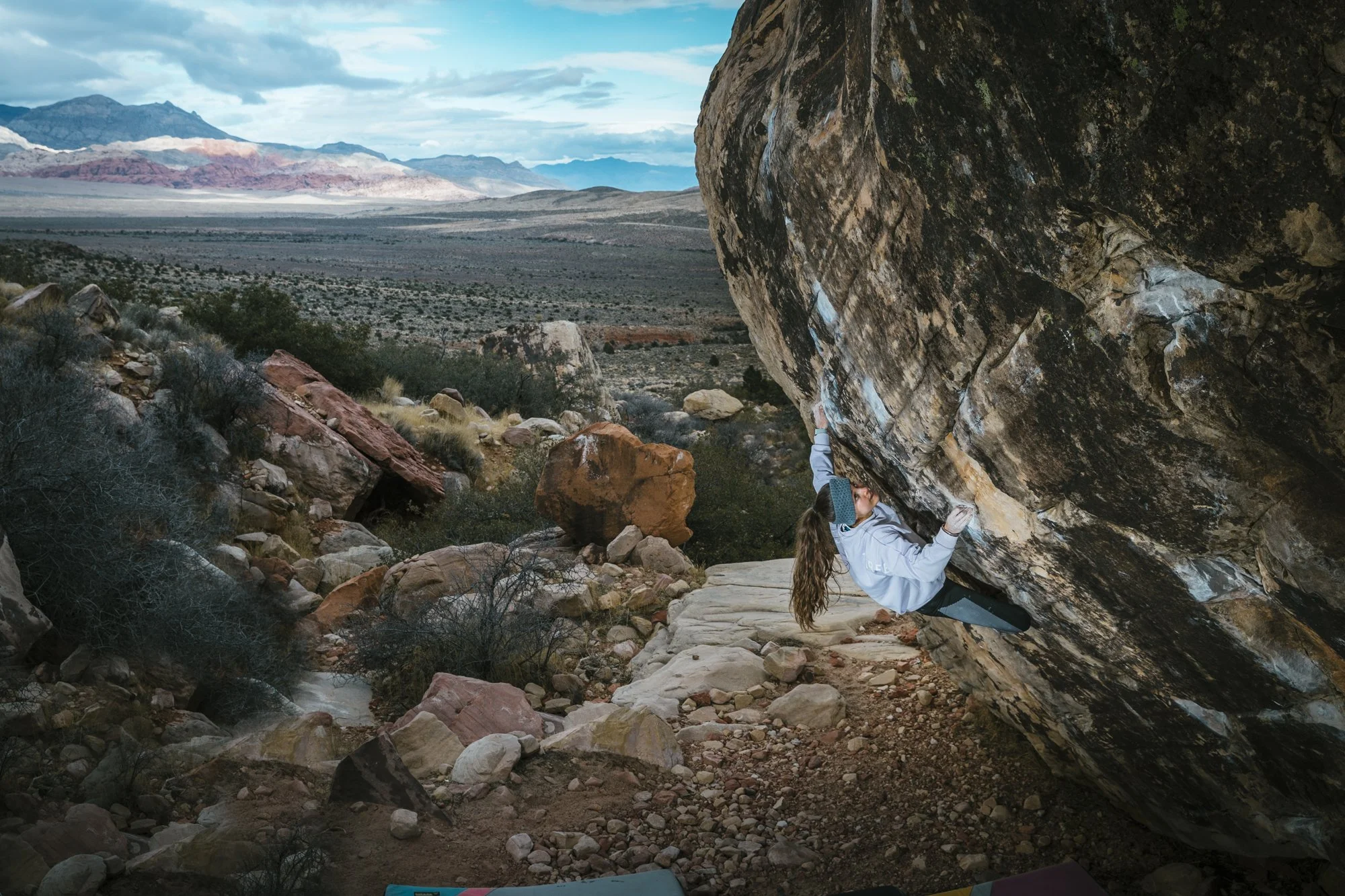
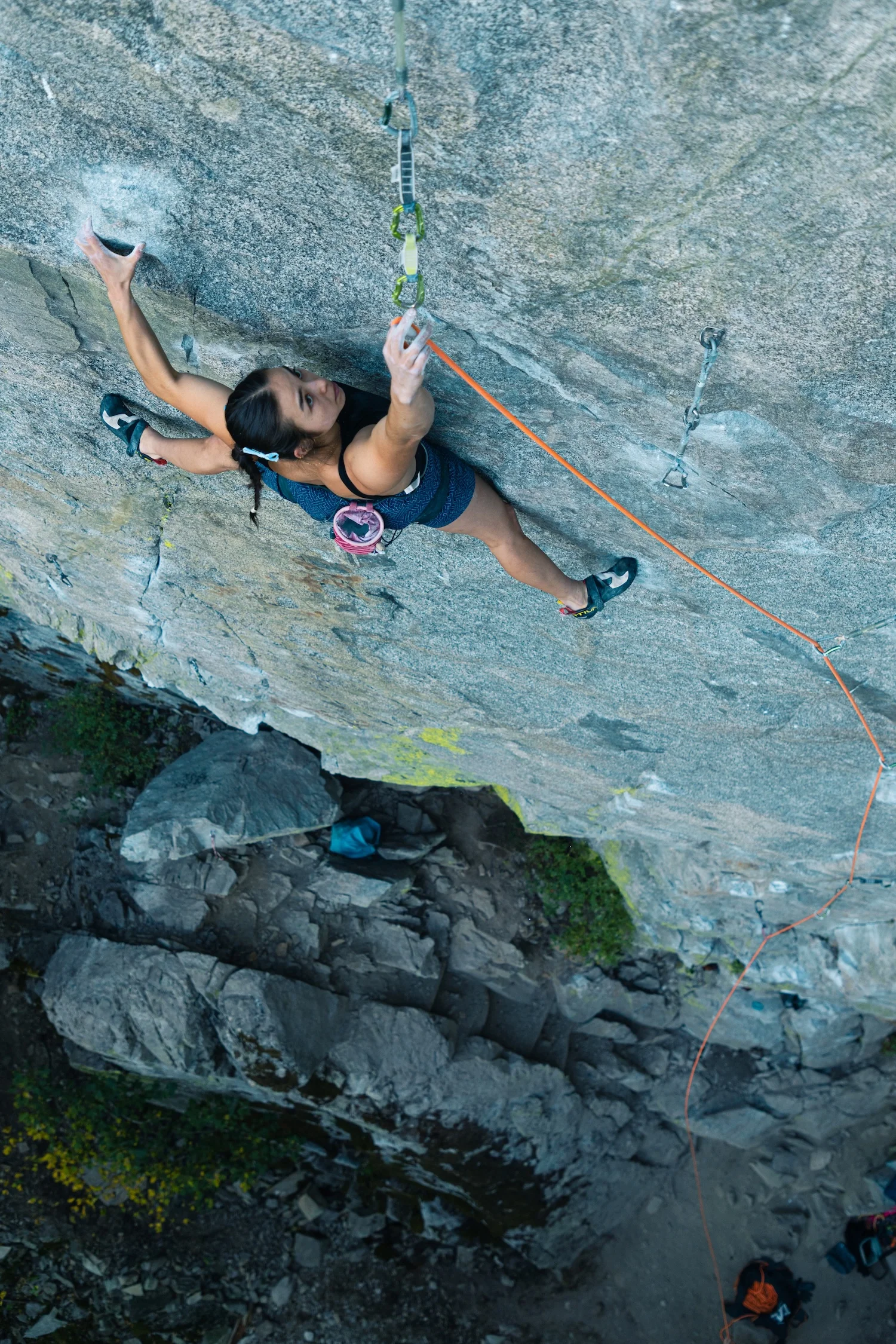
Brooke Raboutou had booked her flight home. She had one final session to send Excalibur 9b+ (5.15c)—an18-move, 40-degree crimpy sport climb near Arco, Italy—before that flight. She felt good about it. She needed the time pressure, similar to a competition. In her mind, two things were true: She might have to walk away from Excalibur for the season, and she could send it during that final session.

On Saturday, she began her day like every other, with yoga and meditation in her Airbnb, breakfast, and a warm up at her friends’ climbing wall. It was the warmest day she had had in Italy, a good sign, since she had previously numbed out on the climb. On her first try on the route that day, she fell on the last move. We’re getting into it, that felt good,Raboutou thought. She fell off the third move on her second try, which hadn’t happened in a while. She wasn’t frustrated; this was part of the process.

“I felt like I mentally was in a place where I was able to try harder than I had before, and had more of a margin than maybe a month ago, from just training on the climb,” said Raboutou.

She rested for 30 seconds and then hopped back on, trying harder than ever. Not every move was perfect, but this time, she stuck the final move from the ground, and time stopped as she clipped the chains.

She topped out the feature, making the moment even more special. Every fall, every moment of doubt, all the ripped skin and sore muscles, the days filled with cold weather, were background noise to this moment, this historic climb—Raboutou believing fully in her abilities and achieving something only a few climbers have.

With her ascent of Excalibur, Brooke Raboutou became the first woman in the world to climb 5.15c.

This cutting-edge success didn’t come out of nowhere. Raboutou has been crushing boulders for the last few years while balancing the Climbing World Cup, the Olympics, and college.

In May 2020, she sent Muscle Car (V14), her first of the grade. Her summer bouldering season in Rocky Mountain National Park saw solid sends with The Automator (V13), The Shining (V12/V13), The Wheel of Chaos (V13), Doppelgänger Poltergeist (V13),and Jade (V14). Raboutou also attended the 2020 Tokyo Summer Olympics, earning fifth in the overall combined event (speed, lead, and bouldering).

After the Tokyo Olympics, she felt very low and lost for a while. It was a pivotal time—she was a sophomore in college and still figuring out what she wanted to do with her life. She didn’t expect to feel the post-Olympics depression that a lot of athletes deal with. Raboutou worked with a sports psychologist and a therapist to help her process her emotions and goals in this heightened context of elite competition. She started to put her well-being above climbing and training. She is still constantly working on shifting that paradigm.

Photo by Jess Glassberg/LouderThan11.

It’s no surprise that in 2021 and 2022, Raboutou sent a handful of V13s and V14s, most of them documented on her Instagram and Mellow Climbing’s YouTube: Euro Trash (V12/8a+) and Euro Roof Low Low (V13/8b) in Little Cottonwood Canyon, Utah; Trieste (V14) in Red Rocks, Nevada; Heritage (V13), La Proue (V13) and Lur (V14) in Switzerland, snagging the FFA for La Proue; and Evil Backwards (V13) in the Mt. Blue Sky area, Colorado.

By the end of 2022, only three women had climbed V15, and none had climbed V16. But the dream was there.

Early in 2023, Raboutou graduated from the University of San Diego with a degree in marketing—something she was cautioned against since she had a full-time professional climbing career. She also took classes in psychology and was interested in how mental health and climbing interact. Balancing learning and climbing was important to her.

“I love climbing so much, but I’ve always believed it cannot be my everything,” said Raboutou.

In October of 2023, Raboutou sent Box Therapy (V15/V16) in Rocky Mountain National Park, and she promptly downgraded it from V16 to V15. Her brother, Shawn Raboutou, an elite boulderer who has climbed V17, sent the boulder that same day. In an Instagram post, she wrote, “I first touched this boulder in September 2022 and have not stopped dreaming about it since that day. It took me a whole year to get back on it, but in a few sessions, I was able to stand atop one of the most beautiful climbs I’ve ever done.”

The following year, she turned her sights toward the 2024 Paris Olympics. With only two spots for women on the bouldering and lead USA climbing Olympic team, the pressure was on. Natalia Grossman secured the first spot during the Pan American Games in Chile. In June 2024, Raboutou secured her place on the team in the Budapest Olympic Qualifiers.

Coming back to the Olympics the second time, she felt more grown up. She knew what to expect and had built a support team since Tokyo that would help her thrive under the unique pressure of competing in the Olympics.
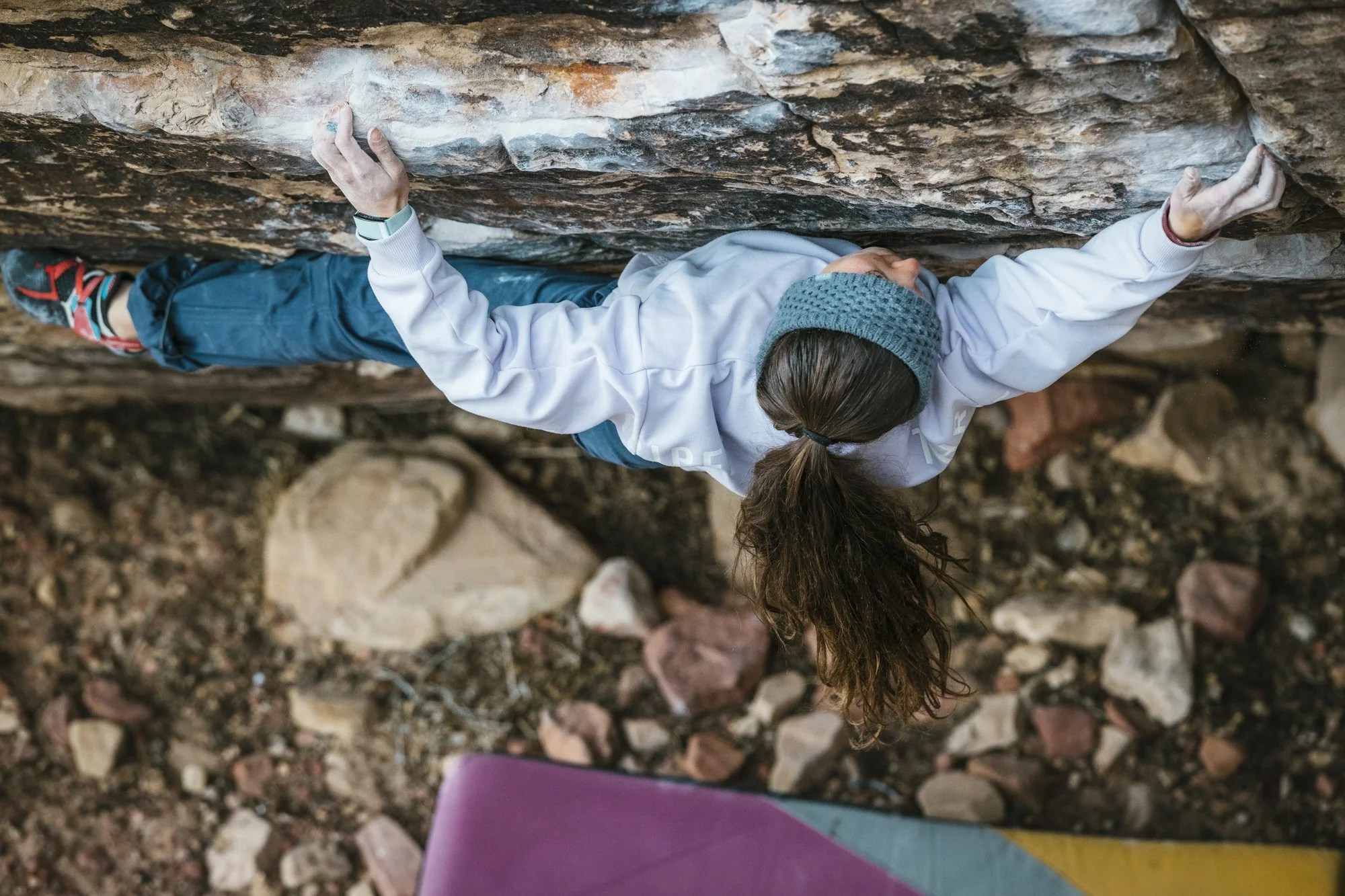
Photo by Jess Glassberg/LouderThan11.

For most of the competition, Raboutou was neck and neck with Janja Garnbret, a Slovenian climber widely considered one of the best competition climbers of all time, who had taken home gold in the Tokyo Olympics. After a stellar showing during the boulder- ing finals, Raboutou launched into the final lead competition knowing she would medal in some form for the combined event. Ultimately, Garnbret eked out more points, taking home gold once again. Once Garnbret lowered, climbers and non-climbers alike watched as the two hugged, smiling—sharing an emo- tional moment. Raboutou took home silver in the combined bouldering and lead category, becoming the first American woman to win an Olympic medal in climbing.

With such a massive win behind her, Raboutou visited Europe in November and December 2024 to find a project that would push her limits. She was following her brother around, and he encouraged her to hop on Excalibur.

Cristian Dorigatti and Morris Fontanari originally bolted Excalibur. The route is named for a sculpture of a sword in an anvil near the base of the climb. Shortly after bolting the route, the pair invited Stefano Ghisolfi to try it. He made the first ascent of Excalibur in 2023. Will Bosi made the second ascent on February 3, 2025. The route had a definite mystique.

Raboutou knew she wanted to climb the route the first time she touched it. The climb was in her style while still pushing her—something she constantly strives for. With 18 moves, the climb is almost like a long boulder. She was progressing fast; by the fourth or fifth session on Excalibur, Raboutou was falling on the last move.

The crux for most other climbers is a notorious two-finger pocket undercling combined with a high heel hook in a tight box. Because of her flexibility, this move was one of the easier moves for Raboutou. Still, the subsequent and final move required her to launch out of this position and reach farther than most other climbers because of her height. The sequence was frustrating, but she would define it as a love-hate relationship.

However, variables like skin, weather, and a minor shoulder injury slowed her progression. Raboutou decided to come back in March when the weather would be warmer. However, she was still numbing out because of how the holds hit her fingers, causing her to lose circulation. She had to play with the variables to figure out the best method: Hand warmers. Heaters. Warm up. Go.

This left Raboutou with a lot of doubt: “Is it the variables? Am I not strong enough? Will it ever happen? It was many, many sessions falling on the last move and feeling close. But also, like, am I? Am I close? Am I delusional? What am I doing out here?”

In addition, she only had three outcomes when projecting the climb: regress, match her highpoint, or send. This left her in a frustrating position. She worked on trying to enjoy the process and to be present.

“From the beginning, I was like, ‘I want to be out here, until I no longer want to be out here—I’m not trying to beat myself up’,” said Raboutou.

Excalibur was so different from her last year of climbing in the spotlight of the Olympic qualifiers and then participating in the Olympics.

“It was really like a sanctuary for myself to be out there and have this purpose of trying something really hard, but away from the world,” said Raboutou. “No one really knew what I was trying or how I was doing on it.”

She reached a point where she was enjoying the process but knew she would be mentally exhausted by the next week. She booked her plane ticket home. During the final session of her trip she tried harder than she ever had before and sent Excalibur.

This is the first time a new grade was broken within women’s sport climbing since Angela Eiter’s ascent of La Planta de Shiva (5.15b) in October 2017. Margo Hayes was the first woman to send a route in the 5.15 range with her ascent of La Rambla (5.15a) in Spain in February 2017. Other women have broken into the 5.15 range since 2017, but not 5.15c.
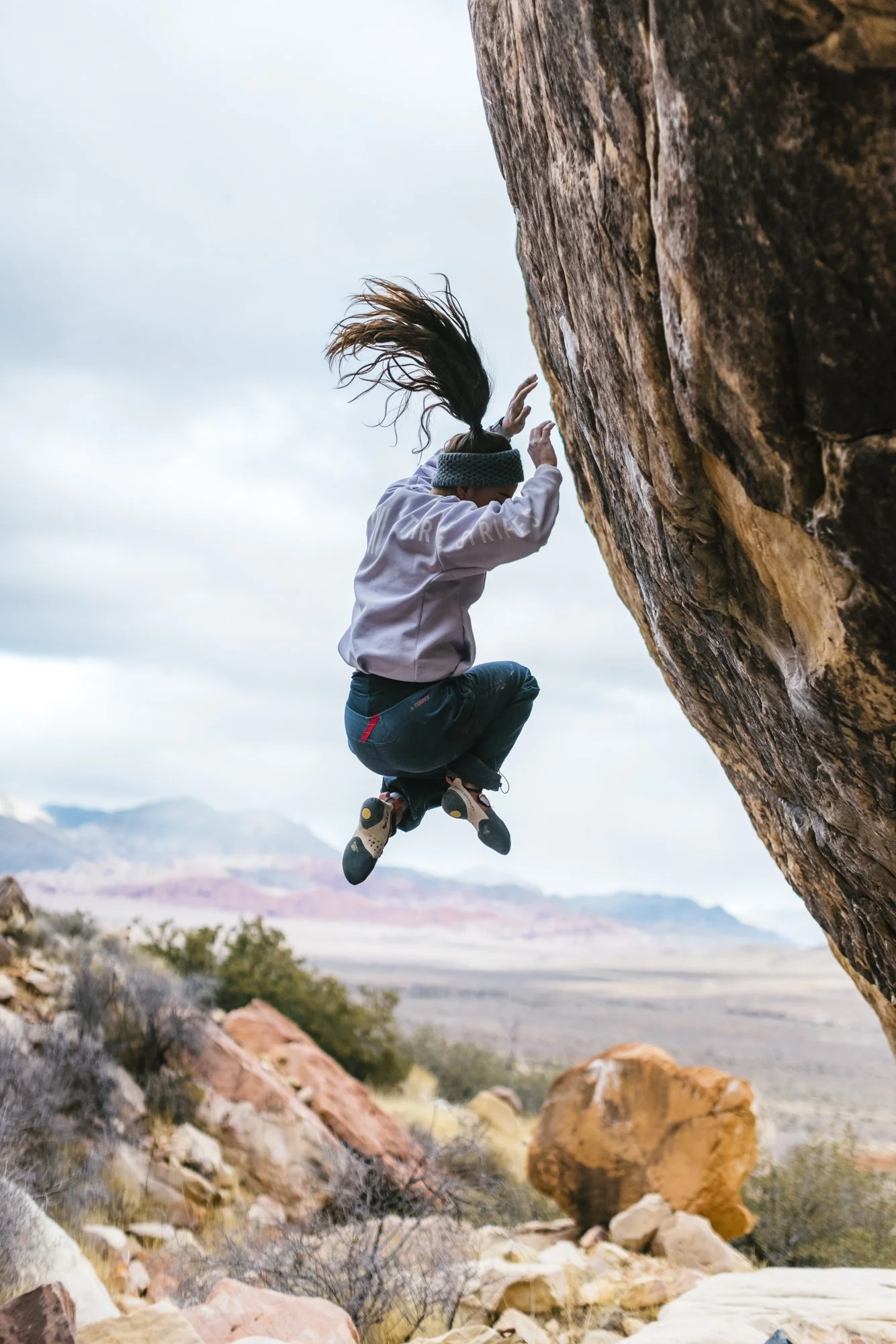
Photo by Jess Glassberg/LouderThan11.

“Brooke Raboutou imagined something no woman had ever done,” said Robyn Erbesfield-Raboutou, Brooke’s mom, as well as a four-time Overall World Cup winner and the third woman to climb 5.14a. “Then she became the one to do it, driven not by expectation but by a dream she made on her own.”

Only ten people, including Raboutou, have climbed routes at the 5.15c grade. The others are Chris Sharma, Sean Bailey, Will Bosi, Adam Ondra, Jakob Schubert, Seb Bouin, Stefano Ghisolfi, Alex Megos, and Jorge Díaz-Rullo. Only ten climbs exist at this grade, and only three exist at the 5.15d grade, none of which have seen repeat ascents. Raboutou becomes the third American to climb 5.15c.

“Climbing a route like Excalibur shows how far the sport has come in the sense of us women not just catching up but actually getting even closer to the men’s benchmarks,” said Janja Garnbret, when asked about the significance of this ascent. “It expands the definition of what’s possible and encourages more women to aim for higher goals and believe they can operate at the absolute limit of the sport. Good job by Brooke for committing to this project, sticking to it through the low times, and finally pulling it off!”

“I’m always trying to push my own limit, and I hope that that pushes the sport’s limit at the same time,” said Raboutou.

When asked who she is outside of climbing, she said simply, “I’m Brooke.” Whether she’s at the crag eating peanut M&M’s or locked in training with Fleetwood Mac in her headphones, her climbing partners would describe her as a diligent worker who is hard on herself, but above all else, is in love with climbing.

Photo by Jess Glassberg/LouderThan11.

Excalibur unlocked this balance of joy and determination for Raboutou. When Raboutou climbs outside, she can fully listen to her mind and body and choose what she wants to climb and how hard. Maybe she can revel in the joy of it. With competitions, if she’s having a bad day, it doesn’t matter; she has to perform. She was almost too comfortable with falling on the last move of Excalibur, swayed by the calmer pace of projecting on rock. So she borrowed from her competition background, injecting some urgency, determination, and time pressure into her experience, and kicked things up a notch. She pulled in one of her biggest strengths, wielding it like King Arthur when he pulled the mythical sword from the stone.

“I feel like I’m constantly unlocking and relearning at the same time, which is kind of the beauty of life, right?” said Raboutou.

Brooke Raboutou will receive the Robert Hicks Bates Award for outstanding accomplishments by a young climber at the AAC Gala on October 18, 2025. She was nominated for the award before news broke of her ascent of Excalibur, proving that Raboutou is just getting started.
Sign Up for AAC Emails

The Line: A Climb for Kei Taniguchi

In 2009, Kei Taniguchi from Japan became the first woman to be awarded a Piolet d’Or (along with climbing partner Kazyua Hiraide) for a new route up 7,756-meter Kamet in India. Tragically, neither Taniguchi nor Hiraide is still with us. In AAJ 2025, we’re publishing a story by Akihiro Oishi, Taniguchi’s biographer, who set out to complete a route she had attempted years earlier in Nepal. We’re sharing part of Oishi’s story here.

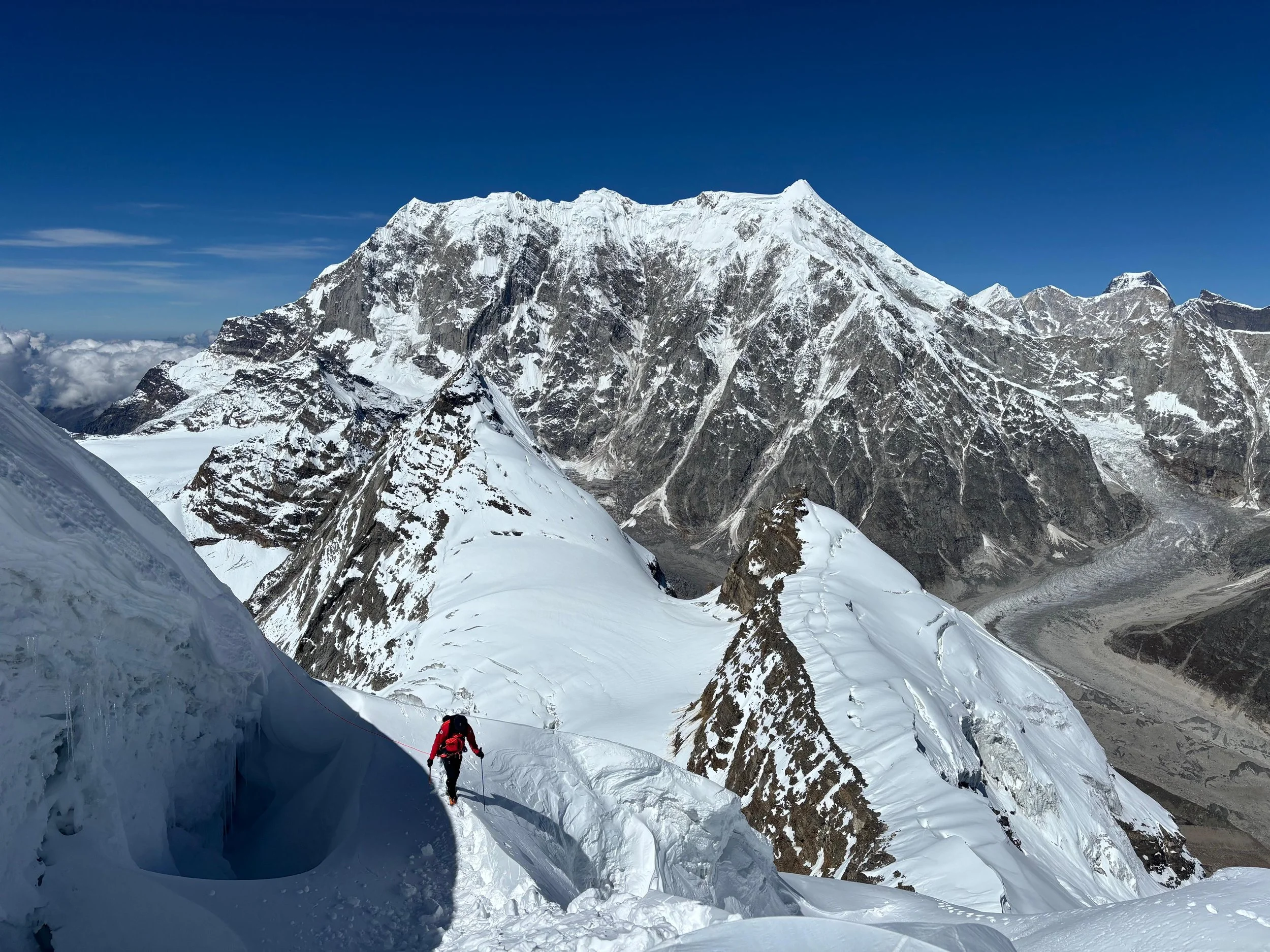
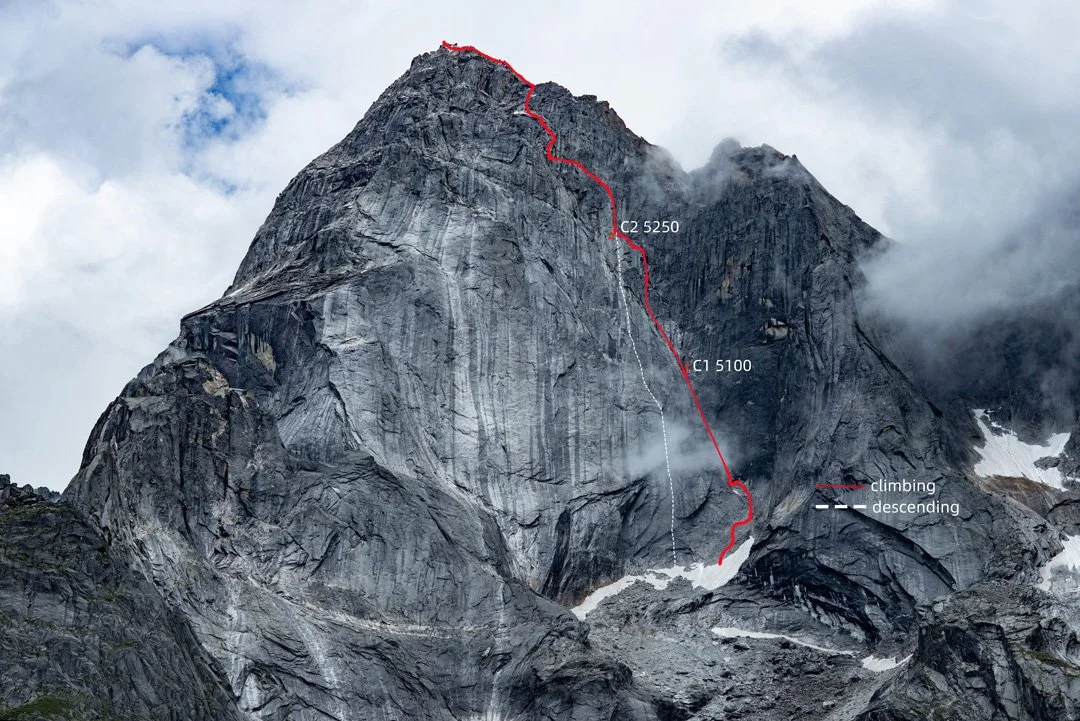
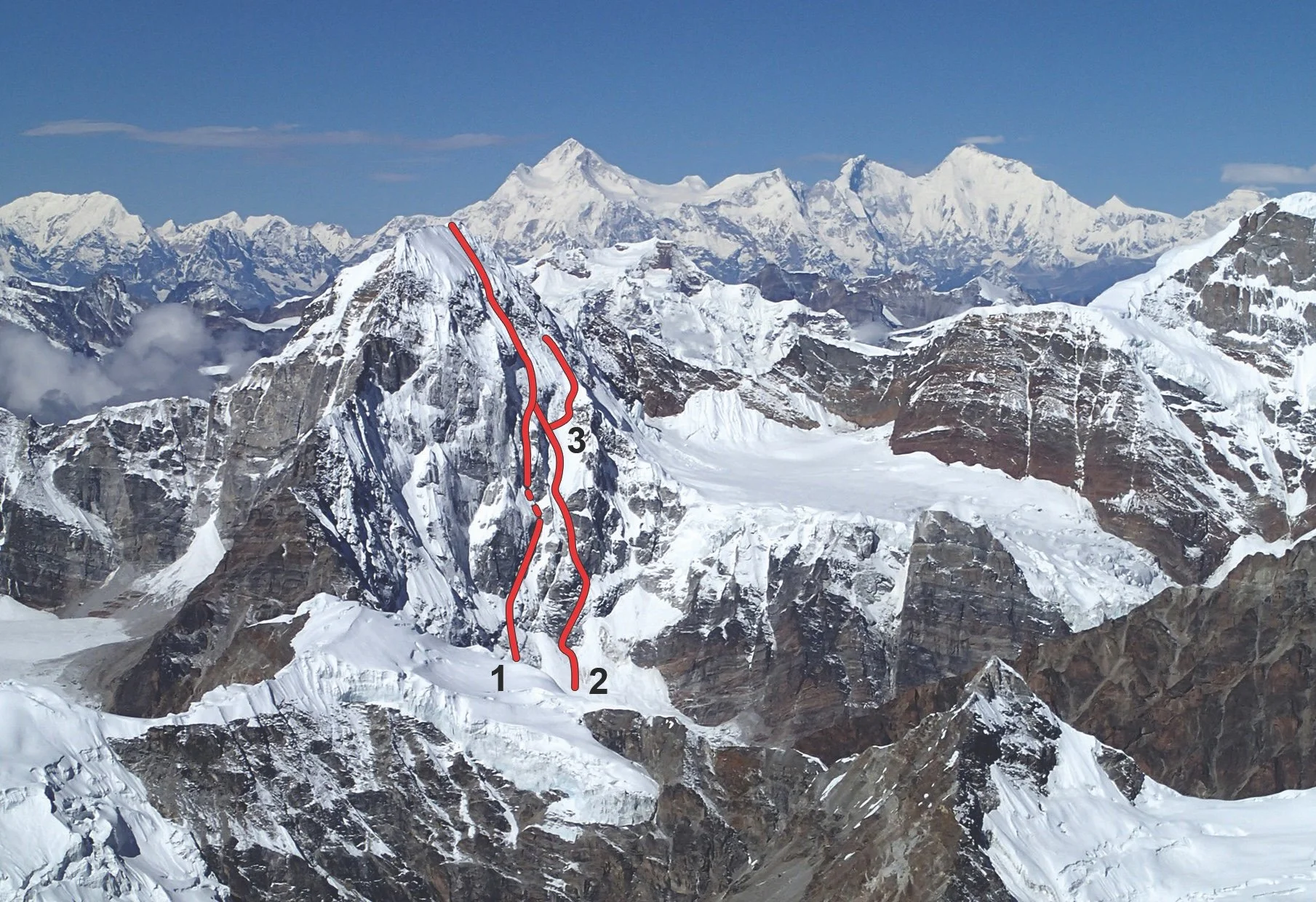
The photo that started it all: the northeast face of Pandra in October 2013. At that time, the face was unclimbed. Subsequently, the marked lines were climbed or attempted: (1) Peine Plancher (2017, the first ascent of the face), (2) A Piece of the Sun (2024), joining the 2017 route to the summit, and (3) the Taniguchi-Wada attempt (2016). The peak at far left, in the distance, is Chamlang; the Tibetan side of the Makalu-Lhotse-Everest group is in the center. Photo: Hiroshi Hagiwara

PANDRA, A PIECE OF THE SUN

“Mr. Hagiwara, what mountain is this?”

The question was asked by Kei Taniguchi as she looked at a picture taken by Hiroshi Hagiwara, editor of Rock and Snow, in 2013. The photo showed the unclimbed northeast face of Pandra (6,673 meters) in eastern Nepal.

In 2016, Taniguchi attempted Pandra with Junji Wada, retreating from two-thirds height (AAJ 2017). On return to Japan she wrote, “I’ve opened Pandora’s Box. I will definitely go back to check what’s inside.” Tragically, a month later, she fell to her death from Mt. Kurodake in Japan.

I interviewed many people to compile a book about Kei’s life, called A Piece of the Sun. In the final chapter, I hoped to incorporate a scene in which some of us, including Wada, climbed Pandra. However, Wada was seriously injured just before our team was due to leave Japan, and the expedition was postponed. Finally, in 2024, eight years after Kei’s accident, I went to Pandra with Suguru Takayanagi and Hiroki Suzuki to complete Kei’s route. Wada had become a family man, starting a new life.

We arrived at our 5,100-meter base camp on October 12. The approach to advanced base and the face itself had changed significantly in eight years due to global warming: The northeast face looked far drier than in pictures taken by the French team that completed the first route up the face. [In October 2017, one year after the attempt by Taniguchi and Wada, French climbers Mathieu Détrie, Pierre Labbre, and Benjamin Védrines completed Peine Plancher (1,200m, WI6 M6; see AAJ 2018).]

After acclimatization, we left advanced base for Pandra at 7 a.m. on October 25. It took three hours to reach the foot of the wall, after which we climbed to a bivouac site at 5,500 meters, where we pitched the tent using a snow hammock. The climbing to this point, following the line taken by Taniguchi and Wada, had involved crumbling rock and brittle ice.

Early on the second day of the ascent of the northeast face of Pandra, climbing the Pandra Great Icicle. Photo: Suguru Takayanagi

On day two, we climbed three pitches of excellent, steep alpine ice, dubbed the Pandra Great Icicle. Above, a couloir with poor protection and belays cut through the center of the face, and at 5,800 meters we made our second bivouac.

On the 27th, we headed directly toward the summit. [From around this point or below, in 2016, Taniguchi and Wada traversed to the north spur; the 2024 team continued direct and joined the line of the 2017 French route, which came in from the left.] At around 6,000 meters, the French party had found a pitch of M6. Takayanagi, who is about ten years younger than us, onsighted that pitch easily—he should achieve great things in the Himalaya. At 6,200 meters, we found a bivouac site beneath a rock outcrop.

Akihiro Oishi, belayed by Hiroki Suzuki, traverses insecure snow on the fourth day of the ascent of Pandra’s northeast face. Photo: Suguru Takayanagi

The next morning, we left our bivouac gear and headed for the top. Takayanagi climbed an overhang that was much more difficult than the M6 the day before. We then climbed ice and difficult sugar snow, with little meaningful protection, to reach a snow cave at around 6,500 meters after dark. We shivered through the night in just the clothes we were wearing.

With Suzuki in the lead, it took only 30 minutes to reach the top the next morning. Suzuki shouted, “Whoa, we did it!” I’ve been climbing with him for 20 years, but this was the first time I’d heard a serious roar. By 4 p.m. we had returned to our snow cave, and the following day we rappelled to the base.

We named our route A Piece of the Sun. It will continue to burn in our hearts and guide us toward greater mountains.

                  —Akihiro Oishi, Japan, with help from Kaoru Wada, Hiroshi Hagiwara, and Rodolphe Popier


Kei’s Climbs in the AAJ

Kazuya Hiraide (left) and Kei Taniguchi in 2008, leaving base camp for acclimatization before their first ascent of the southeast face of Kamet in India. Photo: Taniguchi Collection

2004 Taniguchi and Kazuya Hiraide complete a new route up 7,027-meter Spantik in Pakistan; partner Kazuo Tobita, who was ill, remained at high camp.

2005 After warming up and acclimatizing with the second ascent of the southeast ridge of 7,546-meter Muztagh Ata in China, Taniguchi and Hiraide complete a partial new route on the north side of Shivling in India.

2008 Taniguchi and Hiraide make the first ascent of the southeast face of Kamet, the climb that earned them the Piolet d’Or. Their alpine-style ascent was completed in a 12-day round trip from base camp.

2011 The same pair climb a new route on 7,694-meter Gurla Mandhata in Tibet and traverse the mountain, bagging the first ascent of the south peak along the way.

Kei Taniguchi and Junji Wada celebrating after 38 days on the Ruth Glacier in Alaska. Photo: Taniguchi Collection

2014 Taniguchi serves as the leader for a small group of female college students from Japan who make the first ascent of Mansail in Mustang, Nepal. The same year, she and Junji Wada climb a number of routes, some of them new, above the Ruth Amphitheater in Alaska.

2016 Taniguchi and Wada attempt Pandra in Nepal, retreating from the north spur after four days of climbing in November.

Less than a month after returning home from Nepal in 2016, Kei Taniguchi died in a fall while descending Mt. Kurodake on Hokkaido. She was 43. Kazuya Hiraide, her main partner for the great climbs of the early 2000s, died on the west face of K2, along with Kenro Nakajima, in July 2024.

Akihiro Oishi, Taniguchi’s biographer and the author of our Pandra report, wrote a feature article about her for Alpinist 68. You can read the first half of the story online.


Request for Reports

Have you or your friends climbed a long new route this year in Alaska, Peru, Bolivia, Kyrgyzstan, or Greenland? We’re working right now on these sections for the 2026 AAJ. Email us about significant first ascents in these locations…or anywhere in the world!


The Line is Powered by:


The Line is Supported by:

The Line is the newsletter of the American Alpine Journal (AAJ), powered by Arc’teryx, with additional support from Mountain Project by onX. The line is emailed to more than 80,000 climbers each month. Sign up below to receive future emails. Find the archive of past editions here. Got a potential story for the AAJ? Email the editors at [email protected].

Guidebook XV—Policy Spotlight

A Little Rust is All It Takes

By Stephen Gladieux, AAC delegate to the UIAA Safety Commision

Consider the following true story:

It’s the mid-2000s and two friends are on a long, multi-pitch sport climb. They’re excited—it is the climbing vacation to paradise they’ve dreamt about. They’ve been on clean, hard limestone all week. They’re prepared and plenty experienced for this climb.

The leader has reached a belay stance and is getting ready to bring up their partner. They are building an anchor on two shiny new bolts. As the leader flakes the rope, they see the first bolt on the next pitch is close, and they decide to clip the rope into it—giving their partner a little more of a top-rope in the last moves and setting them up for swinging into the next pitch. The follower gets to the anchor and clips in. What a climb! They both lean back to laugh.

Both anchor bolts break. They fall.

Only that extra bolt on the next pitch holds, keeping them from dying, but all three bolts were shiny and brand new.


Corrosion isn’t always visible, and there are a few different kinds of severe corrosion that result in scary failures like the one described above. These have been known for a long time in industries like construction and nuclear power, but it has only been in the last 20 years or so that we’ve recognized them in climbing anchors. These failures don’t require a lot of corrosion, just a very small amount. The two main types are Stress Corrosion Cracking (SCC) and Sulfur Stress Cracking (SSC), but there are others as well. For a number of reasons, these are really terrifying problems in climbing safety: they can happen very quickly without any easy-to- spot outward signs; they are difficult to predict; and they happen on stainless steels that climbers and route developers commonly think of as bomber. Like in any other part of climbing, assumptions can kill.

Starting in the late 1990s, climbers started talking about this issue. The problem seemed particularly obvious in coastal climbing areas, but it began to crop up elsewhere as well. Companies were quietly adjusting the alloying content of their wedge bolts, scientific papers were being written, and developers were beginning to use glue-ins and titanium. And ultimately, the Union Internationale des Associations d’Alpinisme (UIAA) Safety Commission (SafeComm) started looking into the issue in a rigorous way.

The UIAA is where the buck stops with global climbing safety. It is a union of climbing federations from 73 countries that works on things like mountain medicine, protecting climbing areas globally, organizing Ice Climbing World Cups, and standardizing training curricula and safe practices. It is where gear failure from all countries gets analyzed. It is where climbers, manufacturers, and labs come together to make climbing safer. As the national organization for climbers in America, the American Alpine Club is the U.S. representative to the UIAA.

To address the SCC issue, the SafeComm worked for almost 15 years to develop a new Rock Anchor Standard that tests the complete anchor—UIAA123. In the summer of 2025, we updated it at our 50th anniversary meeting with guidance on welding.


How Stress Corrosion Cracking (SCC) Works

SCC starts with a pit on the surface of the material. This could be a small defect in the steel, damage caused by placing the bolt, or something left over from manufacturing. Pitting corrosion can also start the process. Pitting corrosion causes deepening pits to form in the surface and is typically fueled by the presence of chlorine. In all these types of corrosion, chlorine isn’t consumed, it is just something that facilitates the corrosion’s progress. That means it doesn’t take very much to make this happen—a high concentration, but not a large amount.

Once there is a deep enough pit, the process changes—in some cases it will stop here, but in others, the corrosion will develop into SCC and a crack will begin to extend from the bottom of the pit. This crack drives forward through the shaft of the bolt via a complex mechanism that doesn’t cause the outside of the bolt to corrode. In a short time, the bolt could break with body weight but show little sign of this danger.

Sulfur Stress Cracking (SSC) is similar in effect, but not in process. For now, we’ll focus on SCC.

Stress Corrosion Cracking requires three things: a susceptible material, a suitable environment, and sufficient stress in the material. None of these things are quite as straight-forward as they seem and the rate of cracking can vary from a few months to several years. However, solutions exist to keep our community safe.

Rethinking Susceptible Materials

Photo by AAC member Caleb Timmerman.

There are hundreds of alloys of stainless steel. Climbers have historically only used a few. These historically-used alloys tend to be more susceptible to SCC than zinc plated low carbon steel. There is a spectrum of resistance to SCC. The resistance of a material comes from more than just its chemical composition: It is influenced by its microstructure, and this is controlled by how it was manufactured.

The thermal history of a bolt—how it was heated and cooled—can have a particularly large effect on its resistance. In fact, a relatively resistant material can be made extremely susceptible to SCC through its manufacturing process. This is one reason why any welding in bolts or anchor rings and chains can be dangerous if not well controlled. It is not just about the type of steel alone.

Acknowledging the Environments That Facilitate SCC

The environments that cause SCC aren’t all that exotic. We’ve seen it in some places more than others, but the ingredients can be found at many crags. Only a small amount of chlorine is required. The presence of sulfur helps. Calcium can make both worse. Concentration right at the bolt is what matters, not how much there is in general.

These elements are not rare. Calcium is in many of the rocks we climb, not only limestone and dolomite. Sulfur can come from many sources: In the Pacific we see underwater volcanoes vent into the water; in swathes of the U.S., coal power plants create plumes of sulfur that drift eastward. Sulfur-reducing bacteria in the soils above our climbs convert it to a form that is more dangerous. Chlorine can come from seawater and spray hundreds of kilometers inland. It can come from road salt. It is in our sweat and in rocks and lakes.

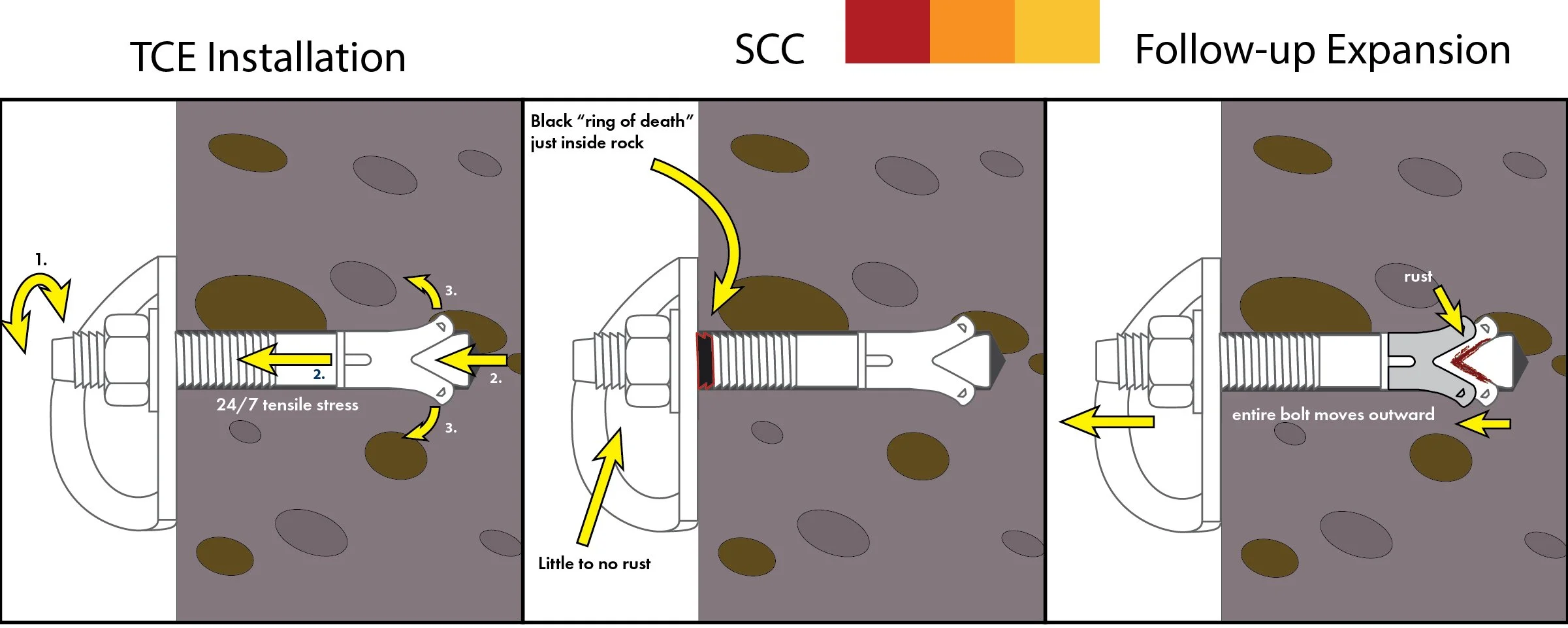
TCE Installation steps: 1) the nut or bolt is turned to a specified maximum torque based on the shear strength of the bolt; 2) the shaft is pulled out of the hole; 3) friction between the rock and the collar keeps it in place, which causes expansion as the wedge on the shaft moves through it. As the wedge meets more and more resistance to pulling out, tensile stress is generated in the shaft which will be there from now on. Tension in the bolt shaft can be a factor that contributes to Stress Corrosion Cracking (SCC), as described on page 20. The second illustration above illustrates how hard it is to detect SCC. The third illustration shows how a small amount of corrosion in the expansion components of a TCE can lead to the bolt slowly moving out of the bolt hole instead of expanding more, even without SCC developing. Illustration by AAC member Stephen Gladiuex.

Understanding Stress Created by Bolt Type

Most of the fixed anchors we use are torque controlled expansion anchors (TCEs). This includes wedge bolts and sleeve bolts like the five-piece as well. Think of them as small machines that are part of the safety system. When the nut or bolt in these machines is turned, it creates tension in the shaft—when the shaft is pulled out by this tension, and the collar/sleeve stays put, it results in expansion at the back of the hole. There is no way to avoid this stress—it is inherent to the design of the bolt. This stress is there day and night. In this kind of bolt, that inherent stress allows SCC to form cracks across the shaft.

And even without SCC, and instead with the littlest bit of rust, these bolts can become ticking time bombs.

When the bolt was brand new, there was less friction between the wedge and the collar than there was between the collar and the rock. When it was initially tightened, this friction caused the collar to stay put—and instead the wedge moved and the bolt expanded. But with only six months and a winter, and the environment found at any crag in the U.S., now there is a little corrosion between the wedge and the collar.

When that first big fall happens, the wedge could expand just a little more, the machine would work, and the bolt could be stronger. The climber would see a spinning hanger, but after tightening it, the bolt wouldn’t move again until a bigger fall happened, which might never happen. It was able to have follow-up expansion because the machine in the back of the hole still worked.

In a different scenario, both the wedge and the collar could move out together, because they are stuck together due to just a little rust. The climber still sees a spinning hanger and still tightens it—but the bolt doesn’t expand more, it just moves out of the hole. It will keep pulling out, little by little, and keep getting weaker. Depending on the type of bolt, you may never know.

Different bolt types are also made differently. Any time metal is bent or reduced in size by a process called rolling, there are residual stresses in the material. Hangers and glue-ins exhibit these kinds of residual stresses, but they tend to be lower in magnitude, and that’s good. It is one of the reasons glue-in anchors are a better choice for corrosion. It would be possible to almost eliminate these residual stresses with an annealing heat treatment, but this would add cost.

If a good resin is used for a glue-in anchor, the bolts also get the added benefit of having the metal shaft insulated from contact with compounds in the rock or its surface.

All of this combines to make SCC difficult to predict, and especially difficult to estimate how long it will take to render a bolt unsafe. Often, the only sign that’s visible is a slight black ring around the shaft just at or inside the rock. It is tough to predict, it is tough to inspect, and it can kill.


UIAA123—Not as Simple as 1, 2, 3

In order to have confidence in our fixed anchors, we need to evaluate the entire bolt/ hanger/chain assembly, and its installation process as well. We need to pair these anchors with a crag environment that they can handle. The UIAA 2020 Rock Anchor Standard Update included testing the complete anchors and classifying them.

A lot of work went into figuring out the line between different environments, and how to test them in a repeatable way. You can now find bolts, hangers, and complete top anchors on the market that are certified to the UIAA Standard from a number of major brands such as Lappas, Fixe, AustriAlpin, Team Tough, and Climbing Bolt Supplies. Lappas and Fixe have anchors that have been certified at the SCC level as well.

In the spring of 2025 we met with bolt and anchor manufacturers and introduced a requirement to improve welding quality. This most commonly affects welded top anchor rings and chains, but also glue-ins where the ring is welded. Manufacturers are now required to follow welding industry standard quality controls. These standards ensure that welds are executed with the precision and quality needed to maintain the safety, reliability, and durability of the anchors. Most importantly, this will prevent any welds from being a sort of Achilles heel that cracks quickly in an otherwise safe anchor.

So now, with a classification of anchors and with tests, we’ll be safe, right? Not yet—there is more to do. We need to understand our crag environment in order to select the right bolt. It can vary pretty dramatically from route to route, and even bolt to bolt on a route. The classification must be sufficient for the whole route, and preferably the whole crag. One of the next projects we are working on at the UIAA is to improve the maps of corrosion risk and pin them with specific knowledge of crags and crag chemistry so that there can be better guidance for land managers and those placing bolts.


Next Steps

Recently at the UIAA SafeComm, we received a request from the town of Kalymnos, an iconic climbing area in Greece. They have many routes that are suffering from corroded anchors. Climbers have become an important part of the local economy, and Kalymnos has gotten a large grant to rebolt routes—but they don’t know whom to trust with this important task, or how it should be done. Not every climbing area is fortunate enough to have a great local climbing organization that is skilled in route maintenance.

At the UIAA we’re pivoting again to help solve this challenge. We’re beginning work on the idea of a rebolting certification course that will include feedback from all over the world to gather the best techniques. Pooling knowledge and techniques globally will pay off in making climbers and routes safer everywhere. It will also mean that land managers will have something to look toward when they are not sure whom to trust with the lives of people climbing, or with the conservation of crags.

The UIAA has been around since the early 1930s. We just hit the 75th anniversary of our first rope safety standard, and the 50th anniversary of the Safety Commission. In those years we’ve moved from climbers not knowing which ropes they could trust with their lives, which carabiners and helmets to use, to having gear so clearly marked and reliable that most climbers don’t think about it. With the new welding update to our Rock Anchor Standard, we are working toward the day that each fall on a bolt—no matter where you are in the world—can be infused with just as much trust.


About the Author

Stephen Gladieux has been the AAC delegate to the UIAA Safety Commission since 2020, and was a corresponding member and consulting expert since 2012. He’s been climbing for 31 years, and he holds a degree in materials science and engineering, as well as one in French literature from the University of Michigan. He does about half of his climbing underground and sees bolt failure all over (and under) the world. Stephen lives outside Portland, Oregon.


Sign Up for AAC Emails

Guidebook XV—AAC Updates

A Message from AAC Leadership

Dear AAC Community,

It’s easy to think that, as climbers, all of our success stories are individual. After all, when it comes down to executing that final crux on your project, it’s you alone that reaches the top. But one of the things I love about the AAC, and the stories in this edition of The Guidebook, is how individual success is supported by community. The summit is not a vacuum; when we reach the top, our accomplishments are because of ourselves and also those whom we’ve leaned on and learned from.

In these pages, you’ll see that support unfold. In our Member Spotlight, “The Quiet Stories the Land Can Tell,” Rob Mahedy, normally a solo adventurer, learns through a battle with cancer what it means to accept support from his community in order to pursue the summit of Mt. Hayes in Alaska. In our Rewind the Climb story, “A World of Appalling Grandeur,” we celebrate the 100th anniversary of the first ascent of Mt. Logan—a joint expedition between the Alpine Club of Canada and the American Alpine Club that made a huge splash in the newspaper headlines of 1925, in a world that was just imagining that humanity could stand atop Everest. In a splendid deep-dive into corrosion in bolts, called “A Little Rust is All it Takes,” Stephen Gladieux illuminates the importance and impact of the UIAA Safety Commission, for which he is a representative for the AAC. Through SafeComm, the AAC is able to join forces with representatives from nations across the world and work together to formalize standards for climbing equipment and safety practices.

Our final story, “Balance,” is a feature about Brooke Raboutou, who will receive the Robert Hicks Bates Award this year for exceptional accomplishments by a young climber. It’s in her story that I see this interweaving of community so clearly. Brooke’s accomplishments do stand by themselves—silver medalist in the 2024 Olympics for bouldering & lead, an ascent of Box Therapy (V15) in addition to multiple V14’s, and now the first woman to climb 5.15c with her recent send of Excalibur. I have seen Brooke grow from a bright, curious team kid into the warm, determined athlete she is now. The seed of Brooke’s success grew and flourished under the sunshine of overwhelming support from her family, coaches, fellow athletes, and friends, who push and encourage her. She has developed her incredible strength and talent in part because of her environment. As a result, Brooke’s spirit is so vivid that she inspires her community— myself included—to cultivate that same spirit in themselves.

An interesting note: Brooke was nominated for the Bates Award before she sent Excalibur (5.15c) and became the first woman to climb the grade. Excalibur, then, is simply another example of her momentum. There are still frontiers for women to face and break in climbing, but as a community, we are no longer asking whether a woman can climb a given grade. We are just asking—when?

I bouldered with Brooke recently in Bishop, and we made a day of touring the classics. No need to prove anything; we weren’t chasing the most difficult climbs. Instead, we focused on climbing for sheer beauty and joy. What I see in these stories of perseverance and adversity, of pouring one’s life into climbing safety and education, and in Brooke’s story, is that beautiful impulse of climbing for the soul. I see that same impulse bring so many AAC members together.

I hope you enjoy these stories of your fellow members and that they inspire you to shine brightly, connect with others, and pursue your climbing aspirations this summer.

Nina Williams

AAC Board President


AAC Updates

Advocacy

  • The U.S. House of Representatives removed the public lands sell-off bill from the reconciliation package. The Senate subsequently proposed legislation that considered public lands sales in11western states, which was ultimately removed from the package following strong public opposition. The AAC continues to work with our partners, such as Outdoor Alliance, to coordinate responses to these efforts to introduce legislation that impacts our public lands.

  • The AAC Advocacy department will travel to Washington, D.C., in October to engage with lawmakers on a variety of issues and support Outdoor Alliance’s Grasstops Collective.

  • The AAC’s Advocacy Director was recently appointed to the UIAA’s Mountain Protection Commission. The commission, founded in 1969, is one of the foremost authorities regarding the question of sustainability in mountain regions.

Member Services

  • As of June, expenses up to $15,000 in mortal remains transport are now included in the rescue benefit at the Partner, Leader, Advocate, and Great Ranges Fellowship membership levels. Learn more at americanalpineclub.org/rescue.

  • The 2025 American Alpine Journal and Accidents in North American Climbing books were sent to the printer in June. If you’ve opted in to print copies, you can expect to receive your books in late summer.

Operations and Governance

  • The AAC Board of Directors met in Boulder, Colorado from June 6 to 8 for a Board retreat and meeting. The Board discussed strategic priorities for the upcoming fiscal year and future plans for the AAC, and enjoyed some Front Range climbing and dining!


Sign Up for AAC Emails

Guidebook XV—Member Spotlight: Rob Mahedy

The Quiet Stories That Land Can Tell

By Joe Tedino

Photo by Eric Larson.

Rob Mahedy, a 59-year-old cancer survivor from Crested Butte, Colorado, arrived in Alaska this spring with a purpose: to summit Mt. Hayes via the Washburn route. No stranger to high-altitude climbs—he’s soloed Mt. Earnslaw in New Zealand, Island Peak in Nepal, and Denali (Mt. McKinley)—Mahedy encountered a different kind of challenge this time. In Fairbanks, he heard reports of a milder winter and below-average snowpack, signs of a shifting climate he could not ignore. He adjusted course, choosing not to summit this year but to climb as far as the famed knife ridge, saving the final push for another expedition. As with his own survival, the lesson was clear: adaptation is not a sign of weakness—it’s wisdom.

“I didn’t get to the top,” Mahedy said in an interview shortly after his eight days on Mt. Hayes, “but I do consider it a successful reconnaissance climb.”

First climbed in 1941 with low-tech gear and legendary grit, the Washburn route to the Mt. Hayes summit is still considered one of Alaska’s great mountaineering achievements. Known formally as the North Ridge, the route’s reputation rests not only on its technical difficulty, but on the boldness of those who first dared to climb it. Towering 13,832 feet and rising more than 8,000 feet from the valley floor in just over two miles, Hayes is the tallest peak in the eastern Alaska Range—and one of the steepest in the country. So formidable is its Northeast Face that it wasn’t summited again until 1975, when climbers Charles R. Wilson and Steve Hackett led a four-person team across the ridge. In the American Alpine Journal that year, Wilson recalled sections so narrow and soft that “you could not put your feet side by side”—a place where progress toggled between precision and peril.

Mahedy remembers a previous climb that took him to the top of Denali—the classic West Buttress, a route that was also pioneered by Bradford Washburn. Climbing with a small group at first, he broke off and made his way up during a 21-day adventure. “I stood atop the summit alone,” he recalled. “I had a clear summit day and could see down the Susitna River to Cook Inlet and west to the Bering Sea.” He descended for six days on skis. With Hayes, he was searching for a similar moment of stillness.

To begin his Mt. Hayes climb along the Washburn route, Mahedy flew to Anchorage and then boarded the Alaska Railroad for the 12-hour trip to Fairbanks, where his local fact-finding began. A number of questions ran through Mahedy’s mind as he met up with experienced climbers in Fairbanks. “What am I up for, what am I getting myself into?” he wondered. “These people have local knowledge, so what went through my mind was, ‘What can I learn?’ ”

Mahedy was confident about withstanding the bitter cold temperatures, which can drop below −4°F with windchill factors below −22°F. Even with his experience in Alaska and Nepal, he knew to be wary of the glacier travel and potential crevasse navigation ahead of him. Weighing heavier on Mahedy was how cancer would affect his strength and stamina.

Mahedy, a muscular six-foot-four alpinist, left New Jersey for Crested Butte as a young man and quickly took to the mountains like a local. He hiked, skied, cycled, and climbed with the quiet intensity of someone who doesn’t just visit wild places but needs them and absorbs the solitude. A carpenter by trade, he’s helped restore many of the historical commercial buildings in Crested Butte’s bucolic downtown, shaping the town with the same hands that have gripped ice tools on Himalayan ridges.

But his passion lies beyond the summits—deep in the hidden recesses of the backcountry. “I seek out remote mountain ranges that are not heavily visited,” he said. “I follow bighorn, mountain goats, elk, caribou—sometimes bear and wolverine—looking for freshwater springs, and often I’ll stumble on evidence of the people who were here before us.” For Mahedy, wilderness exploration isn’t just about elevation—it’s about connection, and the quiet stories the land can tell. Whether it’s a summit or a century ride, Mahedy tends to meet the landscape on its own terms—and rarely turns back.

But his battle with aggressive bladder cancer and lung cancer since the middle of 2024 has taken its toll on his health and fitness. Last November, a tumor was removed from his abdomen along with his bladder. Doctors fashioned a replacement neobladder using material from his small intestine. Then his cancer—urothelial cell carcinoma—was found to have metastasized in his lungs, requiring weeks of chemotherapy.

Mahedy had an abnormal winter as he underwent treatment—only a few outdoor adventures close to home, including a weekend camping trip in March that enabled him to experiment with how to empty his neobladder in cold temperatures. Climbing Mt. Hayes along the Washburn route was a goal he set for himself last year, as long as his body would survive.

On May 8, after receiving good news from his doctor that immunotherapy treatments had shrunk the tumors on his lungs, Mahedy set out for Fairbanks. There, he met local Mike Hopper, who told Mahedy that he had attempted Hayes five times himself. During a 90-minute meeting over coffee with Hopper, Mahedy spread out his maps on the table and described his plan. Hopper pointed out the best routes to take and the ones to stay away from. Later, at an equipment store, Mahedy met Grant Wilson, a local climber who has explored around Mt. Hayes many times as well. He and Mahedy discussed climbing together next April when the temperatures are likely to be colder and the snow conditions more favorable for a summit attempt. Wilson explained that the lack of snow, warmer May temperatures, and the fact that Mahedy was going it alone made reaching the summit this time unpredictable.


Rob Mahedy documents his solo spring expedition to Alaska’s Mt. Hayes—a journey of resilience, reconnection, and reconnaissance. From trains and bush planes to whiteouts and ridgelines, each snapshot marks a step in his ongoing quest to meet the wilderness, and his own limits, on their own terms.


Mahedy assembled supplies for a 14-day mountain exploration, then met pilot Jesse Cummings at Golden Eagle Outfitters. They planned a 45-minute flight into the wilderness, but trouble arose immediately. Due to a winter with low snowfall, their aircraft’s skis couldn’t land at the intended drop-off point. They had to return to Delta Junction, transfer Mahedy’s gear to another plane equipped with low-pressure tundra tires, and then fly back to the Stonehouse drop-off.

With little snow, Mahedy had to haul his 60-pound supply sled over bare ground, which required offloading some equipment and making multiple trips to a camping spot. “Every mile turned out to be three miles—up and back and up again,” he said. Eventually, he made his way up to “this beautiful lateral moraine on this massive Hayes glacier. I finally got to the snow.”

Carrying 50 pounds on his back and pulling the sled, Mahedy spent three days getting to an elevation of 6,000 feet, which revealed a stark truth: His strength had deteriorated significantly. His decline was a direct result of inactivity over the previous six months following surgeries and chemotherapy. Despite his attempts at prior conditioning—limited backcountry skiing and mountain climbing in March and April before his Alaskan venture—he had lost ten pounds and considerable muscle mass.

“My fitness was not as good as it could have been,” he said. “But I could feel myself getting stronger as I went up—my legs, my thighs, my back. So that was encouraging. I was certainly physically weaker than I’ve been in over a decade, but I felt I was mentally stronger than ever to climb and climb safely.”

But cancer had not only taken a toll on his muscles and fitness. There were now new logistical challenges to contend with as he learned to navigate utilizing his replacement neobladder. On Mt. Hayes, Mahedy carried a lightweight cot that enabled him to recline above the ground and, when necessary, to use gravity to help the flow of urine into a urostomy bag. “I had to catheterize myself, and I figured all that out; nothing froze,” he said with a laugh. In this way, Mahedy locked down some survival beta that most alpinists never think twice about.

Over the course of his days on the mountain, two whiteout snowstorms dumped a foot of snow on the glacier, adding more uncertainty to his quest. During those hours, he read and enjoyed the sounds and sights of the wilderness. It also gave him a chance to reflect on why he does these climbs. “It’s a quest for me to find happiness,” he said. “I find joy in deep wilderness, where there is solitude, and it’s just me, the elements, and the animals in nature. I really do enjoy being high up in the mountains by myself.”

Once the snow let up, he was able to continue to an elevation of about 9,000 feet where he got a full view of the route that goes up the knife ridge to the summit. “It was very valuable to have two days of clear weather to get up on the ridge high above the glacier and see the original Washburn route,” Mahedy said. “I give them a lot of credit for doing what they did back in the 1940s.”

Mahedy feels good about his Mt. Hayes trial run and has made plans to climb with Wilson, the Fairbanks climber, next April to finish the job. “He and I will get together, perhaps with another guide or two—we’ll try to keep it a small group—and go for the full summit push,” Mahedy said.

The plan fits Mahedy’s new mindset since his cancer diagnosis. “I know I need to rely more on others and to not go it alone,” he said. As a cancer patient, Mahedy experienced an outpouring of support from family and friends, as well as from two local cancer support organizations—Gunnison Tough and Living Journeys. Both have been at his side since his diagnosis in May 2024.

“When I tell my doctors about the help that I’m getting, they are pretty amazed,” he said. “Our small community is really helping me financially, mentally, and nutritionally. I think the love is as important as the medicine.”


Sign Up for AAC Emails

Periodizing Mental Training with Neal Palles

The AAC’s Climbing Grief Fund has a directory of therapists who are specialists in the unique risks, challenges, joys, and euphoria of outdoor recreation, and are informed practitioners who support climbers experiencing grief and trauma. And though the directory is an invaluable resource when people need support in the face of the most intense kinds of grief and tragedy, these counselors also have expertise in other areas, including sports performance psychology. Because it's all connected–just as grief and trauma impacts our relationship to climbing, so too, does working on resilience, self-compassion, and other mental health skills help us excel at our goals in climbing. In this episode, we have therapist and sports psychologist Neal Palles on to chat about how to practice and stack various mental training techniques and concepts on top of each other to build towards peak performance. We periodize our physical training, and according to Palles, we can apply that same concept to mental skills as well. Dive in!


The Prescription—Free Solo Fall

Besides being prime time in the high country, summer is a high-traffic season for alpine rock and long moderate climbs. This time of year, climbers of all levels venture unroped onto “easy” terrain. Every year, we also see a handful of free solo accidents. These are almost always fatal and usually take place on well-trafficked moderate routes.

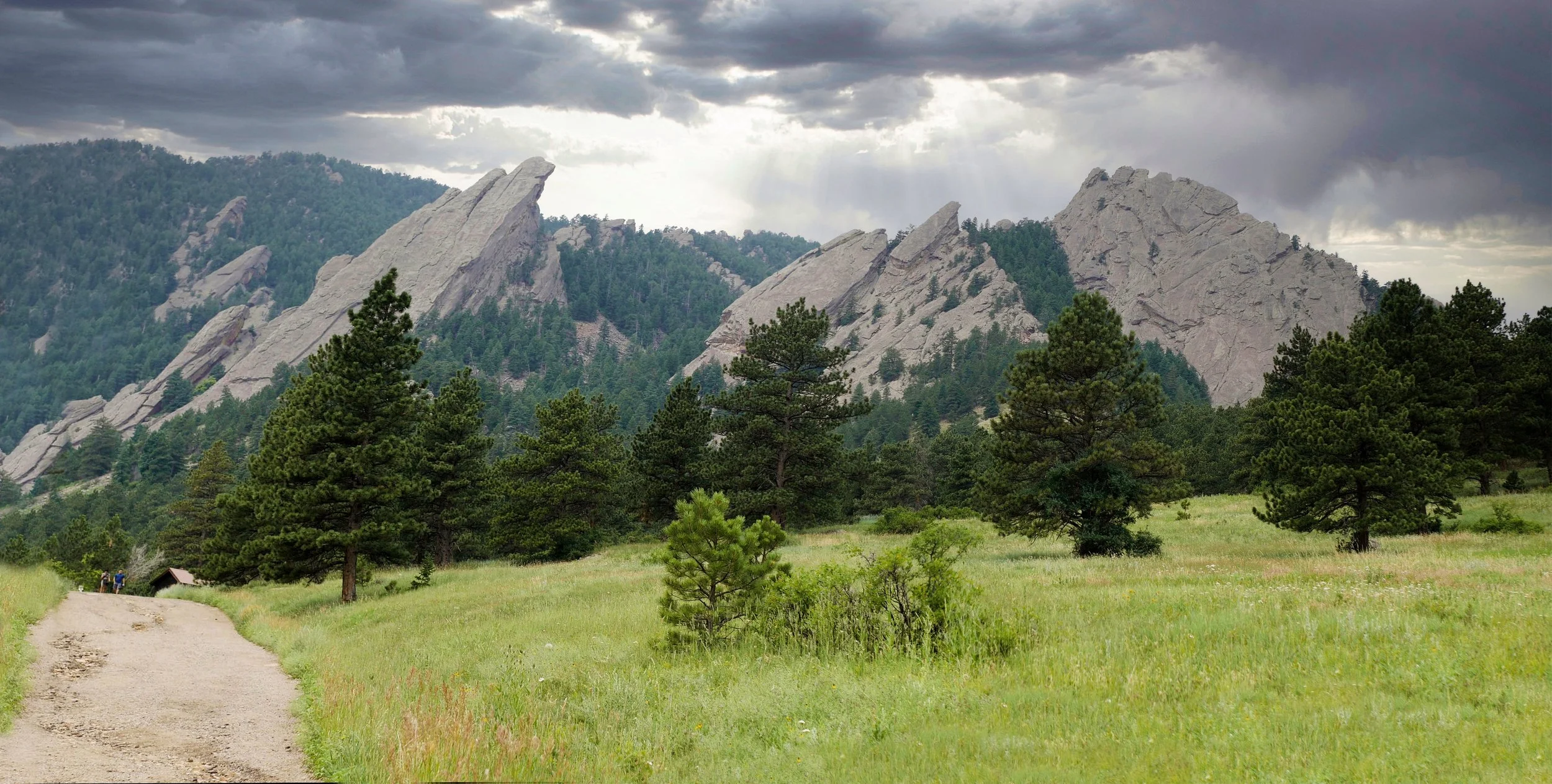
A disturbing pattern emerged last year when several fatalities occurred on adjacent formations in the same area. Recently, the Flatirons above Boulder, Colorado, saw three fatalities, two within two days in mid-December.

The Flatirons above Boulder, Colorado, see thousands of ascents every year, many by unroped climbers. Close proximity to the metropolitan Front Range, high visibility to the public, and complacency on technical climbing terrain can contribute to accidents. Photo from Wikimedia | joiseyshowaa

FREE SOLO FALLS

Boulder, Flatirons

On December 16, 2024 the Boulder County Sheriff’s Office received a report that 42-year-old Keith Hayes did not return home that evening. Around 9 p.m., friends of Keith found his body near the top of Second Flatiron after he presumably fell while unroped from Freezeway (5.7). Friends of Hayes report that there was no sign of snow or ice on the route and that there was no sign of broken rock contributing to the fall.

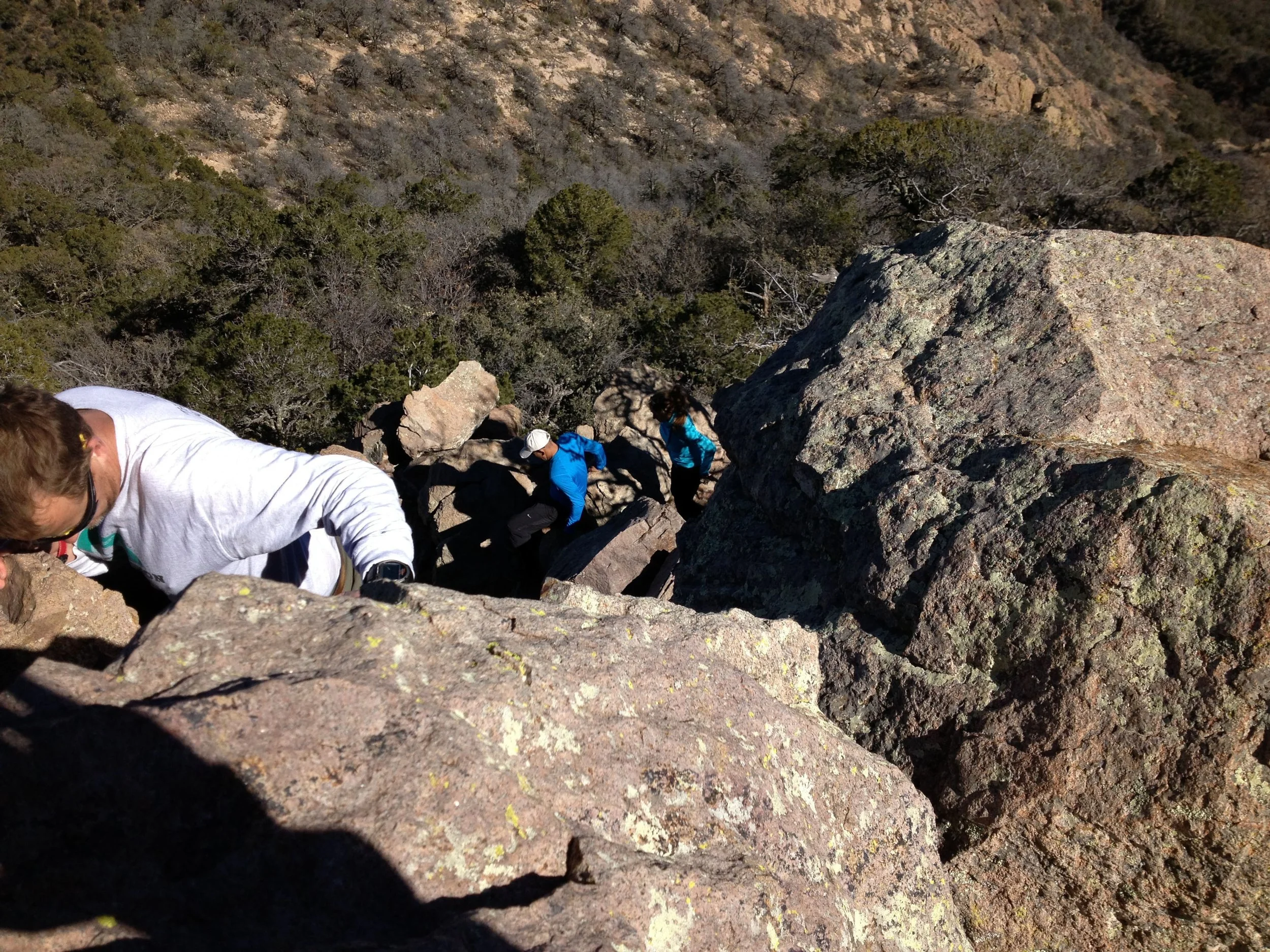
Here we see a group scrambling high above the ground in Big Bend National Park. Loose rock, dirt/gravel underfoot, inattention, and haste can trigger fatal falls. Photo from Wikimedia | Yinan Chen

The day after, December 17, a 27-year-old male was reported missing after not returning home in the evening from a Flatirons climb. The Boulder Emergency Squad found the body of the missing male the next day on the Standard East Face route (5.4) on the Third Flatiron; he was presumed to have fallen unroped. Rocky Mountain Rescue Group recovered the body after an eight-plus-hour operation.

“Scrambling” blurs the line between third-class (easy unroped climbing) and fifth-class technical climbing. While the grade of the actual climbing is often anywhere between 5.0 and 5.6, the terrain is climbed unroped and is usually accompanied by consequential fall potential.


Video Analysis—Free Solo Fall

A search of the Accidents archive reveals 33 accidents in the Flatirons described and analyzed by the editors (including 11 deaths) since the 1950s. Many of these were the result of unroped climbing.

The editor of Accidents in North American Climbing, Pete Takeda, walks us through why free soloing or scrambling accidents are so prevalent in this area.

Pete Takeda, Editor of Accidents in North American Climbing; Producers: Shane Johnson and Sierra McGivney; Videographer: Foster Denney; Editor: Sierra McGivney; Location: Flatirons, Boulder, Colorado.


ANALYSIS

Freezeway is a steep, alternate finish to gain the summit of the Second Flatiron after completing one of several low-angle east face routes. Keith Hayes was very experienced and had climbed this route without a rope many times before his fall. The Standard East Face of the Third Flatiron is one of the most popular beginner climbs in the U.S. and is frequently climbed unroped.

The accidents shocked the local community, and the timing and proximity of both fatalities gained national attention. These tragedies serve as a reminder of the inherent risks of free solo climbing. Experience and fitness do not guarantee survival, and familiarity can degrade attentiveness. (Source: Friends of Keith Hayes and Bill Kinter.)


Powered By:


Outdoor Alliance: Roping Up For Recreation Advocacy

In this episode of the podcast, we are celebrating the recipient of the AAC’s 2025 David Brower Conservation Award: Outdoor Alliance. Outdoor Alliance is the only organization in the U.S. that unites the voices of outdoor enthusiasts to conserve public lands and waters. OA advocates and amplifies the voices of recreationists to help ensure those lands are managed in a way that embraces the human-powered experience. Over the last 10 years, Outdoor Alliance has been instrumental in helping pass the EXPLORE Act in 2024, and they are receiving the Brower award for their work on passing this instrumental recreation bill. Dive in to the episode to hear about the origins of Outdoor Alliance and the power behind their methods and perspectives, featuring Outdoor Alliance CEO Adam Cramer, and the AAC’s Policy Director Byron Harvison.


The Prescription—Fall on Rock

This July, we look back at an accident in 2019. A climber took a serious lead fall while clipping the third bolt on a popular sport route in North Carolina called Chicken Bone (5.8). This climber made a fairly common error when his rope crossed behind his leg while climbing. This oversight resulted in serious injury from what should have been a routine fall.    

Easy access and solid quartzite make North Carolina’s Pilot Mountain a popular destination. Photo: bobistraveling

FALL ON ROCK | Rope Behind Leg, No Helmet 

North Carolina, Pilot Mountain State Park, The Parking Lot

According to Mountain Project, Chicken Bone is an “awesome moderate and one of the longest routes at Pilot [Mountain].” The route has also seen several accidents in the last decade, including two serious falls at the third bolt (yellow circle). Ben Alexander

During the afternoon of May 6, Ranger J. Anderson received a call reporting a fallen climber. When Anderson found the patient, Matthew Starkey, he was walking out, holding a shirt on the right side of his head and covered in blood. However, he was conscious and alert. After ensuring the patient’s condition did not worsen, Anderson accompanied him on the hike. Medical assessment revealed a two-to three-inch laceration on the right side of his skull and light rope burns on his leg.

Starkey explained to rescuers that he had been lead climbing outdoors for his first time on the route Chicken Bone (5.8 sport). As he was nearing the third bolt, he lost his grip on a hold and fell. His rope was behind his leg, and this caused him to flip upside down and hit his head on a ledge below. Starkey said he was unsure, but felt like he had “blacked out.” He was not wearing a helmet.

(Source: Incident Report from Pilot Mountain State Park.)


Video Analysis—Rope Behind Leg

Many of us have fallen and had the rope catch behind our leg. Usually, we get nothing more than a bad rope burn. Unfortunately, there can be severe consequences if we get a hard catch, flip upside down, and strike our head.

Pete Takeda, Editor of Accidents in North American Climbing, is back with some advice on how to fall correctly.

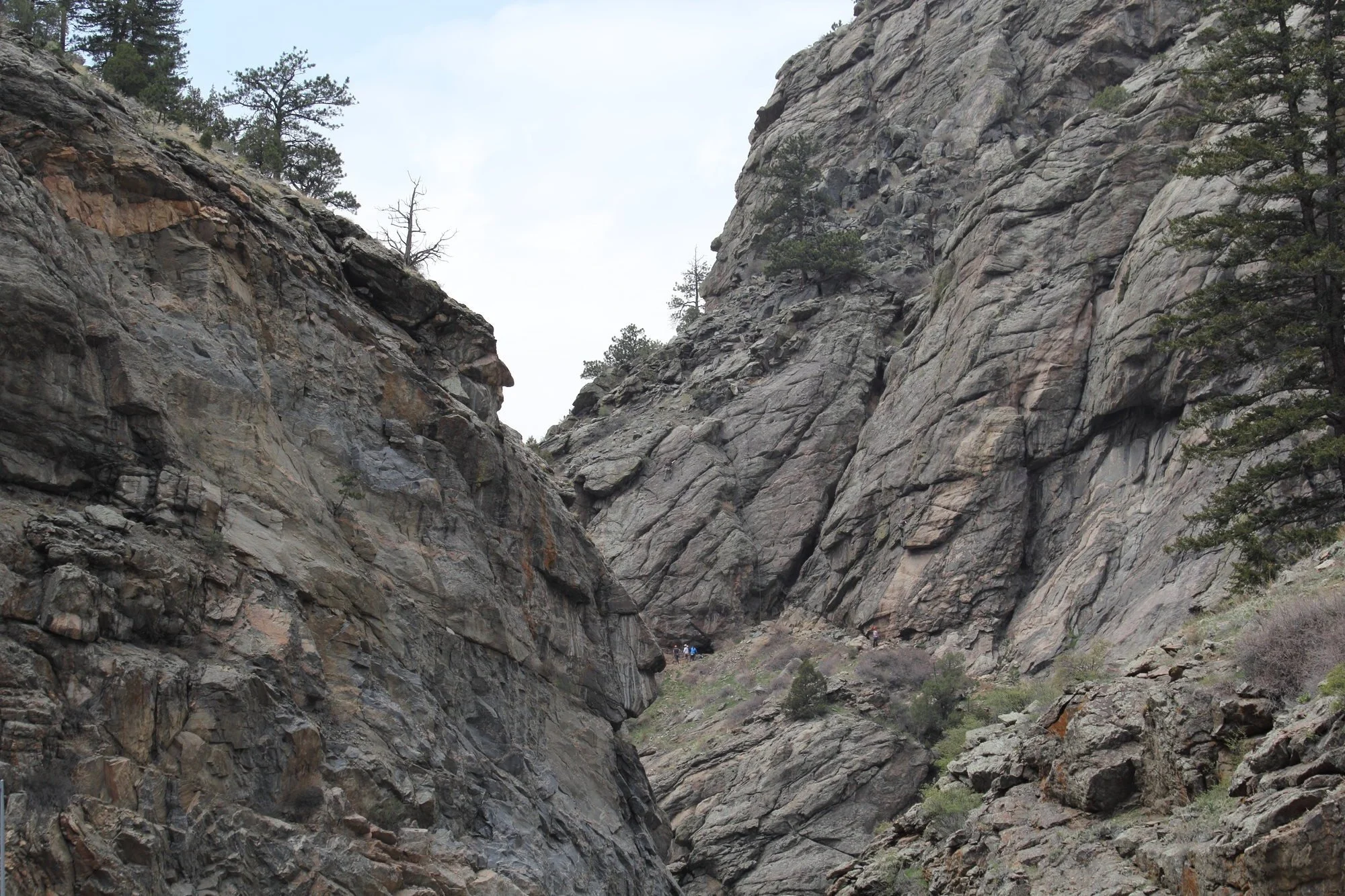
Pete Takeda, Editor of Accidents in North American Climbing; Katie Ferguson, Executive Assistant; Producers: Shane Johnson and Sierra McGivney; Videographer: Foster Denney; Editor: Sierra McGivney. Location: Canal Zone, Clear Creek Canyon, CO.


ANALYSIS

Avoid getting your feet and legs between the rock and the rope. A fall in this position may result in the leg snagging the rope and flipping the climber upside down.

While many sport leaders pass on wearing a helmet, this accident is a good example of its usefulness. Leading easier climbs can increase the risk for injury, as they often tend to be lower angle and/or have ledges that a falling climber could hit. (Source: The Editors.)

Editor’s Note: This was Starkey’s first outdoor climbing lead, and his lack of experience perhaps contributed to the accident.


Chicken Bone has been the scene of multiple accidents, mostly involving inexperienced climbers. Here are two more examples:

Lead climbing carries inherent dangers regardless of the grade and amount of protection. Popular moderates might be more perilous than notoriously dangerous routes, as climbers can be more easily caught unawares on “easy” and well-protected terrain. 


Powered By:


The Line: Two New Routes on the Incredible Hulk

Monica Jones on the Green Flame (5.12b), pitch five of the new route Choose Joy (IV 5.13a) on the Incredible Hulk. Photo: Abel Jones.

Already stacked with four-star alpine rock climbs, the Incredible Hulk in California’s Sierra Nevada got two more cool routes in 2024. Reports from the Hulk by Abel Jones and Jeremy Collins will be published in AAJ 2025; we’re previewing them here for those who might like to sample the goods this summer. You can find the complete reports, more photos, and topos for the climbs at the AAJ website—see the links below.

CHOOSE JOY

Chase Leary following Pitch 11 (5.12b), high on Choose Joy.
Photo: Abel Jones.

Over 15 years of exploring and countless days of dreaming led to the discovery of a new route on the tallest section of the Incredible Hulk. The basis for the route was an array of features I had spied over the years while climbing classics on the peak’s roughly 1,200-foot walls. During the COVID-19 lockdowns and California’s smoke apocalypse of 2020, my wife, Monica, and I took extended climbing trips to the area, armed with binoculars and our imaginations. We spent a lot of time gazing from the cliffs surrounding Maltby Lake, which offer a unique perspective from slightly up-canyon of the typical bivy area.

Putting a rough plan in place, I spent the next couple of years roping in various partners for ground-up exploration. We scoured the right side of the west face of the Hulk, trying to link the desired crack systems. After cruising dreamy, well-protected sections, we’d be stymied by closed seams or blank faces that forced us onto existing routes or dangerously loose terrain. We pioneered some decent pitches that led to nowhere in the area left of what became our final line, and we did a chossy 5.10 that topped out to the left of Red Dihedral, right of our final line.

Chase Leary following pitch six (5.11b) on the 12-pitch Choose Joy. Photo: Abel Jones.

With our ground-up methods exhausted, we started swinging around to seek out the highest-quality free climbing. The advice I got from other developers was to “make it classic,” and we aimed for that. I spent two summer seasons—2022 and 2023—scrubbing and equipping, primarily alone.

In the summer of 2024, my wife and I attempted the route and found it harder than expected. We had to redpoint most of the five 5.12s, cleaning and working our way up. The crux third pitch, a beautiful 5.13- splitter, was out of my league due to soaring summer temperatures and my still-developing fitness.

Monica and I worked out a 5.11 variation around the pitch, but the direct route deserved a proper send. Eventually the temperatures dropped, and with refined beta and support from one of the Sierra’s main crushers, Chase Leary, I was able to pull off a no-falls free ascent on August 28. The ascent included a thrilling runout due to skipping the gear placements I had rehearsed for the 5.13- crux—I climbed through the hardest part to a thumb jam, then barely got in a below-knee placement. I also got to witness some amazing onsighting by Chase, and the absolute glory light and stoke we had topping out the 1,200’ line.

Choose Joy (12 pitches, IV 5.13a) is a safe, no-grovel endurance route characterized by sustained 5.11 to 5.12- crack and face climbing between nice belay stances. We placed bolts where necessary. This route provided me with a ton of joy, and I hope it will do the same for others.

— Abel Jones


AAC Members Only: Download the 2025 AAJ

If you are an active AAC member, you can download a PDF of the 384-page 2025 American Alpine Journal right now and discover hundreds of new climbs. Log in to your Member Profile, look for the Publications section, and open the download link. The printed AAJ will be mailed out in September.

Have you climbed a long new route this year in the Alaska, Peru, Bolivia, or Greenland? We’re working ahead on these sections for the 2026 AAJ. Email us about significant first ascents here or anywhere in the world!


INFINITY GAUNTLET

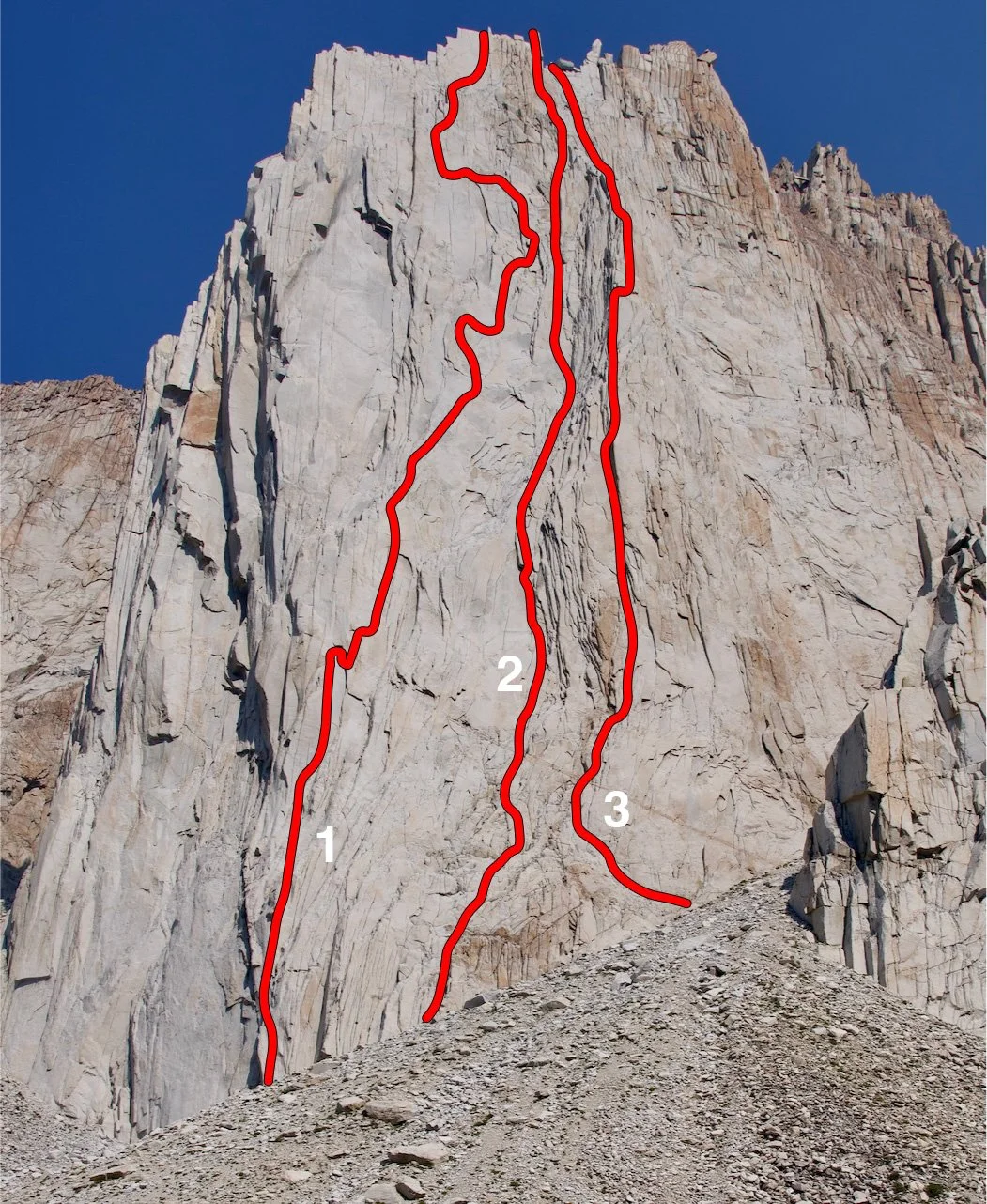
The west face of the Incredible Hulk, showing the new routes (1) Choose Joy (5.13a) and (2) Infinity Gauntlet (5.11d). Both routes are 12 pitches. Route 3 is the classic Red Dihedral. Many other routes are not shown. Photo: Jeremy Collins.

It’s a funny story: My first time hiking in to climb the Incredible Hulk was in 2003 with my friend Allen Currano. He caught wind of a prank I was going to pull, and he found a way to meet me at my own juvenile level. We both changed into spandex Spider-Man costumes at the base and did probably the first team Marvel superhero ascent of the peak. Other lighthearted ascents followed as I fell in love with the place, including a stimulating ski-in February ascent of Beeline with Chris McNamara.

In the spring of 2024, when I sent a note to prolific Hulk climber Dave Nettle with an idea for a new line right up the middle of the face, he replied with some advice and gave his blessing: “If you are motivated, why not go explore the possibilities there? Go get it, amigo!” My longtime partner Jarod Sickler also has a Hulk crush, and he was quick to join the effort. Moi Medina, a part-time DJ and full-time history professor in Los Angeles, was headed to Tuolumne at about the same time, but when I told him what we had in mind, he quickly rerouted.
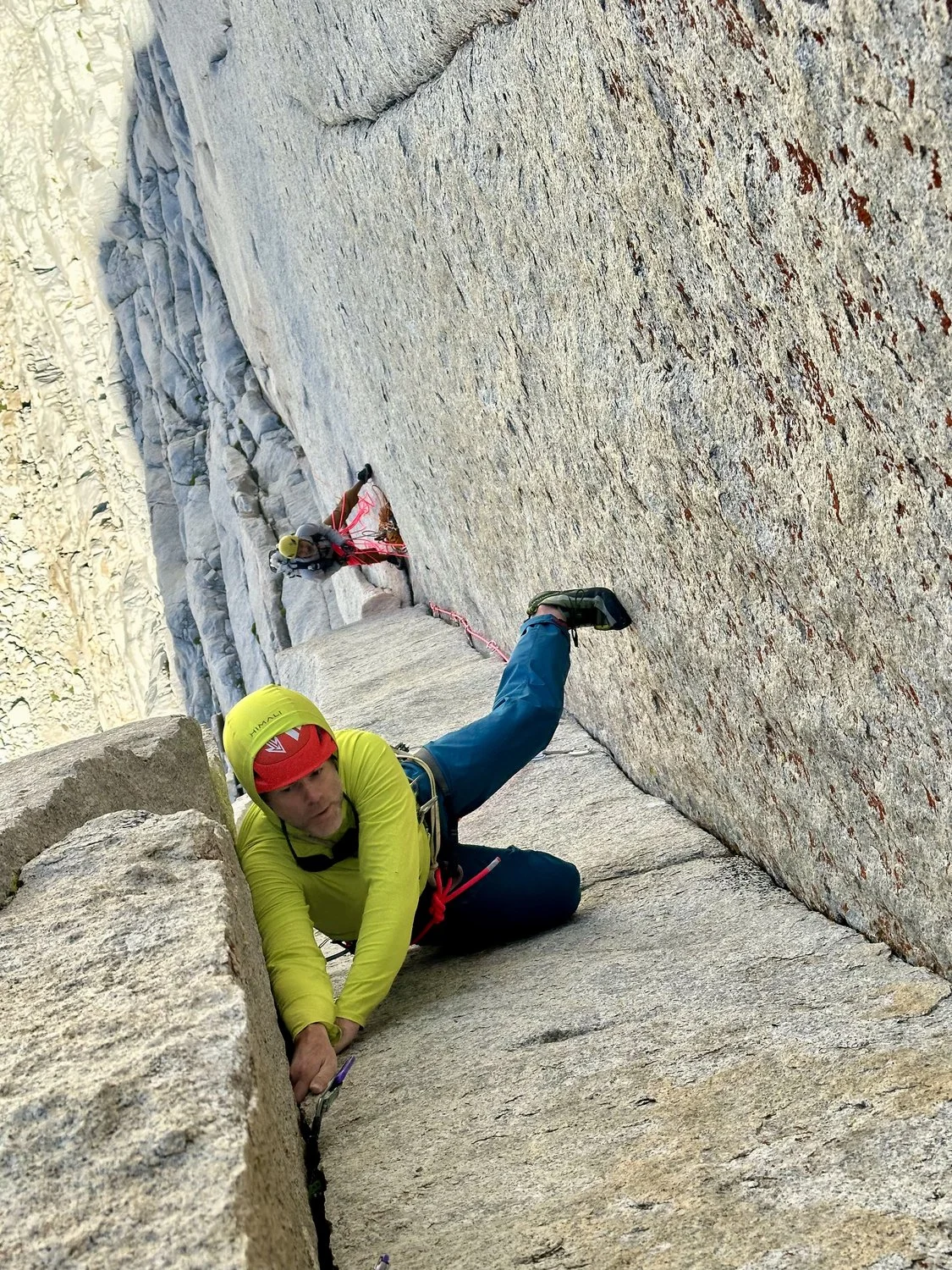
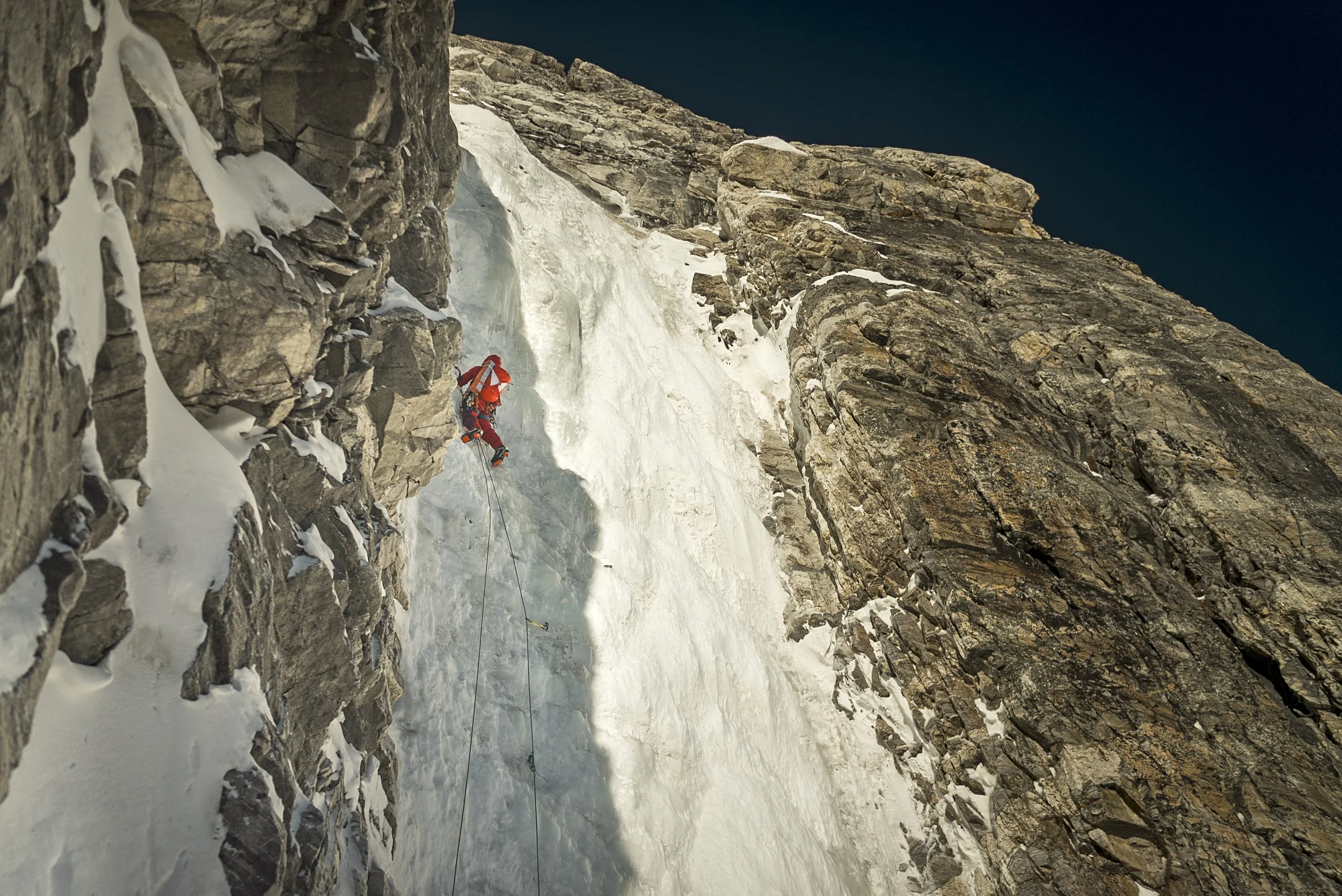
Jarod Sickler leading the bombay chimney on pitch four (5.11c). Photo: Jeremy Collins.

We left the ground with low expectations for rock quality: The line is the obvious weakness up the center, so for all we knew there was a great reason it hadn’t been climbed. Fortunately, we found the choss manageable and the short sections of crunchy rock cleaned up without too much hassle.
Starting about 100 feet left of the Red Dihedral and about 100 feet right of Tradewinds, we stayed committed to not getting pulled into the “folds” on our right, an accordion series of tight dihedrals that looked like a shattered Devils Tower. In the end, the line was mostly moderate, like its popular neighbor, with short, punchy cruxes and fantastic, airy positions. Notably, pitch four offered a tips layback (5.11c) leading into a bomb-bay chimney, and pitch five had a 5.11d boulder problem (the crux of the route) on a hanging arête.

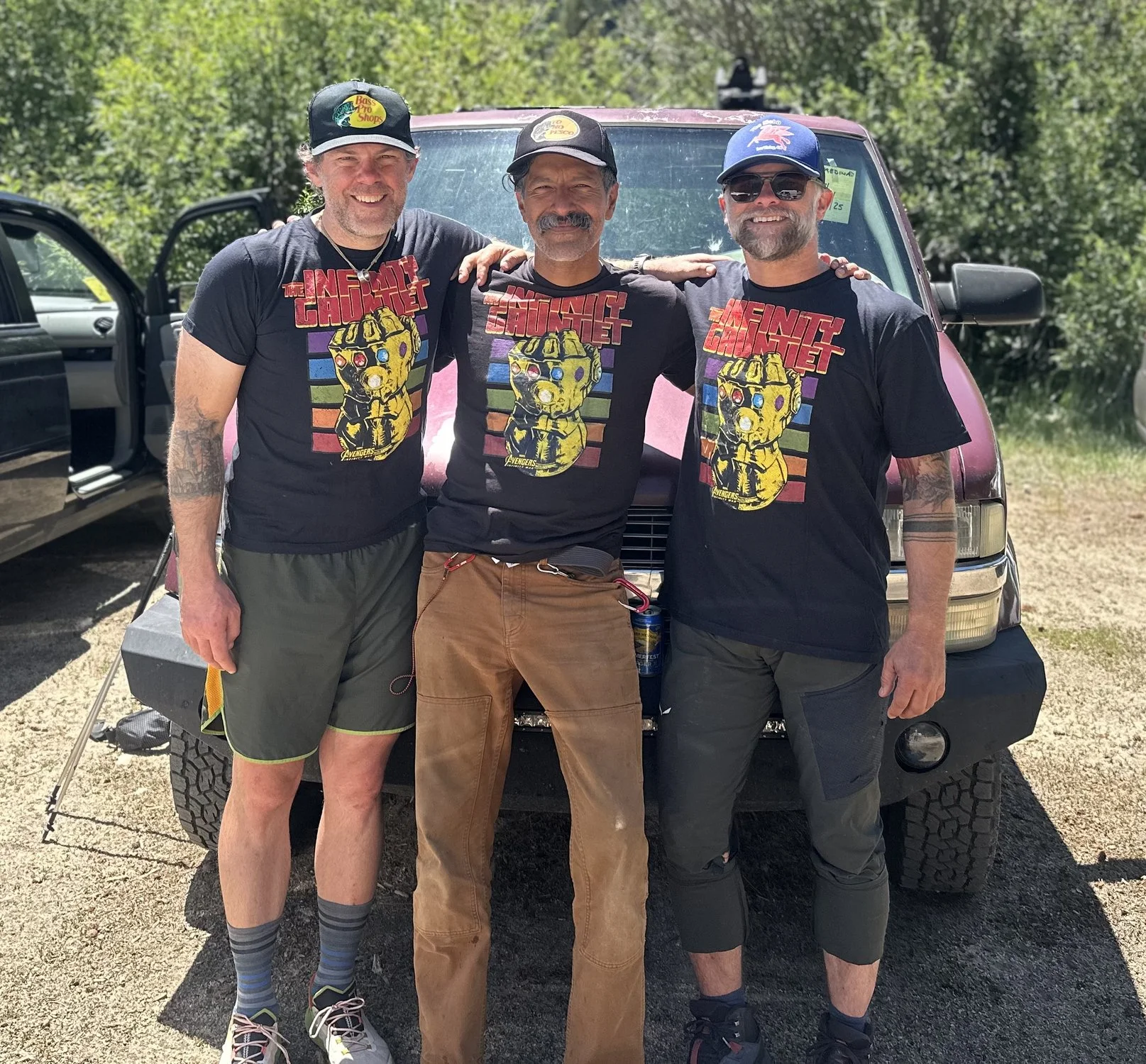
Superheroes: Jarod Sickler, Moi Medina, and Jeremy Collins.

In all, Infinity Gauntlet (12 pitches, IV 5.11d) took us two long weekends to establish. We drilled 17 protection bolts on lead. While our primary goal was to create a quality route, our secondary goal was to create a better descent option for Red Dihedral than the standard scramble-to-single-rappel-to-loose-1,000-foot-gully option. There are 13 rap stations straight to the ground that double as belays on the way up; we added a rappel station halfway up the first 70m pitch to ensure no rap was longer than 35m.

— Jeremy Collins


THE CUTTING EDGE: MT. PROVIDENCE

The Cutting Edge Podcast returns to Alaska for Episode 70 with Anna Pfaff, Andres Marin, and Tad McCrea. This past spring, the trio completed a direct new route up the south face of Mt. Providence in the Alaska Range. The nearly 1,000-meter climb had stout difficulties on rock, ice and snow. For Pfaff, who lost six toes to frostbite on a nearby peak in 2022, the summit was a form of redemption. And on Mt. Providence, all three climbers found large doses of good fortune and serendipity. Host Jim Aikman interviewed each climber to capture this compelling story of friendship, belief, and kismet in Alaska.


Supported By:

Powered By:

The Line is the newsletter of the American Alpine Journal (AAJ), powered by Arc’teryx, with additional support from Mountain Project by onX. The line is emailed to more than 80,000 climbers each month. Find the archive of past editions here. Got a potential story for the AAJ? Email the editors at [email protected].


Sign Up for AAC Emails

2025 American Alpine Club Gala Awards

MEET THE AWARDEES

Discover their incredible stories, then join us for the 2025 American Alpine Club Gala to hear more!


The Robert Hicks Bates Award: Brooke Raboutou

"Trieste" (V14) —Red Rock National Conservation Area, NV. Photo by Jess Glassberg/Louder Than Eleven.

FOR OUTSTANDING ACCOMPLISHMENT BY A YOUNG CLIMBER

Brooke Raboutou grew up in Boulder, CO, where she began climbing at age two. At 11, Raboutou sent Welcome to Tijuana (5.14b) in Rodellar, Spain, becoming the youngest person to climb the route. From 2020 to 2022, Raboutou pushed bouldering grades, sending Muscle Car (V14), The Atomator (V13), The Shining (V12/13), The Wheel of Chaos (V13), Doppelgänger Poltergeist (V13), Jade (V14), Euro Trash (V12/8a+), Euro Roof Low Low (V13/8b) Trieste (V14), Heritage (V13), La Proue (V13), Lur (V14), Evil Backwards (V13). Raboutou was the first American to qualify for the Olympics, and during the Tokyo Olympics in 2021, she finished 5th. 

In October 2023, Raboutou sent Box Therapy in Rocky Mountain National Park and promptly downgraded it from V16 to V15. In 2024, Raboutou won silver in the combined bouldering and lead competition at the Paris Olympics, becoming the first American woman to win an Olympic medal in climbing. In April 2025, Raboutou sent Excalibur (5.15c), becoming the first woman to send the grade. 


David R. Brower Conservation Award: Outdoor Alliance 

Crested Butte. Photo by Holly Mandarich.

FOR LEADERSHIP AND COMMITMENT TO CONSERVATION AND THE PRESERVATION OF MOUNTAIN REGIONS WORLDWIDE

Outdoor Alliance is a nonprofit coalition of national advocacy organizations that includes American Whitewater, American Canoe Association, Access Fund, International Mountain Bicycling Association, Winter Wildlands Alliance, the Mountaineers, the American Alpine Club, the Mazamas, the Colorado Mountain Club, and the Surfrider Foundation. For more than ten years, Outdoor Alliance has united the human-powered outdoor recreation community to achieve lasting conservation victories. Its work has helped to permanently protect 40 million acres of public land, secure $5.1 billion in funding for the outdoors, and convert more than 100,000 outdoor enthusiasts into outdoor advocates. Adam Cramer will be accepting the award on behalf of Outdoor Alliance. He is the founding Executive Director and present CEO of Outdoor Alliance. During his time as CEO, Adam has brought new sensibilities to conservation work that have resulted in hundreds of thousands more acres of protected landscapes, improved management for outdoor recreation, and thousands of outdoor enthusiasts awakened to conservation and advocacy work. He is an avid whitewater kayaker and mountain biker, but is always on the lookout for a good skatepark. 


Honorary Membership: Jack Tackle

Chilling ll in the Kishtwar Himalaya in India in 2015. Photo by Renny Jackson.

Honorary Membership is one of the highest awards the AAC offers. The award is given to those individuals who have had a lasting and highly significant impact on the advancement of the climbing craft.

For 52 years, Jack Tackle has focused on alpine climbing, particularly first ascents, in the Himalayas, South America, and Alaska. Jack Tackle is best known for his climbing in Alaska. He has done 35 separate trips, combining both attempts and successes since 1976, and completed 17 significant first ascents in Alaska’s various ranges. Tackle is a past Board member of the AAC (nine years) and served as Treasurer of the AAC from 2009-2012. He has been a member of the AAC since 1978. He presently serves on the Pinnacle and Grand Teton Climber Ranch committees and is the chairman of the AAC Cutting Edge Grant committee. For 30 years, Tackle was an independent sales rep for outdoor brands, including Patagonia, Black Diamond Equipment, and Vasque Footwear. In addition, Tackle guided for Exum Mountain Guides in the Tetons for 40 years, from 1982 to 2022.


The H. Adams Carter Literary Award: Michael Wejchert

Michael Wejchert. Photo by Alexa Siegel.

FOR EXCELLENCE IN CLIMBING LITERATURE

Michael Wejchert began climbing as a scared ten-year-old in a swami belt. Now a scared thirty-nine-year-old, rock and ice climbing remain his overriding passion. He began writing about climbing in high school and hasn't stopped. In 2013, he won the Waterman Fund Essay Contest for a piece called Epigoni, Revisited, about a failed attempt to climb Mount Deborah in the Hayes Range of Alaska. His first book, Hidden Mountains, won a National Outdoor Book Award in 2023. His essays and features have appeared in virtually every North American climbing magazine and major media outlets: Alpinist, Ascent, Rock & Ice, Appalachia, and the New York Times, to name a few. He is a proud contributing editor at the new Summit Journal. He lives just down the road from Cathedral Ledge, New England's finest trad cliff.


The Pinnacle Award: Kelly Cordes

Kelly Cordes at the team's second bivy, Great Trango Tower, 2004. Photo by Josh Wharton.

FOR OUTSTANDING MOUNTAINEERING AND CLIMBING ACHIEVEMENTS

As an undersized kid who wanted to be a cowboy, Kelly Cordes never dreamed that climbing would define his life. But he stumbled upon an obsession that took him to places of unimaginable beauty and infused his world with meaning. He established challenging alpine routes in Alaska, Peru, Patagonia, and Pakistan along the way. Some of his notable ascents include: the first ascent of the Azeem Ridge on Great Trango Tower, Pakistan; first link-up of Tiempos Perdidos and the upper West Face ice routes on Cerro Torre, Patagonia; first ascent of Personal Jesus on Nevado Ulta, Peru; first ascent of The Trailer Park on London Tower, Alaska; first ascent of Deadbeat, Thunder Mountain, Alaska; and the first ascent of Ring of Fire, Thunder Mountain, Alaska. His personal experiences intersected with a larger journey in his award-winning book, The Tower: A Chronicle of Climbing and Controversy on Cerro Torre. Cordes was also a senior editor of the American Alpine Journal for many years. He claims to never tire of mountains and wild places. 


The David A. Sowles Memorial Award: Jacques-Olivier Chevallier, Vivien Berlaud, Paulin Clovis

Photo by GMHM.

FOR UNSELFISH DEVOTION TO IMPERILED CLIMBERS 

McNeill-Nott Award recipient Michaelle Dvorak and her climbing partner, Fay Manners, attempted a first ascent on Chaukhamba III (6,995m) in northern India. Falling rocks sliced their rope, sending their haul bag, with most of their gear, plummeting down the mountain. The two sent out an SOS before Dvorak’s phone died and hunkered down as a storm rolled in. They waited for rescue, but helicopters circled them without seeing them. After two days of waiting, they decided to descend on the third day. They only had one set of crampons, making the impending challenge a high-consequence affair. 

Three climbers from the French Groupe Militaire de Haute Montagne of Chamonix, or the High Mountain Military Group, named Vivien Berlaud, Paulin Clovis, and Jacques-Olivier Chevallier had heard that two climbers were missing and abandoned their attempt on the peak’s east pillar to rescue the two climbers. The High Mountain Military Group is an elite and small unit that includes some of the best mountaineers in the French Armed Forces among its members.

The two climbers safely reached the French advanced base camp with Vivien Berlaud, Paulin Clovis, and Jacques-Olivier Chevallier's help. The Indian Mountaineering Federation (IMF) helicoptered them out the next day. 

Vivien Berlaud is a sergeant of the High Mountain Military Group. 

Photo by GMHM

Paulin Clovis is a member of the High Mountain Military Group. In 2023, he did the first repeat and winter ascent of Directissima (1200m 7a A2) on Pointe Walker on the north face of the Grandes Jorasses. 

Jaques-Oliver Chevallier is a High Mountain Military Group member and a mountain guide. Some of his accomplishments include: the Triple Direct (975m VI 5.9 C2) on El Capitan, Yosemite Valley; Cassin Route (1200m IV 5.9+ TD+/ED1 A1) on the north face of the Grandes Jorasses; Mont Blanc with a client; and Intégrale de Peuterey (4545m VI 5.9 WI4 M5) in the Mont Blanc massif.


Angelo Heilprin Citation: Rick Wilcox

Ty Marshall, Edge of the World 5.13c, The Prow Area, Cathedral Ledge, NH. Photo by Andrew Burr.

FOR EXEMPLARY SERVICE TO THE CLUB 

“Rick embodies the spirit of the Angelo Heilprin Citation through his decades of tireless service to the AAC, his instrumental role in establishing and leading critical mountain rescue operations, his entrepreneurial vision in fostering a thriving climbing community, and his dedication to our community and pursuits. It is without reservation that we select Rick Wilcox for the Angelo Heilprin Citation.” - Selection Committee.

Rick Wilcox has exemplified the dedication and service required for the Heilprin Citation for over half a century. He has been an AAC member since 1973 and served as secretary to three AAC presidents, providing invaluable continuity and institutional knowledge. He was also a member of the AAC Board of Directors and a highly active participant in the AAC New England section.

In 1976, while managing EMS in North Conway, NH, he was instrumental in establishing Mountain Rescue Service (MRS). He then served as MRS president for an impressive 41 years, leading essential rescue operations in the extreme environments of the White Mountain National Forest, which was recognized in 1999 when the New Hampshire MRS received the David A. Sowles Award for critical assistance to climbers.

Beyond his direct contributions to the AAC and mountain rescue, Wilcox purchased International Mountain Equipment in 1979, a pillar of the climbing community. Later, he co-owned International Mountain Climbing School with Brad White, which grew into a highly respected brand. In 1993, Rick, alongside Nick Yardley, co-founded the Mount Washington Valley Ice Fest, now the premier ice climbing event in the Northeast. He also had a six-year tenure as a director of the American Mountain Guides Association.

Wilcox’s unwavering dedication to the Club has benefited countless climbers for decades, particularly in the Northeast, where he has been a vital behind-the-scenes nexus. 


American Alpine Club award winners will be honored with bespoke, sustainable, custom-made awards by metal artist Lisa Issenberg. Lisa is the owner and founder of the Ridgway, Colorado studio, Kiitellä, named after a Finnish word meaning to "thank, applaud, or praise." Lisa has been providing custom awards for the American Alpine Club since 2013. Kiitellä's process includes a mix of both handcraft and industrial techniques. To learn more, visit kiitella.com


Attend the 2025 American Alpine Club Gala in Denver, CO, on October 18, 2025, to hear more from these awardees.


Suffer Well: A Climbing (and Life) Philosophy, with Kelly Cordes

Every year, the AAC bestows awards to climbing changemakers and celebrates their accomplishments at the AAC Gala. We’ll be announcing those award winners in mid July, but first, we wanted to give our listeners a sneak peak into the stories awaiting you, through diving into the life and personality of one awardee.  We invited the alpinist and climber Kelly Cordes, who will be receiving the Pinnacle Award this year, onto the pod to celebrate his outstanding mountaineering and climbing achievements, and simply to ramble a bit and tell good stories. Though too humble to brag, Cordes is known for his bold ascents, including the Azeem Ridge on Great Trango Tower, a link-up on Cerro Torre, many first ascents in Peru and Alaska, as well as his “disaster style” and “suffer well” philosophy. With a 20-year lens, we have Cordes reflect on the Azeem Ridge story and tell it anew with all that he’s learned since then. We also spend some time talking about his writing life, including supporting editing the AAJ for 12 years, and co-writing the bestseller, The Push, with his close friend Tommy Caldwell. Dive in to get just a taste of Cordes’ story, and why he’s committed to suffering well.


The Prescription—Rappel Fatalities

This month, we recall a tragic accident from 2023 ANAC. While recalling this accident is disturbing, it’s important to understand that there were 14 published rappel accidents that year, eight of which resulted in fatalities. The trend shows no sign of abating. In the upcoming 2025 ANAC, our data tables record a total of 15 reported rappel incidents that involved 23 climbers and ended with five fatalities. It’s not all bad news. In the 2025 ANAC, we also feature an article with tips for improved rappel safety from John Godino of Alpinesavvy.com. 

The west face of Tahquitz Rock was the scene of a tragic rappel accident in 2023 when two climbers fell to their deaths after an apparently solid rappel sling broke. Photo: Benjamin Crowell—Wikimedia.

Rappel Fatalities | Broken Anchor Sling

Tahquitz Rock, Riverside County, California


On Wednesday, September 28, 2022, Chelsea Walsh (33), a documentary filmmaker, and Gavin Escobar (31), an ex–Dallas Cowboys football player, died in a fall at Tahquitz Rock (Lily Rock). The Riverside Mountain Rescue Unit (RMRU) responded to the accident and later provided an in-depth analysis. They concluded that a degraded rappel sling caused the fatal fall of several hundred feet. This was one of two fatal accidents in 2022 due to a broken rappel-anchor sling.

RMRU reported that, around 8 a.m., Escobar and Walsh told another climbing party that they intended to climb Dave’s Deviation (3 pitches, 5.9). The weather appeared good, with only a few puffy clouds. At 10:30 a.m., a team on a route to the left, Super Pooper (5.10b), saw Escobar and Walsh near the top of their route. The weather was still good.

Fifteen to thirty minutes later, it began to rain. The team on Super Pooper began talking about retreating. By noon, the weather had gotten even worse. A team on Left Ski Track (5.6) had topped out and took shelter under a rock near the top of The Trough, a four-pitch 5.4. According to the RMRU report, by this time, “(the) weather has significantly deteriorated, with thunder and heavy rain and small hail. Members of both climbing parties were surprised at how quickly the storm intensified. Water was running down rock faces and soaked all climbing gear.”

Between noon and 12:15 p.m., the team on Super Pooper began to retreat. They heard a noise from the direction of Walsh and Escobar’s route and saw two falling climbers and a very large rock falling with them. The four climbers near the top of The Trough heard the same. No one heard rockfall before the sight and sounds of the fall. When RMRU arrived, they found Walsh and Escobar at the base of a gully below The Trough. The location of the bodies aligned with the fall line below a tree that was above the finish of Dave’s Deviation. Later investigation and video taken by Walsh confirmed the pair chose the tree—with an in situ rappel sling—as a bail point. The video also showed Escobar initiating the rappel and both climbers clipped into the single webbing loop. Both climbers appeared in good spirits and unhurried in making their rappel arrangements.

Above, we see the broken sling. At the time of the accident, this sun-bleached sling appeared darker/newer because it was wet from the rain storm that caused the climbers to rappel from this spot. Photo: James Eckhardt/RMRU.

The RMRU reported that the pair were found “wearing helmets, harnesses, and climbing shoes. Chelsea had a PAS girth-hitched through her harness with a locked screwgate at the far end, an unlocked screwgate clipped to an ATC, and an unlocked screwgate clipped to a hollow block. Chelsea was not connected to the rope or any anchor material. Gavin had a single-length sling girth-hitched to his harness’ tie-in points with an unlocked carabiner clipped to the sling and the belay loop. Additionally, an ATC was attached to his belay loop with a locked screwgate and both strands of the rope running through the ATC and through the screwgate. There was a four-to-five-foot loop of rope extending from the top of the ATC with two opposite and opposed wire-gate carabiners clipped to the rope. These carabiners were not connected to anything else. The rope had some sheath damage to the area around the ATC and significant sheath damage a few feet below the ATC, but there were no breaks present. Each end of the rope had a single figure 8 tied into it, one loose and one hand tight.”

The RMRU report summarizes, “As the storm moved in, the party reached the pine tree close to the first pitch of Upper Royal’s Arch and, given the conditions, decided to rappel. By the time they reached the pine tree, the webbing [around the tree] was wet, and as such, it would have been more difficult to ascertain the quality of the webbing without closely inspecting the knot and seeing the original color. They likely clipped into the webbing with their personal anchor systems. As the terrain below the pine tree is sloping, with only small areas to stand, it is likely they would have both been weighting the webbing. They then tied stopper knots into their rope, clipped it through the two wire-gates opposite and opposed, and dropped the ends. Gavin was first on rappel and descended a few feet before the webbing broke. As it was a single strand with no redundancy, both climbers fell. There was no evidence of rockfall hitting the tree or surrounding rock, and the webbing could not have been cut by a rock.


Video Analysis—Rappel Anchors

In this video, Jason Antin, IFMGA/AMGA Guide, gives some tips to avoid mistakes at the anchor:

  • Avoid rappelling from a single sling.

  • Avoid rappelling from an anchor made of old webbing.

  • White or gray nylon webbing is a red flag and needs closer inspection.

  • Beware of blotchy or faded webbing. Inspect the knot to try to spot an alternate (original) color inside. Try turning a sling over to look at its “under” side, against a tree or chockstone.

  • Carry a knotted sling or cordelette to back up anchors and a knife to cut away bad webbing and carry it out.

Credits: Pete Takeda, Editor of Accidents in North American Climbing, Jason Antin, IFMGA/AMGA guide; Producer: Shane Johnson and Sierra McGivney; Videographer: Foster Denney; Editor: Sierra McGivney; Location: Little Twin Owls, Lumpy Ridge, CO.


ANALYSIS

Rappelling from a single sling is not advisable. Nor is rappelling from an anchor comprised of old webbing. That said, most experienced climbers (the editors included) have at one time or another done both. Walsh and Escobar were very experienced and, based on their video, they felt in control of the situation. While the weather played a factor in their decision to retreat, it also indirectly played a role in the team’s decision to use the questionable rappel sling. The rain had made the sling appear in much better condition than it was. The RMRU report states, “The webbing felt old and stiff when dry, but when wetted, it felt significantly better and looked much less faded. It was gray/white…however, upon retrieval and closer inspection, it had originally been fluorescent green and was now fully faded from prolonged sun UV exposure.”

The RMRU report added that, “The unfaded color was visible in the knot, however it was very difficult to see without close inspection.” Any white or gray nylon webbing at an anchor is a red flag: Such webbing is sold, but it’s uncommon, and it suggests closer inspection. The same goes for any blotchiness (from fading) in the webbing. Inspecting the knot for soundness is a good step, for obvious reasons, but possibly spotting an alternate color inside the knot is also good reason to inspect it. Also, try turning a sling over to look at its “under” side, against a tree or chockstone. These days, sewn aramid-fiber slings are the norm. It is expensive to leave behind long looped runners as rappel anchors. To get around this problem, consider carrying a long knotted sling or cordelette that is better suited for backing up suspect anchors; a knife will be handy to cut the sling to length. This solution is inexpensive and reasonably light weight. (Sources: James Eckhardt, RMRU, and the Editors.)

These are images of the failed webbing rappel anchor from Tahquitz Rock. (A) Webbing as it was found on tree, with arrows indicating the two broken ends. (B) Image showing the full length of webbing retrieved with break and (C) close-up image of break. (D) Test 1: webbing broke at 2.54kN. (E) Test 2: webbing broke at knot at 3.56kN. Image also shows the original color (neon green) of the webbing. (F) Test 3: webbing broke at 3.2kN. Photos: RMRU.


Only a Few Days Left—Get the Shirt

Accidents in North American Climbing is one of climbing’s most historic and treasured publications. Get it with your American Alpine Club Membership! For the month of June only, also get the limited edition T-shirt!

Already a member? Donate $30 or renew in the month of June!

Use promo code: DIRTBAG


Powered by:


The Line: Coveted Chinese Wall Finally Climbed

The west face of Seerdengpu, a towering rocky summit of 5,592 meters in China’s Siguniang National Park, had been attempted at least a dozen times without success. Among others, West Virginia climber Pat Goodman tried six different lines during three separate expeditions. In 2024, a Chinese climber finally topped out on the 850-meter face, in his fourth year of attempts. Unable to secure a permit, he climbed alone and in secret in August 2024, completing only the second known ascent of the peak. Below is his story.

SEERDENGPU, WEST FACE

The west face of Seerdengpu (5,592m), approximately 850 meters high. Prior to 2024, the peak had only been climbed once, in 2010, by Americans Dylan Johnson and Chad Kellogg. The west face had been attempted at least a dozen times without success. Photo: Griff.

In 2015, when I first saw Seerdengpu (5,592m) from the west, I never thought that one day I would stand on the summit. The ca 850m west face was one of the great unclimbed walls of Siguniang National Park and had been attempted many times, notably by American Pat Goodman. In 2013, with Matt McCormick, he made unsuccessful attempts on three different lines, then later another attempt with Marcus Costa, and another, more toward the southwest, with David Sharratt. Costa made another attempt with Enzo Oddo. The face had also been tried by Russian, Australian, Polish, and Chinese teams. Loose terrain and objective danger appear to have been a common problem. 

Until 2024, Seerdengpu had only one ascent. In 2010, Dylan Johnson and Chad Kellogg (both USA) climbed the northeast ridge (see note below). Prior to their ascent, four parties had attempted the north face.

I first tried the west face in August 2021 but chose a poor line and retreated after 80 meters. In 2022, I changed to the previously attempted line on the right side of the wall (the line attempted by Costa and Goodman, as well as the Russian and Chinese teams). I retreated after 350 meters. Over three weeks in July 2023, I only reached 200 meters up the same line. I returned in August 2024. 

Unable to get an official permit, I had to work alone, as porters did not dare provide service. [Because of this, the author is using an alias.] I entered the valley several times as a tourist, each time carrying a 40-liter bag. In the end, I ferried a total of 75kg of equipment from the road in Shuangqiao Valley to my base camp at 4,500 meters. 

French climber Enzo Oddo in the ice gully on the west face of Seerdengpu in January 2015. Oddo and Marcos Costa attempted a winter ascent, hoping to avoid the rockfall danger that plagued other attempts. The ice was excellent, but two-thirds of the face still involved hazardous rock climbing. The successful 2024 ascent followed the same gully in August. Photo: Marcos Costa.

After the initial 170 meters of the face, which is 5.7, the route enters a gully. It is always wet. Some previous attempts had failed due to the volume of water, and in 2015 Costa and Oddo tried this route in January, finding the gully nicely frozen but the rock above dangerously loose. They retreated from the Russian high point. I kept mostly in the bed of the narrow gully, which was wet and loose, but easier (5.8 C1+). I made my first portaledge camp at the top of the gully at around 5,100 meters.

On the first day above the portaledge, I climbed 80 meters at 5.9 C1+. When I rappelled to the ledge that evening, I found two holes in the fly, one of them large. A small bag on the ledge had also been hit and damaged. The next day, I climbed up left on loose but easy rock (5.6), found a site for my next camp, and spent all the following day moving my equipment to Camp 2 (5,250m).

On August 24, I aided a horizontal crack and took the only fall of the route. I retreated and took a different line, a corner with a thin crack that evolved into a chimney. It was a brilliant 60m pitch at 5.9+ C2. (I suspect it would go free at 5.11 or 5.11+.) Above this, I traversed left using all my 70m rope, then went back to the portaledge for the night. I found it difficult to sleep due to the cold, and perhaps the excitement of being close to the top. 

On the 25th, I regained my high point and continued up at 5.8 C1+. That day I dropped an ascender, a Camalot, and a sling. I realized that I was losing concentration and needed to be more careful. That night, I didn’t get to sleep until 3 a.m. I was sick and cold. I left Camp 2 again at 8 a.m. on August 26—a total of 27 days since I first started ferrying loads from the road. I reached my high point at 11 a.m. and climbed for a further 150 meters to the top of the face. From there I walked 200 meters over ice and boulders to reach the highest point of the mountain, at 2:55 p.m., for its second ascent. 

Close-up view of the first ascent of the west face of Seerdengpu. The wall is about 850 meters high, and the climbing distance of the route totaled about 1,200 meters. Photo: Griff.

Unfortunately, just 50 meters before reaching the summit, a loose boulder fell onto my left foot and broke a toe. As I started back down, it began to rain. Four hours of rappelling through rain and sleet took me back to the portaledge. My foot was painful and didn’t look good, so I decided I should get off the mountain the next day and called friends to let them know.

On the 27th, I threw some gear and the portaledge off the wall and rappelled from 11:30 a.m. to 5:30 p.m., reaching base camp that day. A few days later I was in a Beijing hospital, having an operation on my toe. My friends later collected my gear from base camp.

I named the route Wild Child. It has around 1,200 meters of climbing up to 5.9+ C2. I did not carry a bolt kit, but there are five bolts in the initial gully, all installed by a 2014 Chinese team for rappel anchors. Higher, there is one bolt at Camp 1, thought to have been installed by the Russian team.

—Ma Fang, China

Editor’s Note: Because he climbed without a permit, the author of this report used a pseudonym for his AAJ story.


Only a Few Days Left—Get the Shirt

The American Alpine Journal is one climbing’s most historic and treasured publications. Get it with your American Alpine Club Membership! For the month of June only, also get the limited edition t-shirt!

Already a member? Donate $30 or renew in the month of June!

Use promo code: DIRTBAG


SEERDENGPU: THE FIRST ASCENT

Seerdengpu from the north, with the line of the first ascent by the northeast ridge (mostly hidden). The "nose", unsuccessfully attempted by several teams, divides shadow and sunlight. The west face, climbed in 2024 for the mountain’s second ascent, is partially in view to the right. Photo: Dylan Johnson.

American climbers Dylan Johnson and Chad Kellogg made the first ascent of Seerdengpu in 2010, two years after climbing a new route up nearby Siguniang. On their third attempt in 2010, the pair climbed the northeast ridge of Seerdengpu in a 34-hour round-trip push from their high camp. It was Johnson’s third summit in the Qionglai Mountains and Kellogg’s seventh. Tragically, Kellogg died less than four years later in a rockfall accident in Patagonia. Johnson’s report about the Seerdengpu climb appeared in AAJ 2011: Read it here.


Powered by:

Supported by:


The Line is the newsletter of the American Alpine Journal (AAJ), powered by Arc’teryx, with additional support from Mountain Project by onX. The line is emailed to more than 80,000 climbers each month. Find the archive of past editions here. Got a potential story for the AAJ? Email the editors at [email protected].

2025 Climbing Accident Trends: What the Data Tells Us

It’s that time of year again–the AAC has invited the editor of Accidents in North American Climbing, Pete Takeda, to hop on the pod to chat about emerging trends in climbing accidents. This year, we’re also delighted to have a conversation with Dr. Valerie Karr, a professor at UMASS who has stepped in to help us with a massive data analysis project. Valerie used grounded theory analysis to parse through 20 years of accidents data—picking out patterns in how human behavior contributes to accidents. We discuss some examples like risk normalization, the mentor trap, and attitudes around fixed gear. Dive into the podcast to hear about her findings and learn more about the case studies that stuck out to the editors this year.


Guidebook XIV—Policy Spotlight

Photo by AAC member Kennedy Carey.

EXPLORE—An Act and The Act

By AAC Advocacy Director Byron Harvison
Photos by AAC member Kennedy Carey

Act

1. A thing done; a deed.
2. A written ordinance of Congress, or another legislative body; a statute.
3. A main division of a play, ballet, or opera.

Drama

1. A play for theater, radio, or television.
2. An enticing, emotional, or unexpected series of events or set of circumstances.


EXPLORE, in the waning days of the 118th Congress, met every definition of the words “drama” and “act” as it made its way into becoming law. As I sat at my computer watching Senator Joe Manchin ask for unanimous consent of the bill on the Senate floor, it was not lost on me that years of work, by hundreds of organizations, teetered on the edge of achievement. And it passed in a most glorious fashion. But let me back up just a bit...

Act 1, Scene 1

Not too long ago, in early December of 2024, the AAC policy team traveled to Washington, DC, and met up with the Access Fund and American Mountain Guides Association (AMGA). The mission was clear—examine and pursue all avenues to get the EXPLORE Act passed. At that time, attachment to the National Defense Authorization Act (NDAA) was still on the table, as was the possibility of being bundled in with the Continuing Resolution (CR) to keep the government funded. Additionally, there was the less probable route of the bill going “stand-alone” for a unanimous consent vote on the Senate floor, but we sensed that there wasn’t enough floor time, especially given the need to end the lame-duck session of Congress, and the condition that a unanimous consent vote had to actually be unanimous without a single dissenting vote.

Photo by AAC member Kennedy Carey.

It was an all-hands-on-deck moment for recreation-based organizations—Outdoor Alliance, Outdoor Recreation Roundtable, Surfrider, The Mountaineers, IMBA, Outdoor Industry Association, organizations representing hunting and fishing interests and RV interests, and many, many more orgs, all working simultaneously in an effort to see this historic recreation bill package passed.

Our small team focused a lot of effort on speaking with the bipartisan group of 16 senators that submitted a joint letter to the Secretaries of Agriculture and the Interior expressing the appropriateness of fixed anchors in Wilderness and wanting a report on the status of the agencies’ respective proposed fixed anchor regulations. The Protecting America’s Rock Climbing (PARC) Act, a component of the EXPLORE Act that serves to recognize recreational climbing (including the use, placement, and maintenance of fixed anchors) as an appropriate use within the National Wilderness Preservation System, further emphasized the intent of those senators, and of Congress more broadly, to preserve the historical and well-precedented practice of fixed anchor utilization in Wilderness.

Scene 2

It is no secret that the waning days of the 118th Congress were fairly chaotic. Characterized by the forthcoming change of administrations, few clear “unified” priorities, and the pending departure of several longtime members of Congress, the landscape was hard to navigate. We left DC understanding the potential pathways to passage of EXPLORE, but still not certain which vehicle would get it across the finish line. The following week we saw it miss the cut for the NDAA Manager’s Amendment and concentrated on advocating for its inclusion in the CR. As the days drew closer to a potential government shutdown, we came to understand that the CR was likely going to be relatively tight compared to previous iterations, and would probably not allow for bills such as EXPLORE to ride on it. The CR was out for us. That is when we heard that Senator Joe Manchin (I-WV) was considering introducing EXPLORE as a stand-alone bill.

Photo by AAC member Kennedy Carey.

This was INCREDIBLE news. However, we had some concerns as we knew that the Senate was working off of the House-passed version, which had been passed via unanimous consent (UC) in April of 2024, stewarded by Rep. Bruce Westerman (R-AR). We understood that the Senate wanted the House to address some issues in the bill, but that would require the bill to be sent back to the House for consideration and a vote...which would require time. And there wasn’t any.

On the morning of December 19, we heard that Senator Manchin was planning to introduce the House version of EXPLORE on the Senate floor for a UC vote. For those tuning into the live broadcast, we had no idea what time the possible introduction would occur. It was observable that Senator Manchin was talking to a group of senators and then left the floor. A few hours later Senator Manchin appeared and presented the EXPLORE Act for consideration via a UC vote. During his introduction, he emphasized that the EXPLORE Act was “...something that we all agree on” and that “the House and Senate are in agreement,” and that there were some changes that needed to be made but could be accomplished during the next Congress. Now keep in mind, in order to pass via UC there cannot be a single vote of dissent.

Scene 3

After Senator Manchin teed the bill up for a vote, Senator Ted Cruz (R-TX) stepped up to the podium. He began by reserving his right to object until the end of his speech. This is to say that no one knew whether he would be objecting and opposing the UC of EXPLORE or allowing it to pass. He spoke to his TAKE IT DOWN Act, which is a bill seeking to protect victims of deepfake pornography. The years of work on all the bills associated with EXPLORE hung in the balance—all the work on SOAR, BOLT, VIP, and Recreation Not Red Tape, on the precipice of passage. You can imagine all the breaths that were being held while Senator Cruz spoke.

“I do not object.”

Those words, spoken as a favor to retiring Senator Manchin and Rep. Westerman, provided true theater drama that we are generally accustomed to watching in a much different environment. The historic EXPLORE Act was passed, via unanimous consent through the Senate, and was on its way to the president. On January 4, 2025, President Biden signed the EXPLORE Act into law, and it became Public Law Number 118-234.

Act 1, Scene 3, complete.

Act 2

As EXPLORE was being teed up for a vote in the Senate, the National Park Service quietly announced that it was withdrawing its proposed fixed anchor guidance. This gesture suggests a new window of opportunity for climbing organizations, as well as other interested recreation and search and rescue organizations, to work in collaboration with land agencies to develop sound fixed anchor policies that reflect the direction of Congress and their passing of the PARC Act.

The AAC Policy Team and the Executive Director have visited DC over the last two months, working carefully with our partner organizations in these quickly evolving times to support the implementation of EXPLORE, discuss impacts on our public lands as a result of the federal reductions in force, and address other issues.

Stay tuned on the AAC’s digital platforms to learn more about the status of public lands policies, and how they impact, or may impact, climbers.


Sign Up for AAC Emails

Guidebook XIV—An Interview with Dougald MacDonald

Photo by AAC staff Foster Denney.

How would you describe the scope of the work that goes into making the American Alpine Journal (AAJ)?

Dougald MacDonald: Producing the AA J is a year-round effort that involves literally hundreds of people. The actual “staff” of the AAJ (who are all part-timers and volunteers) includes more than 15 people, and each year we work with roughly 300 individual climbers and photographers to share their stories.

The book goes to press in late April, so the peak of the cycle is in March and April. But the work on the following year’s edition starts immediately, plus we prepare and upload online stories all year round. AND we produce The Cutting Edge podcast and the monthly Line newsletter.

What’s the history of the AAJ? How has it changed over the years?

DM: The AAJ is coming up on its 100th birthday, and unsurprisingly it has changed quite a lot over the years. It started out as much more of a Club publication, telling the stories of AAC members’ adventures. In the 1950s, with the rise of Himalayan climbing, the book started to become much more international. But it was really Ad Carter—who edited the AAJ for 35 years, starting in the 1960s—who created the wide-ranging, international publication it is today. We no longer focus mostly on the activities of AAC members—though we’re very happy to tell those stories when we can—but instead try to document all significant long routes and mountain exploration anywhere in the world, by climbers from every country.

For both the AAJ and Accidents in North American Climbing (ANAC), the most significant changes of the last 10 to 15 years have been 1) the introduction of color photography throughout both books and 2) the launch of the searchable online database of every AAJ and ANAC article ever published.

Dougald questing off in Lumpy Ridge, Rocky Mountain National Park, CO. Land of the Cheyenne people. Photo by AAC member and former AAJ senior editor Kelly Cordes.

What’s an example of a unique challenge the editors have to deal with when making the AAJ?

DM: One challenge is that we come out so long after many of the climbs actually happened. So, readers may have seen something about any given climb several times, in news reports and social media posts and even video productions. But the AAJ has never been in the breaking news business. Instead, we aim to provide perspective and context. Perspective in that we don’t have any vested interest that might slant a story one way or another, and context on the history and geography that helps readers really understand the significance of a climb, how it relates to what’s been done before, and what other opportunities might be out there. Another big challenge is language barriers, since we work with people from all over the world. We’re fortunate to work in English, which so many people around the world use these days. We also use skilled translators for some stories, and online translation tools have improved dramatically in recent years. But there’s still a lot of back-and-forth with authors to ensure we’re getting everything just right.

What’s an example report that was really exciting for you to edit from the last few years?

DM: For me, personally, the coolest stories are the ones that teach me about an area of the world—or a moment in climbing history—that I knew nothing about before starting to work on a story. In the upcoming book, for example, we have stories about winter climbing in Greece (who knew?) and a mountain range in Venezuela that’s gorgeous and has peaks over 16,000 feet. Unfortunately, that range is rapidly losing its snow cover and its small glaciers. AAJ senior editor Lindsay Griffin, who is editing the story, did some cool climbs in the range in 1985, and the difference between his photos and those from today is shocking.

Are there any big differences in process between making the AAJ and ANAC?

DM: The biggest differences are just the scale and scope of the two books: The AAJ is a nearly 400-page book that tries to cover the entire world, and ANAC averages 128 pages and focuses on North America. There’s also a sense of starting from scratch on lots of AAJ reports, since the mountain or area in question may be entirely unfamiliar to the editor handling a story, whereas most of the accident types are all too familiar. Still, there’s always something new to learn in both books, and that makes the work very interesting and rewarding.

What emotions are you wrestling with when you ultimately send off this book to the printer?

DM: One word: relief! But also a lot of pride for what we accomplish.


Friends of the AAJ and Accidents

The American Alpine Journal and Accidents in North American Climbing are more than publications—they are the home to essential climbing knowledge. The AAJ is the sport’s definitive collection of cutting-edge climbing reports, and Accidents is the most in-depth accident analysis available to the climbing community. These publications are some of our most treasured member resources, and YOU make them possible!

By joining Friends of the AAJ and Accidents, you ensure these essential educational tools continue to inform and inspire climbers everywhere.

With a designated gift of $250 or more, you’ll be recognized as a key supporter with your name printed in the corresponding 2026 publication—publicly demonstrating your commitment to the climbing community. Friends of the AAJ also receive a signed hardcover edition of the book! When making your gift, please denote which publication you are supporting. Questions? Reach out to the team at [email protected].

Your support makes these world-renowned books possible every year! Go above and beyond for climbing inspiration and education today!


Sign Up for AAC Emails

Guidebook XIV—Member Spotlight

Photo courtesy of the Grunsfeld Collection.

No Mountain High Enough

The Intersections between Space Travel and High-Altitude Mountaineering

Member Spotlight: Dr. John Grunsfeld, Astronaut
By Hannah Provost

Spacewalking outside the Hubble Space Telescope, John Grunsfeld wasn’t that much closer to the stars than when he was back on the surface of Earth, but it certainly felt that way. The sensation of spacewalking, of constantly being in freefall, but orbiting Earth fast enough that it felt like weightlessness, was more of a thrill than terrifying. Looking out to the vaster universe, seeing the moon in its proximity, the giant body of the sun, stole his breath away. Grunsfeld was experiencing a sense of exploration that very few humans get to. It was deeply moving, a sensation he also got in the high glaciated ranges when he’d look around and be surrounded by crevasses and granite walls of rock and ice. Throughout his life, he couldn’t help but seek out the most inhospitable places on the planet, and even beyond.

You might think that there is nothing similar between climbing and spacewalking. But when you ask John Grunsfeld, former astronaut and NASA Chief Scientist—and an AAC member since 1996—about the similarities, the connections are potent.

The focus required of spacewalking and climbing is very much the same, Grunsfeld says. Just like you can’t perform at your best on the moves of a climb high above the ground without intense focus on the next move and the currents of balance in your body, so, too, suited up in the 300-pound spacesuit, with 4.3 pounds per square inch of oxygen, and 11 layers of protective cloth insulation, you still have to be careful not to bump the space shuttle, station, or telescope as you go about the work of repairing and updating such technology—the job of the mission in the first place. Outside the astronaut’s suit is a vacuum, and Grunsfeld is not shy about the stakes. “Humans survive seconds when vacuum-exposed,” he says. With such high risks, it’s a shame that the AAC rescue benefit doesn’t work in space.

Not only is spacewalking, like climbing, inherently dangerous, it also requires intense focus, and it can be a lot like redpointing. Grunsfeld reflects that “it’s very highly scripted. Every task that you’re going to do is laid out long before we go to space. We practice extensively.” In Grunsfeld’s three missions to the Hubble Space Telescope, his spacewalks were a race against the clock—the battery life and limited oxygen that the suit supplied versus the many highly technical tasks he had to perform to update the Hubble instruments and repair various electronic systems. It’s about flow, focus, and execution—skills and a sequence of moves that he had practiced again and again on Earth before coming to space. Similarly, tether management is critical. Body positioning, and not getting tangled in the tether, is important in order to not break something—say, kick a radiator and cause a leak that destroys Hubble and his fellow astronauts inside. But to Grunsfeld, the risk is worth it. The Hubble Space Telescope is “the world’s most significant scientific instrument and worth billions of dollars. Thousands of people are counting on that work.”

Indeed, perhaps a little more is at stake than a send or a summit.


Grunsfeld climbing at Devil’s Lake, WI. Land of the Myaamia and Peoria people. Photo by AAC member Tom Loeff.

Growing up in Chicago, Grunsfeld’s mind first alighted on the world of science and adventure through the National Geographic magazines he devoured, and a school project that had an outsized effect. Grunsfeld’s peers were assigned to write a brief biography of people like George Washington and Babe Ruth. Rather than these more familiar figures, Grunsfeld was assigned to research the life of Enrico Fermi—a nuclear physicist who was instrumental in the Manhattan Project, the creator of the world’s first artificial nuclear reactor, and a lifelong mountaineer. Suddenly, science and the alpine seemed deeply intertwined.

Grunsfeld started climbing as a teenager, top-roping in Devil’s Lake, back when the cutting edge of gear innovation meant climbing by wrapping the rope around your waist and tying it with a bowline. Attending a NOLS trip to the Wind River Range and further expanding on his rope and survivor skills truly cemented his love of climbing in wild spaces. Throughout the years, climbing was a steady beat in his life, a resource for joy. He would climb in Lumpy Ridge, the Sierra, the White Mountains of New Hampshire, Tahquitz, Peru, Bolivia, and many other places with his wife, Carol, his daughter, and close friends like Tom Loeff, another AAC member.

If climbing was a steady beat, his fascination with space and astrophysics would be a starburst. At first, his application to become a NASA astronaut was denied, but in 1992, Grunsfeld joined the NASA Astronaut Corps. It would shape the rest of his life’s work. Between 1995 and 2009, Grunsfeld completed five space shuttle flights, three of which were to the Hubble Space Telescope—which many consider to be one of the most impactful scientific tools of modernity, because of how its 24/7 explorations of space have informed astronomy. On these missions, Grunsfeld performed eight spacewalks to service and upgrade Hubble’s instruments and infrastructure. Over the course of his career, he has also served as the Associate Administrator for Science at NASA and the Chief Scientist at NASA Headquarters in Washington, DC. His own research is in the field of planetary science and the search for life beyond Earth.

Grunsfeld [left] and team on the summit of Denali (Mt. McKinley), Denali National Park, AK. Photo provided by Grunsfeld Collection.

But in 1999, even with two space missions under his belt, Grunsfeld couldn’t get the pull of high-altitude mountaineering out of his mind. He has an affinity for the adventure of exploring some of the most adverse places humans have ever explored. He was ready for his next great adventure. He wanted to climb Denali (Mt. McKinley).

Many aspects of Grunsfeld’s Denali saga are familiar. Various trips resulted in unsuccessful summit attempts: from a rope team he didn’t fully trust, to eight days at the 17,000-foot high camp with bad weather. On his 2000 attempt, he was followed around by cameras for a PBS special that never came to fruition, and he attempted an experiment about core temperatures in high-altitude terrain using NASA technology. Ultimately the expedition came back empty-handed—without a summit and with a faulty premise for their measurements of core temperature. When he returned in 2004 with a team of NASA colleagues, Grunsfeld was able to stand atop Denali and take in the jagged peaks all around him.


The connections between climbing and space travel aren’t limited to the physical demand, focus, and calm required. Both activities are inherently dangerous, and nobody participating in either of these activities has been left unscathed. Just like how many climbers have had a friend or an acquaintance experience a significant climbing accident, Grunsfeld knew the true danger of space travel. In 2003 while Grunsfeld was still in Houston, one of the most tragic space shuttle disasters in American space history occurred. On reentry into the atmosphere, the space shuttle Columbia experienced a catastrophic failure over East Texas. According to NASA’s website, the catastrophic failure was “due to a breach that occurred during launch when falling foam from the External Tank struck the Reinforced Carbon Carbon panels on the underside of the left wing.” Grunsfeld was the field lead for crew recovery—picking up the pieces of the disaster so as to bring the bodies of the lost crew members home. It’s no wonder that in other parts of his life and in his climbing, he is deeply committed to safety and disseminating as much climbing knowledge as possible about safety concerns.

After the Columbia disaster, Grunsfeld was often asked why he would consider going back to space when the risks were so high. On his final flight to the Hubble Space Telescope in 2009, Grunsfeld reports, there was a 62% probability that he and his team would come back alive. Those aren’t the most inspiring mathematical odds. But as a crew, and for the agency NASA, it was critical to update the technology on the Hubble Space Telescope at that time. He reflects: “It may seem crazy to fly with those odds, but in fact my earlier missions were much more risky, we just didn’t know it at the time.” In comparison, risk assessment in the mountains is considerably more individualized.

Space exploration and mountaineering also have a distinct investment in monitoring the state of our natural landscapes and environment. From space, it’s a lot easier to see how fragile and small Earth is, in the grand scheme of things. It’s also easier to see the changing climate and its impact across the planet. Putting on his scientist hat, Grunsfeld tried to capture the significance of space observations to climate research, saying, “Most of what we know about our changing climate is now from space observations, because we get to see the whole Earth all the time, and you really have to look at sea level not as a local phenomenon, but [look at] how does it change over a whole Earth for a variety of different reasons.”

From sea level rise to vanishing bodies of water, Grunsfeld has seen some dramatic changes to Earth’s surface from the first time he was in space, in 1995, to his last time in 2009. With his decades of exploration in the mountains, he’s also seen glaciers and once permanent snowfields disappear. You can tell from the passion in his voice that Grunsfeld has a keen awareness of what’s at stake as the climate changes—he’s seen it happening already.


In addition to bringing Grunsfeld to incredible places, climbing also brought him into close connection with incredible people. Grunsfeld had originally met the famous photographer, and fellow AAC member, Brad Washburn through AAC annual meetings and at Boston’s Museum of Science, where Washburn was the director for many years. Their friendship would result in two incredibly rare moments for climbing, photography, and space exploration.

Photo provided by the Grunsfeld Collection.

Washburn, the raspy-voiced photographer who was excellent at pulling off the unbelievable, was working on a documentary recreating the famous journey of the explorer Ernest Shackleton when he called up Grunsfeld for a favor. For the film crew to cross the mountainous, cold, and deeply unfriendly landscape of South Georgia just like Shackleton did in 1916 was still an incredibly unlikely feat. Luckily, Grunsfeld had what you might call “pull.”

“I was able to get space shuttle photography from a classified DOD shuttle flight which flew over South Georgia and made these huge prints for Brad,” Grunsfeld says—ultimately giving Washburn and his team the information they needed to safely traverse this rugged terrain.

But that wasn’t the end of Grunsfeld and Washburn’s story. Grunsfeld was attempting Aconcagua in 2007 when Barbara Washburn called to share the news that her husband had passed away. When Grunsfeld landed back in the States and was able to connect with Barbara on the phone, he offered to do something to honor his relationship with Washburn. His 2009 space mission was coming up, and he could take something of Washburn’s along. In the end, Grunsfeld brought Washburn’s camera from the famous Lucania expedition on his last flight to the Hubble Space Telescope. The 80-year-old camera (at the time) was used to take photographs from Hubble, including an image of the Hubble Space Telescope with Earth’s rim in the background, as seen on the back cover of this Guidebook. Washburn’s camera and the prints of the photos that Grunsfeld took remain as some of the AAC Library’s most fascinating holdings in the climbing archives.

But in fact, Grunsfeld’s (and Washburn’s) story isn’t the first to connect the vastly different fields of astrophysics and mountaineering. Lyman Spitzer, a longtime AAC member and supporter of the Club, and a prolific mountaineer, is credited for the idea that led to the Hubble Space Telescope. It almost makes Grunsfeld’s life’s work seem written in the stars.

Surprisingly, Grunsfeld reflects that there is little time for fear in space travel. Take launch, for example. The astronauts in the space shuttle are sitting on “four and half million pounds of explosive fuel,” says Grunsfeld, ticking down the seconds until they are launched into space. The launch mechanics are so powerful that within eight and a half minutes, the shuttle is traveling 17,500 miles per hour, orbiting Earth. Grunsfeld recalls that on his first mission, sitting in the flight deck of space shuttle Endeavor, at 30 seconds to launch, he heard the final instructions over the intercom: Close your visor, turn your oxygen on, and have a good flight. Was this the point he was supposed to get scared? There was no turning back, no getting off, no stopping the ride. So he didn’t let fear in. There was no use for it. And at the same time, there was so much awe that despite the risk, he felt deeply alive. It was a lot like the calm that comes with executing in the face of danger when climbing or in the mountains. In the face of danger, utter clarity.

With the focus and body awareness and rehearsal, the firsthand witnessing of our changing climate and its impacts, the risks involved and the utter sense of awe, space-walking and climbing are not as different as they might at first seem. And for Grunsfeld, one adventure could fuel another. In his downtime floating within Hubble, one of his favorite activities used to be looking back down on Earth, using a camera with a long lens to zoom in on various alpine regions—and scout the next mountain to climb.


The Yosemite Big Wall Permit System: Impact and Logistics

Nico Favresse, Yosemite, US, Alien Finish 12b, Rostrum. PC: Jan Novak.

Climbers and other visitors who plan on entering Yosemite National Park between 6 a.m. and 2 p.m. from June 15 thru August 15, 2025, or during Memorial and Labor Day weekends, will require reservations. Visitors holding a Half Dome or wilderness permit, in-park camping or lodging reservations, or entering on a regional or tour bus will be exempt from reservation requirements. Reservations will be available on Recreation.gov beginning on May 6, 2025 at 8 a.m. PDT, with additional reservations becoming available 7 days prior to any arrival date. Reservations will cost $2, and each visitor will be allowed to make two entry reservations per three-day period.


Yosemite's iconic granite walls draw climbers, hikers, and outdoor recreationists from all over the world. Big wall climbers spend long days on El Cap and Half Dome above the valley floor, attempting free ascents or classic aid climbs. Due to the park's growing popularity, reservations and permit systems have been implemented. Climbing is no exception. 

In 2021, Yosemite NPS began a two-year big wall permit system pilot program in hopes it would help climbing rangers understand patterns on the wall and minimize negative impacts on the landscape through education. In January 2023, the permit program became permanent, and now all climbers staying overnight on big walls are required to have a permit. 

PC: Andrew Burr

As with everything in the climbing community, there has been a lot of discourse surrounding this, as seen on Reddit and Mountain Project threads over the past couple of years. Climbers speculated: Would the rangers be enforcing a quota? Would these permits be available 24/7, or would reservations need to be made in advance? Would climbers have to use the dreaded recreation.gov?

Through the permit system, big wall permits are free and available for climbers to self-register 24 hours a day, 7 days a week, near the El Capitan Bridge at a kiosk near the food lockers. There is no quota for routes. 

In addition to timed permits, during peak hours (6 a.m. and 2 p.m. on Memorial Day weekend, any day between June 15 and August 15, or Labor Day weekend), climbers must make reservations to enter the park. This is a timed entry reservation that is also used at other parks, such as Zion National Park, Rocky Mountain National Park, and Arches National Park, allowing the park to regulate the influx of visitors. 

There is no formal check-in with the rangers after climbing (or bailing). Yosemite climbing rangers and stewards use the information they gather from the permit system to update an Instagram account that reports on big wall traffic. The Instagram's daily posts include information for the number of people on popular climbs like Freerider/Salathe, Zodiac, and Regular Northwest Face of Half Dome

"It is a work in progress, but we are trying to find a sustainable way to get that information out to climbers so that people can disperse from crowded routes if they want," said Yosemite Climbing Ranger Cameron King. The feedback the rangers have received on the account has been positive.  

Below, we've created a guide to help you navigate your next Yosemite trip filled with all the fine print and details to minimize route finding off the wall. 


How To Climb a Big Wall in Yosemite: A Checklist

PC: Andrew Burr.

How to Get Your Wilderness Big Wall Climbing Permit 

  • Permits are free, and there is no quota. Climbers can self-register 24 hours per day, 7 days per week, at a kiosk near the food lockers near El Capitan Bridge. 

  • You can pick up your permit the day before or the day of the start of your overnight climb. This allows for more in-person education opportunities but doesn't limit climbers to "office hours." 

  • Up to eight people can be on a wilderness climbing permit.

  • There is some flexibility, so you're not locked in! If the trip leader, formation, route, and dates remain the same, and the maximum number of people specified on the permit is not exceeded, things can change last minute.

    • If the number of people on the permit changes, the trip leader is not required to change the permit, and it will still be valid.

    • The permit system is not held to a quota, so there is no need to fill out the permit for the maximum number of people if you are unsure about the number of climbers in your party. The rangers encourage folks to be as accurate as possible when filling out the permit. 

    • You don't want to miss this: Climbers with a Wilderness Climbing Permit are eligible to spend one night before and one night after an overnight climb in an open backpacker's campground. 

      • The cost is $8 per night (per person); reservations are not required. 

      • Tent camping only, no sleeping in your car. 

      • For 2025, White Wolf campground is closed, and Tuolumne Meadows is set to open in August.

  • The Fine Print from Yosemite NPS: 

    • Except for the base of Half Dome, camping at the base of any Yosemite Valley Wall is prohibited. Camping on top of Half Dome is also prohibited. You must be at least one topo pitch above ground level before you can bivouac on the wall.

    • When camping in legal areas or at the base or summit of walls, select previously impacted sites or durable surfaces. Trampling vegetation is prohibited.

    • Fires are prohibited at the summit and base areas of all Yosemite Valley Walls (Half Dome, El Capitan, Washington Column, etc.)

    • Packing out your solid human waste from the wall is required. You must have an adequate container to carry your human waste from the wall. Once you have finished, you cannot leave your human waste (or container) unattended—dispose of waste properly in dumpsters (wag bags, etc.) or pit toilets (paper/waste only). Consider packing out urine from popular routes/bivy sites as well.

    • Carry out all trash. Water bottles are considered trash if left behind.

    • Proper food storage is mandatory. All food must be hung on the wall at least 50 feet above the base of the route in 5th class terrain (or Aid). Do not leave food unattended while shuttling loads for your climb. On the summit of walls, you can either: 1) Store your food in a bear resistant canister or 2.) Hang food at least 50 feet over the edge. Do not hang your food in trees. Report any bear incidents to the nearest ranger or by calling 209.372.0322.

    • You are not permitted to leave ropes unattended for over 24 hours. If you are "working" a route, remove ropes after you are finished for the day. Be considerate of other climbers, and refrain from fixing lines on popular routes. All fixed ropes and caches must be labeled with name, date, and contact information, and will be removed if left unlabeled or abandoned.

    • The use or possession of a motorized drill is prohibited.

The Iconic Camp Four and Other Camping Options:

Nick Sullens, and Will Barnes, lat minute prep before heading to the Captain., Yosemite NP. PC: Jeremiah Watt.

  • Outside of peak season (October 28, 2024 - April 14, 2025), the campground is first-come, first-serve. 

  • You don't want to miss this: Climbers with a Wilderness Climbing Permit are eligible to spend one night before and one night after an overnight climb in an open backpacker's campground. 

    • The cost is $8 per night (per person); reservations are not required. 

    • Tent camping only, no sleeping in your car. 

    • For 2025, White Wolf campground is closed, and Tuolumne Meadows is set to open in August.

  • In a calendar year, people can only stay for 30 nights in Yosemite National Park. From May 1 to September 15, the camping limit is 14 nights, and only seven nights can be in Yosemite Valley or Wawona.

AAC Inspiration:


Further questions?

PC: Andrew Burr

  • Find information on current conditions throughout the park here, and the forecast updated here.

  • Call a climbing ranger at (209) 354-2025 or email a ranger through the contact us form. 

  • During the busy season, climbing rangers are available at the Ask-A-Ranger climber program at El Capitan Bridge from 12:30 p.m. to 4:30 p.m. for more in-depth big wall leave no trace and climbing technique advice, safety tips, and route condition information. 


Guidebook XIV—Rewind the Climb

David Hauthon on Directissima (5.9), The Trapps, Shawangunks, New York. Land of the Mohican and Munsee Lenape people. Photo by AAC member Francois Lebeau.

Setting the Standard

By the Editors

Before there were 8a.nu leaderboards and Mountain Project ticklists, before there were beta videos and newspaper articles for every cutting-edge ascent, there was a word-of-mouth understanding of who was setting the standard of the day.

Pushing the standard of climbing at the Gunks has proven to be key in the history of climbing in the United States, and any connoisseur of climbing history will know the names of Fritz Wiessner, Hans Kraus, Jim McCarthy, John Stannard, Steve Wunsch, and John Bragg—all AAC members by the way. But what often gets overlooked in the whispers of rowdy Vulgarian parties, naked climbing antics, and strict leader qualifications that swirl around Gunks history are the distinct contributions of women to Gunks climbing. A central figure in this story is the unique character Bonnie Prudden.

First, we must set the scene. Prudden was most active climbing in the Gunks in the late 1940s and early 1950s, when climbing on rock was done in sneakers with a hemp rope. Rather than boldness, a strict no-falls attitude pre-vailed, and good judgment was prized over achieving the next cutting-edge grade. Pitons and aid climbing were status quo, and without a priority on pushing the limits of the sport, the time period was considered non-competitive. While Wiessner, Kraus, Prudden, and others were climbing 5.7s (even occasionally 5.8), most climbers stuck to routes rated 5.2–5.4.

Climbing in the Gunks started with Fritz Wiessner, who went on a developing tear starting in 1935. He and Hans Kraus would be the leading developers of the area until the late 1950s, collectively establishing 56 of the 58 multi-pitch climbs put up in that period. In 30 of those first ascents, Prudden played a role, and she wasn’t just tagging along.

With competition on the back burner, the significance of leading was murky. Some of the climbers at the time proclaimed that there wasn’t a big difference between leading and following. However, the great tension and division that would characterize the Gunks’ history— between the Appalachian Mountain Club climbers (Appies) and the rebel Vulgarians that opposed their rules—came down to the question of regulating leading. The Appies, the dominant climbing force in the Gunks until the Vulgarians and other rabble-rousers splintered the scene in the 1960s, created a lead qualification system, determining who could lead at any given level. Alternatively, some climbers were designated as “unlimited leaders,” who didn’t need approval to lead specific routes.

Although they were painted as control freaks by the Vulgarians, the truth behind why the Appie crowd was so invested in regulating leading (and minimizing the risk inherent in climbing) was because they were keenly aware of the generosity of the Smileys, the landowners who looked the other way as climbers galavanted around on the excellent stone of the Trapps and Sky Top.

Bonnie Prudden was lucky enough to rise above all of the drama. As a close friend and frequent climbing partner of Hans Kraus’s (who was obviously an “unlimited leader,” being one of the first, and much-exalted, developers of the area), Prudden had frequent access to new, difficult climbs. In interviews with researcher Laura Waterman, Prudden relayed that in the early years, while climbing with her then husband, Dick Hirschland, she always led because of their significant weight difference. Later she took the lead simply because of her skill, tutored by Kraus and Wiessner.

Shelma Jun on Harvest Moon (5.11a). Photo by AAC member Chris Vultaggio.

Prudden took her first leader fall on the 5.6 Madame G (Madame Grunnebaum’s Wulst) and recalls catching a fall from Kraus only four times. At the time, 5.7 and 5.8 was the very top of the scale, and Prudden was keeping up—and sometimes showing off.

The story of the first ascent of Bonnie’s Roof, now free climbed at 5.9, is often held up as proof of Prudden’s talent, and rightfully so. But the gaps in the story and the fuzziness of Prudden’s memory of it might reveal more than the accomplishment itself.

On that day in 1952, Prudden thought the intimidating roof “looked like the bottom of a boat jutting out from the cliff,” as she wrote in an article about the climb in Alpinist 14, published in 2005.

Overhanging climbing was still a frontier to explore, but Kraus was a man on the hunt for exposure, rather than difficulty. It just so happened that the massive overlapping tiers of Bonnie’s Roof would provide both.

Prudden wrote about the first ascent: “I don’t remember who took what pitch since by then we were swinging leads. But I do remember quite well reaching the Roof’s nose. This airy feature was the reason for the climb. Getting to it had been one thing; getting over it would be something else.” The very fact that she couldn’t remember the precise order of leads indicates how commonplace this was for her—how comfortable she felt on the sharp end.

Kraus struggled for a long time to find a place for a piton over the roof, and ultimately backed down in a huff, ceding the lead to Prudden. As she started up on the sharp end to see if she could locate the next hold that Kraus could not, she quickly found a hole over the lip that would take gear, a massive positive jug that was hard to see from below. She nailed in the piton without weighting it, pulled over the lip with ease, and ultimately climbed the pitch with only one point of aid. It seems that she “floated it,” as we might say today. Rather than the giddy breathlessness one might imagine upon pulling a strenuous lip encounter and succeeding where Kraus could not, Prudden’s first ascent seemed to get a shrug of the shoulders. This was just the usual business, and her telling of it reveals just how blasé climbing at the top of the standard was for Prudden.

Carmen Magee on Tulip, (5.10a). Photo by AAC member Chris Vultaggio.

Prudden’s involvement in 30 first ascents, including several at the highest difficulty of the day, had her setting the standard of the time. But researcher and historian Laura Waterman has uncovered a weird quirk to Gunks climbing history that should be noted. Women were involved in over half of the FAs during the 1940s, but decreasingly so in later decades. For example, between 1960 and 1970, only 5% of first ascents involved women.

Indeed, many female climbers of the later decades note a cultural sentiment about the frailty of women regarding sports, as an AAC Legacy Series interview with Elaine Matthews, iconic Vulgarian during the 1960s and 1970s, reveals. According to Matthews and others, there was a perception that women and girls “might hurt their reproductive organs” if they ran or did other forms of athletics. Women would not be climbing at the top of the standard in the Gunks again until the late 1970s.

Funnily enough, though she had an outsized effect on early first ascents of multi-pitch Gunks classics, none of these climbs were included in her climbing résumé when Prudden (then going by her married name, Hirschland) applied for AAC membership. Though she was accepted as the 652nd member of the AAC in 1951 on the merit of the mountains she’d climbed, today her legacy is much more tied to first ascents like Bonnie’s Roof, Something Interesting, Oblique Twique, Hans Puss, and Dry Martini.

For the women who came after her, perhaps the shrug at the Bonnie’s Roof belay is more important than the first ascent.


The Gunks: A Climbing Timeline

The Time of the Appalachian Mountain Club or “Appies”

  • 1935
    European Fritz Wiessner discovers the Gunks’ climbing potential and begins opening up new routes in the 5.2–5.5 range.

  • 1940
    Hans Kraus, another European climber, arrives in the Gunks. By 1950, Kraus and Wiessner would be responsible for putting up 56 of the 58 multi-pitch climbs in the Gunks. Twenty-three of the FAs went to Wiessner, 26 to Kraus, and seven to them both.

  • 1941
    AAC members Kraus and Wiessner put up High Exposure (5.6), a Gunks classic.

  • 1945
    The “Appies,” or members of the Appalachian Mountain Club, are regularly climbing at the Gunks on weekends. Due to safety concerns and fears of stepping on the toes of the private landowners, the Smileys, the Appies soon adopt a strict set of regulations, including requiring registration to come on climbing trips, designating rope teams and climbs, and creating restrictions on who is qualified to lead and at what level.

Bootleggers

  • Early 1950s
    The Bootleggers, largely consisting of Kraus’s climbing circle of friends, sidestep the restrictions of the Appies and often climb the hardest routes of the time.

  • 1952
    AAC member Bonnie Prudden leads the intimidating roof of what would become Bonnie’s Roof, with one point of aid, when her climbing partner, Kraus, can’t figure out the roof move (now climbed at 5.8+ or 5.9).

  • 1957
    AAC member Jim McCarthy puts up the hardest rock climb in the Northeast with Yellow Belly (5.8 or 5.9), through a steep roof, ushering in a culture of pushing the standard.

The Vulgarians

  • 1957
    Art Gran splits with the Appies. The Vulgarians are born when he joins and mentors some college party kids who begin resisting the leader regulations upheld by the Appies.

  • Late 1950s
    Rich Goldstone and AAC member Dick Williams establish boulders now graded up to V6 and V7 in the Trapps, though bouldering is mostly considered a training tool at this time.

  • 1960
    Jim McCarthy introduces the first solid 5.9 at the Gunks with his ascent of MF.

  • 1967
    AAC member John Stannard climbs the iconic Foops, ushering in 5.11 using repeated falls and rehearsal tactics.

  • 1970
    The first Vulgarian Digest is published; “blame” goes to Joe Kelsey.

The Clean Climbing Era Begins

  • 1972
    The clean climbing movement, largely spearheaded by John Stannard in the region, overhauls the old ways.

  • 1973
    Standard and AAC members Steve Wunsch and John Bragg usher in 5.12 while trying to free old aid lines. Of particular note are Kansas City (5.12-) and Open Cockpit (5.11+ PG13).

  • 1974
    Wunsch frees Supercrack, probably the hardest climb in North America, possibly even the world, at the time.

  • 1977
    Barbara Devine reestablishes the women’s standard (after an extensive lull), climbing Kansas City and desperate 5.11s like Open Cockpit, To Have or Have Not, and Wasp Stop, among others. In 1983 she does the first female ascent of Supercrack.

The Great Debate on Ethics and Style

  • 1983
    AAC member Lynn Hill makes a splash as one of four Gunks climbers to master Vandals, the Gunks’ first 5.13.

  • 1986
    “The Great Debate” is held at an AAC member meeting, attended by many Gunks legends, fleshing out questions about rap-bolting, hangdogging, and other modern climbing tactics versus the traditional style of ground-up development and ascent.

  • Late 1980s
    AAC member Scott Franklin pushes Gunks standards with his ascent of Planet Claire, sometimes considered the world’s first traditional 5.14, but which later settled at the grade 13d. Franklin also establishes modern testpieces like Survival of the Fittest (5.13a), which he later solos, and Cybernetic Wall (5.13d).

Resurgence of Bouldering

  • 2006
    The Mohonk Preserve and the American Alpine Club (alongside the New York State Office of Parks, Recreation, and Historic Preservation and the Palisades Interstate Park Commission) partner to create a campground within walking distance from some of the Gunks’ greatest crags.

  • 2023
    William Moss establishes a 5.14d R at the Gunks with his first free ascent of Best Things in Life Are Free (BT).

  • 2024
    Austin Hoyt puts up The Big Bad Wolf, the first V15 in the northeastern United States.

A huge thanks to Laura and Guy Waterman and Michael Wejchert, whose research and book Yankee Rock and Ice is the basis for much of this timeline.


Book Your Stay at the Gunks—AAC Lodging

The AAC’s lodging facilities are a launch pad for adventure and a hub for community. Experience this magical place for yourself by booking your stay at the Samuel F. Pryor III Gateway Campground today.

AAC members enjoy discounts at lodging facilities across the country. Not a member? Join today.


Sign Up for AAC Email