Setting the Climbing Record Straight, with Gunks Legend Russ Clune

Russ Clune is a climbing lifer. He came up climbing at the Gunks, traveled around the world to climb with friends and legends like Wolfgang Gullich, and would help establish the iconic Gunks 5.13 Vandals, alongside Jeff Gruenberg, Lynn Hill, and Hugh Herr. He also shares about sending Mantronix, his hardest climb ever, “back when 5.14 was hard.” These days, he’s a keeper of stories from the Gunks and across the world, and has a running record of Gunks climbing history in his head. On this episode, we meander through stories from Russ’s many climbing travels, explore Gunks toproping ethics and the often forgotten tactic of yo-yo climbing, and set the record straight on some of the most iconic cutting edge Gunks ascents from the 70s and 80s.


If you believe conversations like this matter, a donation to the AAC helps us continue sharing stories, insights, and education for the entire climbing community. Donate today!


The Lizard Life: A Glimpse at Hueco Climbing Culture in Its Modern Age

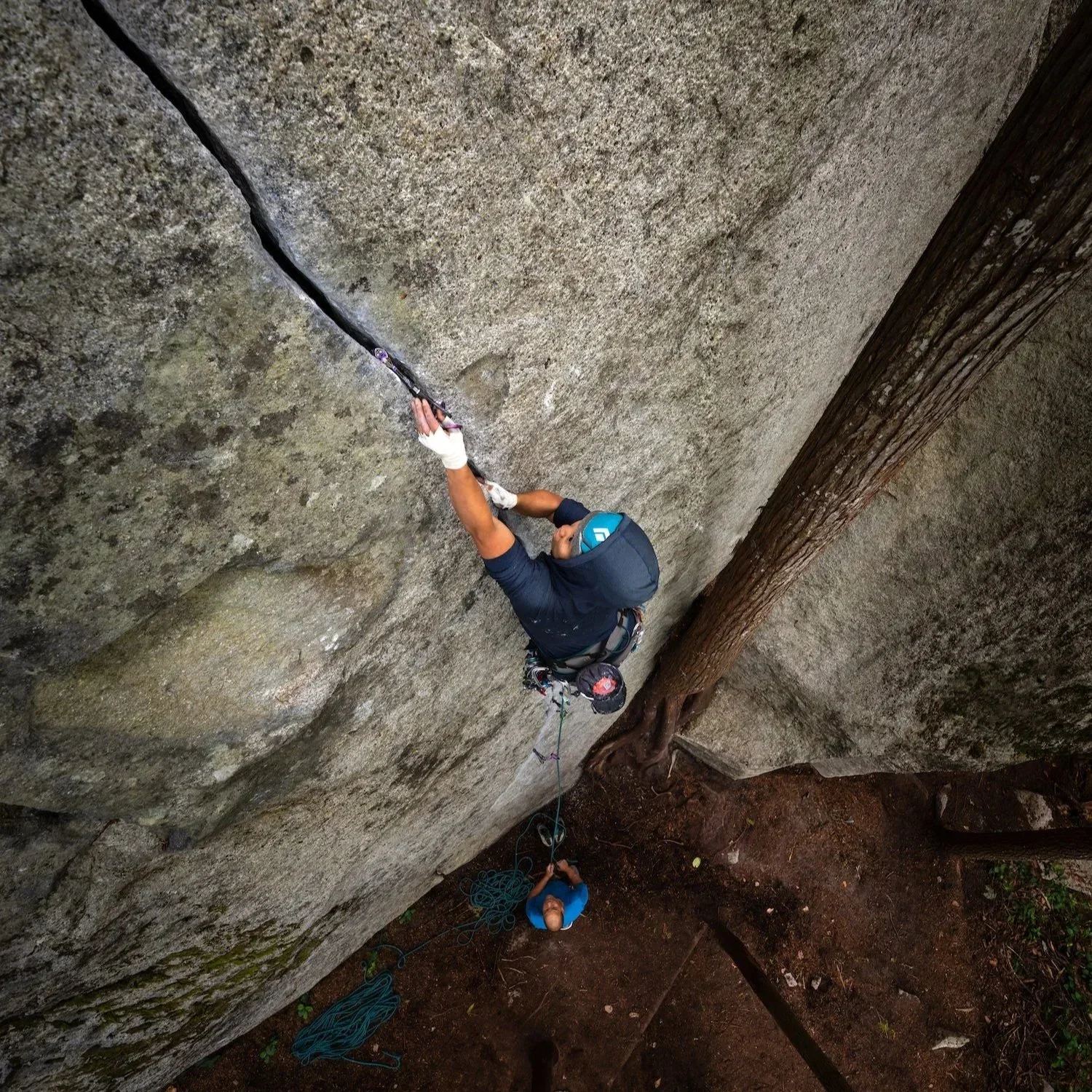
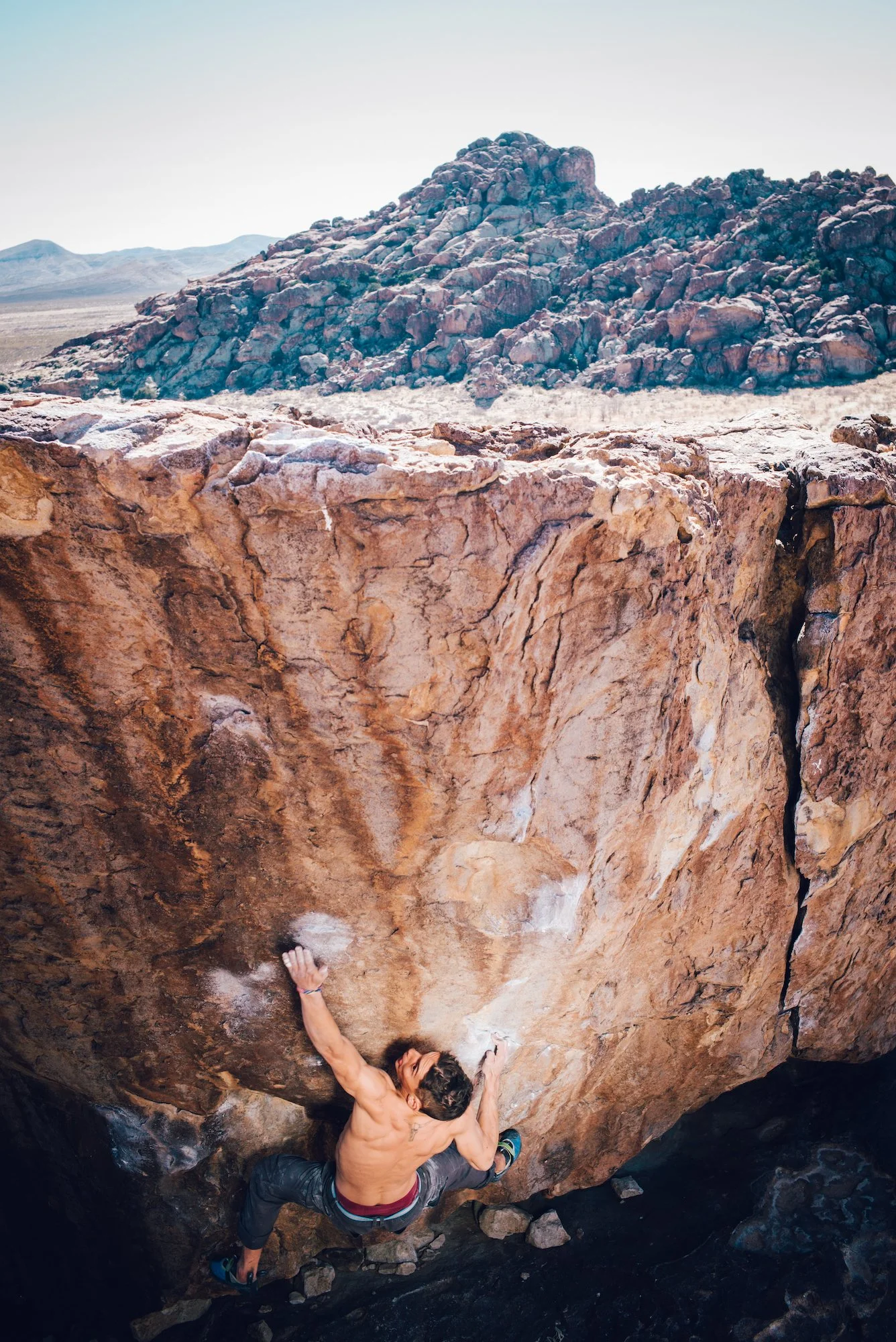
Photo by AAC member Michael Lim.

By Hannah Provost

Originally published in Guidebook XVI

Luis Contreras is breathing steadily, forcefully, with intention.

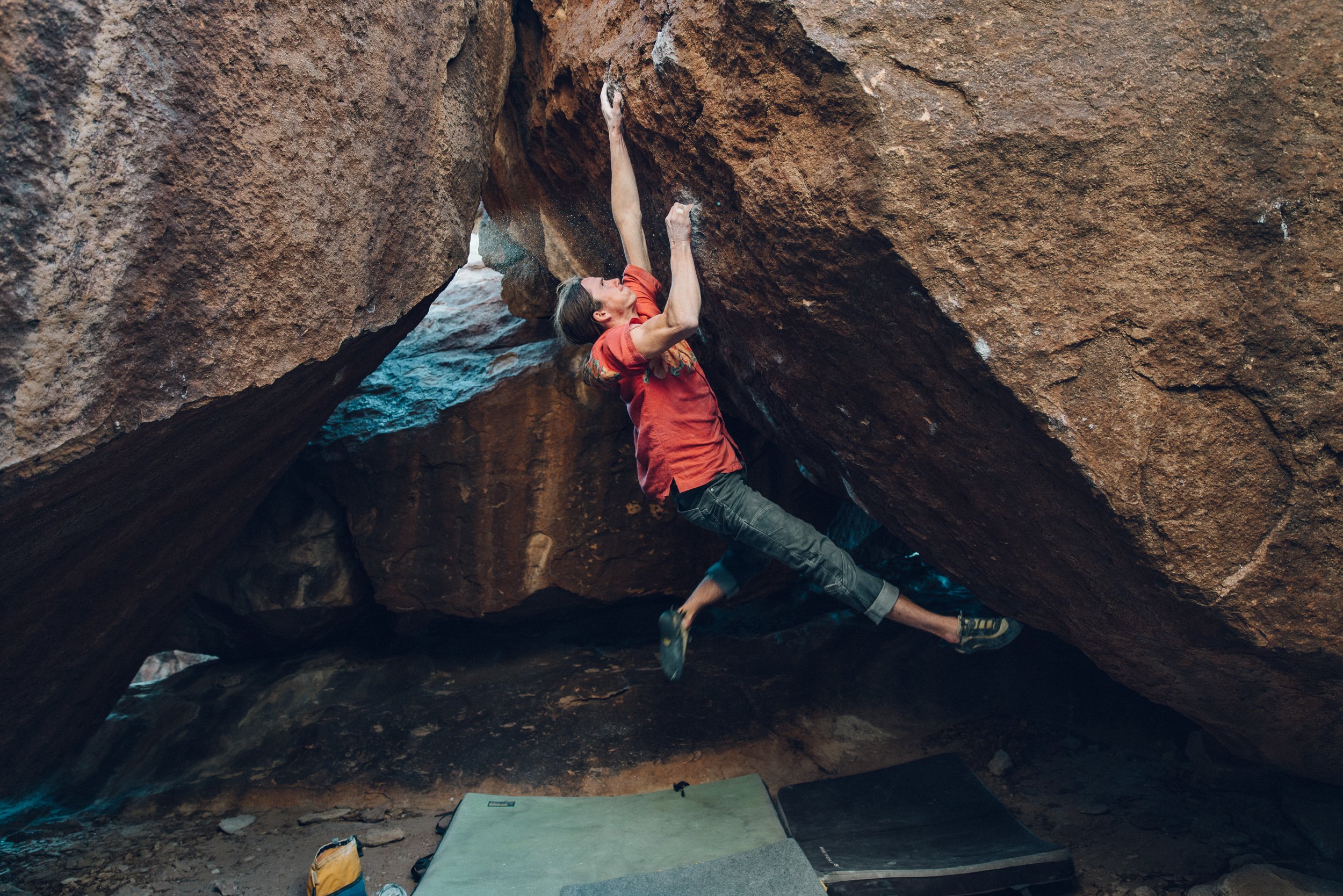
He is 15 feet off the deck, and has 20 more feet of textured edges, sidepulls, and huecos to top out Wyoming Cowgirls, a 35-foot V5 on Hueco Tanks’ North Mountain that has recently been reopened.

A few pads sit lonely in the rocks below. Each of his precise foot placements and composed breaths are indicators of the stakes, and they reflect the time this climber put into top-rope rehearsing such a consequential highball. His movements are linked in chains of powerful bursts punctuated by rests. A certain barely observable shaking reverberates from his core into his limbs, but his breaths and the wind are the song he is dancing to—the shaking and the fear squashed down.

For Contreras, “the best climbs are the ones that even if you’re not a climber you walk by and you say, 'Wow that’s a sick climb...' I [am] drawn to these striking tall faces.” Wyoming Cowgirls had always been one of those climbs.

Contreras tops out quietly, his focus unwavering until he is fully over the rounded slab of this immense boulder, where he sits. No whoops, no cheers. Just a private adrenaline high coursing through his veins.

Instead of celebration, he gazes out to the brush-filled desert beyond.


How do you understand the essence of a place? There are of course the facts and figures, the ecology and topography of the terrain, but there are also the traditions and rituals and history of the people who move across it. Such entanglements are why some might say that “the climbing community” (singular) is a misnomer. Our landscapes too-specifically shape us.

For example, Rifle is the land of lifers. That tight canyon, with its near-instant access to climbing seconds from the car, allows for kids splashing in the stream, craggers at Project Wall rubbernecking as you drive by, and the daily parking shuffle as you move from crag to crag. Ten Sleep is Adult Summer Camp: Given the long journey required to get there and its minimal infrastructure, the place welcomes tech bros and remote workers to set up shop for a month or the whole summer, with scheduled camp activities limited to river time, brewery time, or climbing time. As a final example, the Red River Gorge is never never land, where a dirtbag might never grow up.

Climbing cultures, like any culture, are a mixture of language, beliefs, rituals, norms, legends, and ethics that are largely shared by a community and emerge from the interaction of that community with their landscape. Hueco’s iconic roofs, abundant kneebars, airy highballs, deep bouldering history, importance to Indigenous cultures like the Tigua Indians of Ysleta del Sur, and fragile and rare ecosystem shape its climbers too, on an individual level and at scale.


Bouldering in Hueco is an intimate affair. With guides required to access most of the climbing, and groups capped at ten people, “most people know most people, and if you don’t know them it’s only a matter of time,” says Luis Contreras, who is a Hueco guide of a decade and El Paso born and raised.

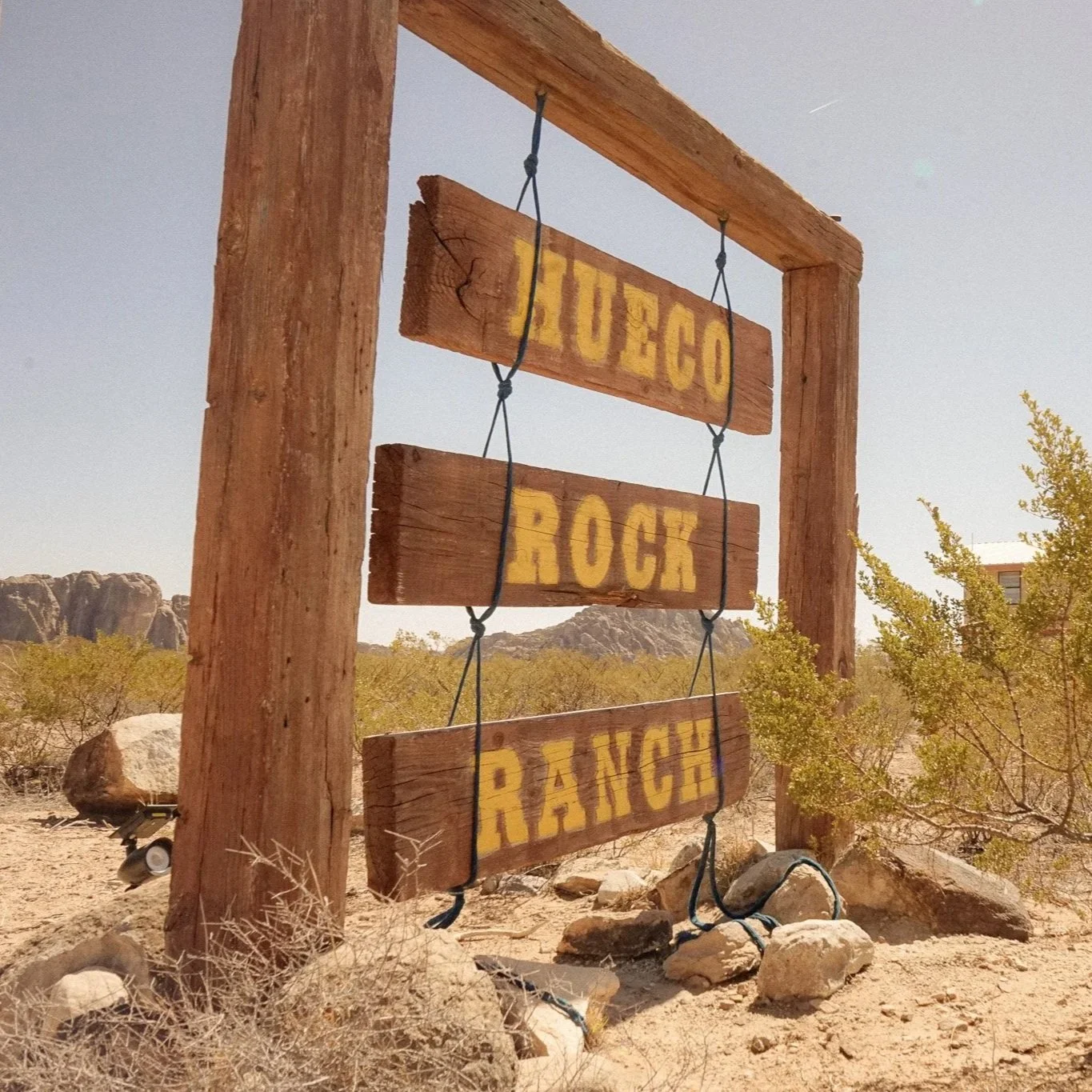
Most climbers at Hueco fall into one of four groups: the El Paso “city” climbers, the lifers who own property right outside Hueco Tanks State Park, the seasonal dirtbags who migrate every winter, and the out-of-town visitors who pilgrimage there (often yearly) when they can scrabble together some PTO. Even the visitors become known entities—once you have a guide you trust, why not come back to climb with them again and again? You’ll likely find who you’re looking for at one of three community hubs: the Iron Gnome, the AAC’s Hueco Rock Ranch, or the Mountain Hut.

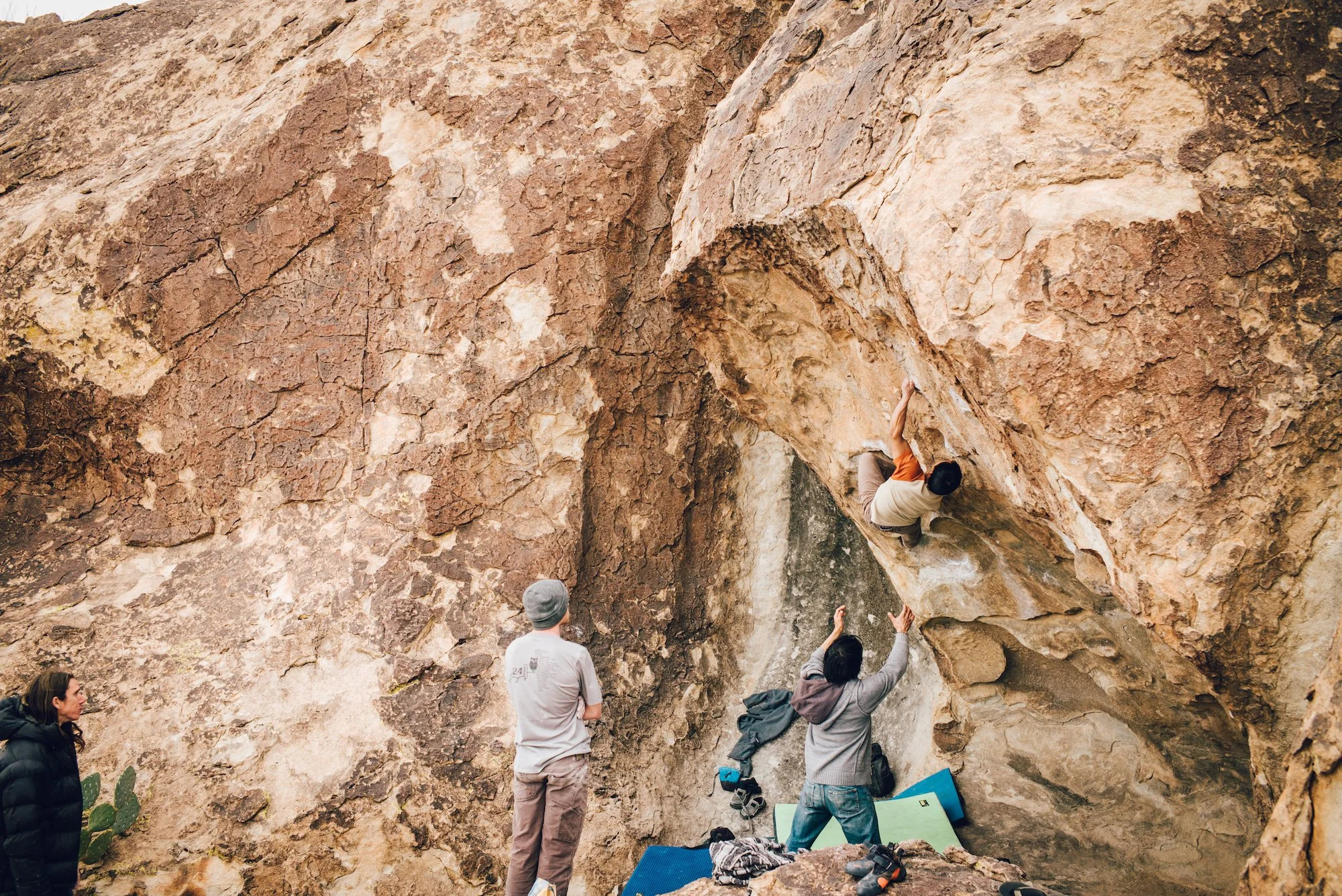
Photo by AAC member Dawn Kish.

Within such a small community, a run-in with an old head or unique character is considered commonplace. You might chat with Lynn Hill over beers at the Iron Gnome, or spot Jason Kehl out in the distance developing a new line. You’ll likely wave at Sid Roberts as he leaves the park from his early-morning session, or even share a laugh with the colorful John Sherman—the originator of the V-Scale.

But no matter what kind of Hueco climber you are, climbing at Hueco feels deeply entangled—it requires a self-consciousness of landscape, access, and ethics that doesn’t just fall away when you throw down your pads and pull onto rock. But that’s not a downside for locals like Luis Contreras and Joey McDaniel. That’s the richness of it.


Among the javelinas and ringtails, among the scooped huecos and textured patina crimps, it’s common to hear the idea that “climbing in Hueco is a privilege.”

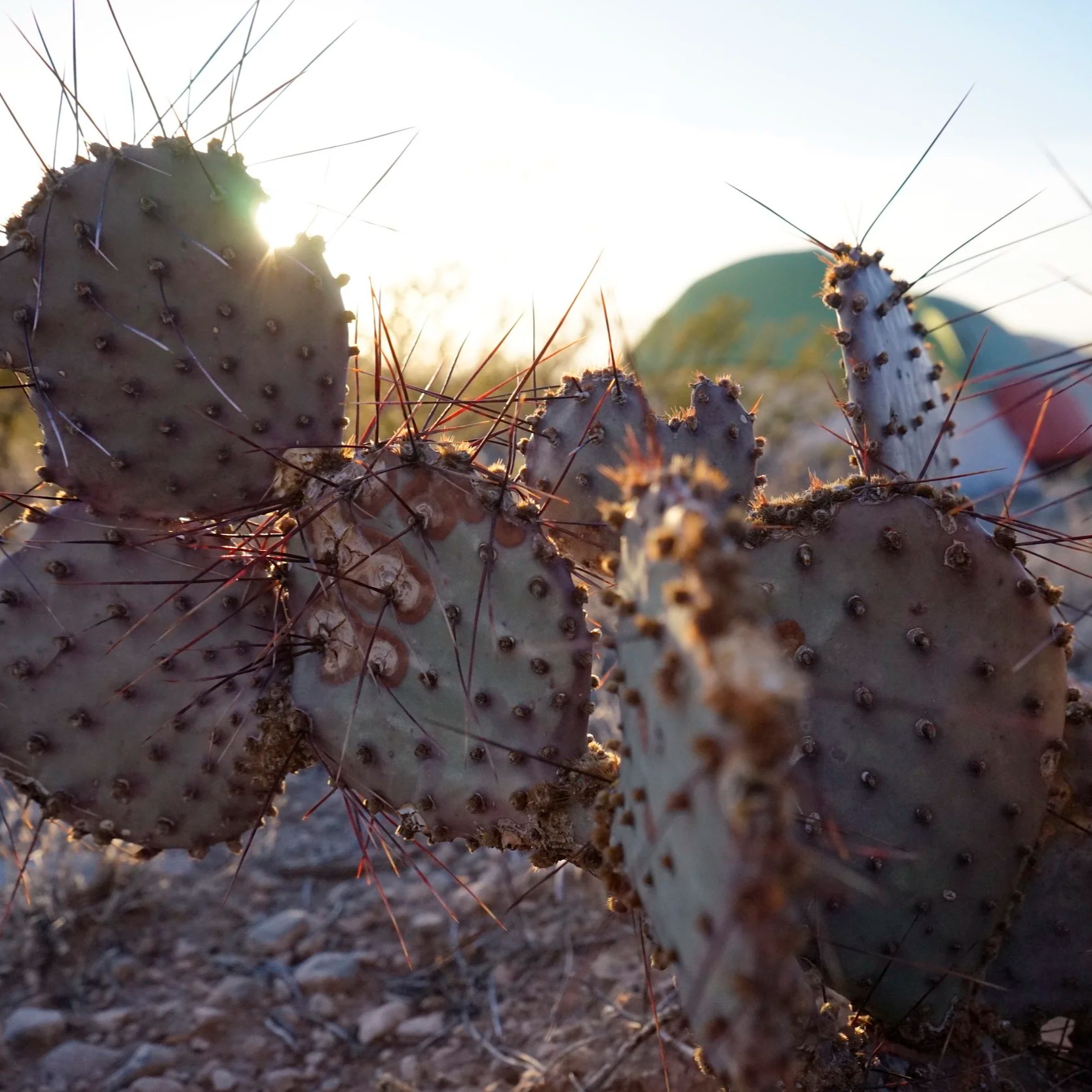
Again and again, locals point to a shared ethic when asked about the culture of Hueco. There is a protectiveness over the ecological uniqueness of the place. The Chihuahuan Desert holds 25 percent of the world’s cacti diversity after all—including prickly friends like the Texas rainbow cactus, scarlet hedgehog cactus, and horse crippler cactus. Hueco guide Joey McDaniel always likes to say, when it comes to Hueco, “the more you look, the more you see.” And indeed, for the ancient water systems in the huecos for which the park gets its name—where the famous fairy shrimp eggs lie in wait, for years at a time, anticipating the water that will enable them to hatch— this is most certainly the case.

Some Hueco climbers express pride in the sandbagged nature of the grading. Others hold tight to the humbling challenge posed by the proliferation of highballs in the area.

Others note the awe of walking past ancient rock art on your way to the proj, or learning from a tribal elder during the park’s Community Fair (also known as the Interpreter Fair) about the way local tribes continue to celebrate Hueco as a sacred space.

For some, there is something special about how knowledge and local ethics are passed down orally—from guide to climber as they laze about in the shade between burns. Whether it’s the story behind the FA of Scarface and The Flame, or how Verm started it all.

Plus, climbing at Hueco doesn’t come easy. It’s serious business that you follow established trails, and climbing is an absolute no-go until at least 24 hours after it rains. Water scarcity in this desert area can be a pain for van-lifers, and group dynamics among tours can be a challenge when climbers don’t agree on an itinerary, or are restricted by the number of groups that can be in one area at a time. Evidently, going with the flow is essential.

Photo by AAC member Michael Lim.


Photo by AAC staff Foster Denney.

Book Your Stay at the Hueco Rock Ranch

The AAC’s lodging facilities are a launch pad for adventure and a hub for community and the Hueco bouldering season is upon us! Experience this place for yourself by booking your stay at the Huceo Rock Ranch today.

AAC members enjoy discounts at lodging facilities across the country. Not a member? Join today.


But these are the rules of the Hueco game.

Some of Hueco’s traditions flirt with a classic climbing motivator: competition.

Photo by AAC member Foster Denney.

Challenges are what you get when locals get bored—or when climbers want to break from the bleariness of project-send-repeat. They range from famous and lauded, like the Big Five in Fontainebleau—a circuit of five classic problems from 7c to 8a (V9 to V11) in the Cuvier Rempart sector, which pro climbers now complete in a day—to locally legendary, like the Dungeon Master challenge at Staunton Rocks, which involves sending all the 5.13s at the crag in a day (still unclaimed).

At Hueco, there’s the Wanker 101.

The Wanker 101 is a list of one-hundred-and-one boulders on North Mountain, ranging up to V2 but most in the V0 range, that essentially functions as a tour-de-North Mountain and an iconic test piece of volume, skin strength, and planning. These days, a number of the original lines are closed due to proximity to rock art or fragile environmental surroundings, so alternative problems have been chosen to ensure the challenge lives on.

Carrie Cooper, reflecting on her experience completing the challenge in an article for Climbing, highlights how unexpectedly challenging the Wanker is, even if by the numbers it looks trivial. But with that volume of climbing, and romping on beautifully sculpted holds, can come a climber’s high: “It felt like falling in love. Problems 96 to 99 were fantastic, every move a joy. We would rest at interesting holds, 15-plus feet up, no pad, almost singing to one another the beauty of the climb.”

During the 2024-2025 winter season, AAC Hueco Rock Ranch camper Jackson Jewett on-sighted the challenge in a very impressive time of 5 hours 38 minutes.

In recent years, a new challenge has emerged that’s a little more bite-sized, though one climber reflects that “so far, all who've completed it have tasted blood.” The car-to-car format of the No One Runs Out of Here Alive Challenge is familiar, but with a bouldering twist. Competitors bust up the infamous chain trail on North Mountain, top out Nobody Gets Out of Here Alive (one of the most iconic and classic V2s at Hueco) and return to the starting position. The fastest time is currently held by Jake Croft at 6 minutes, 24 seconds.

Of course, other traditions have popped up, shaped by Hueco’s unique environment. One that stands out is the newer tradition of Aoudad Feast.

Aoudads are barbary sheep that roam in and out of Hueco Tanks State Park and the surrounding area. These brown mountain-goat-looking creatures are actually invasive, and have posed a growing problem in the park, due to overgrazing, kicking up soil, displacing native animals, and competing for the same resources. For Aoudad Feast, local climber Billy Heart hunts a few aoudad (outside the park boundaries of course) and provides a meal for local climbers—an excuse to gather and bring attention to the ecological impact of the aoudad, which is often incorrectly attributed to climbers. Appropriately for the desert, the party can get a little weird.

While not necessarily making a dent in this environmental issue, the event is symbolic at the least—these local climbers are tuned in to what matters to Hueco climbing, and how access is complexly intertwined with the landscape’s environmental health.


Hueco, importantly, has a critical role in bouldering history and the cutting edge of the sport. It has become known as a proving ground for climbers of all levels. And it certainly has been the site of many a sending rampage. Though no doubt it requires “paying your dues” to learn the movement and style, the rock also largely rewards strength and power—something plenty of pro boulderers have in spades. For example, Nathaniel Coleman showed up to the AAC’s 2024 Hueco Rock Rodeo and flashed Slashface (V13) and sent Li (V13) and Coeur de Leon (V14), among plenty of other double-digit boulders.

Similarly, Michaela Kiersch had her “best bouldering day ever” at the same Rodeo, reclimbing Crown of Aragorn (V13) and standing atop plenty of other double-digit boulders, like Thrilla in Manilla (V12), Rumble in the Jungle (V12), Phantom Limb (V12), Power of Landjager (V11), and Sunshine (V11).

Matt Fultz, a pro climber known for being down-to-earth with an unusually long wingspan, has been at the forefront of recent hard ascents in Hueco in the last year. Last winter he reopened a climb that previously had been done at V12, located on the left side of the famous Martini Cave. A key hold had broken around 2005, and the route was proclaimed impossible. Fultz was able to reopen the problem again as The Hangover, playing into the martini theme of the area. According to Fultz, it was “probably the most morpho problem [he’s] ever done.” He shares: “I thought the original sequence looked so fun, but was disappointed to hear it was broken and impossible. It wasn’t until last year that I realized I could potentially span the move, but only using every inch of my [six-foot-five] wingspan, along with extra strategy on how I would grip the holds and set up for the move. After a few days of dialing in the sequence, I was able to open up the line again.”

Photo by AAC member Keith Allen Peters.

That same season, Fultz also did the second ascent of Desesperación, and has proposed an upgrade to V15 for the climb, since he thought it was at least a grade harder than its twin, Esperanza (V14). Reflecting on his process, Fultz shares that Desesperación “involves some cryptic moves in and out of a kneebar to some very intense shoulder and tension positions, all through a 60-to-70 degree roof. It’s so cool! It was a pleasure to work out the moves from scratch, as all I had for clues on beta were a couple pictures from the first ascensionist, Martin Mobraten. Projecting Desesperación was different from trying The Hangover in that the biggest challenge was solving the puzzle rather than spanning the moves.”

Of course, Jason Kehl has proved ever-prolific in his ongoing development of boulders in the park, but first ascents on the cutting edge of the sport have slowed down. Fultz thinks that will change in the future: “To my knowledge there is currently nothing harder than V15 that has been climbed at Hueco, but I believe that there is so much potential for harder problems! And with how incredibly talented the upcoming generation of boulderers are, I have no doubt V16 and beyond will come to Hueco in the near future. I think generally people can find Hueco difficult for projecting or having extended trips due to the regulations, but what I’ve found is that they're really not as bad as their reputation.”


Photo by AAC member Michael Lim.

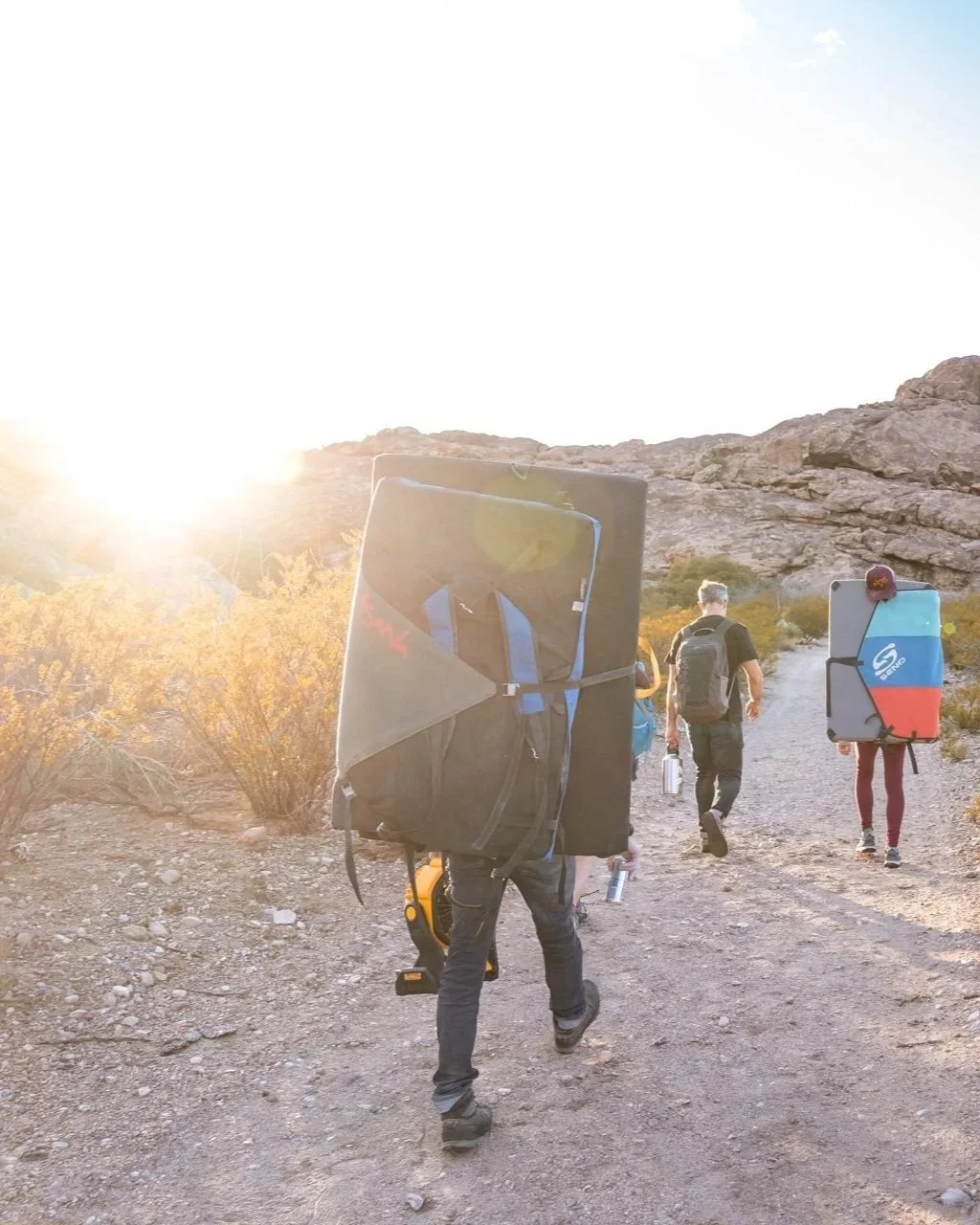
But Hueco’s star status for the pros is just one piece of the puzzle. The close-knit “keep it small” culture at Hueco is why the mijos and mijas will rally around a friend to support a big highball attempt, lugging out pads on a rest day. It’s reinforced by how far Hueco and El Paso are from other major cities, requiring a force of will to get there. And it’s fueled by waiting in the hot desert sun in your car, living the “lizard life” as one climber called it, alongside friends and strangers, waiting in line to be one of the 70 climbers allowed into North Mountain to climb for the day—knowing that climbing access isn’t a guarantee.

Rather than begrudging the regulations and inconvenience, many climbers of Hueco seem to recognize that the lizard life represents something necessary about an incredible world-class climbing area that climbers share with the world. This holistic take on climbing access even pervades the art coming out of the Hueco climbing scene. The Hut Smut Review is a zine that many locals and travelers have contributed to in its first few years. The driving force behind Hut Smut is to get into the complexities of who we are as climbers and how that fits into our other identities. Joe Knapp, one of the creators of the zine, says the idea originated during the dead space and boredom of hot lizard days. What else will emerge from this landscape?

Like every crag, Hueco is a unique experience. Traditions and competitions have emerged around Hueco’s boulders, ecology, and culture. Climbers aren’t afraid to hold each other to the ethics of the area. And at the center of it all are the crimps that taste like glory, that pulled us in in the first place.

Forget stone monkeys—meet us in the dusty Hueco Tanks parking lot so we can be rock lizards.

Psyched to visit Hueco? It’s imperative that you be in the know on all Hueco Tanks State Park regulations and the ins and outs of getting a guide: tpwd.texas.gov/state-parks/ hueco-tanks/activities


Sign Up for AAC Emails

Stay Frosty: The Rescue Matrix, with Pete Takeda and Jason Antin

You’re in the thick of it. An accident just happened while you were out climbing, and now you have to decide: do I self-rescue, or do I call for outside help?

In this episode of the podcast, we dive into that moment of decision, and provide a series of questions that you can use as a matrix to help you decide what to do next. Our guests, Accidents Editor Pete Takeda, and IFMGA/AMGA Guide and Search and Rescue volunteer, Jason Antin, weigh in.

Pete reflects on accident reports from ANAC where individuals have self-rescued, called SAR, or had to do a little of both. We break down a few of these case studies to explore what circumstances caused the accident victims to make the decisions they did to initiate rescue.

Then, Jason shares what happens behind the scenes when you call Search and Rescue for help, and how self-rescue techniques can supplement a SAR team’s mission and help SAR get to an injured party faster. Dive in to help prepare yourself, in case you ever find yourself in the thick of it.


If you believe conversations like this matter, a donation to the AAC helps us continue sharing stories, insights, and education for the entire climbing community. Donate today!


The Line—Reward and Risk on Kaqur Kangri

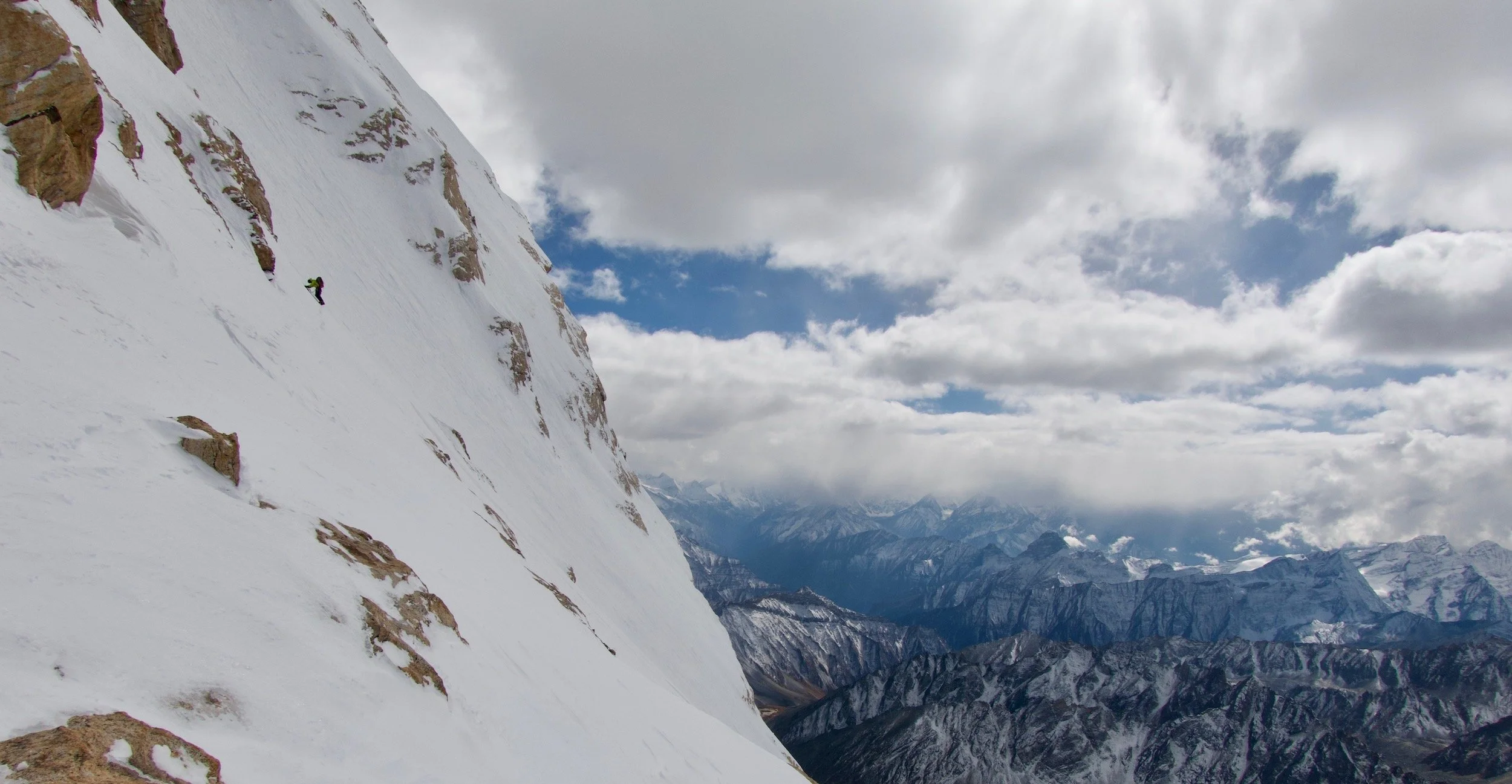
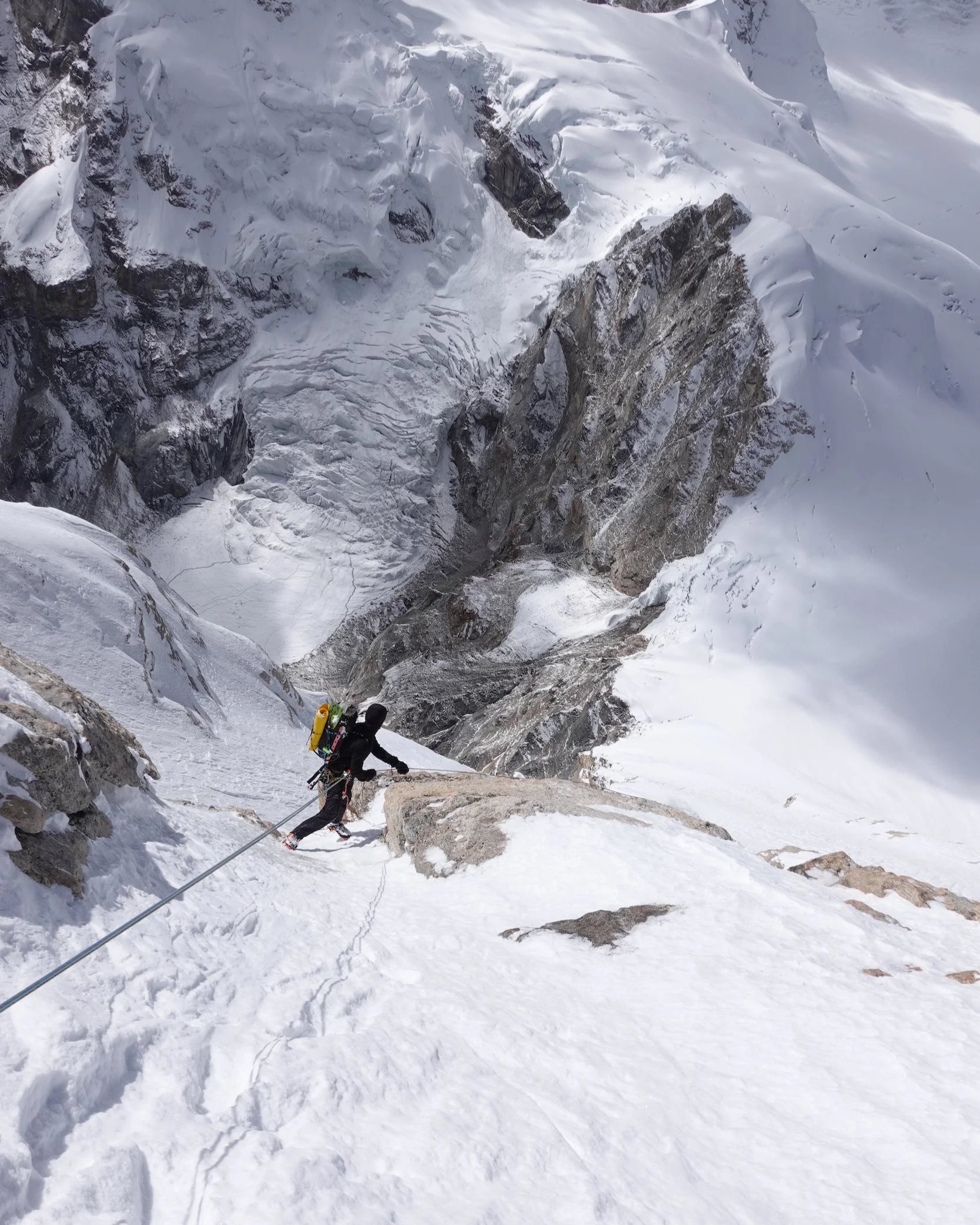
Most of the descent from the 6,859-meter summit of Kaqur Kangri involved exposed downclimbing. Photo by Spencer Gray.

Three teams will be honored with Piolets d’Or in Italy this December, and all three contributed feature articles about their climbs to the 2025 American Alpine Journal (AAJ). Tom Livingstone wrote about his and Aleš Česen’s new route on Gasherbrum III in Pakistan; Dane Steadman described the first ascent of Yashkuk Sar, also in Pakistan, with August Franzen and Cody Winckler; and Spencer Gray told the story of climbing the southwest arête of Kaqur Kangri in Nepal with Ryan Griffiths. 

There’s a lot to love about Spencer’s AAJ piece—it documents an amazing ascent. But we were also struck by the final passage, in which he reflects on the inherent and sometimes insidious risks of Himalayan alpinism. No one got hurt on the climb of 6,859-meter Kaqur Kangri, but afterward Spencer tallied 20-plus incidents that each could have ended very badly. Honest self-assessments like this are essential to a long life in the mountains, so we’ve shared Spencer’s thoughts here for readers to consider in light of their own climbing.


Kaqur Kangri: A Dangerous Game

Objectives like the southwest arête of Kaqur Kangri used to be what most climbing was: trying something kind of hard, an inconvenient distance from home, and relying on imagination as much as effort to turn a thing dreamt into a thing done. There are still plenty of places to contrive that same experience. We just have to look harder—and be willing to court risk in an unpredictable operating environment. 

Our team didn’t have what we’d consider a close call, but in debriefing, I still counted 23 discrete times when the risk ticked up. A mule nearly broke my knee with a kick when I tried to bring it into camp one morning. On our first day of climbing, we hustled up a ramp that was probably at the outside edge of the ricochet zone of the upper serac band. Two days later, Ryan [Griffiths] and I both simultaneously realized that we were pushing our unroped luck on low-angle but hard-frozen talus above the west face. “If we slip here, it’s to the bottom, eh?” I said.

Of four minor rockfall incidents, we mitigated two by our choice of protected belays and bivvies. Another was friendly fire: On rappel, I chucked a baseball-sized rock so the ropes wouldn’t dislodge it. But I misaimed, and the rock bounced down the snow slope and nailed Ryan in the shoulder. I reasoned that Ryan had probably done something in a prior life to deserve getting punched in the clavicle. He was less sure.

On day three, below the snowfield, we pulled through suspended, stacked blocks in a roof that would have chopped the rope had they dislodged. On the upper headwall, my ice tool tethers got tangled behind a cam after I had campused out a diagonal rail. I couldn’t reverse the move, and I couldn’t continue until I had unthreaded the tools. Half growling, half screaming, I locked off on one arm, frontpoints screeching, and freed myself. When he followed, Ryan simply lowered out and jugged. 

On the descent, Ryan and I had probably our riskiest moment when we crossed a 40-foot-wide wind slab partway down the upper northwest face. It appeared suddenly, a shallow pocket of cross-loaded danger in an otherwise stable snowpack. The tension on the slope and the soft, hollow thump as our boots and ice tools pressed through the snow put us both on edge. But with no other signs of failure or propagation, and a morning of downclimbing a similar aspect and angle above us, we each judged it safe enough to proceed.

An hour before we regained the base of the mountain, fed up with navigating the messy corners of the final glacier, we briefly but obtusely committed to soloing steep glacial ice, embedded with crushed pebbles, as we traversed 15 feet above the bottom of a closed crevasse. We were spurred on by our friend Matt’s tiny light in the distance and the promise of fresh Snickers. Perhaps a week on the mountain and the tedious descent had dulled our nose for risk. 

Three days later, we stopped at Chyargo La on the trek back out and took in our final view of Kaqur. I crouched beneath fluttering prayer flags to lounge against a rock, my fingers getting sticky pulling globs of gulab jamun out of a can we’d saved until now for a treat. Kaqur’s summit seracs glinted in the midday sun from what seemed like a very long ways away. Matt and Ryan laughed as I passed them the can for a shot of syrup to wash it all down.

—Spencer Gray

In the decade between 2015 and 2024, 73 individuals received Piolets d’Or to honor alpine-style ascents completed in the prior year. Eight of these highly skilled climbers—about 11 percent—subsequently died in the mountains. It is no secret or surprise that high-level alpinism is a very dangerous game. Nonetheless, Spencer’s words remind us that the hazards are manifold and ever present, and that these often superhuman achievements also come with heavy potential costs. —Dougald MacDonald, Editor, AAJ

Ryan Griffiths rappelling the northwest ridge of Kaqur Kangri. The team exited to skier’s left off the glacier below to return to their advanced base camp. Photo by Spencer Gray.

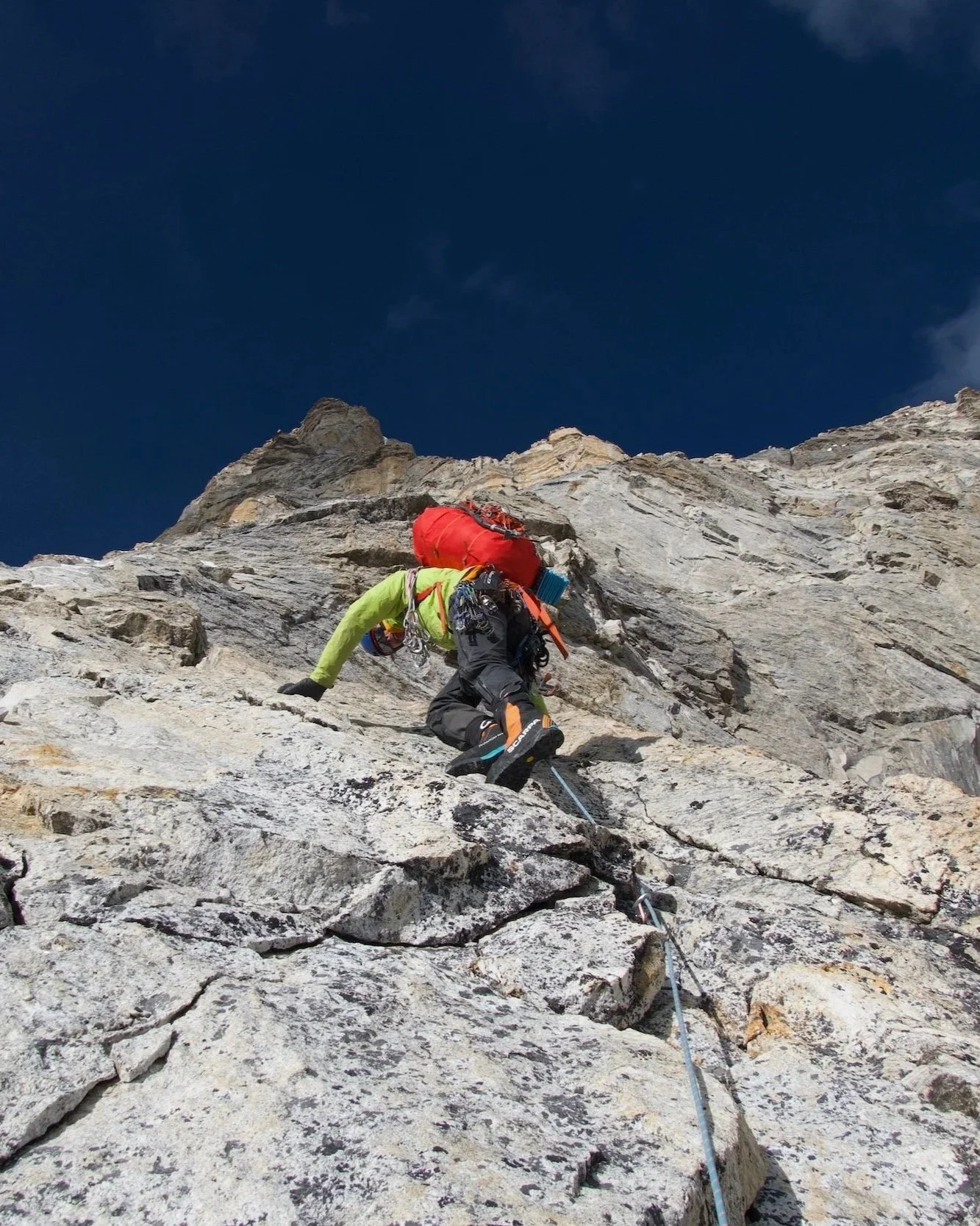
Spencer Gray on beautiful rock at about 6,000 meters on Kaqur Kangri, below the hanging snowfield that separates the south face’s serac bands. Photo by Ryan Griffiths.

Climb if you will, but remember that courage and strength are nought without prudence, and that a momentary negligence may destroy the happiness of a lifetime. Do nothing in haste; look well to each step; and from the beginning think what may be the end.
— Edward Whymper, "Scrambles Amongst the Alps"

New Cutting Edge Episode—Ultar Sar’s Southeast Pillar

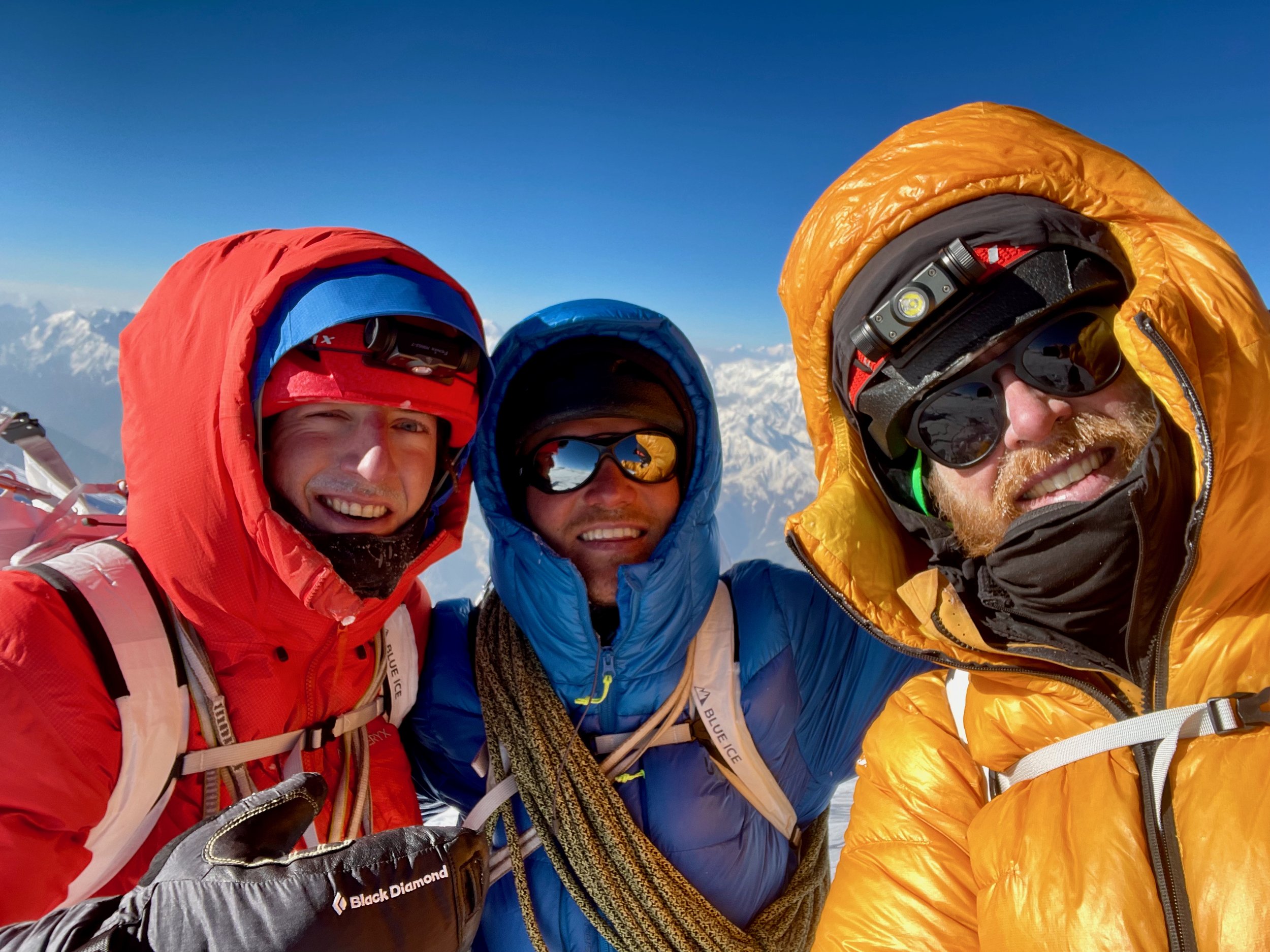
Ethan Berman, Sebastian Pelletti, and Maarten van Haeren (left to right) on the summit of Ultar Sar. Photo: Maarten van Haeren.

The Cutting Edge podcast has returned for a new season of in-depth interviews with climbers just back from great ascents. The October episode highlights one of the climbs of the year from the Karakoram: the first ascent of the southeast pillar of 7,388-meter Ultar Sar in Pakistan. Host Jim Aikman interviewed climbers Ethan Berman and Maarten van Haeren, along with Karakoram expert Steve Swenson (more than 20 expeditions to Pakistan!) and AAJ editor Dougald MacDonald. 

New episodes of the Cutting Edge will appear each month during the 2025–2026 season! Subscribe to the feed wherever you get podcasts to ensure you never miss an episode.


The Line is Powered By:


The Line is Supported By:


The Line is the newsletter of the American Alpine Journal (AAJ), powered by Arc’teryx, with additional support from Mountain Project by onX. The line is emailed to more than 80,000 climbers each month. Sign up below to receive future emails. Find the archive of past editions here. Got a potential story for the AAJ? Email the editors at [email protected].

To see The Line every month, sign up below!

The Fluidity of Grief and Beauty: A Story from the McNeill-Nott Award

Photo by AAC member Kelly Fields.

By Heather Smallpage

Originally published in Guidebook XVI

I move, therefore I am. I reminded myself of this throughout the journey to and from Arviqtujuq Kangiqtua, formerly known as Eglinton Fjord. Throughout our five-week, multi-sport, primarily human-powered expedition to Baffin Island, in the Canadian Arctic, Kelly Fields, Shira Biner, Natalie Afonina, and I continued to move. We skied over 100 miles across the sea ice in order to get there, and we slogged for another 100 miles over moraine fields, loose talus, sinking meadows, a frozen lake, and a partially frozen river to get out. Movement was our rule, our rhythm. And as a team of three women and a non-binary person, we were motivated to define this movement on our own terms.

Kelly, Shira, Natalie, and I met for the first time in person at the Ottawa Airport en route to the Arctic. Only a few of us had tied in together before this trip. Prior to our real-life introduction, we spent months exchanging messages, photos, screenshots, videos, and group calls on WhatsApp. Now, past the logistical chaos of prep for this expedition, we still had a lot of learning to do about each other. I’m lucky in that I know an abundance of female, non-binary, and queer people who are incredible climbing partners. I prefer to rope up with them because of my ongoing struggles with self-confidence and self-trust that I learned in the shadow of my male climbing partners.

Here was an opportunity to move toward my goals and the style of climbing that most inspires me, alongside a group of people who uplift one another. When we received our first grant—the McNeill-Nott Award from the American Alpine Club—I started to feel that other people believed in us, which gave me more belief in myself. Representation is important, and the organizations that supported us believed that too. It was coming together all too perfectly.


I stared at the vast ice and seascape before me: Circles of white interrupted the piercing blue water that settled up to a foot deep in some places. We were leaving the bay in the small Inuit community of Clyde River.

The gray sky let go of gentle snowflakes that melted on my sunglasses, making my surroundings appear as if I were looking out a window on a rainy day. “So...how thick is this ice?” I asked, my voice wavering. The last time I had put skis on was a number of years ago. On snow, on solid ground.

However, I was soon submerged within and captivated by the ice’s symphony as we glided, heaved, soared over, walked, and trudged—depending on the conditions of the sea ice—over a hundred miles on a seascape that was constantly changing. Moving through that environment was dictated by the wind, temperature, snow, and our bodies’ needs. One moment, we would be trapped in a cloud, the snow absorbing the sound around us and sticking to our ski skins so thick that we had to take them off. Moments later, after turning a corner, the winds had blown the clouds and snow off the surface, and we found ourselves flying over the best ice conditions we had yet experienced. That landscape spoke to me, telling me that it, too, exists in states of movement and change.

I often look to the natural world to find my own sense of belonging. Being a non-binary person often means that I don’t always find a type of belonging that is representative. I struggle in groups of men. In groups of women, I push back on the definitions and create an exclusionary space for myself. Asking for a non-binary category creates the exact thing I don’t want to exist within: a category. One day, I hope I can exist in a way that is outside the confines of man or woman—that I can exist as myself without needing to choose between explaining and educating, or quietly disrespecting myself.

Photo by AAC member Natalie Afonina.

The thing about gender, being non-binary specifically, is that it’s simultaneously the most painful and most beautiful experience one can have. There is a deep gratitude in being the truest form of yourself; there is a wholeness in accepting one’s authenticity. It can also often be painful to a core level. My relationship with gender is like the Arctic wind: always present, sometimes gentle and caressing, other times a chaos that threatens to knock me down.

I felt the spirits skiing into Arviqtujuq Kangiqtua. Finally, among those great walls, exhausted, hungry, sore, and cold, we debated where to set up our base camp and had a hard time getting anywhere productive with it. I remember feeling confused about how I could be in the greatest place I’ve ever stood, a place that made my soul feel so full, yet in conditions that made my humanity feel so absent. Feeling insignificant because of landscapes that humble us is familiar to me, welcomed even. I much prefer the way the land makes me feel small, compared to the way humans have that same ability.

We settled into a base camp at the toe of Eglinton Tower. For a few days, we unpacked our cache of climbing gear and food, and Kelly and I healed our blisters we got from skiing in. I had blisters, and Kelly essentially had holes in her feet. After a few days of rest and skin care, inspired by a period of good weather, we started up the talus to the mountain’s base.

Some hours later, I found myself in a massive offwidth flake high up on the route at midnight, poking my head outside of it, feeling the never-setting sun on my skin. I saw a river of clouds drifting through the canyon below us, swallowing the ground and remaking it into a moving mass of shadows, curves, and drifts that was the most spectacular portrayal of beauty my eyes have had the pleasure of taking in. I started crying in disbelief. Then crying in belief. How often is it that we have the opportunity to pause and take in the moments of beauty that surround us? I had not experienced something that forced me to see my own grandeur and the beauty of it all, or to reckon with the work that I’ve put into arriving here. I found myself in the center of all of that, celebrating this arrival as I felt my humanity swimming through my body as I swam my way up the chimney.

Eglinton Tower has two tiered summits connected by a long stretch of 2nd-to-5th-class terrain. We ascended the main headwall on the lower summit, walked along a series of ledges, and scrambled to the top of a terrace as snow and wind started blowing. From there, we saw the true summit, another 300 meters of rock with portions of snow and ice. It looked unwelcoming and uninspiring with the worsening weather and our lack of food and energy. We celebrated our high point and began our 11-hour descent.

After 49 hours, Kelly, Shira, and I had made our way up and down Eglinton Tower, establishing Lemnos in the Clouds (5.11+ A0). I could say many things about that climb—about our shiver bivy, how Kelly climbed in approach shoes because her heels still had holes in them, how beautiful the rock was to climb, witness, and respect—but the lessons it taught me in taking that pause stay with me most. A pause to let yourself listen to and sing with the birds, to witness the magnificence of your surroundings, and yourself within them; a pause to allow yourself to be in awe.

Photo by AAC member Kelly Fields.


Photo by AAC member Heather Smallpage.

After resting for a few days and monitoring the weather, we decided to start moving from base camp to our next obstacle: Ayr Pass, a six-kilometer pass that connected us to Ayr Lake. It looked cruel and intimidating, and unfortunately was our only option to get back to Clyde River. Now that we had more food, our climbing gear, packrafts, and other essentials resupplied from the cache, we found ourselves with hundreds of pounds of food and equipment. Thus, we became mules.

As we approached Ayr Pass, the fjord fingered off into an outlet and the walls grew around us—the blackest walls I’ve ever seen, where light is swallowed by the water that has dripped and stained the rocks throughout time. We did some repacking and started off on the first of our slogs. First, we crossed a moraine field flowing with a river of silt, where our steps were swallowed by saturated sand and mud. Then came heinous mounds of sand, a frozen lake covered by avalanche debris that we post-holed through, and a large field of loose talus scattered with unstable boulders of all sizes. Finally, we navigated 3rd and sometimes 4th-class terrain with our loads threatening our balance. At last we arrived at our new camp with stiff shoulders and bruised hips, surrounded by tussocks, wildflowers, mosses, streams, boulders, and probably fairies. We walked Ayr Pass five times, three times with heavy, awkward bags.

The conditions of Ayr Lake were a big question mark, and one that would dictate how fast we could move and how easy it would be to continue. Navigating an ice breakup is difficult and incredibly slow-moving work, which we hoped to avoid by getting to the lake before the weather warmed up. Fortunately, it was still solidly frozen apart from the edges, so we packed our pulks again with all our gear and headed north, across the lake toward the Kuugaaluk River.

All this slogging allowed me to take a moment to check in with myself. At this point three weeks in, I wasn’t eating or sleeping much. I felt angry and I couldn’t focus for long. Suddenly, it became abundantly clear: I wasn’t doing too well.

Despite so many moments of connection with myself, moments that could be nothing but experiencing a relationship with this landscape, I was emotionally exhausted from, of all things, disconnection.

I had hoped that going to Baffin Island with women would be a chance to be part of something that could heal some of the jealousy, insecurity, and isolation I feel when I compare myself to people I can understand but don’t identify with. Instead, I found myself drowning. The contradiction was startling: We were in a landscape that elicits a presence that connects to the soul, among certain dynamics that severed any hope of authenticity from each other. The weight of the grief grew heavier as I came to understand that I wasn’t part of a team where there was care for one another or compassionate communication, as I had dreamed.

We were a fractured group because of behaviors that placed experiences and achievements above character.

Photo by AAC member Kelly Fields.


Support This Work—AAC Grants

Today, with up to $100,000 in annual grant awards, the Club continues to support these endeavors and is proud to stand behind the individuals and their projects which seek the betterment of the climbing community and climbing landscapes.


Photo by AAC member Kelly Fields.

Approaching the end of our trip, we spent two days paddling on the Kuugaaluk River— the two most peaceful days of the expedition. On our first day, we were in light rain as we pushed off from our beachfront camp. Our second day on the river immersed us in blue skies and gentle flows.

I spent the few hours we had on the river floating and singing along with the rhythm of the water. It was a time for reflection about all the land we had moved across, by foot, ski, rock, and water; all the far-reaching sights we had seen; and the variety of noises the wind creates. It was a place that connected me to myself, and the changing currents of the water reminded me of the changes in myself—my movement going forward, my flow being the pace of the moment, needing to be nothing more than what I am. The river offered me peace and gentleness when I needed it most. When we got to shore, I thanked the Kuugaaluk as I looked up and felt the sunshine on my skin.

To me, the Arctic feels like a landscape that knows no depth, with wisdom frozen in the glaciers and a sea that is inaccessible to those just passing through. It is a place that impels one to be fully present with your surroundings.

I left Baffin Island with feelings of wonder, gratitude for the lessons from the land, and a deep exhaustion permeating my mind and body. Since coming back and having space to process the duality of the beauty and grief of it all, I’ve felt as if I’ve been laid out for the one who matters most: myself. My resiliency, grit, and authenticity stare back at me. I moved deeper into the person I am.

I move, therefore I am.


Sign Up for AAC Emails

The Prescription—Anchor Failure

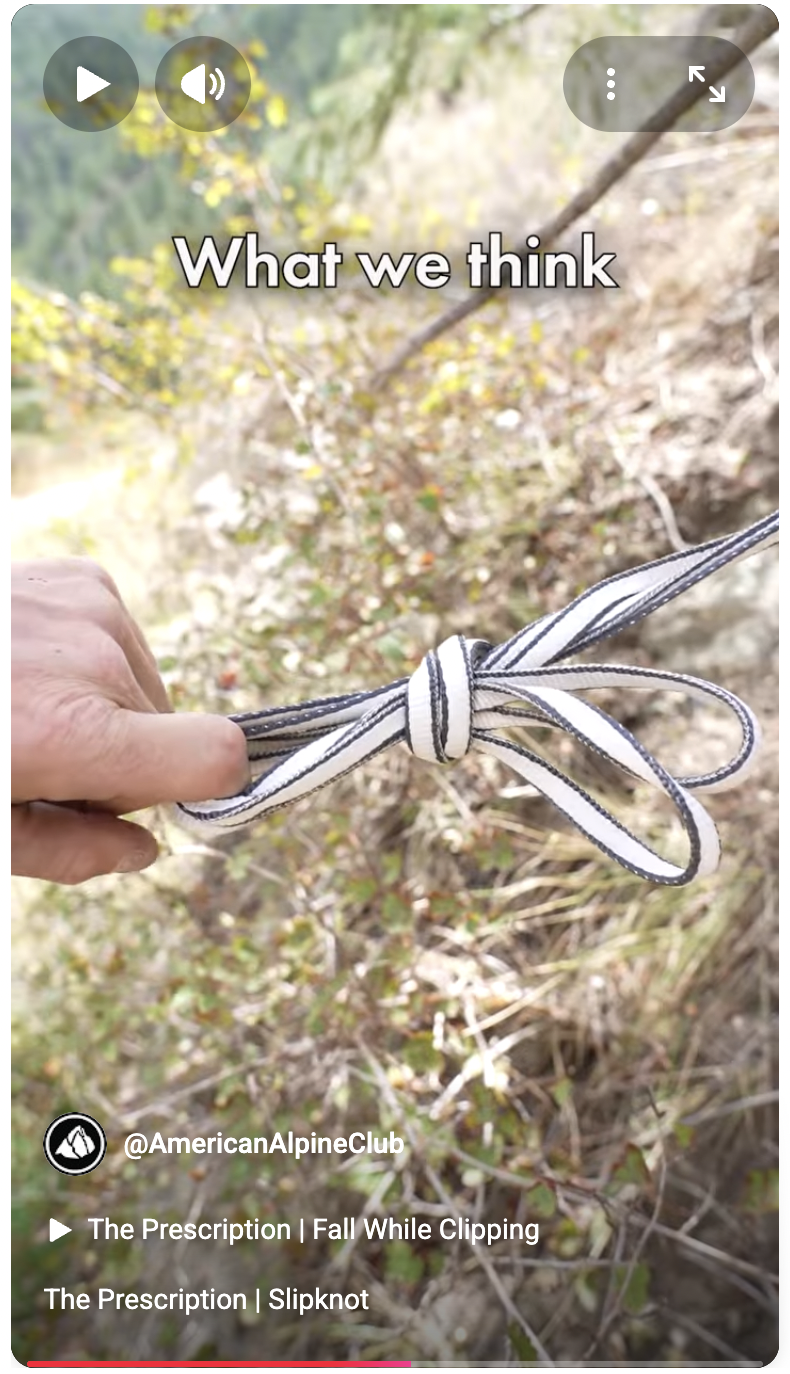
This month we feature an accident that occurred in 2024 on Yosemite’s Manure Pile Buttress when a climber mistied a knot. You can reference this accident in this years Accidents in North American Climbing (page 46). The knot involved was bulky and involved multiple strands of webbing, brought together to tie a single anchor loop. The average climber only needs to know several simple knots but sometimes, even experts can get it wrong. This climber was lucky and escaped with minor injuries.

Yosemite National Park. In spring of 2024 a serious accident took place on a relatively small and very popular crag called manure Pile Buttress. Photo by Andrew Burr.

Anchor Failure | Slipknot Came Untied

Yosemite National Park, Manure Pile Buttress

On June 24, 2024 during the American Alpine Club’s United in Yosemite Climbing Festival, a climber led the first pitch of After Six (5.7). At the belay tree, the climber set up a lowering anchor using a knot on a quad-length sling with two locking carabiners. The climber weighted the rope and lowered. He cleaned the top piece of gear (a camming device). Below, a second cam proved too tight to remove so he unclipped it. The climber continued to lower. At the third piece from the top, the anchor knot failed. The climber fell 80 feet before the belayer caught his fall, when the climber was about five feet above the ground. The climber was lowered and SAR was called. His injuries included a sprained ankle, lacerations on the face, a broken nose, and rope burns on the hands and fingers. 

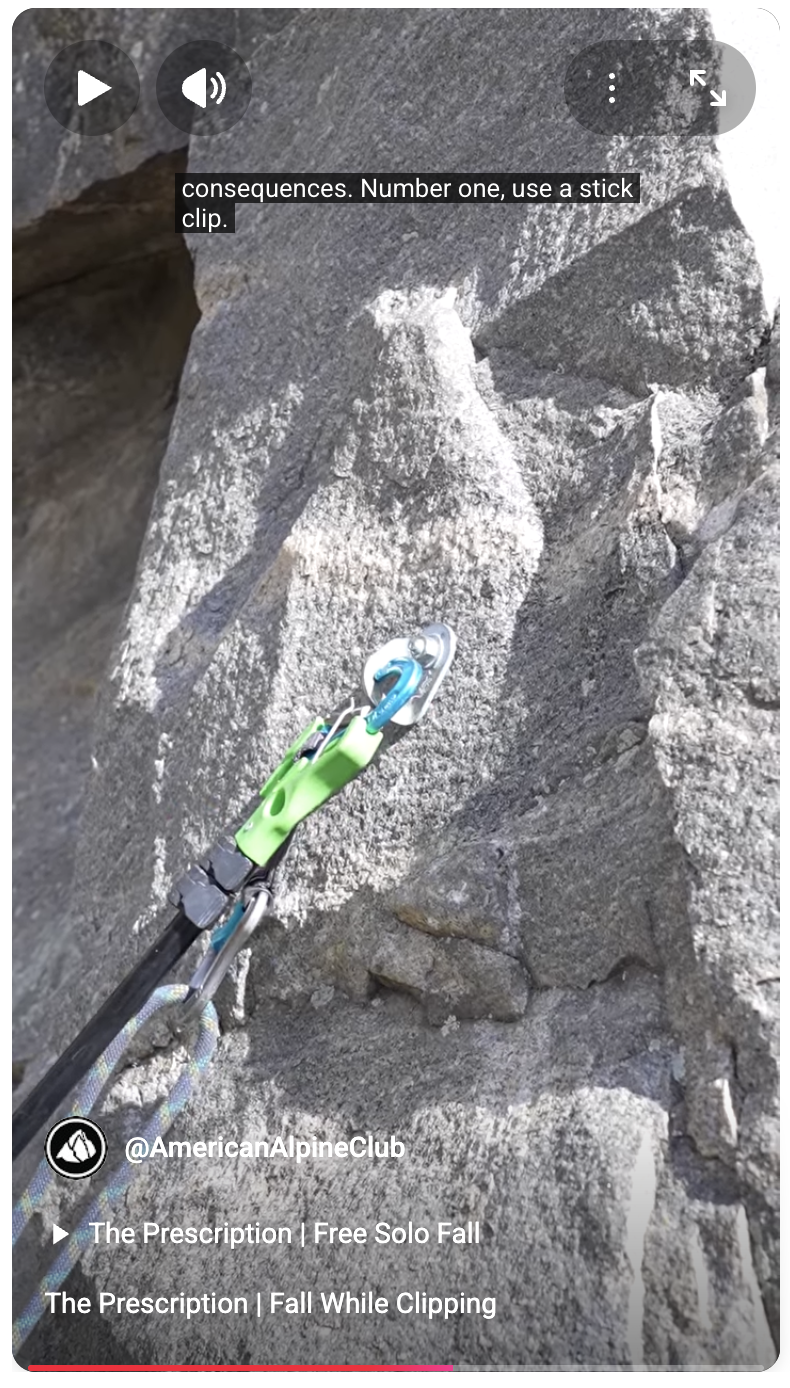
In June, a lowering climber fell 80 feet when his anchor “knot” came undone. In this photo taken after the accident, it appears that he had completed a serviceable overhand knot. In actuality, he had tied a slipknot and clipped into the loops. The two pulled loop ends are visible in the photo above. Anonymous


Video Analysis

A slipknot looks deceptively like other knots you'd use in a climbing anchor, but when you actually load it, it's not going to hold much at all. Pete Takeda, Editor of Accidents in North American Climbing, and IFMGA/AMGA Guide Jason Antin, are back to explain how a slipknot can have serious consequences when used in climbing anchors.

Credits: Pete Takeda, Editor of Accidents in North American Climbing; IFMGA/AMGA Guide Jason Antin; Producers: Shane Johnson and Sierra McGivney; Videographer: Foster Denney; Editor: Sierra McGivney; Location: Accessibility Crag, Clear Creek, CO.


ANALYSIS

The climber was fortunate that he had high protection that stopped him from hitting the ground when the anchor failed and lots of slack was introduced into the belay system. The anchor sling was found with an intact overhand knot. The belayer, who wishes to remain anonymous, wrote to ANAC: “We believe it was an attempted overhand knot but it was actually a slipknot.” The still-locked masterpoint carabiners were found clipped to the rope by the fallen climber. 

*Editor’s Note: After analysis, it was determined that the climber had attempted to tie an overhand knot but failed to pull the two end strands completely through the knot. He then clipped the two locking carabiners through the unsecured loops. Since there were so many strands of webbing in the mix, it was hard to tell the difference between a fixed loop and a slip loop. When weighted, the slip loops had sufficient friction and compression to hold, if only momentarily, while the ends gradually crept toward release.

(Sources: Anonymous and ANAC Canada Editor Robert Chisnall.)


The Prescription is Supported By:


Sign Up for AAC Emails

AAC's 2025 Impact Report

At the AAC, we believe in the power of climbing to change lives. We are driven by the potential to support our members deeply, to use the AAC’s expertise and legacy to deliver resources that climbers can lean on, and that’s why we are so proud of this Impact Report. Each grant recipient we inspired, each lodging guest we launched into adventure, each climber who has learned how to climb a little more safely through our publications—this is what drives our work.

How does it all break down?

Here’s how we’ve met the needs of the AAC community this year.


Support the Club

Donate today and support the AAC’s work. Just like putting in the work on your climbing project, or that long hike to an obscure alpine adventure, we all know that it takes dedication to progress in climbing. It is the dedication of donors and supporters like you that helps the AAC progress in our work—so thank you!


Sign Up for AAC Emails


Understanding the Climbing Rage Bait Trend, with Owen Clarke

In this episode of the podcast, we have adventure writer Owen Clarke on the pod to talk about rage bait, and how it’s showing up in climbing media and culture. Owen Clarke is a prolific writer, who regularly contributes to Summit Journal and Climbing.com, as well as many other media outlets. Recently, he covered rage bait for an article on Climbing.com, where he dove into a case study of the free soloist Lincoln Knowles. Rage bait is content that is intentionally created to elicit strong reactions from people—it’s trolling with intention, in order to drive clicks, comments, and other forms of engagement. Dive in to this episode to hear from this expert about why rage creates engagement, how shock-factor in traditional action sports media lends itself to evolving into rage bait, the unique elements of climbing rage bait, and why its specific to short-from media.


In Memory of Charlie Porter

The Story Behind the Charlie Porter Climate Science Fund

by P. Thom Davis, Thornton, NH

Charles Talbot Porter (1951-2014), known as Talby to his family and Charlie to everyone else, was a quiet force in climbing history, but he was also an incredible mover and doer in the evolving discipline of climate science. Within these two lanes, he has made an incredible mark on climbing and climbing landscapes, and his legacy underpins and inspires the Charlie Porter Climate Science Fund, the main funding source for the AAC’s Research Grant. 

Who was Charlie the climber?

Charlie grew up along the border of Massachusetts and New Hampshire, and as a teenager, he hitchhiked West to climb in the Washington Cascades. In late March of his junior year in prep school, Charlie participated in a rescue in Huntington’s Ravine on Mount Washington, saving the life of an ice climber and a would-be rescuer, after 3 climbers had been caught in an avalanche (Appalachia No. 147, December 1968). During his senior year of prep school, Charlie spent many weekends in Durham, New Hampshire, where he met climbing partners and his first wife, and was widely recognized for his heroics on Mount Washington the year before. He then learned to aid climb at Cannon Cliff and Cathedral Ledge. Upon graduation from prep school in spring 1969, Charlie moved to Camp 4 in Yosemite, where he became a force in pioneering big wall aid routes.

Charlie Porter’s list of first ascents in Yosemite is formidable: New Dawn (VI, 5.9, A4, 7 pitches, 11 days, solo, lost haul bag, 1972); a new route on Quarter Dome in Tenaya Canyon (two days, with Gary Bocarde, 1972); The Shield (VI, 5.9, then A5 with the infamous 35 consecutive RURP placements, multiple days, with Gary Bocarde, October 1972); Zodiac (VI, 5.7, A3, solo, November 1972); Tangerine Trip (VI, 5.9, A4/5, 10 days, with Jean-Paul de St. Croix, April 1973); Mescalito (VI, 5.9, A4, with Steve Sutton, Hugh Burton, and Chris Nelson, October 1973); Grape Race (VI, 5.9, A5, 7 days, with Bev Johnson, spring 1974); Horse Chute (VI, 5.9, A4, four days, with Hugh Burton, October 1974); and Excalibur (VI, 5.9, A5, multiple days, with Hugh Burton, 1975). Charlie also made the second ascent of Royal Robbins’ Tis-Sa-Ak route on Half Dome in 1972.

As Charlie’s big wall climbing in Yosemite was winding down, he moved on to attempt new routes in the Greater Ranges. In June 1974, he made the second ascent of Alaska’s Moose’s Tooth on its southwest wall of the West Summit (VI, 5.8, A4, 800-meter Moose Antler Route) in alpine style with Gary Bocarde, John Svenson, and Michael Clark (AAJ 1975). Then, during the winter of 1974/1975, he made the first ascent of Polar Circus (V, WI5), the classic, 500-m vertical, waterfall-ice route on Cirrus Mountain in Banff National Park, with Bugs McKeith and the Burgess twins, Alan and Adrian (AAJ, 1976). 

In August/September 1975, Charlie made the first ascent of the northwest face of Mount Asgard on Baffin Island (VII, 5.10, A4, nine days) solo after climbing the first part with Rick Sylvester and Shari McVoy. It was 26 years before Cedar Wright and Jason ‘Singer’ Smith made their epic second ascent (AAC Cutting Edge podcast, 2002).

During May 1976, Charlie made the first solo ascent of Denali’s Cassin Route (Alaska grade 5, 5.8, AI4) on which he suffered pulmonary edema. On the summit, he addressed his dire medical situation by gobbling down a bagful of diuretics provided to him by his physician father, which not only cleared the fluids from his lungs but also his entire body (reported in AAJ 1977). In June 1976, Charlie made the first ascent of Middle Triple Peak’s west face in Alaska’s Kichatna Spires with Russell McLean over 10 days (AAJ 1977). And that is only the tip of the iceberg, an apt metaphor for Charlie and his later work. 

Who was Charlie the climate scientist?

In 1979, after attempting to climb the east face of Cerro Fortleza in Torres del Paine with Russell Mclean, Charlie began several years of exploration of the Chilean fjords in a modified kayak with a sliding seat and rowing oars, where he collected botanical specimens (pressed properly for preservation and donated to the Harvard Herbarium), examined archeological sites where he collected charcoal for radiocarbon dating, traced over 6000-year-old portage routes, and met his third wife, the daughter of a Chilean navy ship captain. In 1979, Charlie also kayaked solo around Cape Horn and attempted to cross the Drake Passage to Antarctica with Ned Gillette in a covered rowboat, the Sea Tomato.

In 1984, Charlie established his non-profit Patagonia Research Foundation to conduct archeological, botanical, climatological, glacial geological, oceanographic, and seismological surveys while supporting academic scientists from around the world. Charlie was fond of describing his residence at the south end of Puerto Williams, Chile, as the southernmost habitation in the Western Hemisphere. 

Charlie was the quintessential autodidact and, with only one metallurgy course taken at MIT, learned to forge his own climbing hardware, including specialized RURPs and ice axes, along with steel-hulled boats for travel in the iceberg-infested Southern Ocean, including Wild Pigeon, Gondwana, and Ocean Tramp. From these seacraft, Charlie helped set up automated weather stations in isolated locations like Puerto Eden and Cape Horn, collected lake sediment cores on South Georgia Island for radiocarbon dating and paleoenvironmental reconstruction, and mapped glacial moraines in the Cordillera Darwin. 

Some of the academic institutions with whom Charlie collaborated include the Fundación CEQUA and the University of Magallanes in Punta Arenas, Chile, Lund University in Denmark, and the Climate Change Institute at the University of Maine, where he held a research affiliate appointment up to the time of his passing in 2014. 

Learn More About Charlie Porter:

Despite Charlie’s reticence, displayed by never carrying a camera or seeking publicity by publishing his climbs, much of the above is known through reports written by his climbing partners when he was not climbing solo. Other resources to explore include a rare interview with Mark Chapman and George Bracksieck published in Rock and Ice magazine (#53, Jan./Feb, 1993, pages 22-29), a short eulogy titled ‘In memory of Charlie Porter’ by Greg Landreth, a longtime friend from Isla Navarino, Chile, published in Alpinist (No. 146, page 42, spring 2014), and a lengthy special collection of essays published in Alpinist (No. 147, pages 76-87, summer 2014), titled ‘Visions of Charlie Porter,’ with essays by Gary Bocarde, Sibylle Hechtel, Alan Burgess, Russell Mclean, and Stephen Venables.

The 2025 Annual Gala: Celebrating the Climbing Life

The AAC Gala. PC: Jim Aikman

This event was supported by Vibram, Adidas FiveTen, and First Western Trust. 

At this year's AAC Gala, the energy for celebrating climbing was unprecedented. Three hundred sixteen climbers from all over the country gathered in Denver, CO, including longtime members, athletes, awardees, and climbing legends. The night was filled with bold stories of climbing, community, and history. There was a thread connecting them all: the American Alpine Club.

“The AAC is a people-first organization,” Nina Williams remarked in her opening speech. She noted that the AAC’s grants, lodging, events, advocacy, library and archives, volunteers, and membership all bring people together. 

Nina Williams. PC: Jim Aikman

AAC Executive Director Ben Gabriel noted that climbing isn’t only about the summits we reach but the partnerships we build, and as the AAC looks towards the future, we are stronger together. 

As one way to celebrate the richness of the people that make up the AAC, the 2025 awards were given out for accomplishments in climbing, advocacy, literacy, and volunteerism. French Groupe Militaire de Haute Montagne of Chamonix received the David A. Sowles Memorial Award. Other award winners included Michael Wejchert for the H. Adams Carter Literary Award, Brooke Raboutou for the Robert Hicks Bates Award, Rick Wilcox for the Angelo Heilprin Citation, and Outdoor Alliance for the David R. Brower Conservation Award. Later, Jack Tackle accepted the Honorary Membership award, and Kelly Cordes accepted the Pinnacle Award during their speeches. 

Recipient of multiple AAC grants, AAC member Zach Clanton told the story of his most recent climb on the Southeast Face of The Trickster in Alaska, where he and Matt Kilgerman put up The Raven-Wolf Route (5.10 C2). It was the second ascent the mountain had seen. John Svenson had first climbed it 42 years ago.

“This summer, we pulled off a 6,000-foot pure rock climb on a mountain with all the mysteries intact. This was high adventure at its finest,” said Clanton. 

During this climb, Clanton felt connected to past generations of Alaskan adventurers like Svenson, an Alaskan artist and climber, whose art was included in the Gala auction. The climb inspired Clanton to connect to his artistic side. Clanton went on to reflect on how the Trickster ascent represented how all of those AAC grants over the years had literally changed his life’s trajectory.

Kelly Cordes. PC: Jim Aikman

When former AAJ editor and Pinnacle Award winner Kelly Cordes took the stage, we learned he was a super fan of Jack Tackle when he was a young climber in the 90s. When Tackle visited Missoula, Montana, where Cordes was living at the time, Cordes went to hear him speak. After Tackle was done speaking, Cordes got the courage to go up to Tackle. 

“Jack gave me the gift of his attention and his presence, and I came away feeling not that I can be him—we all know there’s only one Jack f***ing Tackle—but deeply inspired as a person beyond the super hero I thought he was and who I now know him to be,” said Cordes. 

Cordes went on to describe his inspiration drawn from the AAJ—”it was, and it still is, like the Bible to me”and his many adventures as an alpinist. 

After all this talk about Jack Tackle, Tackle himself finally took to the stage and imposed wisdom on the room. 

PC: Jim Aikman

“The three tenets I came up with as my mantra for alpinism were first, commitment. Commitment to the goal, to yourself, and to your partners. Vision, the second one, was the ability to see what is possible and make a plan to achieve it. And the last was trust. Trust in yourself and trust in your partners,” said Tackle. 

Much like the chatter around a campfire after a long day of climbing, this Gala was full of high energy, sharing stories and laughter. The celebration of our climbing history and the push to pave the way for the future of climbing were inspiring. With all the laughter and catching up with old friends, there was an undertone of passion—passion for what we want to see next, passion for the importance of storytelling, and passion for uplifting one another. When climbers come together through the AAC, we make an impact. 

The money raised through the live auction and donations at the Gala will be extremely influential, but the work doesn’t stop there.  

With all this vigor from the Gala, the AAC wants to continue to bring exceptional benefits to climbers, like the AAC rescue benefit, the Live Your Dream Grant, Accidents in North American Climbing, the American Alpine Journal, and advocating for the places we love, to name a few of our incredibly impactful programs. 

We need your support to continue delivering unmatched resources for climbers. Help us grow and continue to do the work we are most passionate about: supporting climbers. 

The Line: First Ascents and New Routes on Stunning Peaks in Tibet

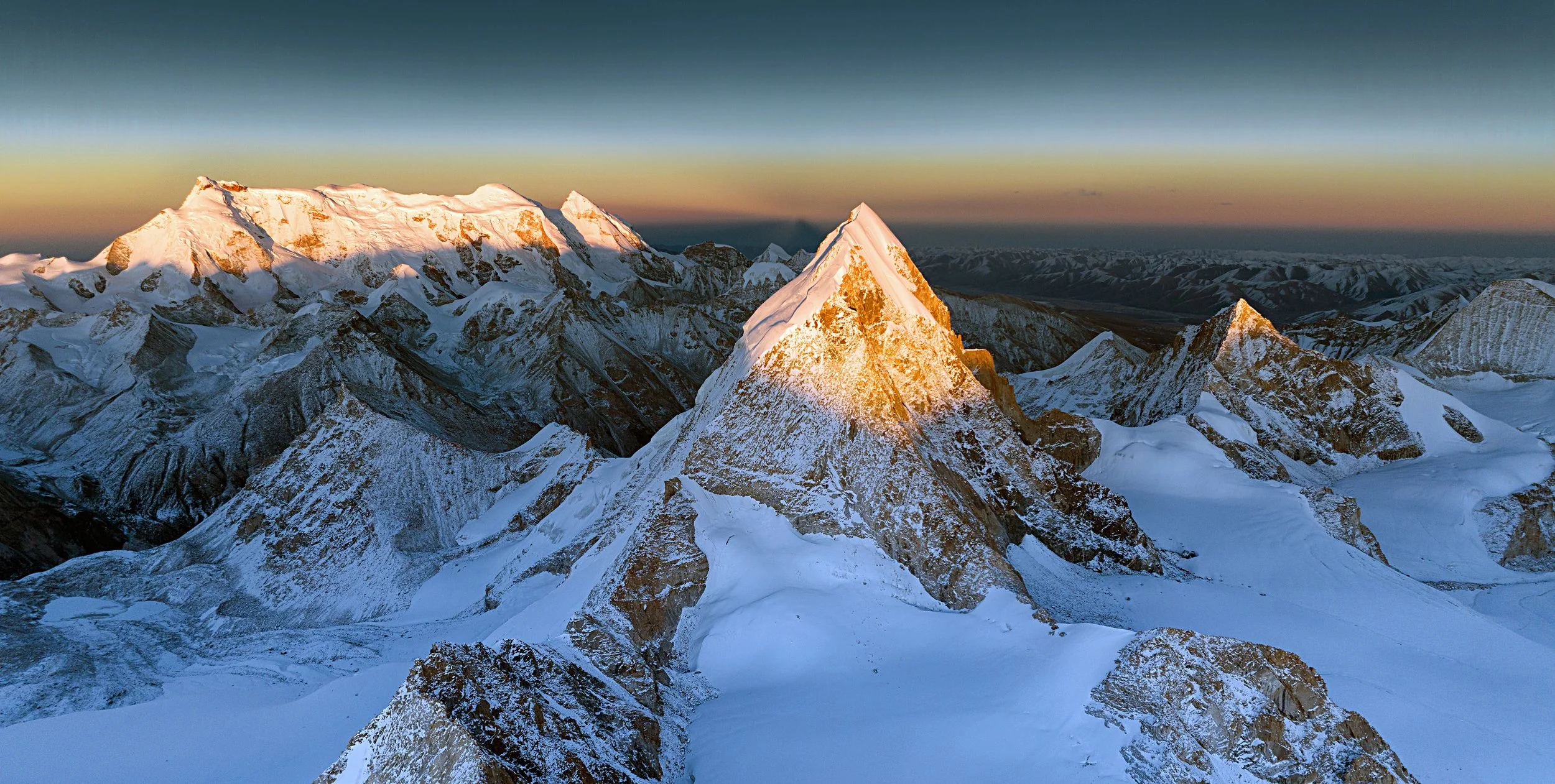
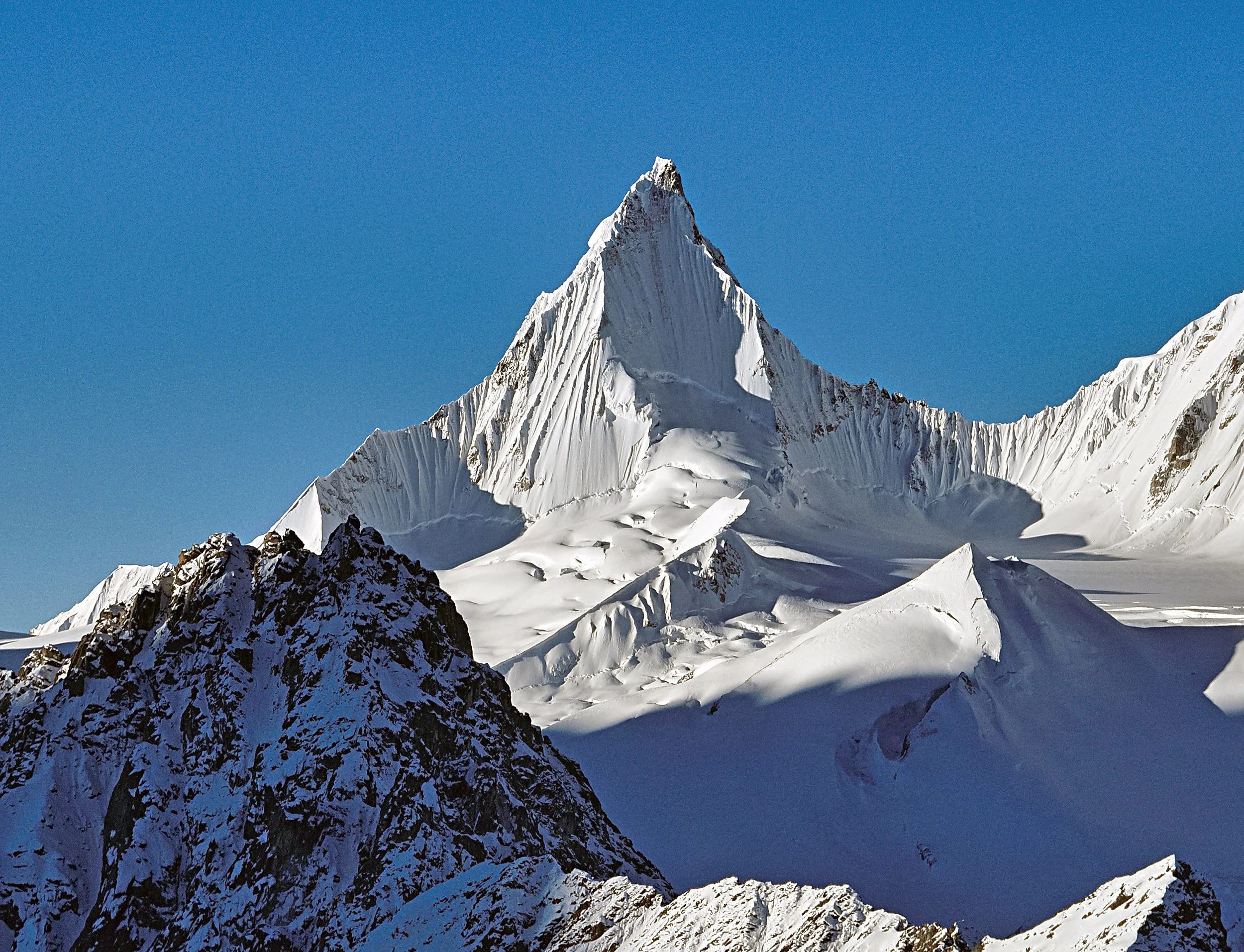
Sir Duk (Golden Dragon, 6,614m) in the Nyanchen Tanglha West mountains. Behind and to the left is the Nyanchen Tanglha Group, with the highest summit, Nyanchen Tanglha I (7,162m), on the left. Three routes have been climbed up the sunlit southwest face and south ridge of Sir Duk, including two summit routes and a line in 2024 that reached the west shoulder. That report is now at the AAJ website. Photo: Fan Rui

The vast Nyanchen Tanglha (a.k.a. Nyainqentanglha) ranges in Tibet span more than 750 kilometers in an arc north of Lhasa—it’s one of the world’s great collections of unclimbed or seldom-climbed high peaks. In the first decade of the 2000s, the Japanese geographer and photographer Tamotsu Nakamura, an AAC honorary member, published a series of articles describing these mountains, including a three-part opus in AAJ 2003 on mountains “East of the Himalaya” (also the title of Nakamura’s landmark 2016 book), with enticing photos from the Nyanchen Tanglha East range.

A bit of a gold rush followed, with various Western climbers snagging the first ascents of attractive summits in Nakamura’s photos. However, there are major logistical difficulties to climbing in this area, including road access and permits. The last AAJ articles about climbs in the Nyanchen Tanglha by Western climbers were published in 2017.

Into the breach has stepped a cohort of Chinese alpinists who have rapidly gained experience and skill in their home mountains in recent years. Now ready to tackle more difficult and remote objectives, they have made many impressive ascents, aided in part by rapid development of road and rail networks in Tibet. Three climbs from late 2024 are highlighted below. These reports could not be completed in time for the 2025 AAJ, but these ascents and many more in Tibet will be described in detail in next year’s book.

Many thanks to Xia Zhongming, who facilitates and writes AAJ reports from China— including these three—and has contributed greatly to the world’s knowledge of modern Chinese alpinism.


MANAMCHO FROM THE SOUTHWEST

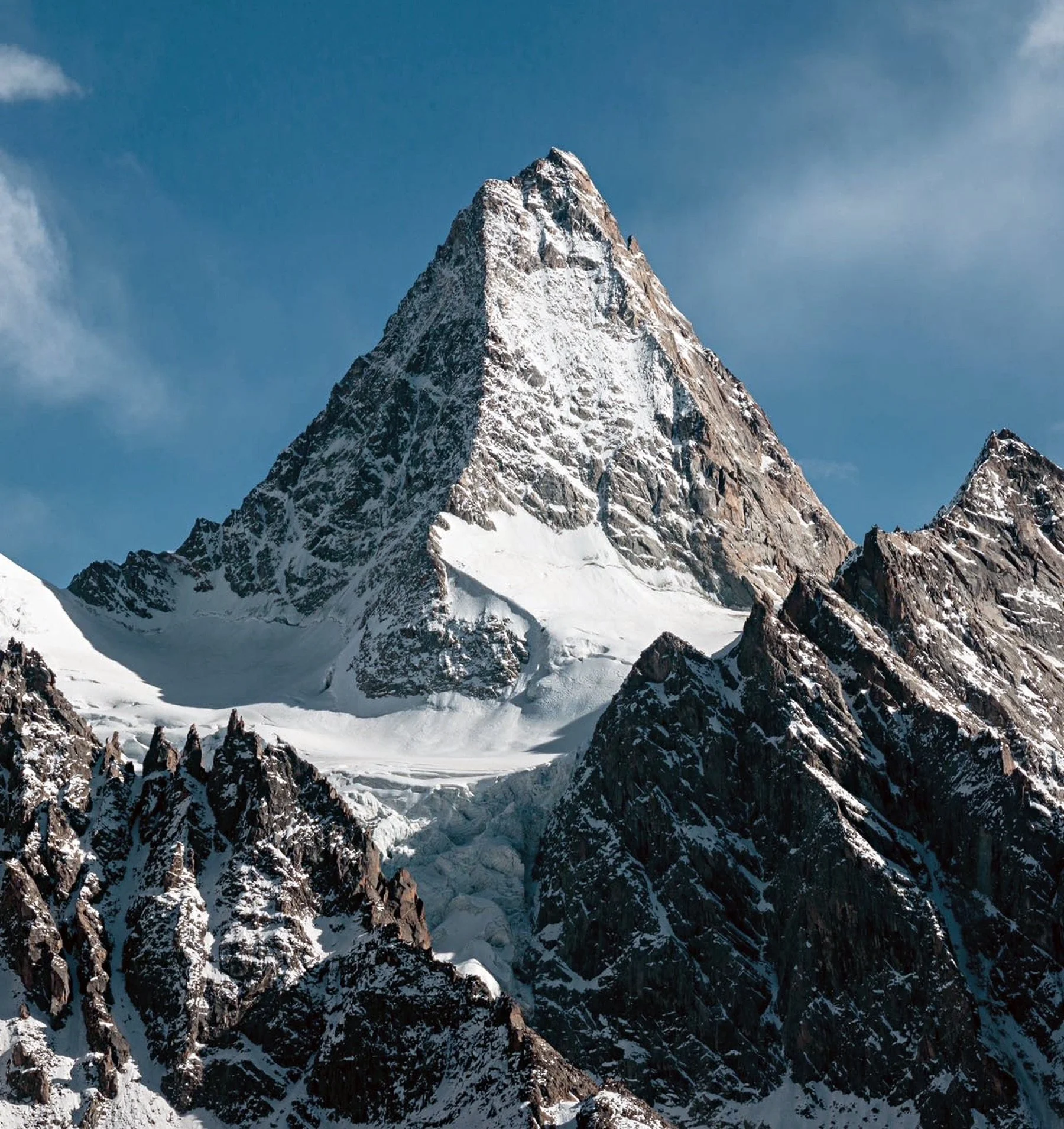
Manamcho (6,264m) from the northwest. The original route (2007) climbed the arête facing the camera. The 2024 route by Chinese alpinists Liu Junfu and Wang Shuai climbed the right side of the sunlit face. Photo: Lai Xingzhu

In 2005, British climbers Mick Fowler and Chris Watts made the first ascent of Kajaqiao in the Nyanchen Tanghlha East mountains. Two years later, Fowler returned with fellow Brit Paul Ramsden to climb Manamcho, a spectacular, Matterhorn-like peak nearby, by the northwest ridge. In September 2024, Chinese alpinists Liu Junfu and Wang Shuai climbed Manamcho’s second route, up the southwest side of the 6,264-meter mountain, in one long day from high camp. To overcome a crux rock slab near the top, Liu tied a rope to one of his ice tools and threw it up the rock. After more than ten tries, the tool stuck and Liu was able to batman up the rope and surmount the slab, opening the way to the summit. See the full report.


CHUCHEPO, FIRST ASCENT

Chuchepo (6,613m), with the 700-meter northeast face in shadow. This face was climbed directly to the summit in September 2024. Photo: Tong Haijun/Wang Yongpeng

Wang Yongpeng on the upper northeast face of Chuchepo during the first ascent. The shapely peak in back is unclimbed Sendho (6,252m). Photo: Tong Haijun

In the southwest section Nyanchen Tanglha East lies Nenang (6,870m), the highest of this range’s unclimbed peaks. Around 10 kilometers from Nenang to the west and east stand two spectacular mountains: Chuchepo (6,613m), west of Nenang, and Jiongmudazhi (6,590m) to the east. Both peaks were noted in AAJ 2007, but no known attempts were made on either peak until August 2024, when Tong Haijun and Wang Yongpeng from China climbed Chuchepo by a direttissima on the northeast face.

On August 16, the two began their approach from the Niwu Valley to the north, establishing advanced base at 5,300 meters after an 11-hour day. From there they scoped a feasible line up the northeast face. The next day, the pair spent seven hours crossing the snow-covered, crevassed glacier before camping at 5,900 meters.

On the 18th, the two left camp at 3 a.m., and after a difficult pitch to cross the bergschrund, they continued up easier terrain to reach 6,230 meters before sunrise.

The major technical difficulties now followed. Wang led a pitch where the ice was too thin to place screws and the rock too compact for cams. Tong then climbed a very run-out pitch on snow-covered compact rock. After this, the snow became deeper and the difficulties eased. Wang made a final belay in deep snow a couple of meters below the summit ridge, and Tong then tunneled through the cornice and continued up left to the highest point. The 700-meter route was graded D+ M4 AI3 75°. See the full report.


JIONGMUDAZHI, FIRST ASCENT

The northwest face of Jiongmudazhi (6,590m) and the line of the first ascent in September 2024. Photo: Tong Haijun/Wang Yongpeng

Less than a month after climbing Chuchepo, Tong Haijun and Wang Yongpeng returned to the area in September 2024 to attempt the first ascent of Jiongmudazhi (6,590m). Again, Tong and Wang approached from the north, via the Biyong Glacier, where they spent a very difficult day bypassing an 800-meter-wide icefall surrounded by steep cliffs. On September 8, another big day brought them to their second camp, at 5,855 meters.

The next morning, they left at 3 a.m. The visibility was poor, and it began to snow heavily. They alternated trail-breaking to the foot of the northwest face, left of the fall-line from the summit. Crossing the bergschrund, Tong led a five-meter vertical ice wall followed by deep snow. Wang led both the second and third pitches, slanting right toward a rocky area. Above this, they then began simul-climbing with intermediate protection; at one point, the two pitched a 20-meter vertical section with no protection.

When dawn broke, an ice block the size of two sofas collapsed from a serac barrier less than 50 meters away. They continued, climbing the right side of another serac barrier, when suddenly the mist cleared and they saw the main summit over to their right. This clearing was fortunate, as otherwise they would have continued up to a false summit. They reached the top at 11 a.m. and were back at their first camp by 5 p.m., having rappelled most of their route. See the full report.

We’ll be adding more of these reports and others from China to the AAJ website in the coming weeks. Follow the AAJ Instagram page for updates.


The Line is Powered by:


The Line is Supported By:


The Line is the newsletter of the American Alpine Journal (AAJ), powered by Arc’teryx, with additional support from Mountain Project by onX. The line is emailed to more than 80,000 climbers each month. Sign up below to receive future emails. Find the archive of past editions here. Got a potential story for the AAJ? Email the editors at [email protected].

To see The Line every month, sign up below!

The Prescription—Ground Fall

It’s Rocktober and across the continent climbers are sending their projects. This month we remind you that mishaps in “safe” genres like sport climbing can have serious consequences. This accident occurred in 2019 and was only reported this year. However, in the newly published 2025 ANAC, we feature several similar groundfall accidents.  


As you’ll also see below, we’re also featuring a human factors post-accident analysis that reveals some recurrent themes and behavior patterns. These are introduced in an article written by Dr. Valerie Karr.

Red Rock Canyon National Conservation Area is one of the best rock climbing areas in North America. This area features hundreds of boulder problems, sport routes, and traditional climbs. As such, it also hosts a wide range of climbing accidents. Photo by BLM.

Groundfall | Foot Slipped While Clipping

Nevada, Red Rock Conservation Area

On June 22, 2019, B, a male climber, was leading Where Egos Dare (5.12a) as a cool-down after a long session. The four-bolt route was easy enough for this climber that he could run a quick lap and as a result B “didn't take it seriously and was climbing very arrogantly… without careful consideration of the consequences.” Besides being short and punchy, the route also has several hard clips that put the leader within groundfall range.

B was, “…cooling down after a hard day of projecting. At the third bolt I pulled a bunch of slack to clip and my foot popped.” He had placed his foot carelessly on a bad part of the hold when it slipped. He had an arm full of slack and, “…decked straight on my butt.” He suffered lumbar compression fractures and fractured sacrum. “I was mere inches away from a shelf that, that had I impacted with my lumbar spine, I would've undoubtedly been paralyzed.” Though in serious pain, he, “walked out under my own steam. Likely due to adrenaline.”

Where Egos Dare (5.12a). The four lead bolts are each marked with a yellow “x”. In June 2019, a climber fell while clipping the third bolt and he landed on the ground. Besides highlighting the inherent dangers of sport climbing, this accident is an example of “risk normalization.” Photo by Anthony Lijewski.

ANALYSIS

B fell approximately 15 feet. A pit/trough below Where Egos Dare created a ledge that one could hit in a fall. He had stick clipped the first bolt but, “Had I stick clipped the third, this accident wouldn't have happened. Back then I considered it ‘cheating’ to clip more than the first, which in retrospect is silly.”

He adds, “Sport climbing is flippin’ dangerous! For all the sketchy gear routes I've done in my life it was a 35' tall 12a sport climb that nearly cost me the ability to walk. Unfortunately, I don't think most sport climbers have a clue about this.”

Finally, the fallen climber said, “I’d add that one should climb more carefully. Because this route was well below my redpoint level I didn't take it seriously. Ultimately, I put my foot to the right of the actual foothold and that is what did me in. Luckily, I'm physically 100% now, but it was such a close call that I definitely have residual psychological effects. My wife still has trouble belaying me despite it not being her fault. I think the psychological impacts of such accidents cannot be overstated.”

(Source: Anonymous Climber.)


HUMAN FACTORS ANALYSIS

This is the actual sloping and insecure foothold from which B’s foot slipped, sending him to the ground. Photo by B.

This groundfall is a classic case of risk normalization in which repeated exposure to hazards without consequence, lowers the perception of danger. Over time, shortcuts—clipping from poor stances, eschewing procedures like a higher stick clip, and a casual approach to moderate climbing—diminish the perceived hazards of consequential terrain. On the day of his accident, B admitted he was climbing “carelessly,” on a warm-down route that was well within his ability. Other distracting factors contributed to an atmosphere of informality and distractions at the base of the crag that compounded a sense of invulnerability. 


B’s narrative also reveals how cultural values within climbing can magnify risk through what he called the “purity ethics.”Beyond simple overconfidence, B acknowledged an internalized idea that stick clipping beyond the first bolt was “cheating.” This belief overrode pragmatic risk assessment. Only after his accident did he reframe those values, prioritizing safety over style with an understanding that it’s “all contrived anyway.”

(Source: Dr. Valerie Karr.)


VIDEO ANALYSIS

Pete Takeda, editor of Accidents in North American Climbing, and IFMGA Guide Jason Antin discuss how to reduce the likelihood of an accident a couple bolts off the ground.

Pete Takeda, Editor of Accidents in North American Climbing; IFMGA/AMGA Guide Jason Antin; Producers: Shane Johnson and Sierra McGivney; Videographer: Foster Denney; Editor: Sierra McGivney; Location: Accessibility Crag and East Colfax, Clear Creek, CO.


The Prescription is Powered By:


Sign Up for AAC Emails

A Tribute to Balin Miller

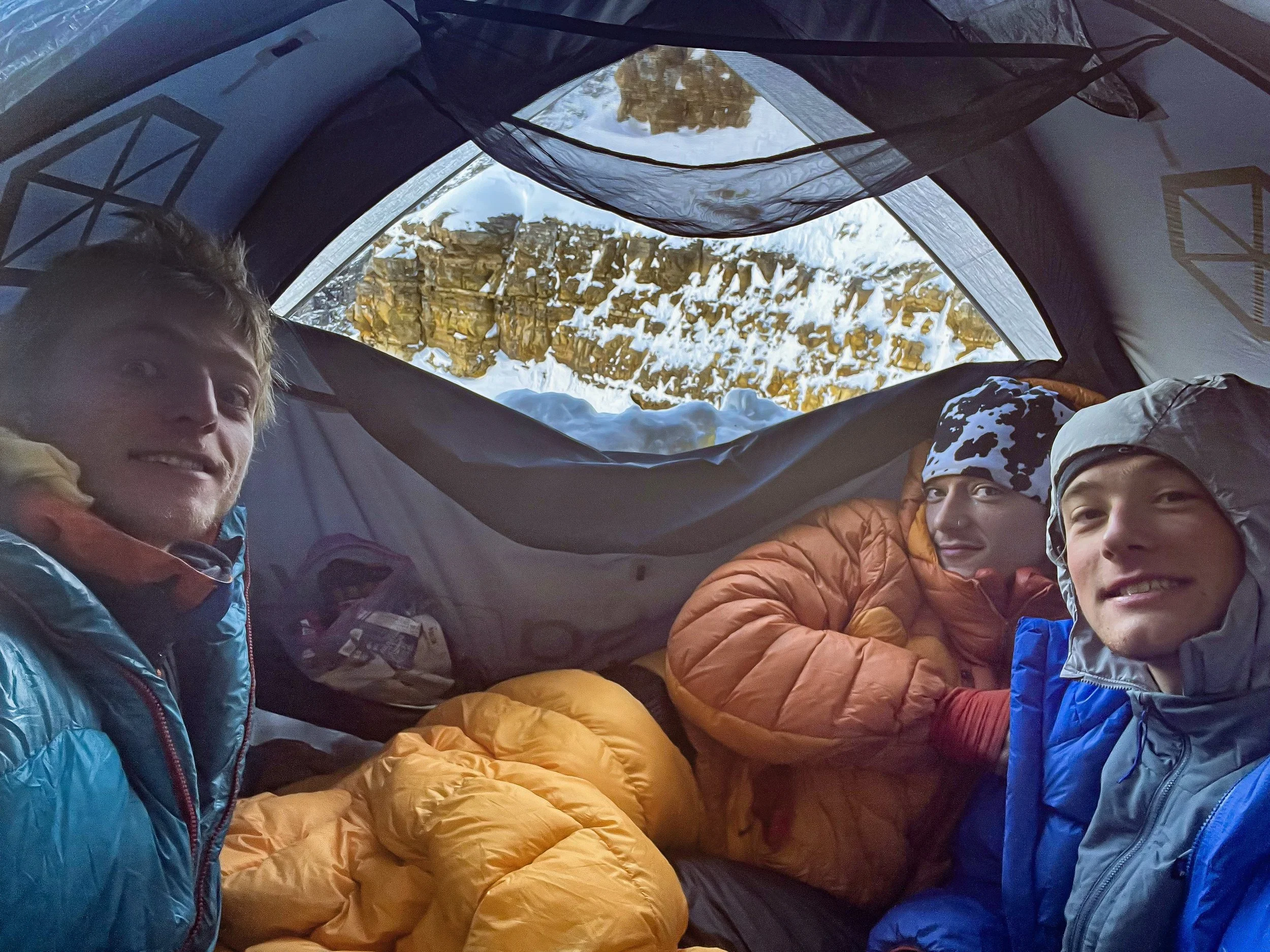
Balin Miller, Adrien Costa, and Aidan Whitelaw at the bivy spot on Infinite Patience getting cozy in a two-person tent. Land of the Mountain Metis, Stoney, Cree and Secwepemc peoples. PC: AAC member Balin Miller

It is with great sorrow that we honor the passing of AAC member Balin Miller (23), who died in a climbing accident in Yosemite in October 2025. Miller was an astonishing rising star, dedicated to the sport and exceedingly bold as an ice climber. He was an AAC member for four years, and received the Mountaineering Fellowship Fund Grant (MFFG) multiple times, which awards climbers age 25 and younger with funds to explore remote areas and seek out climbs more difficult than they might ordinarily be able to do. The AAC featured one of his MFFG-funded trips to Canada in our publication, Guidebook XII. In the pages of “Mountain Sense,” you will get a glimpse of this stalwart ice climber who had a goofy side. 

Miller was known for his audacious solos, like his solo of Fitz Roy, and the infamous Reality Bath in Canada—until Miller’s ascent, unrepeated since it was first put up by Mark Twight and Randy Rackliff in 1988. Though he was best known for these solos, he also regularly roped up with partners he trusted, accomplishing notable climbs like the Harvard Route on Mt. Huntington, Deprivation on Mt. Hunter, and the Ragni Route on Cerro Torre. 

Balin Miller questing off to lead a mixed pitch on Infinite Patience (VI5.9M5WI5).Land of the Mountain Metis, Stoney, Cree, and Secwepemc peoples. AAC member Adrian Costa

Before he passed, Miller had been working on a story for the 2026 AAJ about his 2025 summer season in Alaska. One highlight achievement of that summer was his historic solo of the Slovak Direct (M6 WI 6 A2; 9,000ft) on Denali (Mt. McKinley). The AAJ will be publishing his story posthumously to honor his legacy, accomplished in such a short life. 

While we honor Balin’s life and accomplishments here, more than anything, we are left with a somber realization of the pain experienced by those who are grieving him. Our thoughts are with Balin’s family and friends, and all who shared a rope and a laugh with him. 


Get Support from the Climbing Grief Fund

If you or another climbing in your life have been impacted by the loss of a loved one in the mountains or in a climbing accident, you can get support. The AAC’s Climbing Grief Fund offers funding for climbers to seek therapy to start their journey through grief and loss. 

Learn more about how to apply to get funding for therapy services, below. Or, access our directory of knowledgeable climbing and outdoor-sports-oriented therapists.

22 Seasons at Denali Base Camp, with Lisa Roderick

On this episode of the podcast, we chat with Lisa Roderick about her book: A Place Among Giants: 22 Seasons at Denali Basecamp. As basecamp manager at Denali (also known as Mt McKinley), Lisa was everywhere and doing everything—going out of her way to help climbers even when it wasn’t in her job description. Her job ended up panning out to include: coordinating planes dropping off and picking up climbers and tourists; reporting weather over the radio to nearby pilots maneuvering the Alaska Range; reporting weather to climbers up on Denali without service; and occasionally supporting Denali National Park Rangers in search and rescue efforts. Really only accessible by small planes, the Kahiltna Glacier is its own unique, isolated world—full of inspiration, history-making climbs, risk, worry, fascinating climbing personalities, days sunning on the glacier, and moody weather. Dive into the episode to learn more about Lisa’s decades of experience in one of the most volatile and vibrant climbing hubs on the planet.


The Line: A Wild and Crazy First Ascent in Idaho

First ascents are as much about imagination as they are about strength and skill: They require seeing a possibility where few had imagined one before. River guide and climber Matt Ward had seen a huge, steep wall above Idaho’s Salmon River many times, and he dreamed of making the first ascent. The wall looked climbable, but how to get there? The wild story of how he and Ky Hart solved that problem is published below. Matt’s story appears in AAJ 2025, which is now starting to arrive in AAC members’ mailboxes. But not everyone reads the AAJ cover to cover, and we didn’t want anyone to miss this unique tale of adventure.

IMPASSABLE CANYON, REDSIDE WALL

“Beavers!” Ky Hart yelled over his shoulder.

“No! Bears!” I yelled back.

Actually, it was three bears. Two small black bear cubs were timidly swimming on an eddy line in the Middle Fork of the Salmon River. The large mama bear was waiting for her cubs to follow her across, and she stood up tall when she saw Ky and me about to swim between her and her babies.

“I’m gonna touch one!” Ky yelled out.

My instinct was to do the exact opposite—swim away from them. But the swift current was quickly moving us both directly at the cubs. Fortunately, our appearance shocked them into action. The cubs swam hard for mama, and the current shot us past them.

Looking back on the experience later that day, it occurred to me that the fact that Ky’s first thought was to swim over and touch a wild bear cub while its mother watched was one of many things that made him the perfect partner for this trip. Unhinged, yes. But our plan to hike 22 miles, swim three and a half miles of whitewater, and climb a new route on a backcountry big wall would require more than a little madness.

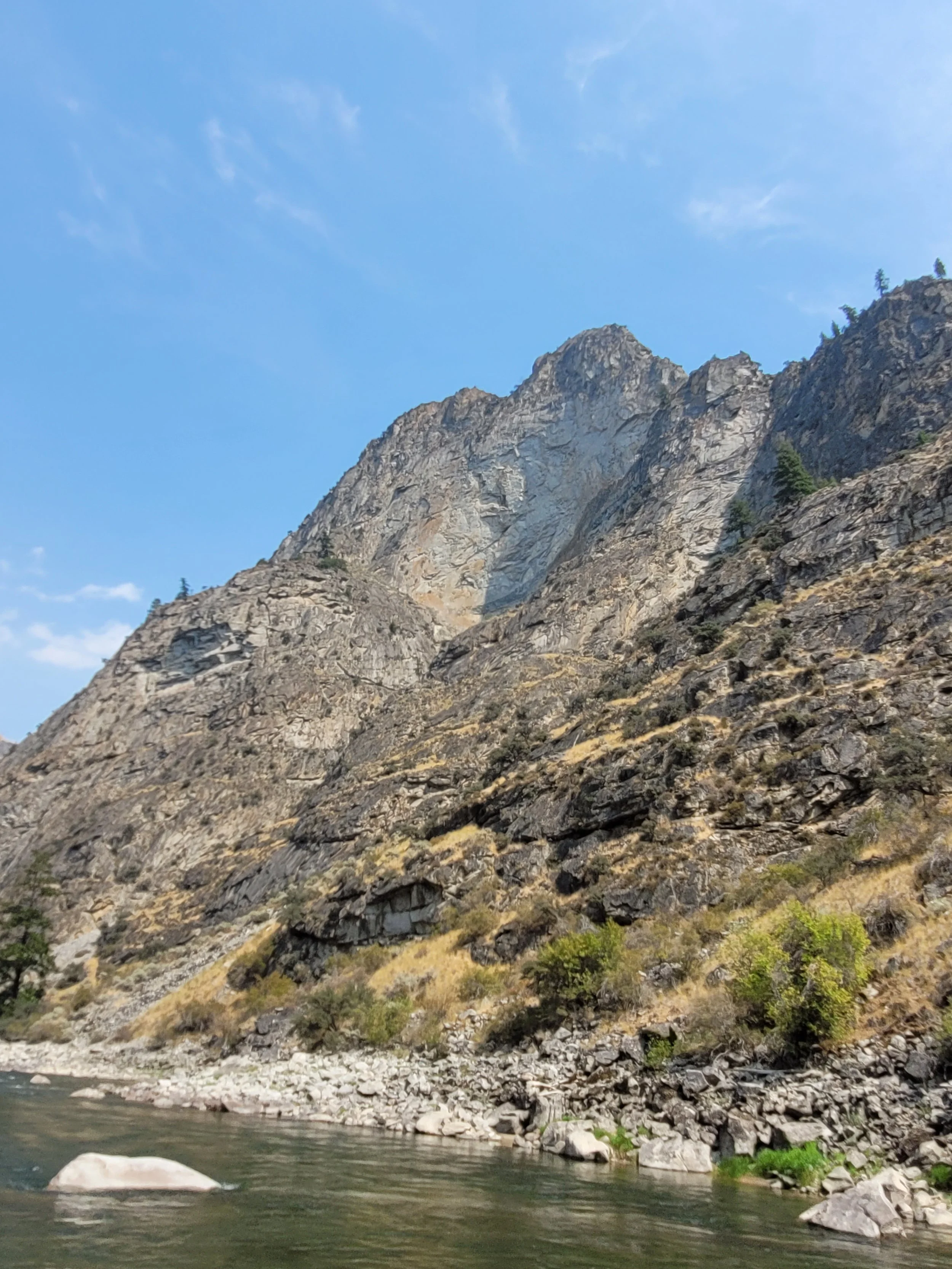
The view of Redside Wall from the Middle Fork of the Salmon River. It would be a challenging first ascent if it were near the road. Eighty-two miles down a heavily regulated wilderness river, Redside would require a novel approach. Matt Ward

Impassable Canyon on the Middle Fork of the Salmon, deep in the heart of Idaho’s massive Frank Church Wilderness, is legendary among river runners and all but unknown to climbers. River permits for the Middle Fork can only be won through a lucky pick in the annual lottery. Once a trip has launched, numerous necessary rules regulate the way that boaters can use the wilderness. One of these prohibits any river trip from camping more than one night in Impassable Canyon.

Over three commercial seasons as a raft guide on the Middle Fork, I had become obsessed with what appeared to be the tallest wall in Impassable Canyon. It’s a landmark for the famous Redside Rapid, and because of this, I’ve always called it the Redside Wall.

The Redside Wall is 82 river miles from the Boundary Creek boat ramp. The nearest trail to the wall crosses the river 3.5 miles upstream, but only after a 22-mile hike down Waterfall Creek. Over years of dreaming about trying to climb Redside, that seemed like the best option—except that those 3.5 downstream miles aren’t walkable at water level; the river often runs against steep, impassable walls. Hitchhiking downstream on river trips would also be illegal, since we wouldn’t be listed on the boat’s permit.

During one of many conversations with river and forest administrators on how to access the area legally, I finally asked the right question. “I don’t need a permit to swim in the river, do I?” The answer was no, I didn’t, delivered with a sideways glance and a chuckle.

At that moment, I hatched a plan. Ky and I would hike the Waterfall Creek Trail into Middle Fork Canyon, descending over 5,500 feet in 22 miles. Then we would swim with our backpacks down 3.5 miles of whitewater, including numerous Class III rapids. Then we would spend three days making the first ascent of a dramatically overhanging wall. Then we would join a friend’s river trip (for which we were listed on the permit) and paddle out.

Ky Hart adds some natural flotation to his waterlogged backpack during the three-mile swim down the Middle Fork of the Salmon River. Matt Ward

On August 29, 2024, we began the hike. After eight hours on the move, we reached the Middle Fork and made camp near the confluence with Big Creek, where a charred hillside across the river was still smoking from a wildfire. We were awoken repeatedly that night by the sound of trees falling and rockfall.

The next morning, we walked until Cutthroat Cove Rapid, where the bank cliffed out. It was time to swim. We eased into the river wearing our PFDs, gasped at the chill of the water, and began the most ridiculous stage of the plan. The bear sighting happened within the first mile. Soon after, our lips were blue, our teeth chattering. Ky found driftwood logs and lashed them to his backpack, which kept him farther out of the water. I opted for walking on sunlit banks when possible; this paid dividends when I found two beers that had been lost by some river trip.

Despite walking past several rapids, we still swam three miles. After the portage around Wall Creek Rapid, we jumped in for the final swim to the wall. Arriving at the beautiful beach beneath it felt a little surreal.

That afternoon, we started up the gully leading to the base of the wall and found the big-wall rack and portaledge I had stashed the week before, while guiding a trip down the river. We began climbing beautiful gray granite, smooth as glass in places. The gully pitches had worried us because they’d looked so polished, but we found enough cracks, bushes, and trees to make good, if dirty, progress.

Matt Ward leads the first difficult aid pitch (A3) on the upper Redside Wall. Ward had cached climbing gear and a portaledge below the wall during a previous river trip. Ky Hart

That evening, we were back on the beach, having fixed our ropes on the first three pitches. With seven river-trip launches a day on the Middle Fork, it was inevitable we would see many boats during our time on the beach. So began the endless answering of questions like, Where’s your boat? And, You didn’t really swim here, right? And, Do you need some beers? I love many things about river people, but especially the ever-present beer supply and the willingness to hand cold ones to suspect characters limping across the beach claiming they’re here to “do a little climbing.”

Hart jumaring after the bivouac on the Redside Wall, with the Middle Fork of the Salmon River about 1,500 feet below and wildfire smoke filling the air. Matt Ward

The next morning we packed the haulbag and committed to the wall. Our progress slowed considerably as the wall reared back and the cracks became seams. Beaks, hooks, and small gear got us to a decent bivy and, just like that, the first A3 pitch was in the bag. Ky went up on the next aid pitch and—long after sunset—kept hooking in the dark. We were, as usual, lost on the wall, but hadn’t found any dead ends yet.

Dawn broke hot. The smoke in the air was dense. We decided to pack a day bag, bring all of the rope we had, and see what happened. Ky swung 20’ away from the wall as he jugged the static line, a reminder of just how steep this thing was.

Looking down from high on the Redside Wall. Matt Ward

We were now in the large open book feature that splits the middle of the face, and the angle eased with every rope length. On the 12th pitch, I left the book and headed straight up with hopes of topping out. A mix of hooking and free climbing brought me onto a ledge covered in huge blocks, with a panoramic view of Impassable Canyon. We could see the Waterfall Creek Trail, most of what we’d swum to get here, Redside Rapid, and much of what lay downstream of us. A short scramble and a 5.8 pitch reminiscent of climbs in the Sawtooth Mountains brought us to the top. Not so much a summit as a high point on a ridge, 1,800 feet above the Middle Fork. We descended to the portaledge by rappelling from natural anchors.

The first lightning strikes happened at twilight but were far enough off to the west not to worry us at first. The Sawtooths and the Salmon River Mountains are both well known for exceptionally violent thunderstorms, and I’ve been pinned down by them more times than I’d like to remember. As the storm came closer, Ky began shooting photos as the lightning illuminated our exposed portaledge. It may have been an illusion, but it seemed we were above the lighting as it shot through the clouds. I pondered whether our 25 beaks could act as a lightning rod. We fell asleep late that night to a soundtrack of thunder, both silently repeating our trip’s mantra: Unkilled once again, so far.

Matt Ward and Ky Hart at the top of the Redside Wall after completing its first ascent via No Rolling Stone (13 pitches, V5.10 A3). Matt Ward

The next day, as we lazed in the shade at the beach, our friends swung by to pick us up, as planned. Our buddy J.P. and the other 13 people on his river trip loaded us up, fed us, and treated us like royalty. We spent another night on the river and the next day drove out to the city of Salmon, ecstatic and shocked that the logistics had all worked out.

Two weeks later in Stanley, Idaho, I married Makayla Hoyt, my best friend and the woman of my dreams, at a beautiful ceremony along the Salmon River. The Redside Wall was my last hurrah as an unmarried man. For the first time in my life, I ain’t No Rolling Stone (13 pitches, V 5.10 A3). 

—Matt Ward


The Line is Supported By:

The Line is Powered By:


The Line is the newsletter of the American Alpine Journal (AAJ), powered by Arc’teryx, with additional support from Mountain Project by onX. The Line is emailed to more than 80,000 climbers each month. Sign up below to receive future emails. Find the archive of past editions here. Got a potential story for the AAJ? Email the editors at [email protected].

Flashback to the Era of AAC Member Applications

In this episode of the podcast, we sit down with AAC Librarian Natalie Siciliano to chat about a fascinating part of the American Alpine Club’s history: the days when you used to have to apply to be a member of the Club. The application membership system lasted for over 90 years—which means we have extensive records in our archives that feature the climbing resumes and recommendation letters from thousands of climbing's most fascinating characters. In this episode, we dive into the how and why of this application system, why it got dismantled, and what membership at the Club looks like now. Plus, we take a look at some highlights from the applications of legends like Lynn Hill, Yvon Chouinard, Ichiro Yoshizawa, and more.


The Prescription—Off Route Rappel

Fall is finally here and conditions for rock climbing are prime. Many of you will be heading out to crags or walls that require rappels. Just remember that while rappel mishaps come in all forms, two common errors are getting off the rappel route and/or getting the rappel rope stuck. To extricate oneself and avoid rescue it’s good to learn the art of ascending a rope. 

In this incident from 2021, one climber found himself off route. With some basic tools and an understanding of the concept of rope ascension, this climber got his team out of trouble.

Devils Tower is an immensely popular summit with a high concentration of routes that follow splitter cracks on solid rock. Photo by NPS.

Off Route Rappel | Improvised Rope Ascent

Devils Tower, South Face

On May 25, Climber 1 (David) and Climber 2 experienced a common rappel mishap on Devils Tower.

David recounts: “I share this as a cautionary tale. After climbing the Bon Homme Variation (5.8) and then the Bailey Direct route to top out, we decided to head down by the Meadows rappels. I saw a cairn and some rap rings and rigged the rap, assuming I was on the Meadows rappe route. Boy was I wrong! After descending about 125 feet (with two 60-meter ropes), I realized I was off route. I saw a tiny ledge with a second rap anchor at 150 feet, but when I got there with no Meadows in sight, I knew I was screwed.

There was a steady 30 mph wind with gusts to about 45. Luckily, we had a set of small radios, so I could talk with my partner. I pulled up an end and tied in and had him start belaying me. Unfortunately, the climbing was well above my grade and the rock was covered with lichen and offered no grip, so I was going nowhere fast.

He started hauling me but didn’t know how to rig something to assist, so I had him tie off his ATC to fix the line. I knew the concepts of self-rescue/ jugging but hadn’t ever practiced. I had to quickly figure it out. I carry a Petzl Micro Traxion as well as a Sterling HollowBlock to use as a prusik. I attached the HollowBlock high and clipped into it with my rappel extension. I put the Micro Traxion low on the rope and rigged a foot stirrup with a cordelette, all while hanging in air 500 feet above the boulder field.

I figured out the method—step up on the Traxion, slide up the prusik, sit back on the prusik, pull slack through the Traxion, repeat over and over. A few times, I got to where I thought I could climb, but it was too complicated to switch from jugging to climbing.

At one point the sling to my prusik got tangled in the Traxion. Somehow I got the Traxion opened (while just hanging on the prusik) and freed the sling. It’s impossible to relay the genuine fear I had during this experience. In the end it all worked out, and in about an hour I was back on top. I learned a lot. “


The Meadows rappel descent on Devils Tower is surprisingly deceptive, especially given its popularity. Over a thousand people use this descent every year. NPS Pamphlet

ANALYSIS

The Meadows rappels are known to lead climbers astray and have been the location of at least one recorded fatality. The descent is unobvious, despite it being used to descend from the most popular routes on Devils Tower. With an almost 90-year rock climbing history, there are many anchors on the Tower–some at five- to ten foot intervals–that make even well-traveled rappels problematic.

As David recounts, “I should have spent more time looking around and been 100 percent sure of the descent route. The top of the Tower is disorienting if you don’t pay attention to the landscape on the ground.” David was smart to carry tools for ascending a fixed rope—a little prior practice would have made his journey back to the anchor a lot easier. Learn and practice safe transitions from rappelling to ascending and the methods to back up such an ascent. Bringing radios was another good choice. David recalls, “It was very windy, and it was impossible to shout. Without the radios I’m pretty sure I would have had to call SAR. Best thirty dollars I ever spent.”

(Sources: David, via Mountain Project, and the Editors.)


Video Analysis

Every year, we receive several reports of people getting stuck while rappelling and having to ascend their ropes. Knowing this one technique would save you a lot of stress and prevent what could be a costly and risky rescue.

IFMGA/AMGA Guide Jason Antin walks us through ascending a double rope after rappelling off route. We recommend that climbers take a rock rescue course from a guide to get a full in-depth training on how to ascend a rope.

Credits:
Pete Takeda, Editor of Accidents in North American Climbing, IFMGA/AMGA Guide Jason Antin, Producers: Shane Johnson and Sierra McGivney; Videographer: Foster Denney; Editor: Sierra McGivney, Location: Accessibility Crag, Clear Creek, CO.


The Prescription is Powered By:


Sign Up for AAC Emails

Guidebook XV—Rewind the Climb

A World of Appalling Grandeur

The First Ascent of Mt. Logan

By Hannah Provost with support from the AAC Library

Photos from the Allen Carpé Collection in the AAC Library

The snowy fortress of Mt. Logan massif had opened its door after weeks of siege. It was June 23, 1925, when Allen Carpé and five others stood atop the highest peak in Canada for the first time, the sheer pinnacle of the summit plunging down sharply to the Seward Glacier below.

To Carpé, in the thin air, it felt like every moment was twice lived.

And in the media storm and flurry of drama that followed, he would be called upon to set the record straight—and relive those moments yet another time.


At first glance, the 100-year-old story of the first ascent of Mt. Logan might have a familiar outline—a band of men push up and up to ascend to the great heights, facing great hardship along the way. In the classic telling, we follow the expedition leader Albert MacCarthy as he spends weeks caching supplies in the dead of winter, utilizing sleds pulled by snowshoe-clad horses, and higher up on the mountain, cunning dog teams that fight whenever left alone.

In the classic telling, we follow MacCarthy, American Alpine Club representative Allen Carpé, American Norman Read, Colonel Foster, and the others on the expedition as they ferry their own gear back and forth between each subsequent camp, the measure of days the number of heavy loads these men have carried to the next advanced base camp, or their proximity to frostbite. With teeth on edge, we’d read of 11 journeys through a precarious icefall as they consolidated their camp above 10,000 feet, transporting nearly a ton of equipment and food.

Once high on the massif, we’d delight in the cunning trick, attributed to MacCarthy, of planting 600 bare willow branches in the blowing snow every hundred feet, to prevent against getting lost in the whiteout. Such trail maintenance would ultimately save lives and precious time, but still couldn’t prevent one rope team from losing their way during a storm that chased them down from the summit. Those men spent 42 hours without shelter in the freezing, grainy snowbanks, only realizing their mistake when they found themselves walking in circles, back on the summit plateau, the slopes ominously appearing at unexpected angles.

The theme of that story is loneliness, drudgery, and the sheer force of will needed against the worst conditions that such an icy world could offer.

Reflecting on these themes, Carpé writes in his own telling of the ascent, published in 1933 in the American Alpine Journal: “I think it was during these days that the awful loneliness of these great ranges was first borne in upon me with something of the force of a personal experience. Until we turned the corner into the Ogilvie glacier, we could look back down the valley and sense the presence of the lower hills and of living things. Now as we worked in toward the savage cliffs of Logan we entered a new world of appalling grandeur, and our little band seemed insignificant and very much alone. We had no support behind us, no organization of supply, no linkage at all with the outer world. We were on our own.”

That telling is perhaps best left to those who experienced it. But a 100-year distance can sharpen the focus of our lens on something else—the mundane letters and newspaper stories that came afterward, that can so easily be forgotten as part of the story, and that might tell us a little something different about the legacy our climbing ancestors have left us.

There are, of course, the historical accounts—a hundred pages dedicated to the planning of the ascent, scientific studies accomplished during the expedition, and the story of the climb itself, all included in the Canadian Alpine Journal. Because the AAC was not yet publishing the American Alpine Journal (it would do so for the first time in 1929), the American account of the ascent was published in the Appalachian Mountain Club’s journal. The American public, too, was in awe, with repeated articles appearing in the New York Times, the Boston Transcript, and others.

But a flurry of letters from September 1925, dashed off in angry haste with cross-outs and misspellings, reveal a gap in the telling. The writer, expedition member Norman Read, repeatedly argues to his friend and reader, Allen Carpé, that the representations of the expedition in the media are “positively disgusting in its sensationalism and its falsity.” He asks Carpé to write the story the right way—to tell it in a manner ‘worthy of the fraternity of mountaineering.’ The letters are a source of 100-year-old gossip—they tell of personal disgruntlement and vendetta, but also raise a question that a century later still holds: If there is no cheating in climbing, only lying, then what do you do about a little storytelling flair—a little hyperbole? What are the ethics of telling a mountaineering story right?

Flip over one of The New York Times clippings that features the story of the Logan ascent, and you’ll see pictures of the season’s debutantes printed in sepia—flaunting flapper dresses and long strings of pearls. It was the 1920s: a period of extravagance, economic growth, and patriotism after the horrors of the First World War. Only a decade before, in 1913, did the first people stand atop Denali (Mt. McKinley). In 1924, a highly public attempt on Mt. Everest ended in the disappearance of George Mallory and Andrew Irvine, generating considerable speculation about whether they had made the first ascent before going missing. The American Alpine Club was founded in 1902; the Alpine Club of Canada had started in 1906. Amid this milieu, as they watched the U.K.’s Alpine Club take their shot at Everest, the Canadians and Americans had started to look around for their own slice of history. There was a lot at stake— this ascent needed to make a splash.

From the get-go, the Logan expedition was known to be a massive undertaking in logistics, and MacCarthy took on the labor of caching the supplies needed for a siege-style ascent, so deep in the Canadian interior that it was a slog of over 100 miles from the nearest town to Logan’s surrounding glaciers. As Carpé would write, MacCarthy “was not a man to hold back when there was work to do.” MacCarthy, as leader, dominated the expedition, and this really rubbed Read the wrong way.

Read alludes to “unpleasantness of the trip” and “personal grievances” in his letters. And it seems that such unpleasantness wasn’t all in Read’s head. MacCarthy, in his own account of the trip for the CAJ, closes with an acknowledgment of his behavior, and quite the excuse: “Thus, at midnight on June 28th, we again were down to the level where men think and breathe and work in a rational way and so may be held accountable for their actions. If sometimes while above that level, I was harsh and disagreeable, I ask that my companions please forgive me.”

Many accusations pile up in Read’s letters.

Read had heard whispers that the Canadians hadn’t even wanted the Americans to come along, and in Read’s opinion, Foster and MacCarthy were colluding to take all the attention from everyone else.

In the newspaper stories citing MacCarthy and Foster as sources, aspersions were cast that Read had deserted his companions in an hour of need, that another expedition member was weak and ineffectual, that Carpé was a coward and had wanted to turn back during the final summit push, and that “[MacCarthy] forced [Carpé] on since he felt that the official representative of the American Alpine Club should reach the top.”

And then there was the hyperbole—yes, they had rafted back down the river as the final leg back to town, but they were not “plunging through the swift waters of canyons” by any stretch. Similarly, there was plenty of heroism in the expedition, but the newspapers likewise stretched the danger they faced in the final snowy pitches. Read writes: ”Nobody was in a precarious position and there was no danger of loss of life that I could see. Such accounts as these hardly seem to fit in with the ethics of true mountaineering.”

In each of his letters, Read nudges Carpé to set the record straight. Always, it is some version of the note in his last letter: “Someone ought to really write the true story and blow up their attempt to distort the facts.” It was the 1920s version of double-texting: Read, experiencing intense emotion after reading each newspaper story, wrote Carpé multiple letters before ever receiving a response.

Allen Carpé did set the record straight—in fact it was one of his last acts. Carpé’s accounting of the Logan expedition, included in the 1933 AA J, was published posthumously, after he went missing on Denali in 1932. It is suspected that he fell into a crevasse while attempting to help a fellow expedition member. He had brought a draft of what would become the 1933 AAJ article, intending to work on edits for a magazine, before he vanished on the mountain. It is one of his last known writings.

Seven years after the original ascent, Carpé’s story is reflective of the man himself. In his AAJ obituary, W.S. Ladd describes Carpé as a “quiet, shy man” with a “clear, calculating mind...precise in his methods” and with “little patience with inefficiency.” Indeed, “all his efforts I shall always think of as being governed by one motive—precision.”

Allen Carpé (right) with Howard Palmer.

How did Carpé, given this characterization, receive Norman Read’s undifferentiated vitriol for the leaders of their expedition, and the (supposedly inaccurate) tales told in the media? Carpé’s own letters back to Read have yet to be found, if they even survive at all, and yet penciled-in commentary in the margins points to a potential understanding of his mind.

The marginalia could be Carpé’s reactions to Read’s letters—or maybe Howard Palmer’s, whose papers they were found with, or an unknown other—but regardless the marks are enough to question the full veracity of Read’s grumbling. “Not strictly true” is noted in the margins where Read shares his version of events to prove he didn’t desert his fellows. Yet Carpé does address some of Read’s concerns in his own account—he clearly wasn’t discounting Read outright. Whether we should consider Carpé’s account as universally true, it’s hard to say—but at least he seems a more measured and dispassionate observer of the tale than either Read or MacCarthy and Foster.

Carpé’s telling captures great trials with understated grace. Describing the summit, he writes:

What did we see, how did we feel, what were our thoughts in that precarious half-hour of victory? The first question is the easiest: we saw fog about us, and rare glimpses of a world far below of which we seemed not at all a part, and for a time we saw in the fog gigantic shadow mind...precise in his methods” and with “little patience with inefficiency.” Indeed, “all his efforts I shall always think of as being governed by one motive—precision.”

How did Carpé, given this characterization, receive Norman Read’s undifferentiated vitriol for the leaders of their expedition, and the (supposedly inaccurate) tales told in the media? Carpé’s own letters back to Read have yet to be found, if they even survive at all, and yet penciled-in commentary in the margins points to a potential understanding of his mind.

The marginalia could be Carpé’s reactions to Read’s letters—or maybe Howard Palmer’s, whose papers they were found with, or an unknown other—but regardless the marks are enough to question the full veracity of Read’s grumbling. “Not strictly true” is noted in the margins where Read shares his version of events to prove he didn’t desert his fellows. Yet Carpé does address some of Read’s concerns in his own account—he clearly wasn’t discounting Read outright. Whether we should consider Carpé’s account as universally true, it’s hard to say—but at least he seems a more measured and dispassionate observer of the tale than either Read or MacCarthy and Foster.

Carpé’s telling captures great trials with understated grace. Describing the summit, he writes:

What did we see, how did we feel, what were our thoughts in that precarious half-hour of victory? The first question is the easiest: we saw fog about us, and rare glimpses of a world far below of which we seemed not at all a part, and for a time we saw in the fog gigantic shadow

images of ourselves...As to the rest, I fear we were too spent to make the answer very exciting. Almost automatically we went through the appointed routine: hand-clasps and congratulations, a round of motion pictures, the empty gesture of a record of names and date thrust into the snow. Then we turned and began the descent in the gathering storm.

Whether truly Foster and MacCarthy’s fault, or the heavy hand of overexuberant newspaper editors, the sensationalism of the media recounting of the Logan ascent feels a little familiar to our modern gaze. In Carpé’s hands, the moments of low morale at the false summit, or the small moments of heroism, like when in their haste to descend they were all going the wrong way before Read saw the error and corrected course, feel truer.

In Carpé’s more stoic account, there is danger and bravery, heroism and moments of a greater spiritual connection. The drama is already there, in the act of climbing itself. Even if some of Read’s fighting words come from a place of hurt ego, perhaps his larger point isn’t so off the mark. We don’t need to add anything in for effect—climbing already has a built-in plot. Logan was already a world of appalling grandeur.


Sign Up for AAC Emails

Softening to Grief, with Therapist Ash Langholz

For this episode of the AAC podcast, we’re having a conversation with therapist Ashlee Langholz about grief, traumatic grief, and how the Climbing Grief Fund (CGF) can support climbers and other mountain athletes who are experiencing loss. While we’ve had a few CGF grant recipients on the podcast in recent years to reflect on their personal journeys with grief, this episode is more about demystifying grief therapy and what Ash has learned throughout the years of professionally supporting people in their grief journey. Plus, our host delves into some of her own personal experiences with the topic.

Do you need mental health services as you grapple with loss and injury related to the mountains and mountain sports? Apply to the Climbing Grief Fund today at americanalpineclub.org/grieffund.