The Prescription—Leader Fall on Rock

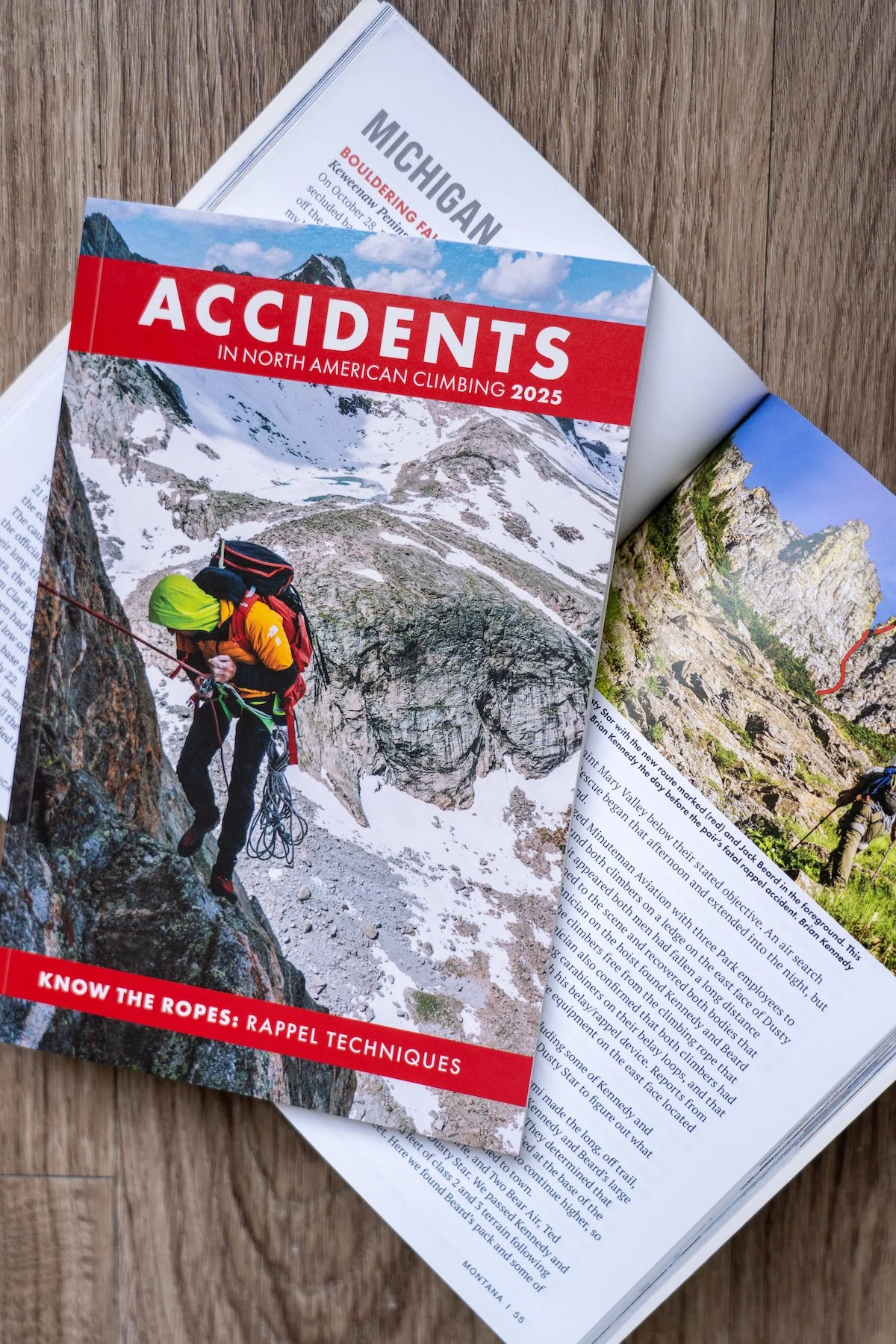
It’s May and we’re fully into the spring season. We have the first installment of a two-part series that demonstrates what to do if the leader falls and is knocked unconscious. It is not an uncommon scenario as we see in an accident we reported in the 2025 ANAC. 

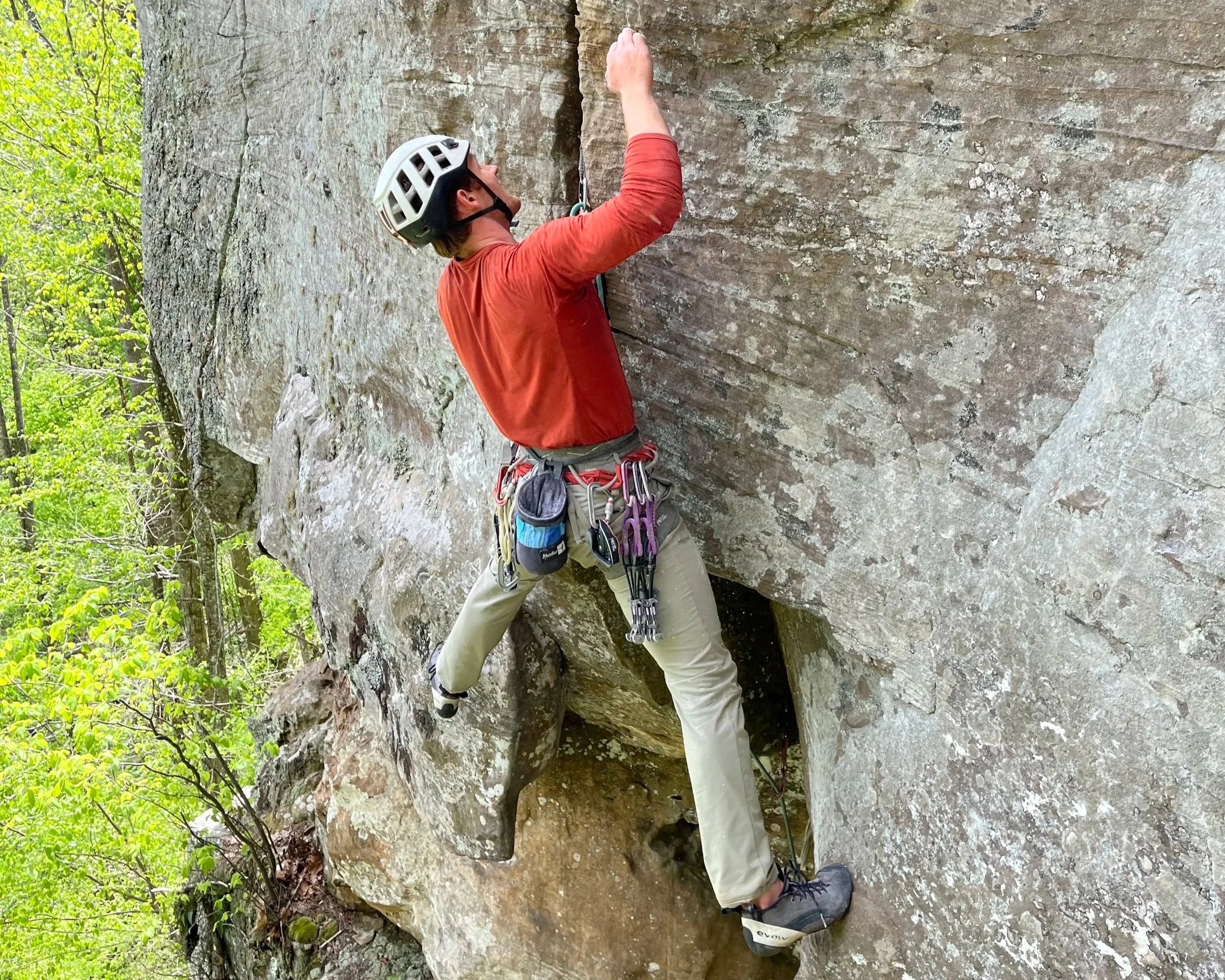
This accident took place in November 2024, when a climber was leading the overhanging second pitch of a route in Red Rock Canyon, Nevada. This climber fell and was knocked unconscious and ended up hanging above and out from the wall. As you’ll read, this story has a happy ending because of well-informed and decisive action by the belayer.
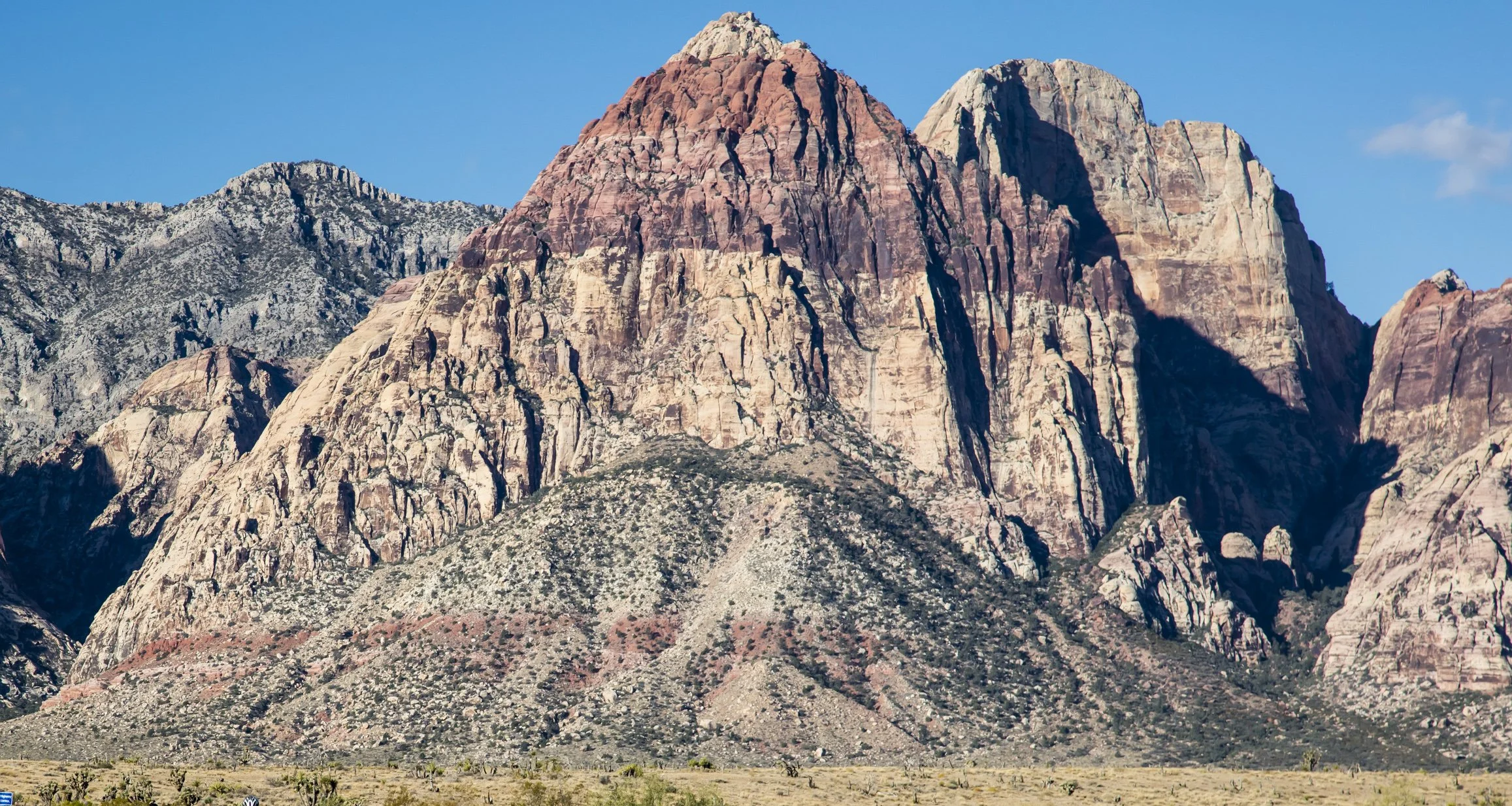
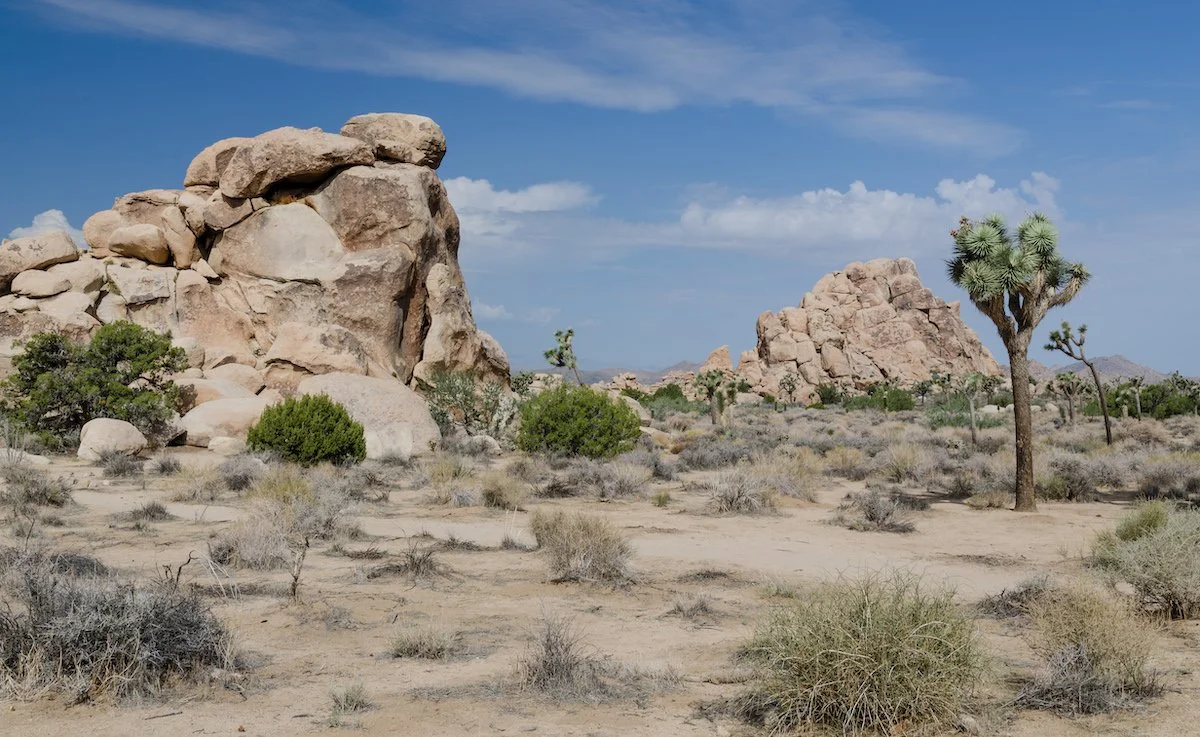
Red Rock Canyon lies just outside the Las Vegas metropolitan area. This proximity belies the remote wilderness setting in which rescues are often complex and hazardous. BLM Nevada.

Leader Fall on Rock | Protection Pulled Out

Red Rock Canyon National Conservation Area, Oak Creek Canyon, Black Orpheus Amphitheater

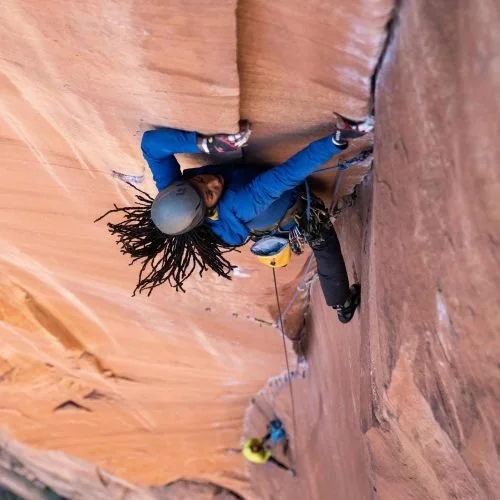
On November 10, I, Eric Chaudhary and a partner (male, 26) were climbing Marijuana (5 pitches, 11c) in the Black Orpheus Amphitheater. He was leading the second pitch (10b). It exits hard left off a hanging belay with one bolt for protection about six feet above and ten feet to the left of the belay. The route then cuts back right to a roof/bulge move where I believe he placed a BD #0.3 Z4 cam. 

He did the move, mantled up, and was getting his stance when his foot slipped and he fell. The piece in the roof ripped, causing him to fall about six feet directly onto the rope which was clipped to the first bolt. His ankle caught and flipped him aggressively. The first thing that struck the wall was his head. He was wearing a helmet. 

He was unconscious and was hanging upside down approximately ten feet to my left and four feet above me. I lowered him to a small ledge that flipped him upright. He was now level with me. I then tied off the rope and broke the belay. I called 911 (spotty reception) and relayed our location. I then yelled to a party of hiker/climbers at the base of the canyon. I informed them we needed helicopter rescue and that I was not sure if EMS had received my location.

I then attended to my partner and basically lassoed him with a coil of rope and pulled him to me at the belay. Around then he started regaining consciousness. I secured him to the anchor, untied him, and set-up a rappel. I rapped to the base of the first pitch with him attached to me. Luckily, we had twin 60m ropes. 

At the actual base of the climb there is one belay bolt, but unfortunately it was too high to utilize. I built a two-piece gear anchor to descend a 150-foot section of low 5th class slab that comprises the approach to the first pitch. As we were rappelling, a SAR member yelled from the base of the canyon. I told him my partner was in and out of consciousness and we needed helicopter rescue. I finished the rap to a large ledge system. Five minutes later a helicopter arrived. They flew out my partner, then returned for a SAR team member and myself. 


Video Analysis

Here's the scenario: Your climbing partner took a leader fall, they are unconscious, and unresponsive.

What do you do?

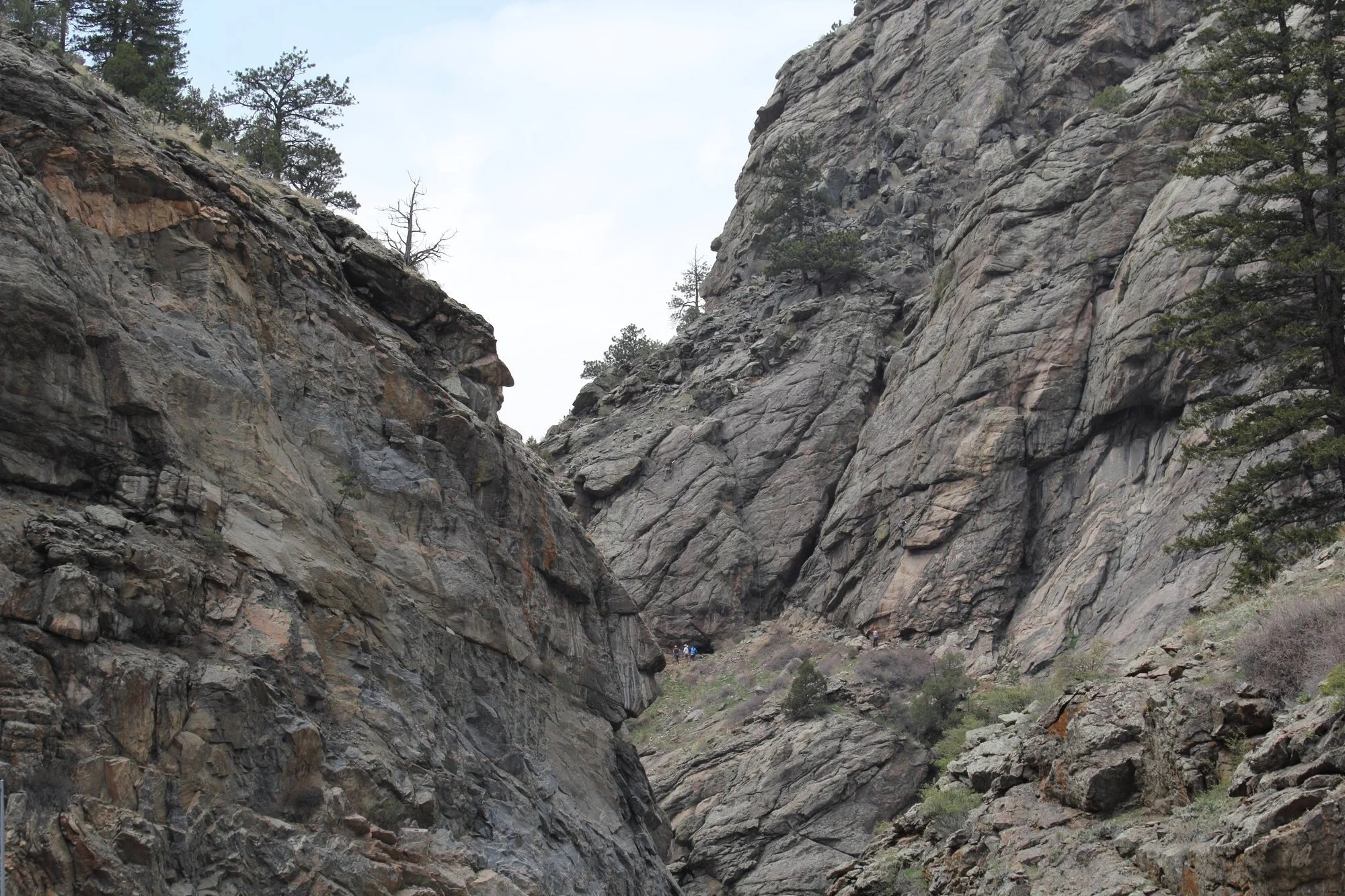
In this video, Jason Antin shows you ONE way to rescue an unconscious leader while on a multi-pitch climb. We recommend taking a course with an IFMGA/AMGA guide to learn more about rock rescue.

Credits:
Pete Takeda @pete_takeda, Editor of Accidents in North American Climbing; IFMGA/AMGA Guide Jason Antin; Producers: Shane Johnson and Sierra McGivney; Videographer: Foster Denney; Editor: Sierra McGivney; Location: Boulder Canyon, Boulder, CO

In this month’s featured accident, a climber was knocked unconscious while leading a second pitch. His partner swooped into action, effecting a self-rescue, and getting them both safely off the wall.

Jason and Pete are back to share knowledge about what to do if your leader is knocked unconscious.

Video Credits: Pete Takeda, Editor of Accidents in North American Climbing; IFMGA/AMGA Guide Jason Antin; Producers: Shane Johnson and Sierra McGivney; Videographer: Foster Denney; Editor: Sierra McGivney; Location: Boulder Canyon, Boulder, CO.


Analysis

I inspected the cam that blew, and it had a gouge in two of the lobes. The next party to climb the route retrieved our bail anchor. I was told that the spot where the piece had blown had no fresh scar. I’m still not sure why it didn't hold and hope to climb the route again to inspect it. (Source: Eric Chaudhary.) 

Editor’s Note: It was fortunate that Chaudhary was very competent and effected an efficient self-rescue. Had he not descended to a helicopter accessible area, the rescue might have taken many hours longer—sunset was 4:30 p.m. Though close to Las Vegas, Red Rock is a remote venue and climbers should consider carrying an emergency satellite communication device. 


The Prescription is Supported By:


Sign Up for AAC Emails

Undercover Crushers: Brother-Sister Duo Vasya and Nadya Vorotnikov

In this episode of Undercover Crushers, we talk to AAC members Vasya Vorotnikov and Nadya Vorotnikova about how exactly they crush so hard. While Vas isn’t totally undercover, he isn’t as well-known as he deserves. He’s a quiet phenom, having sent Jaws II in 2007 after the original climb Jaws, going at 14b, broke. The new version, Jaws II, was the second 5.15a in the United States. Nadya is likewise crushing, sending 5.14a a couple times in the last few years, and diving into route development in the South Platte of Colorado—one new climb that she contributed to, with her friend, Tal Wanish, is even featured in this year’s ACJ! In this discussion, the siblings describe learning to climb in Russia when they were little, immigrating to the United States and starting to compete in junior level competitions in the early 2000s, and what has shaped them into the climbers they are now.


We dive into sandbagging, breaththroughs, climbing as coping, coaching yourself, and being the kind of climbing partner that won’t bail—even when you end up climbing in a snow storm. Nadya shares about turning to trad climbing to push her mental limits, after being burnt out from competitions, and what motivates her to give back to the climbing community. Plus, Vasya describes his volume goal from last year, when he set the goal to climb 365 NEW routes 5.12s and harder, 100 new 5.13s and harder, and 10 new 5.14s and harder, all on outdoor rock. Turns out, he far surpassed his goal…


Introducing: The American Climbing Journal, with Editor Matt Samet

You’ve probably heard of Matt Samet—he’s a climbing lifer, and as a writer and editor in the climbing industry for 25+ years, he’s left his mark on climbing media. Recently, the AAC hired him to help create the all-new American Climbing Journal, a journal of record documenting the most significant climbs in rock climbing each year—with stories written almost entirely from the first person POV of the climbers themselves. For 97 years, we’ve documented the cutting-edge of alpine climbing in the AAJ, and it’s been high-time the AAC has done the same for bouldering, sport-climbing, single-pitch trad climbing, and performance big-wall ascents. The ACJ also includes profiles on new areas and major local ascents from all across the US and the world.


In this episode, we sit down with Matt Samet to chat about some of the behind the scenes secrets of creating the book, why it matters to have a collected “yearbook” of climbing when we have the internet, the fickle nature of recording climbing history as it happens, a sneak peek into the big ascents in the book, as well as a fairly long sidebar about AI. Dive in to nerd out about hard rock climbing.


Get your hands on the ACJ!

AAC members at the Partner, Leader, or Advocate level are eligible to get a copy of the ACJ as a member benefit! Keep your eyes peeled for AAC emails, so you can ensure you’re opted-in!

Not a member? Join or renew before July 1 to ensure you get this year’s copy!

Supporter level member? Upgrade by July 1 to get your copy.


The ACJ is Powered By:

The ACJ is Supported By:

A Tribute to Jim Whittaker

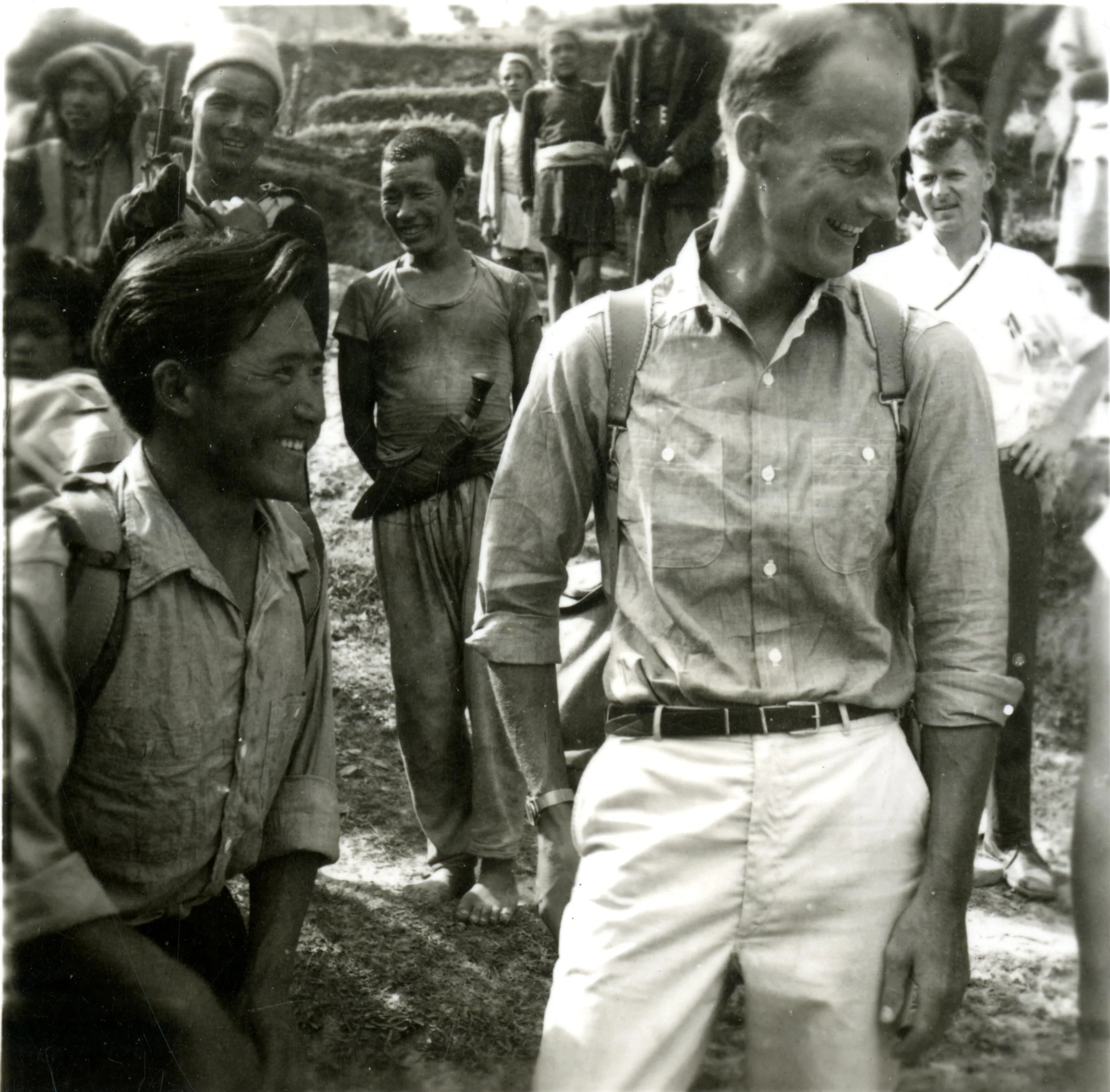
Jim Whittaker and summit partner Nawang Gombu Sherpa. Photo from Elizabeth Hawley Collection, American Alpine Club Library

We are saddened by the passing of mountaineering legend Jim Whittaker—a man who left an indelible mark on climbing history. “Big Jim” passed away on April 7, 2026, surrounded by his family. He was the 1,007th AAC member in the Club’s history (his twin brother Lou was the 1,008th)—and we are honored to have been a small part of Whittaker’s story. 

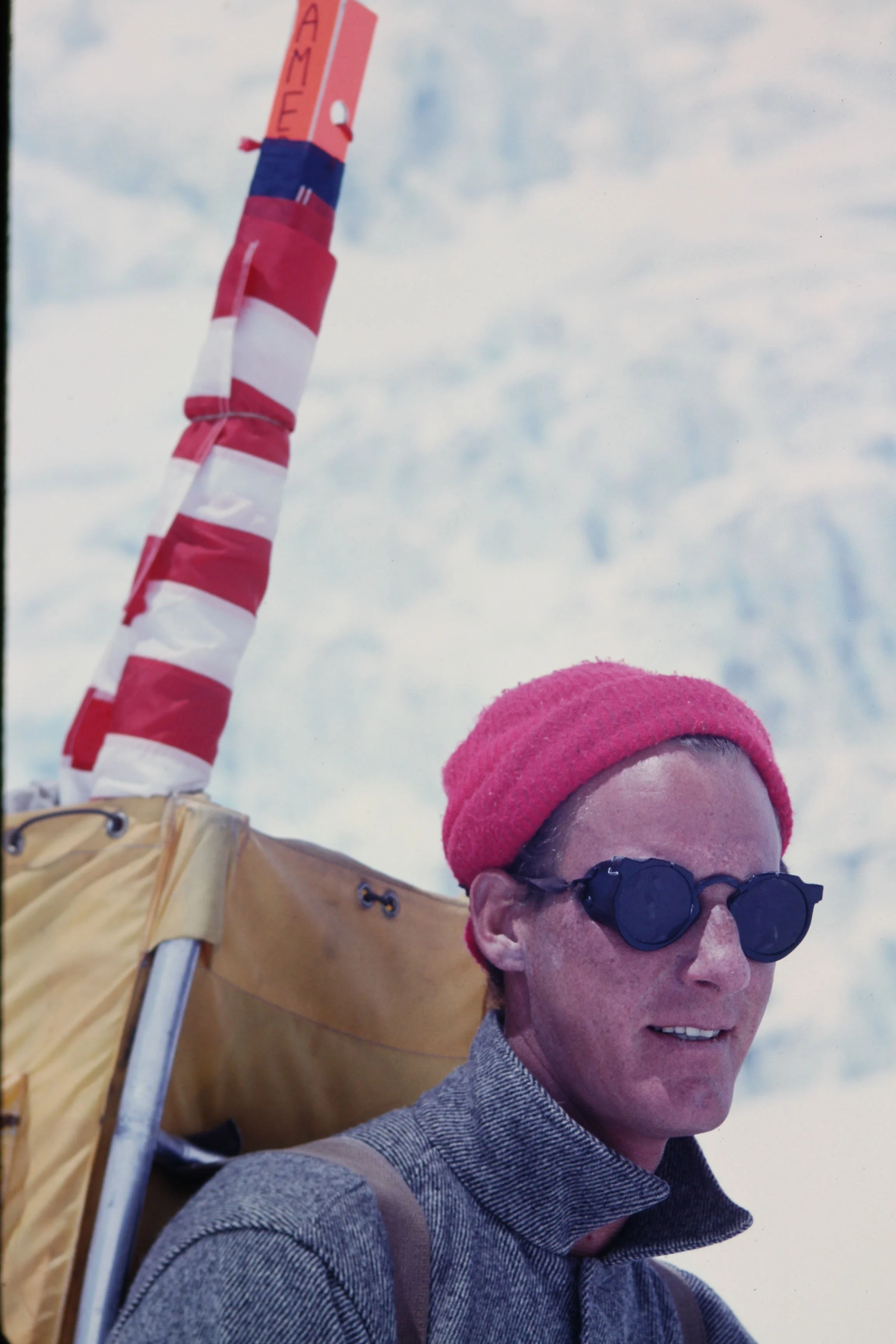
Jim Whittaker during the 1963 American Everest Expedition. Photo by James T. Lester, courtesy of the AAC Library

Jim Whittaker is famous for being the first American to summit Everest in 1963. In the 1964 edition of the American Alpine Journal, Willi Unsoeld wrote an account of the 1963 American Everest expedition, including the moment that Big Jim and Nawang Gombu left Camp VI that historic morning for their summit bid: “On the morning of May 1 there was a gigantic plume of snow directly above us, with Lhotse and Nuptse barely visible. Makalu was completely blotted out. After a quick breakfast—a cup of hot Jello per man—Big Jim and Gombu were on their way by 6:30.” Whittaker’s own personal experience of this epic moment of mountaineering history is told in far more detail elsewhere, but the AAJ account makes it clear that this was no stroll in the park. Whittaker and Gombu were hit by a storm on the south summit, and were initially lost and intimidated by the look of the steep final summit ridge before they eventually decided to continue. With the top in sight, they turned to each other, each offering for the other to go first, then “side by side they walked the last five feet. Beyond, everything fell away. They hugged each other, fighting to maintain their balance on the storm-swept summit of the world.”

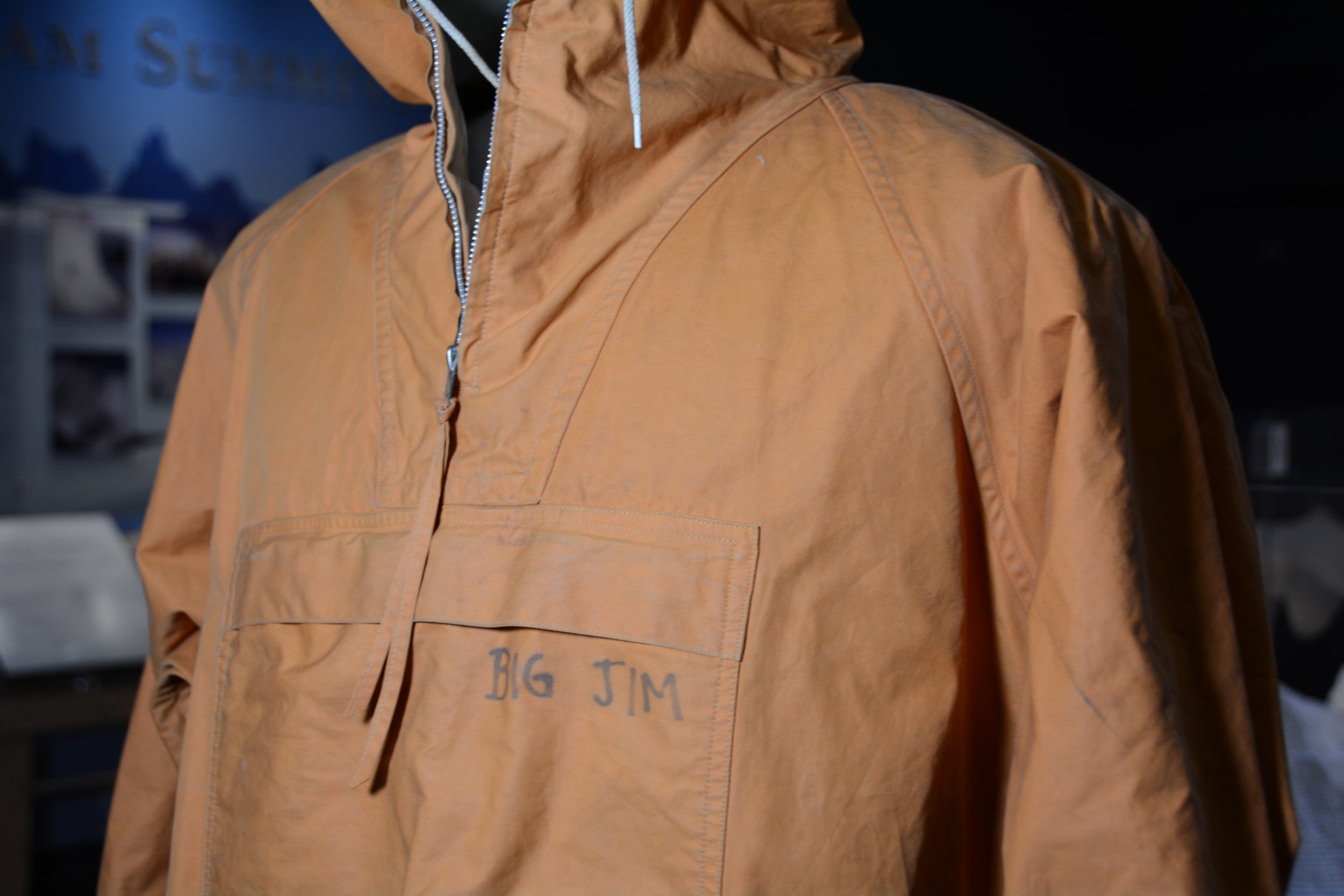
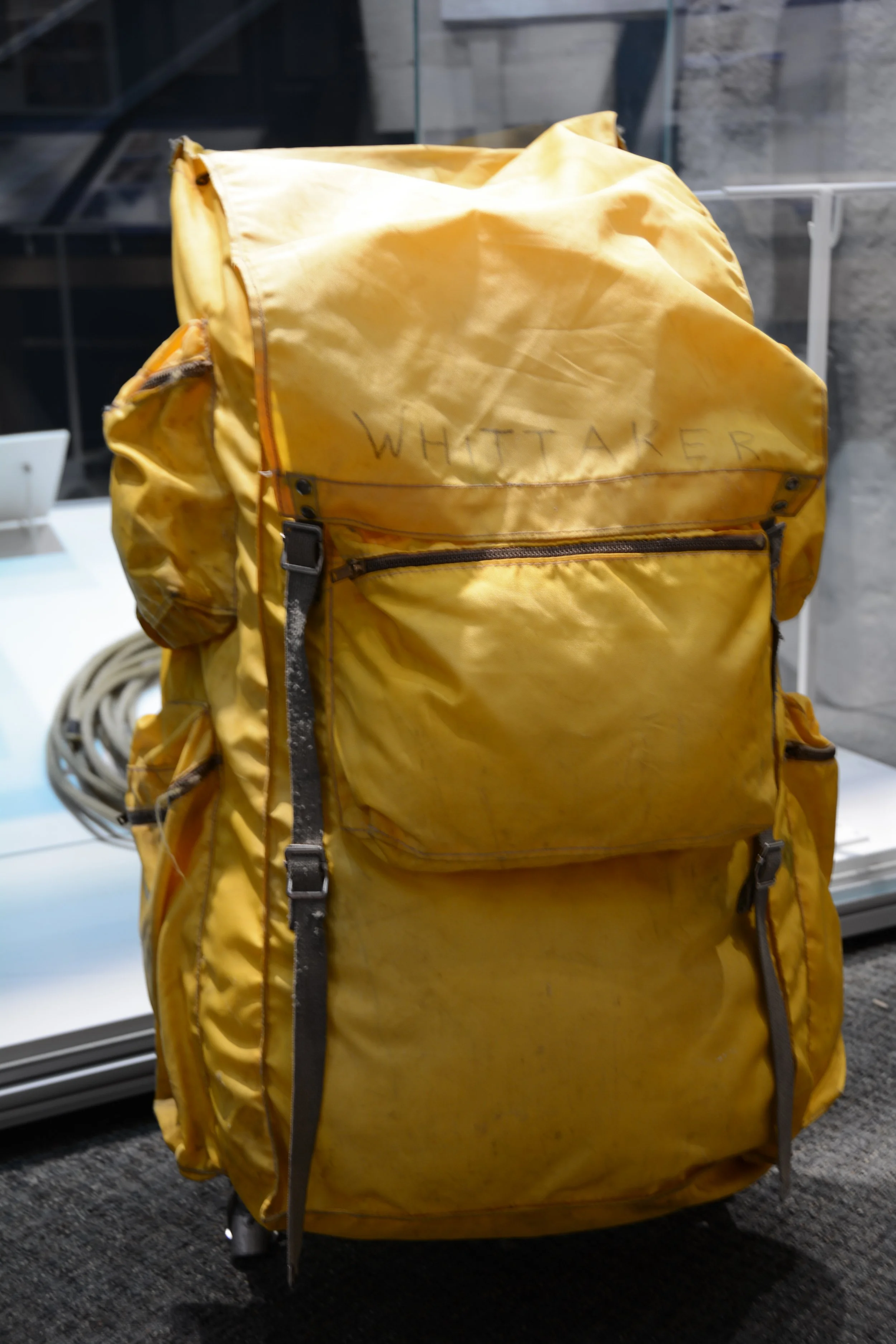
Some of Jim Whittaker’s gear from the 1963 Everest Expedition is housed in the American Alpine Club Library and Archives.

But even with the American flag planted on the summit, their trials weren’t over. Upon starting their descent, they both promptly ran out of oxygen, and not long after, a big cornice dissolved between the two men: “Big Jim found himself staring at Tibet below his feet!” But the descent was dire in other ways as well. As Unsoeld tells it, Whittaker “found it necessary to heed what would appear to be the highest call of nature in mountaineering history”—and right after getting back into his harness to follow Gombu, found himself slipping and hanging from the rope upside down. After a massive struggle to right himself, Whittaker and Gombu continued to suffer an agonizingly slow and painful descent, before they finally found their stashed oxygen, and the rest of the descent went smoother. The 1963 American Everest Expedition would put 4 more men on the summit—with two of those men accomplishing the first ascent of the West Ridge and the first traverse of the peak. 

Jim Whittaker’s pack from the 1963 American Everest Expedition. Hosed in the American Alpine Club Library and Archives.

Yet, Whittaker’s life was so much more than Everest. As Lou Reichardt wrote in a review of Whittaker’s memoir, A Life on the Edge: Memoirs of Everest and Beyond: “The book provides a view of a life well led by a mountaineer who has always stretched his own boundaries, has used fame wisely, has always been willing to take risks to advance good causes and has never lost his reverence for nature.”

In the AAC archives, you can find some of the lesser known stories from Whittaker’s life: his accident on Denali (Mt. McKinley) in 1961; his involvement in the first ascent of Canada’s Mt. Kennedy in 1966, which he climbed with his friend Bobby Kennedy (the expedition and ascent was made in honor of the recently assassinated President John F. Kennedy); his leadership on several tumultuous expeditions to K2, that ultimately resulted in the first successful American ascent, and third ever ascent, of K2, in 1978; and the Everest International Peace Climb which he initiated and led in 1991.

Many have noted that despite being devastated first by the assassination of JFK, and later the assassination of Bobby Kennedy, Jim Whittaker never lost his idealism and optimism. The Everest International Peace Climb is perhaps the clearest example of this. As he wrote for the AAJ in 1991: ”Our goal was to place three climbers, one from each country, on the top of the world. They would demonstrate that through friendship and cooperation high goals can be reached. We chose our enemies to climb with—the Soviets and the Chinese. This was before glasnost, before perestroika, before the Reagan-Gorbachev summit, before Gorbachev went to Beijing. We would hold the summit of all summit meetings, enemies becoming friends.”

Despite differences in tactics and strategies, and plenty of translation and communication issues, each team of climbers brought commitment to the effort, and as the leader, Whittaker helped build something extremely special: “a small city of mountaineers from three diverse cultures who would trust their lives to each other on the highest mountain on earth.”

As Whittaker wrote in summary, “We succeeded far beyond our wildest dreams: no deaths; 20 to the summit; first Soviet woman to the summit; second Chinese-Tibetan woman to the summit; five ascents without bottled oxygen; two tons of garbage removed from the mountain. To climb Everest is difficult. To do it with former enemies, through interpreters, and to place at least three of each country on the summit were said by many to be impossible.”

For Whittaker, mountains could be so much more than something to conquer. They are also a moving practice of trust, connection, grit, and hope. 

In Whittaker’s 1962 member application to the AAC, one of his recommenders, John S. Day, wrote: “If I were asked who taught me the most, and who inspired me the most in connection with mountaineering, my answer would be an unqualified ‘Louie and Jim Whittaker.’” Clearly, we are not alone in being moved by Big Jim’s vision of mountaineering. 

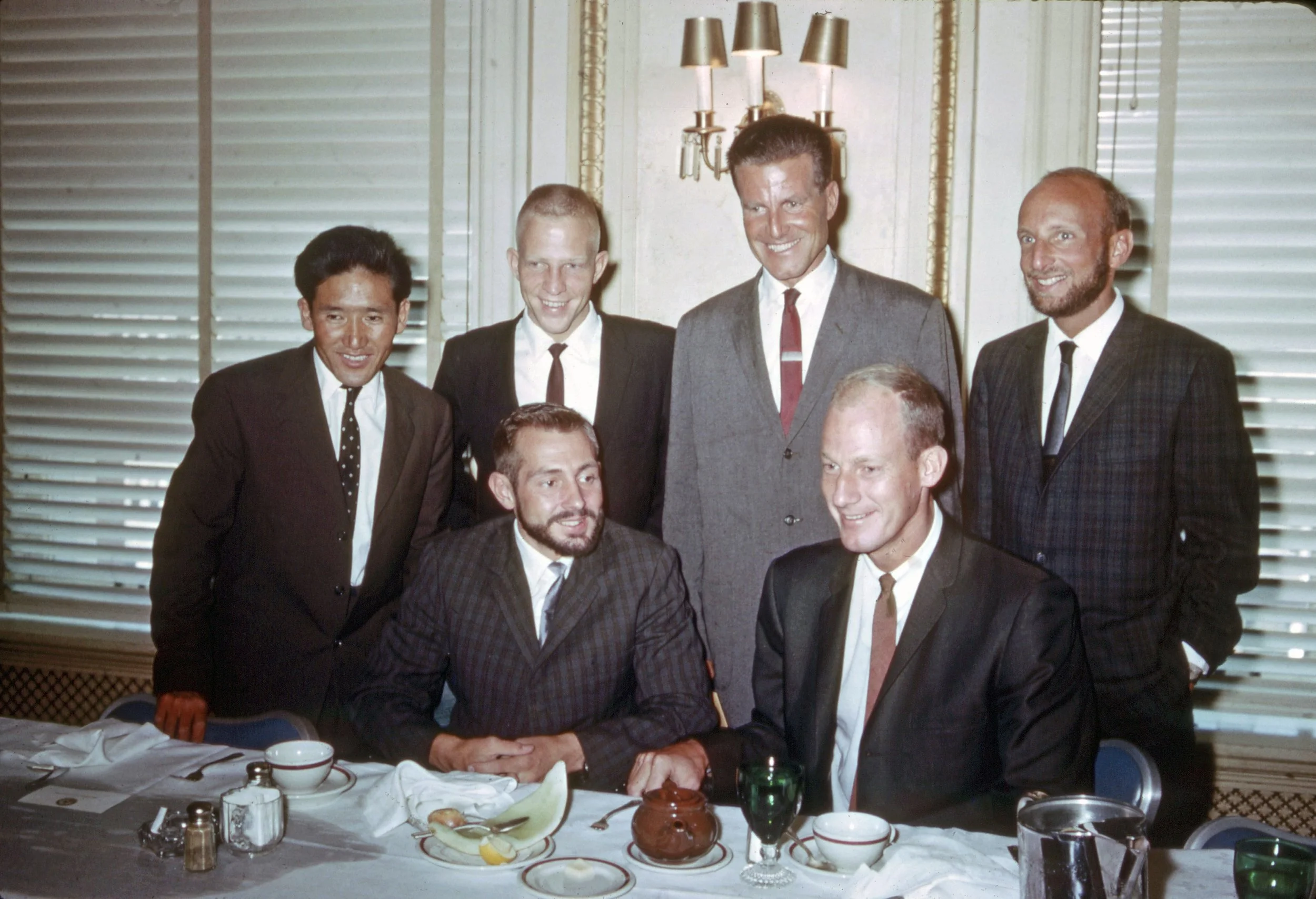
Team members from the 1963 American Everest Expedition who summited Everest, plus expedition leader Norman Dyhrenfurth. Willi Unsoeld, who also summited, is not pictured.
Back row: Nawang Gombu, Lute Jerstad, Norman Dyhrenfurth, Tom Hornbein; Seated: Barry Bishop and Jim Whittaker.

Photo by Barry Corbet, courtesy of the American Alpine Club Library


Want to learn more about Jim Whittaker? The American Alpine Club is proud to share a short Legacy Series film, historic 1964 article from the American Alpine Journal, and Legacy Series podcast to celebrate the spirit of exploration and community that Jim helped define:


Mentorship for the Next Level, with Sam Hennessey and Anne Gilbert Chase

What does it take to level up? The right mentor.


That’s why the AAC has started our Mentorship Program, beginning with the year-long Alpine Track. To kick things off, we had the cutting-edge alpinists coaching this year’s inaugural program, Sam Hennessey and Anne Gilbert Chase, on the podcast to dive into what the Alpine Track is, who it’s for, and why experienced climbers could benefit from such in-depth mentorship and technical field programs. This rigorous program makes the secrets of elite climbing accessible to climbers ready to push themselves. In this episode, Sam and Anne Gilbert dive into stories about their own epic adventures, what drives them to be a mentor, and what they wish they knew about the alpine environment when they were less experienced, as well as the details of the program and how you can apply.

Are you ready to level up? Discover the world of AAC Mentorship when you listen in.
***
You can apply to be a part of this small cohort of mentees from now until May 15, 2026. Learn more about the program schedule, requirements, and FAQs here.


The AAC Mentorship Program is presented by Arc'teryx.


The Prescription—April

It’s April, and the outdoor climbing season is in full swing. A lot of us will be rusty after the long winter, so now is a good time to get current on basic skills—like lowering. Lowering errors are a leading cause of climbing accidents: Each year we see multiple instances of lowers gone wrong, an unfortunate number of which result in fatalities.

Lowering is a frequent transition from ascent to descent. With lowering accidents, there are usually two main culprits: Either the rope is too short and/or there’s poor communication.

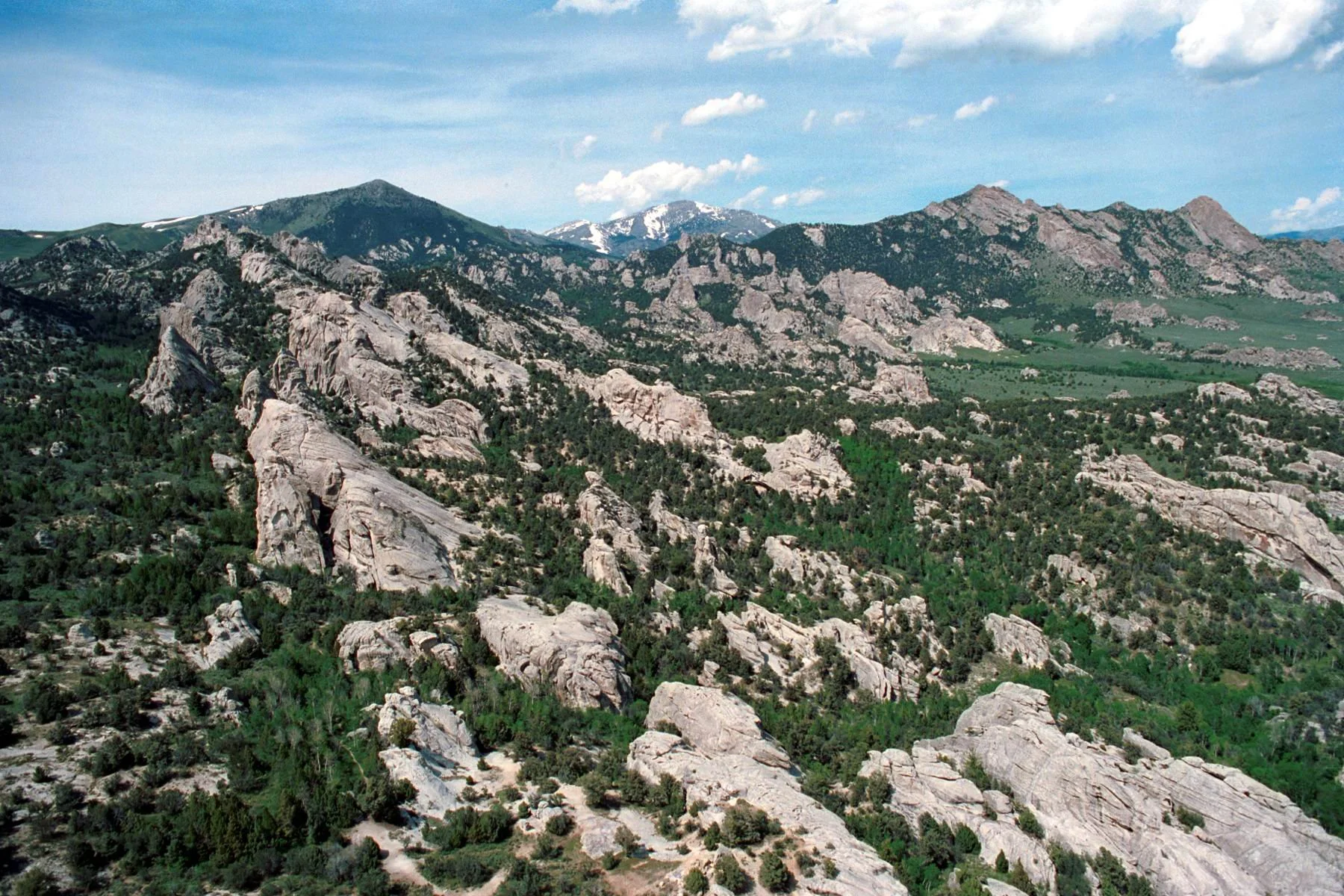
The City of Rocks National Reserve, Idaho, is home to hundreds of routes on beautiful, varnished granite. Some routes require a 70-meter rope to safely toprope or lower from the anchors. In May 2023, a climber was lowered off the end of the rope. He flipped upside down and suffered a fatal head injury. Photo by NPS.

Lowering Error | Rope Too Short, No Stopper Knot

City of Rocks National Reserve, Idaho, Super Hits Wall

On May 26, 2023, Brock Anderson and his family witnessed a tragic accident on the Super Hits Wall at the City of Rocks. They were sharing laps on two climbs with another married couple when a group of four young men joined their group. Anderson wrote to ANAC:

The climbers had general knowledge of the area, but very little beta and no guidebook. We helped them identify the routes. One of the young climbers, Kyle Melby (22), led Twist and Crawl (5.8). My son was reading a book directly under the route as we began wrapping things up. I had a premonition, just an inkling that [my son] wasn't in a safe place. I asked him to move 50 feet over to a shaded boulder. I thought nothing of it, just did a Dad-instinct thing. 

Kyle was finishing Twist and Crawl, and the two others were preparing to climb Mystery Achievement (5.7), as our group packed up and headed to the car. We were about 60 seconds down the trail when we heard Kyle fall and impact the rock. He had been lowered off the end of his rope. While we didn't see the fall, we understand that he fell feet-first onto a flake near the bottom. He landed, tilted backward, and impacted the back left side of his head, crushing his helmet and sustaining a horrible head injury. The total fall was about 35 feet. 

I ran to my truck and grabbed my trauma kit, along with a Garmin inReach. We were able to stop the bleeding fairly quickly, conduct a visual inspection, do a C-spine assessment, and get an SOS out. 

It was miraculous that Kyle’s only injury appeared to be his head wound. He was belligerent and disoriented (often the case with head injuries). With the help of several other trained first responders, we were able to calm him somewhat, but we couldn't keep him still. Within the hour, a helicopter was on the ground at Bread Loaves and several local agencies were on the scene. They helped transport Kyle via backboard to my truck and up the road to the helicopter. Kyle was flown to Pocatello. We believed he would be fine, but two days later he died from his injuries. 

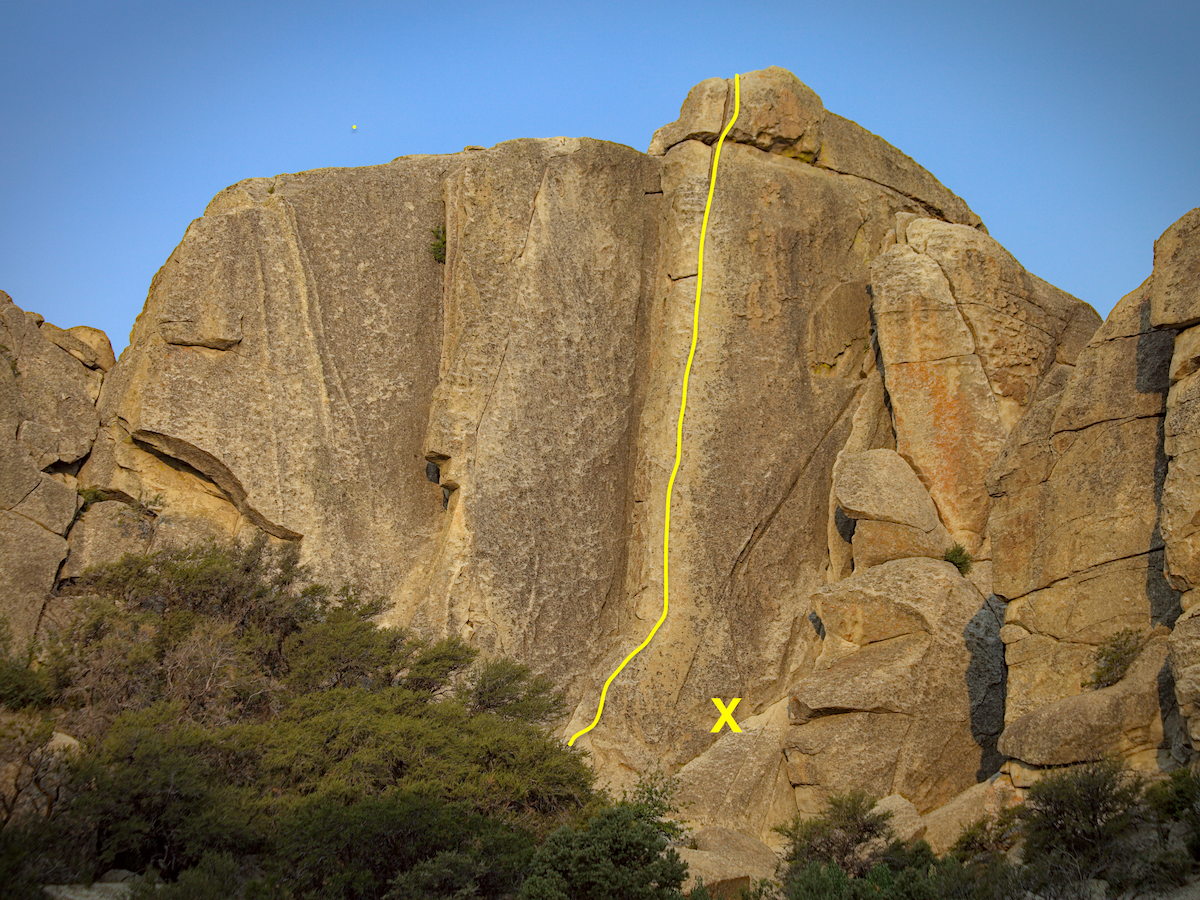
The Super Hits Wall at City of Rocks. The climber was lowering from Twist and Crawl (yellow line) and fell after the end of his rope slipped through his partner’s belay device. His feet struck a large flake near the route’s base (yellow X). That impact flipped him upside down, resulting in a head injury that would ultimately prove fatal. Photo by Camdon Kay.


Analysis

Lowering accidents are all too frequent. Twist and Crawl is 33 meters long and thus requires a 70-meter rope to allow an uninterrupted lower while retaining a reasonable margin of safety. A rough calculation, factoring in the length of route, length of fall, and rope stretch, indicates that Melby was most likely being lowered on a rope between 50 and 60 meters in length.

Anderson, a licensed raft guide, provided these recommendations after the accident:

  • Keep a closed system. Use a stopper knot at the end of your rope.

  • Speak out if you see an error. I wish I had said something. Some climbers may take offense or feel like you’re imposing on their experience, but it is worth going the extra mile. My premonition to move my son from the fall area could have included a friendly question about whether Kyle’s party knew the route was long and that a 60-meter rope might not be enough. 

  • Learn about where you are climbing. Nuances like long ropes being standard at the City are important details.

(Source: Brock Anderson.)


Video Analysis

Learn how to avoid this lowering error.

Jason Antin and Pete Takeda are back to explain how to avoid lowering off the end of your rope.

The biggest takeaway? When you’re out climbing, close your system, and try to keep your eye on the length of the lower.

Credits: Pete Takeda, Editor of Accidents in North American Climbing; IFMGA/AMGA Guide Jason Antin; Producers: Shane Johnson and Sierra McGivney; Videographer: Foster Denney; Editor: Sierra McGivney; Location: Accessibility Crag, Clear Creek Canyon, Golden, CO


2025 Accidents in North American Climbing Chinese Translation

The 2025 ANAC has been translated into Chinese by a group of climbers who have produced a limited print version. Youqing Huang, part of a volunteer team in Beijing, met with ANAC Editor Pete Takeda in Salt Lake City. Said Huang, “It is with genuine enthusiasm and a shared commitment to climbing safety that we have brought this project to fruition. We look forward to continuing our work with the American Alpine Club in the years to come.”

This is a private volunteer initiative; you will be able to access a copy through the AAC Library.


Sign Up for AAC Emails

Tuolomne Adventures with the Rooting Souls Team: A Story From the Catalyst Grant

Zivia, Sof, and Rosemary on the Summit of Matthes Crest. PC: Miya Tsudome

By: Zivia Berkowitz

In August of 2021, I did a three-week backpacking trip on the Sierra High Route. Over the course of the expedition, we went up and down countless passes, and I stared in wonder at the sheer granite peaks of the Sierra Nevada. I had never led a trad climb or done any alpine climbing. On the trip, I made a promise to myself that my return to the Sierra High Country would be for a rock climbing trip. 

Sof and Zivia on the summit of Cathedral Peak. PC: Emmie Snead

My name is Zivia Berkowitz. I’m a climber and outdoor educator based in central Wyoming, and for the past two years, I’ve been working with a handful of close friends on a passion project—a documentary film called Rooting Souls. Rooting Souls is an expression of my desire, as a Black queer woman climber, to explore themes of community, connection, and sense of place through the trials and tribulations of expedition rock climbing. To achieve this goal, I am leading an expedition with Sof Petros and Rosemary Saal to climb the North Face Standard Route of Batian Peak (17,054 ft) on Mt. Kenya in September 2026, as a self-sufficient team of Black womxn climbers. 

Climbing a 22-pitch, 2,600ft technical rock route at altitude requires us to train individually but also to gain experience climbing together as a team. This August, the Rooting Souls climbing team received a Catalyst Grant from the American Alpine Club to go on a training trip in Tuolumne Meadows to sharpen our trad/alpine multi-pitch skills. I’m excited to share what we did on our training trip in the trip report below.


Day 1 (8/30/25): After 12 hours of driving from my home in Lander, WY, I finally arrived in Bishop, California, buzzing with excitement to see my friends and climbing partners for the week. We all trickled into Bishop from various parts of the country. I drove from Wyoming, Sof flew from Seattle to Sacramento to meet Rosemary, and together they drove down to Bishop. Chey flew from Denver to Vegas and then rented a car and drove the rest of the way to Bishop. 

Between the giggles and gossip that come with friends reuniting after many months, we spent the evening grocery shopping, going over final logistics and plans with Jazz and Miya (who joined to help us document this trip), and making sure we had everything we needed to drive into Tuolumne Meadows the following morning. 

Day 2 (8/31/25): We departed Bishop around 8 a.m. and drove to Tioga Lake just outside of the Yosemite National Park entrance. We set up camp at the Tioga Lake Campground, fortuitously securing a spot in the campground just as the previous campers were packing up to leave. After camp was set up, we took time to recuperate from our extended travels, basking in the sun, jumping in the lake, and filming interviews. Restored by the downtime, we drove to Puppy Dome for the afternoon. At Puppy Dome, we experimented and refined our systems for traveling in low 5th-class terrain as a team (in anticipation of the following day's objectives). We caught a beautiful sunset at Puppy Dome before heading back to camp for dinner. The rest of the evening was spent preparing for our ascent of Matthes Crest the following day.

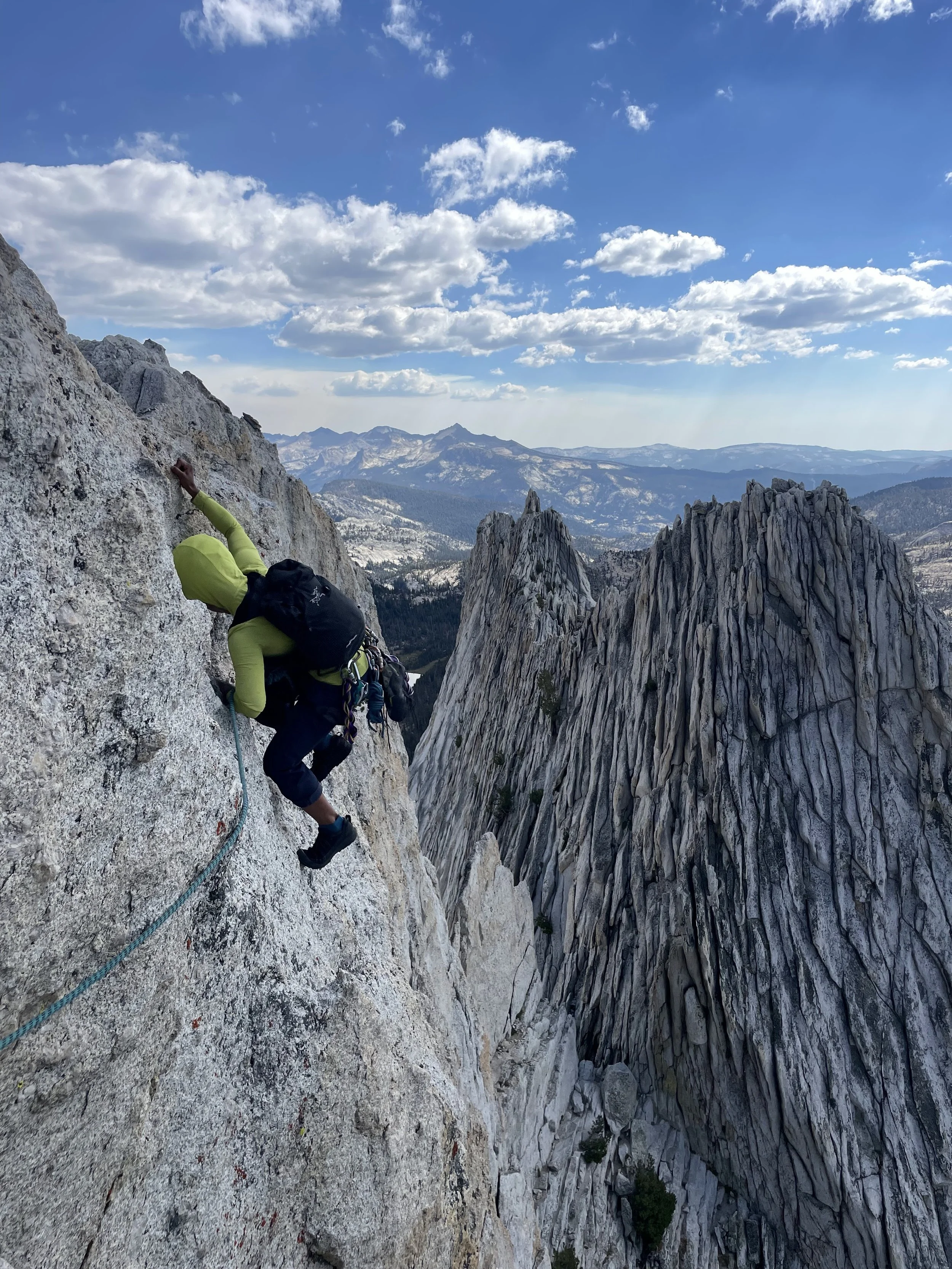
Sof leading on Matthes Crest. PC: Zivia Berkowitz

Day 3 (9/1/25): By 5:15 a.m, wheels were rolling, and we were on our way to the Cathedral Lakes Trailhead. We met up with Miya Tsudome and Gerry Egbalic, who were going to climb the objective ahead of us and help us document our time on the Crest. By 6:30 a.m., after some minor parking lot chaos, we began the approach to Matthes Crest. Approaching Matthes requires approximately three miles of hiking on trails, followed by another three miles off-trail with 1,700 ft of elevation gain. We reached the southern terminus of Matthes Crest just after 9:30 a.m. and began racking up in anticipation of our climb. There was one party ahead of us, and once they completed the first pitch, we began climbing. We pitched out the steeper terrain until we gained the ridge of Matthes. Once on the ridge, we simul-climbed most of the way. Sof and I took turns leading in blocks. This was my first time simul climbing, it was super valuable for me to practice simul-climbing in real time since it is a technique we are planning to use on Mt. Kenya. We reached our high point of the day on the North summit of Matthes (10,923 ft) around 3 p.m. At approximately 7 p.m, nearly nine hours after we started climbing, we completed our final downclimb of the day–we scrambled down off the ridge of Matthes back to the ground in the last light of the day. The apocalyptically vibrant and smoky sunset offered us a moment of reverence and awe for the beauty and power of the natural world. Once we were all on the ground, we took a beat to eat some food, reset, and begin our long walk back to the trailhead. We reached the trailhead just after 10 p.m., exhausted and elated by such a long and rewarding day in the High Sierra. 

Day 4 (9/2/25): We had a slow morning after our 16+ hour moving day on Matthes. We carved out time to debrief and process our ascent. In our debrief, we discussed what went well, what challenged us, and how we can apply our learnings on Matthes Crest to Mt. Kenya and other future objectives. Rain was forecasted for the afternoon and evening, so we thought it best to use the day as a rest day.  

Rosemary on lead. PC: Russell Woo

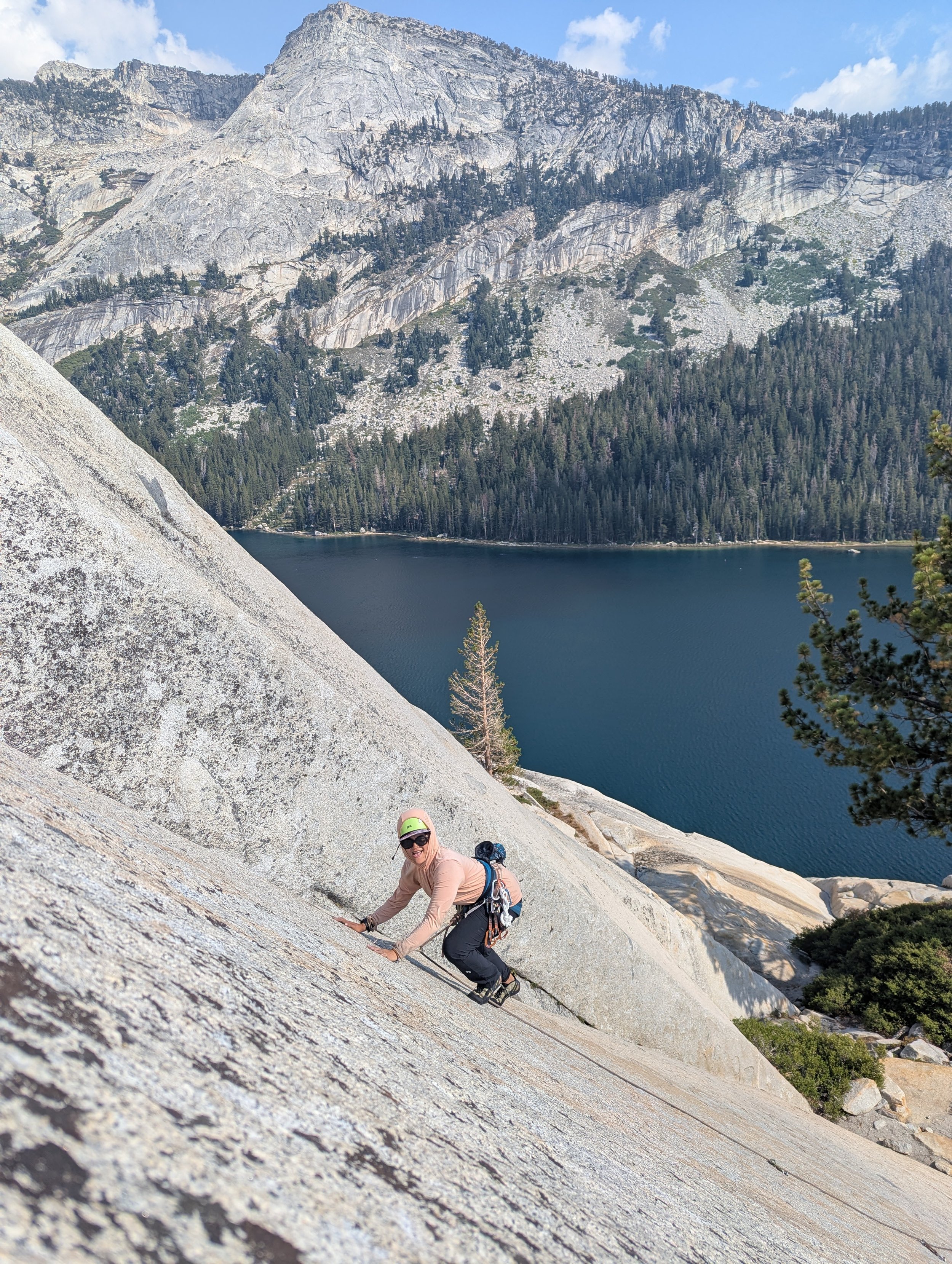
Day 5 (9/3/25): The forecast remained poor (significant afternoon precipitation). While we would’ve liked to climb another longer multipitch, the threat of aforementioned rain forced us to be flexible. As our time together is both precious and limited, we decided to see what we could climb. We compromised by choosing to attempt some lower-commitment routes at Stately Pleasure Dome. We went up Jabberwalky (5.5, 2 pitches) and Aoxomoxoa (5.5, 2 pitches), which proved more complex thanks to some chopped bolts. For me, the highlight of the day was when Rosemary came out of a lead climbing hiatus as she glided up Turkey Trot (5.8). Rosemary climbed with confidence and precision on the delicate slab, Tenaya Lake sparkling behind her. We all cheered with joy as Rosemary reached the anchor.

Day 6 (9/4/25): The weather cleared, and we were able to fit in one more day in the alpine. We chose to climb another Eastern Sierra classic, the Southeast Buttress of Cathedral Peak and Eichhorn Pinnacle. We began our approach at the Cathedral Lakes Trailhead around 7:15 a.m and reached the base of Cathedral Peak to begin our ascent around 9 a.m. We were familiar with most of the approach from our day on Matthes (although somehow that didn’t prevent us from walking in the wrong direction for a number of minutes). We simul-climbed most of Cathedral Peak, swapping leads, and summiting around 1 p.m. After descending the summit of Cathedral Peak, we traversed our way to the base of Eichorn Pinnacle for our last pitch and final summit of the trip. From the summit of Eichorn, we rappelled to the base of the pinnacle, then hiked to the Cathedral Peak walk-off. Once we were back at the base of Cathedral Peak, we started hiking back to the parking lot (with no misnavigations!). We were back to our vehicles before sunset, around 6 p.m. 

Day 7(9/5/25): We packed up camp in the morning and departed Tuolumne Meadows. On our drive to Bishop, we savored our final moments of the trip, exchanging music recommendations and reminiscing on our time together. At the Bishop Airport, we said our goodbyes, marking the end of a fruitful and memorable trip. Rosemary and I continued driving back to our respective homes thereafter. 


Rosemary and Sof at an anchor on Stately Pleasure Dome. PC: Zivia Berkowitz.

This grant was quite literally the catalyst for an incredible climbing trip. There are so few Black women climbing traditional alpine style routes, and we come from and live in so many different places! Finding the resources and time to come together is often a challenge. It was a gift to climb historic routes like Matthes Crest and Cathedral Peak as a team. This group of people, the intentions we set to build our skills as alpinists, push ourselves, support each other, and have a blast while doing so, was soul-filling and inspiring.

On a practical level, we practiced new systems on lower 5th-class terrain and gained valuable experience and insights into how we can move as efficiently as possible in exposed, technical terrain. 

Descending Matthes Crest while the sunset glowed red on the horizon, with a team of fellow Black women climber baddies and the friends supporting us, instilled in me a deep sense of gratitude.  

As Black women alpinists, we are often isolated in our experiences. Through the Catalyst Grant, we grew and learned together. On this trip, community and affinity were sources of boundless motivation and inspiration. Our time together in the High Sierra offered opportunities for growth as a climbing team with an abundance of dreams and bigger objectives ahead. 

Learn more about Rooting Souls, support the project, and stay up to date with our antics at rootingsouls.net and @rootingsouls on Instagram. Thanks to the American Alpine Club and The Catalyst Grant for the support! 


The Catalyst Grant is supported by:


The American Alpine Club Announces 2026 McNeill-Nott Winners

March 2026

The American Alpine Club (AAC) and Mountain Hardwear are excited to announce the 2026 McNeill-Nott recipients. The unexpected loss of Sue Nott and her climbing partner, Karen McNeill, on the Infinite Spur (5.9 M5 AI4) on Sultana (Mt. Foraker) in 2006 prompted the AAC to partner with Mountain Hardwear to establish the McNeill-Nott Award in their memory. Nott and McNeill were two accomplished alpinists who pushed the sport. Among many other accomplishments, in 2004, they were the first all-female team to summit Denali's Cassin Ridge (5.8 WI4) despite harsh weather conditions that grounded almost all other teams, an AWOL crampon, running out of food, and being caught in a small wind slab avalanche. We seek to preserve the spirit of these two talented and courageous climbers by giving this grant to amateur female climbers exploring new routes or unclimbed peaks with small teams.


Allie Oaks will receive $3,500 to attempt an unclimbed buttress on a peak in the Damodar Himal subrange of the Himalaya in Nepal. After examination of the available pictures and reading through previous trip reports, their intended route will require remote international travel, multiple days of trekking to a distant valley, engaging glaciers, alpine ice, snow travel at high altitude, technical mixed climbing, navigation of exposed ridgelines, and overnight bivies. Oaks and Suzanna Lourie are grateful for the opportunity to carry forward the curiosity and intrepid spirit of Sue Nott and Karen McNeill. 

Allie Oaks and Suzanna Lourie


Rell Lennox will receive $3,500 to attempt an unclimbed line in the Cochamó Valley, Chile. Lennox previously spent five weeks in the Valley exploring the area to find potential new routes and taking the time to climb the classics. Lennox will be returning to the valley with Flavie Cardinal, their gaze set on a clean and splitter unclimbed line.


Applications for the McNeill-Nott Award are accepted each year from October 1 through December 31.


Contact:

Berkeley Anderson, Director of Grants and Community Support: [email protected]


Powered by:

About Mountain Hardwear

Mountain Hardwear, Inc., was founded in 1993 and is based in Richmond, CA. We exist to encourage and equip people to seek a wilder path in life. For 30 years, we’ve built essential equipment for climbers, mountaineers, and outdoor athletes and have supported expeditions on the world’s highest peaks. Relentless precision continues to inspire everything we do — our designers sweat every stitch and detail to continuously improve function, durability, and comfort. Mountain Hardwear is a wholly-owned subsidiary of Columbia Sportswear Company that distributes its products through specialty outdoor retailers in the United States and 34 countries worldwide. www.mountainhardwear.com


About the American Alpine Club

Founded in 1902, the American Alpine Club (AAC) is committed to providing climbers with resources that advance knowledge, inspiration, and advocacy. Through our rescue benefit and medical expense coverage, climbing and grief grants, campgrounds, and discounts, we are committed to empowering our members. We share knowledge and inspiration through the American Alpine Journal, Accidents in North American Climbing, and preserving climbing history in the AAC Library and Archives. Finally, we advocate for our members and the places we climb by breaking down barriers to climbing and seeking to preserve our climbing landscapes and public lands nationally and locally. At the AAC, we are connected through our passion for climbing. United We Climb.


Austin Mallet's Secrets to Building Momentum

The AAC has launched a new grant, called the Momentum Grant, to fund intermediate to advanced alpine adventures, with a focus on ice, mixed, rock, and ski-alpinist objectives. The Momentum grant is in partnership with the family of Austin Mallet, in honor of Austin. Austin was a Texas native who developed a deep passion for big mountain objectives, but whose time was cut short by a tragic avalanche in 2024.

 Austin approached climbing with incredible discipline and sought to grow his skillset and develop his mountain craft at every opportunity. The Momentum Grant will preserve Austin’s spirit by supporting the projects of passionate climbers seeking to elevate their skills in big mountain environments. 

To get applicants inspired by Austin’s story, and to share about the kinds of projects the grant funds, we had some of Austin’s closest friends on the podcast, to share stories of his adventures and mountain philosophy. In this episode, we hear memories from his partner, Emily McKay, and two of his close climbing friends, Chris Labosky and Aiden Whitelaw. We explore Austin’s never-ending psych for adventure, his dialed planning methods, his generosity, his deep belief in his climbing partners, and much more. Dive in to get inspired by Austin’s legacy, and dream up your application for the Momentum Grant. Applications close April 30, 2026. 

Photos provided by Emily McKay and Chris Labosky.


The Steck-Salathé on Yosemite’s Sentinel Rock

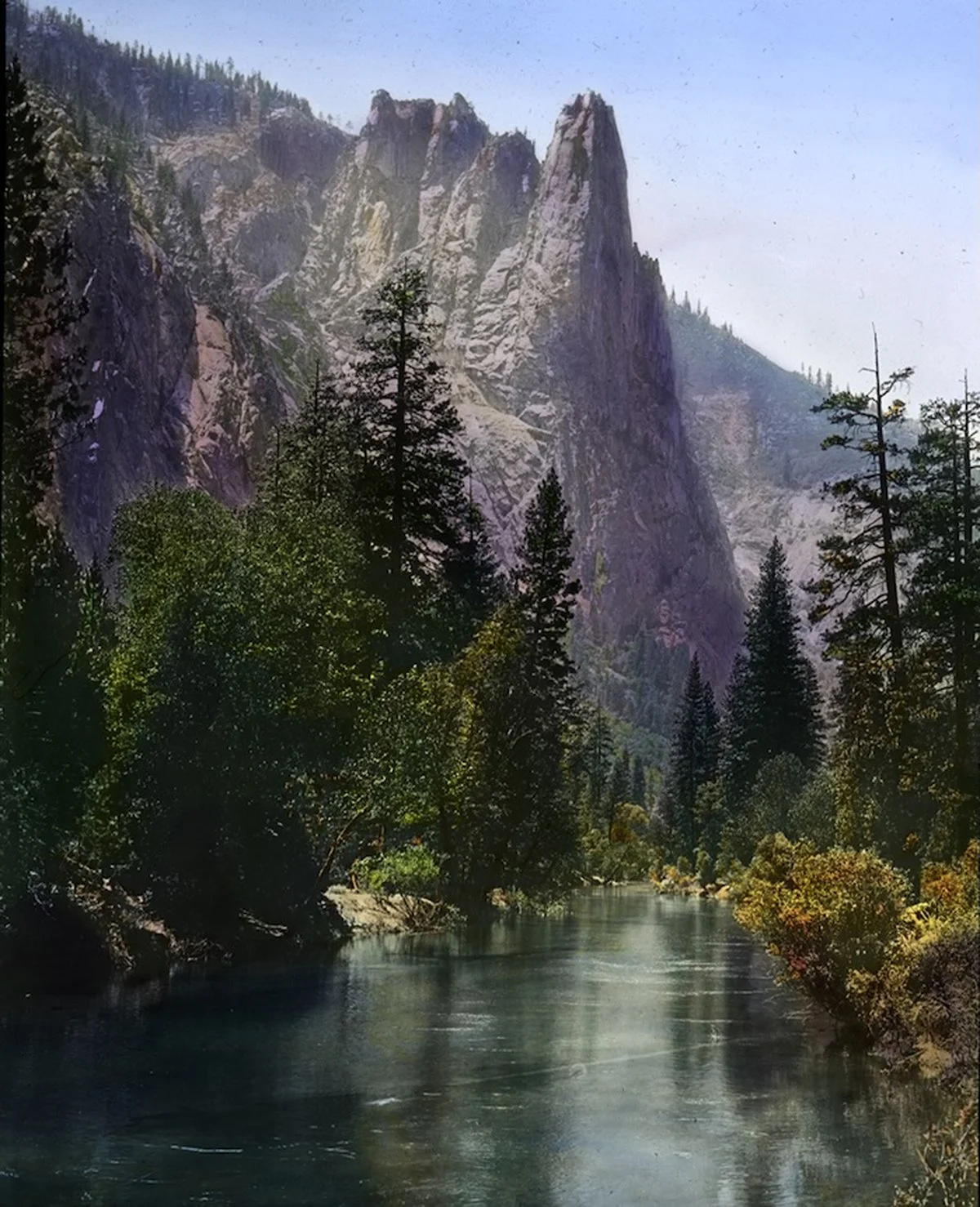
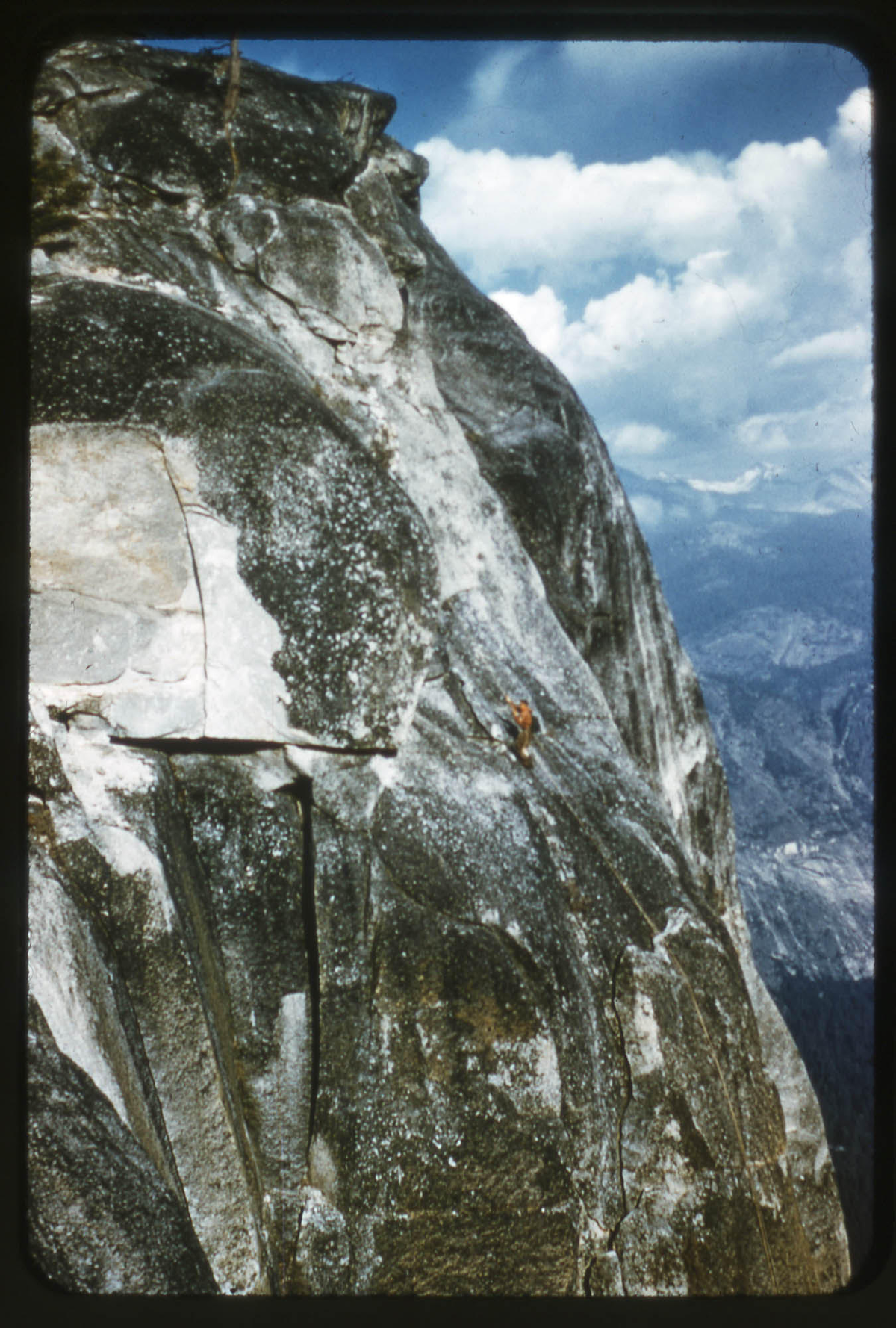
Sentinel Rock circa 1916. Photo provided by Mountain Views Collection.

By Sierra McGivney, with research and imagery support by the AAC Library.

Originally Published in Guidebook XVII.

A lone blacksmith gazed out his window one morning in 1945. He felt awful. After 13 years of working away in his San Mateo, California, forge, located on Highway 101, his health had begun to decline. He watched as a cow and its calf grazed peacefully in a field.

“John, look at those healthy animals. They eat grass, not meat. You eat meat, and you are always feeling sick,” said the voice of an angel.

The angel and the blacksmith conversed a while more. Suddenly, it all clicked for the blacksmith: Vegetarianism was the answer to his problems. Little did John Salathé, the blacksmith, know that his sickness and this moment would propel him toward the tall granite walls of Yosemite, solidifying his spot in climbing history.

Salathé was an immigrant from Switzerland who headed westward, landing first in Montreal, where he met and married Ida Schenk. He then immigrated to the U.S., settling near the Bay Area. There, he opened up Peninsula Wrought Iron Works, his blacksmith shop. He was described as lean and ruddy, and spoke with a thick Swiss accent.

Once Salathé began to fall ill, doctors recommended that he spend time in the Sierra Nevada, where he learned about the Sierra Club. In the fall of 1945, Salathé joined the Sierra Club on a climbing outing at Hunters’ Hill near Vallejo, California. Robin Hansen led a complex and exposed pitch of climbing. He called down to Salathé to “climb freely.” Hansen tugged on the rope but felt no movement or weight. After two or three minutes, Salathé appeared from around the corner unroped because he thought that to climb freely was to free solo. This was the beginning of many instances in which Salathé scared his climbing partner by being extremely bold.

“Height had no meaning to John, and to him fear was a stranger,” wrote Hansen in his tribute to Salathé in the 1994 AAJ.

Salathé started to feel physically better, between his newfound vegetarianism and passion for climbing. Naturally, Salathé was drawn to Yosemite. At 46, he quickly picked up the basics of climbing but was not the most agile; therefore, he leaned into the technical aspects of climbing that were then evolving in the Valley.

Piton technology, when Salathé started climbing, was subpar, so he decided to forge his own. Most pitons at the time were malleable steel pitons, bought at the army surplus store or imported from Europe. They worked great in parallel-sided cracks, but most cracks are irregular along the edges and in the back—the pitons pounded into these fissures tended to get stuck, and if they were removed, they were often too damaged to be reused. Salathé’s high-strength carbon steel pins were far tougher than the European pitons of the day. On each, he added a P inside a diamond, the logo of his blacksmith shop. He could make them big, small, wide, narrow, or long, for the type of cracks he encountered on various climbs.

In 1946, Salathé convinced his friend John Thune to climb the Lost Arrow Tip with him.“I have found a rock in Yosemite that has never been climbed. It is an easy one,” he told Thune. The Lost Arrow Tip is a 250-foot formation, now classified as Grade III, 5.7 C2— not an easy climb, then or now.

Thune, less experienced than Salathé, was the belayer. As Thune stood in the Arrow Notch, belaying, he watched as Salathé’s first piton, of his own making, popped out, and Salathé went for a ride into the void.

“Slowly, John worked his way back to the notch and said with a smile, ‘Well, we start over again.’ He had little fear of high places. I did the shaking for him,” Thune later said.

They got about 30 to 50 feet from the summit, but darkness was approaching, so they retreated. Competition was stiff in the Valley. Unfortunately, another group—the foursome of Robin Hansen, Anton (Ax) Nelson, Fritz Lippmann, and Jack Arnold—just days later got to the summit first by lassoing the Arrow Tip from across the rim. Salathé later told Steve Roper in all seriousness that this competing team had enjoyed “the help of the devil.”

Later that year, Salathé and Ax Nelson climbed the Southwest Face of Half Dome (800’, 7 pitches, Grade IV) in Yosemite. They bivouacked and placed 150 pitons as they ascended, both a first for Yosemite. According to Roper’s Camp 4: Recollections of a Yosemite Rockclimber, for the next year, this stood as the hardest rock climb in the United States, until Salathé and Nelson climbed the Lost Arrow Chimney (1,100’, 10 pitches, IV 5.10a) in 1947. It was the most challenging climb at the time and the first successful big-wall ascent in the United States, done in a single push that took the two men five days and five nights. The sun was rising on the golden age of climbing in Yosemite.

On January 20, 1950, Salathé filed for American Alpine Club membership, backed by Oscar A. Cook and seconded by Richard C. Houston. Allen Steck, a newcomer rising in the Valley after returning home from World War II, had his AAC membership proposal published in the January 10, 1950, list, which Houston also seconded. Both of their climbing résumés were long, but there was something just beyond the horizon waiting for them. It would become one of the greatest climbs in North America: the Steck-Salathé (15 pitches, V 5.10-) on Sentinel Rock.

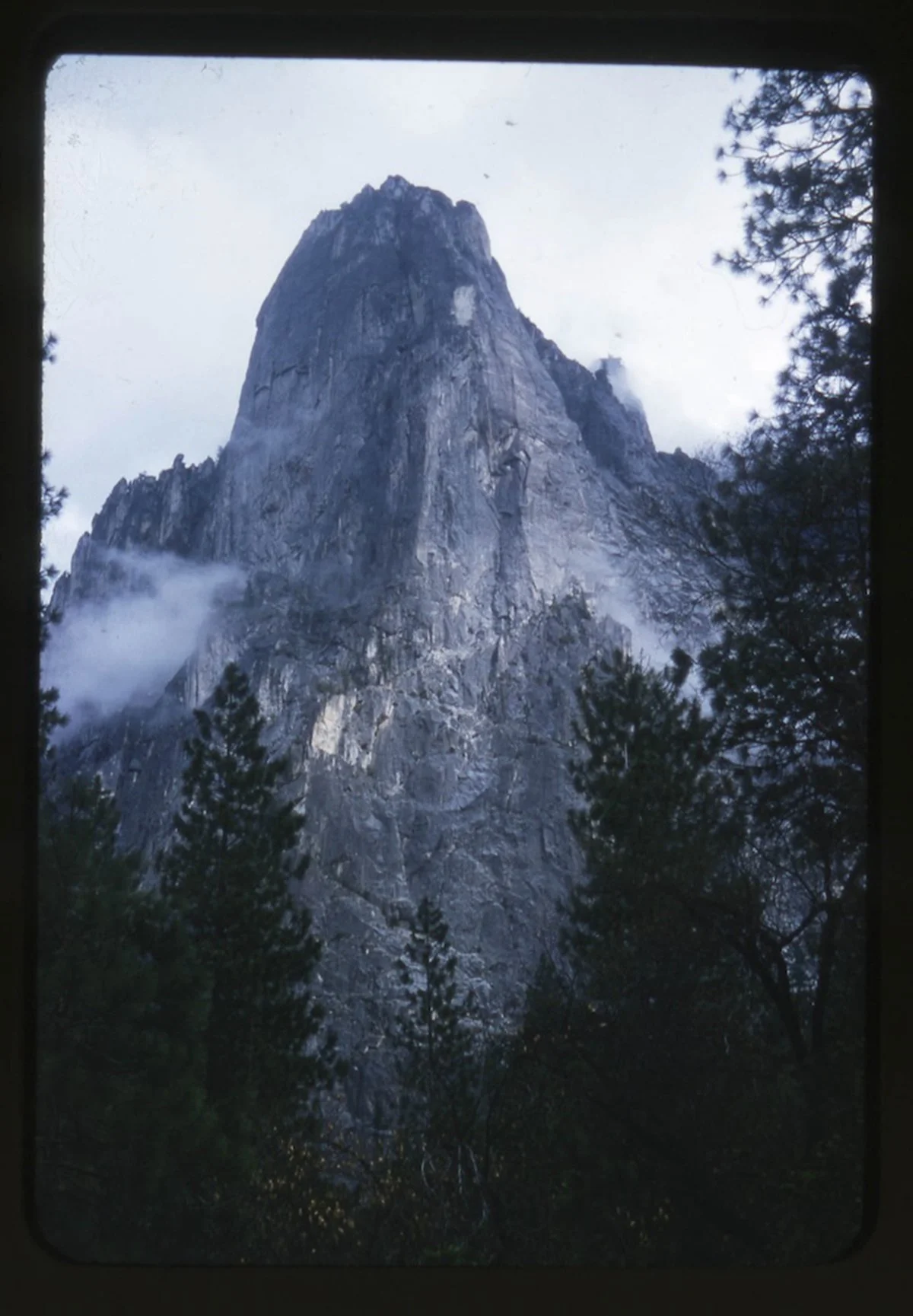
Sentinel Rock circa the 1950s, photo by Nicholas B. Clinch Collection.


Sentinel Rock circa the 1950s, photo by Nicholas B. Clinch Collection.

In 1950, Allen Steck had become obsessed with climbing Sentinel Rock, and he wasn’t alone in his ambitions. The Valley was a competitive environment. Steck, Phil Bettler, Bill Long, and Jim Wilson made a serious attempt in October 1949, but only managed to reach 400 feet past the previous attempt. More attempts were made in 1950, and with the Fourth of July weekend approaching, Steck was getting antsy; someone would unlock the climb soon. He lay awake at night thinking about the north wall above the buttress.

At the time, Steck was a 24-year-old living in Berkeley, California. He was young and ambitious, just beginning to make a name for himself in Yosemite, and a “carnivore,” as Salathé would say. In contrast, Salathé was 51, had dentures, and was known for his doggedness and patience in climbing. All of Steck’s friends were out of town that weekend, so he asked Salathé to join him.

The angels had earlier told Salathé to look around the Valley, and he would see three superior climbs: Half Dome, the Arrow, and the north face of the Sentinel. The first two were completed, but there was one last climb to go.

Perhaps Salathé and Steck were always moving toward this climb, fated to complete it together—the innovator and the young gun.

When Nelson heard of their plans, he remarked to Salathé, “If you expect to make the top, Al will have to be every bit as stubborn as you!”

On the morning of June 30, the two quested off—Salathé with a handful of dates and Steck with dried fruit, canned tuna, and some nuts. Between the two of them, they had two gallons of water in tin cans, believing it would be enough for their time on the wall.

By midafternoon on the second day, they had reached Steck’s previous high point.

“Even though we were swinging leads, it was clear that Salathé, an aid specialist that he was, should be the one to tackle the steep, almost blank section known as the ‘Headwall,’” wrote Steck in his memoir, A Mountaineer’s Life.

The terrain was complex and unknown, Salathé’s progress slow. They retreated to their bivy at the top of the Flying Buttress. At first light on July 2, Salathé went to work, struggling on the steep headwall for seven hours. They began to feel hot and thirsty. Temperatures reached 105°F on the valley floor—the climbers were like two eggs in a frying pan. Even worse, their water—which should have been enough for a few days under cooler conditions—wasn’t going to last much longer given the dehydrating effects of the heat.

At last, they reached the Great Chimney. They looked up at a steep, flared slot ending in a narrow section. Steck began to wonder how they might escape the wall. Disappointment and thirst were setting in.

The next day, July 3, Steck noticed a cave at the far end of the chimney. He roped up and wriggled up it, popping out a hundred feet above. Salathé ditched an empty water can and his dates, his parched mouth making them unappealing, and prusiked up to Steck. For years to come, climbers would see a rusted tin can as they entered the chimney.

Now, they were at another impasse: A slot about the width of a human head rose above them.

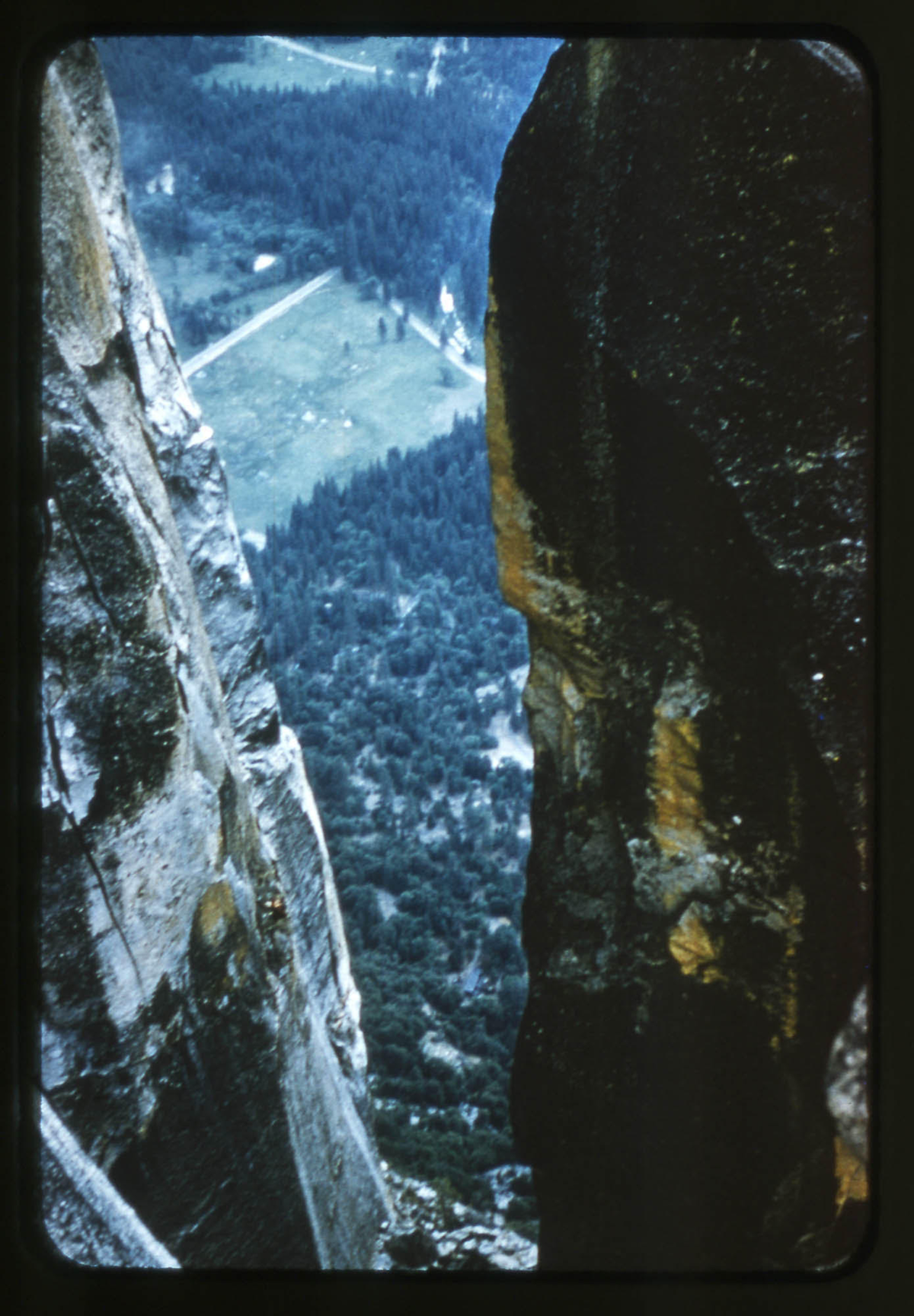
Sentinel Rock circa the 1950s, photo by the Nicholas B. Clinch collection.

Salathé searched for a crack, discovering a rare and thin line leading around the outside of the slot. Salathé placed pitons, climbing the outer face of the chimney until he reached an ample ledge. Salathé had solved the crux of the Narrows, which would become the most notorious feature on the route. Salathé’s route up the Narrows has no known repeats: On the second ascent, in 1954, Royal Robbins discovered an oval-shaped hole in the ceiling above the belay spot, shinnying through this and the chimney above until he found himself in the sunlight again. This has become the standard route.

Steck, before following Salathé, saw water dripping down in a crack. He desperately reached for it, but it was only enough to moisten his lips.

They continued upward in the unrelenting heat, letting their tempers boil over. Whatever their motivations were—anger, water, or the love of climbing—they ended the night two pitches from the summit, albeit sleeping in a painful, seated position hanging from their anchors.

On the morning of July 4, Salathé used their last half cup of water to moisten his false teeth so he could put them back on. By noon, the two stood at the summit.

They “yelled and jumped and almost kissed each other to think we’d made it,” said Salathé in an interview with the San Francisco Chronicle in 1950.

Steck, meanwhile, had become crazed with thirst. He threw his food off the summit and rushed down a gully leading to Sentinel Creek, which they could see from the summit, leaving Salathé. Water was all he could think about. Steck got cliffed out 30 feet above the creek and had to climb back up the gully. He “tripped over bushes, fell over unseen ledges, and finally collapsed fully clothed into a pool at the foot of a small waterfall,” as Steck later wrote in his Sierra Club Bulletin article about the ascent, “Ordeal by Piton.”Salathé, ever patient, had taken his time and traversed over to the water. The men immediately got to slaking their thirst.

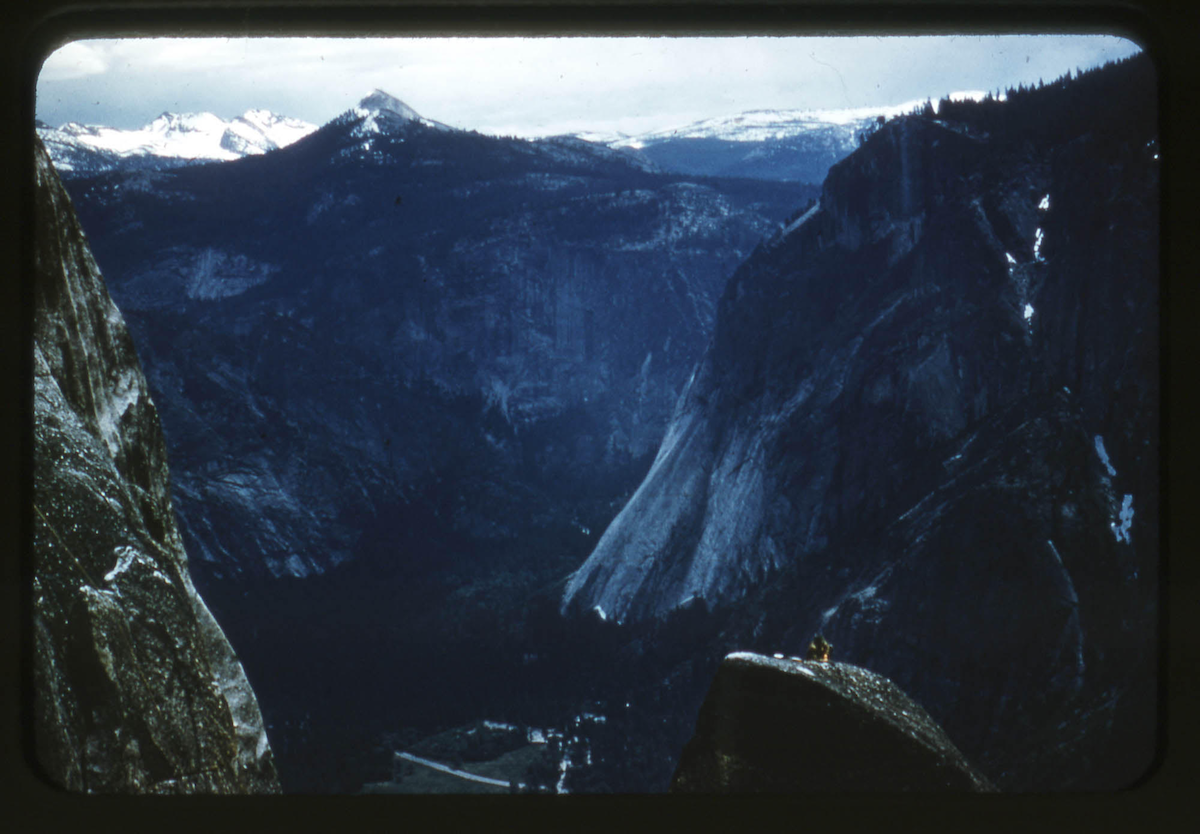
Sentinel Rock circa the 1950s, photo by Nicholas B. Clinch Collection.

Finally, after facing a complex descent over steep, water-worn granite slabs down toward the Valley, they piled into Salathé’s Model T Ford for the drive back to Berkeley, stopping at a produce stand on the way. Salathé bought various fruits, and they ate them eagerly.

“And I can say, in retrospect, that it was well worth the effort. The reason, the incentive, the motive for all this? It is an intangible, provocative concept that I shall leave to the reader to explain. Some think they know why; others despair of ever knowing. I’m not too sure myself,” concluded Steck in “Ordeal by Pitons.”

It was clear Steck was a bit fed up with the climb, but like all climbers, as time goes on, the sufferfest memories fade, and going back up doesn’t sound so bad. Steck went on to climb the Steck-Salathé five more times, the fifth time on the 50th anniversary, when Steck was 75 years old.

Unfortunately, Salathé’s mental health deteriorated soon after this ascent. His wife, Ida, took unknown legal action against him in 1952, and shortly after, he believed she was trying to poison him with cobra venom. He soon returned to Switzerland and joined a religious cult led by a medium who claimed to have the “spirit Joseph” speak through her.

In 1963, Salathé returned to the United States, were he wandered the deserts and mountains of California, living off the land and a pension from the Swiss government.

The Steck-Salathé route on Sentinel Rock was a monumental climb in Yosemite history, a five-day big wall that opened up the idea that other walls could be and would be climbed, if only climbers were willing to bivy for multiple nights in a row. Soon after, several other big features were climbed in the valley, including the Regular Northwest Face of Half Dome in 1957 and The Nose of El Capitan (47 days on the wall) in 1958. Salathé and Steck’s route opened up a new playing field for climbers, leading to some of the greatest routes in North American climbing history.


Sign Up for AAC Emails

The Line—A Sensational Spire in Pakistan

One winner of a 2025 Cutting Edge Grant from the AAC was alpinist and photographer Tad McCrea, who, along with fellow American Jon Griffin and German climber Thomas Huber, traveled to the Karakoram for their second expedition to attempt two sensational peaks. The first part of Tad’s trip report is shared below. For the second half, you’ll have to wait for your 2026 American Alpine Journal, coming later this year.

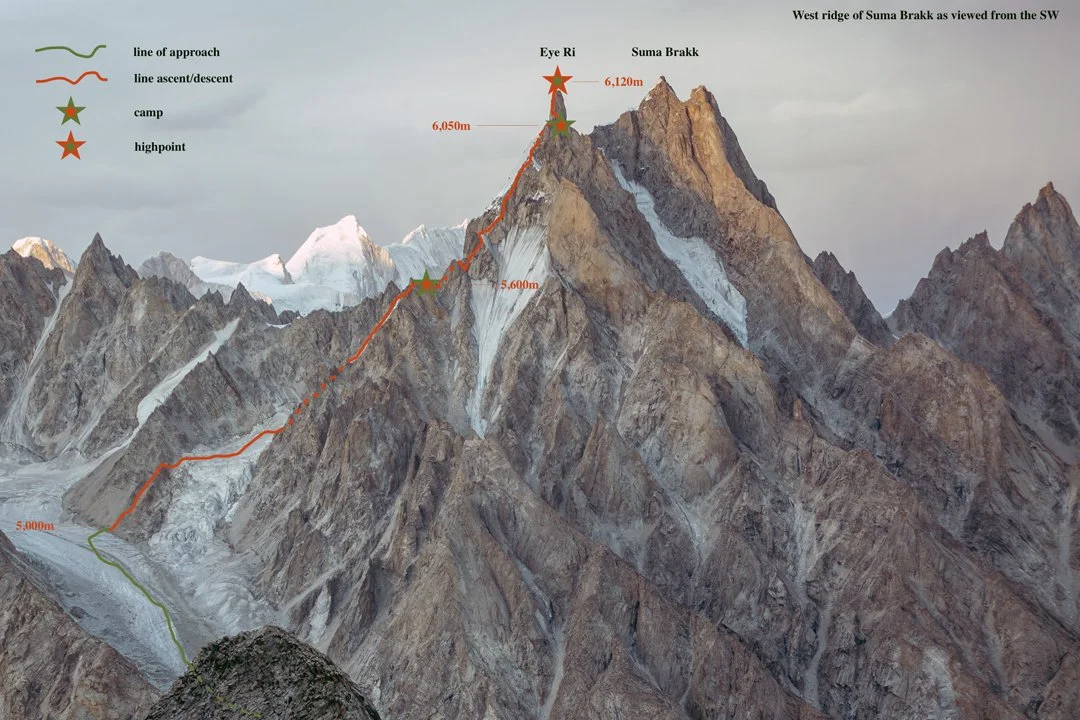
The line of the 2025 first ascent of Eye Ri (Suma Brakk West) by the west ridge. The central and highest peak has been climbed twice. Tad McCrea

Eye Ri, First Ascent, via Northwest Face and West Ridge

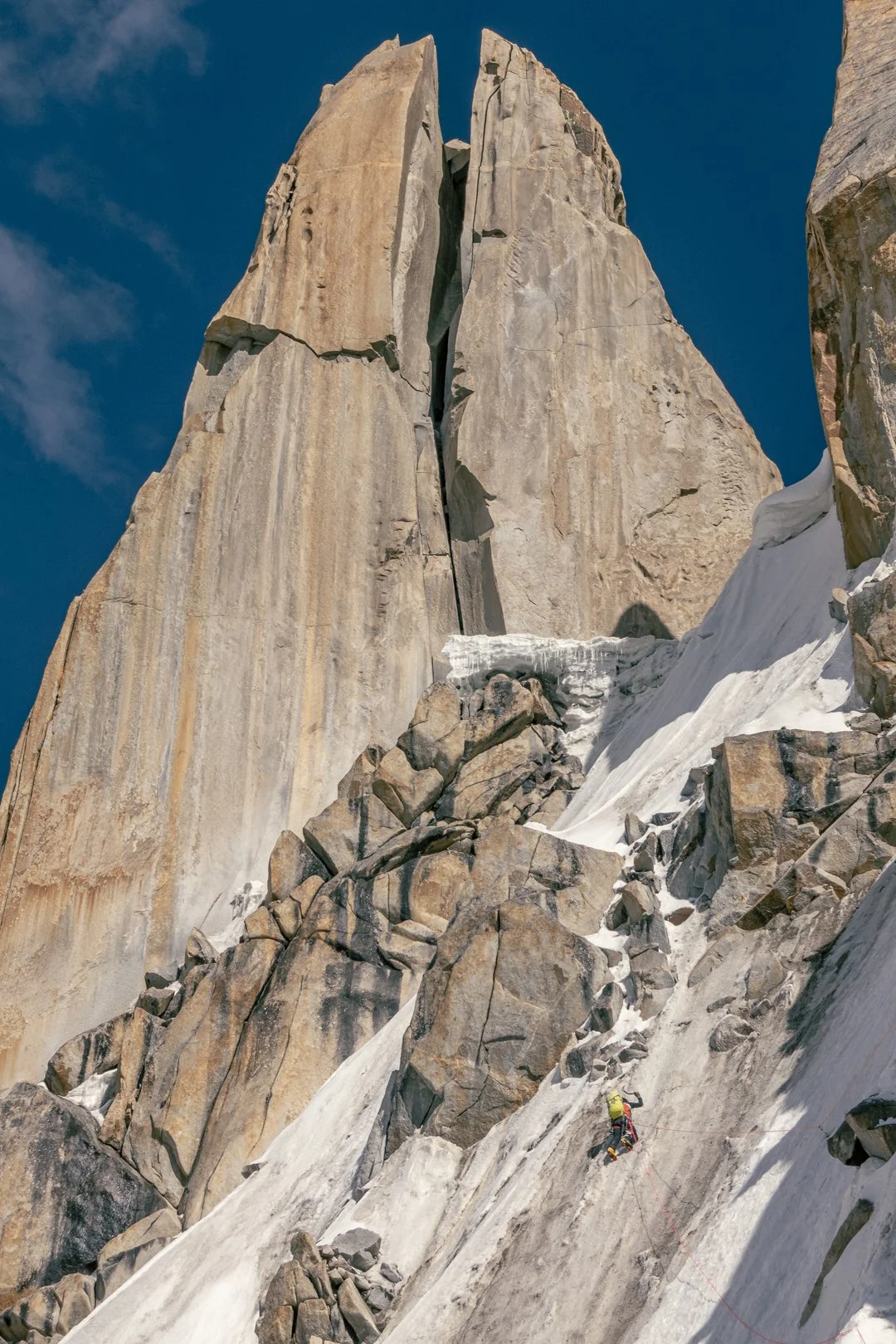
Jon Griffin heads toward the astonishing summit tower of Eye Ri, the west summit of Suma Brakk. Tad McCrea

Jon Griffin, Thomas Huber, and I had visited the Choktoi Glacier in 2024, our goals the west summit of Suma Brakk and the southeast pillar of Latok III. Initially, the weather was stunning, but as our preparation was beginning to pay off, we were hit by five weeks of wet and restless weather. Our objectives quickly became out of reach.

On July 14, 2025, the three of us reconvened in Skardu, in northern Pakistan. The approach this time to base camp, at around 4,400 meters on the east side of the glacier, was challenging due to hot weather and raging river crossings. 

Then, five days into our stay at base camp, Thomas and I were called to assist in the attempted rescue of Laura Dahlmeier on Laila Peak. [The German athlete was a two-time Olympic biathlon champion and friend of Huber’s. She was retreating from the peak when she was hit by rockfall, fatally, around 5,700 meters.] Along with Americans Jackson Marvell and Alan Rousseau, who were on another expedition in Pakistan, we were airlifted to the peak, where we located her body from the air and realized any attempt to retrieve her would be futile. We hiked out to Hushe, then were helicoptered back to our Choktoi base camp on August 2. 

Two days later, we made an acclimatization trip to 5,700 meters near Suma Brakk. At 12:30 a.m. on August 9, we set off from base camp for the final climb.

On summit day, Thomas Huber reascends the first pitch on the final tower of Eye Ri. Tad McCrea

Suma Brakk is a triple-summited peak that has been climbed at least a couple of times by different routes. [The first ascent of the central and highest summit (6,166m) was made in 2007 via the southern slopes and southeast ridge, by Americans Doug Chabot, Mark Richey, and Steve Swenson. In 2018, Fabian Buhl and Alexander Huber—Thomas’s brother—completed the south ridge, with more than 56 pitches of climbing]. The west summit, which we dubbed Eye Ri (6,120m), was unclimbed. It appears as a spectacular needle when seen from the Choktoi side; moving around the peak to the west exposes a gash splitting the entire summit tower. There is a giant chockstone wedged 15 to 20 meters from the top that mimics Sauron's Eye.

Jon Griffin (leading) and Thomas Huber near the top of Eye Ri during the first ascent, with the Choktoi Glacier far below. Tad McCrea

We started up loose ribs and even looser rock gullies just left of a 300-meter icefall blocking access to a hanging glacier at the base of Eye Ri’s northwestern aspect. We had been here the year before, so we knew where to find the best path to the notch leading to the upper glacial basin. The climbing ranged from steep walking to scrambling. A hike up the glacier, then steep snow and névé with occasional stretches of ice and mixed (50°–75°), took us to the previous year’s high point at 5,600 meters on the west ridge, between the first and second gendarmes. While I chopped out a site for the tent, Jon and Thomas took our two single ropes and a tag line and fixed three pitches to the top of the second gendarme. 

After making the first ascent of the triple-topped peak on the left side of this photo, Americans Doug Chabot, Mark Richey, and Steve Swenson gave it the name Suma Brakk, meaning “three summits” in Balti. They climbed the central summit in 2007. The 2025 first ascent of the pinnacle on the left, now called Eye Ri, followed the west ridge, descending to the left. The sea of rock fins and summits below and right of Suma Brakk, all below 6,000 meters, belongs to the Choktoi Subgroup, while the high pyramid at far right is Chiring (7,045m). Tad McCrea.

The next day, we continued past three more gendarmes to a bivouac below the final tower. There were a few rock pitches up to 5.10+ on textured golden granite, and ice up to 80°, and we needed the full quiver of alpine tactics and trickery to get our under-acclimatized bodies up to 6,000 meters.

In the morning, we climbed three challenging pitches up the tower, utilizing 12 bolts for protection and anchors. Free climbing up to 5.11, we also employed a variety of aid tactics. At a bus-sized platform four meters below the top of the tower, we fixed lines and rappelled 85 meters to our camp.

On August 12th, we jugged our lines and did a short boulder problem to the summit, for what appears to be its first ascent. We laughed, danced, and cried a little as we soaked in the expansive vista, then descended all the way to our 5,600-meter camp, making at least 15 rappels. With the heat maxing out, we were incredibly thankful to be on a ridge, as the mountain was exploding on all sides. The following day, we retraced our steps to base camp. We named the route HmlaA (1,000m, 5.11 A3 80°).

Left to right: Jon Griffin, Tad McCrea, and Thomas Huber.

—Tad McCrea, USA


New Cutting Edge Episode: Massive Climbs and Wild Adventures in Mozambique

The enormous granite peaks of Mozambique are among Africa’s most impressive rock formations, yet fewer than a dozen climbing teams have ever explored them. In 2025, a Spanish and American trio put up a 17-pitch route in Mozambique, and for this episode we spoke with one of the team members—American Dakota Walz—about what they encountered, including a seemingly inscrutable bureaucracy and a night in detention before they could even start the climb. Following the successful ascent, they suffered debilitating illness thanks to ill-advised celebratory ice cream.

In between were glorious days on a unique African mountain, creating a route worth repeating. Host Jim Aikman also chats with Majka Burhardt, a veteran of two climbing expeditions to Mozambique, about navigating the cultural and logistical challenges in a country struggling with a legacy of conflict. And AAJ editor Dougald MacDonald shares insights on southern Africa’s extraordinary granite climbing.


Sign Up for AAC Emails

Ask Me Anything, Prescription Edition: Stacked Rappels and Old Cams

In this episode, we sit down with THE dynamic duo Pete Takeda and Jason Antin. Pete and Jason recap and expand upon the climbing accidents featured in the January and February Prescription, the AAC’s monthly dose of accident analysis from our annual book, Accidents in North American Climbing. Then, they answer audience questions that stemmed from their original analysis. We explore questions like what are the pros and cons of stacked rappels—and sidebar into some misunderstandings about simulrapping. We also explore what happens when old stiff cams are put in wet and grimy cracks, and the alternative uses for old gear. If you’ve left a comment on our Prescription videos, or written into the accidents email inbox, we may just have answered your questions! Dive in to hear about these topics and more.

Pete Takeda is the editor of Accidents in North American Climbing. Jason Antin is an IFMGA/AMGA guide. Together, they are the experts behind the AAC’s most popular media—our monthly Prescription email and video. Get it straight to your inbox when you sign up for AAC emails below!


The Prescription—Short Fall to Ground

It’s March, and climbers all over North America are getting ready for some spring cragging. It’s time to inspect your rack…and rope. When it comes to the latter, there’s an old adage that says: Ropes don’t break—they cut. This maxim provides some comfort, as how often do sharp objects truly come into contact with your rope? Before you draw any conclusions, however, check out this accident from May 2024, which appeared in the 2025 edition of Accidents in North American Climbing.

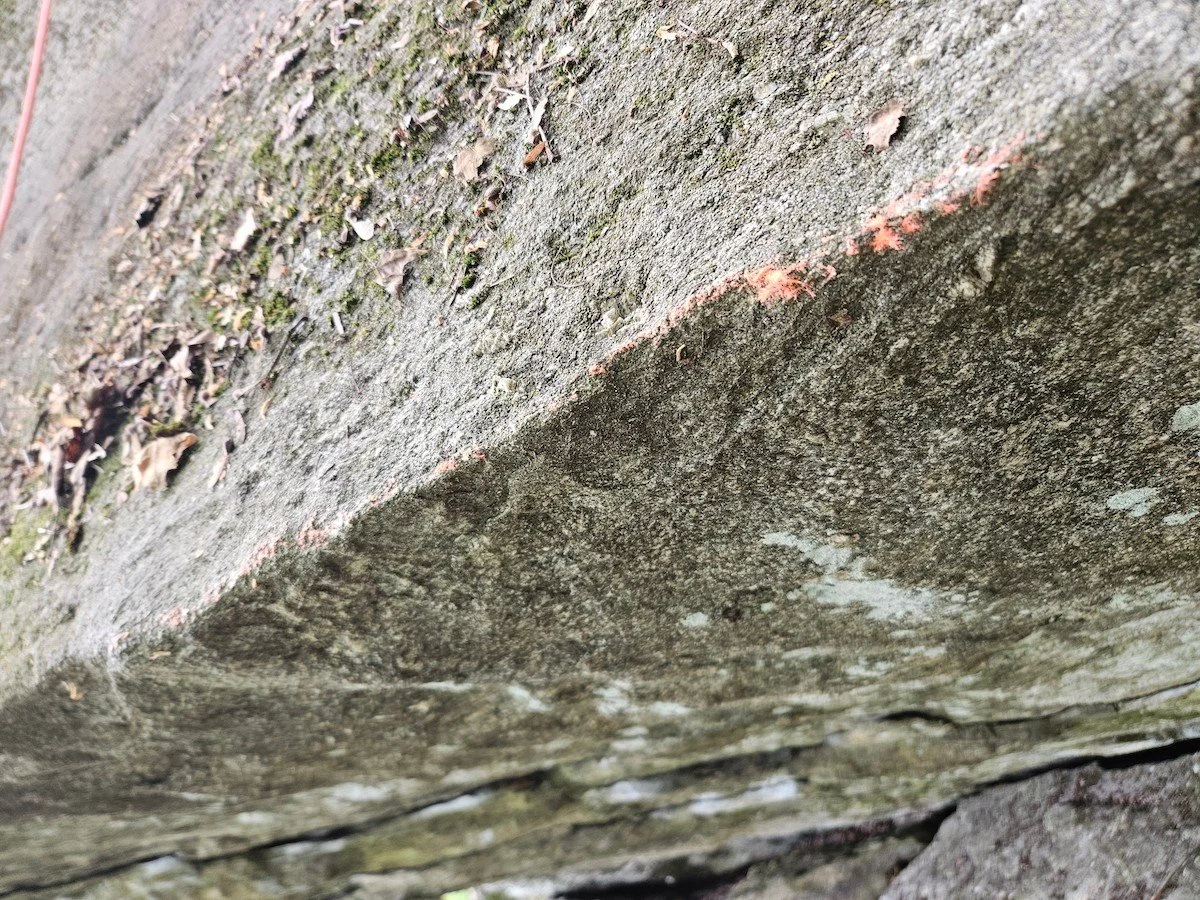
Here is the actual cutting edge as photographed after the accident. We can see the orange fuzz left behind by the rope’s sheath. Photo by Tom Neary.

Short Fall to Ground | Rope Severed by Edge of Rock

Western Massachusetts, Farley Ledges, Pot Ledge Buttress

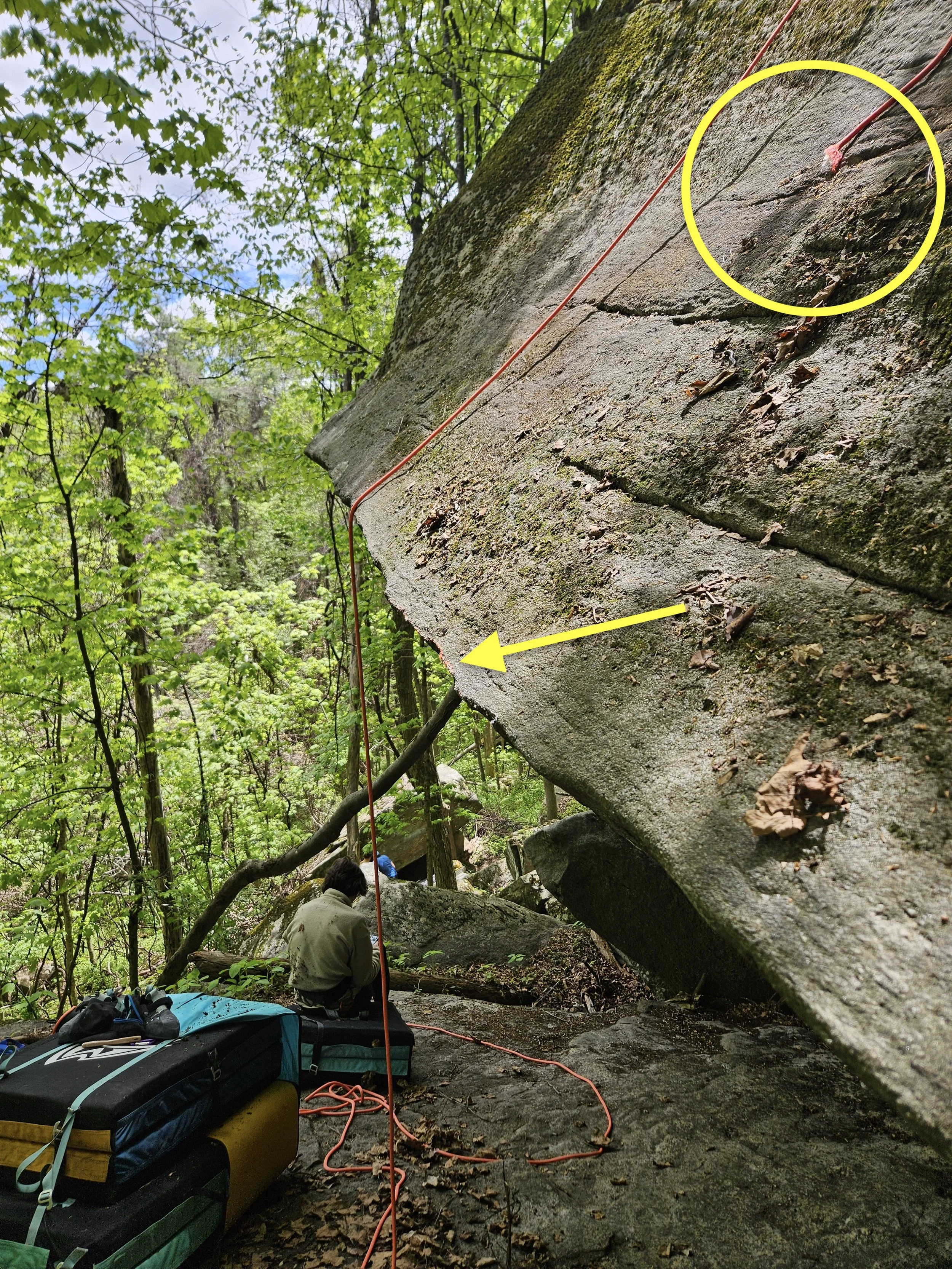
On May 11, 2024, Tom Neary and his younger brother Paul were checking out a new boulder. On top, they tied their 9.5mm dynamic rope to a tree. This created two rope lengths, with both ends reaching the ground. This configuration allowed them to rappel simultaneously, with each of them cleaning moss and dirt from the 20+-foot-high boulder. The first 10 to 12 feet of the rock were overhanging. At the lip, the angle dramatically kicked back. The juncture of the overhang and slab was a straight and horizontal edge whose exterior angle was around 60 degrees.  

While on rappel and cleaning below the lip, Paul slid sideways. The brand-new rope, tensioned under body weight, was pulled across the edge. It was cleanly severed. The younger Neary fell four feet, landing on flat rocks below the boulder. Fortunately, he suffered only minor injuries.

Here we can see the severed rope end circled in yellow. Also visible is the edge that cut the rope and some residual rope fuzz (yellow arrow). Photo by Tom Neary.


ANALYSIS

It’s never a good idea to run a rope, especially a dynamic rope, over an acute edge. While these climbers felt that the lip was not extremely sharp, they did not account for the motion of the sliding rope. On occasion, a climber might fall or lower over a sharp edge, but the force is not often concentrated on the isolated radius of a loaded rope. In this case, the side-to-side motion acted like a saw blade. 

There have been several fatalities when a tensioned rope, often with a climber jumaring on one end, was severed over an edge. By way of experiment, one can saw through a tensioned rope across the edge of a brick (a mere 90-degree angle) in less than a minute. 

Just like runnering, avoiding a cut rope takes a keen eye and the ability to predict where nylon might contact an edge or rough spot. When in doubt, use a rope sheath/rope protector or improvise with a T-shirt, jacket, or pack. Athletic tape can be used, if needed, to hold the edge guard in place.

(Source: Tom Neary and the Editors.)


Video Analysis

Pete and Jason are back to explain the consequences of a rope running unprotected over an edge, and provide some tips on how to avoid injuring your rope and yourself.

*This is a recreation of the accident. No climbers were harmed in the making of this video, only one rope.

Credits:
Pete Takeda, Editor of Accidents in North American Climbing; IFMGA/AMGA Guide Jason Antin; Producers: Shane Johnson and Sierra McGivney; Videographer: Foster Denney; Editor: Sierra McGivney; Location: Tunnel 1 Boulders, Clear Creek Canyon, Golden, CO


Photo by AAC staff Foster Denney.

An Interview with ANAC Editor Pete Takeda

In the recent edition of the AAC’s Guidebook, Pete Takeda sits down to give us the details of the intricate work behind Accidents in North American Climbing. The interview walks us through the process of making the book, the history of the publication, and the challenges facing this impactful publication.

“I’ve been a reader of ANAC since I started climbing. I never imagined I’d become the editor but here I am, five years into the job and working with a great team at the AAC,” says Pete. Read the interview in Guidebook XVII.


The Prescription is Supported By:


Sign Up for AAC Emails

USA Ice Climbing Forms as an Independent Organization

USA Ice Climbing (USAIC) and the American Alpine Club (AAC) proudly announce that USAIC has become an independent organization and is moving toward 501(c)(3) nonprofit status. This milestone establishes USAIC as the official organization representing competitive ice climbing in the United States, supporting athletes at the national level and on the international World Cup circuit, as the sport gains global momentum and is under consideration for inclusion in the French 2030 Winter Olympics.

The formation of USAIC as an independent nonprofit marks a major step in the evolution of competitive ice climbing, creating a dedicated platform to grow the sport, elevate elite athletes, and strengthen pathways from grassroots participation to international competition. Similarly, USA Skimo (Ski Mountaineering), which also shared strong roots with the AAC, debuted as the only new sport at the 2026 Milan Cortina Winter Olympics.

USAIC was recently approved as an Associate Member of the International Climbing and Mountaineering Federation (UIAA), a significant achievement supported by the American Alpine Club, which serves as the United States’ National Federation Member to the UIAA. This recognition further reinforces USAIC’s role on the global stage and its commitment to international collaboration and excellence.

For more information, please contact USAIC at www.usaiceclimbing.org.

Founded in 1902, the American Alpine Club is a 501(c)(3) nonprofit organization dedicated to advancing knowledge, inspiration, and advocacy for climbers. Guided by a shared passion for climbing, the AAC delivers world-renowned resources that support and inspire the climbing community.


Stories from USA Ice Climbing


Sign Up for AAC Emails

An Interview with ANAC Editor Pete Takeda

ANAC Editor Pete Takeda on set for a Prescription shoot in Boulder Canyon, Colorado. Photo by AAC member Foster Denney.

Originally published in Guidebook XVII.

Photo by AAC member Foster Denney.

AAC: Describe the scope of the work that goes into making Accidents in North American Climbing [ANAC].

Pete Takeda: The scope and the type of coverage we do have expanded over the years. It’s not just a print publication anymore, where we analyze accidents from across the continent. It’s also the monthly email, called The Prescription, that delves into one of the accidents from that year’s book, repackages it, and adds related resources. Now we’ve also brought in the video component, with me as the on-camera personality, plus IFMGA/ AMGA guide Jason Antin and how he recommends folks avoid the accident we’re analyzing.

So as an editor, I have to change hats a bit. I kind of hate being the on-camera personality. But I see it has an impact, and so whatever I feel about it is irrelevant because it serves the community.

Another new exciting thing is working with Dr. Valerie Karr, a professor who studies human behavior across many complex environments, who came out of the blue and scanned and made searchable every physical copy of ANAC dating back to 1948. We can now respond to legitimate, official queries for data.

Dr. Karr has also brought forward a framework for examining human factors in accidents. In other words, how you feel, what you’re thinking, your background, what you’re doing and experiencing in the moment, and how those all can lead to accidents and also influence the outcome. For example: I was distracted, or I was thinking about my dog, or someone asked me a question. It’s just basic things like that every climber can relate to. You can read about some of her initial findings in this year’s book.

So, we’re no longer just addressing the mechanics of the accident: My carabiner came undone, or the rope was running over the edge, or I placed a cam and it blew. It goes beyond just these technical aspects.

AAC: What’s the history of ANAC?

Pete: First, it was simply a report from the AAC Safety Committee, starting in 1948. In 1952 they settled on calling the annual book Accidents in North American Mountaineering. The person who really evolved it into what it is today is Jed Williamson, a past president of the AAC and the editor emeritus on the masthead of ANAC. He steered the direction of ANAC, as a volunteer, for 30 or 40 years. He’s the one who established this current format and managed to source information from all these different reporting sources, like federal rangers, SAR teams, and individuals.

In 2016 the name changed to Accidents in North American Climbing, [to reflect the fact that] we as climbers really would not self-apply the term “mountaineer” to what we do 99 percent of the time.

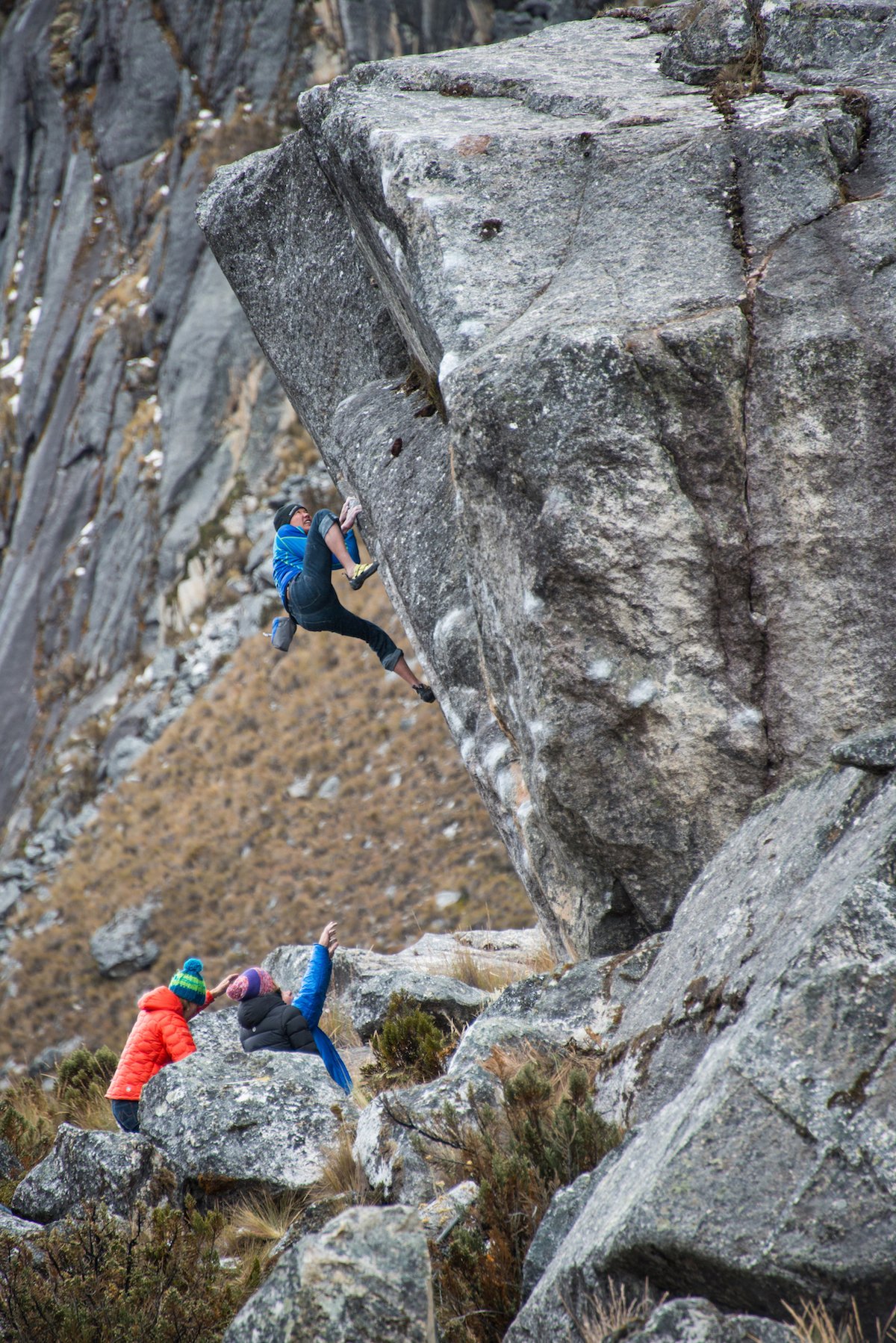
Pete Takeda highball bouldering in the Peruvian Andes. Photo provided by Pete Takeda Collection.

AAC: What’s a unique challenge you’ve faced while compiling and editing ANAC?

Pete: Figuring out how to accurately portray such technical concepts is always a challenge. You really have to partition your mindset, just like you do in the disciplines in climbing. Some things work in the print realm. Some things work in the digital realm. Some things work in video.

With a print publication, you’re combining imagery with graphics and words. Between those three things, you should be able to allow people to view the material, read the material, and come away with as comprehensive and as fact-checked a report as they can. And that’s something that really sets us apart: We actually check facts.

Of course, it is challenging to create a graphic that matches the nuances of how a knot came undone or how a carabiner unclipped, but we have excellent designers on our team. [Another] major hurdle I have is acquiring photos for every accident, either of the accident scene or showing the mechanics of the accident, the routes, the area, etc. People on Mountain Project have been very generous in donating their photos.

The purpose of all this material is to evoke questions. You can usually tell how successful you’ve been by the questions that people write on social platforms or via email. That’s [certainly] the case with the Prescription videos—and, if someone wants to dig more, they can always look in the book or get on the AAC website and look up the accident.

The ultimate thing is for people, regardless of experience level, to think about what they do in the light of understanding the mechanics and mindset that create any accident situation. I hope the analyses always get people thinking: What can I do that might encourage an accident? What do I do that might encourage me to be safer and more accountable to all those people around me? That’s definitely the culture in backcountry skiing, but I don’t see that same culture universally in climbing.

Once you bring humility to reading these reports, and self-analyze, you can start being accountable to safety for yourself and, more importantly, safety for others.

I guess that’s the challenge of the human race: Have some humility, get out of your f@#$ing head, and start f*&%ing thinking about the impact and effect you’re having on yourself and others. If everyone did that, you know, now that would be a utopian society—but that’s another story.

AAC: Is there an example accident report that was especially standout for you from the 2025 ANAC?

Pete: There was the anchor knot coming undone in Yosemite: The individual attempted to tie a BFK but instead tied a slipknot. And I can totally see that happening to anyone.

Another involved someone I knew—Robbi Mecus, who was a correspondent with ANAC from back East. She died in a fall [during a descent] in the Ruth Gorge, Alaska, and her partner survived despite critical injuries. That one got to me because there’s a person who really does everything right and is super aware of the hazards, yet still perishes.

I think the takeaway is that climbing is dangerous. It can be fun; it can be joyous; it can be an athletic thing where you share these moments with your friends—and it should be. But there are times when we have to remind ourselves that this is dangerous. There are things at stake.

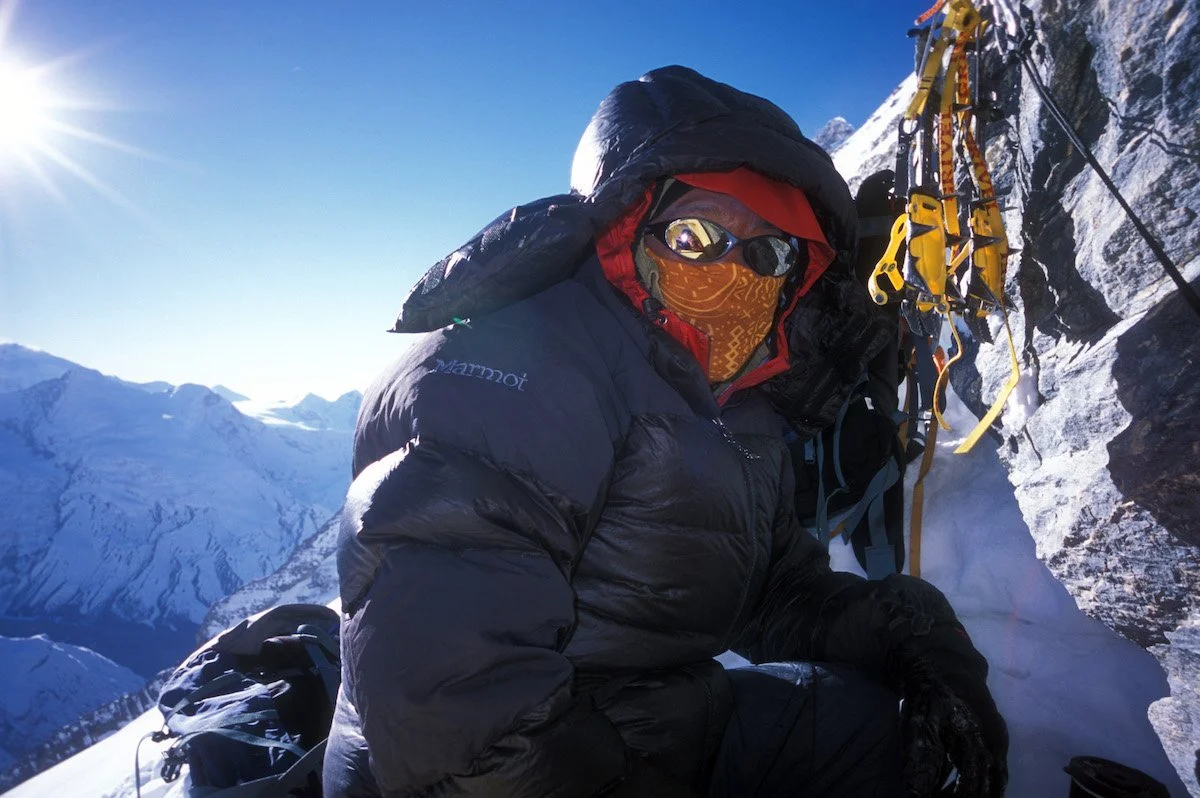
Pete Takeda on Nanda Devi, India. Photo provided by Pete Takeda Collection.

AAC: Any others?

Pete: One I found really, really interesting was a ground fall in Mission Gorge, San Diego. It’s really slick crack climbing on granite. These cracks often collect fine dust. Someone was leading a pitch and using hard aluminum Camalots—like, first-generation or second-generation ones that were 30 years old. And they were using super-unstable second-generation Metolius TCUs. This person had multiple pieces pull just by taking.

This climber is just doing their thing; nothing should go wrong. And suddenly all these pieces are blowing out. Apparently, the day after, someone suffered the same thing [on an adjacent climb].

It’s a combination of the dust and the crack, the slick rock, the hard, thin cams. You know, you might’ve done your hardest send in 1990 on this gear. [But now,] there’s no reason not to replace your gear. Because every so often something bad happens, like someone has a really worn Grigri and they partner up with someone who has one of those super-slick, ultra-skinny ropes. You know, there’s nothing wrong with this, but there’s also nothing right with it, especially when you lose control of the rope and your partner falls and hits the ground.

Finally, some people really pooh-poohed the reality of the knee-stuck-in-an-offwidth video we made. Sure enough, I got two accidents reported where that happened in 2025. And, for the 2026 book, and I kind of predicted this, but man, someone got stuck in an inversion offwidth. With that scenario, the clock is ticking, and you will die from hanging upside down from one knee, unable to move. The blood goes to your head; you suffocate. Stay tuned for that story in the 2026 book. [Editor’s Note: The climber survived!]

AAC: What parts of your specific climbing background inform your editorial vision?

Pete: The length and breadth of my climbing career is the single strength I have. I started as a boulderer, then we developed into top-ropers, and then we got into leading. Then we got into bolting. And then I moved to Yosemite and got into big-wall climbing—a lot of aid, speed ascents, so on. Then got into ice and mixed climbing; competed; got into pure ice; low-altitude alpinism. Then alpine rock, all that stuff, and then Himalayan alpinism and Alaskan alpinism.

So, along that path, I’ve either had the mishap, witnessed the mishap, had a close call, or nearly died in the same ways that people report. I understand the mindset. And I also understand, from having friends die or almost getting killed or being party to an accident, what it’s like being the partner involved.

I bring all that skill and experience into my tone and the way I treat people with whom I have a dialogue. I think that really informs things, because I’m really nonjudgmental. And you learn, like, Wow, I could do everything right; I could be minding my own business, and still get killed.

For longevity, we have to be taking what we know and giving it to other people without any thought of recompense. That’s the final stage in a climber’s evolution. At the same time, still burn your friends off and tick that next box. That’s all part of the game.

AAC: What have you learned about the emotional side of accidents from talking to so many accident witnesses and survivors?

Pete: Whenever there is an accident, especially a really serious one, we walk away as observers or participants with some degree of survival guilt. This is as old as time itself.

People often go straight to: How could I have prevented this? And right there is a mistake.

It was an accident. It was something that was unintentional. You don’t wake up in the morning and go: God, I really hope my climbing partner takes a big whipper today and breaks both legs. That would just make my day. I usually bring people back to that. Just think about what you were thinking the morning of the accident. That’s the truth of the intentions there. There’s always a presumption within humans that we can control things that we [can’t].

On a final note, I think the people who really walk away with a positive experience from accidents are the SAR folks who go in and do the job they’ve trained to do, or the volunteer rescue people—they get to practice their skill set and actually have a happy ending to the story when they save someone.


Sign Up for AAC Emails


The Huayhuash Is Still Open

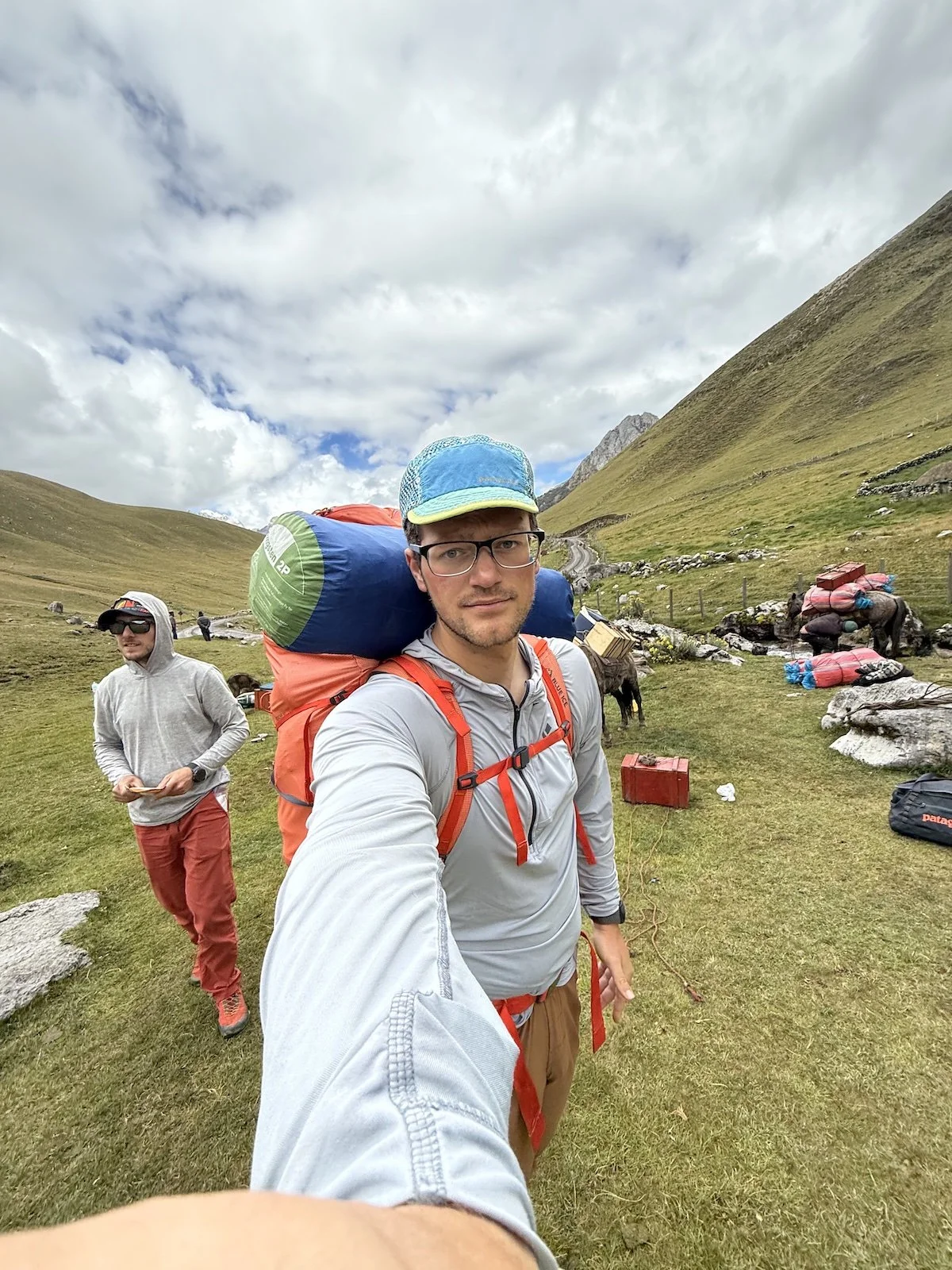
Eric Kanopkin quests to find a dry spot for his tent. Photo by AAC member Luca Raso.

A Rare Ascent of Jirishanca Chico—A Story from the Mountaineering Fellowship Fund Grant

By Luca Raso

Originally published in Guidebook XVII

The mountain’s scale, as seen through my own eyes, terrified me. Film and photographs, a 60-year-old trip report, and even the topo sketches I had stared at for hours before arriving—none of them captured the size, or the exposure, or the weight of it. Lying in its eastern valley, listening to the static hiss of rain against nylon, I couldn’t sleep. I had been catfished by my own dreams. Any confidence I had built up in the Cordillera Blanca now felt suspect. Bootpacks and snow anchors set in place by mountain guides, lively refugios and high camps, and broader terrain that was mostly walkable; these were all crutches that fed into my delusion, now taken away by just one close glimpse at Jirishanca.

On June 2, 2025, after a few hours of tossing and turning in my sleeping bag, I set off with my partner Eric Kanopkin to climb Jirishanca Chico, a 5,400-meter peak in the Cordillera Huayhuash range of Peru. The grassy hills that rolled up to Niñacocha, the meltwater of the Rondoy Glacier, were flooded with rainwater and cow manure. Our double boots squished loudly as we went up the valley, waking and startling cattle as we passed. We were indiscreet spies under the cover of midnight’s darkness, clambering across no-man’s-land toward what we assumed was our acclimatization objective.

The first time I had seen the Huayhuash was back in 2024, from the popular hilltop sport climbing crag of Hatun Machay. I was there with Maxwell Hodges, a friend who helped introduce me to the climbing life—as well as to the Cordillera Blanca. That day, we were sunning ourselves on rock, a happy respite from slogging up the Blanca’s sloping glaciers. “Why don’t we head there?” I had asked him, pointing toward the jagged, snowcapped massif of the Huayhuash.

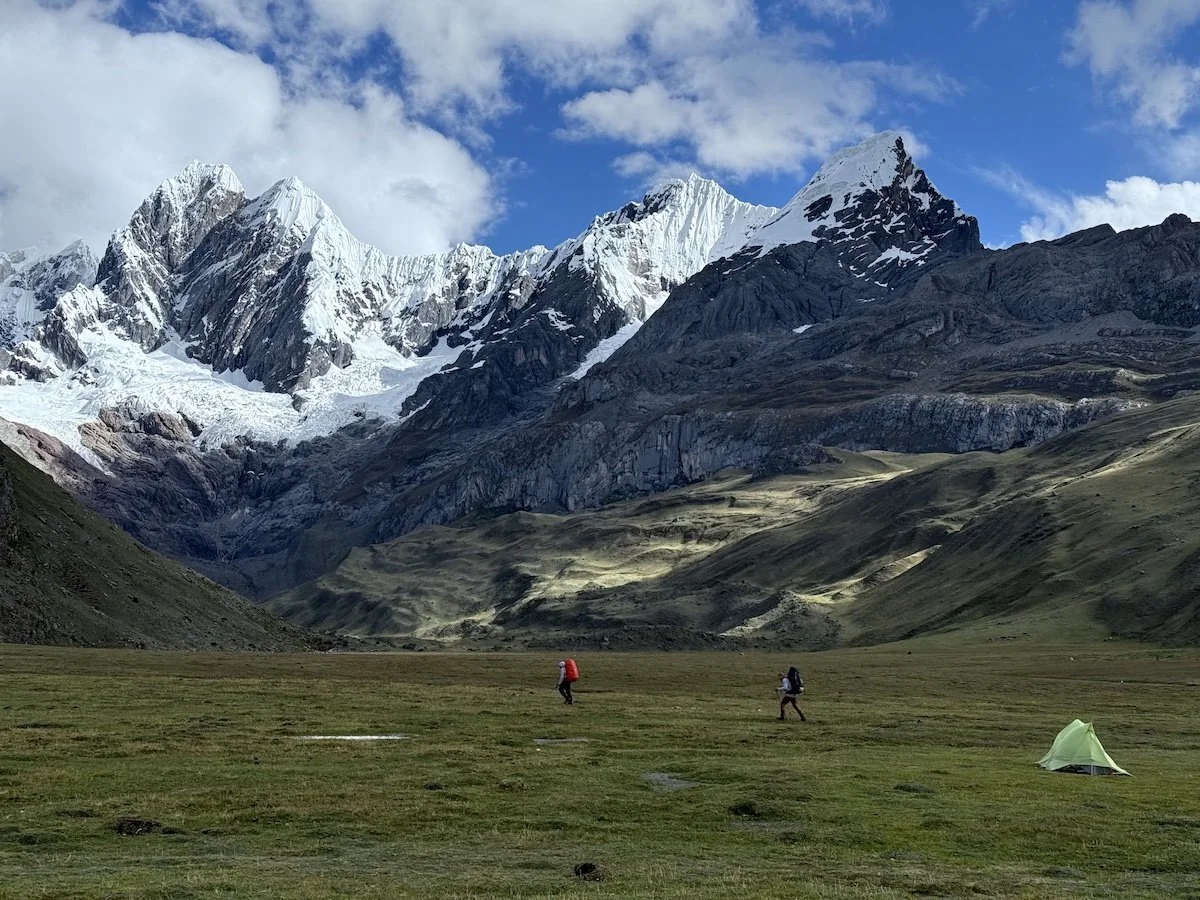
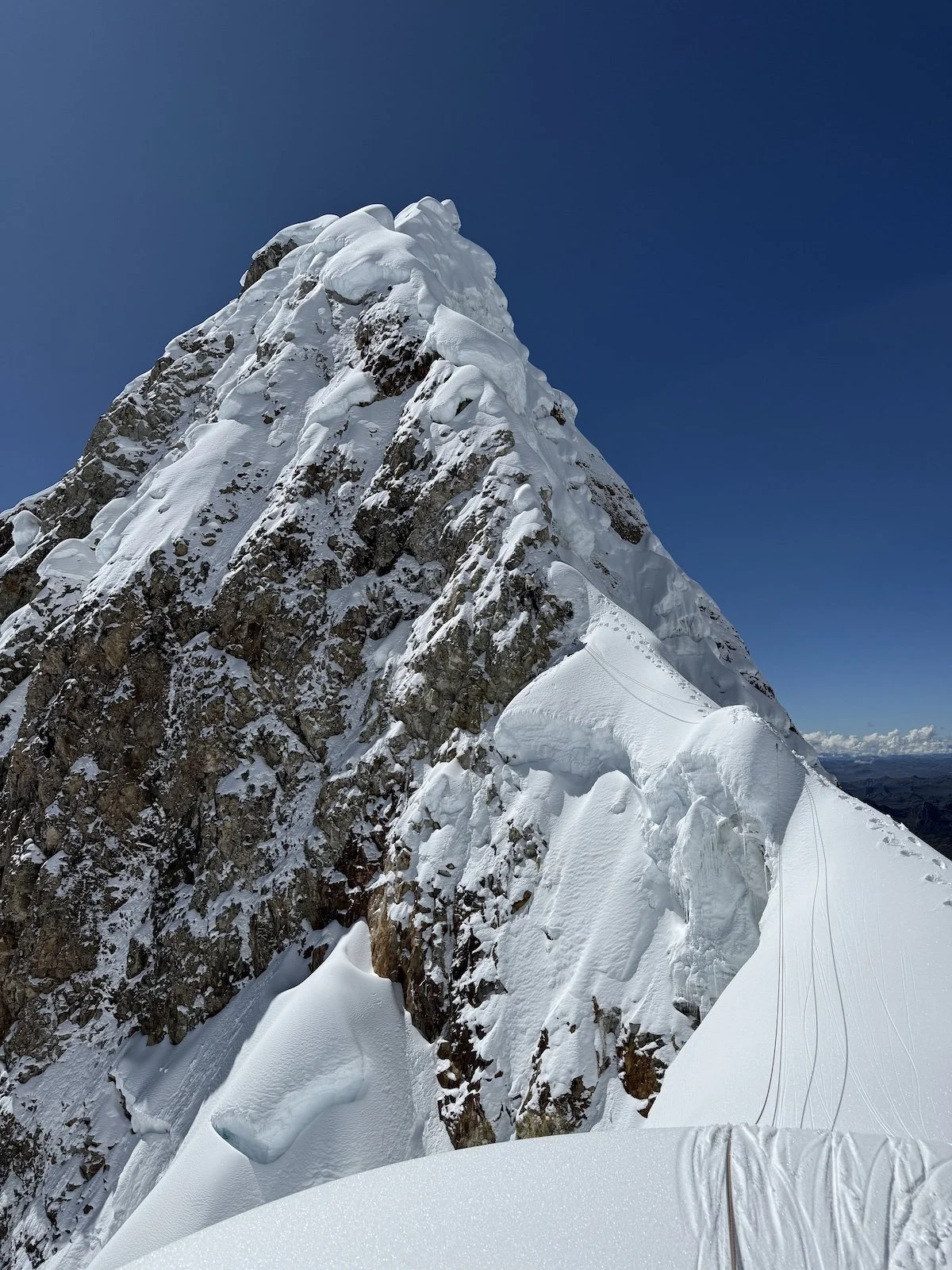
Trekking into the Mitococha Valley with views of (left to right) Jirishanca Chico, Jirishanca’s twin peaks, Rondoy, and Ninashanca. Photo by AAC member Luca Raso.

All we knew then of that place was the famous climbing accident recounted in Joe Simpson’s Touching the Void. While descending a 6,000-meter peak called Siula Grande in 1985, Simpson broke his leg and fell into a crevasse, which ultimately resulted in one of the most epic survival stories in mountaineering. Max just laughed. We weren’t ready. He was right; we could barely lead the bolted 5.10s at Hatun without our legs shaking.

Throughout a season of climbing the high peaks of the Cordillera Blanca and another year of climbing in Colorado, I could not stop thinking about the Huayhuash. Max and I climbed tourist peaks like Chopicalqui, Tocllaraju, and Pisco, and since we were always surrounded by other climbers and guides from all over the world, it was easy enough to mimic the common patterns of ascension even on our dirtbag budget. We followed the well-worn paths made by pack mules and beater taxis. Throughout our adventures, I kept my head up to admire the condors, untethered by the ground’s limits, as we were.

Luca and Eric find a mule at the Quartelhain trailhead of the Cordillera Blanca after driving through herds of cattle. Photo by AAC member Luca Raso.

The Huayhuash represented something different to me. Unlike the Blanca, it hosts no regular climbing activity; it’s harder to reach and has a higher concentration of more technical peaks. The number of climbers coming into the range each year can be counted on one hand. A significant reason for that lies in its history. The Huayhuash was closed off to climbing in the late 1980s into the ‘90s, as a result of the violent hegemony of a Maoist terrorist group called El Sendero Luminoso. Foreign climbers were turned away from the remote area for years, and the Huayhuash faded off of ticklists. Even after its reopening, the Huayhuash brought in limited climbing activity, while the Blanca, just hours to its north, expanded in popularity.

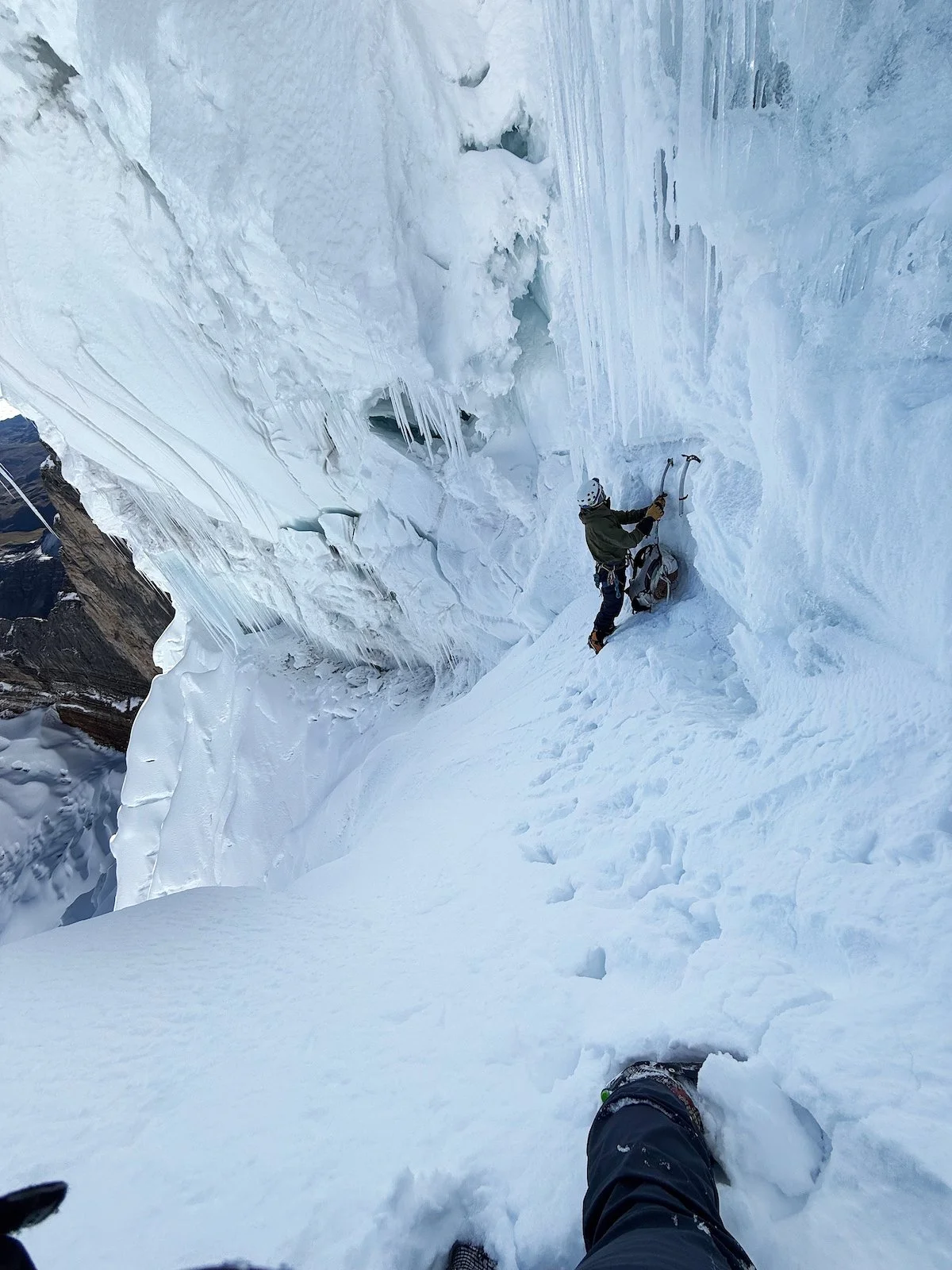
Eric Kanopkin traverses around one of the snow mushrooms on the west ridge of Jirishanca Chico before leading a pitch up an ice runnel. Photo by AAC member Luca Raso.

After leaving Peru in 2024, I was still drawn to the Huayhuash, but not just for the austere beauty of its mushroom-capped ridges and dramatic summit pinnacles. The mystique that shrouded the range, the lingering stigma among climbers, was what really captivated me. It was simply bizarre to me that two ranges, the Huayhuash and the Blanca, so close and similar in geography, could be perceived so differently by climbers. Stoked, ambitious, and just out of college, I was determined to go find out for myself.


Once the sun rose, warm colors illuminated a world of winter above us. Eric and I were finally on the Rondoy Glacier, heading toward Chico’s northeast face. To climber’s right, Jirishanca’s north ridge was a sweeping ramp of snow and ice into the golden and pink heavens. That was the ultimate route that we were preparing for on Chico, a goal that ironically seemed farther out of reach the closer we got to it. I was worried that I was already in over my head, but my fear was dissipating from the restless night before. Dwarfed by the apu, the Quechua’s mountain gods, I was momentarily comforted by the extreme beauty around me. In that light, I was inside a Gothic cathedral on a Sunday morning, soothed by the voices of the choir. It took me a while to notice the serac that loomed over our path on the face above. Anxiety returned. “Are you worried about that?” I asked Eric.

He paused to catch his breath and looked at it. “Let’s just keep moving.”

To gain the west ridge, we simul-soloed a couple of easy mixed steps and then steep snow, around 100 meters or so. Once we crested it, we could see that much of the ridge proper was a corniced knife-edge, narrow and even steeper on its southern side. Between us and the summit stood a kilometer of snow mushrooms.

At first, the ridge looked impassable. The only other two reported attempts of this exact ridgeline (besides its first ascent) declared it to be too dangerous. Still early in the morning, we decided to give it a shot. We moved back down from the ridgeline to go around the serac, eventually climbing through it via a narrow chute of ice. This was nothing in comparison to our next obstacle. Across a football field of flat ridge, a 30-meter step of snow-covered rock stood in our way. Shattered limestone choss frosted with dollops of sugar snow obscured any obvious line.

Eric Kanopkin leads the chossy mixed crux pitch on Jirishanca Chico’s west ridge. Photo by AAC member Luca Raso.

Protection was doubtful, the climbing was steep, and the snow on top was too shallow for any pickets. Demoralized, I looked to Eric.

Eric, ten years older than me, was one of my first ice climbing partners back in Colorado. The two of us have gotten in over our heads together several times—trauma-bonding over epics like the 29 hours it took us to climb Kiener’s Route on Longs Peak in the dead of winter. Married, with a steady job and a house, Eric had his sh*t together, and he was easy to trust. When I asked him to come to Peru for his first trip, his eyes lit up. Our first week and a half climbing together in Peru had its highs and lows. We went to the Ishinca Valley and easily climbed Urus Este as our first acclimatization climb, though a bad empanada resulted in some gastrointestinal difficulty. On the North Face of Ranrapalca, I had my turn. Halfway up the route, I vomited all over the ropes and soiled my new M10 pants, which I blamed mostly on altitude sickness.

Base camp in the Huayhuash had been anticlimactic. Days of rain isolated us in our separate tents, and despite the surprising numbers of trekkers and their entourages around us, a claustrophobic loneliness set in. Eric had mentioned that his wife was not happy with his decision to go on this trip without her, and he was preoccupied with the aftermath via his inReach. I spent a lot of time alone in my tent, listening to the soft patter of rain and the thundering conversation and laughter emanating from the trekkers’ tents across the valley. It was a different feeling of remoteness than I’d expected from the Huayhuash.


Luca Raso is very tired and stressed out on Jirishanca Chico’s summit mushroom. Photo by AAC member Eric Kanopkin.

“I think I can do it,” Eric said.

I looked down at our anchor, two pickets and an ice tool tied together. “Well, if that blows, I will try to jump off the other side of the ridge.”

Literally on the edge of my snow seat, I watched Eric lead the rope up and over the mixed step. At every placement of piton and Camalot, I shouted forced stoke at him. He showed stubborn confidence in every hook of his tool, standing on his frontpoints without any tremor in his legs. Occasionally, he cleaned chunks of rock into the abyss, but it never startled him. He was all in.

Once he swam up the next mushroom of sugar snow and built another picket anchor, he groaned with relief. “Hell yeah!” I yelled back. Eventually, the rope went tight, and I followed in his wake. I didn’t say anything when his gear came out with eerie ease, even as each pry of my ice tool to clean the pitons fractured more heaps of rock off the ridge.

From there, we swung leads across knife-edges and snow mushrooms for another half a kilometer to the summit. Often, it was hard to tell whether there was any mountain beneath our feet. It became clear why most climbers had thought the ridge to be too dangerous. The snow mushrooms’ physical structures seemed impossible: How could deep powder pile up so steeply without collapse? A few weeks after our ascent, Alexander Huber, Dani Arnold, and Simon Gietl bailed from Jirishanca’s east ridge, just across the saddle from our route, opting to end their route at the east summit, instead. It’s hard to say if conditions were the same, but there is a chance that we were braver (or more stupid) than the professional alpinists.

Eric let me have the final pitch. Exhausted from breaststroking my tools and kicking my feet into nothing, I had to catch my breath before belting out a loud “Whoo!” on Jirishanca Chico’s summit. From there, I finally appreciated the panorama of Siula Grande, Yerupajá, and Jirishanca around me, a momentary distraction from the stress of the past seven or so hours. Eric joined moments later, and we rejoiced in the reunion.

As we downclimbed the ridge back to the glacier, I thought about sirens. In The Odyssey, Ulysses sails his crew through treacherous waters past these alluring creatures and their infamous, transfixing siren song. While his sailors plug their ears to avoid the danger of drowning themselves for this beauty, Ulysses commands them to tie him to the mast of the ship. While most rational people would decide to cover their ears, Ulysses risked his sanity in order to experience something truly beautiful.

Perhaps Eric and I, tethered to each other, heard the Huayhuash’s siren song. On that delicate, corniced ridgeline, we experienced a new level of earthly beauty, unparalleled by any other experiences I have had in the mountains. But its fatal temptations also frightened me to my core. We were already talking about bailing on Jirishanca proper as we descended its smaller sibling. We had escaped the treacherous ridge alive, and it was hard to fathom another one on an even larger mountain at 6000 meters. We were satisfied enough with our time on Chico, a probable second known ascent of the Northeast Face. But as we left the Huayhuash and went home (where Eric patched things up with his wife), the feeling of failure crept into my mind. It felt as if we had gotten away with something, just barely escaping the lethal lure of the mountain.

With time and distance, this ascent has become a scrying glass. I had been driven by curiosity, a quiet itch to see if these seldom-climbed peaks could be a place of exploration and self-discovery for someone like me. I found the Huayhuash to be a place of alluring, dangerous beauty, but not without significant challenge. Yet my experiences there have ultimately reinforced my original curiosity with the range. As a young climber who quite frequently gets in over his head in climbing, the Huayhuash was a lesson in restraint. I came to the range with arrogant ambitions to climb Jirishanca, and its smaller sibling humbled me. While I false-started on the main objective for that trip, I am only more excited to return as a more experienced climber and rediscover these peaks with trusted partners like Eric—to hold me to the mast.


Sign Up for AAC Emails


Denali Rescue, 1979: The Untold Full Story

In this episode, we have climbing legends Jamie Logan, Jack Tackle, and Ken Currens on the podcast to retell the story of an accident and rescue on Denali from 1979. Jack Tackle and Ken Currens were climbing partners with a number of big mountains and first ascents under their belt, and in 1979, it was their first trip to the Alaska Range.

They had decided to attempt the unclimbed southeast face of Denali (also known as Mount McKinely). This face would later become known as the Isis Face. In the middle of the climb, Ken, on lead, took a 250 ft fall when snow gave way beneath him. Once the rope came taught, he was hanging in mid air over a cliff, his femur badly broken. The rescue that followed is a story for the ages.

We dive into the mechanics of the accident, what Jack Tackle had to do to get help, and how Jamie Logan and Mugs Stump—two of the most impressive alpinists of the time—were critical in helping save Ken. She and Mugs are especially known for the first ascent of the Emperor Face the year before, and though Mugs has passed, Jamie was able to fill us in on their experience of the rescue.

In this episode, these climbing legends put together, in real time, the pieces of this story (that they all remember a tad bit differently)—47 years later.


Safer Than Socks in Your Hat

George Hurley and Layton Kor on the Titan, 1962. Photo by Huntley Ingalls.

A History of Climbing Helmets and an Updated UIAA Standard

By AAC UIAA Representative Stephen Gladieux, with research support from Denis Pivot, Lionel Kiener, and Alain Maurice

Translations of Chevalier and Bonatti by Stephen Gladieux

Originally Published in Guidebook XVII


Less than a thousand feet from the summit, on the north face of the Eiger, Gaston Rébuffat hooked a finger into a piton, left behind from a previous ascent. The night before, as they bivvied, Rébuffat was surprised to find himself sleepless, with a sense of bad omens. “The stars seemed so near that you could touch them, and the Milky Way shone with sinister brightness,” he wrote in his book Starlight and Storm.

On that July day in 1952, their surroundings did prove sinister. Stuck behind several slower parties and faced with warming temperatures, Rébuffat’s team had to inch their way across the tedious traverses that guarded the summit, often taking alternate routes in order to avoid bottlenecks.

As luck would have it, Rébuffat hooked that piton at the exact moment a thunderous crack boomed from above. A massive rock came tumbling down, bursting and splitting into pieces that struck Rébuffat on the head. “But the finger hooked through the piton still held. It was very painful, and felt as if it had been sawn through.... A little blood fell from my cap and reddened the snow-flecked rock.”

Yet, with his head aching and the motivation drained out of him, Rébuffat carried on. Rumor has it that Rébuffat had stuffed his hat with socks, as was the custom at the time when climbing in areas with rockfall danger, and some credit this habit for saving his life. Well, that and the piton.

Without the padding of his rudimentary “helmet,” Rébuffat might not have become the first man to climb all six of the great north faces of the Alps.

Since then, it’s fair to say climbing helmets have undergone an evolution.


Helmets: A History

The history of head protection in climbing starts earlier than Gaston Rébuffat’s injury on the Eiger. There was a parallel evolution, but staggered, between those climbing in the mountains and those exploring underground in caves.

In 1936, the trailblazing French caver Pierre Chevalier reported, “Helmets are beginning to be considered essential in sport caving.” However, during this period, and until around 1950, climbers aboveground were still wearing wool berets as the standard headwear. In 1948, Chevalier’s Escalades Souterraines (Subterranean Climbers) was published. It was one of the seminal works in early caving.

In the early 1950s felt hats became the norm. When there was risk of rockfall, they would occasionally be stuffed with socks or newspaper. This is where Rébuffat’s story takes the stage.

Four years later, in 1956, the ninth edition of Accidents in North American Mountaineering (now Accidents in North American Climbing) already showed an increasing preference for protective headgear. In comments preceding the accident reports, the editors wrote: “Another point that should be re-emphasized is the desirability of wearing a plastic helmet to protect the head from falling rock in areas where this danger is present. This has become a standard practice for some rock climbers in the Yosemite area.”

As helmets for other sports evolved, so too did climbing helmets. In 1954, Amisano Gino Valenza (AGV) produced the first fiberglass motorcycle helmet. It was used by many climbers until climbing-specific models became available.

Walter Bonatti knew helmets were critical. Describing his last ascent of the north face of the Matterhorn, done solo in winter, he wrote:

Again once more, I look to lighten my pack to move more rapidly. I toss food, two étriers, some pitons. I am tempted to get rid of my helmet as well, the glorious plastic helmet that, for four years, accompanied me on the most difficult enterprises. But after an instant of hesitation, I stay my hand and hold the helmet to my chest.

I caress its bumps as if they were wounds: each one of them corresponding to a rock, fallen off Mont Blanc, the Andes, so many other mountains. I placed it back in my pack.

It’s clear Bonatti recognized how many times the helmet had prevented injury. Despite the weight of early helmets, anyone who had their life saved by one would appreciate their value.

The new, lighter fiberglass motorcycle helmet and its growing use by serious climbers spurred the creation of helmets designed for climbers. Sporthaus Schuster was one of the earliest to come out with a model, released in 1960.

Helmets still weren’t used in a widespread way, however. They only had traction in select locations and circles of climbers. In 1966, Joe Brown developed a fiberglass helmet specifically for climbing. He only produced 50 or so of these before contracting with Mo Anthoine to make them. The Joe Brown helmet became popular with English-speaking climbers (and cavers) and was used extensively for decades.

In 1980, the first climbing helmet standard was created: UIAA 106. This was later used to create the European standard EN12492 in 2000, which made it a legal requirement for helmets sold in Europe.

With two milestones, 1993 was a big year for helmets. C.A.M.P. launched its LW 260 helmet. It was the first shell-and-foam-style helmet and weighed only 260 grams. That same year, Petzl started selling the once-ubiquitous Ecrin Roc. This powerhouse of a helmet, which most climbers have seen or worn, was the first with easy on-head adjustability. This allowed it to be loaned, rented, or borrowed easily. Many more climbers were able to try them or even swap them on climbs.

Helmets have continued to evolve alongside climbing. With helmets like the LW 260 and Petzl’s Meteor, which came out in 1997, the excuse that a helmet was too heavy for moving fast and light was seriously challenged. Helmets were becoming more and more comfortable.

In the earliest days of climbing, rockfall was considered the primary reason to wear a helmet. Both Gaston Rébuffat and Walter Bonatti prepared for rockfall hazards—and they both likely survived because of it. So, why did the standard for helmets need to change in 2025?

Ultimately, our climbing has changed, and so has the technology available to design helmets.

In an accident from 2022, ANAC editors reported on a leader fall at Smith Rock, where the climber got their leg snagged around the rope, flipped upside down, and smacked their head. The climber was not wearing a helmet. The analysis included the takeaway that “wearing a helmet would have prevented the skull fractures and brain bleed.”

Accidents like this certainly could have happened in the 1950s, but as we began to climb steeper routes, free, at ever higher grades, significant lead falls became more frequent. A fall on steep rock at Smith Rock is not going to result in a broken ankle from hitting a ledge as much as it might result in an inverted climber hitting the side of their head on the wall.

In 2023, when a climber was lowered off the end of his rope, having tied no stopper knot and misjudged the length of the climb, the climber suffered a serious head injury. Witnesses wrote to ANAC: “While we didn’t see the fall, we understand that he fell feet-first onto a flake near the bottom. He landed, tilted backward, and impacted the back left side of his head, crushing his helmet and sustaining a horrible head injury. The total fall was about 35 feet.” Though the climber was wearing a helmet at the time of the accident, it was not certified with any sort of rim impact. The crushed helmet shows that the climber was better off than had they not been wearing one, but it raises questions about helmet designs that were never forced to consider rim or side impacts.

The injury described above is one that doesn’t require a steep, hard climb. Rappel accidents are unfortunately common. Both of these accidents highlight that when we design helmets, we should care not just about protecting from rockfall, which is typically from directly above or a slight off-angle—rim impact is important too.

Climbing has changed over the decades. Routes are steeper in both rock and ice. Climbing and skiing have blended more and more. Ski mountaineering is becoming nearly mainstream. We must be more concerned with protecting ourselves from rim impact injuries, be it from flipping on a steep climb or falling while skiing—or something else unexpected.

A helmet can prevent injury in many cases or reduce the severity of injury. Modern helmets are not built with a nearly indestructible shell like early fiberglass helmets. Rather, they are designed to crush during impact—that is how they absorb some of the impact forces and spread the remaining force out, therefore making the peak force lower.

Berets stuffed with newspaper/socks.

First fiberglass motorcycle helmet.

1936: Pierre Chevalier reports that helmets begin to be used in sport caving.

1940s: Bérets used by French Alpinists.

1950s:

  • Amisano Gino Valenza (AGV) makes the first fiberglass motorcycle helmet.

  • French climbers favor berets stuffed with socks or newspaper

Pre-1960: Helmets are rarely used in climbing (outside of caves).

Joe Brown’s climbing helmet.

1966: Joe Brown produces a fiberglass climbing helmet that weighs 650 grams.

1980: The first UIAA 106 Helmet standard is published.

1993: Petzl releases its Ecrin Roc helmet. C.A.M.P. comes out with the shell-and-foam LW 260, at 260 grams.

1997: Petzl goes even lighter with the Meteor.

First UIAA 106 Helmet standard.

2000: The EN 12492 standard is published using UIAA 106.

2018: Petzl shares its PCSR-001 ski touring helmet testing standard with other manufacturers.

2025: UIAA 106 is updated with 10° rim impact.

2026: The UIAA will establish a ski mountaineering helmet standard.


Petzl Ecrin Roc helmet.

C.A.M.P. shell-and-foam.

Petzl meteor.


Modern Helmet Standards

The UIAA 106 helmet standard has now been updated since its first version in 1980. It consists of multiple requirements based on the variety of ways in which a helmet needs to protect a climber. Helmets are conditioned at different temperatures and humidities before testing—for example, they’re artificially aged with UV radiation to simulate degradation over time—all to ensure they work in the environments where we climb. The real soul of the standard can be boiled down to a few key ideas: A helmet has to prevent a sharp rock from penetrating, it has to absorb impact forces, and it has to stay on if it gets pulled or pushed up or off your head.

As more accidents like the ones described above occur, due to the increased prevalence of that kind of impact, it is the middle requirement that we need to look at in depth. What does impact absorption mean? How do we control it?

One of the most common serious closed head injuries happens as a result of a sudden impact to the head. In a coup-contrecoup injury, the head is typically moving very quickly and then is stopped by an immobile object. The brain sloshes forward and hits the inside of the skull, then rebounds and hits the other side, getting damaged in both cases. With this and other types of traumatic brain injury (TBI), the goal is to slow the acceleration (or deceleration) of the head. We do that by limiting the forces that get transmitted to the head when it is impacted.

The UIAA helmet standard allows a maximum of 8 kN of force to be transmitted to your head. Essentially, when a bigger impact (sudden) force hits the helmet, it needs to slow down that transmission to your head.

The UIAA standard limits this to 8 kN, whereas the EN standard only limits it to 10 kN—so a UIAA-certified helmet is much safer than one only certified to EN 12492.

The UIAA Safety Commission took the lead on a revised helmet standard because of the large amount of research and testing involved. We could be more nimble and get an update published much more quickly. And of course, the sooner a standard is published, the sooner the wheels can get turning on implementing it, as there is a lag time between a new or updated standard and when manufacturers are able to change designs or update testing, and finally get a new product on the market.

From 2022 to 2025, the UIAA conducted a large helmet study with nine labs and numerous manufacturers. One of the most difficult issues was standardizing the impact testing in a way that consistently worked, given the different testing apparatus at different labs and manufacturers. Also, helmets have ventilation holes in different places. Any ventilation hole means you might get unlucky with a sharp rock, but the test shouldn’t favor one ventilation hole pattern over another arbitrarily; though, if a ventilation pattern is truly better, the tests should show that. These are the shared challenges for manufacturers and the UIAA Safety Commission.

Several years of work resulted in an updated helmet standard that includes testing for impact absorption 10° above the helmet’s rim on the front, back, and sides. Helmets will be coming onto the market in 2026 that will be tested to this new standard.

Wearing a helmet is a deeply personal safety decision. Bonatti’s indecision was ultimately swayed by memories of the times his helmet saved his life. But a helmet doesn’t last forever; they break down with time, UV exposure, and small impacts, even if there is no major event. Check the manufacturer’s recommended lifespan and inspect your helmet for damage. It can be worthwhile to upgrade to a new one even if your current helmet isn’t quite to the end of its recommended life.

Now, almost 74 years after socks in his hat likely saved Rébuffat’s life, we can have confidence that a new helmet can do the same for an accident that impacts the rim.


Sign Up for AAC Emails


A Team Sport: The Psychology of Caregiving After A Climbing Accident

Part of the Climbing Grief Fund’s (CGF) mission is to expand the conversation around grief, loss, and trauma in the climbing community, and interrogate narratives that can be unhelpful to healing. In this episode, we unpack some of the unique challenges faced by caregivers after a loved one gets into a climbing accident, and explore why it can be helpful for caregivers to get mental health support too, not just those directly impacted by an accident.

In section one, we have the CGF Therapeutic Manager, Trevor Davis, on the podcast, to talk about the scope of the Climbing Grief Fund, as well as its ongoing expansion and impact. Trevor chats with Jay Louie, a therapist in the CGF Directory and a CGF committee member, about these topics, and together they frame the conversation about why CGF resources are for caregivers too.

In section two, we dive deeper with Jay, as they share some case studies to illustrate the very human experiences of caregiving after climbing accidents. They share these case studies from their professional experience as a therapist and AMGA Guide, described anonymously, with permission from their clients.

In section three, we sat down with Andrew Kirchner, an incredible supporter of the Climbing Grief Fund and a survivor of a climbing accident himself. Andrew describes his accident, and how it made him realize that the accident didn’t just happen to him, it had a dramatic impact on his loved ones as well. Andrew also elaborates on what motivated him to make the Edwards-Ginsburg fund, and thereby support the CGF’s work so generously.


Elsewhere: The Problem of Human Waste Management in the Wilderness

A Profile of AAC Member Geoff Hill

By Hannah Provost

Originally published in Guidebook XVII.

It wasn’t the first time, nor would it be the last, that Geoff Hill had chopped up frozen human waste—overflowing from a 200-liter barrel. He was a graduate student at the University of British Columbia (UBC), studying the effects of climate change in the Canadian Arctic. The university had arranged a deal with the Inuit whose land he was standing on. The students could conduct research there, but they could not leave any trace, including human waste—hence the chopping.

All around him, the Arctic gleamed in shades of dense ice, the ocean a penetrating blue. Below the tundra, in a hole, out of sight, was where the research team kept the thing no one ever talks about: a frozen bucket of human waste, a.k.a. a “sh*t barrel,” as Hill often calls it. Tucked away. Put elsewhere.

And that’s the trouble. In a wilderness like the Arctic, there is no elsewhere.


As a climber who fell in love with alpine rock, Hill has spent much time on the road driving toward his next climbing destination. He learned quickly that what he loved most was swimming through a 5.10 hand crack high on a steep, sunny wall. That lifelong thirst for high-country granite would bring him to many wild places, including Mt. Barrill in the Ruth Gorge, El Cap, the Bugaboos, and Mont Blanc’s aiguilles. An epic during an alpine climb in the Canadian Rockies in 2004 spurred him to start reading Accidents in North American Climbing, and he would continue engaging with the AAC throughout his climbing career—for the rescue benefit, community, and research grants that would, in turn, help catalyze his calling.

His passion for these alpine landscapes was boundless, but Hill’s educational path in environmental science was bringing him up against the reality of outdoor recreation’s environmental impact. He wanted to do something about it.

Hill began with driving, launching the Biodiesel Project at UBC, which added sodium hydroxide and methanol to a vat of recycled cooking oil to create an alternative to diesel. “It was fun and dangerous in the beginning,” he recalls. “The pH is crazy. Like, if it splashed in your eye, for sure it would have dissolved a hole in your eyeball.” But it worked. He would fuel up his 1993 Volkswagen Jetta with this biofuel and hit the road to Canmore, Squamish, and even Yosemite. He would later teach some Yosemite rangers how to run their own trucks on biofuel from their waste kitchen grease.

Called by the mountains, Hill toyed with becoming an ACMG Guide (the AMGA equivalent in Canada), but when he failed his exam, he realized his heart wasn’t in it and that he’d rather serve the mountain environment itself—not clients.

Funded by Canada’s Natural Sciences and Engineering Research Council (and an AAC Research Grant), Hill started ringing up the rangers and national park personnel he’d worked with during his previous studies and guide training. He wanted to study the alpine environment in a way that would produce practical results: What did they need help with?

Geoff Hill installs a urine-diverting conveyor-belt toilet system at Rocky Mountain National Park.

Again and again, the National Park Service spoke to the problem of human waste management. Tara Vessella, who runs the backcountry program in Rocky Mountain National Park, spoke of the ongoing struggle to find new land for pit toilets. As Hill recalls her saying, “I cannot find a spot in the forest to put a new pit toilet because every time I dig a hole in the ground, I find old sh*t.” The pit-toilet model, so ubiquitous in the United States, wasn’t sustainable for backcountry landscapes with such intense visitation numbers. So Hill, recalling his frozen-waste-chopping days, embarked on a PhD that would make everyone else’s “business” into his business.


Humans expel feces and urine daily—what we term “waste” when it’s not well integrated into the ecosystem, especially our poop. Yet when we look at the terms more commonly used for animal poop—dung, scat, droppings, guano—the “waste” subtext is absent, revealing a bias toward thinking that human excrement is dysfunctionally related to the natural environment. But Geoff Hill believes it doesn’t have to be that way.

The science is pretty straightforward: Human urine (and all mammal urine, for that matter) is excellent plant fertilizer. Meanwhile, human poop is food for invertebrates and microorganisms—in fact, in the process of eating mammal poop, microorganisms produce rich organic matter that makes for fertile soil.

We’ve evolved to be part of our ecosystem. As Hill puts it, “[We’re] no different than a buffalo running around, dropping a dump on the prairie.” But the problem comes at scale, and when these streams mix.

As Hill relates, “[Waste] became a problem when we moved into castles from nomad culture. It’s concentrated there; it’ll breed bacteria. People got really sick. Black plague. So, got to get it out of the castle. We [then] try putting it in buckets and sloshing it out onto the street.... More black plague. So, get it in the river. But there’s no sense in having a bucket of poo and a bucket of pee if you’re just going to put it in the river, so put it in one bucket intentionally—that’s the toilet.”

Continues Hill, “And from a human health perspective, it is one of the great inventions of all human time. Add to it flushing water and a waste water-treatment plant, so you’re not polluting the river, and you have this whole paradigm of human waste going together in a single-hole toilet and getting flushed downstream to be managed elsewhere.” This paradigm, so dominant in the Western world, doesn’t transfer well to the alpine, however, where there really is no “elsewhere” and where the single-hole toilet is in fact part of the problem.

With no plumbing and waste-removal being exceedingly expensive in such remote locations, the pit toilet—burying it and forgetting about it—has become the common solution. But when human urine and excrement are stored together, like in a pit toilet, urea—the main chemical constituent in urine—will rapidly oxidize into ammonia. And ammonia is toxic: It smells bad, and the invertebrates and worms that would normally happily eat mammal waste, catalyzing its decomposition, say no thanks.

In 2000, the EPA banned the creation of new large-capacity cesspools (which include many pit-toilet designs), “because untreated sanitary waste from cesspools can enter ground water and contaminate drinking water sources.” Between the ammonia toxicity, Vessella’s testimony about running out of land for new pit toilets, and the EPA ban, it was clear that what Hill was hearing from the rangers was rooted in very tangible problems.

At first, Hill was tempted to believe that composting toilets could be the solution. But as he researched and tested the output of various models installed in national parks, he repeatedly found grim results. Because these toilets required the introduction of dry goods like wood shavings for their “composting” process, they added volume. Moreover, they weren’t actually creating compost—with the amount of excrement added daily, the process for turning the results into safe fertilizer was too slow, plus most parks had to remove the waste anyway, instead of reintroducing it back into the ecosystem, because the composted waste didn’t meet federal safety standards for fertilizer.

Hill eventually found himself in France, looking at a conveyor-belt toilet. This model took the science seriously and did one major thing differently: The conveyor belt diverted the urine so that the combination of waste products wouldn’t create ammonia, leaving the worms and nematodes to gobble up the solids. And the design was feasible without running water—after a user does their business, urine is directed to the ground via grooves in the conveyer belt, while the inclined conveyer belt carries away the solid waste thanks to a few steps on a mechanical foot pedal. Once it’s in the storage container for solids, worms happily munch away. The example toilets Hill saw in Europe barely needed attention from their technicians, even after years of use, simply because the system was functioning properly, resulting in a significantly lower volume of end product.
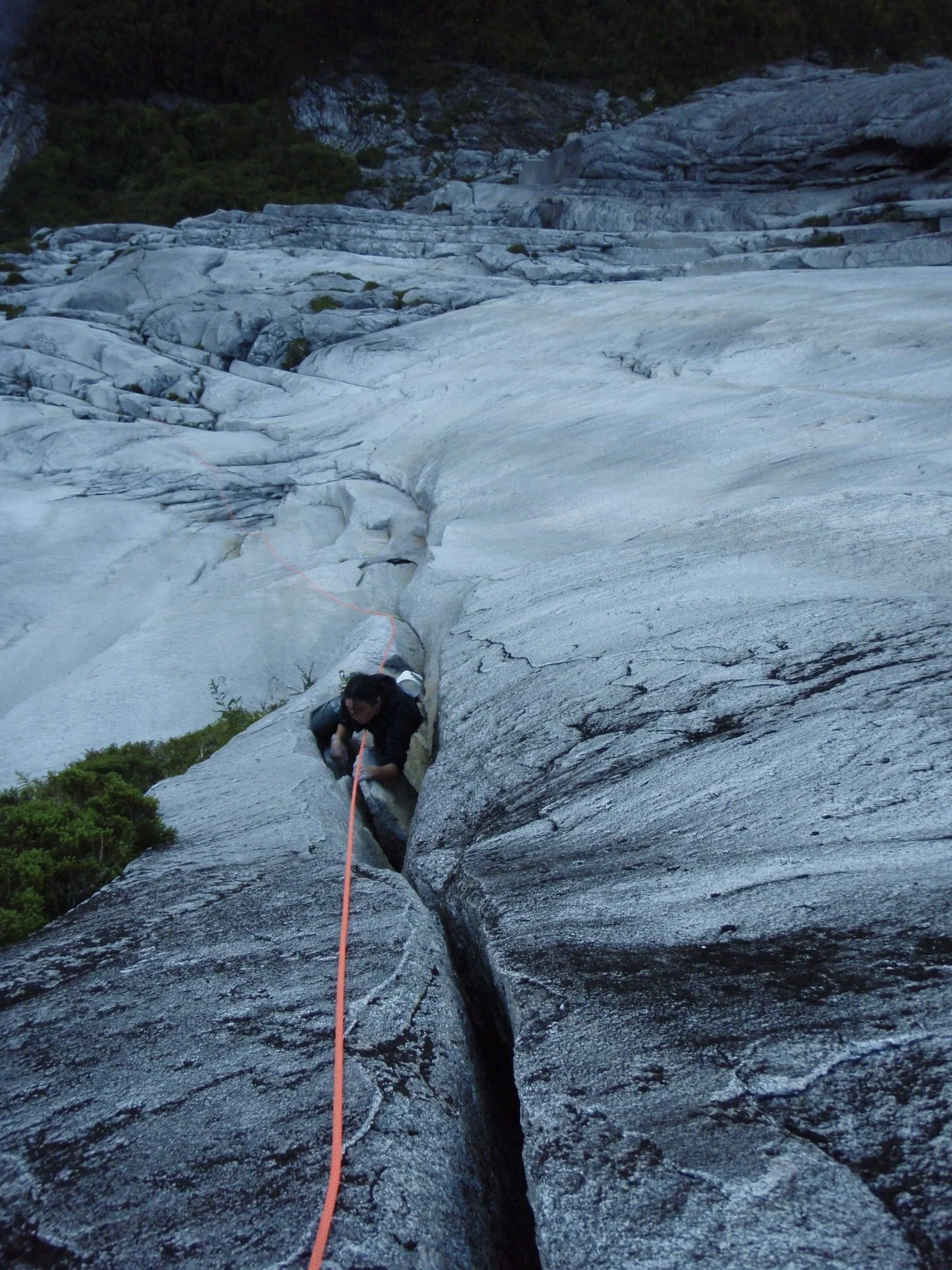
He quickly licensed the use of these robust, reliable, stainless steel, urine-diverting conveyor-belt toilet seats from Emmanuel Morin, the industrial designer who designed and sold them through his company Ecodomeo, and started using them in toilets across the Americas. Hill’s business, Toilet Tech, was born.


Through Toilet Tech, Hill has outfitted over 400 remote sites, from Alaska’s Wrangell–St. Elias National Park and Preserve and Glacier Bay to Los Glaciares and Torres del Paine in Argentina and Chile, respectively. You can also find Hill’s creations at Smith Rock and Angels Landing in Zion, where desert environments also make human waste management extra tricky. In fact, Hill’s toilet technology might be the most efficient and cost-effective solution for any public-use toilet that isn’t incorporated into existing municipal sewage structures.

However, the US Forest Service, BLM, and National Park Service move slowly, and often don’t have the funds for a new system, regardless of how badly they need it or how well it works. But despite these constraints, many enterprising NPS staff have partnered with Hill to implement this new vision of waste management in the backcountry—at Mt. Rainier, Rocky Mountain, Zion, and other national parks.

Ultimately, Hill isn’t making a crapload of money on this endeavor—it’s a side quest at best. Yet Hill’s passion for eco-forward innovation and deep knowledge of composting continue to motivate his work at Toilet Tech and his salaried position as head of science at Earth Funeral, a company that specializes in an environmentally friendly alternative to burial and cremation that uses a 30-day process to transform a body into nutrient-rich soil. Hill’s love for alpine granite remains undimmed as well, and has inspired a new dream that involves figuring out how to clean up water bodies in the alpine—he envisions a world in which climbers can hike up to alpine ascents with a teacup, no filter needed.

Though most of us climbers can’t do much more than incorporate good WAG bag etiquette into our climbing ethics, it’s inspiring to know that some climbers are using their expertise to move the needle on the infrastructure that supports our outdoor recreation. Perhaps someday soon those outdated pit and composting toilets at your local area will be replaced by one with conveyor belts, all thanks to Geoff Hill.

Beyond all this, Hill’s story also helps us shift a common paradigm: What would it mean to interrogate the things that we, as a community, let disappear into the elsewhere—that we bury and don’t address? Whether it’s our excrement, the way we interact with and support (or don’t support) each other, or our relationship with fear and risk tolerance, sometimes it’s worth taking a page out of Hill’s book and uncovering the stuff put elsewhere.

Sign Up for AAC Emails